1. Introduction
Contemporary Standard Dutch is a verb second language (V2; see Lass Reference Lass1994:224–225), which means that it places a specific syntactic restriction on the placement of the finite verb within a given clause or sentence. A V2 clause has the finite verb (the verb inflected for person and number) in second position with a single core constituent preceding it (see Ouhalla Reference Ouhalla1994:284ff., Borsley Reference Borsley1996:220ff., Fromkin et al. 2000:341ff., Adger Reference Adger2003:329ff., Carnie Reference Carnie2007:281f for further discussion on the V2 principle in several languages). In default declarative sentences, the first position is generally occupied by the subject, as illustrated in 1a.Footnote 1 The V2 principle, however, allows any constituent to occupy the first position as long as the second position is occupied by the finite verb. In cases where the first constituent is not the subject, this leads to inversion from SVX to XVS to retain the V2 position of the finite clause. This is illustrated in 1b,c, where the direct object Die jongen ‘that boy’, as the first constituent, triggers inversion of the subject je ‘you’ and the finite verb moet ‘should’. The examples in 1 are from Standard Dutch.
(1)


V2 word order is common across the Germanic languages and is also found in Indo-Aryan Kashmiri (Hook Reference Hook1976), Northeast Caucasian Ingush (Nichols Reference Nichols2011), Uto-Aztecan O’odham (Zepeda Reference Zepeda1983), and fragmentarily in Rhaeto-Romansh Sursilvan (Liver Reference Liver and Elmentaler2009). Among members of the Germanic family, English is an exception, as it has predominantly SVO instead of V2 order. Yet certain vestiges of the V2 phenomenon can still be found: Witness examples such as Never have I heard such a story, with negative and restrictive adverbials and instances with certain locative and temporal adverbials, as in Here’s Johnny! (see also Haeberli Reference Haeberli, Zwart and Abraham2002).
While this basic syntactic restriction is part and parcel of the core syntax of Belgian and Netherlandic standard varieties of Dutch—and most of their dialects for that matter—authors such as Vanacker (Reference Vanacker and Schmidt1967), Debrabandere (Reference Debrabandere1976), Ryckeboer (Reference Ryckeboer2004), Devos & Vandekerckhove (Reference Devos and Vandekerckhove2005), and Van der Horst (Reference Van der Horst2008) have observed that there are regions in the province of West Flanders (Belgium) and Dutch-speaking parts of Nord-Pas-de-Calais in France where this restriction seems to be overruled. In these regions, instances without inversion can be attested in cases where the first constituent is not the subject, as shown in 2 below: Examples 2a,b are from French Flemish dialects (Ryckeboer Reference Ryckeboer2004:82); 2c–e are from West Flemish dialects (Devos & Vandekerckhove Reference Devos and Vandekerckhove2005:100). Topicalized constituents in these examples include adjuncts of time, place, frequency, and condition, realized as full NPs and prepositional phrases, as in 2a–d, or as a finite embedded clause, as in 2e. The noninverted subjects are both nominal, as in 2b,d, and pronominal, as in 2a,c,e.
(2)

The noninverted word order in languages with a V2 restriction does not only occur in Flemish dialects. Leaving aside the multitude of studies on V2 syntactic variation as a symptom of diachronic developments and change within particular languages, similar contemporary V2-related syntactic variation has also been attested by Cognola (Reference Cognola2013) in Mòcheno, a minority language spoken by 580 people on a German-speaking island of northern Italy.Footnote 2 Kern & Selting (Reference Kern and Selting2006), Sollid & Eide (Reference Sollid and Eide2007), Ganuza (Reference Ganuza2008), and Opsahl (Reference Opsahl2009), in their turn, discovered similar patterns in the Swedish, Norwegian, and German urban vernaculars of adolescents (see Freywald et al. Reference Freywald, Cornips, Ganuza, Nistov, Toril, Nortier and Svendsen2015 for a comparison of the structural shape and usage of the noninverted order in these regions). However, unlike the patterns found in Mòcheno, the Flemish noninverted order is not geographically confined to a very small area (see Saelens Reference Saelens2014), nor is it found in the speech of a small number of speakers (at least not at the time of data collection, see section 4.1).
However, the noninverted order in the Swedish, Norwegian, and German data is mainly used by adolescents as an active linguistic resource to show solidarity with peers, to contest official school discourses, and to play around with linguistic stereotypes (see, among others, Ganuza Reference Ganuza2008:109 and Sollid & Eide Reference Sollid and Eide2007) as part of their innovative urban varieties. In contrast, no such uses have been reported for Dutch innovative urban vernaculars. Such uses do not show up in the linguistic stereotyping of urban youths either (Freywald et al. Reference Freywald, Cornips, Ganuza, Nistov and Opsahl2013). Rather than being an innovative use marking peer membership, noninversion should be considered a characteristic of West Flemish dialects, as it has been attested in the speech of several generations of speakers. Even today, instances of noninversion can still be attested in West Flanders (see the examples in 3, taken from Haegeman & Greco Reference Haegeman and Greco2018), though it should be observed that the frequency of noninversion and its geographical prevalence may be diminishing together with the dialects in which noninversion is used, due to processes of standardization and dialect leveling (see section 4.1 for a more extensive discussion on sociolinguistic aspects).
(3)

Despite the frequency and prevalence of noninversion in these Flemish areas, a number of issues still remain unclear or understudied. First, the debate regarding its actual origin is still ongoing. According to Vanacker (Reference Vanacker1977) and Taeldeman (Reference Taeldeman and Ureland1982), the absence of inversion is a remnant of the language spoken by Germanic tribes who lived along the coast of the North Sea (the so-called Ingveonen). Paardekooper (Reference Paardekooper1955), in his turn, traces the phenomenon back to French, and Willemyns (Reference Willemyns1971), Debrabandere (Reference Debrabandere1976), and Van der Horst (Reference Van der Horst2008) find its origin in Middle Dutch. Interestingly, Paardekooper’s account of the impact of French is similar to the traditional views that account for the syntactic variation found in Mòcheno as one that is triggered by contact with Romance languages. These views, however, have been refuted by Cognola (Reference Cognola2013). In a similar vein, Ganuza (Reference Ganuza2008) was unable to support the claim that the attested variation in Swedish adolescents was caused by two competing grammars in L2 learners. Saelens (Reference Saelens2014) presents a more nuanced approach to the Flemish dialects and discusses the purported Ingvaeonic origin of noninversion in greater detail.
Second, since the absence of inversion is not attested systematically in these areas, the West Flemish and French Flemish dialects present interesting cases of synchronic syntactic variation, the dynamics of which have not been fully accounted for. While some of the existing studies do rely on corpus data to illustrate this phenomenon and to discuss the impact of a number of variables on the syntactic phenomenon at hand (for instance, Vanacker Reference Vanacker and Schmidt1967, Reference Vanacker1977), none of the studies have relied on data samples that were sufficiently large to measure the impact and interplay of these variables through advanced statistical analysis. This paper addresses this problem by examining an extensive corpus of spoken data and thus developing a more in-depth analysis of what is referred to as V2 variation in West Flemish and French Flemish dialects. Not only do we aim to provide a more detailed description of the phenomenon itself based on extensive corpus-based analysis of real data, we also want to assess the impact and interplay of language-external and language-internal variables based on regression analysis.
Before presenting the data analysis, more background is provided on the structure of the main clause in Dutch, on the dialectic landscape in Flanders, and on the language-external and language-internal variables that have been reported on in the literature. These topics are addressed in sections 2.1, 2.2, and 3, respectively. In section 4, attention is paid to the data and how they were gathered and analyzed. The actual analysis, discussion, and conclusions are presented in sections 5–7.
2. Theoretical Framework
2.1. The Structure of the Main Clause in Dutch
In Dutch main clauses, verbs can occupy two nonadjacent fixed positions, the so-called poles of the clause.Footnote 3 The finite verb occupies the V2 position, or the first pole, and the remaining verbs are placed in the so-called clause-final verb position, or the second pole. These two poles divide the clause into three topological fields: One field in the clause-initial position before the first pole (the prefield), one field in between the two poles (the middle field), and a field after the second pole (the postfield).Footnote 4 Examples are presented in 4.
(4)

As mentioned in the introduction, while the prefield mostly contains the subject of the clause (see 3a), constituents other than the subject may also enter this position. This, however, leads to inversion of the finite verb and the subject, as shown in 4b.
In addition to these core positions, there is also a position that prefaces the prefield, the so-called aanloop ‘preface’. Dutch grammar allows constituents that are more loosely connected to the core sentence to appear in the preface. These constituents are typically coreferential with another constituent in the core sentence. They are usually separated from the main clause by an intonation break (which is represented by a comma in writing; Haeseryn et al. Reference Haeseryn, Romijn, Geerts, de Rooij and van den Toorn1997 [E-ANS 2012:21.8.1]), and when the subject occupies the clause-initial position, the constituents in the preface do not cause inversion.
In the Standard Dutch sentences in 5, for instance, the constituents die man ‘that man’ in 5a and dat huis van jullie ‘that house of yours’ in 5b both appear in the preface and are coreferential with the core subject die and the core direct object dat, respectively. Both constituents are separated from the main clause by an intonation break. As expected, in 5a there is no inversion: The core sentence has the default S-V-X order, with the subject die occupying the prefield position. Note that 5b does contain inversion, which, however, is triggered not by dat huis van jullie ‘that house of yours’ in the preface position but by the direct object dat in the prefield position, and so the word order in the core sentence is DO-V-S.
(5)

It should be noted, though, that the presence or absence of a pause in itself need not always be symptomatic of syntactic integration. In particular, sentences with a clear pause may or may not contain inversion. In 6a,b, for instance, a clear pause appears between the sentence-initial obligatory adverbial and the finite verb. However, despite the lack of prosodic integration, both adverbials, in een mande van witte wissen ‘in a basket of white rods’ and ’s navonds ‘in the evening’, do trigger inversion, which points to their syntactic integration. At the same time, examples 6c,d also contain a clear pause but show no inversion. Yet both adverbials, ton achternaars ‘then after that’ and binnen 20 jaar of binnen 30 jaar ‘within 20 or 30 years from now’, are syntactically integrated as they are not coreferential with anything in the core sentence. In this respect, 6c,d are different from 6e: In the latter, the sentence-initial constituent is coreferential with the subject; it cannot cause inversion as it belongs to the preface, not the prefield. Examples 6a,b,e are from West Flemish; examples 6c,d are from French Flemish.
(6)

Because intonation cannot serve as a reliable diagnostic tool for syntactic integration, sentences with a clear pause and no inversion, such as 6c,d, are assumed to be a variant of sentences with no pause and no inversion. In other words, the lack of inversion in 6c,d is not due to the lack of syntactic integration of sentence-initial adverbials, but due to variation in the given V2 pattern.
The data analysis in section 5 also captures rare examples of two constituents in the prefield, which reflects earlier stages of the dialects. In the next section, closer attention is paid to the dialect areas in Flanders.
2.2. The Dialectic Landscape in Flanders
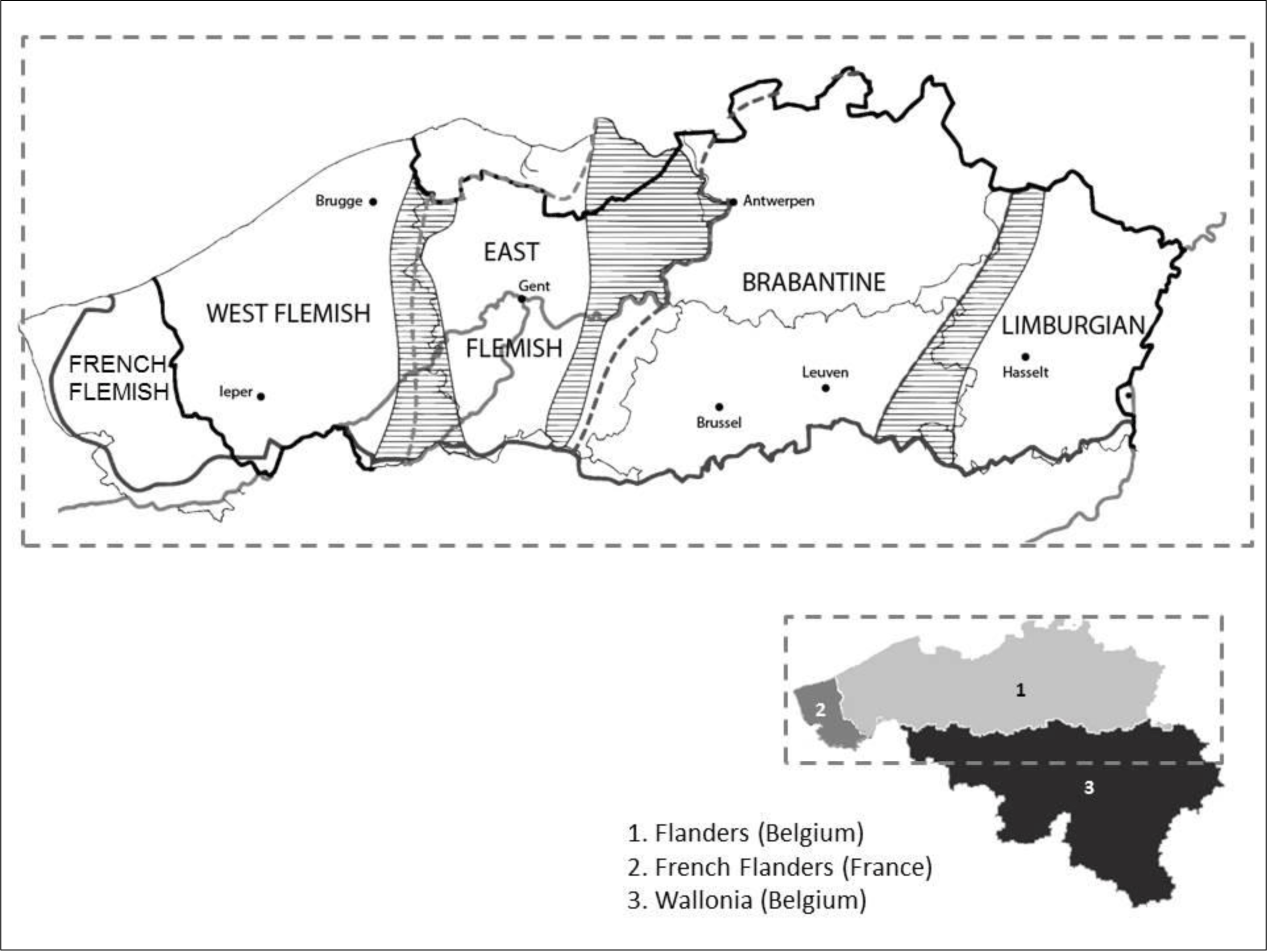
The West Flemish and French Flemish dialects under discussion are both spoken south of the Netherlands’ border, that is, in Belgium and France. The West Flemish dialect area is situated in the west of Flanders; the French Flemish dialect area is located in the north-west of France, in the north of the region Nord-Pas-de-Calais (see figure 1). Unlike the West Flemish dialect area (and most other Dutch dialect areas for that matter), the area where the French Flemish dialects are spoken does not have Dutch as its official language. Since the second half of the 17th century French Flanders has belonged to France, and French is now the official language.
Dialect areas in Flanders.

Figure 1 includes a map of the dialectal regions in the Southern Dutch language area. In addition to the West Flemish and French Flemish dialect areas, other dialectal regions include the East Flemish, Brabantine, and Limburgian dialect areas.Footnote 5
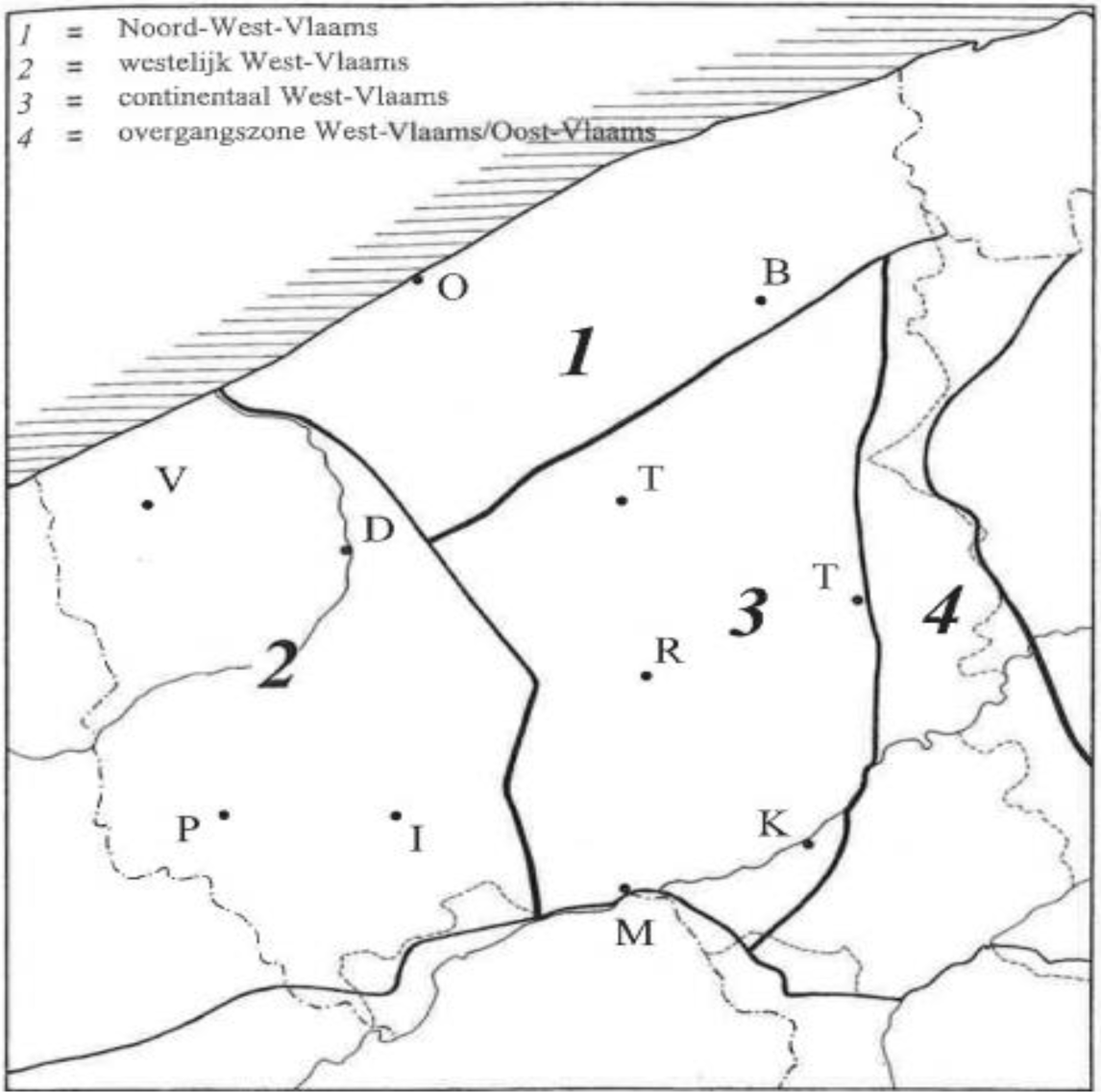
West Flemish and French Flemish dialects share a fair number of features that distinguish them from the dialects of the other large dialect areas in Flanders and the Netherlands (Ryckeboer Reference Ryckeboer2004, Devos & Vandekerckhove Reference Devos and Vandekerckhove2005). Yet there is substantial, but fairly systematic, intraregional dialectal variation that allows for further subclassification. Devos & Vandekerckhove (Reference Devos and Vandekerckhove2005:30–36), for instance, divide the West Flemish dialect area into four different dialect regions (see figure 2), based on isoglosses that represent phonological dialect characteristics: (1) northern West Flemish, (2) western West Flemish (including the French Flemish dialect area, in the French region Nord-Pas-de-Calais), (3) continental West Flemish, and (4) the transition zone between the West Flemish and East Flemish dialect area.Footnote 6 While phonological dialect features need not neatly overlap with syntactic dialect features, the areas marked by the isoglosses do represent the coarse-grained subdivisions that have been used in the literature. These dialect regions are also taken as the starting-point for our balanced data sampling (see section 4.1 for a number of additional comments).
Subdivision of the West Flemish dialect area (Devos & Vandekerckhove Reference Devos and Vandekerckhove2005:29).

The isoglosses present the demarcation of dialect areas with unique features, though it should be observed that this diverse dialect landscape is suffering from dialect erosion. Studies such as Vandekerckhove Reference Vandekerckhove2000 and Ghyselen & Van Keymeulen Reference Ghyselen and Van Keymeulen2014 have shown that the dialects in Flanders are suffering from dialect shift and dialect leveling: As the use of dialects as a means of communication decreases, they lose (some of) their typical characteristics.
The West Flemish and French Flemish areas under study are also affected by dialect loss, though not to the same extent. The knowledge and use of French Flemish dialects are decreasing rapidly, as (French) Flemish has lost prestige compared to French. Children born after World War II are almost exclusively raised in French and are—notwithstanding some exceptions—unacquainted with French Flemish dialects (Ryckeboer Reference Ryckeboer2004). The West Flemish dialect area, on the contrary, occupies an exceptional position in the Southern Dutch language area, as West Flemings use dialect more often than people from other dialect areas in Flanders (Vandekerckhove Reference Vandekerckhove2000, Devos & Vandekerckhove Reference Devos and Vandekerckhove2005). Still, in the West Flemish dialect area, dialect knowledge and use are decreasing, too (Ghyselen & Van Keymeulen Reference Ghyselen and Van Keymeulen2014).
3. Variables Affecting V2 Variation
In the next sections, we briefly discuss a number of variables that have been reported to determine inversion (or the lack thereof). Some of these variables (for example, region) pertain specifically to the dialects at hand, while others manifest themselves in the language as a whole (for example, prosodic integration) or they have been extrapolated from other languages as possibly relevant to the current study (for example, pronominal subjects in V2 Old English).
3.1. Region and Prosodic Integration
Previous studies that have reported on V2 variation in Flemish dialects mainly associate the phenomenon with French Flemish and the west of the West Flemish dialect area, near the French border. Vanacker (Reference Vanacker and Schmidt1967), for example, studied the occurrence of (non)inversion through translation tasks in which dialect users had to translate Standard Dutch sentences taken from the Series of Dutch Dialect Atlases (Reeks Nederlandse dialectatlassen, RND) into their own dialect. The Standard Dutch sentences with the sentence-initial element other than subject all had the default inversion order; yet, when translated into French Flemish, almost none of them had inversion.Footnote 7 These results show that the speakers’ preference for noninversion is fairly strong, as it overrides the so-called transfer effect in translation: “respondents tend to focus more on the lexicon and pronunciation, and tend to stick closely to the grammar of the original sentences” (Cornips & Jongenburger Reference Cornips and Jongenburger2001:223–224).Footnote 8
In West Flanders, noninversion mainly occurred in the west of the dialect area, near the French border (see Taeldeman Reference Taeldeman and Ureland1982:283). Subsequent research into spontaneous language use based on dialect recordings from five different areas in French Flanders and the west of West Flanders also showed a higher concentration of noninversion in French Flanders: 161 instances (or 89.4%) of noninversion out of 180 sentences versus 53 instances (or 50.5%) out of 105 sentences in West Flanders. Similar results were attested by Vanacker (Reference Vanacker1977), who observed that topicalization without inversion occurs more often in French Flemish dialects than in West Flemish dialects.
At the same time, there are indications that noninversion also occurs in inland areas (Vanacker Reference Vanacker1977), albeit less frequently. This is clear from the results of a survey conducted for the Syntactic Atlas for Dutch Dialects (Syntactische Atlas van de Nederlandse Dialecten, SAND 2005:74). The 107 respondents in this survey, from mainly from the west of the Dutch-speaking language area, had to indicate grammaticality/acceptability of sentences without inversion and suggest possible corrections. Six out of eleven locations where the noninversion was not corrected were situated in French Flanders; the remaining five were scattered over the rest of West Flanders. Not only was noninversion attested outside the western part of West Flanders, one of the locations was actually situated very near the border with East Flanders, which may indicate that the phenomenon is actually more widespread across the West Flemish dialect area than was originally anticipated. So far, however, the spread and frequency of noninversion in areas other than French Flanders and the west of West Flanders have not received ample attention in the literature. Our data analysis, however, includes all dialectal regions in West Flanders.
Vanacker (Reference Vanacker and Schmidt1967:847–848) stressed the possible impact of prosodic integration on inversion. He started from the hypothesis that the presence of pauses may induce noninversion, as the speaker moves the topicalized element further away from the core sentence, which leads to a loss of syntactic integration. To test this hypothesis, Vanacker (Reference Vanacker and Schmidt1967) compared the translated sentences with and without pauses from the RND and concluded that only a minority of the sentences with a topicalized constituent followed by a pause showed inversion (10.5% in French Flemish dialects and 14% in West Flemish dialects).
However, as mentioned above, the relation between prosodic integration and syntactic integration is not always that clear cut. While in many cases prefield constituents separated from core elements by a pause do not trigger inversion (see, for instance, the topicalized elements in the preface as discussed in section 2.1), instances of such constituents causing inversion have been attested as well (see Vanacker Reference Vanacker and Schmidt1967:852). Conversely, the absence of pauses need not imply that the preposed constituent is fully integrated syntactically. For instance, in the West Flemish examples in 7, the temporal adverbial ‘s anderendaags ‘the next day’ is attested in three different contexts: With a pause and without inversion in 7a, without inversion and without a pause in 7b, and with inversion and without a pause in 7c.
(7)

Unlike Ganuza (Reference Ganuza2008:54), who excludes all sentences in which the preposed constituent is followed by a pause or by an interruption of some kind as instances of noninversion, we do include sentences with prosodically nonintegrated elements, as long as the latter do not have coreferents within the core clause. This less restrictive selection procedure is informed by the data that contain inverted and noninverted examples, regardless of the presence of pauses.
3.2. Form of the Subject
Following Fischer et al. (Reference Fischer, Kemenade, Koopman and van der Wurff2000), who studied V2 variation in Old English, and observed a V2 constraint similar to the one found in contemporary Standard Dutch, we selected form of the subject as a possible variable.Footnote 9 Their results showed that the V2 order was the norm in sentences with a nominal subject, but it was far less common in sentences with a pronominal subject: If a constituent other than the subject was preposed, pronominal subjects preceded the conjugated verb more frequently than nominal subjects (Jacobson Reference Jacobson1951, Fischer et al. Reference Fischer, Kemenade, Koopman and van der Wurff2000). Swieczkowski (Reference Swieczkowski1962:31) studied the word order in the 14th-century Middle English texts Piers Plowman and Middle English Sermons and observed the same pattern as Fischer et al. (Reference Fischer, Kemenade, Koopman and van der Wurff2000): Pronominal subjects precede the finite verb more often than nominal subjects. According to Jacobson (Reference Jacobson1951:121), however, the impact of the subject’s formal features diminishes in Middle English.
The observation that pronominal subjects precede the finite verb more often than full NPs is consistent with the crosslinguistic tendency for pronouns to occupy a higher position (that is, to appear closer to the beginning of the sentence) than full NPs. In French, for example, the pronominal object always precedes the verb, whereas the nominal object often follows it (je le vois ‘I see him’ versus je vois l’homme ‘I see the man’). Similar tendencies are observed in Italian, Greek, and Icelandic (see, among others, Greenberg Reference Greenberg1966, Hróarsdóttir Reference Hróarsdóttir2001). In view of this crosslinguistic pattern, one could assume that in West Flemish, too, noninversion would be found more frequently with pronominal subjects than with full NPs.
In addition to distinguishing between pronouns and full NPs, a further distinction needs to be made within the pronoun category, that is, between full and reduced pronouns. The relevance of this distinction is suggested by cliticization in Germanic-Romance contact areas and the impact of cliticization on the constituent status of pronouns. Flemish shows extensive cliticization (see De Vogelaer Reference De Vogelaer, Stathi, Gehweiler and König2010 for a comparison wof Germanic and Romance languages) in which lighter reduced pronouns cliticize more strongly to the left periphery (in comparison to full pronouns). Consider the examples in 8: The reduced forms of the 1st person singular pronoun are cliticized to the subordinate conjunction and the finite verb in 8a (West Flemish), and to the negation particle in 8b (French Flemish).
(8)

In addition, reduced pronouns are frequently cliticized in doubled (or even tripled) coreferential subject constructions in Flemish, as in the West Flemish examples in 9 (see also SAND 2005, maps 52–60).Footnote 11 In such cases, the status of the subject in the prefield as a full-blown constituent has been contested (see, for example, De Vogelaer Reference De Vogelaer, Bergs and Diewald2008 on this debate), which may also have an impact on inversion: They may trigger inversion to a lesser extent, which is reflected in a higher proportion of noninverted sentences.
(9)

At the same time, though, cliticized double subject pronouns do occur in inverted clauses as well, as in 10a. Furthermore, doubling of the subject pronoun is not restricted to reduced pronouns only. In 10b, for instance, subject doubling involves full pronouns. In such cases, the first pronoun may still function as a full constituent and have a different impact on V2-variation compared to its cliticized counterpart. The examples in 10 are from West Flemish.
(10)

Finally, it should also be noted that while the constituent status of cliticized pronouns in double subject constructions has been contested, their occurrence in default (or standard) inverted V2 clauses with a single pronoun shows that they can still have constituent strength. This point is illustrated by the West Flemish examples in 11.
(11)

In view of the data in 9–11, a more refined level of annotation is called for that distinguishes between full and reduced pronouns. Sentences with double subjects were left out of the data analysis: First, the constituent status of the cliticized subject remains unclear, which raises questions regarding the SVX order in the syntactic structures under consideration. Second, only those structures where both subject pronouns follow the verb, as in 10a, could be considered true instances of inversion. For these reasons, double subject is not included as a variable in the model that accounts for attested V2 variation. Currently, the data sample is too small to allow for insightful comments. More data are needed for a proper analysis of structural variation in SVS-clauses.
3.3. Form and Function of the Topicalized Constituent
Research on French Flemish and West Flemish dialects (Vanacker Reference Vanacker and Schmidt1967, Reference Vanacker1977) shows a difference between topicalized embedded clauses on the one hand and topicalized phrases on the other hand in terms of their tendency to trigger inversion. The translation data Vanacker (Reference Vanacker and Schmidt1967:846) analyzed showed that topicalized embedded clauses rarely cause inversion. Additional research into spontaneous speech in seven French Flemish and five West Flemish cities close to the French border revealed that in French Flemish, inversion never occurred with topicalized embedded clauses, whereas in West Flemish, it only occurred in 17.5% of the cases.
Vanacker (Reference Vanacker and Schmidt1967) hardly observed any inversion triggered by embedded clauses, which may be a relic from Old and Middle Dutch, where embedded clauses were not considered to be syntactically integrated in the main clause (Burridge Reference Burridge1993). A more detailed account (couched in grammaticalization theory) of the syntactic integration of embedded clauses into main clauses is described by Vandenberghe (Reference Vandenberghe2006:73). Under this account, syntactic integration is viewed diachronically as a gradual and unidirectional process, whereby the internal coherence between two clauses within a sentence increases and one sentence becomes increasingly more integrated with the other. The dependent clause gradually becomes a constituent within the main clause: It loses its characteristics as an independent clause (see Lehmann 1988 on grammatical dependency) and becomes structurally integrated (see Lehmann 1988 on embedding). This evolution is also reflected in Coussé’s (Reference Coussé, De Caluwe, Devos, Van Keymeulen and De Schutter2004) study on 13th-, 15th-, 17th-, and 19th-century prose texts in Holland. She observes an increase in inverted structures across centuries that correlates with greater syntactic integration: Before the 17th century, preposed embedded clauses never caused inversion; the two types of structures coexist in 17th-century prose, whereas the 19th-century data display a fairly systematic use of inverted structures with preposed embedded clauses.
Conditional clauses form an exception, as they do lack inversion in 19th-century prose. As Burridge (Reference Burridge1993:41–42) observes, “[f]or some reason, sentences involving conditional clauses lag behind those involving other types of subordinate clause. [...] In Modern Dutch, expressions involving conditional clauses remain conservative [...]” (see also Van der Horst Reference Van der Horst2008:1593 and Broekhuis & Corver 2016 on V2 violations).
The dialect data in the corpus used in the present study may contain features from the prestandardization period. Furthermore, some of the informants were born in the late 19th century. Therefore, noninversion may be attested not only in conditional clauses but in other types of embedded clauses as well, which were still in flux: They had not fully grammaticalized by the time the recordings were made. Thus, given the nature of our data, in our statistical analysis we distinguish between clausal and nonclausal preposed constituents. The analysis is further complemented by comments on the clausal patterns and how they relate to V2 variation (see section 6). Note, though, that the synchronic analysis of the data in this study does not allow for a fine-grained, full-fledged discussion on the nature of clausal patterns and how they affect structural variation. Such a discussion would require a diachronic analysis of different data sets that would probe into the grammaticalization processes behind each of these patterns across time and unravel the nature of their impact on structural variation (as compared to the other variables listed). Our main concern lies with the opposition between the effect of clausal versus nonclausal elements, at the same time acknowledging the attested clausal pattern variation.
As far as the function of the topicalized constituents is concerned, there are indications that topicalized elements in noninverted clauses are restricted to adjuncts, though the literature is not conclusive: According to Willemyns Reference Willemyns1971:353, Debrabandere Reference Debrabandere1976:87, and Taeldeman Reference Taeldeman and Ureland1982:284, the order without inversion only occurs with adjuncts. Ryckeboer (Reference Ryckeboer2004:82) disagrees with this claim; he argues that the topicalized constituents in noninverted clauses are not restricted to adjuncts, but he does not specify the exact nature of the other preposed constituents. Vanacker (Reference Vanacker1977) also observes the occurrence of prepositional objects in combination with noninversion.
As research is inconclusive with respect to the syntactic functions of all the possible prefield constituents and their impact on word order, one is unable to isolate prefield constituents that trigger inversion. Therefore, in the current account all prefield constituents are examined, with a distinction made between central and peripheral elements. Central elements include those constituents that are determined by the verb valency (that is, subject, direct and indirect objects, prepositional objects, obligatory adverbials, complements to the subject and direct object). Peripheral elements include those constituents that add extra information, but whose absence does not lead to ungrammaticality (that is, adjuncts—including place, manner, time, etc.—disjuncts, and conjuncts). This distinction between central (arguments) and peripheral (adjuncts) constituents is justified by observations made in Old and Middle English, and in Flemish dialects: It was noted that preposed arguments (that is, elements semantically closer to the verb) have a different impact on word order from preposed adjuncts. According to Jacobson (Reference Jacobson1951:16) and Swieczkowski (Reference Swieczkowski1962:51), Old English and Middle English displayed more inversion in cases of preposed arguments. In contrast, research on Flemish revealed that preposed adjuncts tend not to trigger inversion. This pattern suggests that central and peripheral constituents have a different impact on inversion: Central constituents may be expected to trigger inversion more frequently than peripheral constituents, the latter being less inherent and hence less syntactically integrated, and as such having fewer repercussions for word order.
Finally, the number of elements in the topic position also plays a role. While present-day Dutch does not allow for more than one constituent in prefield position, Coussé’s (Reference Coussé, De Caluwe, Devos, Van Keymeulen and De Schutter2004) paper on the position of the finite verb in 13th–19th-century Hollandic prose texts shows that earlier stages of the language were less restrictive. Thirteenth-century Dutch was very lenient toward multiple preposed constituents, though a steady decline can be attested over time. Since dialects often preserve characteristics tracing back to previous stages of the language, traces of this leniency are also attested in our data, from dialect speakers born in the late 19th and early 20th century. So far, the presence and impact of multiple constituents in prefield position has not been examined but is worth considering as well.
4. The Data
4.1. Data Collection and Selection
Data for the present study were gathered from the dialect recordings collected by Ghent University and the Meertens Institute in Amsterdam in the 1960s and 1970s.Footnote 12 The purpose of these recordings was to capture the authentic local dialects affected as little as possible by Standard Dutch or other dialects.Footnote 13 Recorded speakers had to meet several criteria: They had to be born and raised in the same place, be relatively old (older than 60), and have a low level of education. Ideally, both their parents and their partner spoke the same dialect. Most of the recorded dialect speakers who met these criteria were farmers born around 1900. All of the dialect speakers were born and raised well before the democratization of education and the introduction of the mass media, which enhanced the spread of Standard Dutch in Flanders (see Jaspers & Van Hoof Reference Jaspers and Van Hoof2013 on the standardization climate in Flanders).
The authentic local dialects were collected based on what Mesthrie et al. (Reference Mesthrie, Swann, Deumert and Leap2009:90) refer to as sociolinguistic interviews: An interviewer asks questions about the interviewee’s youth, profession, his/her experiences in times of war, and so on. To minimize the distance between the “middle-class researcher versus the subject” (Mesthrie et al. Reference Mesthrie, Swann, Deumert and Leap2009:90) and the impact of age or class differences between the interviewer and the interviewee, the interviews proceeded in an informal environment with an interviewer taking on the role of a student.
In the Southern Dutch language area, more than 800 conversations of approximately 45 minutes each were recorded. To select specific recordings from the areas under investigation, we used the isogloss dialect map by Devos & Vandekerckhove (Reference Devos and Vandekerckhove2005:29, figure 2). However, we decided to treat the French Flemish dialect area as a separate area, following comments by Vanacker (Reference Vanacker and Schmidt1967:854) and Ryckeboer (Reference Ryckeboer2004:82), who observed differences in the frequency of inversion between the dialects spoken in the French Flemish and West Flemish dialect area. The western West Flemish area (area 2, figure 2) was thus divided into two regions: The western West Flemish area in Belgium and the French Flemish area in France.
For this study, a total of 25 recordings (5 from each dialect area) of 39 speakers were selected, which amounts to 985 minutes, or 16.4 hours of spoken language data. During the selection procedure, the following criteria were taken into account:
(i) To avoid geographical bias, we selected recordings made in different locations within each dialect area including speakers from central, eastern, western, northern, and southern villages.
(ii) Only transcribed recordings were selected to optimize accuracy of analysis of both written and spoken data.
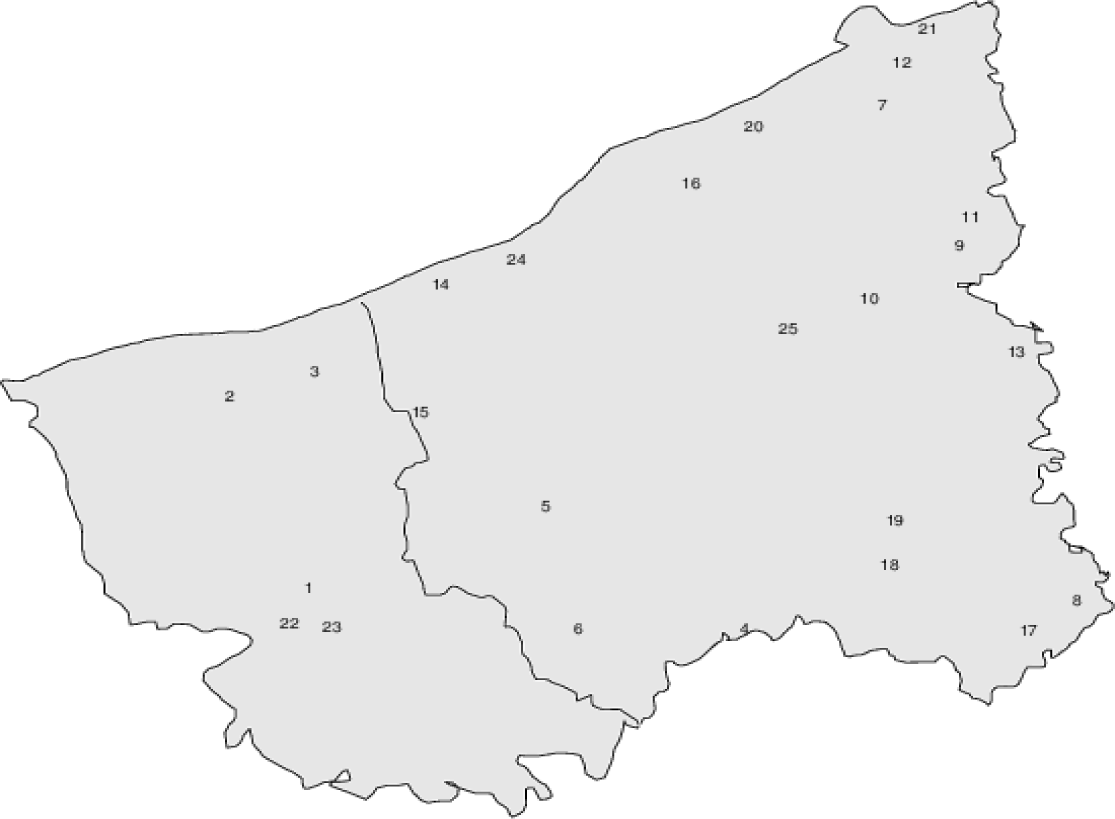
Taking these two criteria into account, recordings from the following 25 villages were selected:
(i) Northern West Flemish (N): Knokke (48’; no. 21, figure 3), Vlissegem (47’; no. 20), Ramskapelle (44’; no. 12), Dudzele (34’; no. 7), and Zandvoorde (28’; no. 16)
(ii) Western West Flemish (W): Koksijde (33’; no. 14), Nieuwpoort (48’; no. 24), Leisele (35’; no. 15), Woesten (2 recordings of 37’ and 5’; no. 5), and Kemmel (39’; no. 6)
(iii) Continental West Flemish (C): Ruddervoorde (48’; no. 10), Torhout (48’; no. 25), Lendelede (36’; no. 19), Heule (14’; no. 18), and Wervik (48’; no. 4)
(iv) The transition zone between the West Flemish and the East Flemish dialect area (T): Oedelem (49’; no. 11), Beernem (44’; no. 9), Ruiselede (32’; no. 13), Tiegem (48’; no. 8), and Heestert (51’; no. 17)
(v) French Flemish (FR): Uxem (48’; no. 3), Capelle-la-Grande (20’; no. 2), Hardifort (24’; no. 1), Bavinchove (33’; no. 22), and St-Marie-Kappel (44’; no. 23)
From this data set, all finite declarative sentences were selected which had a constituent other than the subject in the prefield. This constituent could be nominal or clausal (the latter became syntactically integrated as of the 16th century—see Van der Horst Reference Van der Horst2008; Burridge Reference Burridge1993—and may now trigger inversion, see example 7 above).
Selected villages.

Furthermore, only those instances were selected that allow for both inverted and noninverted order. For instance, 12 and 13 have an inverted and a noninverted variant. However, this is not the case in 14, in which the matrix clause following reported speech always requires inversion, as shown by the ungrammaticality of 14b. This is also true in the other dialects under study.Footnote 14 Example 15 is also problematic for our purposes: The adjunct tons ‘then’ refers to the preposed adjunct de jongen tijd ‘in our youth’, which is similar to reduplicated anticipatory subjects in the root sentence, as in 5a. Recall that such reduplicated subjects are often presented as prototypical instances of constituents in preface positions, which never trigger inversion. Similarly, instances such as 16 and 17, with preposed subjects and objects referred to in the root sentence, do not allow inversion as the preposed element is part of the preface, not the prefield (see section 2.1). Finally, examples with syntactically nonintegrated adverbials such as ‘now’ in 18a were also excluded. The adverbial in 18a has undergone semantic bleaching; it is used as a discourse marker that has no temporal meaning and does not trigger inversion. In contrast, the inverted sentence in 18b has a temporal interpretation.Footnote 15 The examples in 12–18 are from West Flemish.
(12)

(13)

(14)

(15)

(16)

(17)

(18)

As a final point, it should be noted that the results of our selection procedure mostly reflect Greco & Haegeman’s (Reference Greco and Haegeman2016) observed restrictions on initial constituents in noninverted clauses. As a main trend, one can indeed observe—in agreement with Greco & Haegeman—that noninverted clauses do not contain arguments in clause-initial position. Ungrammatical examples 19a–d from West Flemish, adapted from Greco & Haegeman’s (Reference Greco and Haegeman2016) examples 37–40, feature objects, complements, and locative adjuncts selected by the verb. Our data contained only one noninverted example, from French Flemish, with an argument (direct object) in clause-initial position, given in 19e.
(19)

Examples such as 19e may imply that restrictions on clause-initial arguments in noninverted clauses are not as categorical for some speakers. Yet arguments on the one hand and optional elements on the other are clearly associated with different V2 variation patterns. After filtering, the original data set slimmed down from 2,251 to 1,413 sentences, 560 of which (40%) show inversion, and 853 (60%) lack inversion. In the next section, we elaborate on how the different variables were operationalized during the tagging process.
4.2. Data Annotation
The data were annotated according to region, prosodic integration, form of the subject, formal properties and syntactic functions of the topicalized constituents, and the number of constituents in the prefield. In order to study the impact of region and specific location on inversion, each sentence was annotated for region (French Flemish, western West Flemish, northern West Flemish, continental West Flemish, and transition zone), and specific location (the name of the village, see section 4.1). As mentioned above, these geographical labels are consistent with the adapted isogloss model based on Devos & Vandekerckhove Reference Devos and Vandekerckhove2005:30–36.
The next variable is prosodic integration. A distinction was made between instances with no pause, a clear pause, and a short/indeterminate pause. In the statistical model, these distinctions correspond with 0 (no pause), 1 (pause), and 0.5 (indeterminate pause), which turns the variable into a measurement of length. Pauses were caused by interjections between the topicalized constituent and the main clause, as in 20a,b, or by intonation breaks, as in 20c,d. Note again that each example had an inverted and a noninverted variant. Example 20a is from French Flemish; examples 20b–d are from West Flemish.
(20)

The next variable is form of the subject. Following studies on Old English and considering the possible impact of nominal versus pronominal subjects on inversion, all the subjects were divided into full NPs and pronouns. NP subjects, as in 21a, were tagged as nominal, whereas pronominal subjects, as in 21b, were tagged as pronominal. The examples in 21 are from West Flemish.
(21)

Personal pronominal subjects were divided into full and reduced pronouns, based on the distinctions and features found in SAND (2005) and MAND (2008). The opposition full versus reduced is found in pronouns such as gij versus ge, wieder versus we/me, zieder versus ze, ik versus ‘k, etc., examples of which from West Flemish are provided in 22. The reduced pronouns were further divided into weak and cliticized pronouns. Weak pronouns are reduced variants of full pronouns that occur in the same position as full forms, as in 22a,b. Cliticized pronouns are allomorphs of full forms that display their own morphosyntactic and morphophonological properties, as in 22e. To illustrate the contrast, full pronouns are provided in 22c,d.
(22)

In our analysis, the expletive provisional subject er constitutes a separate category due to its special syntactic status, the fact that it belongs to a different word class (Hoeksema Reference Hoeksema2014), and its different impact on inversion (see section 5), as shown in 23a. Sentences such as 23b, with the demonstrative pronoun dat in subject position, also form a separate category, as we were only considering personal pronouns. The examples in 23 are from West Flemish.
(23)

The formal properties and syntactic function of the topicalized constituent also affect inversion. Since topicalized clauses on the one hand and phrases on the other hand purportedly have a different impact on inversion (Vanacker Reference Vanacker and Schmidt1967, Reference Vanacker1977; Coussé Reference Coussé, De Caluwe, Devos, Van Keymeulen and De Schutter2004), it is interesting to study their impact in areas larger than those examined in previous studies. In our analysis, we upheld this distinction. We considered topicalized embedded clauses with a finite verb, as in 24a, and nonfinite (reduced) embedded clauses with participles or infinitives, as in 24b. The examples in 24 are from West Flemish.
(24)

The topicalized phrases included mainly full NPs, as in 25a, and prepositional phrases, as in 25b, but adverb phrases, as in 25c, also occurred. The examples in 25 are from West Flemish.
(25)

As discussed in section 3.3, Jacobson (Reference Jacobson1951:16) and Swieczkowski (Reference Swieczkowski1962:51) observed a difference in word order depending on the type of a clause-initial constituent. Following their research, we distinguish between central and peripheral constituents, that is, between compliments and adjuncts. The adjuncts were further divided into semantic categories, based on Vandeweghe Reference Vandeweghe2010: Restrictive adjuncts, causal adjuncts, concessive adjuncts, conditional adjuncts, temporal adjuncts (of frequency, duration, and time point), adjuncts of means or instrument, locative adjuncts, and adjuncts of manner.
The data were also annotated according to the number of constituents in the prefield, which is our next variable. Multiple constituents can appear in the prefield of inverted and noninverted clauses. These constituents have a syntactic function other than subject. Clauses with constituents in the preface or with clause-initial discourse markers and interjections were excluded, as these elements cannot trigger inversion. In the French Flemish example in 26a, for instance, the prefield contains two constituents, each of which has a separate function (that is, a temporal adverbial ton ‘then’ and a place adverbial van ‘t Boerenhof ‘from the farmstead’). By contrast, in the West Flemish example in 26b, there is only one constituent in the prefield (that is, the temporal adverbial binst de zomer ‘during summer’), which is preceded by a discourse marker/interjection (ewe ja ‘well, yes’).
(26)

We only included instances of constituents that could cause inversion. For example, in the French Flemish example in 27, we did not count the word bon ‘anyways’ as it does not cause inversion.
(27)

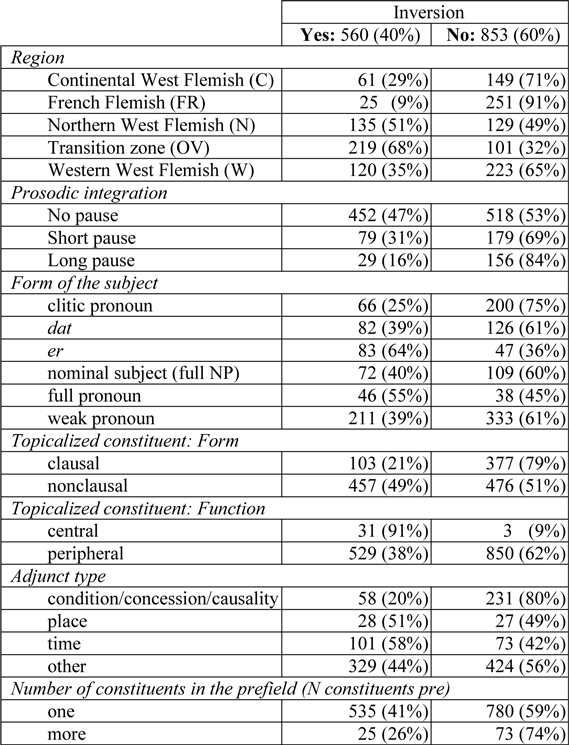
An overview of the values per level for each categorical variable is presented in table 1.
Results across categorical variables.

The overview in table 1 shows a fairly high occurrence of noninversion in the dialects in question; it also shows that different variables are associated with different proportions of noninversion. In the following section, we elaborate on the statistical methods that were used to calibrate the interplay of these variables. We also provide a more extensive discussion of the results.
5. Methodology and Results
We evaluated the effects of our predictor variables on (non)inversion by means of a mixed-effects logistic regression model (with “no inversion” modeled as the success), with two random intercepts: Region and city, with city nested in region. We used the glmer() function in the R package lme4 to fit our model (Bates et al. Reference Bates, Maechler, Bolker and Walker2015). Model quality was evaluated by means of Somers’ Dxy rank correlation, calculated with the somers2() function in Harrell’s (Reference Harrell2016) Hmisc package, and implemented in 100-fold cross-validation (with the predicted responses conditional on the modes of the random effects).
As for the contrast coding of the factors, we used Helmert coding for the variable pause. Pause has a natural order, but an unequal distance between the different codings (no—short—yes), hence our preference for Helmert rather than an ordered (polynomial) coding. We used deviation coding for form of the subject and adjunct type. Neither variable has a base reference level with which the other levels could be compared, so treatment coding (the default coding for categorical variables in R) could not be applied. Deviation coding, which compares the means of the levels to the grand mean, made more sense here. Topic form and topic function received treatment (or “dummy”) coding.
The results for two models are reported. In the first model, we examined the effects of all variables except adjunct type, which is not relevant for peripheral topics. In the second model, we excluded all clauses with central (nonperipheral) topics and tested the variable adjunct type. We interpreted the effects by means of effect plots created with the effects package (Fox Reference Fox2003). As for model building, we included all factors without interactions.
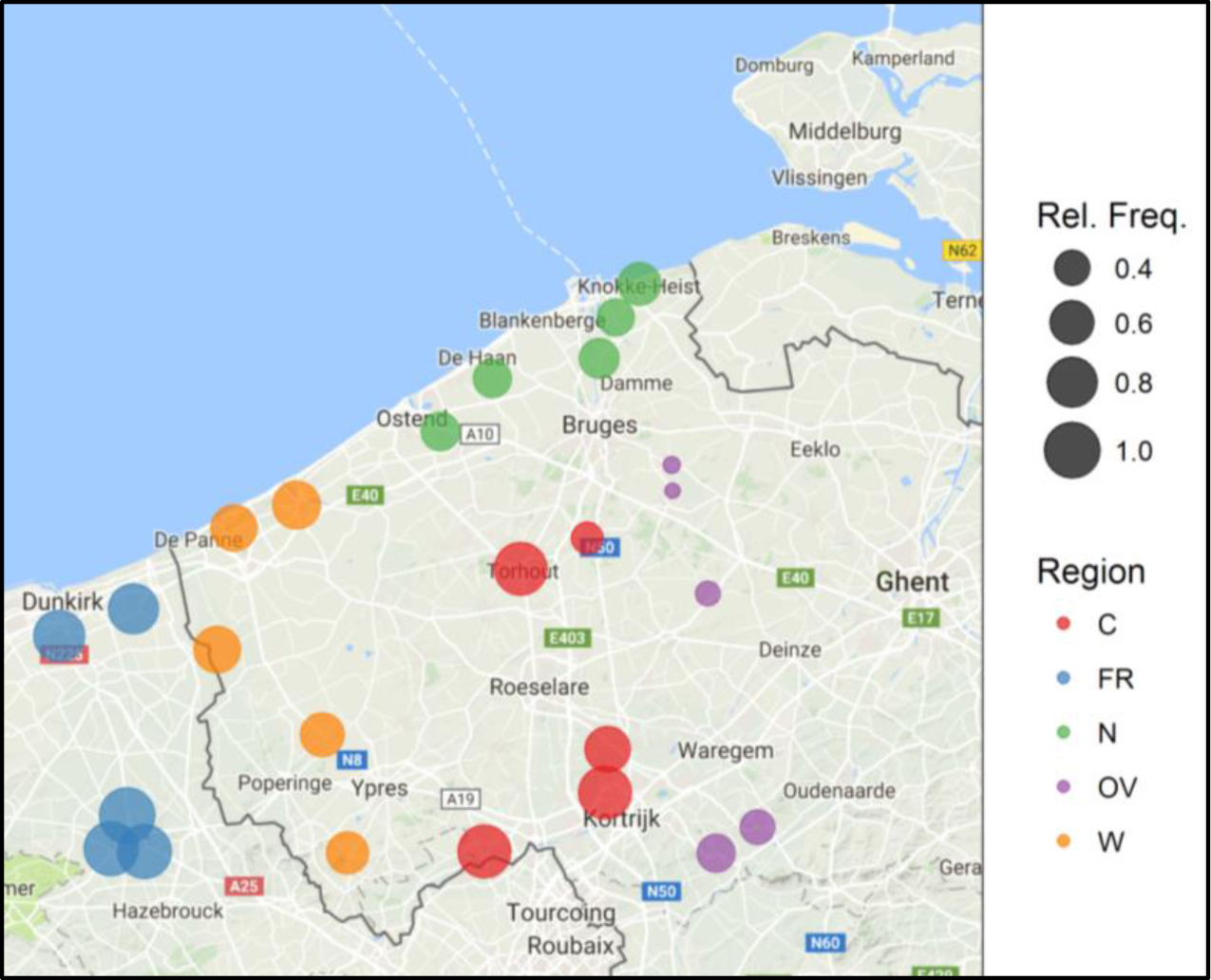
Before outlining the results, we present a general geographical overview. Figure 4 provides a Google map of the geographical area of interest, with a bubble plot of no inversion occurrence per village.Footnote 17
The relative frequencies of no inversion per city and by region.

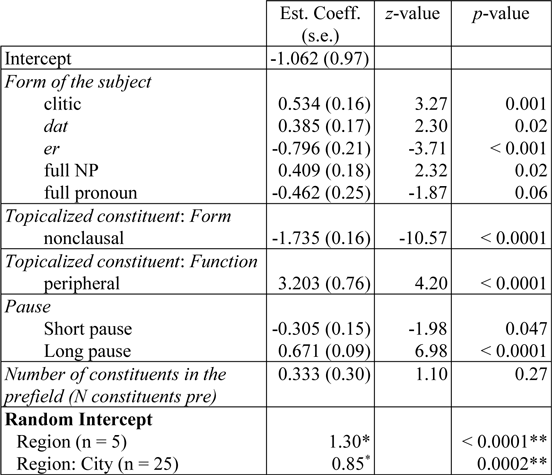
The map suggests a preference for no inversion in the French Flemish region (FR) and the continental region (C) of West Flemish. Furthermore, there is also a clear preference for inversion in the eastern region, which borders on the dialect region of East Flemish (OV). Finally, we note some internal variation within the regions (for example, southern OV versus northern OV). We aim to take both sources of variation into account by including the two nested random factors. Table 2 presents the results for our first mixed-effects logistic regression model.
Model estimates. No inversion is treated as the success.Footnote 18

Model diagnostics indicate a good model fit: Mean C index of concordance=0.88 (after 100-fold cross-validation). Evaluation of the collinearity of the model suggests that this is not a problem: Max VIF=3.6.Footnote 19
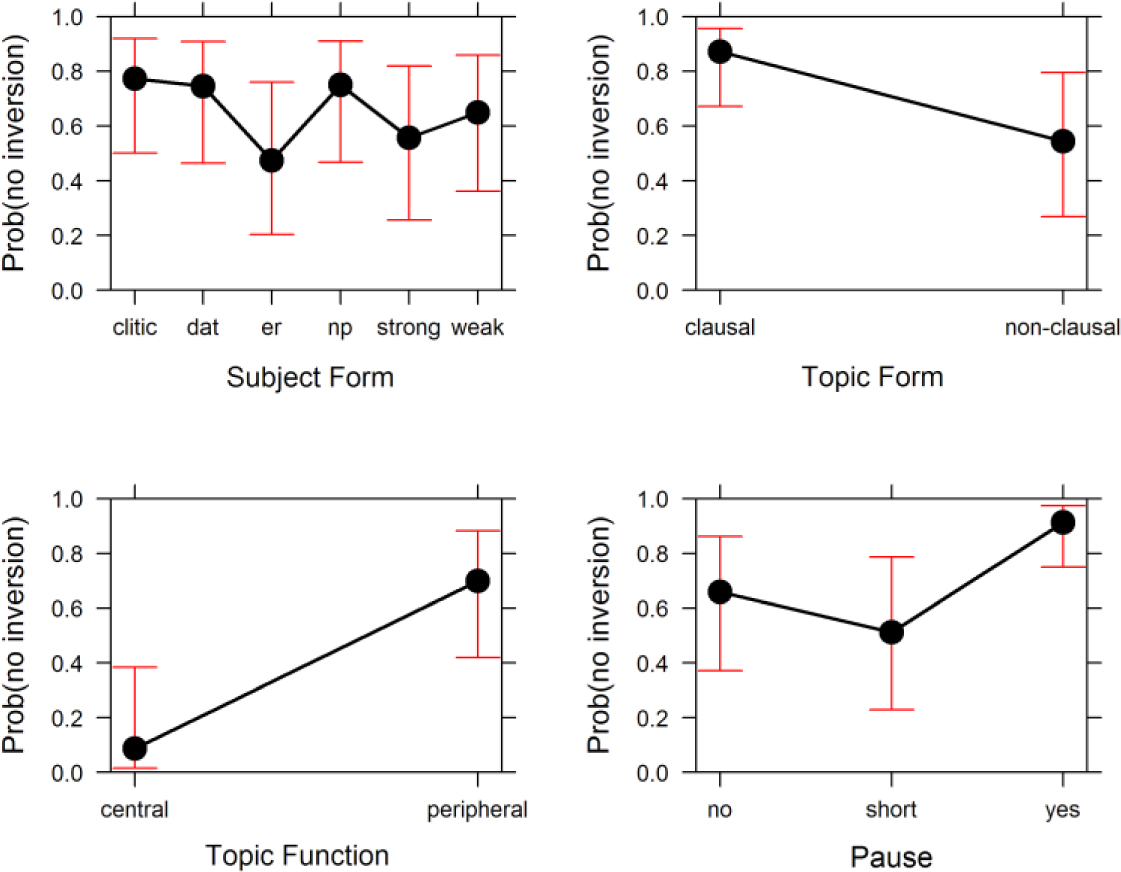
All factors, except for number of constituents in the prefield, are found to have a significant effect on the use of inversion. Figure 5 visualizes the effect of each variable by comparing the predicted probabilities associated with the various values. No inversion appears to be associated with subjects expressed as a clitic, the pronoun dat, and a full NP. Each of these forms of subjects has a significantly higher probability of being associated with no inversion than their grand mean (recall that form of the subject received deviation coding, which means that the coefficients were compared to the mean associated with this particular variable, 66% in terms of predicted probability). Subject er has an opposite effect: It tends to trigger inversion (predicted probability is 47%). The results of the model further indicate that no inversion is associated with clausal and peripheral topics, and the presence of a clear pause (a short pause has a small negative effect in comparison to no pause).
The predicted probabilities and 95% confidence intervals of the significant predictors.

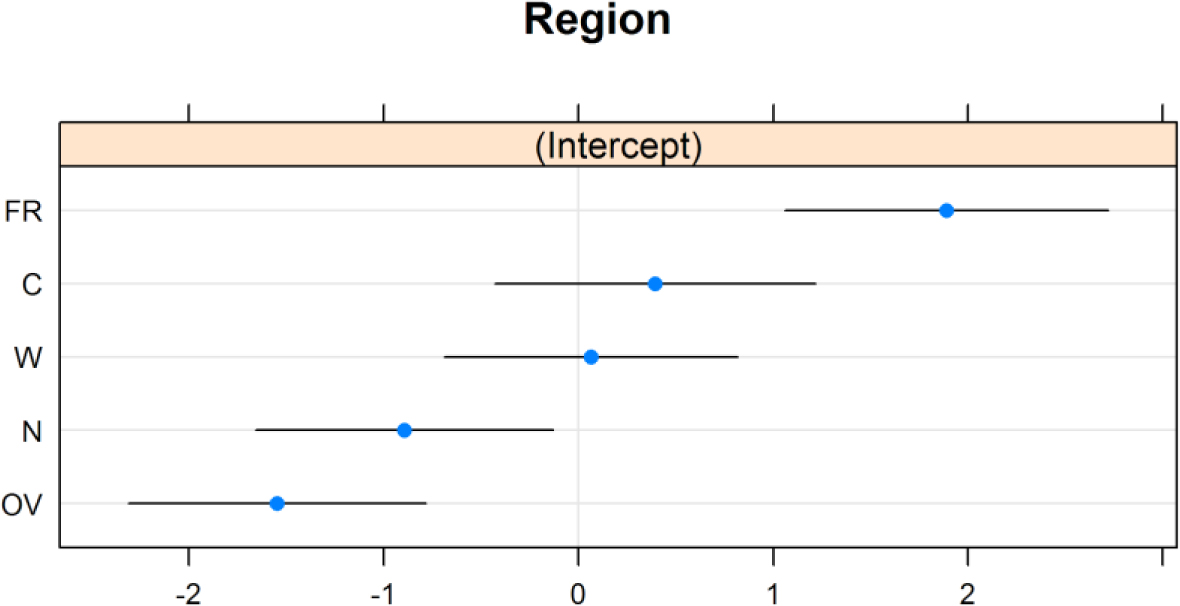
Figure 6 illustrates the variation associated with the random intercepts for region. The results indicate that no inversion is mostly preferred in the French Flemish-speaking region (FR) but dispreferred in the northern (N) and eastern (OV) part of the dialect area.
Random intercepts for region.

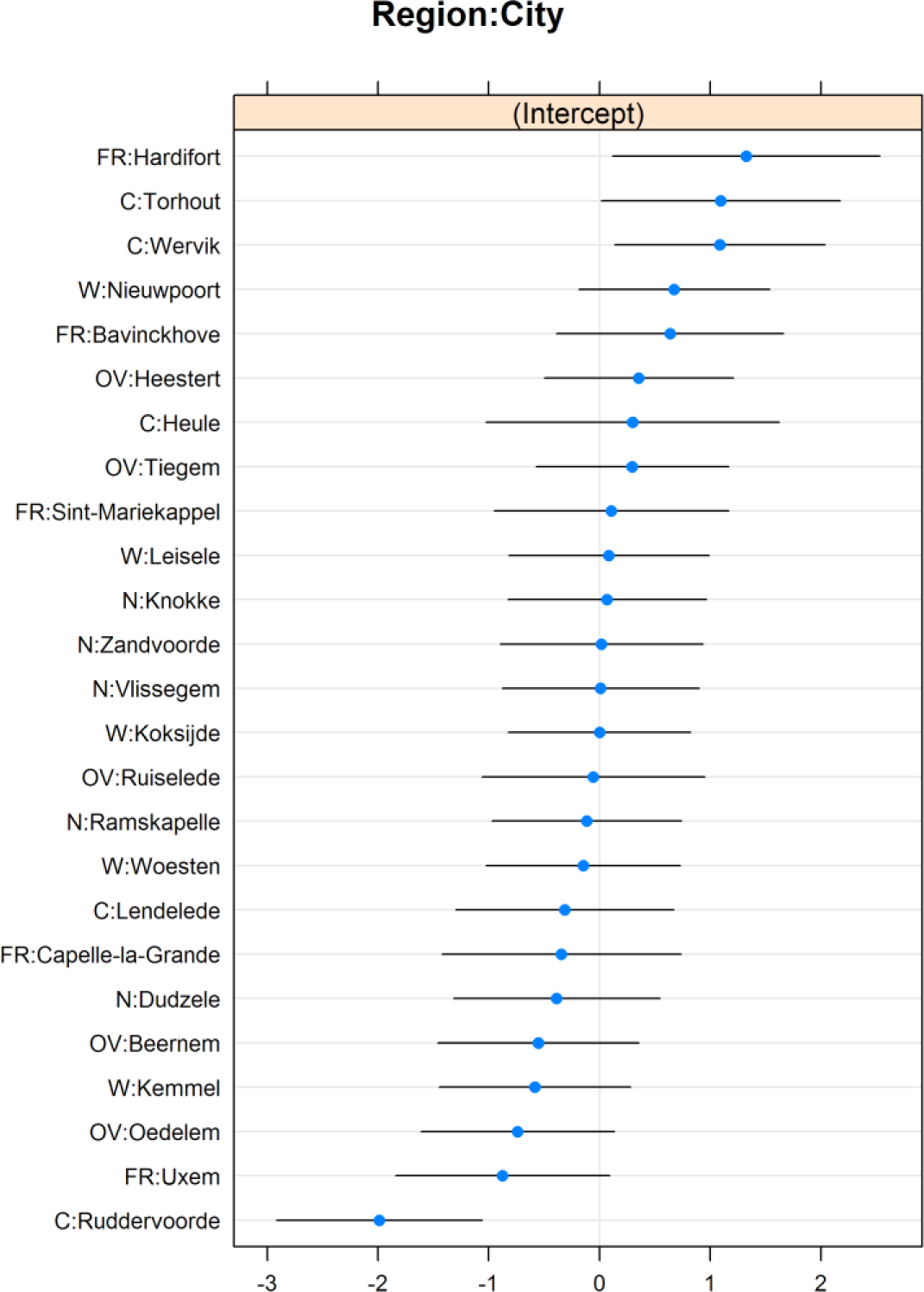
The nested random intercept for city within region was also significant, which is visualized in figure 7. The intercepts can be regarded as adjustments to the more general regional preferences. Consider the predicted result for Ruddervoorde of approximately -2. Ruddervoorde seems to deviate from the general tendency in the continental region (C) with respect to no inversion.
Random intercepts for city within region.

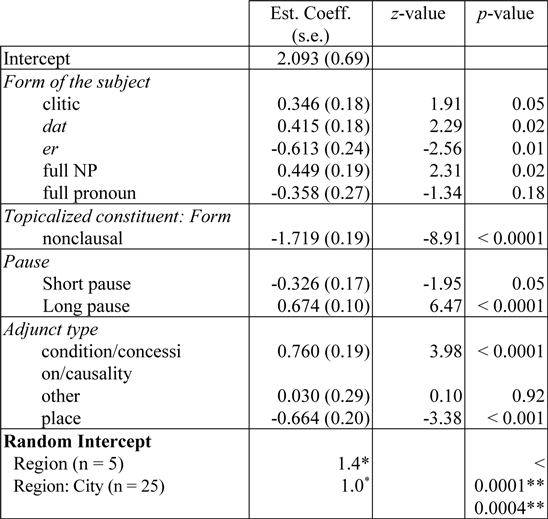
For our second model, we excluded all clauses with central topics. We refitted a mixed-effects logistic regression model, but this time we included the predictor adjunct type. The model estimates are given in table 3.Footnote 20
Model estimates. “No inversion” is treated as the success.Footnote 21

Model diagnostics indicate a good model fit: mean C index of concordance=0.90 (after 100-fold cross-validation). Evaluation of the collinearity of the model suggests that this is not a problem: max VIF=4.6.
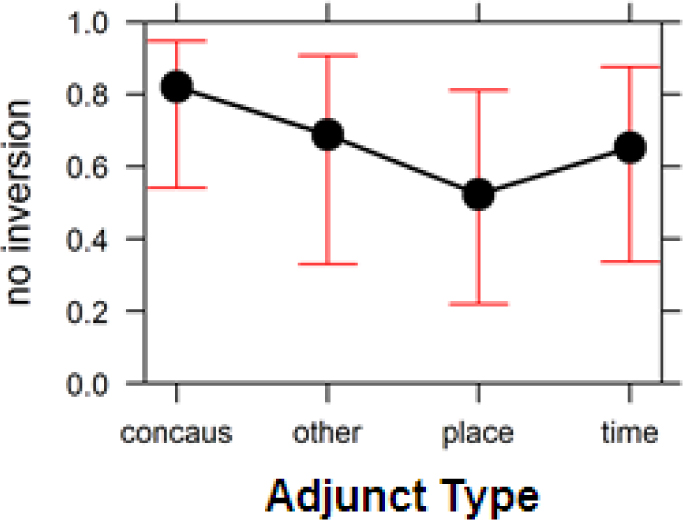
A comparison of the estimated models indicates that the effects—both fixed and random—found in the first model remain stable after we included the variable adjunct type. Suffice it then to look at the effect plot for adjunct type, which is given in figure 8.
Predicted probability and 95% CI for the variable adjunct type.

Adjuncts expressing concession or causality tend not to trigger inversion, whereas adjuncts of place tend to be used with inversion. No evidence is found that other types of adjuncts (including time) yield a significant effect on (non)inversion.
6. Discussion
If one compares the results in section 5 to the expected impact of the variables listed in section 3, a number of interesting findings emerge that underscore the complexity of the attested variation. We briefly discuss each of the listed variables, starting with those whose impact on word order confirms our expectations. First, as far as the impact of prosodic integration is concerned, the analysis is consistent with earlier patterns presented by Vanacker (Reference Vanacker1977), who showed that the presence of pauses induces noninversion. The function of the topicalized element, too, proved to be significant. Like Ryckeboer Reference Ryckeboer2004—but unlike Willemyns Reference Willemyns1971, Debrabandere Reference Debrabandere1976, and Taeldeman Reference Taeldeman and Ureland1982—we show that noninverted word order does occur with central elements, as in the French Flemish examples in 22, albeit (very) infrequently. As such, the data show that noninversion is indeed more associated with peripheral elements (that is, adjuncts) in prefield position, and that syntactically integrated central constituents trigger inversion in most cases, though rare instances of noninverted order do occur.
(28)

A closer look at the different types of peripheral elements reveals that adjuncts of place tend to trigger inversion, whereas conditional and concessive adjuncts do not (see below for further comments). Adjuncts of time as well as adjuncts of means and manner adjuncts do not show a clear impact on word order.
The data also confirm that multiple constituents other than the subject can occur in the prefield, which is a remnant of earlier stages of the language (as observed in Coussé Reference Coussé, De Caluwe, Devos, Van Keymeulen and De Schutter2004). Additional examples from West Flemish are presented in 29. This variable, however, does not have an impact on inversion.
(29)

Now we move on to those findings that reveal a more complicated picture. First of all, as figure 4 shows, the highest proportion of noninverted clauses is indeed attested in French Flemish, while the lowest can be attested in the eastern regions, which corroborates the results of earlier research. At the same time though, a number of unexpected trends have surfaced as well. Interestingly, the second highest proportion of noninverted clauses is attested not in the western part of West Flanders, as was the case in previous studies, but in continental West Flemish. This is somewhat surprising in view of the commonly assumed Ingvaeonic origin of the noninverted syntactic structures. Based on this assumption, one would expect a higher frequency of noninversion in the coastal habitats of the former Ingvaeonic tribes.
The noninverted structures are still more frequent in the northwest than throughout the eastern regions—and systematically more frequent across the entire coastal area. Yet some of the villages in the continental region do show particularly high occurrence of noninversion, the origins of which cannot be causally linked to the known whereabouts of the Ingvaeonic tribes. One possible explanation might, yet again, be contact with French, as some of the villages in the continental region are close to the French border (for example, Wervik). Moreover, note that the area of Courtrai (Kortrijk) used to have a flourishing textile industry, which was mostly in the hands of francophone bourgeoisie. Therefore, speakers from different layers of society may (have) come into contact with French, or they may have learned French to climb the social ladder, which possibly lead to a greater tolerance toward or transfer of noninverted structures. Given this, one of the explanations for the attested internal variation may be linked to idiolect variation influenced by exposure to French. In any case, figure 1 reveals a more nuanced picture than what has been commonly assumed in the literature. There is indeed a trend toward increased use of noninverted structures in French Flanders and their less frequent use in the eastern parts. At the same time, the northern West Flemish area displays lower occurrence of noninverted structures than expected, while the opposite is the case for continental regions.
As far as form of the subject is concerned, noninverted structures are used with subjects expressed as clitics, but also with the pronoun dat and full NPs. Subject er is the only one that has an opposite effect: It typically triggers inversion. Syntactic weight usually has impact on inversion—that is, heavier full NPs are more likely to trigger inversion than lighter clitics. How then can the similarities in terms of syntactic preference between full NPs and clitics be accounted for? One reason why full NPs do occur in noninverted clauses may be related to narrative structure and discursive effects. Greco & Haegeman (Reference Greco and Haegeman2016:15) make the following observation regarding the use of noninverted structures in a narrative context:
[it] often goes along with a high degree of involvement of the speaker, its effect is that of creating an effect of immediacy, with a narrative that puts the speaker as it were in medias res. The pattern may also convey an expressive value, in that the initial adjunct is often used to introduce a frame of reference with respect to which the main proposition appears to be unusual or unexpected[.]
Thus, the narrative effect the speaker aims for overrules the impact of the syntactic weight of the nominal subject. For instance, West Flemish example 30a from our corpus shows the XP-S-V order. Reversing this order, as we did in 30b, changes the hyperbolic sentence into a factual statement of cause and effect.
(30)

The narrative effect may also account for the propensity of dat-subjects to occur in noninverted clauses, especially in contrastive settings that contain temporal frames, with contrastive markers such as toen ‘then’, nu ‘now’, maar ‘but’, etc., as in the West Flemish example in 31. Such examples account for more than a quarter of the attested occurrences of dat-subjects in noninverted clauses.
(31)

At the same time though, not all noninverted clauses with a full NP can be accounted for in terms of narrative considerations, as shown by the West Flemish example in 32: The noninverted clause is a factual statement depicting a routine, which does not call for rhetorical effects (see below for more elaborate comments on discursivity).
(32)

Topicalized clauses show a clear tendency not to trigger inversion, which is consistent with our expectations based on the literature review (Vanacker Reference Vanacker and Schmidt1967, Reference Vanacker1977, Coussé Reference Coussé, De Caluwe, Devos, Van Keymeulen and De Schutter2004; Vandenberghe Reference Vandenberghe2006). Note that about 50% of those topicalized clauses occur in conditionals, whose conservative nature may still be preventing inversion in Standard Dutch as well (see Broekhuis & Corver 2016).Footnote 22 Another 40% of the noninverted structures are temporal clauses, which are very similar to conditionals in their use of als ‘if’ as the dialectal temporal equivalent of toen ‘when’, as in the French Flemish example in 33.
(33)

The fact that temporal and conditional clauses share the subordinating conjunction may partially explain why neither of them triggers inversion. We leave it to further research to explore the link between temporal and conditional constructions from a more diachronic perspective and within the framework of grammaticalization.
While the model has a rather satisfactory predictive value, there are some pending issues that deserve closer attention. First, in addition to the variables included in our model, other factors may influence (non)inversion. In particular, as discussed above, the choice between inverted and noninverted order may be governed by discourse considerations, such as frame setting and information packaging. The interviews for gathering data were set specifically to elicit spontaneous speech, and so the rhetorical aspect of storytelling should not be underestimated, as the participants shared animated stories about country life and harvesting, and the tales of war.
As observed in Greco & Haegeman Reference Greco and Haegeman2016, noninverted clauses are often used as frame setters in narrative contexts. In such cases, the first constituent provides the interpretational frame, or anchor, for the statement that follows (see also Freywald et al. Reference Freywald, Cornips, Ganuza, Nistov and Opsahl2013). The XP-S-V order is mostly used in transitional contexts that involve a contrast, and the first constituent (the XP) specifies modal, temporal or spatial boundaries within which the following statement is to be interpreted. For example, the embedded clauses in 34a contrast two time frames, “in the morning” and “in the evening”, and the noninverted order of the main clauses is meant to draw attention to the fact that “they” (the subject in both cases) behave differently on those two occasions. In 34c, the adjunct ommenekeer ‘all of a sudden’ introduces a new discourse frame that involves an unexpected event. The expressive use of noninverted order conveys the added sense of drama and the speaker’s more active involvement in the events. Examples 34d,e also use historic present tense, which facilitates a live account of the unexpected events described in the main clauses. Example 34a is from French Flemish; examples 28b-e are from West Flemish.
(34)

Some—though not all—of such examples also contain a clear pause following the clause-initial XP, which further signals the shift to a new discourse frame. In such cases, the pause signals syntactic nonintegration of the clause-initial XP and its function as a frame setter, which explains the noninverted order (but see section 2.1 for comments on the nature of pauses and syntactic integration).
However, the data also reveal that the interconnectedness between pauses, frame setting, and the noninverted order is not always straightforward. First, the noninverted order without a pause can be used as a discourse device, as in 34a–c above. Second, when adjuncts are used as frame setters, they do not always block inversion. Example 35a, for instance, contains the same adjunct expressing suddenness and surprise as 34e; the sentence has an inverted order, but this does not entail that there is no discursive effect. Similarly, the temporal contrast expressed in 35b calls for an inverted order. At the same time, there is a fair share of examples with no inversion (especially in the high-frequency regions), whose word order does not seem to be discursively motivated. The examples in 35 are from West Flemish.
(35)

Thus, while noninverted order does seem to serve as a discourse marker, its presence or absence does not seem to be fully motivated by discursiveness, nor is discursiveness expressed by noninversion alone.
The complex interplay between narrative structure and inversion is also nicely illustrated by the structural variation attested in an interview with an informant from Kemmel. In the interview, which lasted 40 minutes, the informant was asked to tell the folklore story of Paardje Malegrijs (Horsie Malegrijs). The story took up 7 minutes of interview time, but the ratio of inverted to noninverted clauses in the story differs substantially from their ratio in the rest of the conversation. Table 4 below shows that the proportion of inverted clauses is substantially larger in the story than in the conversation proper, despite the discursive effects that might have been obtained through the use of noninverted order within the narrative frame of the story.
(Non)inversion in the folklore story of Paardje Malegrijs.

One obvious explanation might be found in the speaker’s attempt to emulate a more standardized version of the language, but the speaker was not trying to make other dialect features sound more standard. In addition, the interview reveals that the informant told the story on different occasions, including a radio broadcast that celebrated the use of dialects, to which he was invited as a guest and story teller. The context of the sociolinguistic interview itself does not account for the shift either: The interviewer is a student learning about dialects from an expert, and so there is no pressure to speak the standard language as the more prestigious variety (Mesthrie et al. Reference Mesthrie, Swann, Deumert and Leap2009:87–89).
The other variables included in this study do not account for the attested variation either. According to Saelens (Reference Saelens2014), V2 variation may still be accounted for by underlying perceptions of the social prestige of varieties or dialects in contact, even when the informant is not aiming to speak the standard language. Since constructive narrative is part of local cultural heritage, the informant might still deem it appropriate to tweak some aspects of grammar to produce a register that diverges somewhat from the dialect he uses in everyday situations. Whatever the explanation may be, the attested patterns of V2 variation reveal that there may be opposing forces at work within narrative contexts: On the one hand, the official nature of the story as a representative of cultural heritage may trigger the use of inverted clauses; on the other hand, the discursive effects aimed for when telling the story may induce noninverted order.
7. Conclusion
The regression-based data analysis of V2 variation in speakers of West Flemish and French Flemish dialects has allowed us to reveal a number of interesting and more fine-grained insights about the phenomenon than has hitherto been possible. The model itself is quite stable and has a fairly strong predictive value. By taking into account the interplay between various factors, we were able to identify those that have a significant impact on (non)inversion. The findings show that all but one variable (number of constituents in the prefield) have a significant impact on V2 variation. Region is the strongest factor, which separates French Flemish, continental West Flemish, and western West Flemish from Flemish spoken in northern West Flanders and in the transition zone. This finding, however, also implies that existing studies have been too restrictive in allocating V2 variation mainly to western West Flemish and French Flemish. In addition, the proportion of noninverted clauses is higher in continental Flemish than it is in the western part of West Flanders, which calls for a reexamination of the impact and interplay between the purported Ingvaeonic origin of noninversion on the one hand and possible transfer effect from French on the other.
As far as prosodic integration and the function and nature of the topicalized elements are concerned, the data are consistent with our expectations: Noninversion occurs more frequently with pauses and with clausal patterns and topicalized elements that have peripheral functions. Among the peripheral elements, conditional and temporal adjuncts show a tendency to occur in noninverted clauses. We also did not find any correlation between the form of the subject (and the associated constituent strength, such as full NPs versus pronouns and full versus weak/cliticized pronouns) and word order. Weaker forms did not occur more frequently in noninverted clauses, just as stronger forms displayed no clear tendency to trigger inversion. Discourse considerations have been argued to have an overruling effect.
There are various suggestions for further research. First, while this paper aimed to map V2 variation in West Flemish dialect areas, it would also be interesting to cross the border of the West Flemish and French dialect areas and examine to what extent the phenomenon can be attested in other dialects, especially those near the transition zone in East Flanders. Second, in view of the current pressure on dialects, follow-up research could investigate how much of the pattern of V2 variation has survived in the dialects of younger speakers. Third, the current, more fine-grained results on regional distribution might be used as a test case to corroborate hypotheses regarding the origin of this V2 variation pattern.
Moreover, while the c-index is quite satisfactory, internal variation (see note 19) is worthy of further attention. In addition to sociolinguistic factors (which are fairly stable), other possible factors spring to mind that could underlie internal variation, including syntactic (alpha and beta) priming (for example, the impact of interrogative inversion on informants’ output in interview situations). A more detailed discussion of the role of discourse in determining word order would be useful; a diachronic analysis that takes into account the degree of syntactic integration of relevant constituents would also contribute to a better understanding of V2 variation. Finally, the current analysis could also further benefit from a more theoretical discussion on the syntactic nature of the clause-initial constituent and how it does or does not fit in with the rest of the structure. See Greco & Haegeman Reference Greco and Haegeman2016 and Haegeman & Greco Reference Haegeman and Greco2018 for insightful comments.