Introduction
In the past, the use of endoscopes in otorhinolaryngology was primarily limited to sinonasal surgical procedures. However, over the years, indications for the use of endoscopes in otology surgery have steadily increased. Endoscopes have been successfully used in middle-ear surgical procedures such as tympanoplasty, mastoid surgery, ossiculoplasty and stapes surgery. They provide a magnified view of the middle ear and visualisation of hidden areas.
In cochlear implantation, locating the round window membrane is crucial for atraumatic and soft electrode insertion. However, in certain patients, particularly paediatric patientsReference Lloyd, Kasbekar, Kenway, Prevost, Hockman and Beale1,Reference Leong, Jiang, Agger and Fitzgerald-O'Connor2 and patients with cochleovestibular malformations,Reference Marchioni, Soloperto, Guarnaccia, Genovese, Alicandri-Ciufelli and Presutti3 identification of the round window membrane is difficult. The use of an otoendoscope facilitates excellent visualisation of the round window niche.Reference Marchioni, Alicandri-Ciufelli, Pothier, Rubini and Presutti4 In this study, we compared microscopic and endoscopic visualisation of the round window membrane during cochlear implantation in 20 patients.
Materials and methods
This study was carried out in the ENT department at a tertiary level hospital, from July 2016 to December 2017. Twenty patients who underwent cochlear implantation during this period were included in the study. All patients underwent detailed pre-operative audiological investigation and imaging, including high-resolution computed tomography of the temporal bone and magnetic resonance imaging.
For each patient, a standard cortical mastoidectomy and posterior tympanotomy was performed using a microscope. Maximum exposure of the round window membrane was achieved, preserving the facial nerve, chorda tympani nerve and posterior canal wall.
The accessibility of the round window membrane using the microscope was graded according to the St Thomas Hospital classification: type I for 100 per cent, type IIa for more than 50 per cent, type IIb for less than 50 per cent, and type III for 0 per cent visualisation of the round window membrane.Reference Leong, Jiang, Agger and Fitzgerald-O'Connor2 Patients with 100 per cent visualisation of the round window membrane (type I) using the microscope were excluded from the study. A 0-degree rigid otoendoscope (1.9 mm) was then inserted into the posterior tympanotomy, and the round window membrane was again visualised and graded according to the St Thomas Hospital classification.
Depending on the accessibility of the round window membrane, the electrode array was inserted under microscopic view via a round window or extended round window approach, or by cochleostomy. For each patient, the round window visibility achieved by microscope and endoscope was compared.
Results
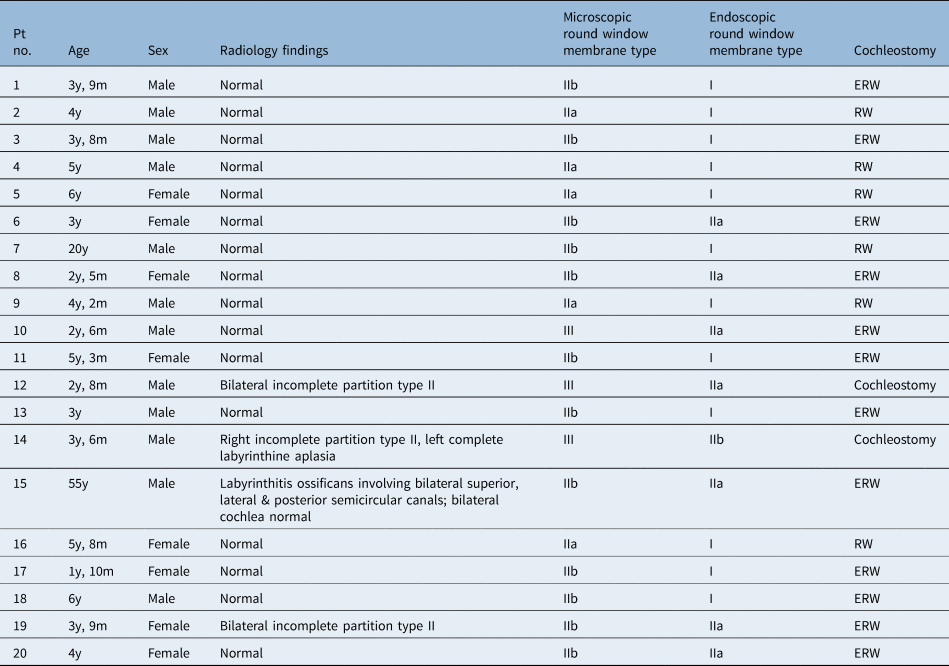
This study included 20 patients who underwent cochlear implantation during the study period (Table 1). Patient age ranged from 22 months to 55 years of age. There were 18 children and 2 adults. The age of the children varied from 22 months to 6 years of age. Among these, three children had incomplete partition type II and the remaining had normal cochleovestibular anatomy. There were two adults with post-lingual deafness, aged 20 years (sudden sensorineural hearing loss) and 55 years (labyrinthitis ossificans).
Patient characteristics

Pt no. = patient number; y = years; m = months; ERW = extended round window; RW = round window
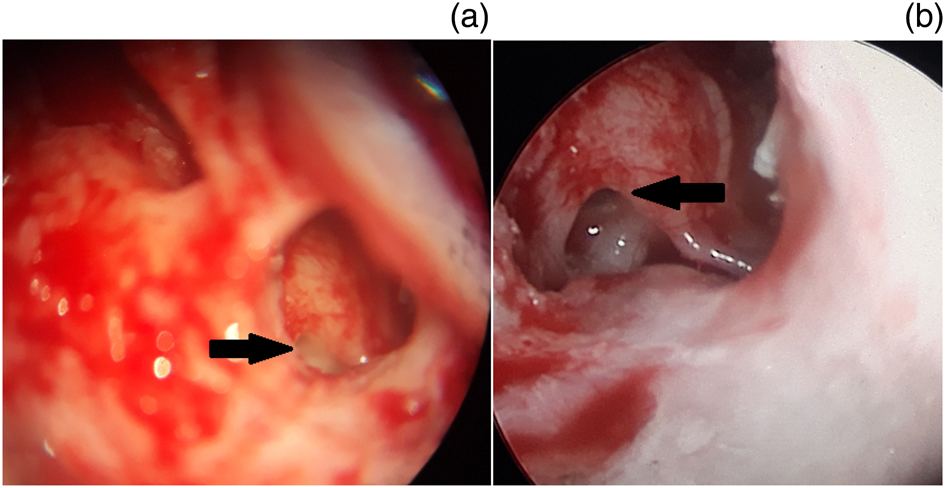
During surgery, the accessibility of the round window membrane using the microscope was classified as St Thomas Hospital type IIa in 5 ears, type IIb in 12 and type III in 3 (Figure 1a). Visualisation of the round window membrane improved in all the patients with the use of the endoscope, as compared to visualisation with the microscope. The accessibility of all five type IIa round window membranes using the microscope improved to type I using the endoscope. Of the 12 type IIb round window membranes, the grades of 7 improved to type I and 5 to type IIa using the endoscope. The accessibility of two of the type III round window membranes improved to type IIa using the endoscope (Figure 1b), and one improved to IIb using the endoscope.
(a) Round window membrane under microscopic view showing St Thomas Hospital type III accessibility (arrow). (b) Round window membrane under endoscopic view showing St Thomas Hospital type IIa accessibility (arrow).

For two patients, both with incomplete cochlear partition type II (St Thomas Hospital type III using the microscope and IIa/IIb using the endoscope), a bony cochleostomy had to be performed for electrode insertion, because of unfavourable anatomy. For the remaining 18 patients, the electrode array was inserted via a round window or extended round window approach. Complete electrode insertion was achieved in all cases. There were no major intra-operative or post-operative complications.
Discussion
Cochlear implantation can be performed by a number of methods, of which cortical mastoidectomy with a posterior tympanotomy is the most common. Over the years, refinements in the surgical techniques have made the posterior tympanotomy approach highly successful, with minimal complications.Reference Rajan, Teh, Prepageran, Kamalden and Tang5 However, the posterior tympanotomy approach poses a risk, although rare, of injury to the facial nerve, particularly in malformed ears. This can occur as a result of bony overhangs or an anomalous course of the facial nerve. In addition, because of anatomical variations, visualisation of the round window membrane may be obscured.Reference Roland, Wright and Isaacson6 The direct line of sight obtained with the microscope through the posterior tympanotomy may not provide adequate surgical exposure, and sometimes it may be difficult to identify the round window and surrounding landmarks. This occurs in up to 11 per cent of adult cases and 22 per cent of paediatric cases, and conventional bony cochleostomy may then be required.Reference Leong, Jiang, Agger and Fitzgerald-O'Connor2 In order to avoid these complications, complementary techniques are considered.
Over the last two decades, endoscopic middle-ear surgery has gained considerable popularity, and endoscopes are now being used during cochlear implant surgical procedures. Using endoscopes in ear surgery can improve optics and magnification, providing clearer, brighter and better quality images. The endoscope also enables a wider field of view, and is able to access hidden areas that are difficult to view using a microscope.Reference Roland, Wright and Isaacson6 The round window niche is one such hidden area that the endoscope can accurately identify. These advantages help to reduce complications and enable atraumatic electrode insertion in the scala tympani for hearing preservation.Reference Rajan, Teh, Prepageran, Kamalden and Tang5
Patients with middle- or inner-ear anomalies may particularly benefit from endoscopic-assisted cochlear implantation. Marchioni et al.Reference Marchioni, Soloperto, Guarnaccia, Genovese, Alicandri-Ciufelli and Presutti3 have described endoscopic-assisted cochlear implantation in patients with middle- and inner-ear anomalies. In patients with advanced otosclerosis obliterating the round window, identification of the fustis, an anatomical landmark to the round window, allows accurate siting of cochleostomy. Additionally, the wider visual field provided by endoscope reduces the need for a more extensive approach.
This study describes endoscopic-assisted cochlear implantation via a conventional posterior tympanotomy approach. In cases with limited visibility of the round window, endoscopic examination through the facial recess can be performed, to obtain a panoramic and magnified view of the round window and surrounding structures. This facilitates a membranous cochleostomy for electrode insertion. Our study demonstrated a significant improvement in visualisation of the round window membrane when using the endoscope, in all patients. This allowed electrode insertion via a round window or extended round window approach in nearly all of the patients. In two patients with Mondini dysplasia, conventional bony cochleostomy had to be performed because of unfavourable anatomy.
In the literature, several studies describe transcanal endoscopic-assisted cochlear implantation.Reference Marchioni, Soloperto, Guarnaccia, Genovese, Alicandri-Ciufelli and Presutti3,Reference Dia, Nogueira, O'Grady and Redleaf7,Reference Migirov, Shapira and Wolf8 Its advantages include avoidance of drilling the mastoid cavity, better round window visualisation and no risk of facial nerve injury. However, in a recent study, Tarabichi et al.Reference Tarabichi, Nazhat, Kassouma and Najmi9 demonstrated that the posterior tympanotomy approach offered the most favourable trajectory for electrode placement. In their radiological evaluation of the position of the round window in relation to posterior tympanotomy, these authors highlighted that the transcanal approach without mastoidectomy did not favour the angle to the axis of the basal turn of cochlea, and the electrode was likely to be deflected off the wall of the cochlea following the trajectory of basal turn. In addition, the transcanal approach is prone to iatrogenic annulus and tympanic membrane injuries, especially in children, as well as electrode extrusion.Reference Dia, Nogueira, O'Grady and Redleaf7,Reference Marchioni, Grammatica, Alicandri-Ciufelli, Genovese and Presutti10
This study describes the auxiliary role of the endoscope in conventional transmastoid microscopic cochlear implantation. The main benefit of endoscope-assisted cochlear implantation is improved visibility of the round window region. This may reduce the risk of complications and is of particular benefit in patients with congenital malformations. However, before embarking on endoscopic-assisted cochlear implantation, surgeons should be trained and well versed in both endoscopic and microscopic ear surgery.
• This study describes the auxiliary role of the endoscope in conventional transmastoid microscopic cochlear implantation
• The main benefit of endoscope-assisted cochlear implantation is improved visibility of the round window region
• Use of an endoscope can reduce the risk of complications and is of particular benefit in patients with congenital malformations
Competing interests
None declared