1. Introduction
In the absence of an international consensus to designate a type locality for the base of the Hettangian Stage and Jurassic System, the base of the Jurassic System in SW Britain has historically been based on the first occurrence of Psiloceras planorbis. To resolve this issue, an international subcommission on Jurassic stratigraphy was established in 1988 with various working groups invited to submit proposals for a global stratotype section and point (GSSP). In the UK, two type sections were proposed: the first is at St Audrie’s Bay, Somerset (Warrington et al. Reference Warrington, Ivimey-Cook and Cope1994, Reference Warrington, Ivimey-Cook and Cope2008) and the second is at Larne, Northern Ireland (Simms & Jeram, Reference Simms and Jeram2007). Another candidate section at Kuhjoch, Karwendel Mountains, Tyrol, Austria was also proposed (von Hillebrandt et al. Reference von Hillebrandt, Krystyn and Kuerschner2007). Following much deliberation, the GSSP was awarded to the Kuhjoch section with a ‘Golden Spike’ ceremony undertaken in 2011 and a detailed description was subsequently published (von Hillebrandt et al. Reference von Hillebrandt, Krystyn, Kuerschner, Bonis, Ruhl, Richoz, Schobben, Urlichs, Bown, Kment, McRoberts, Simms and Tomašových2013). This proposed the first occurrence of Psiloceras spelae tirolicum as defining the base of the tilmanni Chronozone and Hettangian Stage, but it created a problem for defining the base of the Jurassic System in the UK and NW Europe.
The earliest ammonite species recorded in England was P. cf. erugatum from Doniford Bay, Somerset and P. cf. erugatum with Neophyllites sp. in bed 8 at St Audrie’s Bay, Somerset (Page & Bloos, Reference Page and Bloos1998). However, these specimens were crushed, lacked any detail of sutures and were considered by Warrington et al. (Reference Warrington, Ivimey-Cook and Cope2008) to be ‘Too poorly preserved to warrant identification’. Elsewhere Page & Bloos (Reference Page and Bloos1998) recorded Neophyllites above P. erugatum and below P. planorbis in the Wilkesley borehole. Recognition of ammonite biohorizons below P. planorbis in SW Britain is difficult because of a lack of well-preserved specimens. Nonetheless, Page (Reference Page2003) proposed an ammonite zonation for NW Europe in which P. erugatum defined the base of the planorbis Chronozone and base of the Jurassic System.
In contrast to Britain, the Larne section in Northern Ireland has yielded well-preserved uncrushed examples of P. erugatum, N. imitans and N. antecedens below beds with P. planorbis (Simms & Jeram, Reference Simms and Jeram2007). The absence of the tilmanni Chronozone in NW Europe has been attributed to differences in water depth compared with the Northern Calcareous Alps of Austria and its deeper Tethyan waters (von Hillebrandt & Krystyn, Reference von Hillebrandt and Krystyn2009), but the ammonite record in NW Europe has been augmented recently by the discovery of P. cf. tilmanni in the Rødby borehole, Denmark (Lindström et al. Reference Lindström, van de Schootbrugge, Hansen, Pedersen, Alsen, Thibault, Dybkjaer, Bjerrum and Nielsen2017). However, an anomaly in the ammonite record of SW Britain was the discovery of a small psiloceratid ammonite with a simple suture in the Penarth Group at Hampstead Farm Quarry, Chipping Sodbury, England (Donovan et al. Reference Donovan, Curtis and Curtis1989). This specimen was said to occur in a limestone bed at the top of the Westbury Formation, but re-examination of this section has revealed that this limestone bed actually belongs to the Lower Cotham Formation. An unconformity separates the limestone bed in which the psiloceratid was found from black laminated mudstones of the Westbury Formation beneath. A major negative δ13C isotope anomaly CIE1 occurs in SW Britain in the Upper Cotham Member above, so this psiloceratid must be of Rhaetian age.
2. Stratigraphy of the Triassic–Jurassic Boundary at Lavernock Point
The earliest ammonite previously recorded in south Wales is P. planorbis from the St Mary’s Well Bay Formation of the Blue Lias, which is part of the Lias Group (Waters & Lawrence, Reference Waters and Lawrence1987; Simms et al. Reference Simms, Chidlaw, Morton and Page2004) c. 1.4 m above the Dual Bed at Lavernock Point (ST 181 681) (Hodges, Reference Hodges1994). The pre-planorbis beds below (Bull Cliff Member, St Mary’s Well Bay Formation) are developed in a shallow-marine facies of limestones and mudstones generally not conducive to occupation by ammonite species, but dominated by the bivalves Modiolus (M.) minimus and Liostrea hisingeri. In the underlying Penarth Group are a series of breaks in the local stratigraphy caused by tectonic activity related to Central Atlantic magmatic province (CAMP) volcanism and the break-up of the Pangean supercontinent. Evidence for CAMP-related seismicity has been described in Europe by Simms (Reference Simms2003, Reference Simms2007) and Lindström et al. (Reference Lindström, Pedersen, van de Schootbrugge, Hansen, Kuhlmann, Thein, Johansson, Petersen, Alwmark, Dybkjaer, Weibel, Erlström, Nielsen, Oschmann and Tegner2015).
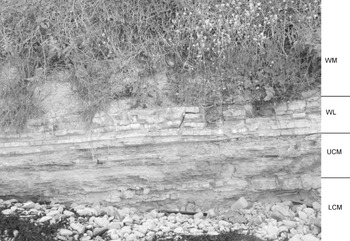
The stratigraphy of the Penarth Group in SW Britain was revised by Gallois (Reference Gallois2007, Reference Gallois2009) who identified several hiati in the lithostratigraphy related to seabed uplift, sometimes with erosion and desiccation, and marine transgressions due to eustatic sea-level rises; these events are reflected in the boundaries of the formations erected for the Penarth Group (Fig. 1). Recent fieldwork at Lavernock Point has confirmed the work of Gallois and identified an additional erosional boundary immediately beneath the ‘Paper Shales’ at the top of the Watchet Mudstone Formation, where small-scale desiccation cracks have also been observed (Fig. 2). These hiati in the upper part of sections traditionally treated as Rhaetian have resulted in the absence of beds that could potentially have contained diagnostic ammonite species.
Lithostratigraphy of SW Britain (Gallois, Reference Gallois2007, Reference Gallois2009).

Section at Lavernock Point (ST 181 681). WM – Watchet Mudstone Formation; WL – White Lias Formation; UCM – Upper Cotham Member; LCM – Lower Cotham Member.

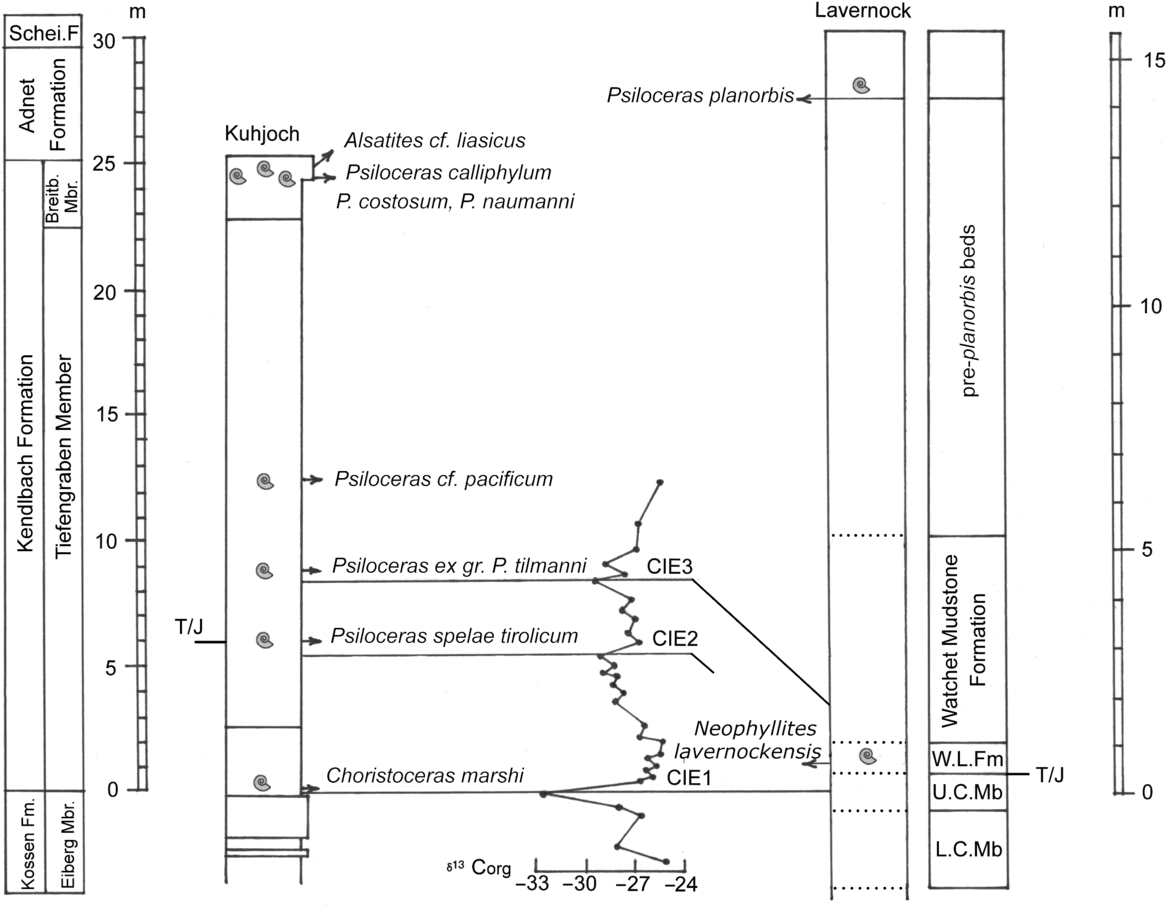
In the Kuhjoch GSSP are several chronostratigraphic markers as represented by a series of major negative δ13C isotope anomalies (Ruhl et al. Reference Ruhl, Kurschner and Krystyn2009). These isotope anomalies have since been recorded in Triassic–Jurassic sections internationally (Guex et al. Reference Guex, Bartolini and Taylor2003, USA; Pálfy et al. Reference Pálfy, Demény, Haas, Carter, Görög, Halász, Oravecz-Sheffer, Hetényi, Márton, Orchard, Ozsvart, Vető and Zajon2007, Hungary; Pienkowski et al. 2012, Poland; von Hillebrandt et al. Reference von Hillebrandt, Krystyn, Kuerschner, Bonis, Ruhl, Richoz, Schobben, Urlichs, Bown, Kment, McRoberts, Simms and Tomašových2013, Austria), enabling correlation with the Kuhjoch GSSP. Chemostratigraphy across the Triassic–Jurassic boundary internationally has recently been summarized by Korte et al. (Reference Korte, Ruhl, Pálfy, Ullmann, Hesselbo, Sial, Gaucher, Ramkumar and Ferreira2019) and shows the effect of CAMP volcanism on the environment at that time. The significant negative δ13C isotope anomalies at Kuhjoch were designated CIE1, CIE2 and CIE3 by von Hillebrandt et al. (Reference von Hillebrandt, Krystyn, Kuerschner, Bonis, Ruhl, Richoz, Schobben, Urlichs, Bown, Kment, McRoberts, Simms and Tomašových2013) (Fig. 3). CIE1, the largest of these, occurs close to the last occurrence of Choristoceras marshi and is of Rhaetian (Late Triassic) age. CIE2 occurs just below the first occurrence of P. spelae tirolicum that defines the base of the tilmanni Chronozone and therefore the Jurassic System. CIE3 occurs c. 2 m above this at Kuhjoch, just below the occurrence of Psiloceras ex gr P. tilmanni (von Hillebrandt et al. Reference von Hillebrandt, Krystyn, Kuerschner, Bonis, Ruhl, Richoz, Schobben, Urlichs, Bown, Kment, McRoberts, Simms and Tomašových2013, fig. 27). CIE1 was recognized in the Upper Cotham Member of the Cotham Formation at Lavernock Point (Suan et al. Reference Suan, Föllmi, Adatte, Bomou, Spangenberg and van de Schootbrugge2012) based on comparisons with St Audrie’s Bay (Hesselbo et al. Reference Hesselbo, Robinson, Surlyk and Piasecki2002), which contains shallow-water ripple-marked sandstones and siltstones with ferruginous staining. This confirms the Upper Cotham Member as being of Rhaetian age.
Comparisons of Kuhjoch type section (Hillebrandt et al. Reference von Hillebrandt, Krystyn, Kuerschner, Bonis, Ruhl, Richoz, Schobben, Urlichs, Bown, Kment, McRoberts, Simms and Tomašových2013) with Lavernock Point section. CIE1-CIE3 – carbon isotope excursions. W.L.Fm. – White Lias Formation. U.C.Mb. – Upper Cotham Member. L.C.Mb. – Lower Cotham Member; T/J – Triassic–Jurassic Boundary.

The base and top of the White Lias Formation above are marked by stratigraphic breaks that might explain the lack of evidence to date for the tilmanni Chronozone here. There is a major negative δ13C isotope anomaly in the Watchet Mudstone Formation above the White Lias Formation at Lavernock Point (Korte et al. Reference Korte, Hesselbo, Jenkyns, Rickaby and Spotl2009; Suan et al. Reference Suan, Föllmi, Adatte, Bomou, Spangenberg and van de Schootbrugge2012), which suggested that the Triassic–Jurassic boundary could possibly lie within this formation. Recognized breaks in the lithostratigraphy above and below the White Lias Formation at Lavernock suggest that this negative δ13C is most probably CIE3.
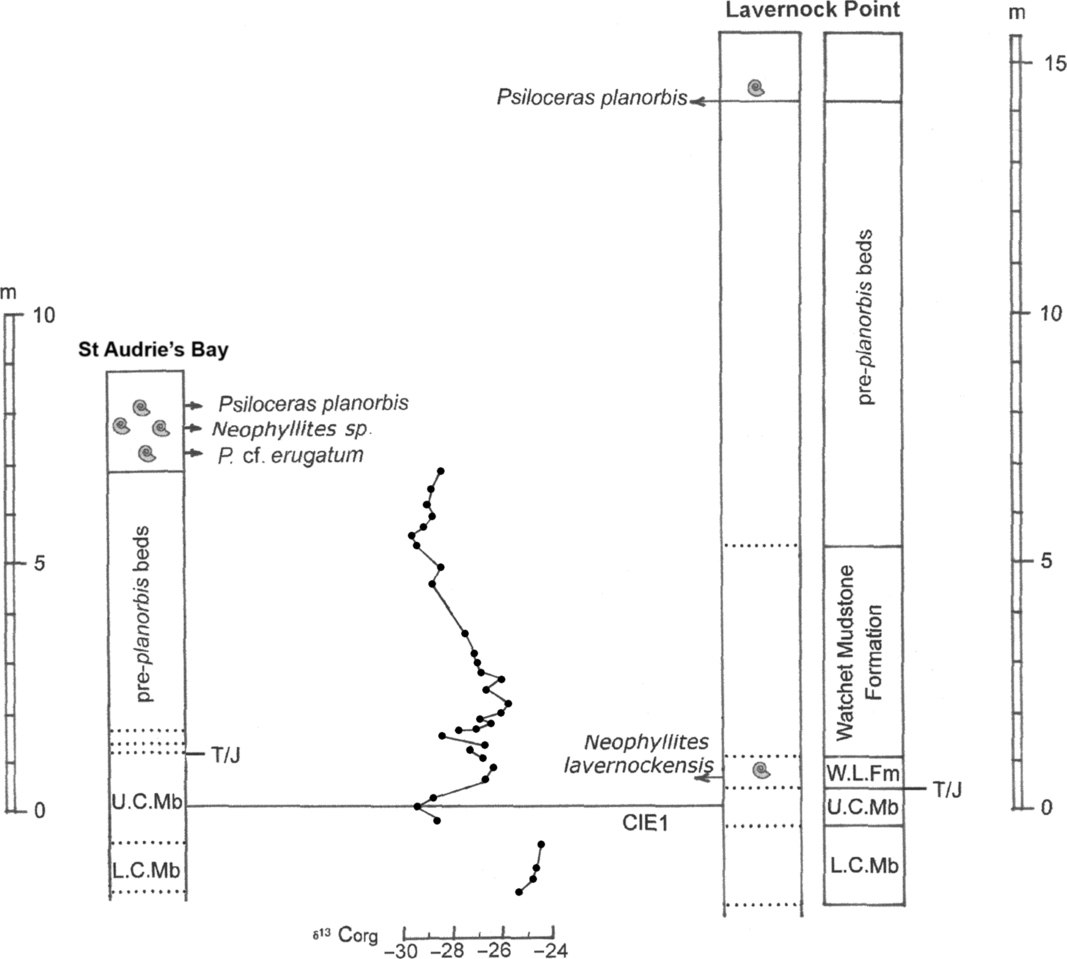
Comparisons between Lavernock Point and the closely studied section at St Audrie’s Bay are shown in Fig. 4. The lithostratigraphy of the Penarth Group at St Audrie’s Bay is based on Gallois (Reference Gallois2009) and the Lower Lias above on Whittaker & Green (Reference Whittaker and Green1983). The first appearance of P. planorbis in this section is based on Hodges (Reference Hodges1994). The hiati in the Penarth Group at St Audrie’s Bay are identical to those at Lavernock Point (Gallois, Reference Gallois2009) and also result in breaks in the CIE record of St Audrie’s Bay (Hesselbo et al. Reference Hesselbo, Robinson, Surlyk and Piasecki2002) compared with Kuhjoch. These breaks are shown in Figure 4.
Comparisons of Lavernock Point section and St Audrie’s Bay section (Gallois, Reference Gallois2009). Abbreviations as in Figure 3.

3. ‘Pre-planorbis’ ammonites at Lavernock
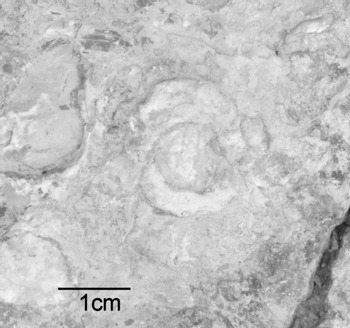
Fieldwork at Lavernock Point, South Glamorgan, Wales (ST 181 681) led to the discovery of a pyritized ammonite (NMW.83.22G.1459; Figs 5–7) in fallen material at the base of a cliff section (Fig. 2) that exposes rocks of the Penarth Group currently treated as Rhaetian (Late Triassic) in age. A second very worn ammonite (Fig. 8) was also seen on the upper surface of a limestone bed at the top of the White Lias Formation. It was just about possible to make out and measure the diameter and umbilical width of this worn ammonite, allowing comparisons with the ratios of Early Jurassic ammonite species. The location of the pyritized ammonite at the base of the cliff, along with its fragile nature, indicates that it could not have moved far from its original location, but it was not found in situ. Attempts were made using geochemical methods to try and determine the bed from which the specimen originated.
Pyritized specimen NMW.83.22G.1459 Neophyllites lavernockensis sp. nov.

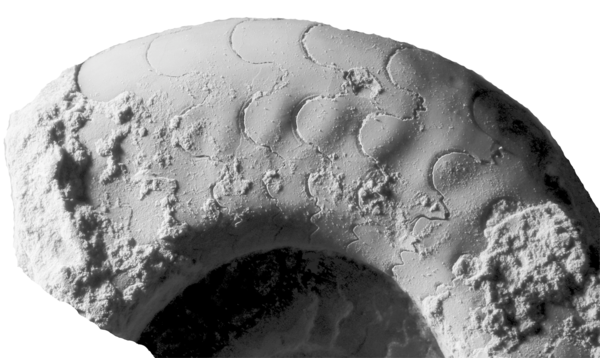
Detail of nodes on largest whorl.

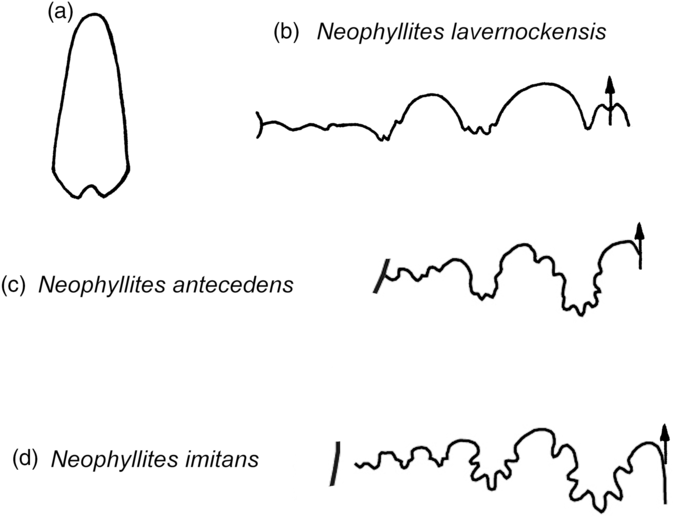
N. lavernockensis (a) whorl section; (b) suture at whorl height 7.6 mm; (c) N. antecedens, Larne, Bed 26; and (d) N. imitans, Larne, Bed 25.

Worn ammonite on upper surface of limestone bed, White Lias Formation.

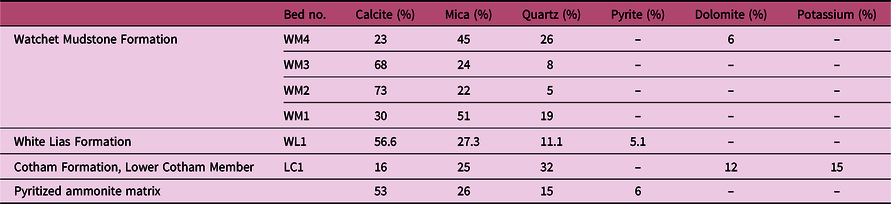
Rock samples collected from each of the beds in the cliff section above where the pyritized ammonite was found were analysed by X-ray diffraction (XRD), as was the limestone adhering to the pyritized ammonite. The results of these XRD analyses (Table 1) suggest a match between the limestone at the centre of the ammonite whorl and the limestone of bed WL1.
X-ray diffraction (XRD) analysis of field samples.

Significantly, this bed is also the only one in the cliff section to contain pyrite. The worn ammonite (Fig. 8) seen on the top bed of the White Lias formation (WL1), although impossible to identify, had whorl dimensions similar to those of the pyritized ammonite. It was possible to measure the umbilical width and diameter of the worn specimen, giving an estimated ratio of 0.45. The pyritized ammonite was measured in a similar way, giving an umbilical width to diameter ratio of 0.42.
The position of these ammonites within the White Lias Formation places them 0.5 m above CIE1 and 1.3 m below CIE3. By comparison with the GSSP at Kuhjoch, this is just above the first appearance of P. spelae tirolicum. The precise distance of this new ammonite from CIE1 and CIE3 at Lavernock is not critical due to the disconformities that exist above and below the bed in which the ammonite is found. In the absence to date of P. spelae tirolicum and P. tilmanni at Lavernock, there is no absolute proof of the chronological position of this new species relative to those species; nonetheless, we can be fairly certain that the tilmanni Chronozone is present at Lavernock. The earliest P. planorbis at Lavernock occurs 1.4 m above the Dual Bed, which is c. 13 m above this new ammonite species.
4. Ammonite systematics
Superfamily Psiloceratoidea Hyatt, Reference Hyatt1867
Family Psiloceratidae Hyatt, Reference Hyatt1867
Genus Neophyllites Lange, Reference Lange1941
Type species. Psilophyllites antecedens Lange, Reference Lange1931
Neophyllites lavernockensis sp. nov
Description. The holotype is an entirely septate pyritic internal cast of 20.8 mm diameter. It is moderately involute, with an umbilical width of 9 mm (0.42 of umbilical diameter) and whorl height of 7.6 mm (0.37 of total diameter). The whorl cross-section is sub-triangular with a rounded venter, and whorl width is greatest (4.6 mm, or 0.6 of whorl height) at the umbilical angle. The flanks are steep, angled at approximately 12° to the vertical. Flanks from umbilical angle to the umbilical seam are relatively flat. The innermost whorls are smooth, but the outer whorl has nodes located at the second saddle of the suture, elongated and acutely angled to the growth lines. The inner walls of the whorls are marked with fine spiral rills. The sutures are simple (Fig. 7). Four nodes occur in a 30° arc, giving an estimated node density per whorl of 40–48 nodes if present (Fig. 6).
4.a. Comparisons with other Early Jurassic Psiloceratidae
The simple sutures in this specimen are unlike any seen in other Early Jurassic ammonites. Only the protoconchs of juvenile ammonites display such simple sutures as seen in Psiloceras ex gr. tilmanni (van Hillebrandt & Krystyn, Reference von Hillebrandt and Krystyn2009, fig. 13). The sutures of mature Psiloceras species are quite complex, whereas those of Neophyllites are less so. The spiral rills seen on the inner walls of the whorls are reminiscent of those observed by Bloos (Reference Bloos1999) in Neophyllites sulcifer Lange, but that species lacks any nodes. The elongated nodes described here are also seen in Neophyllites neumayri Lange, but in that species these are parallel to the growth lines, are positioned closer to the umbilical angle and the umbilicus is more open (umbilical width to diameter ratio: 0.48). All of the species of Neophyllites described by Lange (Reference Lange1941) were considered by him to occur below Psiloceras planorbis, although the exact stratigraphic horizons were unknown at that time. Most of his species are now placed in the planorbis Chronozone. Neophyllites spp. were described by Guex et al. (Reference Guex, Bartolini and Taylor2003) in the New York Canyon, Gabbs Formation section in Nevada, USA below P. pacificum and above P. tilmanni, but sutures were not visible in this material and elongated nodes present in one specimen were developed along the umbilical angle.
The best preserved examples of N. antecedens and N. imitans in the UK were collected at Larne, Northern Ireland (Simms & Jeram, Reference Simms and Jeram2007). The sutures are shown for comparison in Figure 7c and d.
Some features seen in species of Psiloceras and Neophyllites can be seen in this new species, but its suture is unique and very simple. The whorl cross-section and lack of nodes on the inner whorls in N. lavernockensis are similar to P. spelae tirolicum, but the whorl node density in the latter species is much lower and the suture is more complex.
5. Conclusions
An ammonite found ex situ that has been shown to be derived from the top limestone bed of the White Lias Formation at Lavernock Point, and subsequent recognition of a new species Neophyllites lavernockensis, demonstrates that beds traditionally considered to be of late Rhaetian age are, in fact, of Jurassic age. The base of the Jurassic System in SW Britain can therefore be defined as the top bed of the White Lias Formation at Lavernock Point, making the Watchet Mudstone Formation above also part of the Jurassic System. The presence of Neophyllites lavernockensis at this level also marks the local base of the tilmanni Chronozone. Comparisons of negative δ13C isotope anomalies at Lavernock, St Audrie’s Bay and at the Kuhjoch GSSP offer further evidence for the position of CIE1 just below the base of the Jurassic System, in the Upper Cotham Member of the Cotham Formation. There is also evidence that CIE3 is represented in the Watchet Mudstone Formation at Lavernock. The White Lias Formation at Lavernock Point represents a local marine transgression and is much condensed, with breaks in the lithostratigraphy above and below; however, on the Devon–Dorset Coast at Pinhay Bay it is much thicker. Hallam (Reference Hallam1960) recorded a thickness of 7.84 m with several fossiliferous beds (his beds 3, 6, 10, 11 and 13) containing bivalve species such as Chlamys (C.) valoniensis, Plagiostoma giganteum, Liostrea hisingeri, Protocardia phillipianum, Atreta intusstriata and Grammatodon (Cosmetodon) buckmanni. Diligent searching of this and other exposures of the White Lias Formation may locate additional ammonite evidence for the tilmanni Chronozone in Britain.
Acknowledgements
I thank Richard Bevins and Caroline Buttler of the National Museum of Wales, Natural Sciences Department for providing access to facilities, and Tom Cottrell and Amanda Valentine-Baars for assisting with XRD analysis. I also thank Professor John Cope for advice and discussion on ammonite identification. Sofie Lindström and Mike Simms kindly undertook a critique of the original manuscript and suggested improvements. Mike Simms also provided suture details of Early Jurassic ammonites from Northern Ireland.
Conflict of interest
None.