Introduction
From the early 1990s in Italy, a number of changes, including population ageing, the increased participation of women in paid work, the restructuring of the welfare state and increased international immigration, have helped to create and spread a new occupation, that of home eldercare assistant (commonly known as badante).Footnote 1 As Italy's population ages, the need for long-term care is growing. In fact the country has one of the oldest populations of the world, second only to Japan (United Nations Organization 2004). The World Health Organization estimates that the number of people requiring daily care among those aged 60 or more years will increase by 10 per cent during the first decade of this century, and by 42 per cent during its first four decades (see www.who.int/chronic_conditions/countryprofiles/en/). In addition, the availability of care-givers, both informal (family, friends, neighbours) and formal (professional or non-professional paid carers) is decreasing. Several factors are responsible, including reduced family size and thus the number of daughters available to care for elderly relatives, changing family structures, and the progressive attenuation of the extended family (Glucksmann and Lyon Reference Glucksmann and Lyon2006; Lyon and Glucksmann Reference Lyon and Glucksmann2008). At the same time, there has recently been a marked increase in women's engagement in paid employment: in 2005, 45.3 per cent of Italian women actively participated in the labour market (Eurostat 2005).
These trends have left the country with what Hochschild (Reference Hochschild1997) has described as a ‘care-deficit’. This is exacerbated by the weakening of the family's contribution to care, a pivotal element in the Italian welfare system, without a corresponding strengthening of state welfare services. In practice, the principal form of public-sector provision of personal care and support services for frail elders and their families is financial (or social security) benefits to families rather than through actual care services (Palese et al. Reference Palese, Oliverio, Girardo, Fabbro and Saiani2004; Ranci Reference Ranci and Ranci2001). Responsibility for dependent older people and their care therefore falls almost exclusively upon their families, specifically on women. One response in recent years has been that Italian families have increasingly subcontracted the obligations of care to im/migrant women (and less often to men) from all corners of the world, including Nigeria, Peru, Romania and the Philippines.
Much attention has recently been paid to the im/migrant workers that perform these jobs (e.g. Alemani Reference Alemani2004; Andall and Sarti Reference Andall and Sarti2004; Ayalon Reference Ayalon2009; Colombo Reference Colombo2007; Degiuli Reference Degiuli2007; Morini Reference Morini2001), but not to their employers and the reasons that lead them to become employers. The majority of the research on the topic has concentrated on the ways in which immigrant workers provides Italian families with a cheaper alternative to other forms of long-term care (Aronson and Neysmith Reference Aronson and Neysmith2006; Bettio, Simonazzi and Villa Reference Bettio, Simonazzi and Villa2006; Ranci Reference Ranci and Ranci2001; Spano Reference Spano2006). While the economic incentive has certainly been important in creating this new care regime, I argue that not enough attention has been paid to the other motivations and drives. This paper investigates the lived experiences of care through the words of a small sample of Italian care-givers and, in the process, identifies the different elements that converge in shaping long-term care, among them people's ideals and practical understandings of care, and the interplay between families, the welfare state and the care-labour market.
Methodology
To enable an investigation of the needs of family care-givers caring for disabled elders, in 2004 the author approached Tierra Madre (a pseudonym), a feminist non-governmental organisation in Turin, Italy. It is an association of both immigrant and Italian women and has been researching, studying and monitoring eldercare in Italy for many years. Their goal is to reconcile the needs of Italian women unable to sustain the demands of care placed on them and the needs of im/migrant women who are looking for work. The collaboration with Tierra Madre generated a research project that was also supported by ASL 4, a Turin branch of the national health-care system with a special responsibility for the welfare and health of families that are caring for frail elders. The Tierra Madre care-work researchers and I were granted permission by ASL 4 to attend the geriatric assessments performed at their facilities each Wednesday during March and April 2004. These assessments are used to either grant or deny monetary support for the families. After a number of the assessments, the doctors allowed us to introduce ourselves to the older person and to their care-givers and to explain the research project. If the family care-givers showed interest, they were invited to an interview, and if they consented, it was arranged for a later date. In this way, 25 interviews were arranged and conducted. Another was carried out with my landlady, for with the help of many immigrant home eldercare assistants she had been caring for her elderly mother for the previous 10 years. This last case also enabled informal observations over a full year of the relationships among the elders, the family care-giver and two immigrant women who were the home eldercare assistants.
The analysis
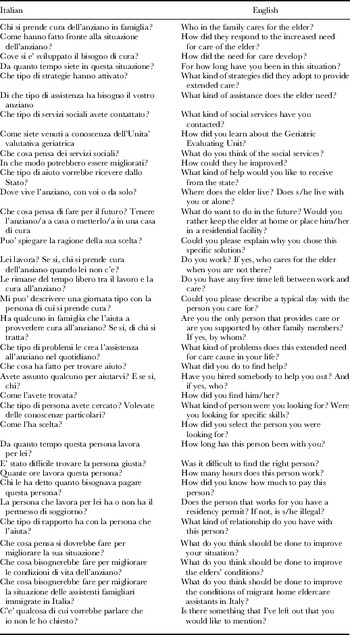
The semi-structured interviews covered a wide range of topics related to the provision of long-term care in family households (see Table 1). The questions were refined and elaborated during multiple meetings with the researchers and members of the Tierra Madre care-work group, and sought to address issues that emerged from the literature and from the everyday concerns of the families that contacted the organisation. The interviews lasted between 60 and 100 minutes and were audio-recorded and transcribed. Subsequently the text was coded into main thematic categories. As Emerson, Fretz and Palmer (1995: 151) put it, ‘qualitative coding is a way of opening up avenues of inquiry’. My goal was not necessarily to attribute labels to the entire data, but to identify and develop concepts and analytic insights through a close examination of the responses. This process, defined as ‘open coding’, allows the categories to emerge, not from preconceived notions but from the data itself (Creswell Reference Creswell1998). This does not mean that coding is entirely discovery, but rather a process that links specific events and observations to more general analytic categories and issues that are subsequently reconciled with the existing literature (Emerson, Fretz and Palmer 1995; Strauss and Corbin Reference Strauss and Corbin1998). Given the large volume of the generated data, this paper focuses exclusively on the meanings and implications of long-term care for the family care-givers and their relationship with the care-labour market and the welfare state. A subsequent paper will explore how family care-givers who become employers selected their employees and the characteristics people employed to construct the ‘ideal’ eldercare assistant.
The interview questions for the family care-givers

The care-givers
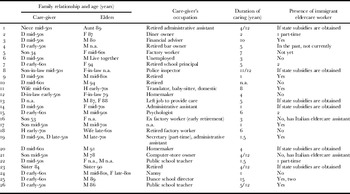
The 26 interviews confirmed that the provision of care to disabled elders is still a women's responsibility (Alemani Reference Alemani2004; Piazza Reference Piazza1997). In 22 cases, in fact, the main care providers were women (summary profiles are presented in Table 2). In only four cases were men the main providers, and in two cases the care was divided between a mother and a son. Most of the family care-givers were women aged in their early-fifties to mid-sixties (a few were older), and they were working full-time or had just retired. In most cases, their families still relied on them for daily subsistence. They belonged to all strata of Italian society, from the very affluent to the lower-middle class. Most had tried before becoming employers to manage the situation by themselves.
Characteristics of the family care-givers and the elders in their care

Notes: All the participants except number 15 had made an application for public aid. Relationships: D: daughter, F: father, M: mother. n.a.: not available.
How employing paid care-givers began
As the interviews made abundantly clear, the amount of care needed by the elders was not fixed but changed greatly over time. When it begins, usually all that is required is some supervision of daily activities, such as keeping an eye on a forgetful elder, or buying groceries, paying bills, and taking care of occasional complex or heavy tasks. One son-in-law recollected:
The current situation started last August after my father-in-law broke his femur – since then he has become vulnerable and needs assistance. He is still independent, for the most part … he can take care of himself in terms of personal hygiene and can, if he feels like it, cook for himself, but he no longer feels confident.
For some fortunate ones, the needs of the frail elder had remained at the level primarily of support and company for a few hours a day. For the majority, however, the need for care had increased over time, either through the slow progression of some form of dementia or the rapid onset of a disease, or as a result of surgery. In all such cases, the amount of care required for the elders readily grew first to full working days and then to 24 hours a day, seven days a week. One daughter, who for five years had taken care of both of her parents, explained her situation:
My odyssey began five years ago when my mother had surgery to replace her knee. Up to that point, my parents were completely independent and needed only a house cleaner once in a while to help them with the most demanding tasks. I used to work back then and I didn't have much time for them. After the surgery, however, my mom became more and more insecure. … So I decided to leave my job to help them out. Progressively my mother's condition got worse. She began to have ischaemic episodes, which first left her in a wheelchair, and then killed her last December. My father, who is now 94 years old, is the only one left and he too needs full-time assistance.
The daughter's experience was by no means uncommon among the respondents. For many families whose elderly relatives had functioned perfectly well for years, a point came when they found themselves progressively engulfed in a growing need for care that, in the absence of publicly-provided services or other feasible alternatives, made it very difficult to balance care and paid or homecare work. In a couple of cases, the heightened need for care forced family care-givers to leave their jobs and to dedicate themselves full-time to manage the elder's physical and mental decline. Furthermore, some cases of onerous and difficult to manage care responsibilities were not short term and endured for years on end. One daughter, who provided assistance for her 80-year-old mother, described the sequence:
We have been in this situation for ten years. … When we first brought my mother to the doctor they gave her six months to live. That happened ten years ago but she is still among us. It is a very difficult situation because my mother suffers from Alzheimer's, Parkinson's and diabetes, and she needs full-time assistance. Everybody commends us for what we have done for her.
The situation can be further complicated when parents on both sides of the family need extended care. One son, whose mother was affected by senile dementia, said:
I finally thought that I could handle the situation when I hired a home eldercare assistant to take care of my mother … but now the situation is once again degenerating, because my mom is beginning to suffer nocturnal incontinence and she doesn't want to wear diapers. Up to this moment, the person who works for her has been getting up to help her, but I cannot ask her to do it forever. I will have to hire somebody else for the night. And now, on top of all this, my mother-in-law's health has begun to decline – she has lost the use of her legs. We are waiting for a hip replacement but in the meantime … we had to hire somebody for her too.
The need for such intensive care and assistance places a huge load on families in terms of both emotional and physical commitment. Women, in particular, continue to be the ones who end up with the greatest burden. It is important to mention that while there were six men among the interviewed care providers, in all their families the women were still considered the main carers. Where brothers and sisters were present, it was often the sisters who took the full load of care. One daughter, who assisted both her elderly parents, explained the family dynamics:
We are three sisters and one brother. I do most of the care, but my sisters in one way or another support me. My brother, instead, is absolutely uninterested. He comes once a month, like the doctor. He has no interest in them, not even a phone call for my mother whose mind still works fine. Nothing.
Even when one or more brothers played a fuller part, at least in terms of economic and managerial support, most women felt that they were better equipped to provide care, which reflects the traditional gendered division of labour. One daughter gave more details:
My brother offers me all the support I need. He helps with the economic aspect of care, which is not a small matter, but also in helping me take decisions and when there are important things to do, like taking [my father] to the doctor, or to obtain the disability certificate. … He helps me, but I'm the one that solves my father's problems on a daily basis … maybe because a woman is more inclined to do these sorts of things.
Independently from their family circumstances, the women who cared full-time for their elderly relative were often caught between two care demands, for the elder and for their own families. One daughter lucidly described the tensions:
[To care for my parents] I had to give up [looking after] myself and my needs, and even those of my husband. On top I often feel split. … I'm confused, especially when I'm really tired, about what I have done for them or for us. Did I buy the milk for them or for us? I can't always remember what I have done in my house and what I have done in my parents' house, because naturally I have to divide myself between the places – my husband complains that I think only about them and not us.
The mention of a husband upset by the limitations posed on the family lifestyle by the extensive care provided to the older person was a common thread in many interviews and indicated an added element of stress in the already over-extended lives of most of the women, but not only husbands complained. As one son remarked, ‘[My mother's situation] makes difficulties for my relationship with my wife. I mean, my wife is very understanding and available, but she thinks that there should be a limit to the time I spend with my mother. She thinks that my mother had her life and we need to have one too’. Many families who care for one or more disabled elders lose the ability to live an autonomous life. Among the participants, even when the help of a home eldercare assistant was available, most needed ‘to fill in’ at the weekend or during holidays. Vacations were no longer considered feasible. This loss of control over one's life was found particularly galling because it came at a time when most of the families had finished raising their own children and many had retired: they were planning to rest and to have a more carefree lifestyle. One daughter elaborated this reaction:
To have a parent so dependent, so needy [it] changes your life. It is a traumatic event, because I have grown children and my husband and I have gotten used to coming and going whenever we wanted, to make plans, to leave on the spur of the moment; and now all that freedom is taken away. … It is a fine line and especially for a woman it is difficult to maintain a balance.
The necessity of living two lives, one for themselves and one for the elders in their care, not only took a great physical and emotional toll on the care providers but also compromised their wellbeing. Many of the interviewed women mentioned that they had developed stress-related ailments that affected them both physically and mentally. The difficulties involved in caring for elderly parents or relatives were amplified because many of the elders were often in a bad mood, difficult to deal with or outright nonsensical because of their ailments and physical and mental decline. One daughter, whose mother was aged 94 years, described such difficulties well:
I don't want to exaggerate, but I think that because of my mom's situation I had become depressed. Every time she sees me we have a fight. As soon as I walk into the house she accuses me: ‘You changed my overcoat, you took my umbrella, you switched my scissors, and you took all the things that were in the dining room cabinets’. I try to explain, to tell her that is not true, but every time she attacks me, and I end up responding crossly and screaming.
Besides the emotional and physical toll of caring for the elders, another aspect that deeply concerns many Italian families is the cost of extended care. Among the participants, only two of the more affluent family members never mentioned the financial costs, but all the others talked about the economic difficulties associated with the provision of good care. One daughter explained her household's situation:
My father lives with us and has a monthly pension of €540.Footnote 2 You wouldn't believe it but with that money I can barely pay for everything he needs. … First he needs medications … and now that he has this oesophagus problem, he eats only baby-food which is very expensive. … Now out of desperation, I hired this Peruvian lady who comes for two hours every evening while I'm [working] at the diner, but he is still alone from 8 pm to midnight when I come home from work, I can't pay for all that. … I give him a sleeping pill and hope for the best.
According to all the interviewees, the older family member's pension was insufficient to cover all the care expenses, so many family care-givers had to contribute financially to ensure proper care. The costs attached to eldercare, particularly when distant relatives were concerned, were often expenses that the family had not budgeted for, which caused great difficulties both in terms of providing the required hours of care and in assuring its quality.
Elders and residential facilities
In spite of the complex emotions and the practical difficulties in providing full-time care for elderly parents and relatives, 22 of the 26 families were resistant to the idea of placing the relative in a residential home. Many considered the option as a kind of abandonment and betrayal, and for these reasons residential facilities were generally seen as the solution of last resort. One daughter, who took care of her mother, elaborated these thoughts:
I wouldn't [put her in a residential facility] because I know she wouldn't want me to. It would be going against her will, even if I think that the facilities of today are no longer what they used to be, because now they have specialised personnel. …. I think that if you have offspring, if you have somebody that, in a way or another, can care for you [that is how it should be].
For others, the notion of keeping the dependent older person at home was not seen as optional or even discussed: it was regarded as a cultural norm, as ‘what people do’. One son who shared his house with his 79-year-old father, whom his wife cared for, explained how the arrangement came about:
My father asked to live with us, but he didn't need to … [he] implied that he should live with us. He expected it, maybe because he is from the South, but I think that it happens here too [in Turin]. Even here in the North people take care of their parents, if they can. They take their parents home with them. … In other words, it's normal for him and for us.
Some families had sold both their previous home and the older person's to buy a bigger home that could accommodate them all. Most family members believed that keeping the older relative at home among their own things, among their memories, enabling them to maintain their habits and their routines, and above all to be surrounded by people who care for them is a moral imperative that should be passed on to future generations. One daughter explicitly spelled out these views:
Every time I think that it is time to put her in a nursing home, I go to look at a few. Every time I've walked out crying, thinking ‘no, it's too early … we can still manage’. Over these ten years we've taken care of her with the help of at least ten different home eldercare assistants. We did this because she's our mother and from a moral standpoint we believe that we should take care of her. Furthermore, my sister and I thought that it was important to set an example for our children, to show them that it is important to take care of your own elders, of your family.
This woman's words were echoed in most of the interviews, even if the reasons that motivated the family members to keep their frail relatives either with them or in their own homes were diverse and in some cases conflicting. Among the mentioned reasons were: affection, respect, gratitude, duty, guilt and, last but not least, fears about their own old age. Most families also believed that to place the older person in a residential facility would amount to consigning them to a depressing and lonesome environment where their mental decline would hasten. One niece expressed such views very well:
When I first spoke with social services, they said that they could find me a place in a facility but my aunt was so used to being independent that I couldn't really agree to it. To dismantle her house, to put her in the facility that I saw … I'm not saying that they suffer there, no, but my aunt's mind is still fine, while some of the elders there are drooling or are grieving all the time. … I don't want my old age to be like that.
Other families were instead plainly concerned about the conditions experienced by the elders in some residential institutions. One daughter, who with her sister cared for her frail mother, gave a particularly distressing account:
We had a terrible experience with my mother-in-law. … She was in a facility where there were only two people to care for 15–20 elderly residents. … It looked pretty nice – they had their own cute, little rooms, but …. when the care-workers were busy and couldn't attend to them, or if an elder talked too much, they would tie them to their chairs, and we eventually figured out that my mother-in-law spent hours tied to her chair looking at a wall and she went crazy because of that … plus they kept men and women together and one of these men, he was sick I understand, but he gave her a beating and broke her nose, and nobody noticed for days. It was only when my mother-in-law was sent to the hospital that everything came out and we ended up filing a complaint with the police.
For others, the decision to keep a frail older parent at home and next to them was dictated not by a general fear of institutions but by the wish to sustain their family life, in other words to ensure that their relationship with their parents was daily and close, not one distanced and mediated by the schedule of an institution. One daughter candidly explained:
I'm not necessarily against the institutions themselves. … Actually, I think that in recent years they have improved quite a bit … but I know that I would miss him, I would miss his presence. Being able to see him only during visiting hours, maybe only once a week or maybe even every day, but amidst many people would not be enough, and I would miss him.
Moral, cultural, and traditional concerns were not the only reasons that kept family members from placing their older relative in an institution, however, for some an important factor was the high cost. One son-in-law explained his dilemma:
I think that the current situation is a disaster, a disaster because there are not enough structures [residential facilities] for frail elders.Footnote 3 There aren't enough. For a residential home, a modest one, private for sure, one has to pay between €1,700 and €2,500 a month. My father-in-law's pension is €1,000 a month.Footnote 4 What can he do with €1,000 a month? Today to have a relatively self-sufficient elder in the family placed in an institution has become a luxury, something that most people cannot afford. I am not a privileged person but I'm not poor, I belong to the middle class, to the bourgeoisie. Well, I find myself in a situation in which both my wife and I work and we cannot afford to put my father-in-law in a residential facility.
The cost of residential facilities in Italy is indeed often high. The monthly fee at a casa di riposo (residential care home) for residents who are relatively self-sufficient or have low-intensity care needs is in the range €1,100–1,200, while the monthly fee at a nursing home may be as high as €2,000 (Lyon Reference Lyon2006).Footnote 5 Finally, admission to public residential institutions, which usually have lower costs, is not easy and in the Piedmont Region an application is placed on a waiting for at least two years (personal communication). The costs of hiring a home eldercare assistant are often no more than or lower than residential home fees. The wages vary greatly, from €1,500 per month for a live-in worker with a residence permit, to €450 per month for a live-in worker who has just entered the country without authorisation (personal communication), which are feasible for lower middle-class families (Glucksmann and Lyon Reference Glucksmann and Lyon2006).Footnote 6 One daughter detailed her household's accounting:
To hire two full-time home eldercare assistants that rotate in order to provide 24-hour, seven-days-a-week assistance while being able to take breaks and time off, I spend €1,700 a month plus room-and-board for both of them.Footnote 7 … We considered that from an economic standpoint the costs were more or less the same because residential facility rates are incredibly high.
For all the reasons that have been mentioned, only four of the 26 interviewees expressed an active interest in placing the elder in their care in a residential institution, and even in these cases it was a future possibility more than an active project.
Family care-givers and public services: an unfriendly relationship
Once the option of an institutional placement was discarded, the respondents believed that they had few choices beyond providing the care themselves or turning to the informal market of paid carers, which reflects their lack of information about public services. Most family members described their contacts with social services as haphazard and few had had the benefit of a full and well-informed appraisal of their situation. One daughter, who with her sister cared for her mother, gave a characteristic account of the hit-and-miss acquisition of information:
We arrived at social services by chance, because we were looking for a residential facility for our mother and we were looking around. … Then one day we went to see a place in San Donato and the nuns there told us what to do, that we needed to have ‘a disability visit’. From there on, various people told us other things and we kind of pieced it together.
This woman's experience was similar to many of the family care-givers. Many described their encounter with social services as a tortuous, difficult process frustrated by a lack of co-ordination among different institutions and a great deal of bureaucracy. While since the 1990s, public services and cash transfers for eldercare have slowly increased in Italy, the additional services have been dispersed among different structures at different levels, from social services to the National Health Care System (NHCS), and among the states, regions and municipalities. This lack of co-ordination has in turn created fragmented and dispersed knowledge about what is available, and a coherent picture rarely reaches the general public. For this reason, most families tend to rely on information gathered through informal networks of friends, relatives and work colleagues. An octogenarian woman who cared for her 90-year-old sister gave an account of the elusiveness of up-to-date information: ‘We heard of this possibility of assistance offered by the ASL (the local agency of the NHCS) through the son of a friend. … Well, his father who has now died got it and I think it would be really helpful for us, considering that I'm 82 and it's becoming harder and harder for me to take care of her’. Furthermore, the lack of co-ordination among different institutions had increased the time and energy that families had to spend before they could access a service, a cash transfer or even a wheelchair. One daughter eloquently complained:
The most stressful aspect of dealing with the local agency of the National Health Care System and the social services is the bureaucracy; it kills everything. They presuppose that one has all the time in the world to spend running around from one office to another. It's a full-time job: how am I supposed to do it considering that I have my job to go to?
Additionally, the long, extended waits caused by complex, multi-level application and assessment procedures were found inconsistent with the urgent and serious care needs arising from frail older people's physical and mental conditions. One daughter who cared for her 91-year-old mother had become distraught by the process:
I say my mother is now 90-years-old, but if it was up to the public services, she would have been buried ten years ago. It's absolutely indecent. … They make you call a thousand times, and either the line is busy or they find a million excuses. They keep sending me from one place to the other while her health keeps deteriorating.
Things did not improve even after the family care-giver had overcome the initial difficulties and actually filed an official application. Many complained that the procedures for obtaining specific services were vague and intrusive, and that the final decision was at the whim of the person in charge. One daughter that cared for her mother who suffered from Alzheimer's disease described her experience:
[Going through the social services] has been a strain, I took my mother to an appointment for claiming the indennita' di accompagnamento [State Care Allowance]Footnote 8 with all the required documents: cat scans, doctor's notes and so on and so forth, and they decided that she was only 70 per cent disabled and therefore didn't deserve the allowance. I became really angry and said to the doctors, ‘What do you mean? What can she do with that 30 per cent, how can she be left alone?’ And they said, ‘Sorry, Madam, that is the law’. So, I left it for some time and then presented the request again … more offices, more lines [queues], and at the second visit they recognised her disability as 100 per cent and gave me the allowance. I asked them, ‘What has changed since last time?’ They didn't even bother answering me.
Finally, some family care-givers were upset by the discrepancy between the official discourse promoted by the NHCS and social services, which emphasises the importance of keeping frail elders at home, and the actual support for families to make that possible, which they considered insufficient in terms of both services and cash transfers. One daughter dismissed the rhetoric with feeling:
I don't know if you have seen in the newspapers, but everywhere they broadcast that it is better to keep the elders at home with their families. I say fine, I'll do it, even if I know that is a great saving for the community because the expenses for their care fall on us … but give us some help. A little something … they never gave me anything, either for my mother or my father. This famous indennita' di accompagnamento, I have never seen it.
Social services, in fact, concentrate almost exclusively on extremely poor families, leaving others feeling helpless (DaRoit Reference DaRoit2007). One son on a modest income and whose wife cared for his father related his experience:
When we went to social services, they told us that they could have offered us some financial support if we had left my father in his own apartment, but now that we had taken him in, he is no longer eligible for that assistance. I don't know how this is possible, considering that in my family of four, I am the only one with an income and I'm a factory worker.
But even when the elders were living by themselves, the criteria for receiving public assistance are very strict. One daughter explained with exasperation:
When I went to social services to request some help to care for my mother, they asked me how much money my mother had in the bank, and because I don't know how to lie, I answered 15 million of old lire, her lifetime savings. The social worker said, ‘Well if she has that [amount] there is nothing we can do. We can provide something only when she has no more than €2,000 in her account’. They will start to help her only when she has not even enough to pay for her own funeral.Footnote 9
Lack of information, poor co-ordination among different public institutions, the extensive bureaucracy, the vagueness of procedures, and perhaps most importantly the fact that public services are directed only towards the most indigent families have generated a widespread sense of dissatisfaction and distrust towards the public care-services and agencies. These sentiments tend to deter families, particularly the more affluent ones, from approaching social services at all. A daughter who supervised the care of her mother declared: ‘No, [I never approached the] social services, because I knew that the help they could offer would have been less than what I needed’. Not all families, however, could afford to forgo financial assistance, and indeed 25 respondents had applied for (but not necessarily obtained) one or more state benefits.Footnote 10 At the time of these interviews, most families were still waiting to hear from social services, and had been waiting from three to six months, but most had already activated different channels to obtain help through the informal labour market. All the public provisions, with the exception of homecare assistance when directly provided by the social services, are cash transfers directly offered to the elders and their families that, while providing economic support, do not help them find home-care workers. Many times during the participant observation I observed that family members who had taken their elderly relatives to the geriatric unit for the disability assessment ask social workers for a list of potential home eldercare assistants. The invariable answer was, ‘we are very sorry but we cannot provide this information’. It is therefore understandable that families turn to the informal networks of friends, relatives, neighbours and work colleagues for advice and information, and to the informal labour market to find home eldercare assistants.
How family care-givers become employers
A much more immediate, effective and flexible alternative to the public services is offered by the informal labour market where employers can purchase the help of migrant workers with little delay. One wife who cared for her husband with Alzheimer's disease made contact with a worker in an unusual way:
I couldn't take it any longer. … I never asked anything of anybody, but at a certain point I understood that I couldn't do it any longer. I couldn't sleep more than three or four hours per night, so I thought, ‘I'll go to the office at the church’ [to find help], and I did, I went there. … There were two elderly volunteers and I explained my problem to them. They looked at a list with the names of people that had recently come by asking for work.
This woman's account illustrates the ways in which many of the interviewed family care-givers became employers. In many cases, the decision to seek paid help followed an emergency, a breaking point that pushed the family care-givers to find immediate help. There were many underlying reasons; for some, the main motives were fatigue and exasperation, and for others, it was the desire to pass the care duties at least temporarily to somebody else. One niece explained, ‘I can't wait to hear if the city is going to grant us some help with home eldercare assistance, I can't wait to delegate to somebody else, I don't care about the €400,Footnote 11 as long as they will give me an amount that will allow me to get back to a normal life’. For others, the reason for turning to migrant women was the desire to find a full-time surrogate for themselves. One daughter declared, ‘I didn't choose a person to care for my mother, I found one … it was either her or me’. Regardless of the reasons, most family members had reached a point of no return. For some, this decision came after years of extended care, and for others it was after only a few weeks, but when taken, it was an urgent need that only the informal labour market seemed able to satisfy. This is why several families approached workers even before knowing that they would receive economic support from the state, and accepted that they might have to use all their available finances. Cash transfers provided from the social services were in fact more often used to extend the hours of purchased care than were the initial trigger for the arrangement.
Direct access to the labour market and to immigrant workers allowed the family carers to control and shape the terms by which the care was provided. When asked what kind of characteristics they were looking for in a home eldercare assistant, the interviewees mentioned trustworthiness, reliability, patience, humanity, diplomacy, respectfulness, sensibility, attentiveness, kindness, and a loving attitude. One daughter explained, ‘an essential characteristic, I would say, is that she would have to be available and profoundly human, because that is very important. I couldn't stand the idea of having a cold woman next to my father, somebody who does this job only to get the cheque at the end of the month; I couldn't stand it’. In some cases, the employers requested specific ethnicities, cultural backgrounds and even levels of education. A son had a very particular profile of a desirable carer:
For me, the person [who should care for my mother] should be sweet, sweet and obliging. … I don't know how to say it, maybe obliging is a bad term, but I think that she shouldn't be a Romanian, more like a Peruvian. … I say this because recently I have contacted a woman from Peru for my mother and she is a completely different person, maybe because they come from a different education, a less developed world and they are satisfied with less; they are more available and kinder. The Romanians instead feel more entitled, they don't think of themselves as domestic workers.
This man's comments illustrate how race, ethnic, national, educational and class differences play a part in determining who is selected to provide care and how. Not all employers, however, were as candid about race, ethnicity, class and nationality. Nineteen of the interviewees did not mention these attributes, and by and large had few specific views about the topic. This is not to say that they are not a concern, because according to the informal mediators of the various non-governmental organisations that I consulted, race, ethnicity, age, nationality and familial status are very important to potential employers. Nevertheless, they seem uncomfortable about talking to researchers about the subject.
The potential homecare assistant's efficiency, experience and training were not emphasised by the employers, who are more interested in the emotional component of the job than its practical aspects, even when the elder's ailments required specific skills. It is interesting to note that only the families employing Italian home eldercare assistants mentioned experience with complex ailments such as Alzheimer's disease as an important criterion. All the others focused more on the personal characteristics of the employee. As one daughter explained:
When I hired Irina, I wanted somebody who would care for my mother with affection, somebody that my mother would enjoy, who was intelligent enough to understand her needs and who had a glimpse of psychology … in other words my substitute. … The fact that she had been a nurse in the past was certainly a plus but not so much [important].
While not all employers were as forward as this informant in her explicit requirement of a substitute for themselves that would provide company and reassurance for their parents and relatives, the idea was implicit in many of the interviewees' responses and in their lists of the desirable characteristics of the paid carer. Most of the mentioned characteristics were connected with the notion of femininity: sweetness, loving attitude, humanity and patience. For others, however, the cost of a more highly-skilled care-giver was an important factor. One daughter explained her selection very well:
I can't afford [to hire a nurse], I can't. … I tried to find a nurse to come in the morning to do what I do to my mother, clean her every morning, I tried. I found this lady, a Romanian woman and she charged €8 per hour and four more at the weekends. How can I afford that? I already have somebody to keep my mother's company that costs me €650 a month; then there is the other one who sleeps here with my mother, who I pay only a couple of hundred, plus room-and-board. I can't afford anything else.Footnote 12
The subcontracting of care duties to a substitute tended to create a great deal of anxiety and guilt among the family care-givers, to the point that even when the elders and the home eldercare assistants had established a harmonious relationship, most of the employers, particularly the women, did not completely stop providing care. Even when affluent and able to purchase all the hours of care that were needed, most family care-givers continued to supervise the care three or four times a week if not daily. One daughter gave a clear description of the complementary roles that had been fashioned:
Even now I go there first thing in the morning every day, to check how he [her father] passed the night. … After that, I make sure that he still has all the medicines he needs, because I'm the one still in charge of this aspect. I go to the doctor, I go to the pharmacy, and I take care of all the requests that need to go through the health-care system or the social services, like a visit to a specialist or getting a special pillow or mattress. I ask the women what they need and I procure it for them. The assistants take care of the daily needs like groceries, newspapers and so on.
Such ‘management of care’ was, however, almost exclusive to the upper-class families for which hiring a home eldercare assistant not only provided a hands-on carer but also substituted for some aspects of psycho-social care. In these cases, as Romero (Reference Romero1992: 131) pointed out, the employers want more than help with the manual tasks, expect psychological needs to be met and anticipate that their own self-esteem and wellbeing will be enhanced (cf. Ayalon Reference Ayalon2009). Employers achieve these goals by supervising and monitoring the employee's work, which activates feelings of power and authority. The change from a care-giver to a care manager also allows the employer to maintain moral and spiritual control over the health and the wellbeing of the frail older person, which enables the traditional family role and a reputation as a responsible, filial caring person to be sustained.
Conclusions
While the small sample does not permit generalisation of the findings to all Italian care-givers, the study's in-depth interviews have provided valuable insights into contemporary private arrangements of long-term care, and about the meanings that family care-givers attribute to their own and the paid carers' roles. In particular respects, it has contributed a deeper understanding of the needs that long-term care generates. It has been shown that the reasons why Italian women, and to a lesser extent Italian men, hire home eldercare assistants are complex and influenced by economic, cultural and ethical considerations. First, the presence of immigrant women in Italy allows Italian families to organise individualised, affordable care for their frail older members – at a cost that is less than most residential facilities and affordable to even lower middle-class families. Second, paid immigrant carers enable families to uphold a customary model of care that is rooted in cultural, social and moral traditions, that considers families, particularly women, as the key providers of personal care, that discourages institutionalisation, and that favours keeping frail older people in their own homes and among their possessions, memories and families.
Third, the presence of immigrant women allows family care-givers of all social classes to change their role from ‘care providers’ to ‘care managers’. The change allows Italian care-givers to delegate the most demeaning aspects of long-term care while retaining moral and spiritual control over the health and the wellbeing of their relative, thus allowing them to fulfil the traditional filial role. In other words, the work of migrant women in effect allows Italian families and the Italian welfare state to maintain the status quo, does not challenge the customary model of care provision, and delays the conceptualisation of and experimentation with alternative models of care. In short, immigrant women workers provide not only flexible and often poorly-paid labour, but to a degree also perpetuate a normative model of the caring family among private individuals and at an institutional level.
The research interviews also provided valuable insights into Italian attitudes towards the welfare state and the private-care market. While the wealthiest respondents had a clear preference for the free-market and wished to bypass the state, the majority wanted to see a stronger role for the welfare state and more help in coping with the high burden of long-term eldercare. In most cases, in fact, the decision to turn to the market came only after all other options had been exhausted. The respondents gave a clear message that Italian families long for a restructured welfare state that offers them not only financial assistance but also, it appeared more importantly, much better information, services and support.
Acknowledgements
My first acknowledgements rightly go to the interviewees whose experiences provided the foundation for this paper. I thank them for sharing their stories, their thoughts, their families, and their time with me. My warm thanks also to the Tierra Madre eldercare workgroup for their friendship, stimulating conversations and the exceptional research opportunities they offered during my stay in Torino. I wish to acknowledge the intellectual guidance of Kum Kum Bhavnani and Richard Appelbaum, and express deep gratitude to Karl Bryant, Hillary Haldane, Helene Lee and Mark Shuller for their skilful editing and insightful suggestions on earlier drafts. Finally, I thank the editor and editorial staff of Ageing & Society for their insightful suggestions and cordial support.