Introduction
Bactrocera dorsalis (Diptera: Tephritidae), is a highly invasive and destructive quarantine pest with a wide host range, affecting over 250 species of fruit trees and vegetables (Clarke et al., Reference Clarke, Armstrong, Carmichael, Milne, Raghu, Roderick and Yeates2005). B. dorsalis were first discovered and recorded in Eastern India in 1794 (Clarke et al., Reference Clarke, Li, Qin, Zhao, Liu and Schutzeet2019; Vargas et al., Reference Vargas, Piñero and Leblanc2015). Its global spread has been facilitated by international trade resulting in serious economic losses (Ekesi et al., Reference Ekesi, De Meyer, Mohamed, Virgilio and Borgemeister2016; Jayanth et al., Reference Jayanth, Kempraj, Aurade and Bruce2017). In China, B. dorsalis was first found in Taiwan, China in 1991, and has since spread rapidly across multiple provinces. The chemical pesticides remains the main method of field control (Li et al., Reference Li, Wang, Wang, Li, Lu, Ge, Xu, Zhong, Wang and Yang2024). However, unscientific usage has led to resistance development in B. dorsalis populations. For instance, resistance to malathion, cyhalothrin, and cypermethrin has been documented in China, with resistance ratios reaching up to 70.4-fold in certain regions (Hsu et al., Reference Hsu, Feng and Wu2004; Jin et al., Reference Jin, Zeng, Lin and Liang2011; Wang et al., Reference Wang, Wei, Dou, Hu, Liu and Wang2013).
Metarhizium spp. are a class of insect biocontrol fungi that have been widely used in biological pest control owing to their wide host range, high safety, strong specificity, and resistance to insecticides (de Faria and Wraight, Reference de Faria and Wraight2007). Its pathogenicity involves two primary mechanisms: Neurotoxic effects mediated by destruxins, which disrupt calcium ion channels and induce muscle paralysis, ultimately leading to host death and nutrient depletion through fungal proliferation accompanied by secretion of hydrolytic enzymes that degrade host tissues (Wang and Wang, Reference Wang and Wang2017). Metarhizium anisopliae demonstrated high efficacy against multiple pests, including B. dorsalis, achieving mortality rates of up to 82% at 5 days post-treatment (Wasuwan et al., Reference Wasuwan, Phosrithong, Promdonkoy, Sangsrakru, Sonthirod, Tangphatsornruang, Likhitrattanapisal, Ingsriswang, Srisuksam, Klamchao, Suksangpanomrung, Hleepongpanich, Reungpatthanaphong, Tanticharoen and Amnuaykanjanasin2021). Similarly, M. anisopliae effectively controlled Blattella germanica, with mortality rates reaching 100% for nymphs and 78.33% for adults at 15 days (Zhang et al., Reference Zhang, Li, Gong, Li, Zhang, Huang and Zhang2018). However, the slow action time of entomopathogenic fungi limits their practical application. Combining entomopathogenic fungi with chemical pesticides can accelerate insecticidal efficiency, reduce resistance development, and lower pesticide usage. For example, combining M. anisopliae with sublethal concentrations of imidacloprid significantly reduced the survival rate of Aedes aegypti (Paula et al., Reference Paula, Carolino, Paula and Samuels2011), while the combination with thiamethoxam accelerated fungal lethality against bed bugs, shortened the lethal time of fungi (Quintela et al., Reference Quintela, Mascarin, da Silva, Barrigossi and Martins2013).
This study investigates the synergistic effects of combining M. anisopliae CQMa421 with chemical pesticides to improve biological control efficacy against B. dorsalis. It identifies optimal concentration ratios and explores the underlying mechanisms, providing a theoretical basis for developing bio-pesticide and chemical pesticide combinations. This approach not only reduces chemical pesticide usage and mitigates resistance in B. dorsalis but also enhances the biological control effects of M. anisopliae, offering new strategies for managing this pest and others.
Materials and methods
Insects
The B. dorsalis used in this study were obtained from an indoor laboratory colony reared at Anhui Agricultural University. Insects were maintained at 26 ± 1 °C, with light-dark cycles of 14: 10 h and relative humidity of 70% at indoor condition. Adults exhibiting high activity and uniform body size, 1–2 days post-emergence, were selected for the experiment.
Toxicity determination of M. anisopliae CQMa421 and chemical pesticides to B. dorsalis adults
The adults of B. dorsalis were used as experimental subjects. Thirty adults of B. dorsalis, which had been eclosion for 1–2 days. Insects were briefly chilled at −80 °C for 2 min to induce temporary immobilisation. After that, 30 adults were evenly tiled in a plastic container with filter paper placed at the bottom, and 3 mL of liquid solution at each concentration was sprayed. Following treatment, insects were maintained at 26 ± 1°C, 70 ± 5% relative humidity, and a 14:10 (L:D) h photoperiod standard laboratory conditions.
Metarhizium anisopliae CQMa421 was cultured on 1/4 SDAY medium at 28°C in darkness until sporulation, then suspended in 0.05% Tween-80 solution. Five concentrations of conidial suspension of M. anisopliae CQMa421 (1 × 10⁴ CFU/mL, 1 × 10⁵ CFU/mL, 1 × 10⁶ CFU/mL, 1 × 10⁷ CFU/mL, 1 × 10⁸ CFU/mL) and sterile aqueous solution containing 0.05 % Tween-80 as control. Mortality was recorded at 12-h intervals up to 120 h. Dead insects were transferred to Petri dishes lined with moistened sterile filter paper and incubated at 25°C to assess fungal growth on the cadavers. The growth of M. anisopliae on the surface of the insect body was effectively lethal. Each treatment and control group was replicated three times, with 30 insects per replicate, resulting in a total of 18 groups (540 insects overall).
The chemical pesticides stock solution was serially diluted with 0.05% Tween-80 to prepare pesticide solutions at concentrations of 11 mg/L, 9 mg/L, 7 mg/L, 5 mg/L, 3 mg/L, and 1 mg/L for deltamethrin, and 6 mg/L, 5 mg/L, 4 mg/L, 3 mg/L, 2 mg/L, and 1 mg/L for chlorpyrifos. The sterile water and acetone mixture containing 0.05 % Tween-80 was set as the control group. The observation was performed every 12 h for 5 days, and the death of the test insects in each treatment group was recorded. Each treatment and control group was replicated three times, with 30 insects per replicate, resulting in a total of 84 groups. Mortality and corrected mortality rates were calculated according to standard methods.
The conidial suspensions of M. anisopliae at concentrations of 1 × 10⁸ CFU/mL, 1 × 10⁷ CFU/mL, 1 × 10⁶ CFU/mL, 1 × 10⁵ CFU/mL, and 1 × 10⁴ CFU/mL were prepared. Deltamethrin was added to these suspensions to achieve final concentrations of 1, 5, and 9 mg/L, while chlorpyrifos was added to achieve final concentrations of 1, 3, and 5 mg/L. A total of 48 groups were observed at 12-hour intervals over 5 days, with three biological replicates in each group. The synergistic effects of M.anisopliae with chlorpyrifos and deltamethrin were determined by Mansour co-toxicity factor method (Mansour et al., Reference Mansour, Eldefrawi, Toppozada and Zeid1966).
Compatibility determination of two chemical pesticides with M. anisopliae CQMa421
Spore suspensions of the M. anisopliae CQMa421 were prepared in 50-mL centrifuge tubes and adjusted to a concentration of 1 × 10⁷ CFU/mL. The suspensions were then treated with solutions of chemical pesticides to achieve the desired 10-fold, 1-fold, and 0.1-fold LC50 concentrations. After thorough mixing, 5 µL of each treated suspension was spotted onto glass slides and evenly spread. The slides were subsequently placed in Petri dishes for moist incubation (2 layers of gauze were laid at the bottom, soaked in water, and sealed with a sealing film at the top) at 28 ± 1°C. After 24 hours of incubation, 100 spores from each slide were observed under a microscope to assess germination, with a total of 3 replicates. The spore germination medium without pesticides was used as the control group. The standard of germination is that the length of the germ tube is greater than half of the spore diameter, and the spore germination inhibition rate is calculated.
Drug-containing medium were prepared by adding different concentrations of these chemical pesticides to the growth medium, followed by inoculation with M. anisopliae CQMa421. Five concentrations of conidial suspensions ranging from 1 × 10⁴ to 1 × 10⁸ CFU/mL, and 5 μL suspension was dripped in the centre of the medium by fixed-point drip method, which was round and cultured in a constant temperature incubator at 25 ± 1°C in the dark for 14 days. The SDAY plate without pesticides was used as a control. Each treatment group and the control group were replicated four times. The diameter of the colony was measured daily using the cross method recorded every day for 14 days. The colony inhibition rate was calculated based on the recorded diameter.
The medium co-cultured with the pesticides and M. anisopliae for 14 days was selected. The medium was randomly perforated at 1/2 distance from the centre of the colony. Four circular mycelial plugs (diameter = 5 mm) were excised and transferred into a beaker. Subsequently, 20 mL of sterile water containing 0.05% Tween-80 was added to the beaker. The mixture was stirred for 15 minutes to ensure thorough dispersion of the spores. The spore concentration was then determined using a haemocytometer, and the sporulation inhibition rate was calculated based on the spore counts.
Determination of enzyme activity in adults of B. dorsalis by deltamethrin combined with M. anisopliae
Insects were treated with a combination containing 5 mg/L deltamethrin and 1 × 10⁸ CFU/mL of M. anisopliae. A sterile water and acetone mixture containing 0.05% Tween-80 was used as the control group, with each treatment replicated three times. Live insect samples were collected at 12, 24, 36, 48, 60, and 72 hours post-treatment. A total of seven different enzyme activities were measured, including acetylcholinesterase (AChE), carboxylesterase (CarE), glutathione-S-transferase (GST), cytochrome P450, superoxide dismutase (SOD), peroxidase (POD), and catalase (CAT). The detection and calculation methods utilised were strictly conducted in accordance with the manufacturer’s instructions (Solarbio, Beijing, China).
Quantitative real-time PCR (qRT-PCR)
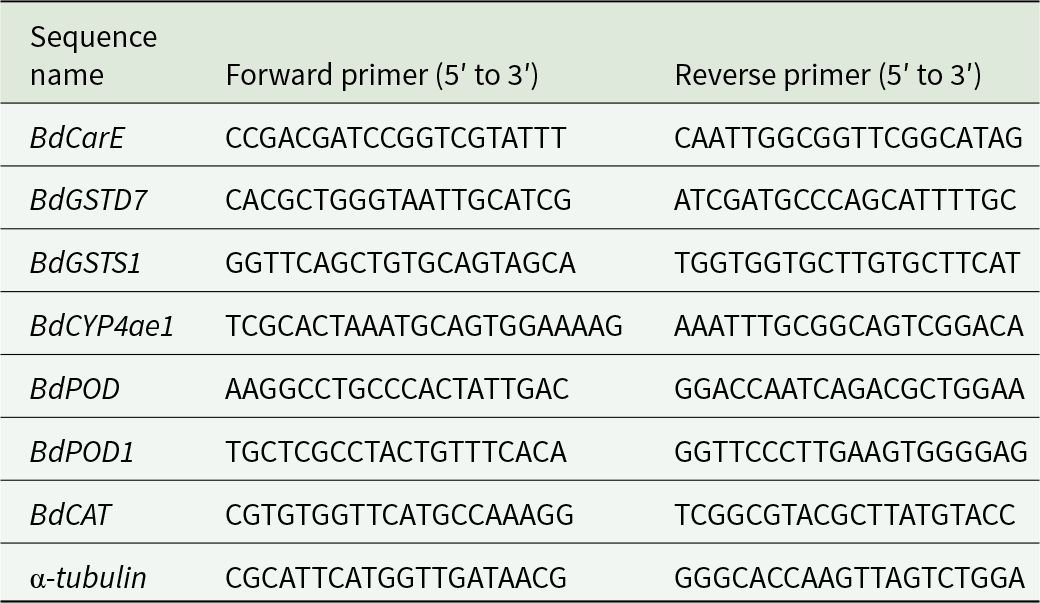
To analyze temporal expression patterns, total RNA was extracted from insects subjected to different treatments. Random sampling was repeated three times for a total of 20 individuals. The total RNA was extracted using RNAiso (Takara, Dalian, China). The cDNA templates were synthesised using the PrimeScript™ RT reagent Kit with gDNA Eraser (TaKaRa) according to the manufacturer’s protocol. The mRNA relative expression levels were performed by qRT-PCR in technical triplicate, using The TB Green™ Premix Ex Taq™ (TaKaRa). The reaction was performed on Bio-rad CFX Dute with the condition of 95°C for 30 s, 40 cycles of 95°C for 5 s, and 60°C for 30 s, followed by a melting curve analysis. The relative gene expressions were analysed using the 2−ΔΔCT method and normalised to the stable internal control gene α-tubulin in the same sample. Primers used are shown in table 1.
Primers used in this study for qRT-PCR

Data analysis
The original data in this study were statistically analysed by Excel software to calculate the mortality rate, corrected mortality rate, enzyme activity, gene expression of the tested insects, and the spore germination rate, mycelial inhibition rate, and sporulation inhibition rate of the fungicides. The data were given as mean ± standard error (SE). Data processing was performed using SPSS stastistics 26.0 software for one-way ANOVA and Duncan ‘s multiple range test to compare the mean values and determine the differences between the groups. Among them, P < 0.05 was a significant difference. Linear regression analysis was performed to obtain the regression equation, correlation coefficient, and chi-square equivalence.
Results
Toxicity determination of M. anisopliae to B. dorsalis adults
The virulence effects results showed the median lethal time (LT50) of B. dorsalis adults was 237.79 h, 235.78 h, 90.20 h, 54.20 h, and 47.45 h, respectively, under the five test concentrations of 1 × 10⁴ to 1 × 10⁸ CFU/mL (table 2). At 24 h, the corrected mortality of M. anisopliae CQMa421 to B. dorsalis adults was 0.00% at all tested concentrations (Table S1). At 36 h, when the concentration of M. anisopliae CQMa421 was 1 × 10⁶ to 1 × 10⁸ CFU/mL, the adults of B. dorsalis began to die, and the corrected mortality rates were 4.00%, 3.00%, and 1.00%, respectively. At 48 h, the adults of B. dorsalis sprayed with M. anisopliae CQMa421 at a concentration of 1 × 10⁵ CFU/mL began to exhibit mortality, with mortality rate was 1.00%. At 84 h, the test insects sprayed with 1 × 10⁵ CFU/mL M. anisopliae CQMa421 began to die, with a corrected mortality rate of 2.00%. At 84 h and 96 h, the corrected mortality rate was the highest (100.00%) in the treatment groups sprayed with 1 × 10^8 CFU/mL and 1 × 10⁷ CFU/mL of M. anisopliae CQMa421, respectively. At 120 h, the corrected mortality rates of the other treatment groups were 90.00%, 16.00%, and 6.00%, respectively.
Determination of the virulence of M. anisopliae cqma421 against B. dorsalis

Toxicity determination of two chemical pesticides on B. dorsalis adults
The results indicated that the slope (b) of the toxicity regression equations of deltamethrin and chlorpyrifos were 3.550 and 3.251, respectively (table 3). The median lethal concentrations (LC50) of deltamethrin and chlorpyrifos were 3.591 mg/L and 2.788 mg/L, respectively. At 120 h, the corrected mortality rates of B. dorsalis adults exposed to six concentrations of deltamethrin were 10.00%, 26.67%, 48.89%, 81.11%, 86.67%, and 94.44%, respectively (Table S2). For chlorpyrifos, the corrected mortality rates at 120 hours were 10.00%, 14.44%, 61.11%, 61.44%, 86.67%, and 95.56%, respectively. The toxicity of both chemical pesticides exhibited a dose-dependent effect on B. dorsalis adults. Specifically, higher concentrations of the pesticides resulted in higher corrected mortality rates, indicating that the virulence of the pesticides increased with increasing concentration.
Determination of the toxicity of two kinds of chemical pesticides to B. dorsalis

Toxicity determination of M. Anisopliae combined with two chemical pesticides on B. Dorsalis adults
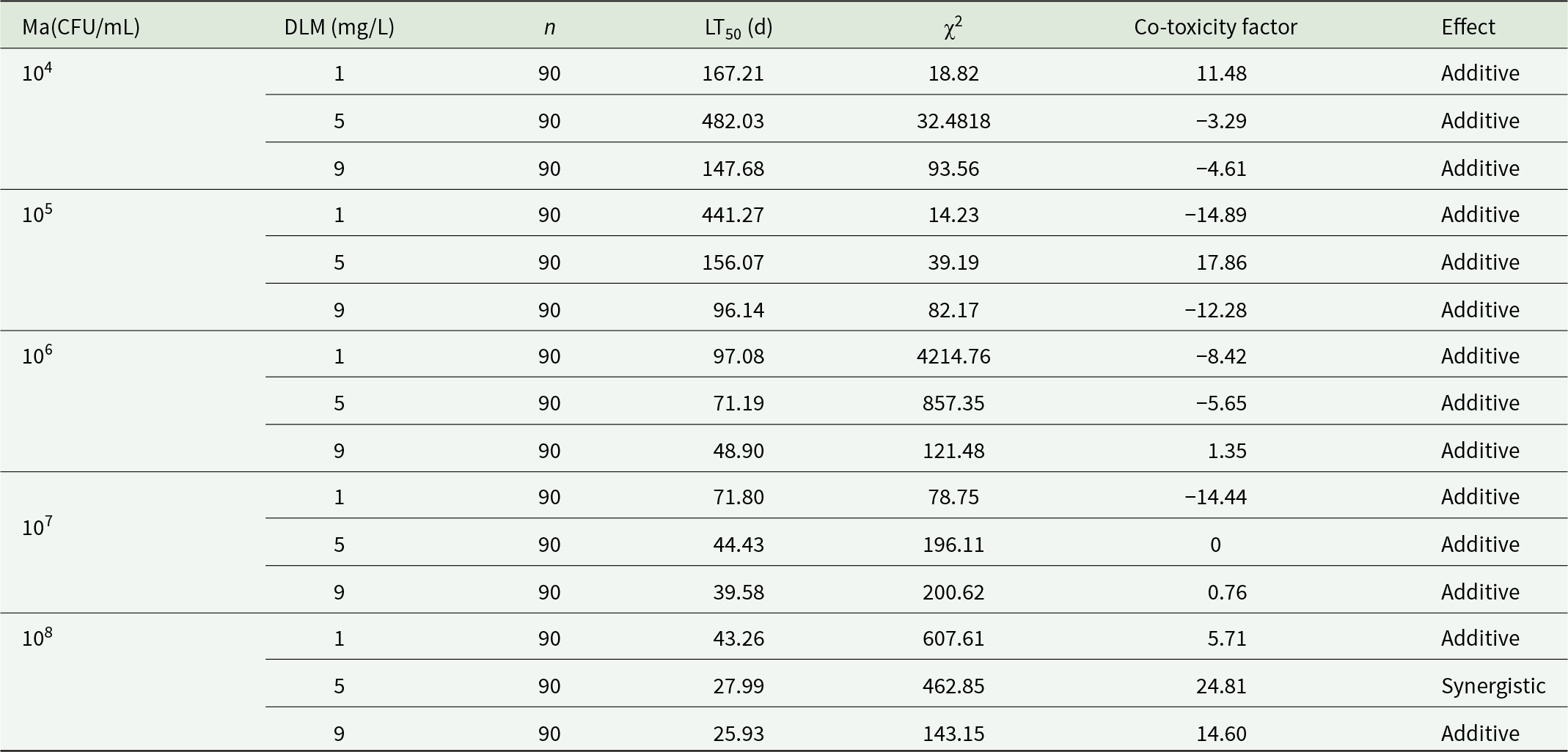
The virulence to B. dorsalis was determined by compounding five concentrations of M. anisopliae CQMa421 conidial suspensions with three concentrations of deltamethrin. The co-toxicity factor was calculated for each combination, revealing no antagonistic effects among the 15 tested groups. This indicated a good synergistic effect between M. anisopliae and deltamethrin (table 4).
Toxicity determination of deltamethrin and M. anisopliae CQMa421 against B. dorsalis

Note: Ma: Metarhizium anisoplariae; DLM: deltamethrin; n: 30 insects in each treatment, a total of three replicates; synergistic: synergistic effect; additive: additive effect.
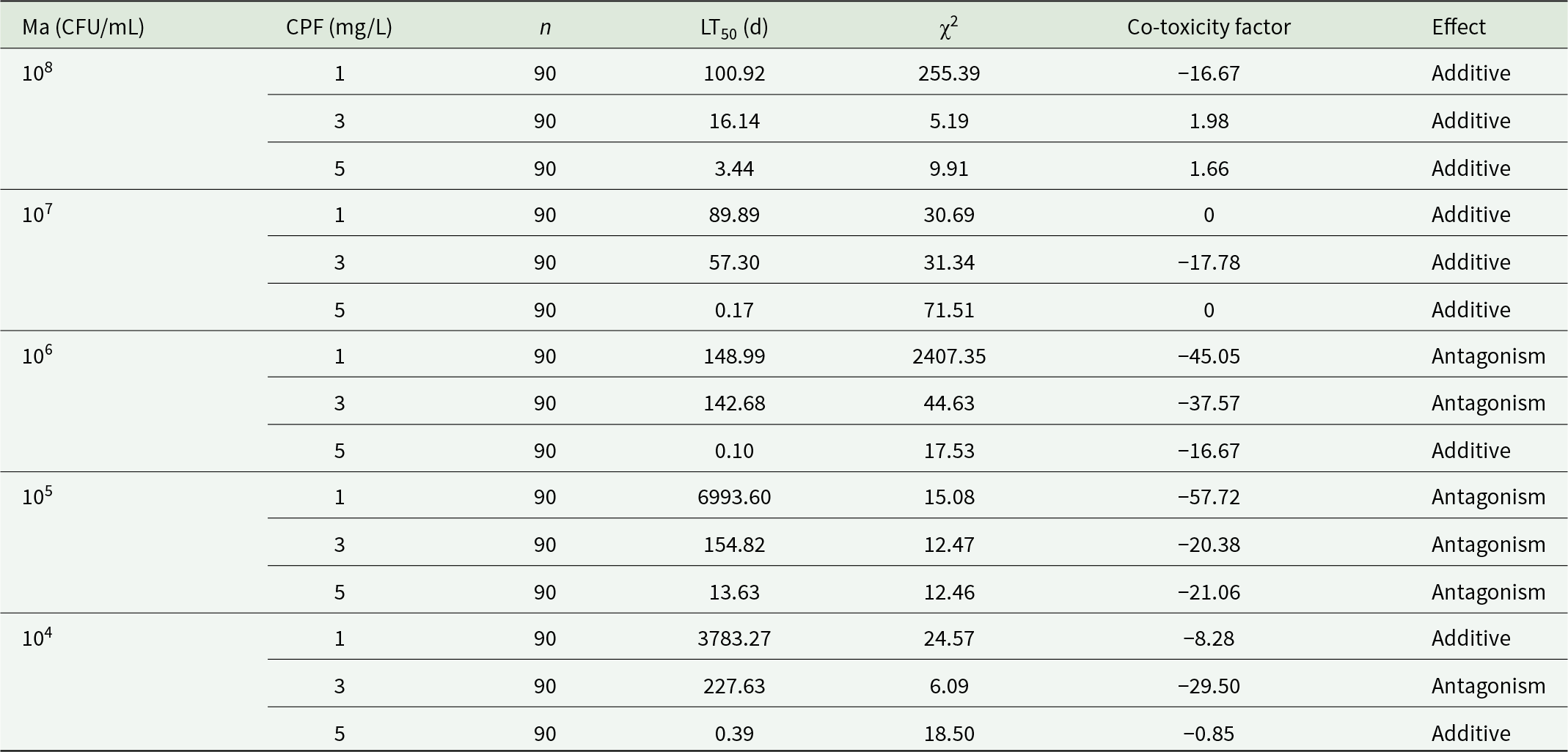
When 1 × 10⁸ CFU/mL M. anisopliae was compounded with 5 mg/L deltamethrin, the co-toxicity factor was exceeded 20, indicating that it had obvious synergistic effect. The results of combinations of M. anisopliae with chlorpyrifos exhibited co-toxicity factors ranging between − 45.05 to 1.98 in these groups, indicating no significant synergistic interactions (table 5).
Toxicity determination of chlorpyrifos and M. anisopliae CQMa421 against B. dorsalis

Note: Ma: Metarhizium anisoplariae; CPF: chlorpyrifos; n: 30 insects in each treatment, a total of three replicates; synergistic: synergistic effect; additive: additive effect.
Compatibility determination of two chemical pesticides with M. anisopliae CQMa421
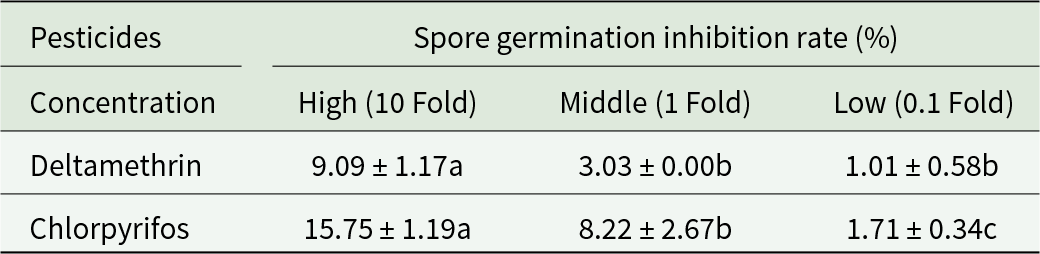
The two chemical pesticides inhibited the spore germination rate of M. anisopliae CQMa421 at all concentration. The highest inhibition rate of spore germination of M. anisopliae CQMa421 was 15.75% at high concentration of chlorpyrifos, and the lowest inhibition rate of spore germination of M. anisopliae CQMa421 was 1.01 % at low concentration of deltamethrin (table 6). At all tested concentrations, chlorpyrifos exhibited a higher inhibition rate on spore germination than deltamethrin. Specifically, at high and medium concentrations, the inhibition rates of deltamethrin were significantly lower than those of chlorpyrifos, with differences of 9.09% and 3.03%.
Inhibition rates of two pesticide on spore germination of M. anisopliae cqma421

Note: The data in the table are mean ± standard error. Different letters indicate the significant difference under different concentrations of two chemical pesticides (Duncan; P < 0.05).
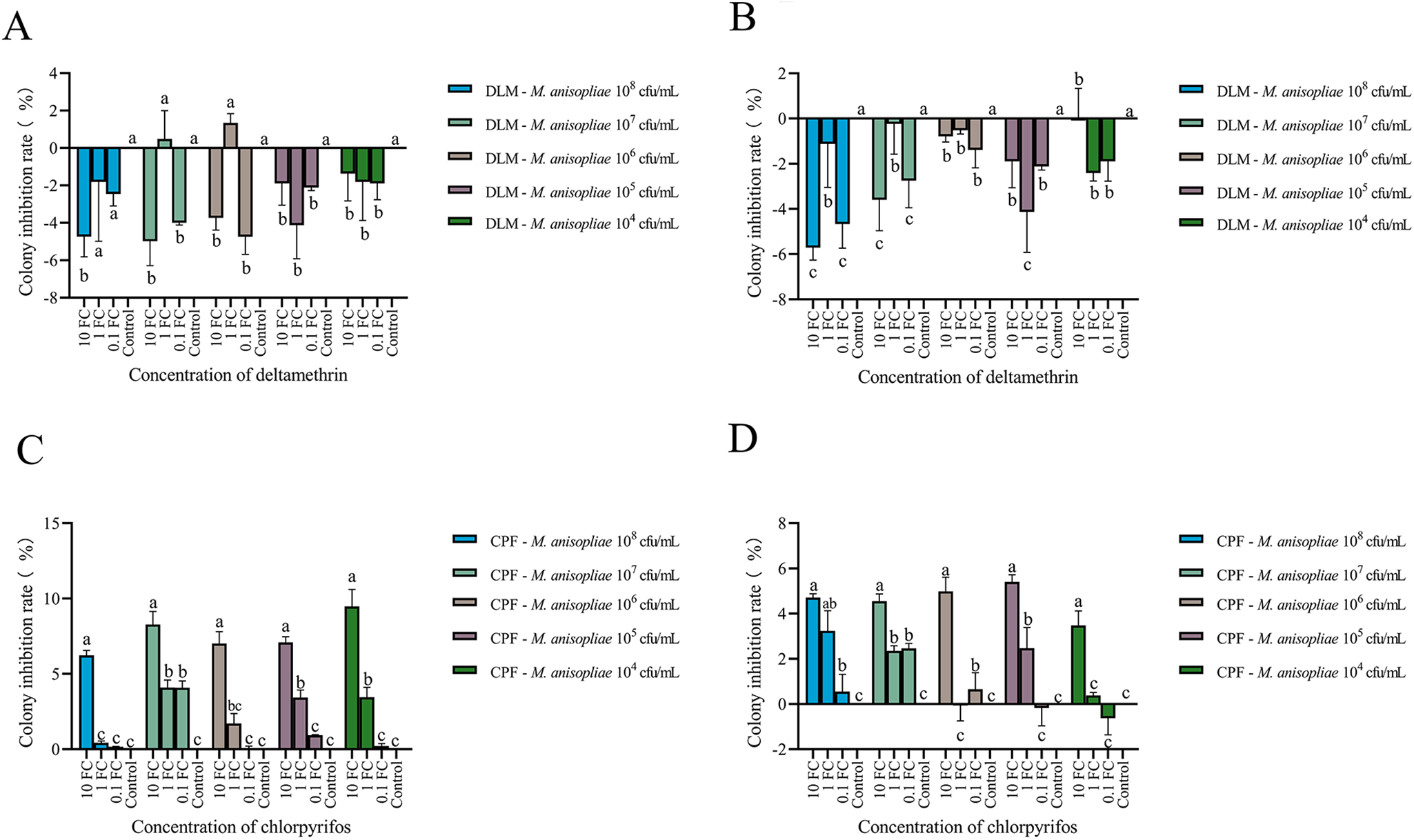
On day 7, different concentrations of deltamethrin promoted mycelial growth to varying degrees (fig. 1A). Among them, the highest concentration of deltamethrin combined with 1 × 10⁷ CFU/mL of M. anisopliae resulted in the highest promotion rate of 4.98%. Other concentration promotion rates ranged from 4.00% to 5.00%. On day 14, except for the high concentration of deltamethrin combined with 1 × 10⁴ CFU/mL M. anisopliae concentration treatment group, which had an inhibition rate of 0.01%, all other groups exhibited promotion of mycelial growth compared to the control group (fig. 1B). On day 7, except that the low concentration of chlorpyrifos had no inhibitory effect on the mycelial growth of M. anisopliae CQMa421 at 1 × 10⁶ CFU/mL, the other treatment groups had different degrees of inhibitory effect on the mycelial growth of M. anisopliae CQMa421 (fig. 1C). The inhibition rates of chlorpyrifos were positively correlated with concentration, ranging from 6.00% to 10.00%. The highest inhibition rate was observed in the group treated with high concentration of chlorpyrifos and 1 × 10⁴ CFU/mL of M. anisopliae, reaching 9.48 %. On day 14, the lower concentration showed varying degrees of promotion of mycelial growth, with inhibition rates of −0.06%, −0.18% and −0.63%, respectively (fig. 1D).
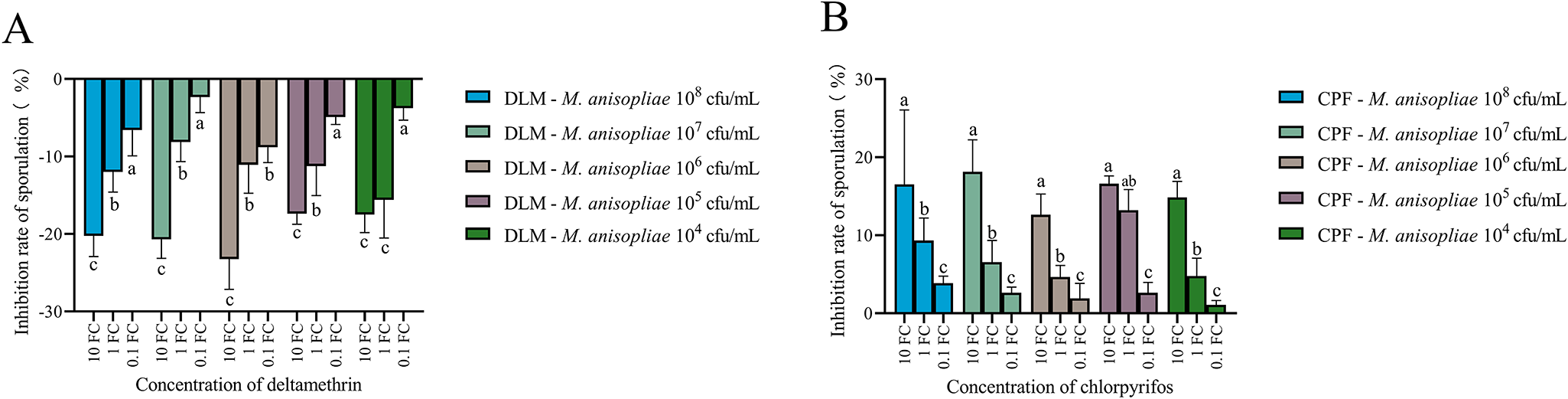
The results showed that high, medium and low concentrations of deltamethrin promoted the sporulation of M. anisopliae CQMa421 at all concentrations (fig. 2A). Under the treatment of high concentration of deltamethrin, the sporulation promotion rate of M. anisopliae CQMa421 was highest at 1 × 10⁶ CFU/mL (23.23%) and lowest at 1 × 10⁵ CFU/mL (17.38%). With medium deltamethrin concentration, the highest sporulation promotion rate was 15.60% at 1 × 10⁴ CFU/mL, while the lowest was 8.14% at 1 × 10⁷ CFU/mL. Under the low concentration of deltamethrin, the highest sporulation promotion rate of M. anisopliae CQMa421 was 8.82% at 1 × 10⁶ CFU/mL, and the lowest sporulation promotion rate was 2.33% at 1 × 10⁷ CFU/mL.
Effect of two chemical pesticide on colony growth of M. anisopliae CQMA421. (A) Effect of deltamethrin on colony growth of M. anisopliae CQMa421 in 7 days. (B) Effect of deltamethrin on colony growth of M. anisopliae CQMa421 in 14 d. (C) Effect of chlorpyrifos on colony growth of M. anisopliae CQMa421 in 7 d. (D) Effect of chlorpyrifos on colony growth of M. anisopliae CQMa421 in 14 d. Different colour showed the different concentration of M. anisoplariae in combination. FC: Fold change. 10FC: 10 times of LC50 concentration. 1FC: LC50 concentration. 0.1FC: 0.1 times of LC50 concentration.

Effect of two chemical pesticide on spore production of M. anisopliae CQMA421. (A) Effect of deltamethrin on spore production of M. anisopliae CQMa421. (B) Effect of chlorpyrifos on spore production of M. anisopliae CQMa421. Different colour showed the different concentration of M. anisoplariae in combination. FC: Fold change. 10FC: 10 times of LC50 concentration. 1FC: LC50 concentration. 0.1FC: 0.1 times of LC50 concentration.

Although sporulation promotion rates varied across different fungal concentrations under the same deltamethrin concentration. However, higher deltamethrin concentrations generally led to higher sporulation promotion rates. For instance, at 1 × 10⁸ CFU/mL, the inhibition rates under high, medium, and low deltamethrin concentrations were −20.24%, −11.98%, and −6.59%, respectively.
At high chlorpyrifos concentration, the highest inhibition rate of sporulation was 18.15% at 1 × 10⁷ CFU/mL, while the lowest was 12.63% at 1 × 10⁶ CFU/mL (fig. 2B). At medium chlorpyrifos concentration, the highest inhibition rate was 13.21% at 1 × 10⁵ CFU/mL, and the lowest was 4.67% at 1 × 10⁶ CFU/mL. Under low chlorpyrifos concentration, the highest inhibition rate was 3.86% at 1 × 10⁸ CFU/mL, and the lowest was 1.08% at 1 × 10⁴ CFU/mL. Chlorpyrifos generally led to an inhibition effect of sporulation of M. anisopliae CQMa421.
Effects of deltamethrin combined with M. anisopliae on enzyme activities in adults of B. dorsalis
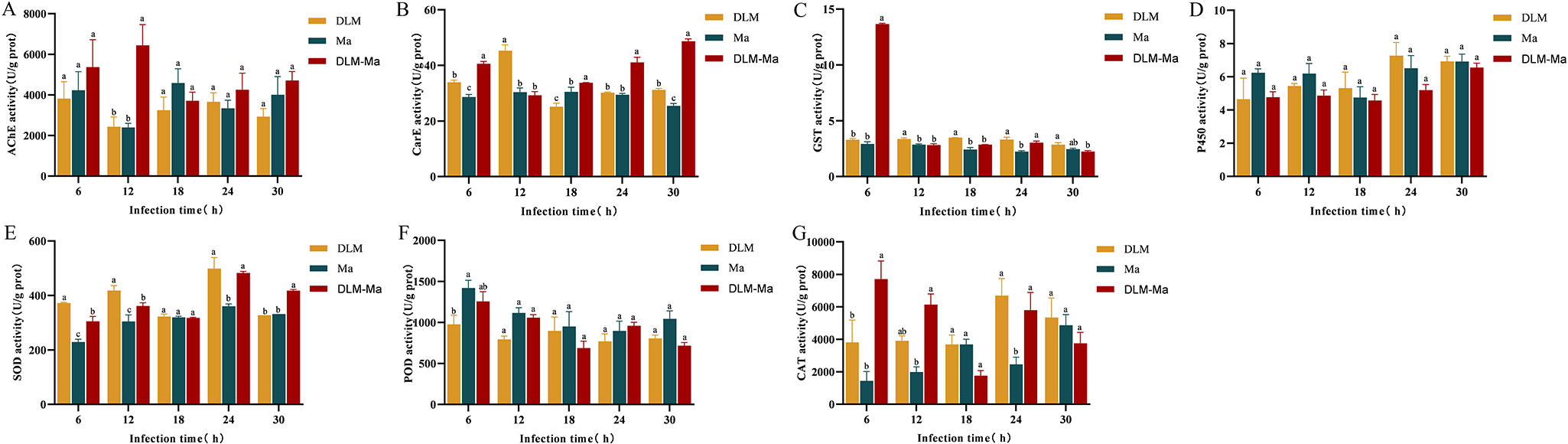
The AChE enzyme activity of the compounding group was higher than that of the other two groups at 6–12 h, and at 12 h, the compounding group was significantly higher than other two groups, which was 2.66 times that of the deltamethrin group and 1.69 times that of the M. anisopliae group (fig. 3A, Figure S1). The CarE activity of the compounding group was significantly higher than that of the other two groups at 6 h, 18 h, 24 h, 30 h, and the highest at 30 h, which was 1.55 times that of the deltamethrin group and 1.91 times that of the M. anisopliae group. At 12 h, the CarE activity of deltamethrin group was significantly higher than that of the other two groups (fig. 3B, Figure S2). The results of glutathione-S-transferase (GST) activity showed that the compounding group was significantly higher than the other two groups only at 6 h, which was 4.81 times higher than the deltamethrin group and 5.59 times higher than the M. anisopliae group (fig. 3C, Figure S3). The results of P450 activity changes showed that the P450 enzyme activity of the compounding group was lower than that of the other two groups at each time period (fig. 3D, Figure S4). The results of superoxide dismutase (SOD) activity showed that the deltamethrin group was significantly higher than that of the other two groups at 6–12 h. At 24 h, the SOD activity of deltamethrin group and compound group was significantly higher than that of M. anisopliae group. At 30 h, the compounding group was significantly higher than the other two groups, which was 1.27 times that of deltamethrin group and 1.26 times that of M. anisopliae group (fig. 3E, Figure S5). The POD enzyme activity of the M. anisopliae group was higher than that of the other two groups at 6 h, 12 h, 24 h, and 30 h. The POD enzyme activity of the compound group was higher than that of the deltamethrin group at 6–12 h, and lower than that of the M. anisopliae group. It was higher than the two groups at 24 h, and lower than the two groups at 18 h and 30 h, indicating that in the compounding group, M. anisopliae accelerated the activation of POD enzyme activity (fig. 3F, Figure S6). The results of CAT activity showed that the compounding group was significantly higher than that of the other two groups at 6–12 h (fig. 3G, Figure S7).
Effect of deltamethrin combined with M. anisopliae on enzyme activity in B. dorsalis adults. (A) AChE activity, (B) CarE activity, (C) GST activity, (D) P450 activity, (E) SOD activity, (F) POD activity, (G) CAT activity. DLM: deltamethrin. Ma: Metarhizium anisoplariae. DLM-Ma: deltamethrin combination with M. anisoplariae. Data are presented as mean ± SE. Different lower letters indicate significant differences at P < 0.05.

Effects of compounding on the expression of detoxification enzyme gene and protective enzyme gene in B. dorsalis adults
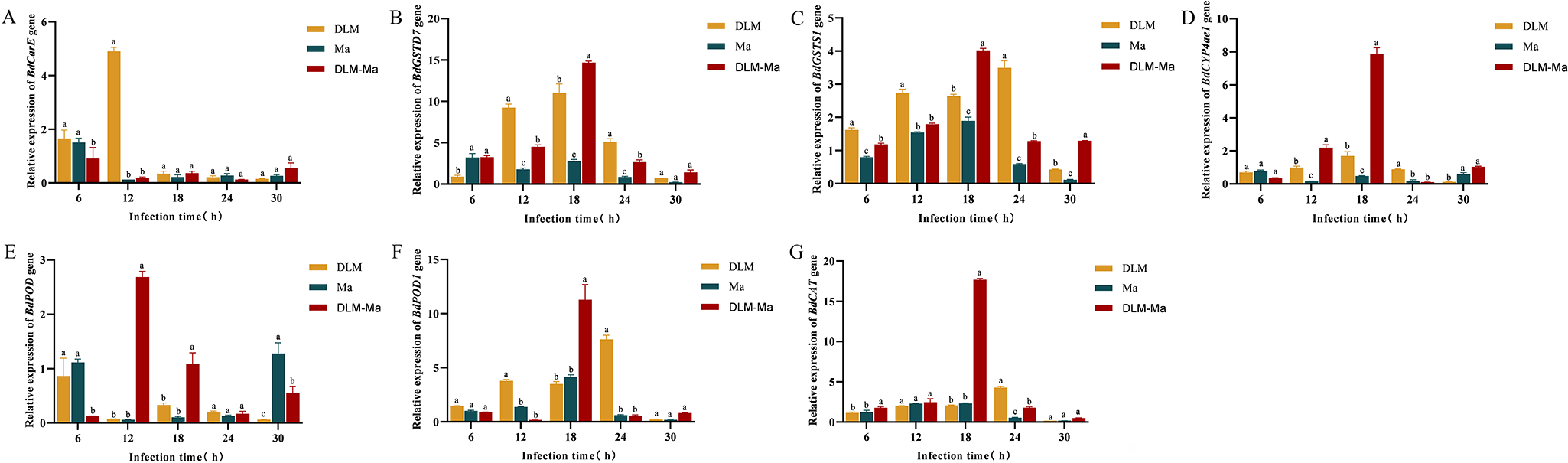
The relative expression of BdGSTS1 gene in the deltamethrin group was significantly higher than that in the other two groups at 6 h, 12 h, 18 h, and 24 h. The relative expression of BdGSTS1 gene in the compounding group was significantly higher than that in the other two groups at 18 h and 30 h, and was 6.82 times that of the deltamethrin group and 8.89 times that of the M. anisopliae group at 18 h (fig. 4C, Figure S10). The relative expression of BdCYP4ae1 gene in the compounding group was significantly up-regulated at 12 h and 18 h compared with the other two groups. At 18 h, the compound group was 4.64 times that of the deltamethrin group and 16.42 times that of the M. anisopliae group, indicating that the compounding increased the relative expression of BdCYP4ae1 (fig. 4D, Figure S11). At 12 h and 18 h, the relative expression of BdPOD gene in the compounding group was significantly up-regulated compared with the other two groups. At 12 h, the compounding group was 15.76 times that of the deltamethrin group and 16.75 times that of the M. anisopliae group (fig. 4E, Figure S12). The relative expression of BdPOD1 gene in the compounding group was significantly lower than that in the other two groups at 12 h and 24 h, and significantly higher than that in the other two groups at 18 h, which was 3.23 times that of the deltamethrin group and 2.63 times that of the M. anisopliae group (fig. 4F, Figure S13). The relative expression of BdCAT gene in the compounding group was significantly higher than that in the other two groups at 18 h, which was 10.59 times higher than that in the deltamethrin group and 9.45 times higher than that in the M. anisopliae group. The deltamethrin group was significantly higher than the other two groups at 24 h (fig. 4G, Figure S14).
Effects of deltamethrin combined with M. anisopliae on the expression of detoxification enzyme genes and protective enzyme genes in B. dorsalis adults. (A) relative expression of BdCarE, (B) relative expression of BdGSTD7, (C) relative expression of BdGSTS1, (D) relative expression of BdCYP4ae1, (E) relative expression of BdPOD, (F) relative expression of BdPOD1, (G) relative expression of BdCAT. DLM: deltamethrin. Ma: Metarhizium anisoplariae. DLM-Ma: deltamethrin combination with M. anisoplariae. Data are presented as mean ± SE. Different lower letters indicate significant differences at P < 0.05.

Discussion
The use of entomopathogenic fungus for pest control is one of the most important means of integrated pest management, offering an environmentally friendly alternative and reduces pesticide resistance. In this study, we evaluated the combined effects of M. anisopliae and deltamethrin on B. dorsalis adults. The results indicated that the combination not only enhanced insecticidal efficiency, but also promote the growth of the M. anisopliae to a certain extent. In this paper, the toxicity measurement demonstrated a dose-dependent increase in mortality rate and a shortened semi-lethal time in B. dorsalis adults. Similar findings have been reported in studies on Anopheles stephensi (Vivekanandhan et al., Reference Vivekanandhan, Swathy, Murugan and Krutmuang2022). Metarhizium anisopliae infects insects by attaching to their cuticle, germinating, and producing invasive hyphae that penetrate the host’s body wall, leading to colonisation of the hemolymph and eventual death(Lacey et al., Reference Lacey, Grzywacz, Shapiro-Ilan, Frutos, Brownbridge and Goettel2015). Following deltamethrin application, M. anisopliae exhibited low sporulation and mycelial growth inhibition rates, indicating good compatibility and a synergistic effect. In a study on the combination of M. anisopliae with chemical pesticide against Agriotes obscurus, it was similarly demonstrated that pesticide can reduce the cuticular defense of the pest and enhance the insecticidal efficacy (Evangelos and Elias, Reference Evangelos and Elias2021).
The deltamethrin could penetrates the insect’s body wall and acts on sodium ion channels, causing repeated discharge of nerve endings and damaging the axons of the insect nerves, leading to nerve paralysis and death (Balabanidou et al., Reference Balabanidou, Grigoraki and Vontas2018; Nauen et al., Reference Nauen, Bass, Feyereisen and Vontas2022; Martin et al., Reference Martin, Chandre, Ochou, Vaissayre and Fournier2002). When combined with M. anisopliae is beneficial to penetrate the B. dorsalis’s body wall and shorten the time required (Gao et al., Reference Gao, Tan, Peng, Song, Qu and Chen2024; Pedrini et al., Reference Pedrini, Crespo and Juárez2007; Wang and St Leger, Reference Wang and St Leger2007). The defense mechanisms of the B. dorsalis against to pesticides are primarily based on physiological and biochemical reactions, involving target enzymes within the insect nervous system as well as detoxification and protective enzyme systems (Gichuhi et al., Reference Gichuhi, Khamis, Berg, Mohamed and Herren2020; Hsu et al., Reference Hsu, Feng, Wu, Geib, Mao and Vontaset2012; Vontas et al., Reference Vontas, Hernández-Crespo, Margaritopoulos, Ortego, Feng, Mathiopoulos and Hsu2011). This combination accelerates the activation of target enzymes like AChE and detoxifying enzymes such as CarE and GST, while inhibiting P450 enzymes activity (Enayati et al., Reference Enayati, Ranson and Hemingway2005; Fournier and Mutero, Reference Fournier and Mutero1994; Sheehan et al., Reference Sheehan, Meade, Foley and Dowd2001). Protective enzymes, including SOD, POD, and CAT, also showed dynamic changes, with the combination treatment significantly affecting their activities (Cao et al., Reference Cao, Yang, Tu, Li and Liu2018; Kumar et al., Reference Kumar, Molina-Cruz, Gupta, Rodrigues and Barillas-Mury2010).
At the transcriptional level, the combination treatment significantly altered the expression of detoxification and protective enzyme genes in B. dorsalis. Specifically, the expression of BdCarE was downregulated, whereas the genes BdGSTD7, BdGSTS1, BdCYP4ae1, BdPOD, BdPOD1, and BdCAT were upregulated (Ge et al., Reference Ge, Zhang, Zhang and Cheng2021; Ling and Zhang, Reference Ling and Zhang2013; Satoh and Hosokawa, Reference Satoh and Hosokawa1998). These changes in gene expression are consistent with the observed alterations in enzyme activities. The pronounced response of detoxification enzymes indicates a significant enhancement in insecticidal efficacy under the combined action of the treatments. The reliability of this synergistic insecticidal effect was confirmed in the present study.
In this study, the synergistic mechanism of deltamethrin and M. anisopliae CQMa421 against B. dorsalis was systematically explored from the physiological, biochemical and molecular levels, which provided reliable basis for improving the insecticidal efficiency of insecticidal fungi and reducing the use of chemical pesticides.
Supplementary material
The supplementary material for this article can be found at https://doi.org/10.1017/S0007485325100217.
Acknowledgements
This research was supported by the Major Program of Natural Science Foundation of the Higher Education Institutions of Anhui Province, China (Grant No. 2024AH040075) and Anhui Provincial Fruit Industrial System, China (Wannongke Letter, 2021-711).
Author contributions
J.Z. and Y.S.: Writing – original draft, Investigation, Formal analysis, Data curation, Conceptualisation. C.S.: Writing – original draft, Formal analysis, Data curation, Conceptualisation. L.L.: Investigation, Formal analysis, Data curation. W.Y.: Software, Formal analysis. Y.G.: Data curation, Formal analysis. R.Z.: Writing – review & editing, Resources, Conceptualisation. S.L.: Writing – review & editing, Conceptualisation. Q.T.: Writing – review & editing, Resources, Conceptualisation, Validation, Supervision.
Competing interests
The authors have no conflicts of interest associated with this work.