1. Introduction and geological setting
The Central Complexes of the British Palaeogene Igneous Province constitute the eroded remains of suites of sub-volcanic intrusions emplaced during opening of the North Atlantic (Woodcock & Strachan, Reference Woodcock and Strachan2000; Emeleus & Bell, Reference Emeleus and Bell2005). Volcanic activity began on the Ardnamurchan (Central) Complex, NW Scotland, with the eruption of basaltic lavas onto Mesozoic strata and Neoproterozoic Moine meta-sedimentary rocks (c. 60 Ma: Chambers, Pringle & Parrish, 2005), followed by the establishment of distinct foci of sub-volcanic intrusive activity, of which three have been recognized in the Ardnamurchan Complex (Centres 1, 2 and 3: Richey & Thomas, Reference Richey and Thomas1930; Woodcock & Strachan, Reference Woodcock and Strachan2000; Emeleus & Bell, Reference Emeleus and Bell2005). Each of these centres is dominated by mafic intrusive rocks that were emplaced either as concentric, inward-dipping sets of cone-sheets related to doming and extension, or as larger annular intrusions, historically interpreted as outward-dipping ring-dykes associated with central subsidence (Richey & Thomas, Reference Richey and Thomas1930; Anderson, Reference Anderson1936). The Centre 3 intrusions are the focus of this study and are described in further detail below.
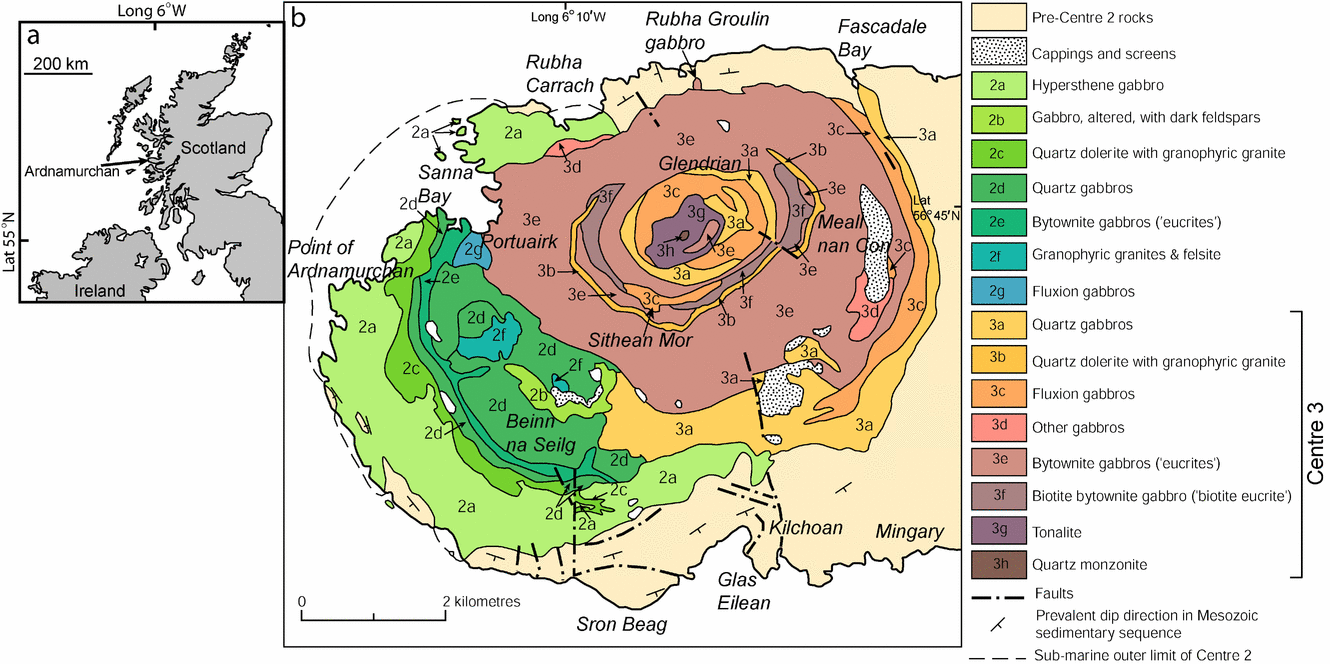
The third and youngest centre of the Ardnamurchan Complex forms the largest and most complete set of ring-intrusions in the British Palaeogene Igneous Province (Fig. 1). Centre 3 is dominated by a gabbroic intrusion called the Great Eucrite (corresponds to 3e on Fig. 1), and traditionally referred to as a classic example of a mafic ring-dyke (Richey & Thomas, Reference Richey and Thomas1930; Wager & Brown, Reference Wager and Brown1968). The Great Eucrite intrusion wholly encompasses a suite of smaller, arcuate gabbro bodies, which have been interpreted as partial ring-dykes (Richey & Thomas, Reference Richey and Thomas1930). In particular, these include the ‘Inner’ and ‘Biotite’ Eucrite ring-dykes (3f on Fig. 1), the ‘fluxion-gabbro ring-dykes’ at Sithean Mor and Glendrian (3c on Fig. 1), and several other quartz gabbro ring-dykes in the Achnaha area (3a on Fig. 1) (Richey & Thomas, Reference Richey and Thomas1930). A central tonalite body, containing a small (more evolved) quartz monzonite zone (3g and 3h, respectively; Fig. 1), is considered to be a late-stage intrusion into these arcuate gabbros (Richey & Thomas, Reference Richey and Thomas1930; Walsh & Henderson, Reference Walsh and Henderson1977), although Emeleus & Bell (Reference Emeleus and Bell2005) suggested a mixed magma origin for this intrusion. The youngest intrusion in Centre 3 was described by Richey & Thomas (Reference Richey and Thomas1930) as a narrow ‘quartz dolerite ring-dyke’ (extensively net-veined with granophyre) and the type example of a ring-dyke intrusion on Ardnamurchan (3b on Fig. 1). Emeleus & Bell (Reference Emeleus and Bell2005) also refer to this latter intrusion as a ring-dyke, suggesting that its arcuate outcrop pattern implies some form of rotational or trap-door collapse subsidence emplacement model.
(a) Location of the Ardnamurchan Central Complex. (b) Principal components of Centres 2 and 3 of the Ardnamurchan Central Complex for comparison with the new mapping presented in this contribution. The Centre 3 gabbros are labelled in the key, based on the original mapping by Richey & Thomas (Reference Richey and Thomas1930). (After figure 26 (b) (P123) of Emeleus & Bell (Reference Emeleus and Bell2005); reproduced by permission of the British Geological Survey. © NERC.IPR/86-08CGC.)

For over 70 years the ring-dyke model had not been seriously questioned for the Great Eucrite, although some workers (N. Bradshaw, unpub. Ph.D. thesis, Univ. Manchester, 1961; K. J. A. Wills, unpub. B.Sc thesis, Univ. London, 1970; Walsh, Reference Walsh1975) noted that macroscopic inward-dipping mineral lamination (fluxion structure) occurs in the ‘fluxion gabbros’ and sporadic inward-dipping layering is present in the intrusion. Although these workers suggested that such features are inconsistent with a ring-dyke model for the Great Eucrite and the Sithean Mor and Glendrian ‘fluxion’ gabbro intrusions in particular, convincing alternatives for emplacement of these Centre 3 gabbro bodies were not proposed. In the recent memoir on the Palaeogene Volcanic Districts of Scotland, Emeleus & Bell (Reference Emeleus and Bell2005) summarized the observations of the workers above and suggested that the Great Eucrite may be a funnel-shaped intrusion. However, they also refer to it as an intrusion ‘largely devoid of internal structure’ in which ‘layering, mineral fabric, xenoliths and pegmatites are uncommon’. The study of O'Driscoll et al. (Reference O'Driscoll, Troll, Reavy and Turner2006) on the Great Eucrite interpreted consistently inward-plunging Anisotropy of Magnetic Susceptibility (AMS) lineations, inward-dipping contacts, and inward-dipping magmatic layering as reflecting a lopolithic geometry and emplacement mode.
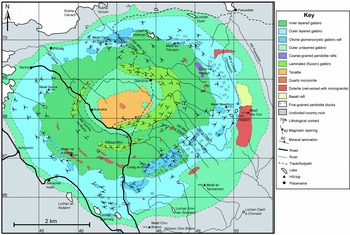
A re-evaluation of the field relationships of the Great Eucrite and other gabbro intrusions is presented below, together with a new map for all of the Centre 3 gabbros (Fig. 2). The present study documents detailed new field observations on lithological relations and magmatic structures in the Centre 3 gabbros and considers these in the context of the recent conclusions of Emeleus & Bell (Reference Emeleus and Bell2005) and O'Driscoll et al. (Reference O'Driscoll, Troll, Reavy and Turner2006). Lithologically heterogeneous block populations and syn-magmatic deformation of inward-dipping magmatic layering in the Centre 3 gabbros are reminiscent of some of the petrological and structural features recently described as characteristic of larger composite layered mafic lopoliths, such as the Skaergaard intrusion, SE Greenland (cf. Irvine, Anderson & Brooks, 1998) or the Rum Layered Suite, NW Scotland (Emeleus et al. Reference Emeleus, Cheadle, Hunter, Upton, Wadsworth and Cawthorne1996). On the basis of the field evidence, the Centre 3 gabbros are interpreted as a single, composite layered intrusion, many components of which display evidence for a significant degree of centrally directed sagging whilst the intrusion was crystallizing.
Revised map of the Centre 3 gabbros. See text for description.

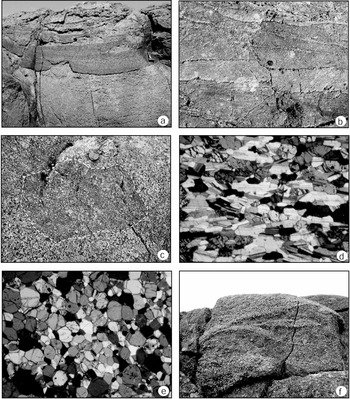
(a) Trough structure (with modal graded bedding of olivine) at NM 49582 68985. Hammer at the right of image is 30 cm in length. (b) Syn-magmatic deformation of layering: lateral variation of the thickness of a plagioclase-rich layer over a short distance, and in the centre of the image below the camera lens-cap (the latter is 4.5 cm in diameter), a small syn-magmatic normal fault (NM 47071 66601). (c) Resorption of a small, fine-grained peridotite block (highlighted) at NM 48859 69742. Camera lens-cap above the block is 4.5 cm in diameter. (d) Photomicrograph of well-developed plagioclase lamination from a fine-grained peridotite block. Image is taken in crossed polars and the field of view is 5 mm in width. (e) Texturally equilibrated olivine-rich peridotite sample. Image is taken in crossed polars and the field of view is 5 mm in width. (f) Magmatic layering in coarse-grained peridotite block at Coire na Rainich (NM 49058 69369). Camera lens-cap in right centre of image is 4.5 cm in diameter.

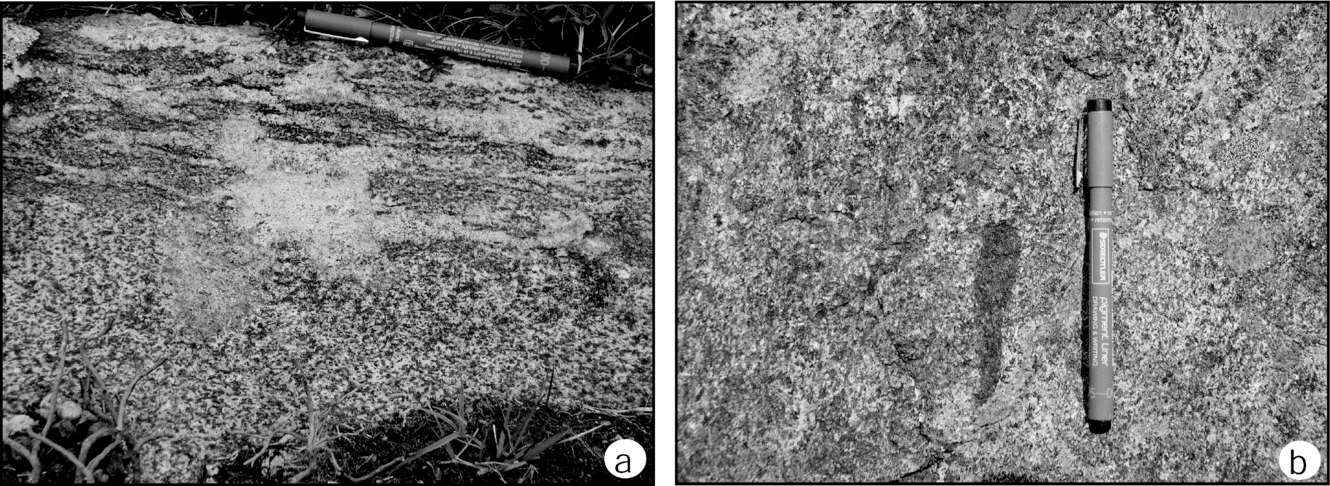
(a) Mixing of olivine and plagioclase-rich crystal mushes (syn-magmatic deformation in laminated gabbro) at NM 46187 68838. (b) Boudinage in pyroxene-rich layer in the Sithean Mor laminated gabbro at NM 47181 67279. The plane of mineral lamination is parallel to the plane of deformed layering, that is, approximately parallel to the orientation of the pen. The pen used for scale in (a) and (b) is 13.5 cm long.

2. Lithological relationships and other field observations
2.a. The Great Eucrite
The outer margin of the Great Eucrite is poorly exposed and reliable contact data are rare. However, one boundary with Jurassic strata in the north of the peninsula (south of Rubha Carrach) is well preserved and can be traced laterally for ∼15 m, dipping inward at ∼50° (the contact referred to by O'Driscoll et al. Reference O'Driscoll, Troll, Reavy and Turner2006; see also Fig. 2). The contact area (at grid reference NM 46316 70123) is marked by a zone of abundant net-veined (with microgranite) dolerite that crops out between Jurassic strata and Great Eucrite gabbro. Outcrops of Jurassic siltstones and mudstones in this area commonly exhibit lens-like quartzo-feldspathic leucosome segregations, suggesting partial melting and varying degrees of migmatization. To the east, the small intrusive ‘Rubha Groulin gabbro’ of Richey & Thomas (Reference Richey and Thomas1930) (Fig. 1) is remapped as part of the Great Eucrite gabbro, based on its very similar appearance in the field and in thin-section. The contact between the Great Eucrite in this area and finer-grained Centre 2, sporadically net-veined, dolerite country-rock also dips inward at 40–50°. Dolerite outcrops further away from the contact with the Great Eucrite exhibit less evidence for microgranite net-veining. This dolerite country-rock is believed here to represent the earlier stage of cone-sheet intrusion in the formation of the Ardnamurchan Complex; cone-sheet forming dolerite represents a significant (volumetric) proportion of the country-rock into which the Great Eucrite was intruded (Richey & Thomas, Reference Richey and Thomas1930; Emeleus & Bell, Reference Emeleus and Bell2005). Outer contact relations of the Great Eucrite are not observed elsewhere, that is, no clear lithological contacts are observed between the Great Eucrite and the following country-rocks of Richey & Thomas (Reference Richey and Thomas1930) (see also Figs 1, 2): (a) the fluxion gabbro of Fascadale (labelled 3c in the east of Fig. 1); (b) the hypersthene gabbro (labelled 2a on Fig. 1); (c) quartz gabbros of Fascadale and Meall an Tarmachain at the southern margin of the Great Eucrite (labelled 3a in the east and southeast of Fig. 1); (d) the fluxion gabbro of Portuairk (labelled 2g on Fig. 1).
Whereas the lack of control on contact relations must largely be attributed to poor exposure, almost complete coastline exposure at Portuairk means this is not the case for the so-called ‘fluxion gabbro’ intrusion that crops out in this area. Although Richey & Thomas (Reference Richey and Thomas1930) describe a contact between the Great Eucrite and the Portuairk fluxion gabbro along the shoreline (NM 44055 68302), they also note that the Great Eucrite itself appears to be ‘fluxioned’ at its outer margin. Re-examination of this inferred contact and a full mapping traverse from the fluxion gabbro intrusion into the Great Eucrite along the shoreline revealed no evidence of an intrusive contact between these two gabbros anywhere along this stretch of coastline. Instead, field evidence suggests that both lithologies grade into one another eastward from Portuairk. This is supported by similar recent independent observations in this area (C. H. Emeleus, pers. comm.). In addition, although fieldwork carried out on the outer Centre 3 ‘quartz gabbros of Fascadale and Meall an Tarmachain’ (Richey & Thomas, Reference Richey and Thomas1930) was not extensive, it seems unlikely from their mineralogical and textural similarities in the field and in thin-section that both quartz gabbros are separate intrusions. Whether the Great Eucrite is intrusive into these gabbros or not cannot be determined due to a lack of outcrop evidence.
Evidence for contacts between the Great Eucrite and its country-rock roof is present on some of the topographically high areas around the course of the Great Eucrite. Meall nan Con (NM 50389 68137) is the highest summit in the west of the Ardnamurchan peninsula, at 437 m (Ordnance Datum). Richey & Thomas (Reference Richey and Thomas1930) referred to the rocks in this area as comprising a vertically sided ‘country-rock screen’ between two ring-dykes and composed of three lithologies: altered porphyritic gabbro, vent agglomerate, and basalt.
The porphyritic gabbro is included with the quartz gabbro (3a on Fig. 1) of Richey & Thomas (Reference Richey and Thomas1930), based on the similarity of both in the field, and is discussed in more detail below. Field observations carried out in this study and other independent observations (Brown, Bell & McCleod, 2006) suggest that the lithology referred to as vent agglomerate by Richey & Thomas (Reference Richey and Thomas1930) is actually a fine-grained dolerite that exhibits abundant microgranite net-veining, very similar in appearance to the net-veined dolerite at the Rubha Carrach contact in the north, described above. In addition, areas of net-veined dolerite are also observed on the summit ridge of Beinn na h-Imeilte (NM 45816 67115; 215 m, Ordnance Datum), above Coire na Rainich (e.g. at NM 49500 69700) and just north of Meall an Tarmachain (NM 49000 66600). Fine-grained, highly altered basalt is present just to the north of Meall nan Con summit (NM 50400 68500) and also north of Meall an Tarmachain (NM 49000 66600) (associated with the net-veined dolerite there). Contacts between the net-veined dolerite of the so-called Meall nan Con screen (Richey & Thomas, Reference Richey and Thomas1930) and Great Eucrite gabbro are observed to be sub-horizontal at Coire Creagach (NM 50300 68300). This observation is supported by the way in which these contacts traverse topographic contours at a very low angle around the Meall nan Con summit knoll. The manner in which the Meall nan Con exposures of net-veined dolerite, together with altered basalt, sit topographically above a flattish contact with the Great Eucrite gabbro suggests that the Meall nan Con mass represents a country-rock roof to the Great Eucrite, instead of a vertically sided screen. Although no clear contacts are observed between net-veined dolerite and Great Eucrite gabbro on Beinn na h-Imeilte or below Meall an Tarmachain, it is thought that, as with the Meall nan Con lithologies, they may represent pendants of roof rock.
O'Driscoll et al. (Reference O'Driscoll, Troll, Reavy and Turner2006) subdivided the Great Eucrite intrusion into three distinct petrological facies of gabbro, separated from each other on textural and mineralogical grounds. The two most common lithologies are (1) a dark grey, olivine gabbro and (2) an extremely heterogeneous, brown–light grey, olivine gabbro. These will be referred to as the inner and outer layered gabbros, respectively, henceforth in this study (see Fig. 2). Both of these components of the Great Eucrite contain variably sized blocks and rafts (from <1 m up to 1 km in length) of a generally unlayered olivine glomerocrystic gabbro (gabbro (3) of O'Driscoll et al. Reference O'Driscoll, Troll, Reavy and Turner2006). An outer unlayered (olivine-poor) gabbro (gabbro (4) of O'Driscoll et al. Reference O'Driscoll, Troll, Reavy and Turner2006) is typically found both around the outer margin of the outer layered gabbro and at its interior. This gabbro corresponds to the ‘quartz gabbro’ of Richey & Thomas (Reference Richey and Thomas1930), based on comparison with their petrographic descriptions and the spatial occurrence of the rock as observed in this study, and also includes the Meall nan Con porphyritic gabbro of Richey & Thomas (Reference Richey and Thomas1930). The ‘Inner Eucrite’ and ‘Biotite Eucrite’ intrusions (3f on Fig. 1) of Richey & Thomas (Reference Richey and Thomas1930) are considered part of the inner layered gabbro of this study. This study therefore recognizes four components to the Great Eucrite of Richey & Thomas (Reference Richey and Thomas1930), the inner and outer layered gabbros, the olivine glomerocrystic gabbros, and the outer unlayered gabbro (see Fig. 2). This sub-division is implicit in all subsequent references to the Great Eucrite in this study.
Magmatic layering in the inner and outer layered gabbros typically comprises thin sequences of plagioclase-rich layers alternating with olivine-rich layers and less commonly pyroxene-rich layers (O'Driscoll et al. Reference O'Driscoll, Troll, Reavy and Turner2006). Individual layer thicknesses rarely exceed 25 cm (maximum thickness of sequences of layers is typically ∼10 m). Layering consistently strikes parallel to the outer margins of the Great Eucrite, can be traced for up to 20 m laterally, and generally dips inward toward the centre of the intrusion at 40–60° (Fig. 2). An exception to this is rare layering observed in the olivine glomerocrystic gabbro, where layering may dip either inwards or outwards. Structures of ‘sedimentary’ appearance are present and commonly associated with layering, particularly in the inner layered gabbro. These include modally graded trough structures (fig. 3a), fallen blocks onto which layers onlap (cf. O'Driscoll et al. Reference O'Driscoll, Troll, Reavy and Turner2006) and graded layering. Layering also very frequently exhibits evidence for syn-magmatic deformation, such as slumping and folding of layers, syn-magmatic faulting and lateral variation in single layer thicknesses (fig. 3b). Planar or linear alignments of crystals associated with magmatic layering are not observed in the Great Eucrite gabbros.
Peridotite blocks are common in the Great Eucrite. These occur as two principal types:
(1) Fine-grained blocks, composed dominantly of olivine and plagioclase, occur concentrated in zones around the southeast, east and northeast parts of the intrusion. These are generally <1 m to 10 m across and are most abundant on the topographically high areas of the intrusion (e.g. east of Meall an Fhir Eoin at NM 48900 69750 and south of Creag an Airgid at NM 47975 66407). At many localities, the peridotite blocks appear to have undergone various degrees of digestion or resorption in their host magma (fig. 3c). Superb relict layering and cumulate textures can be observed in these blocks, as described below.
(2) Three large coarse-grained feldspathic peridotite rafts up to 120 m across occur in Coire na Rainich, at NM 49058 69369, NM 49185 69184 and NM 49207 69273 (Fig. 2). These rocks typically have ≥60% olivine and coarse plagioclase glomerocrysts, giving the rock a very distinctive spotted appearance in the field, where the plagioclase grains weather proud on outcrop surfaces. They also, in some cases, appear to have suffered considerable digestion by the gabbros in which they are incorporated.
The fine-grained peridotite blocks exhibit excellent internal rhythmic layering characterized by alternating olivine- and feldspar-rich layers. Layers in the blocks are generally oriented randomly with respect to the outer contacts of the intrusion. In addition, many of the blocks exhibit layer-parallel mineral lamination defined by fine-grained plagioclase laths (fig. 3d). Fine-grained (<1 mm) olivine crystals commonly occur as glomerocrysts in the blocks and in one particularly olivine-rich sample, appear to show superb solid-state textural equilibration, with a very high percentage of dihedral angles at olivine–olivine–olivine triple-grain junctions approaching 120° (fig. 3e) (Elliot, Cheadle & Jerram, 1997; Holness, Cheadle & McKenzie, 2005). Olivine glomerocrysts in examples of peridotite blocks that display good mineral lamination also frequently have triple junctions that appear to approach textural equilibrium. Layering is observed in the coarse-grained peridotite rafts at just one outcrop, and occurs as very coarse-grained undulating plagioclase-rich bands several centimetres thick that define trough-like structures (fig. 3f). Large equant olivine grains (up to 1 cm) are observed in thin-section examination of this rock. Plagioclase generally occurs as exceptionally large intercumulus grains, in some cases optically continuous in crossed polars for several centimetres.
2.b. The laminated gabbro
Richey & Thomas (Reference Richey and Thomas1930) described two ‘fluxion gabbro ring-dykes’, referring to the fabric in the rocks at Sithean Mor and Glendrian as ‘fluxion structure’ (3c on Fig. 1). This study will refer to this fluxion structure as mineral lamination (cf. Wager & Brown, Reference Wager and Brown1968), because of the unsuitable connotation of flow that the former implies. O'Driscoll et al. (Reference O'Driscoll, Troll, Reavy and Turner2006) briefly discussed both the Sithean Mor (e.g. at NM 46557 67329) and Glendrian (e.g. at NM 47941 69026) laminated gabbros, noting also the presence of a third such area to the northwest of the Achnaha area (NM 46300 68300). A new area of laminated gabbro has also been identified slightly to the south of Sgurr nan Gabhar (NM 46900 69900). The mineral lamination in question comprises a variably well-developed planar fabric defined by the tabular plagioclase crystals. Clinopyroxene and opaque minerals are also common constituent minerals of this rock. There is little evidence observed for crystal-plastic strain of the plagioclase crystals, e.g. deformation twinning.
No chilled margins or intrusive contacts are observed between the laminated gabbro bodies and the inner layered gabbro, and their lamination always strikes parallel to their outer margins and consistently dips toward the centre of the intrusion (O'Driscoll et al. Reference O'Driscoll, Troll, Reavy and Turner2006). The planar fabrics in the outer areas at Sithean Mor, Achnaha and Sgurr nan Gabhar typically dip inward at 50–80°. By contrast, dip values of 30–50° are characteristic of the extensive interior arcuate area of laminated gabbro around Glendrian. Again, no evidence of shear or crystal-plastic deformation is observed with this planar fabric, nor can an associated macroscopic magmatic lineation be distinguished on planar lamination surfaces. However, subtle layering is typically present associated with (and parallel to) the mineral lamination, and evidence for syn-magmatic deformation in the laminated gabbros is common, for example, slumped and intricately mixed-up ‘crystal slurries’ and ‘boudinaged layer planes’ (fig. 4a, b). ‘Sedimentary’ structures such as graded layers and slumped layering are present in the laminated gabbros, although they are not common.
Richey & Thomas (Reference Richey and Thomas1930) considered these bodies to be very closely associated with the quartz gabbros (gabbro 4 of this study), which are compositionally indistinguishable from the laminated gabbros (e.g. Walsh, Reference Walsh1975). Indeed, the pronounced planar foliation exhibited in the case of the laminated gabbro appears to be the principal difference between the two.
2.c. The central tonalite intrusion
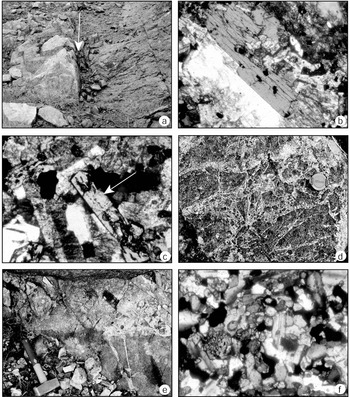
Of the two late bodies that are considered to have intruded the Centre 3 gabbros, the central tonalite (3g on Fig. 1) has been accorded some significance as the most areally extensive intermediate (in composition) intrusion in the British Palaeogene Igneous Province (e.g. Richey & Thomas, Reference Richey and Thomas1930; Thompson, Reference Thompson1983). Contact information with the surrounding quartz gabbro and laminated gabbro is poor, but along its southern margin a steeply outward-dipping (79°SE) intrusive contact toward the laminated gabbro is observed (NM 47523 68048) (fig. 5a). In addition, evidence that the tonalite body has a chilled margin is reflected by a coarsening of grain-size in the rock inward from the southern margin of the body. No intrusive contacts are observed between the tonalite and the small, central quartz monzonite described by Richey & Thomas (Reference Richey and Thomas1930), and it is thought likely that, since both are texturally and compositionally very similar, one is a gradational variant of the other. The tonalite contains ortho- and clinopyroxene, hornblende, plagioclase, biotite, quartz and K-feldspar and up to 10 vol.% opaques. Accessory zircon and apatite are also abundant (1–2 vol.%). Very pleochroic Fe-rich biotite occurs as megacrysts (up to 1 cm in size) and is the only mineral phase (with the exception of the unusually large and fresh zircons) that appears not to have suffered significant alteration and resorption (Fig. 5b, c). Some normal zoning of Ca-rich plagioclase crystals is observed, though many of the feldspars tend to exhibit highly turbid crystal surfaces, suggesting considerable alteration.
(a) Tonalite (left of image) contact with laminated gabbro along the southern margin of the former at NM 47523 68048. Contact dips to the southeast. Camera lens-cap at top centre of image is 4.5 cm in diameter. (b) Photomicrograph of biotite megacryst in tonalite (crossed polars). Width of field of view is 2 mm. (c) Photomicrograph of a zircon phenocryst in tonalite (crossed polars). Width of field of view is 5 mm. (d) Gabbro and dolerite net-veined by microgranite (NM 48777 69500). Camera lens-cap in right centre of image is 4.5 cm in diameter. (e) Thin microgranite sheet intruding gabbro at NM 47550 66036. Hammer in bottom left of image is 30 cm in length. (f) Granular appearance of the quartz dolerite in thin-section in crossed polars. The width of the field of view is 2 mm.

2.d. The quartz dolerite ring-dyke
The second late intrusion associated with the Centre 3 gabbros is a thin, fine-grained, sheet-like dolerite intrusion (3b on Fig. 1), extensively net-veined with microgranite (Richey & Thomas, Reference Richey and Thomas1930). However, remapping of this lithology reveals several lines of field evidence to suggest that this dolerite/microgranite may not actually form a single intrusive body:
(1) The dolerite/microgranite does not crop out extensively, and although it occurs at a consistent topographic height around the interior of the main Great Eucrite topographic scarp, single exposures of no more than several metres in size separated by up to several kilometres of no exposure are not convincing field evidence for its continuity.
(2) The dolerite/microgranite displays considerable lithological heterogeneity. For example, one exposure in the east (NM 48777 69500) consists of a microgranite intrusion approximately 1 m thick with abundant angular dolerite and gabbro fragments (fig. 5d). Other exposures (e.g. at NM 47025 66850) are dominated by dolerite (at least 7–8 m thick), with minor intricate microgranite net-veining. Fine-grained dolerite also commonly occurs in the area mapped as the quartz dolerite ring-dyke, with no apparent evidence of microgranite (e.g. at NM 49290 68905).
(3) The dolerite/microgranite has a very similar field appearance to the net-veined dolerite observed at the summit of Beinn na h-Imeilte, Meall nan Con and also at Rubha Carrach, as outlined earlier for the Great Eucrite outer contacts. Dolerite outcrops are therefore not confined to the area mapped by Richey & Thomas as the quartz dolerite ring-dyke. Further evidence of this is observed in the Sithean Mor laminated gabbro at NM 46648 67259.
(4) Contact orientations for the dolerite/microgranite also make it unlikely that this lithology comprises a single continuous intrusion, as suggested by Richey & Thomas (Reference Richey and Thomas1930). For example, the exposure of microgranite described above from the east of the study area (NM 48777 69500) dips outward (east) at ∼65°, a similar contact to that measured by Richey & Thomas (Reference Richey and Thomas1930). However, two contacts in close proximity just to the south of Sithean Mor (e.g. at NM 46483 67250 and NM 46651 67010) dip inward (north) at 79° and 51°, respectively. In addition, two exposures of the so-called dolerite/microgranite ring-dyke in a small area around NM 49347 68861 and NM 49287 68689 dip 80° inward (NW) and 80° outward (SE), respectively.
(5) Small microgranite sheets devoid of dolerite or gabbro fragments are commonly observed intruding the Great Eucrite (e.g. at NM 47550 66036, NM 47998 66705 and NM 45874 68978) (fig. 5e).
Thin-section examination reveals that the dolerite is dominated by small (∼1 mm long) plagioclase feldspar laths and similarly sized ‘rounded’ clinopyroxene crystals. Though apparently quite fresh, these clinopyroxene crystals appear to have been completely annealed or recrystallized, that is, the rock exhibits a granular texture, suggesting thermal metamorphism (fig. 5f). In several cases, spherulitic growths of clinopyroxene are observed intergrown with the plagioclase. Rare interstitial biotite and quartz are also present, and opaque minerals are abundant (up to 15 vol.%).
3 Discussion
3.a. The Great Eucrite
O'Driscoll et al. (Reference O'Driscoll, Troll, Reavy and Turner2006) compared inward-dipping layering and magmatic structures observed in the Great Eucrite to features commonly observed in large layered lopoliths such as the Rum Layered Suite and the Skaergaard intrusion (Emeleus et al. Reference Emeleus, Cheadle, Hunter, Upton, Wadsworth and Cawthorne1996; Irvine, Anderson & Brooks, 1998; Carr, Groves & Cawthorn, 1994). In light of the latter two studies, the conclusion of O'Driscoll et al. (Reference O'Driscoll, Troll, Reavy and Turner2006) that central sagging occurred in the Great Eucrite is supported by the important field evidence of syn-magmatic deformation of layering presented in this study, which suggests extensive collapse and slumping of unconsolidated cumulate. Additionally, although O'Driscoll et al. (Reference O'Driscoll, Troll, Reavy and Turner2006) noted that triaxial-prolate AMS ellipsoids were unusual as flow fabrics (Rochette, Aubourg & Perrin, 1999), they did not recognize that this might be due to sub-vertical stretching of the crystal mush as central sagging progressed, consistent with the presence of syn-magmatic deformation of layering, rather than magmatic sedimentation and primary flow processes.
In a much earlier study of central sagging and its effects on layering in mafic intrusions, Skelhorn & Elwell (Reference Skelhorn and Elwell1971) described pronounced steepening inward trends in layer-planes from the hypersthene gabbro of Centre 2 on Ardnamurchan. A model for central sagging was proposed by that study, although little was done with the structural data to interpret the overall geometry of the intrusion as either a lopolith or a ring-dyke. However, in a concurrent palaeomagnetic study at the time, Wells & McRae (Reference Wells and McRae1969) showed that magnetic poles from throughout the hypersthene gabbro clustered very closely together, suggesting that little or none of the inward tilting had occurred after cooling below the Curie temperature of ∼570°. This plausibly provides some constraint on the timing of such tilting with respect to the rheology of the partially layered mush, and also has obvious implications for sagging in the Great Eucrite (see also Section 3.c). For example, the hypersthene gabbro palaeomagnetic data lend support to the inference in this study that the Great Eucrite layers may still have been quite hot and capable of being syn-magmatically deformed by central sagging. However, well-defined steepening-inward trends of magmatic layering are not observed in the Great Eucrite.
The field data presented here also suggest that the Meall nan Con screen, long considered an important element in the ring-dyke model for the Great Eucrite, is the roof to the Great Eucrite, based on flattish contacts (seen in the field) with the gabbro rather than steep contacts, as previously described (Richey & Thomas, Reference Richey and Thomas1930). Field and petrographic observations by Brown, Bell & McCleod (2006) indicate that the Centre 3 ‘vent agglomerates’ are, in fact, largely net-veined dolerites. However, as the observations described above suggest, this lithology is not restricted to the inferred roof of the Great Eucrite, but is observed around the outer margin of the Great Eucrite and toward the interior of the intrusion, where quartz dolerite crops out. This close spatial relationship of the net-veined dolerite with the outer contacts of the Great Eucrite suggests that net-veining is a contact metamorphic effect reflecting intrusion of the Great Eucrite, rather than a separate intrusion. Further petrographic evidence of a country-rock origin for the quartz dolerite is presented in Section 2.d and discussed in more detail in Section 3.e.
3.b. Peridotite blocks and rafts
The peridotite blocks and rafts in the Great Eucrite gabbros bear remarkable textural and compositional similarities to the feldspathic peridotites of both Rum and Skye, in which olivine and plagioclase are the dominant mineral constituents. In the case of the smaller (metre-scale) fine-grained blocks, it is clear that these have been transported to some extent by the Great Eucrite gabbros in which they are incorporated. This is deduced on the basis that magmatic layering and mineral lamination in the blocks are discordant to layering in the Great Eucrite gabbros. Furthermore, these blocks are completely out of compositional equilibrium with the Great Eucrite gabbro, as they have typically undergone extensive resorption/digestion. It is uncertain whether the texturally equilibrated nature of many of the peridotite blocks is a result of post-cumulus magma chamber processes or a result of subsequent protracted thermal and chemical interaction with their host gabbro.
The presence of peridotite blocks that display clear evidence of cumulus textures (sensu Wager & Brown, Reference Wager and Brown1968) and internal layering has significant implications for the Ardnamurchan Complex. Superb layering preserved in these blocks, and particularly the very coarse-grained nature of the large rafts (also layered) suggests that there may be a large ultrabasic component to the Ardnamurchan gabbros at depth. However, whereas upward transport cannot be ruled out for the small peridotite blocks, it is considered unlikely that a basaltic magma could have transported the large (120 m diameter) rafts. The possibility exists, therefore, that the peridotite blocks have been emplaced from an ultrabasic intrusion above that has subsequently been completely eroded away. Though simple density considerations indicate that such a magma would be expected to have ponded at a deeper level than the Great Eucrite gabbros, intrusion of the ultrabasic rocks need not have been related to the same pulse of magma intrusion as sourced the gabbros, so that the peridotite was already in place when the Great Eucrite was intruded. It should also be noted that on the Isle of Rum, where open-system magma chamber processes have been inferred (Renner & Palacz, Reference Renner and Palacz1987; O'Driscoll et al. Reference O'Driscoll, Donaldson, Troll, Jerram and Emeleus2007), thick (>100 m) layers of peridotite occur above and below rocks of a more evolved, troctolitic composition in an extensive stratigraphy of at least 16 coupled, peridotite–troctolite units (Emeleus et al. Reference Emeleus, Cheadle, Hunter, Upton, Wadsworth and Cawthorne1996). Another implication of the peridotite blocks on Ardnamurchan concerns previous work on both the Rum and Skye centres, which has shown that emplacement of picritic magmas had a significant part to play in the construction of the basic–ultrabasic components of each igneous centre (Gibb, Reference Gibb1976; Upton et al. Reference Upton, Skovgaard, McClurg, Kirstein, Cheadle, Emeleus, Wadsworth and Fallick2002). Peridotite blocks within the Great Eucrite gabbro may thus also represent indirect evidence for the presence of picrite magma during the development of the Ardnamurchan Centre.
3.c. The laminated gabbro horizons
The Sithean Mor, Achnaha and Sgurr nan Gabhar laminated gabbros exhibit mineral lamination fabrics with typical inward dips greater than 50°, whereas lamination planes in the Glendrian laminated gabbros generally dip at no more than 30°. O'Driscoll et al. (Reference O'Driscoll, Troll, Reavy and Turner2006) suggested that the laminated gabbros on Ardnamurchan represented an upper laminated facies in the larger Great Eucrite layered intrusion. On the basis of these differences in orientation of mineral lamination, it is suggested here that there may be two groups of laminated gabbro present: an outer group comprised of the former three areas of gabbro that may be continuous around the inner margin of the Great Eucrite, and an inner group comprising the Glendrian laminated gabbro. This proposition is supported by magnetic susceptibility characteristics of both groups of gabbro; the Glendrian laminated gabbros generally display much higher magnetic susceptibilities than the other three areas of laminated gabbro, suggesting a subtle compositional difference in both groups (B. O'Driscoll, unpub. data). If this interpretation is correct, then laminated gabbro in Centre 3 may have comprised major units in a layered lopolith at two different stratigraphic levels, with the Sithean Mor, Achnaha and Sgurr nan Gabhar gabbros corresponding to a lower unit, and the Glendrian body corresponding to a higher unit. Similar arrangements of ‘stratiform layers’ of laminated gabbro are described from other layered intrusions, such as the Skaergaard intrusion (Irvine, Anderson & Brooks, 1998), the Rum Layered Suite (Emeleus et al. Reference Emeleus, Cheadle, Hunter, Upton, Wadsworth and Cawthorne1996) and the Sept Iles layered intrusion (Higgins, Reference Higgins1991).
As with the Great Eucrite, syn-magmatic deformation structures in the laminated gabbros, indicating downdip directions of movement of poorly consolidated cumulate, suggest that they have also been affected by the central sagging of the Great Eucrite that was proposed by O'Driscoll et al. (Reference O'Driscoll, Troll, Reavy and Turner2006). The observation that plagioclase crystals in the laminated gabbros exhibit no evidence for extensive solid-state deformation, despite showing syn-magmatic deformation structures, supports the argument made above (Section 3.a) that central sagging of the Centre 3 gabbros occurred in poorly consolidated, partially crystallized cumulates.
3.d. Magma mixing at the intrusion roof-zone
The central tonalite body contains significant amounts of K-feldspar and quartz (modally up to 20% of both combined in a given sample), and is therefore (technically) incorrectly referred to as tonalite. Instead, it plots in the granodioritic or granitic field on a Streckeisen diagram of the relative proportions of quartz, alkali and plagioclase feldspar (Streckeisen, Reference Streckeisen1976). However, the significant range of minerals and textural nature of this rock (described above) suggest that it has not cooled and solidified from an equilibrium melt, but rather from a relatively rapidly cooled mixed magma. The presence of reasonably fresh orthopyroxene, clinopyroxene and Ca-rich plagioclase strongly suggests that a basic melt was involved in the rock's crystallization history. However, significant Na-rich rims on more calcic plagioclase crystals, as well as the presence of quartz and K-feldspar, suggest a magma of more silicic composition. The presence of abundant accessory zircon supports this conclusion, suggesting that parts of this rock cooled from a highly evolved melt (given the highly incompatible nature of zirconium in most mafic and intermediate silicate melts), thought to be derived from partial melting of the Jurassic country-rocks. The rock is considered in this study to have crystallized from two mixed crystal-bearing magmas of contrasting composition. The large fresh biotite plates may be the only mineral that crystallized in equilibrium with the intermediate melt produced from the mixing process.
It is concluded that the Centre 3 ‘tonalite’ is not in fact a separate intrusion. Given its position interior to the Great Eucrite intrusion, where the effects of central sagging proposed here are likely to have been most pronounced, it is proposed that the so-called tonalite represents a preserved zone of interaction between fractionating basic magmas and felsic country-rock, as suggested by Emeleus & Bell (Reference Emeleus and Bell2005). It may therefore, together with the rocks of the Meall nan Con area (described above), provide the best evidence for the presence of the roof-zone of the Centre 3 lopolith. The geochemical work of Walsh (Reference Walsh1975) and Walsh & Henderson (Reference Walsh and Henderson1977) supports this conclusion to some extent, as they suggested that the tonalite was derived from country-rock contamination rather than fractional crystallization of the gabbros. Thompson (Reference Thompson1983) carried out melting experiments on a sample of the inner ‘quartz monzonite’ part of the intrusion (3h on Fig. 1) at 1 kbarH2O and showed that its liquidus temperature was in excess of 1020°C. This led him to conclude that the petrogenesis of the quartz monzonite must have involved a combination of both crustal contamination and fractional crystallization. The felsic magma was probably derived from partial melting of Jurassic sedimentary rocks; field evidence for this process is evident in the development of migmatites close to the outer margins of the Great Eucrite (see Section 2.a).
Magnetic fabric data from samples taken at the tonalite contact with laminated gabbro are somewhat equivocal, and do not confirm or cast doubt on the above interpretation (B. O'Driscoll, unpub. data). Magnetic foliations are parallel to the contact itself, and magnetic lineations plunge steeply outward (downdip) on the contact plane. These might therefore describe an emplacement through upward flow of a separate late felsic intrusion, or a downward-directed stretching lineation related to subsidence of a central roof block, in tandem with overall lopolithic sagging of the Centre 3 gabbros.
3.e. Subsidence of country-rock blocks
An important line of evidence used by Richey & Thomas (Reference Richey and Thomas1930) for their ring-dyke model was the reported outward-dipping nature of the late quartz dolerite intrusion. Highly irregular contact data measured for the dolerite sheet in this study, combined with other field observations outlined above, indicate that it does not have the form of a single coherent intrusion. Thin-section petrography described in Section 2.d (and see fig. 5f) suggests that the dolerite has the granular texture of a baked (thermally metamorphosed) rock rather than the fresh appearance that might be expected from a late-stage intrusive rock. Together with the observation that net-veining of dolerite (or gabbro) by microgranite appears to occur consistently wherever the outer contacts can be closely constrained, it is proposed here that the net-veined dolerite ‘intrusion’ is actually an annularly arranged series of xenolithic roof slabs or pendants of cone-sheet rock that has been back-injected with anatectic country-rock melts of Jurassic mudstones and siltstones. As mentioned previously, the dolerite in this model is provided by the numerous cone-sheets that intrude the Jurassic strata on Ardnamurchan (see Section 2.a). Subsequent thermal metamorphism following emplacement of the Great Eucrite has resulted in the granular textures described in Section 2.d. The position of these roof-pendants immediately interior to the Great Eucrite may indicate the presence of an annular fault located there which controlled their downthrow, perhaps also associated with the proposed sagging of the lopolith.
The implication of this field study is that the original mapping of Richey & Thomas (Reference Richey and Thomas1930) of the Centre 3 gabbros is somewhat overcomplicated in terms of the number of different intrusions mapped. It is proposed here that all of the lithologies observed in Centre 3 can be interpreted as the component parts of a single layered lopolith, one that exhibits a complexity of small-scale structures and heterogeneous block populations that are comparable to those of the larger layered mafic lopoliths of the British Palaeogene Igneous Province such as on Skye and Rum (Wager & Brown, Reference Wager and Brown1968; Emeleus & Bell, Reference Emeleus and Bell2005).
4. Conclusions
This contribution presents a new map of the Centre 3 gabbros of Ardnamurchan, the interpretation of which has led to a re-evaluation of their intrusion geometry and emplacement history. Observations on the Great Eucrite portion of the intrusion strengthen existing hypotheses (Emeleus & Bell, Reference Emeleus and Bell2005; O'Driscoll et al. Reference O'Driscoll, Troll, Reavy and Turner2006) that the intrusion is likely to be a lopolith. The fieldwork presented in this article describes a range of layering, magmatic structures and heterogeneous block populations in the Great Eucrite that have not previously been reported. Previously undocumented areas of laminated gabbro are reported, and two groups of laminated gabbro, comprising upper and lower units in a stratified Centre 3 layered lopolith, are inferred. The central tonalite intrusion is proposed to represent the original subsided zone of country-rock interaction with the top of the Centre 3 magma chamber, that is, the chamber roof, and the late quartz dolerite intrusion is also re-interpreted as an annular series of subsided, thermally metamorphosed and back-injected roof blocks above the Great Eucrite. The range of lithological relationships and magmatic structures provides compelling evidence for an origin as component parts of a single, layered mafic lopolith, and discounts the ring-dyke hypothesis as a valid emplacement mechanism for any of these intrusions.
Acknowledgements
Sincere thanks to Henry Emeleus, Brian Upton, John Reavy, Valentin Troll and David Brown for stimulating discussion and insight, as well as to Trevor Potts for his assistance in the field. Kathryn Goodenough and Brian Bell are thanked for their thorough and constructive reviews. The author also acknowledges funding from the Irish Research Council for Science, Engineering and Technology (IRCSET) and support from the Mineralogical Society Bursary.