This article examines the determinants of political parties’ annual spending levels. The notion of a ‘cost explosion’ in political spending has been widely debated by policymakers, commentators and researchers. It is often regarded as self-evident that the spending levels of political parties and election candidates have been rising steadily (Kulick and Nassmacher Reference Kulick and Nassmacher2012; Nassmacher Reference Nassmacher2009; Overacker Reference Overacker1932; Pinto-Duschinsky Reference Pinto-Duschinsky2002, Reference Pinto-Duschinsky2008). However, to date, clear evidence for this statement has largely been lacking. Therefore, the assumption that costs of politics have been increasing continuously in the past decades needs to be verified. This issue is not without significance: the assumption of spiralling costs has already been highly influential and has had important policy implications as it has guided legislators worldwide. As a response to the presumed expansion of costs, party finance laws in various countries have been reformed. Spending limits, for instance, have been introduced or revised in order to avoid escalating costs (Anderson and Tham Reference Anderson and Tham2014; Ewing and Rowbottom Reference Ewing and Rowbottom2012; Pinto-Duschinsky Reference Pinto-Duschinsky2008, Reference Pinto-Duschinsky2013).
To shed light on this contentious issue, party finance scholars recently performed in-depth analyses of parties’ and candidates’ expenses. Their findings have shown that escalating costs are a myth rather than reality (e.g. Nassmacher Reference Nassmacher2009; Pinto-Duschinsky Reference Pinto-Duschinsky2008). These studies, however, have generally only operationalized spending in two ways. First, the focus has been on political spending or costs of democracy, referring to the aggregate expenses of both political parties and election candidates at the level of individual countries. Second, studies at the party level have only investigated campaign expenses of parties and candidates. In sum, these studies have focused either on aggregate expenses at a national level or solely on campaign expenses of individual parties. Overall annual expenses of individual political parties – that is, the parties’ expenses for both routine costs (e.g. staff, housing and administration) and election campaigns – have remained largely unknown. In spite of some recent exceptions (e.g. Blumenberg Reference Blumenberg2013; Cordes Reference Cordes2002), this has not yet been investigated extensively. Moreover, these recent analyses are highly descriptive and do not attempt to explain interparty differences.
In this article, we therefore aim not merely to examine the spending levels of individual political parties, but to explain why some parties have high levels of annual spending while others have only limited expenditures. To this end, we analyse which variables explain the spending levels of individual political parties on the basis of a dataset with 1,317 observations from 99 parties in nine European parliamentary democracies. We thus attempt to show which characteristics of parties and countries lead to higher spending levels or more moderate ones.
We here investigate overall annual expenses of political parties. This includes both operational expenses (e.g. for staff, housing, meetings and administration) and all communication expenses (e.g. for electoral campaigns, the party newsletter and website). Expenses of election candidates are not included in our analysis. We attempt to explain the parties’ overall spending levels by means of a multivariate model with 12 explanatory variables. Four of these variables are situated at the party level: party strength, age, ideology and government participation. The eight remaining variables are country-level factors: election cycle, campaign spending limits, donation limits, tradition of public funding, electoral volatility, effective number of parties, democratic tradition and number of registered voters.
The following section provides a brief overview of the existing research on political parties’ expenses. Next, the central variables of our study are discussed. We then elaborate on case selection and methodology. After presenting the results of our analysis, the major findings of this study are summarized and discussed in the final section.
The Spending Levels Of Political Parties
As we have mentioned, concerns have often been expressed about rising or even escalating levels of political spending during the past century. It was considered as an established fact that the expenses of political parties and election candidates had been increasing continuously and that a ‘cost explosion’ or an ‘arms race’ in political spending had taken place. As the competition between parties and candidates intensified and became fiercer, it was argued, political actors always tended to spend more in an attempt to outclass their competitors (Pinto-Duschinsky Reference Pinto-Duschinsky2008). Moreover, new and modern campaign styles and techniques such as advertising on television and internet were also supposed to have turned politics into a more expensive business (Farrell and Webb Reference Farrell and Webb2000; Pinto-Duschinsky Reference Pinto-Duschinsky2002, Reference Pinto-Duschinsky2013). In this context, the Global Commission on Elections, Democracy and Security (2012), for instance, referred to ‘an era of explosive growth in campaign expenditures across older democracies’.Footnote 1 However, this ‘ungrounded presumption’, as Michael Pinto-Duschinsky (Reference Pinto-Duschinsky2008) called it, was initially only put to the test to a limited extent (Kulick and Nassmacher Reference Kulick and Nassmacher2012; Pinto-Duschinsky Reference Pinto-Duschinsky2002; Scarrow Reference Scarrow2007).
In recent decades, transparency regulations have been introduced in many countries, obliging political parties to make their financial statements publicly accessible (Casas-Zamora Reference Casas-Zamora2005; Scarrow Reference Scarrow2011; Smulders and Maddens Reference Smulders and Maddens2016). As a result, data on the finances of parties have become widely available, allowing party finance scholars to devote more attention to this subject and to examine the revenues and expenditures of political parties (Nassmacher Reference Nassmacher1989; Van Biezen Reference Van Biezen2008). In this context, the spending levels of parties and candidates and their evolution have gained considerable attention. A number of empirical studies have cast doubt on the assumed cost explosion, as political spending levels were shown to have remained rather constant (Anderson and Tham Reference Anderson and Tham2014; Ansolabehere et al. Reference Ansolabehere, de Figueiredo and Snyder2003; Casas-Zamora Reference Casas-Zamora2005; Kulick and Nassmacher Reference Kulick and Nassmacher2012; Nassmacher Reference Nassmacher1992, Reference Nassmacher2009; Pinto-Duschinsky Reference Pinto-Duschinsky2008). At first sight, it indeed seems that costs have been rising over the past decades, but when controlled for important socioeconomic developments, such as population growth, economic growth and inflation, the increase in political spending largely disappears.
Despite the absence of a cost explosion, several studies reveal substantial differences between individual countries with regard to political spending levels, even when controlling for population size and economic development. While some countries are cost-efficient, others are characterized by high levels of political spending (Heidenheimer Reference Heidenheimer1963; Nassmacher Reference Nassmacher2009). Moreover, spending levels have been found to differ substantially between parties. In this context, Manuela Blumenberg’s study (2013) is of special importance. She analysed the spending levels of individual political parties based on data from Germany, Austria, Denmark and the UK. She did not find any evidence for universally escalating costs at party level. Additionally, Blumenberg tried to explain interparty differences by relating the parties’ spending levels to party-level and country-level variables. She illustrated, among other things, that spending levels are positively correlated with duration of government participation, party size, public funding and electoral volatility, while a democracy’s age and country size have a negative impact on spending levels. This study, however, was largely restricted to bivariate analyses given the limited number of cases and therefore did not discuss or analyse the interplay between different explanatory variables.
In sum, the combined effect of possible explanatory variables on the expenditures of political parties both at the party and the country level is still to be unravelled. We do not yet know which factors affect the spending levels of individual parties, explaining why some parties have limited and others high levels of spending. This leads us to the central research question of this article: Which party-level and country-level variables explain the annual spending levels of individual political parties? This question will be examined on the basis of data from 99 parties in nine European countries by means of multivariate analyses.
Variables and Expectations
In this section, we elaborate on the central variables of our study. The first part describes the dependent variable and its operationalization. Next, the explanatory variables will be discussed, highlighting our expectations about these party- and country-level variables.
Dependent Variable
The overall annual spending levels of political parties are the dependent variable of this study. Party spending thus comprises all annual expenses, including operational or organizational expenses (e.g. for staff, housing, meetings and administration), communication expenses (e.g. for electoral campaigns and marketing between elections) and financial and extraordinary expenses (e.g. interest expenses). We here follow Pinto-Duschinsky (Reference Pinto-Duschinsky2002: 70) in his view that ‘[p]arty funding includes not only campaign expenses but also the costs of maintaining permanent offices, carrying out policy research, and engaging in political education, voter registration, and the other regular functions of parties’. By studying the parties’ overall spending levels, the costs of all these activities are included in our analysis.Footnote 2
Figures on party spending are gathered from the parties’ official financial statements. We acknowledge that the reliability of these figures can be questioned to some extent. Although parties operate within the context of a legal framework of transparency regulations, there is a risk that the official data only represent a part of the real revenues and expenditures due to inaccuracies, misreporting or undeclared flows of money (Hopkin Reference Hopkin2004; Pinto-Duschinsky Reference Pinto-Duschinsky2002, Reference Pinto-Duschinsky2013; Scarrow Reference Scarrow2007). Even though these data should be handled with care, Scarrow (Reference Scarrow2007: 206) argues that ‘in most cases they are far from worthless – particularly in comparative perspective, in which big differences may be more important than details’. Therefore, and because currently no all-encompassing datasets with comparative and reliable figures on party finance are available, we rely on these official party spending data.
Another factor that should be taken into account is that comparative studies on party finance are confronted with important between-country differences (Nassmacher Reference Nassmacher2009; Pinto-Duschinsky Reference Pinto-Duschinsky2002, Reference Pinto-Duschinsky2013). First, not all countries use the same currency. Although the euro is currently used in many European countries, there are still some states that have their own national currency.Footnote 3 Second, economic performance varies considerably between countries. Third, countries also differ strongly in size and in population. These elements impede a clear-cut comparison between states. To cope with these issues, we resort to a solution proposed by Nassmacher (Reference Nassmacher2002, Reference Nassmacher2009).
Karl-Heinz Nassmacher developed an index of political spending (IPS). The numerator of this index is composed of the relative expenses, implying that the total annual expenses are divided by the number of registered voters in order to control for population size. As an extension to this approach, we additionally take into account that not all parties in a country are directed towards the nationwide electorate. Regionalist parties generally only run for election in one specific region or electoral district, thus addressing only part of the electorate. We thus take into account the number of registered voters for each party separately by examining whether a party is active in the entire country or only in one or more districts.
The denominator of the IPS consists of per capita GDP in order to account for differences in economic performance. Moreover, per capita GDP is divided by 2,000, assuming that a year consists of 50 working weeks of 40 working hours each. The denominator thus represents the hourly rate of national income per average person and is expressed in the same currency as the parties’ expenditures (see also Heidenheimer Reference Heidenheimer1963). The major advantage is that this figure ‘will include the impacts of inflation and overall economic growth without trying to tell them apart, and avoid all parity problems’ (Nassmacher Reference Nassmacher2009: 114).
By accounting for both population size (number of registered voters) and economic performance (GDP), this index allows for reliable cross-national analyses. The IPS will therefore be used as dependent variable in this study.
Explanatory Party-level Variables
We expect that the parties’ spending levels are influenced by four party-level variables. First, we consider the role of party strength. We assume this variable to be positively related to the parties’ spending levels, because stronger parties generally receive higher amounts of public funding (Casas-Zamora Reference Casas-Zamora2005; Ohman Reference Ohman2012), allowing them to spend more. If a party’s income rises, we suppose the party will not be inclined to keep its expenses constant and to save more money by raising annual profit, but rather to increase expenses. Recently, both Nassmacher (Reference Nassmacher2009) and Blumenberg (Reference Blumenberg2013) indeed found that if the amount of state funding rises, spending levels increase as well. However, it is not only the amount of public funding that depends on party strength, but so does the amount of revenue from private sources, such as donations and membership fees. The more popular support a party enjoys, the more it can rely on members and supporters for contributions (Mair Reference Mair1994; Van Biezen Reference Van Biezen2004). Analogous to the discussion on public funding, higher levels of private income also allow for higher expenses. Finally, stronger parties often also need a more developed party organization in order to organize their network (Blumenberg Reference Blumenberg2013). Developing and maintaining such an organization inevitably requires financial investments. As a result, stronger parties, having a more developed organizational structure, are confronted with higher spending levels. We acknowledge that party strength can be operationalized in different manners (Blumenberg Reference Blumenberg2013; Ladner and Brändle Reference Ladner and Brändle1999), but we consider the parties’ electoral result to be the most straightforward way. More specifically, we rely on the parties’ vote share in the most recent national or federal elections.Footnote 4
The second party-level variable is party age. This is related to a party’s institutionalization and its organizational development. Young parties generally have only limited means at their disposal, both financially and in terms of grassroots support. It is only when parties grow older that they become institutionalized in the party system and that their available means increase in terms of both money and support. This allows them gradually to develop the party organization, which leads to higher organizational costs. We expect the emergence of organizational routine costs to be the main driver of increasing expenses of political parties. Once the party organization has been developed, it needs continuous maintenance. Permanent financial investments thus become indispensable (Bukow Reference Bukow2012; Starbuck Reference Starbuck1965), while at the same time costs for communication still remain important. In sum, we hypothesize that party age influences spending levels, since once the party becomes institutionalized, it will be able to create an organizational structure, requiring continuous investments. Data on the year of origin of parties come from the ParlGov database (Döring and Manow Reference Döring and Manow2016).
Third, we hypothesize that spending levels are determined by party ideology. In his seminal work on the organization of political parties, Maurice Duverger (Reference Duverger1954) argued that parties differ from each other organizationally according to their ideology. More specifically, socialist and social-democratic parties are reported to be structured in a more centralized manner than their Christian-democratic counterparts, which are rather loosely organized. Other scholars have generalized this finding, arguing that (centre-)right parties often lack the well-developed, well-structured and disciplined organization of leftist parties. Given their tradition as mass parties, leftist political parties are characterized by highly organized networks of local and regional branches and party members (Krouwel Reference Krouwel2012). Right-wing parties, on the other hand, have light and simple organizations with only few formal structures and with a concentration of power in the hands of a small party elite (Enyedi and Linek Reference Enyedi and Linek2008; Janda and King Reference Janda and King1985; Wilson Reference Wilson1998). We assume that these organizational differences between left- and right-oriented parties are reflected in their spending levels, since maintaining a permanent party organization requires continuous and substantial financial investments, as argued above. In short, we hypothesize that spending levels are higher among leftist political parties. In this study party ideology is operationalized in a quantitative manner, in the sense that parties are located on a continuous scale ranging from 0 (left) to 10 (right). These data were retrieved from the ParlGov database.Footnote 5
The last party-level variable to be considered is government participation. Parties belonging to a government majority generally enjoy various benefits (Bolleyer Reference Bolleyer2009; Kopecký et al. Reference Kopecký, Mair and Spirova2012). These advantages can be very tangible and concrete, in the sense that government parties, and more particularly their ministers, can rely on staff, administrative support and office space provided and paid for by the state. Moreover, governmental parties can also make use of the government apparatus for communication on decisions and implemented policies. In other words, they are highly visible. Opposition parties, on the other hand, do not enjoy these benefits. Hence, government participation can be considered as a cost-reducing factor. We expect, however, that government parties will initially be cautious and refrain from promptly reducing their expenditures once they are in government. We expect that they will do so only after they have been in office for a longer period of time. We therefore hypothesize that spending levels decrease the longer a party remains part of the ruling coalition. We here operationalize this variable by means of the number of consecutive years a party has been in office.
Explanatory Country-level Variables
Next to the party-level variables, we also include eight country-level variables. As mentioned above, it is known that some countries are more cost-efficient than others when it comes to political spending. Consequently, spending levels of political parties within individual countries are also influenced by country characteristics. We therefore also need to include these elements in our multivariate model.
First, we include electoral cycles. Parties’ spending levels differ widely between election years and ‘off years’, in the sense that expenditures are substantially higher in election years. In the run-up to elections, parties tend to spend more on campaigning and communication, while routine costs remain rather stable (Blumenberg Reference Blumenberg2013; Cordes Reference Cordes2002; Nassmacher Reference Nassmacher1993, Reference Nassmacher2009). Therefore, we include a dummy variable in the model indicating whether elections were held in that year.Footnote 6
The next three variables relate to the regulatory regime on party finance. Legal regulations can influence the spending levels of political parties both directly and indirectly. First and foremost, we assume that spending limits have a direct effect on party spending. Although legal restrictions on routine or day-to-day expenses are rather exceptional, spending caps with respect to campaign expenditures have been introduced in many countries in an attempt to create more equality between competing parties and to avoid excessive campaign costs (Ohman Reference Ohman2014, Walecki Reference Walecki2007a). Arguably, such spending limits mitigate a party’s campaign expenses, while it is to be expected that expenses are higher in cases without any constraints. We therefore enter a dummy variable in the model, indicating whether there are any campaign spending limits in the context of elections. As we do not expect there to be a major effect from this variable, given that these limits can only reduce electoral expenses, we consider the interaction effect between the election year dummy and the spending limits dummy. This effect should be negative, indicating that the expected positive effect of election years is mitigated in the case of campaign spending limits.
Next, limitations on donations can be considered as having an indirect effect on party spending. Donations not only allow parties to maintain the relationship with their electorate and society at large, they also provide them with additional income, supplementing public funds and membership fees, among other things (Kulick and Nassmacher Reference Kulick and Nassmacher2012; Ohman Reference Ohman2014; Van Biezen Reference Van Biezen2003). However, while donations are usually a flexible source of income, dependent on a party’s fundraising capacity, a ceiling on donations restricts this capacity. It can thus be argued that when donation limits are in place, parties are restricted in gaining additional funds and consequently have fewer financial means at their disposal. As a result, their spending capacity is reduced, leading to lower spending levels. To test this hypothesis, we again include a dummy variable in our model, indicating whether donation limits are laid down in the law.Footnote 7
As a last element of the party finance regime, we consider the tradition of public funding. Presumably, the extent to which parties are accustomed to the practice of state subsidies plays an important role. More particularly, we want to control for the fact that state funding is a reliable and stable source of income for political parties. Contrary to membership dues or donations, for instance, the size of these annual revenues is very predictable (Nassmacher Reference Nassmacher1992). In countries with a long tradition of state funding, this leads to a situation of financial certainty for the parties, as a result of which they will be inclined to spend more. In countries where public funding has not been institutionalized, on the other hand, parties are not accommodated to this predictable source of income. Consequently, they will act more economically and put more money aside as an insurance against electoral adversity. In sum, we hypothesize that a tradition of public funding leads to financial security, which will lead to higher spending levels. We account for this factor by including the number of years since the introduction of public funding in the model.
Next, electoral competition is included, as measured by electoral volatility and the effective number of parties at the electoral level (Bartolini and Mair Reference Bartolini and Mair1990). The underlying idea is that in volatile systems, where parties cannot rely on a loyal and solid electorate, and in systems where many parties compete with one another, parties are highly uncertain about their future electoral results and about their position in the party system. As a result, they will be inclined to take the necessary measures to strengthen their position and to ensure their survival (Panebianco Reference Panebianco1982). This can be done, for instance, by maximizing grassroots support and by building a solid party electorate through permanent campaigning, which is inevitably related to additional expenses. In other words, we expect that high levels of volatility and a large number of parties in the system incite parties to spend more. Volatility figures were imported from the dataset of Vincenzo Emanuele (Reference Emanuele2015); for the effective number of parties we rely on Michael Gallagher’s election indices dataset (Reference Gallagher2017).
The next variable is democratic tradition. We assume that it is only when a political system becomes fully democratic that spending levels are likely to decrease. This hypothesis originates from the work of Pinto-Duschinsky (Reference Pinto-Duschinsky1981), who distinguishes between three stages in the evolution of party finance: while spending levels are expected to be high during the first two stages (the aristocratic era and the plutocratic era), they only decrease substantially in the final stage (the modern era). This argument has already been put to the test by Nassmacher (Reference Nassmacher2009) and Blumenberg (Reference Blumenberg2013), who found that countries of the second and third wave of democratization (Huntington Reference Huntington1991) are more costly than the highly developed countries of the first wave. Moreover, if democratic tradition is measured by the years of popularly elected government and universal male suffrage, a significant negative correlation is found with spending levels. To take this relationship into account, namely that a long democratic tradition coincides with lower spending levels, we include the number of years since the introduction of universal male suffrage in our model.
Finally, we account for economies of scale, given the fact that ‘established democracies differ in size more than in wealth’ (Kulick and Nassmacher Reference Kulick and Nassmacher2012). Earlier research has shown that when spending levels per registered voter are analysed, these relative expenses are generally higher in small democracies than in large ones (Blumenberg Reference Blumenberg2013; Nassmacher Reference Nassmacher2009). In countries with a large population, parties are able to spread basic costs (e.g. fixed costs for the design of a leaflet or a website) over a larger number of voters than is the case in small countries. The number of registered voters should therefore be included as an independent variable in our model.Footnote 8
Case Selection
To test our hypotheses, we collected data on political parties from nine European countries, namely Austria, Belgium, Denmark, Finland, Germany, Italy, Luxembourg, Portugal and Spain. These cases were selected in three steps. First, we restricted our analysis to Northern, Western and Southern European countries. The newly democratized states from Central and Eastern Europe were excluded since they are often characterized by different regulatory regimes. This can be explained by their process of accession into the European Union. Before joining the EU, candidate member states from Central and Eastern Europe had to comply with recommendations with regard to party finance as part of a wider EU anti-corruption strategy. As a result, the Union has influenced party finance regulations in these countries, while this has not been the case for the member states of Northern, Western and Southern Europe (Walecki Reference Walecki2007b). Moreover, it has been shown that laws on party organization and finance are not only more common in newly democratic states than in established democracies, but that they have generally also been introduced for other reasons (Karvonen Reference Karvonen2007; Van Biezen and Kopecký Reference Van Biezen and Kopecký2007). The central aim in newly democratized countries is to break with the former undemocratic regime and to counteract possible anti-democratic tendencies, while stable democracies rather officialize the existing situation with respect to the internal organization and the finances of parties. Given these elements, Central and Eastern European states are generally the focus of a specific branch of party finance literature (e.g. Ikstens et al. Reference Ikstens, Pinto-Duschinsky, Smilov and Walecki2002; Simral Reference Simral2014; Walecki Reference Walecki2007b). Analogously, we also excluded them from our analysis to enhance comparability between our cases.
Second, we only focused on parliamentary democracies with proportional and mixed-member electoral systems. Although not candidate-centred to the same extent as the US, majoritarian and plurality systems in Europe are characterized by a stronger focus on individual election candidates instead of on parties, in comparison with their proportional representation (PR) counterparts (Bormann and Golder Reference Bormann and Golder2013; Grofman Reference Grofman2005; Karlsen and Narud Reference Karlsen and Narud2013). With respect to party finance, this for instance implies that ‘regulation of campaign finance is geared towards individual candidates rather than the parties’ (Hofnung Reference Hofnung2008). We therefore excluded the UK and France from our analysis.
Finally, we examined for which countries we were able to collect data on their parties’ expenditures for a time period of at least five consecutive years. In other words, we can only include countries where the financial statements of political parties are made publicly available, as they are the central source of information for these data. This was only the case in the nine countries listed above. In the remaining countries, party finance data are either not made available or it is impossible to retrieve the parties’ financial statements (Smulders and Maddens Reference Smulders and Maddens2016).
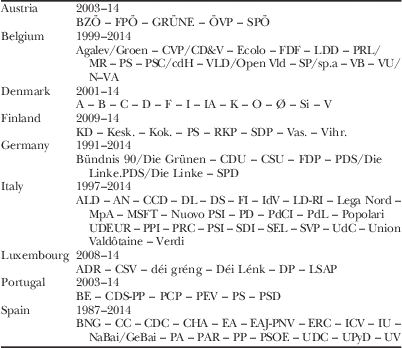
In a next stage, we gathered data for all relevant political parties in the nine selected cases. For the selection of relevant parties, two criteria were used. First, we checked in the ParlGov database which parties were included in the overview of national lower house elections in the period 1995–2014. Second, we selected all parties that published separate financial statements (i.e. were not part of, for instance, an electoral alliance) for a minimum of five consecutive years.Footnote 9 This led to a dataset of 99 political parties and 1,317 individual observations (see Appendix 1).
Methodology
Given our data on 99 parties from nine countries, our analysis has a multilevel structure: individual observations are clustered within parties, in their turn clustered within countries. However, performing multilevel analyses generally requires at least 30–50 units at the highest level (Bryan and Jenkins Reference Bryan and Jenkins2016; Maas and Hox Reference Maas and Hox2005), while our analysis only includes data from nine countries.
This problem can be solved by interpreting our data in an alternative way. Instead of regarding the yearly observations of party P in country C as a separate cluster, we distinguish between different parliamentary terms or periods of office, arguing that the observations of a party during a certain term are more alike than observations in another term, mainly due to a different position of the party in the ever-changing party system. We then consider the observations of party P in country C during term T as a separate cluster, as well as the observations of, for instance, term T+1 and T+2. In other words, all observations of a party are subdivided into different smaller clusters on the basis of parliamentary terms. Our 1,317 data points are thus clustered within parties in a certain parliamentary term, in turn being clustered in countries in that term. This alternative interpretation leads to 415 level-2 units and 44 level-3 units, allowing us to perform multilevel analyses.Footnote 10
Analysis
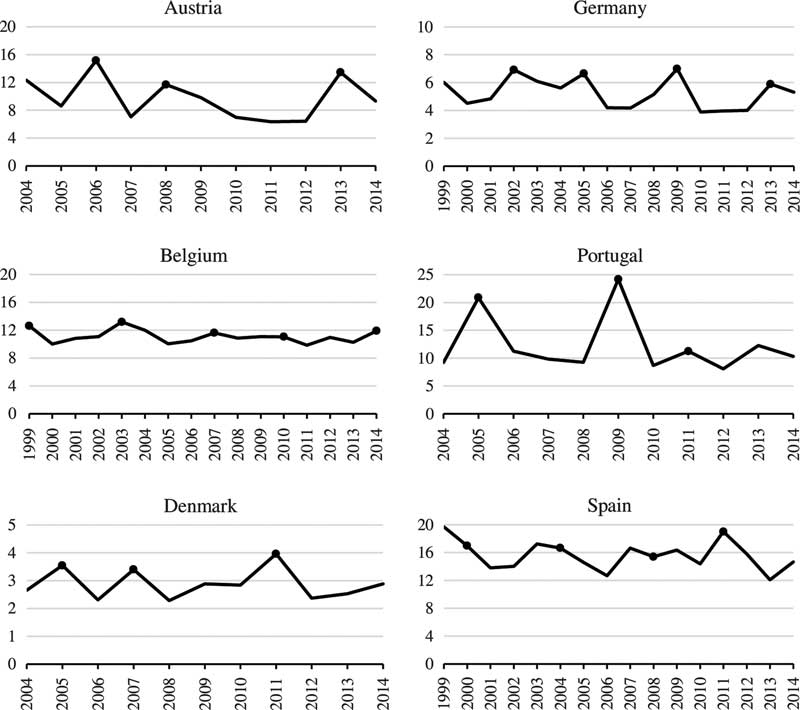
Before turning to the analytical model, we present some descriptive findings. First, we explore the evolution of the parties’ expenditures based on data from Austria, Belgium, Denmark, Germany, Portugal and Spain, six countries for which we have data on the parties’ finances for at least 10 consecutive years, including at least three election years. Figure 1 shows the evolution of the parties’ spending levels, expressed as the index of political spending.Footnote 11 As it is impossible to illustrate these levels for all parties separately, we present the average levels of spending for a fixed number of parties for each country. More specifically, we averaged all parties for which we have financial data for this complete time period.Footnote 12 By keeping the number of parties fixed, we avoid possible artificial fluctuations due to the appearance and disintegration of (often smaller) parties. In this preliminary description, we do not intend to focus on the size of the expenses in the first place, but rather on their evolution.
Evolution of the Parties’ Spending Levels, by Country, Expressed as the Index of Political Spending Note: Election years (at the national or federal level) are indicated by a dot.

Two remarkable conclusions can be drawn from Figure 1. First, it is clear that, despite popular assumptions regarding a cost explosion or an arms race in politics, the spending levels of parties have not increased over the past decade. Several studies have already shown that there has been no increase of campaign spending levels and of the aggregate expenses of parties and candidates at the country level. Additionally, our findings show that annual spending levels of individual political parties have not been rising either. Instead, the graphs in Figure 1 show a rather stable trend. This also illustrates the importance of applying the IPS in comparative research on party finance. Second, the graphs show that expenses are generally higher in national or federal election years (indicated by a dot). While the effect of elections is rather limited in Belgium, with only slight rises in federal election years, it is more notable in the other countries: expenses clearly tend to peak when elections are held. This indicates the importance of including the electoral cycle in our multivariate model.
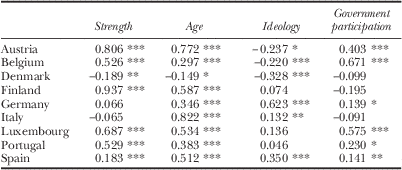
The average spending levels presented in Figure 1 inevitably conceal substantial differences between individual parties. We hypothesized that four party-level and eight country-level variables might explain the differences between individual parties with respect to their spending levels. Table 1 describes the bivariate relationship between the IPS and the four party-level variables by means of Pearson’s r for all nine countries in our dataset. The measures are shown for each country separately to obtain an insight into these bivariate relationships across different states. Similar measures are not presented for the country-level variables, as they have already been discussed extensively in previous studies (e.g. Blumenberg Reference Blumenberg2013; Kulick and Nassmacher Reference Kulick and Nassmacher2012; Nassmacher Reference Nassmacher2009).
Bivariate Relationship (Pearson’s r) between IPS and Party Strength, Party Age, Party Ideology and Government Participation, per country

Note: * p<0.10; ** p<0.05; *** p<0.01.
A number of preliminary findings can be deduced from Table 1. The relationship between party strength and the IPS is generally in line with our expectations: we find a positive and significant correlation for all but three countries in our dataset. Denmark especially is a clear outlier, showing a significant negative relationship. This finding also applies to party age: again, the case of Denmark contradicts the overall positive relationship with the IPS. These results might be attributed to the fact that we only consider bivariate relationships and that in this preliminary stage we do not yet control for other variables, possibly influencing these relationships. With regard to ideology, expressed on a scale from 0 (left) to 10 (right), no clear conclusions can be drawn. In three cases, no significant correlation is found. Of the remaining countries, three reveal a positive relationship, while three others show a negative one. In other words, these figures display no sound evidence of a linear relationship between spending levels and party ideology, in the sense that leftist parties spend more. Finally, the results on government participation are largely at odds with our hypothesis. In six cases, parties tend to spend significantly more as they have been in office for a longer period of time, while we expected a negative relationship. However, this finding might again be the result of the fact that we do not yet control for other variables, such as party strength, influencing government participation as well. These elements thus underline the importance of performing multivariate analyses.
Therefore, after having explored these descriptive data, we now describe the findings of the multilevel model. As the dependent variable is highly skewed and values are all-positive, we apply a natural logarithm transformation. Due to this transformation, combined with the fact that this variable is expressed as an index instead of as absolute values, the parameter estimates of the analytical model are not straightforward to interpret. Moreover, the various explanatory variables in the model are expressed on very different scales. To compare parameter estimates in terms of effect size and to facilitate the interpretation of the model output, we therefore standardize all continuous independent variables.
The intraclass correlation coefficient at level-3 equals 19.0 per cent, illustrating that almost one fifth of the total variance in spending levels is among countries (or at least between parliamentary terms at the country level). More strikingly, however, the intraclass correlation coefficient at level-2 amounts to 73.5 per cent, expressing a very high similarity of observations within the same party (or at least within the same parliamentary term at the party level). These percentages support our decision to perform a multilevel analysis.
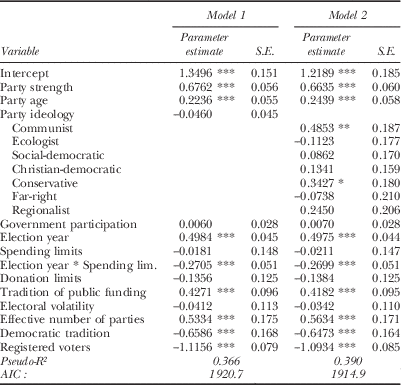
The results of our analysis are shown in Table 2.Footnote 13 As for model fit, we present both the pseudo-R² and Akaike information criterion (AIC) (the latter being 2,290 for the unconditional model). For Model 1, the pseudo-R² is 0.366 and AIC amounts to 1,921. The expenses are clearly influenced by two party-level variables, namely strength and age. Both variables are positively related to the logged IPS and highly significant. This is in line with our expectation: spending levels tend to rise as parties grow stronger and older. The effect of both ideology and government participation, on the other hand, is not significant. With regard to the country-level variables, we first find a clear effect of the electoral cycle: elections lead to significantly higher annual expenses. Moreover, the interaction term with spending limits is significantly negative, illustrating that campaign spending caps succeed in curtailing expenditures in election years. The main effect of both spending and donation limits is, although negative, not significant. In other words, these measures do not help to limit party spending on an annual basis. The effect of public funding tradition is significant and in the expected direction: spending levels increase with the tradition of public funding. With regard to electoral competition, only the effect of the effective number of parties is as expected, with a higher number of parties leading to higher expenses. Electoral volatility does not seem to have a significant effect on party spending. A longer democratic tradition, on the other hand, leads to significantly lower spending levels. Finally, we find that economies of scale indeed occur: the larger the electorate a party addresses, the lower the spending levels.
Results of the Multilevel Models, with the Logged Index of Political Spending as Dependent Variable

Note: For both models: N=1,145; Level-2 groups=361; Level-3 groups=42; * p<0.10; ** p<0.05; *** p<0.01.
The findings with regard to ideology are remarkable and appear to contradict common knowledge. However, this apparent contradiction may be due to the quantitative operationalization of the variable and the assumption of a linear relationship. It is possible that not all leftist parties have higher expenses due to a well-developed party organization, but only the social-democratic ones, with a tradition as a mass party. This can be tested by including seven dummy variables in the model for different ideological families (with the liberal family as reference category).Footnote 14 This alternative operationalization of ideology marginally improves the model fit: the pseudo-R2 increases to 0.390 and AIC decreases slightly to 1,915. However, the results are still not as expected. We find that only two party families stand out with respect to spending levels: communists and, to a minor extent, conservatives are characterized by higher overall expenses. Social-democratic parties, on the other hand, do not spend significantly more than their liberal counterparts. This finding does not match our hypothesis regarding ideology. Indeed, the most left-oriented, communist parties in our study spend more. But while we expected social-democratic parties especially to have higher expenses due to their well-developed party organization and their mass party tradition, this cannot be confirmed on the basis of these results. The parameter estimates and significance levels of all other explanatory variables remain largely unchanged in this second model.
Discussion
In this article, we analysed the spending levels of political parties based on a dataset with 1,317 observations from 99 parties in nine European countries. We first found that, in line with the findings of previous studies, no cost explosion has occurred. Annual spending levels of political parties have not escalated in the past decade, but have remained rather constant. The central aim of this study, however, was to gain an insight into these spending levels, more specifically which party and country characteristics determine that some parties have high levels of spending, while others have only limited annual expenses. The results of the multivariate models showed that there are substantial differences between countries, in the sense that the country-level variables have a significant impact on the parties’ spending levels. The expenses of political parties are significantly higher in election years, but this effect is moderated when campaign spending limits apply. A longer tradition of public funding also leads to higher expenses. Next, electoral competition plays a role: the higher the effective number of parties in the party system, the higher the spending levels. A longer democratic tradition, on the other hand, reduces expenses. Finally, we also found evidence of economies of scale. Our analyses did not show a significant effect of campaign spending and donation limits, nor does electoral volatility affect the parties’ spending levels.
As for the party-level variables, the largest effect involved party strength: the better the electoral result of a party, the higher its spending levels. Spending levels also increase with party age, while the duration of being in office does not make a difference. With regard to party ideology, the results showed that the left–right orientation of a party does not have a linear effect. Leftist parties do not spend more than right-wing parties do. We were only able to conclude that communist and conservative parties are characterized by higher expenses, but not social-democratic ones. The multivariate model has thus provided better insight in the spending levels of political parties. While we already knew why political spending is higher in certain countries, we can now also explain differences between individual political parties regarding their annual spending levels.
Nonetheless, not all results were fully in line with our expectations. First, we found no effect of government participation, while we hypothesized that spending levels would decrease the longer a party remained part of the ruling coalition, as was found by Blumenberg (Reference Blumenberg2013). One explanation might be that government parties, as all organizations, have a number of routine expenses that cannot be cut back easily when in office. Hence, the spending levels of these parties are not structurally lower than those of opposition parties, especially when party strength is controlled for.
Second, no significant effect of donation limits was found. This might be because, even though donations are still an important source of income for parties in many European states (Van Biezen Reference Van Biezen2003), parties can also rely heavily on public funding as a generous and highly predictable source of income. Even when donations are capped, parties will still have sufficient financial means at their disposal to keep their expenses at the same level.
Third, the results showed no effect of electoral volatility either, again contrary to the results of Blumenberg (Reference Blumenberg2013). We hypothesized that parties spend more in volatile electoral systems, for instance on communication, in order to attract voters and to secure their position in the party system. This can be considered as a short-term strategy. However, our findings illustrate that spending levels are not affected by the level of electoral volatility. This rather suggests that political parties, instead of immediately raising expenses in case of electoral uncertainty, tend to stabilize them. This might allow them to save money in the long term and gradually to build up a financial buffer against potential electoral adversity as a result of volatility.
Finally, we found no proof of a linear relationship between spending levels and party ideology. Leftist parties, and especially social-democratic parties, are not systematically characterized by higher spending levels than their right-wing counterparts. We only found that communists and, to a lesser extent, conservatives spend more. This result raises another interesting yet under-researched issue, involving the spending patterns of political parties. Previous studies have shown that leftist parties are generally characterized by a more developed organizational structure in comparison with right-wing parties (Enyedi and Linek Reference Enyedi and Linek2008; Wilson Reference Wilson1998). This implies that these parties arguably have higher organizational expenses. Our findings show that the size of the overall annual expenses of left-wing parties does not differ significantly from those of right-wing parties. Far-left communist parties have higher spending levels, but this finding does not hold true for the often highly organized social-democratic parties, nor for left-oriented green parties. However, we have only focused on overall spending levels and not on spending patterns. It is possible that leftist parties spend their means primarily on development and maintenance of the party organization, while right-wing parties have other priorities, for instance communication.
In more general terms, spending levels of political parties presumably conceal substantial differences with regard to spending patterns: overall annual spending levels might not differ substantially among parties, but the available means may be spent for other purposes. While some parties will be more likely to spend on organization, others will rather spend on communication. Although this argument has already been touched upon in previous studies (e.g. Blumenberg Reference Blumenberg2013), multivariate analyses on the spending patterns of political parties are generally still lacking. Future research thus needs to provide an in-depth assessment on how exactly parties spend their financial means. Combining these future analyses on parties’ spending patterns with the current results on spending levels will undoubtedly lead to a better and more profound insight into the expenses of political parties.
ACKNOWLEDGEMENTS
A previous version of this article was presented at the ECPR Graduate Student Conference in Tartu (10–13 July 2016) and at the IPSA World Congress in Poznan (23–28 July 2016). The authors would like to thank all participants for their comments and insights. The authors would also like to express appreciation for the valuable suggestions received from the anonymous reviewers of Government and Opposition. Jef Smulders gratefully acknowledges the Research Foundation – Flanders (FWO) for its generous support.