Introduction
The development of schizophrenia has been linked to a broad range of perinatal risk factors (McNeil et al. Reference McNeil, Cantor-Graae and Ismail2000; Murray et al. Reference Murray, Sham, van Os, Zanelli, Cannon and McDonald2004; Clarke et al. Reference Clarke, Harley and Cannon2006), including prenatal psychosocial stress. For example, schizophrenia in the offspring has been found to be associated with in utero events such as paternal death (Huttunen & Niskanen, Reference Huttunen and Niskanen1978; Dalman et al. Reference Dalman, Wicks and Allebeck2005), severe weather (Kinney et al. Reference Kinney, Hyman, Greetham and Tramer1999), invasion by a foreign army (van Os & Selten, Reference van Os and Selten1998), maternal depression in gestational trimester II (Jones et al. Reference Jones, Rantakallio, Hartikainen, Isohanni and Sipila1998) and unwanted pregnancy (Myhrman et al. Reference Myhrman, Rantakallio, Isohanni, Jones and Partanen1996). Myhrman et al. (Reference Myhrman, Rantakallio, Isohanni, Jones and Partanen1996) found that women who reported that the pregnancy was ‘unwanted’ (rather than ‘wanted’ or ‘mistimed’) in the middle of pregnancy had offspring who more often developed schizophrenia by 28 years of age [odds ratio (OR) 2.4, 95% confidence interval (CI) 1.2–4.8], this being strongest in female offspring. Another prospective study (Herman et al. Reference Herman, Brown, Opler, Desai, Malaspina, Bresnahan, Schaefer and Susser2006) found a trend towards an association between unwanted pregnancy and offspring schizophrenia-spectrum disorders (p=0.06, hazard ratio 1.75, 95% CI 0.97–3.17).
As these findings potentially have considerable clinical, preventive and theoretical value, they should be retested and the mechanisms for the association investigated. Unwanted pregnancy could represent a more generalized stressful situation during pregnancy and childhood (Rantakallio, Reference Rantakallio1974; Rantakallio & Myhrman, Reference Rantakallio and Myhrman1980) that is associated with risk factors for psychosis, for example somatic perinatal abnormality and malformations (Forssman & Thuwe, Reference Forssman and Thuwe1966; Blomberg Reference Blomberg1980; Lou et al. Reference Lou, Hansen, Nordentoft, Pryds, Jensen, Nim and Hemmingsen1994; Sjöström et al. Reference Sjöström, Valentin, Thelin and Marsal1997; Nimby et al. Reference Nimby, Lundberg, Sveger and McNeil1999), childhood psychosocial stressors (Rantakallio & Myhrman, Reference Rantakallio and Myhrman1980) and social relation problems in the family and in school (Dytrych et al. Reference Dytrych, Matejcek, Schüller, David, Dytrych, Mstejcek and and Schüller1988; Myhrman, Reference Myhrman1988). New studies should test the role of (a) potential ‘confounders’ (e.g. maternal experience of stress in general and active mental disturbance) during pregnancy and (b) subsequent potential ‘mediators’ such as labour-delivery and neonatal complications (Cannon et al. Reference Cannon, Jones and Murray2002), malformations (McNeil et al. Reference McNeil, Cantor-Graae and Ismail2000; Cannon et al. Reference Cannon, Jones and Murray2002) and childhood psychosocial stressors (Wicks et al. Reference Wicks, Hjern, Gunnell, Lewis and Dalman2005). Studies should also test (c) the relationship between unwanted pregnancy and genetic risk. Mothers with unwanted pregnancies may themselves have had psychological problems during pregnancy (Myhrman et al. Reference Myhrman, Rantakallio, Isohanni, Jones and Partanen1996), and parents' mental health has not been taken into consideration in studies of the effect of unwanted pregnancy (Kubicka et al. Reference Kubicka, Roth, Dytrych, Matejcek and David2002). Isohanni et al. (Reference Isohanni, Moilanen, Jokelainen, Jones, Myhrman, Rantakallio and Veijola2004) suggested that unwanted pregnancy might represent a marker of genetic risk, being most frequent in schizophrenia cases with a positive family history of psychosis. Alternatively, unwanted pregnancy could represent an environmental stressor that interacts with genetic risk for psychosis. Finally, studies should determine (d) whether unwanted pregnancy is associated with offspring affective disorders, to test for specificity of outcome. Longitudinal studies (Forssman & Thuwe, Reference Forssman and Thuwe1981; Kubicka et al. Reference Kubicka, Roth, Dytrych, Matejcek and David2002) have found that unwanted pregnancy (rejected application for therapeutic abortion) increased the risk for offspring to become psychiatric patients (especially in-patients; Kubicka et al. Reference Kubicka, Roth, Dytrych, Matejcek and David2002) in adulthood, and to score high on depression (Kubicka et al. Reference Kubicka, Matecjck, David, Dytrych, Miller and Roth1995, Reference Kubicka, Roth, Dytrych, Matejcek and David2002). The relationship was strongest in unwanted females (Kubicka et al. Reference Kubicka, Matecjck, David, Dytrych, Miller and Roth1995).
We thus investigated the four issues (a)–(d), studying offspring at genetic high risk and normal risk who were prospectively investigated from foetal age to young adulthood.
Method
Subjects
The subjects came from the Swedish High-risk Project, which is a prospective longitudinal study of individuals at genetically heightened risk for serious mental disorder, defined on the basis of a maternal psychosis history, and individuals at normal risk (NR), defined by an absence of a psychosis history in the mother and father, prior to the birth of the subjects (McNeil et al. Reference McNeil, Kaij, Malmquist-Larsson, Näslund, Persson-Blennow, McNeil and Blennow1983a). None of the fathers in the high-risk (HR) group had been hospitalized for a psychosis. The maternal sample was selected in 1973–1977 from all prenatal clinics in southwest Sweden, and prospective investigation of the offspring was begun during the mothers' pregnancies (McNeil et al. Reference McNeil, Kaij, Malmquist-Larsson, Näslund, Persson-Blennow, McNeil and Blennow1983a). HR and NR groups were comparable to one another on maternal age, parity, social class, marital status and geographical residential area during pregnancy. At mean 22.4 [standard deviation (s.d.)=1.0] years of age, 93.3% (n=166) of the subjects (93.8% HR, 92.9% NR) were successfully followed up and assessed (Schubert & McNeil, Reference Schubert and McNeil2003). These 166 subjects represented 75 HR offspring, that is 38 offspring of women with a history of schizophrenia-spectrum psychoses and 37 offspring of women with a history of affective-spectrum psychoses, and 91 NR offspring of comparison women without a psychosis history (Schubert & McNeil, Reference Schubert and McNeil2003). All analyses in the current study are based on these 166 subjects.
Pregnancy attitude and stressors
Two structured interviews were conducted in person with the subjects' mothers at their local prenatal clinics during pregnancy. The first interview was conducted (by T.F.M.) after quickening (84% in pregnancy weeks 21–32), and the second interview was conducted by a project-staff midwife near the end of pregnancy (McNeil et al. Reference McNeil, Kaij and Malmquist-Larsson1983b, Reference McNeil, Kaij and Malmquist-Larsson1984). Detailed information was obtained on the woman's life situation and relationships to close relatives; physical and mental health; fears about the near future; and both initial and later attitude towards the pregnancy and having a baby.
The woman's final total attitude towards this pregnancy and reproduction was summarized (by T.F.M.) at the end of pregnancy, according to a five-point scale: ‘very positive’ (strongly positive attitude only), ‘positive’ (moderately positive attitude only), ‘ambivalent’ (a mixture of negative and positive attitudes), ‘negative’ (moderately negative attitude only), and ‘very negative’ (strongly negative attitude only). This summary was a clinical judgment integrating the information obtained through the following seven interview items, plus the interviewer's subjective impressions and interpretations of the mother's statements (McNeil et al. Reference McNeil, Kaij and Malmquist-Larsson1983b, p. 453): (a) pregnancy (un)planned (actively planned/let it happen consciously/an unplanned mistake/a technical failure of contraceptives), (b) use of contraceptives near the time of conception, (c) woman's initial (five-point: from very positive to very negative) reaction to pregnancy, (d) woman's consideration of a legal abortion, (e) woman's consideration of giving up the baby for adoption, (f) woman's (five-point: from very positive to very negative) attitude towards the pregnancy/reproduction in the middle of pregnancy, and (g) woman's (five-point: from very positive to very negative) attitude towards the pregnancy/reproduction near the end of pregnancy.
‘Unwanted pregnancy’ was scored if the final total attitude was clinically judged as ‘ambivalent’ (21.7% of the total sample), ‘negative’ (7.2%) or ‘very negative’ (0.6%); and scored as ‘positive’ if the total final attitude was judged as ‘positive’ (63.3%) or ‘very positive’ (7.2%). Unwanted pregnancy was thus observed in 49 (29.5%) of the current total 166 cases (similar to the 30% observed in the USA; Abma et al. Reference Abma, Mosher, Peterson and Piccinino1997).
Three other somewhat similar co-temporaneous pregnancy characteristics (scored prospectively by T.F.M.) were chosen as possible ‘confounders’ for the effects of unwanted pregnancy: (a) active maternal mental disturbance during pregnancy, based on maternal report and interviewer's observation, and judged by the interviewer on a seven-point rating scale (McNeil et al. Reference McNeil, Kaij and Malmquist-Larsson1984), dichotomized as categories 1–3 (none–mild) versus 4–7 (clear mental disturbance), (b) notable smoking in pregnancy trimester II (McNeil et al. Reference McNeil, Kaij and Malmquist-Larsson1983b; Henriksson & McNeil, Reference Henriksson and McNeil2006) dichotomized as none–moderate (0–10 cigarettes/day) versus notable smoking (>10), and (c) level of total pregnancy stress (i.e. ‘experienced stress associated with problematic events, situations and/or future threats during this pregnancy’); scored on a four-point scale and dichotomized as categories 1–2 (none/mild) versus 3–4 (stress exceeding a mild or natural type and level often experienced by pregnant women). The choice of confounders was based on the premise that unwanted pregnancy could be just one aspect of a larger or general stressful situation during pregnancy, and inclusion of such possible confounders would reduce the risk of incorrectly assigning the hypothesized effect to unwanted pregnancy, if it instead resulted from other, somewhat similar phenomena.
Perinatal complications and malformations
These somatic conditions were included as potential subsequent ‘mediators’, in which the stress associated with unwanted pregnancy hypothetically might lead to somatic complications, thus increasing the risk for schizophrenia in the offspring. The offspring were delivered in the obstetric departments of 11 hospitals in 11 cities in southern Sweden. Information on labour-delivery and neonatal complications was obtained in all cases from standardized medical records, and in 83% from personal observations by T.F.M., who was present on the delivery ward prior to 2 h post-partum (in most cases prior to the delivery). Five objectively defined variables from a previous study (McNeil & Blennow, Reference McNeil and Blennow1988) were analysed: (a) prolonged labour (>10 h in primiparae or >6 h in multiparae, from the onset of regular painful uterine contractions and 3-cm cervix dilation, until birth), (b) foetal distress (meconium in amniotic fluid and/or foetal heart rate <120 and/or >160 beats/min), (c) low 1-min Apgar score (<7 points), (d) abnormal gestational age (<37 or >42 completed weeks), and (e) abnormal birthweight for gestational age (at least 2 s.d.) below or above the population gender-specific weight mean for that gestational age). Information on offspring malformations was independently obtained (by L. Lundberg, M.D.) from well-baby clinic records for repeated examinations during the first 4 years of life, and by personal examinations of the newborns by the first author and a paediatrician (McNeil et al. Reference McNeil, Blennow and Lundberg1992). Malformations included both major and minor anomalies (Ekelund et al. Reference Ekelund, Kullander and Källén1970) and were scored here as present versus absent.
Early childhood stressors
Information on psychosocial stressors during the offspring's first 4 years of life was independently obtained through assessment of well-baby clinic records by K.M.H., who was blind as to the subject's risk-group status and all other data used in this study (Henriksson & McNeil, Reference Henriksson and McNeil2004). The stressors that were noted were judged to be potentially harmful or threatening to the child's health or well-being, and constituted (a) suspected or confirmed physical child abuse; (b) social problems in the family, including drug/alcohol abuse, neglect of the child, maltreatment of some other family member, sustained unemployment, poverty or criminality; (c) the child having to spend time in a foster home/public nursery; (d) the child being reared by a single parent for a substantial period; and/or (e) either of the parents dying or being severely ill with an acute physical or mental illness or hospitalization during the offspring's first 4-year period. Stressors were scored as present (⩾1) versus absent.
Adult mental disturbance in offspring
A physician (E.W.S.) who was blinded as to the subject's risk-group status and all previous project information, and who had extensive experience in psychiatric diagnosis, examined the subjects during a full day of assessment at their local general practitioner's office (Schubert & McNeil, Reference Schubert and McNeil2003). The Swedish version of the Structured Clinical Interview for DSM-III-R (SCID I and II) was used to diagnose Axis I and Axis II disorders. Axis I disorders could occur at any time during adolescence and adulthood until follow-up. Axis II personality disorders were scored if occurring at the time of follow-up (Schubert & McNeil, Reference Schubert and McNeil2003).
Schizophrenia-spectrum disorders (schizophrenia, schizo-affective psychosis or Cluster A paranoid, schizoid and schizotypal personality disorders) were diagnosed in 10 of the 166 subjects, that is in six (15.8%) of the 38 offspring of women with a history of schizophrenia-spectrum psychoses, two (5.4%) of the 37 offspring of women with a history of affective psychoses, and two (2.2%) of the 91 NR offspring (Schubert & McNeil, Reference Schubert and McNeil2003; Schubert et al. Reference Schubert, Henriksson and McNeil2005). Affective disorders [manic episode of psychotic degree, major depressive disorder, dysthymic disorder, and depressive disorder not otherwise specified (NOS)] were diagnosed in 35 (21.1%) of the 166 subjects, that is in 14 (36.8%) offspring of women with a history of schizophrenia-spectrum psychoses, 11 (29.7%) offspring of women with a history of affective psychoses and 10 (11.0%) NR offspring. Four subjects (three offspring of women with a history of schizophrenia-spectrum psychoses and one offspring of women with a history of affective psychoses) had both schizophrenia-spectrum and affective disorders. To separate the two mental outcomes, we included these four subjects in analysis of the relationship between unwanted pregnancy and schizophrenia-spectrum disorders, but excluded them from the analysis for the more frequent affective disorders.
Analysis
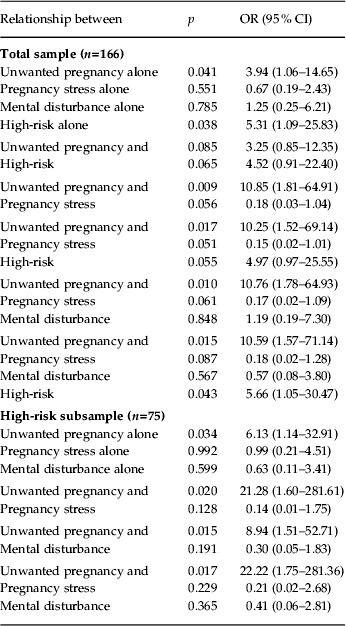
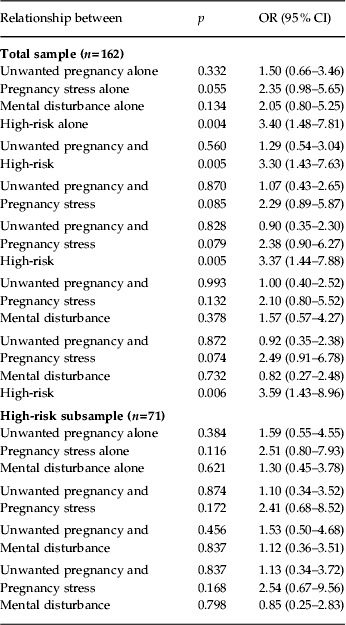
Analyses were performed both in the total sample and in the HR subsample alone, as offspring adult mental disturbance and maternal pregnancy stressors tended to occur more frequently in HR subjects (McNeil et al. Reference McNeil, Kaij and Malmquist-Larsson1983b, Reference McNeil, Kaij and Malmquist-Larsson1984; Schubert & McNeil, Reference Schubert and McNeil2003). Logistic regression (SPSS 12.0, SPSS Inc., Chicago, IL, USA), with ORs and 95% CIs, was used to analyse the relationship between unwanted pregnancy and offspring adult mental disorder (schizophrenia-spectrum and affective disorders). Analyses were conducted both with and without potential confounders/mediating risk factors and offspring sex, to determine whether different combinations among the confounders (Tables 1 and 2) and the mediators/sex (Table 3) explained (i.e. diminished) the relationship between unwanted pregnancy and offspring mental disorder. Genetic-risk status was included in analysis of confounders in the total sample, as risk-group status was known to be related to both confounders and offspring mental outcome. The effect of each potential mediator and offspring sex was tested separately to determine whether a given factor was responsible for the relationship between unwanted pregnancy and mental outcome.
Unwanted pregnancy, potential pregnancy confoundersFootnote a and offspring adult schizophrenia-spectrum disorder (logistic regression analysis)

OR, Odds ratio; CI, confidence interval.
a Rate in total sample (n=166); unwanted pregnancy (n=49, 29.5%); pregnancy stress (n=98, 59.0%); mental disturbance (n=28, 16.9%). Rate in high-risk subsample (n=75); unwanted pregnancy (n=28, 37.3%); pregnancy stress (n=47, 62.7%); mental disturbance (n=25, 33.3%). Rate in normal-risk subsample (n=91); unwanted pregnancy (n=21, 23.1%); pregnancy stress (n=51, 56.0%); mental disturbance (n=3, 3.3%).
Unwanted pregnancy, potential pregnancy confounders and offspring adult affective disorder (logistic regression analysis)

OR, Odds ratio; CI, confidence interval.
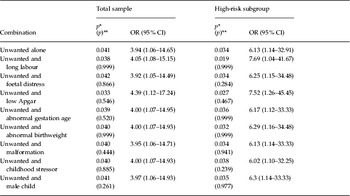
Adult schizophrenia-spectrum disorder as a function of unwanted pregnancy, alone and in combination with potential ‘mediators’: perinatal/sex/childhood factors (logistic regression, analysis)

* p=odds ratio (OR) and 95% confidence interval (CI) for unwanted pregnancy.
** p for other factor.
Fisher's exact probability, with ORs and 95% CIs, was used to study the associations between unwanted pregnancy and (a) pregnancy stressors, (b) perinatal/neonatal complications/malformations, (c) early childhood environmental stressors and (d) genetic risk-group status. Statistical significance was defined as p<0.05, two-tailed. An interaction between genetic risk-group status and unwanted pregnancy, as related to offspring adult mental outcome, was evaluated for the four different combinations of HR/NR-group status×unwanted/wanted pregnancy exposure, with ORs and exact 95% CIs calculated using StatXact-6 (Cytel Software Corporation, Cambridge, MA, USA).
Results
Unwanted pregnancy and co-temporaneous pregnancy stressors (confounders)
In the total sample, unwanted pregnancy was significantly positively related to total maternal pregnancy stress (p<0.0001, OR 13.59, 95% CI 4.59–40.23) and to active maternal mental disturbance (p=0.0011, OR 4.24, 95% CI 1.82–9.87) but not to notable smoking (p=0.271, OR 1.67, 95% CI 0.73–3.81). The HR subsample showed similar significant relationships between unwanted pregnancy and total maternal pregnancy stress (p<0.0001, OR 16.10, 95% CI 3.42–75.78) and active maternal mental disturbance (p=0.006, OR 4.27, 95% CI 1.54–11.84), but not notable smoking (p=0.792, OR 1.21, 95% CI 0.42–3.49). Total pregnancy stress and active mental disturbance thus represented potential ‘confounders’ and were controlled for in analysis of the relationship between unwanted pregnancy and offspring mental outcome.
Unwanted pregnancy and adult offspring schizophrenia-spectrum disorder
Unwanted pregnancy was significantly related to offspring adult schizophrenia-spectrum disorder in both the HR subgroup by itself (OR 6.13) and the total sample (OR 3.94). In the total sample, this relationship was attenuated somewhat when adjusted for genetic-risk status (OR 3.25), but became stronger (ORs>10) when also adjusted for total pregnancy stress and active maternal mental disturbance in combination with genetic-risk status (Table 1).
Offspring (female) sex was not significantly related to schizophrenia-spectrum disorders in the total sample (p=0.33, OR 0.45, 95% CI 0.11–1.81) or the HR subgroup (p=1.00, OR 0.83, 95% CI 0.18–3.79). The relationship between unwanted pregnancy and adult schizophrenia-spectrum disorders was unaffected when sex was controlled for in both the total sample and the HR subgroup (Table 3).
Secondary descriptive analyses in the total sample showed that offspring schizophrenia-spectrum disorder was found for 4/36 (11.1%) women with ‘ambivalent’ attitudes and 2/13 (15.4%) women with ‘negative’ or ‘very negative’ attitudes, as compared with 4/117 (3.4%) with ‘positive’ or ‘very positive’ attitudes. Offspring schizophrenia-spectrum disorder showed somewhat varying relationships to the individual standardized items contributing to the clinical summary, that is unplanned pregnancy (OR 1.22, 95% CI 0.58–2.51), non-positive initial response (OR 1.10, 95% CI 0.51–2.37), having considered an abortion (OR 1.84, 95% CI 0.54–6.29), non-positive trimester II attitude (OR 1.81, 95% CI 0.84–3.88) and non-positive trimester III attitude (OR 1.71, 95% CI 0.83–3.50).
Potential ‘mediators’ for unwanted pregnancy
Perinatal complications
In the total sample, unwanted pregnancy was not significantly related to prolonged labour (n=11 cases, p=0.312, OR 2.00, 95% CI 0.58–6.93), foetal distress (n=56, p=0.719, OR 0.82, 95% CI 0.40–1.67), low 1-min Apgar score (n=14, p=0.069, OR 0.17, 95% CI 0.02–1.34), abnormal gestational age (n=30, p=0.827, OR 0.86, 95% CI 0.35–2.10), abnormal birthweight for gestational age (n=8, p=0.441, OR 0.34, 95% CI 0.04–2.86) or malformations (n=64, p=1.00, OR 1.01, 95% CI 0.51–2.01). The HR subgroup showed similar results for prolonged labour (n=5, p=0.060, OR 7.82, 95% CI 0.82–74.27), foetal distress (n=22, p=1.00, OR 0.94, 95% CI 0.34–2.64), low 1-min Apgar score (n=8, p=0.24, OR 0.22, 95% CI 0.02–1.89), abnormal gestational age (n=14, p=0.55, OR 0.64, 95% CI 0.18–2.29), abnormal birthweight (n=4, p=1.00, OR 0.56, 95% CI 0.06–5.71) and malformations (n=28, p=1.00, OR 0.90, 95% CI 0.34–2.37).
In both the total sample and the HR subgroup, the relationship between unwanted pregnancy and adult offspring schizophrenia-spectrum disorder remained statistically significant and unchanged by the inclusion of each of these perinatal risk factors and malformations in the logistic regression analysis (Table 2).
Early childhood environmental stressors
Unwanted pregnancy was not significantly related to early childhood environmental stressors in either the total follow-up sample (p=0.346, OR 1.49, 95% CI 0.72–3.06) or the HR subgroup (p=0.64, OR 0.78, 95% CI 0.31–2.00). The inclusion of childhood stressors together with unwanted pregnancy in the logistic regression led to no attenuation of the relationship between unwanted pregnancy and adult schizophrenia-spectrum disorder (Table 3).
Genetic risk, interaction with unwanted pregnancy
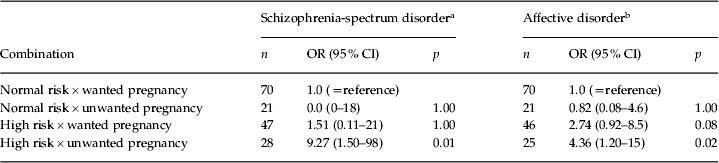
Unwanted pregnancy tended non-significantly to occur more frequently in the HR (37.3%) than the NR (23.1%) sample (exact p=0.060, OR 1.99, 95% CI 1.01–3.90), yielding weak support for unwanted pregnancy as a sign of genetic risk for psychosis. However, unwanted pregnancy showed an interaction with genetic risk for psychosis, demonstrating an association with offspring mental outcome within the HR group. Compared to the reference condition of ‘normal risk and wanted pregnancy’, genetic HR subjects exposed to unwanted pregnancy had a more than ninefold significantly increased rate of adult schizophrenia-spectrum disorder, whereas genetic HR subjects exposed to a ‘wanted pregnancy’ did not have a significant increase in such disorders (Table 4). Unwanted pregnancy was associated with an increase in schizophrenia-spectrum disorders only in the HR subgroup.
Interactions between risk-group status×(un)wanted pregnancy in relation to offspring adult mental disorder

OR, Odds ratio; CI, confidence interval.
a Ten with schizophrenia-spectrum disorder among 166 subjects.
b Thirty-one with affective (no schizophrenia-spectrum) disorder among 162 subjects (four subjects with schizophrenia-spectrum disorder excluded).
Unwanted pregnancy and adult offspring affective disorder
Unwanted pregnancy, by itself and when adjusted for maternal total pregnancy stress and active maternal mental disturbance, was not significantly related to adult offspring affective disorder in the total sample or in the HR subsample (Table 2). Offspring affective disorder was found for 8/34 (23.5%) women with ‘ambivalent’ attitudes and 3/12 (25.0%) women with ‘negative’ or ‘very negative’ attitudes, as compared with 20/116 (17.2%) with ‘positive’ or ‘very positive’ attitudes (total sample).
Genetic risk-group status was significantly related to affective disorders, but inclusion of risk-group status together with unwanted pregnancy, and with the other confounders, did not influence the absence of a relationship between unwanted pregnancy and affective disorders. Furthermore, female offspring sex per se was significantly related to adult affective disorder in both the total sample (p=0.0048, OR 3.38, 95% CI 1.44–7.90) and the HR subgroup (p=0.033, OR 3.45, 95% CI 1.19–9.99), but unwanted pregnancy remained unrelated to adult offspring affective disorder in both samples when controlled for sex (total sample: p=0.285, OR 1.60, 95% CI 0.68–3.77; HR subgroup: p=0.213, OR 2.05, 95% CI 0.66–6.37).
By contrast, a significant interaction between unwanted pregnancy and genetic risk was observed for adult offspring affective disorder, unwanted pregnancy having an effect within the HR subgroup. Genetic HR cases exposed to unwanted pregnancy had more than a fourfold significantly increased rate of adult affective disorder (compared with the reference condition), whereas genetic HR cases exposed to ‘wanted pregnancy’ had only a non-significant increase in affective disorder. Unwanted pregnancy was not associated with increased affective disorder in the NR group (Table 2).
Discussion
Unwanted pregnancy, in interaction with genetic risk for psychosis, was associated with a significantly increased risk of schizophrenia-spectrum disorders and of affective disorders in the offspring in young adulthood. The effect seemed to be limited to the HR subgroup. The combination of ‘unwanted pregnancy and genetic risk group’ was more strongly associated with offspring schizophrenia-spectrum disorder (OR 9.27) and with affective disorder (OR 4.36) than was ‘wanted pregnancy and genetic-risk group’ (OR 1.51 and OR 2.74, respectively) (Table 4).
The basis for the associations between unwanted pregnancy and offspring mental disorder remains unclear. Offspring sex did not influence the association with schizophrenia-spectrum disorder, and the association was even stronger (both total sample and HR subgroup) when controlled for active maternal mental disturbance and total stress during pregnancy. Unwanted pregnancy seems to represent only a subset of phenomena representing total pregnancy stress; whereas high pregnancy stress characterized 90% of women with unwanted pregnancy, 50% of women with a ‘wanted pregnancy’ also had a high pregnancy stress level. That the association between unwanted pregnancy and offspring schizophrenia-spectrum disorder became even stronger when controlling for total pregnancy stress (Table 1) might mean that total stress contains other stressful factors that, in some manner, tend to ‘mask’ the relationship between unwanted pregnancy and offspring disorder.
The potential ‘mediators’ through which unwanted pregnancy might increase risk for offspring schizophrenia-spectrum disorders did not influence the association when they were controlled for. Further exploratory analyses of additional specific childhood stressors showed little association with unwanted pregnancy; post-partum psychoses (frequently leading to mother–infant separation; McNeil, Reference McNeil1986) were significantly less frequent in index mothers after unwanted pregnancies (14.7%) than after wanted pregnancies (38.5%) (exact p=0.028, OR 0.28, CI 0.09–0.83). Index mothers with unwanted pregnancy were not consistently different from other index mothers regarding sensitivity, social contact and tension during mother–child interaction in feeding or play situations in the home at 6 weeks or 6 months post-partum (McNeil et al. Reference McNeil, Näslund, Persson-Blennow and Kaij1985; Näslund et al. Reference Näslund, Persson-Blennow, McNeil and Kaij1985); only one of 24 comparisons showed significantly poorer interaction characteristics after unwanted pregnancy (i.e. reduced maternal social contact in play at 6 weeks among affective women; p=0.012). Nevertheless, negative influence associated with unwanted pregnancy could, in principle, occur later during childhood. For example, HR offspring born after unwanted pregnancy tended somewhat more frequently to have had a foster mother sometime from 6 to 20 years of age (21.4%) than did other HR offspring (12.8%) (p=0.35, OR 1.86, 95% CI 0.53–6.47).
The strengths of the study are its prospective nature, data from multiple sources, the use of a definition of ‘unwanted pregnancy’ based on clinical integration of multiple specific items collected over time during pregnancy, the use of two different mental outcome variables to test specificity, and the inclusion of both genetic HR and NR groups, allowing the study of interactions between unwanted pregnancy and genetic risk.
The major limitation of the study is the relatively small number of cases with schizophrenia-spectrum disorder (the wide CIs for significant findings suggesting caution in drawing conclusions). T.F.M. collected and scored data on pregnancy situation, perinatal complications and some of the malformations (with potential interdependence), but unwanted pregnancy was not significantly related to the perinatal variables or malformations per se (Table 3), and unwanted pregnancy remained significantly associated with offspring schizophrenia-spectrum disorder even with pregnancy confounders and the perinatal/malformation variables controlled for (Tables 2 and 3). Finally, our conclusions must be limited to the possible confounders and mediators studied, and other unmeasured factors could in theory explain the apparent effect of unwanted pregnancy.
In total, the results might suggest that unwanted pregnancy is not simply a marker of genetic risk (Isohanni et al. Reference Isohanni, Moilanen, Jokelainen, Jones, Myhrman, Rantakallio and Veijola2004) but could potentially constitute a functional, discrete environmental factor that, in combination with inferred genetic risk for psychosis, increases risk for offspring schizophrenia-spectrum disorder and affective disorder in adulthood. Alternatively, one or more of the myriad of the possible early or later physical or psychosocial factors not included for study here could be the true mediator of the relationship between unwanted pregnancy and adult offspring mental disorder. We welcome other prospective high-risk studies to test this possibility.
Acknowledgements
Support was provided by the Stanley Medical Research Institute, Bethesda; grant no. MH18857 from the NIMH; and grant no. 3793 from the Swedish Medical Research Council.
Declaration of Interest
None.