Introduction
As a consequence of sharp increase in the number of elderly people, the number of those who need care has also risen. It is estimated that among people over 65 years of age who receive some type of care, this is informal in 84.9% of cases (Rogero-García and Rosenberg, Reference Rogero-García and Rosenberg2011), which suggests that the family constitutes the main source of support in caring for dependent relatives: persons requiring daily assistance to fulfill health, personal, and domestic needs due to illness, impairment, or disability (Harwood et al., Reference Harwood, Sayer and Hirschfeld2004; Bond and Rodriguez Cabrero, Reference Bond, Rodriguez Cabrero, Bond, Peace, Dittmann-Kohli and Westerhof2007). The primary caregiver can be defined as an individual who devotes most of their time to caring for a dependent person (van Durme et al., Reference van Durme, Macq, Jeanmart and Gobert2012), taking on the main tasks involved in care with all the responsibilities that this entails. This primary caregiver is considered by the rest of the family to be the one responsible for a dependent person, and does not tend to be paid for carrying out such tasks (Barbosa et al., Reference Barbosa, Figueiredo, Sousa and Demain2011). Caregivers are commonly described as second victims of the illness and it is widely accepted that caring for an elderly dependent person is a burdensome and stressful task (Makizako et al., Reference Makizako, Abe, Shimada, Ohnuma, Furuna and Nakamura2009). There is much evidence about the impact of providing care on the physical and mental health of family members (Pinquart and Sörensen, Reference Pinquart and Sörensen2007; Bialon and Coke, Reference Bialon and Coke2012). Some effects that caregivers’ poor health may ultimately have on care receivers have also been studied (Bilotta et al., Reference Bilotta, Bergamaschini, Arienti, Spreafico and Vergani2010).
Several models have attempted to conceptualize the stress process experienced by the caregiver. Most of these models describe in its own way the elements involved in the process with special focus on different types of stressors, the modulating variables, and the consequences of the care (Lawton et al., Reference Lawton, Moss, Kleban and Glicksman1991; Pearlin and Mullan, Reference Pearlin and Mullan1994; Haley et al., Reference Haley1996). Nevertheless, the main determining factor of stress, over and above the objective situation being taken into consideration, is the assessment that caregivers carry out of their situation (Lawton et al., Reference Lawton, Moss, Kleban and Glicksman1991). Thus, the concept of subjective burden describes the extent to which the caregivers perceive that the care they provide has influenced different aspects of their health, and their social, personal, and economic life (Zarit et al., Reference Zarit, Reever and Bach-Peterson1980). Subjective perception of burden can be influenced by increase of stressors such as deficit increase in patient, caregivers’ social support, or personal characteristics of both caregiver and care receiver (Leggett et al., Reference Leggett, Zarit, Taylor and Galvin2010). In addition to the impact that subjective burden may have on the caregiver's health, another important consequence of subjective burden lies in the extent to which it can influence the decisions that the caregiver may make as to whether to continue providing care (Zarit and Zarit, Reference Zarit, Zarit, Downs and Bowers2008). Greater prevention of subjective burden could lead to a better management of these undesirable consequences of caregiving (del-Pino-Casado et al., Reference del-Pino-Casado, Frias-Osuna, Palomino-Moral and Pancorbo-Hidalgo2011).
Assessing the level of strain in caregivers is not a simple matter. Burden has many dimensions (Guberman et al., Reference Guberman, Keefe, Fancey, Nahmiash and Barylak2001; Zarit et al., Reference Zarit, Femia, Kim and Whitlatch2010) and personal values and cultural, ethical, and religious variables influence the way in which this is experienced and expressed. However, assessment of the perception of burden is a key resource in determining the types of services and support needed by caregivers (van Mierlo et al., Reference van Mierlo, Meiland, Van der Roest and Dröes2012), as well as in achieving advances that may lead to the design of specific intervention strategies and assessment of their effectiveness (Zarit, Reference Zarit, Qualls and Zarit2009; Zarit et al., Reference Zarit, Femia, Kim and Whitlatch2010; Losada et al., Reference Losada, Márquez-González and Romero-Moreno2011).
There are several tools available for assessing caregivers’ burden, although only a few are available in Spanish. The Zarit Burden Inventory (ZBI; Zarit et al., Reference Zarit, Reever and Bach-Peterson1980) is the most widely used – also in Spanish-speaking countries – albeit especially designed to measure the perception of strain experienced by adults who care for people with dementia. This specificity also characterizes other scales available in Spanish that have been designed or adapted to assess caregivers’ burden when relatives suffer from specific diseases like schizophrenia (Vilaplana et al., Reference Vilaplana2007), bipolar disorder (Reinares et al., Reference Reinares2004), or peritoneal dialysis (Teixidó-Planas et al., Reference Teixidó-Planas, Tarrats, Arias and Cosculluela2006). Only the Caregiver Strain Index (Robinson, Reference Robinson1983) translated into Spanish by López and Moral (Reference López and Moral2005) seems to be conceived for a more widespread use. There is no doubt that specific tools can be very helpful in specific settings and for research purposes. Nevertheless, screening tools that can be applied to the majority of the cases are also required in some practice settings.
The importance of the ease of administration of this sort of scales is another important reason to explore new alternatives in Spanish. For ongoing use in practice or clinical settings, the length of the ZBI has been found excessive (Huyck et al., Reference Huyck, Ayalon and Yoder2007). Within this context, the purpose of this study is to help to expand the catalogue of assessment resources available in Spanish – short in length – which can also be used in the case of family members who take care of individuals not necessarily having cognitive impairment.
The Caregiver Risk Screen (CRS) was developed by Guberman et al. (Reference Guberman, Keefe, Fancey, Nahmiash and Barylak2001) in the English language alongside another tool, the Caregiver Assessment Tool. The CRS was created with the specific aim of enabling the risk attached to the physical and emotional well-being of the caregiver to be measured through 12 items associated with physical and emotional health, the capacity to deal with it, the social activities that a break with the practice of care can entail, the relationship between the person receiving the care and other family members, the joint responsibility of care-related tasks, and control over their own life. The sample of caregivers that participated in the development of the original version of the tool consisted of females (82%) and males (18%) with an average age of 60 years, from both rural and urban settings, and in 57% of the cases taking care of cognitively impaired relatives (in contrast to 43% caregivers taking care of people without cognitive impairment). The internal consistency of the original version of the scale is high (Cronbach's alpha = 0.88). The Caregiver Burden Screen was used to measure convergent validity (Rankin et al., Reference Rankin, Haut, Keefover and Franzen1994), obtaining a high positive and statistically significant correlation (r = 0.83; p < 0.005; Guberman et al., Reference Guberman, Keefe, Fancey, Nahmiash and Barylak2001). The CRS is useful in assessing the change experienced by caregivers throughout the care process (Huyck et al., Reference Huyck, Ayalon and Yoder2007).
Methods
Participants
The sample is made up of 302 primary family caregivers of dependent people from the province of Biscay (Spain) who had requested financial provision for family caregivers under the protection of the Spanish Act of “Promotion of the Personal Autonomy and Care for Dependent Persons” approved by Spanish Congress in 2006 and managed in Biscay by the provincial government. Family caregivers are therefore the caregivers of individuals who – according to the above-mentioned regulation – have a severe level of dependence and, as detailed in the law, need another person's help everyday to perform some or all their daily living activities, i.e., persons who show a low to very low level of personal autonomy. With regard to the sample characteristics, they have a similar profile as that of caregivers in the rest of Spain (IMSERSO, 2005). The average age is 57.3 years (SD = 13.9; range: 21–91 years) and 21.1% are male and 78.9% female. Of the total caregivers, 59.3% care for their mother or father or their mother-in-law or father-in-law, 25.3% care for their spouse, and 25.6% for their grandmother, grandfather, or other family members. Of the total participants, 90% live permanently with the person receiving the care, and as far as intensity of care is concerned, 78.8% stated that they care for their family member “most of the day” as opposed to 14.9% who said they do so for “some hours a day,” 4.3% care for “some hours a week,” and 2% reported carrying out care-related tasks for “some days a month.”
As for the persons receiving the care, the average age was 74.3 years (SD = 24.2; range: 2–104 years); 33.9% of those receiving the care were men and 66.1% were women. As reported by caregivers themselves, care receivers suffered from a central nervous system disease (37.4%), dementia (44.7%), bone diseases, rheumatism, chronic pain, and associated mobility problems (19.7%), vascular or heart diseases (11.7%), diabetes mellitus (5.7%), breathing problems (4%), depressive symptoms, anxiety, or anguish (2.7%), psychiatric diseases (2%), tumors or cancer (2.6%), and digestive diseases (1.7%). Caregivers informed that 68.6% of the patients receiving care experienced cognitive impairment.
Measures
Caregiver Risk Screen (CRS)
The scale is made up of 12 items with a Likert-type response option from 0 (totally disagree) to 3 (totally disagree). The authors of the original version of the scale treated the items comprising the scale as a single component. For CRS adaptation and validation study purposes, the main authors of the tool were contacted, who expressed their agreement with the adaptation process.
Zarit Burden Inventory (ZBI)
The Spanish adaptation (Martín et al., Reference Martín, Salvadó, Nadal, Miji, Rico and Lanz1996) of the ZBI has been used to measure concurrent validity (the same construct). This test quantifies the degree of subjective strain evidenced by family caregivers of people with dementia, and it is one of the most commonly used scales. This is a self-administered scale consisting of 22 statements that describe how family caregivers feel. The caregivers must state the frequency with which they experience emotions that describe each item by using a scale comprising five response options from 0 (never) to 4 (almost always). The scores obtained in each item are added, and the final score represents the degree of strain experienced by the caregiver. Cronbach's alpha in this survey was 0.89. Cronbach's alpha in the original test (Martín et al., Reference Martín, Salvadó, Nadal, Miji, Rico and Lanz1996) was 0.91 and 0.92.
Symptom Check List-90-R (SCL-90-R)
The SCL-90-R inventory (Derogatis, Reference Derogatis1977) in the Spanish version (González de Rivera et al., Reference González de Rivera1989) was used to determine the convergent validity (with similar constructs). This is a self-administered questionnaire for general psychopathological assessment. It consists of 90 items and five response alternatives on a Likert-type scale ranging from 0 (not at all) to 4 (a great deal). It is preferably applied to community surveys aimed at detecting minor psychiatric pathologies. It includes nine dimensions of primary symptoms (somatization, obsessive–compulsive, interpersonal sensitivity, depression, anxiety, hostility, phobic anxiety, paranoid ideation, and psychoticism) and can also be used to extract three global indexes that reflect the overall level of seriousness of the subject. Analyses of the scale developed by Hoffman and Overrall (Reference Hoffman and Overrall1978) suggest that this questionnaire proves especially useful in obtaining a measurement of general distress or discomfort.
Procedure
The following translation and re-translation method was used to translate the CRS into Spanish (Behling and McFillen, Reference Behling and McFillen2000). Two bilingual lecturers with a large experience in translating texts in the field of psychology helped with the work. Translations were reviewed by two different sets of people: 1) Professionals working in the area of gerontology and 2) Family caregivers. All of the items were rated favorably, with no suggestions made or matters raised.
Once the translation was verified, the provincial government was used to help contact the sample. A letter was sent by ordinary mail, including a protocol, a stamped addressed envelope, and a letter informing the recipient about the research. The caregivers answered the questionnaire on voluntary basis and returned it to the University of Deusto.
Statistical analysis
In order to describe the level of caregiver risk in the sample, frequencies (n), proportions, central tendencies (mean (M)), and deviations (standard deviation (SD)) were measured. For the analysis of the items in the CRS, mean, standard deviation, asymmetry (Sk), Kurtosis (K), and the correlation coefficient (r) between the item and the rest of the scale were measured, as well as the value of Cronbach's alpha coefficient if the item was removed.
The suitability of the correlation matrix was verified to ensure that it is factorized on the basis of the Kaiser–Meyer–Olkin (KMO) test and the Bartlett sphericity test. The Parallel Analysis (PA) test (Timmerman and Lorenzo-Seva, Reference Timmerman and Lorenzo-Seva2011) and the Minimum Average Partial Method (MAP; Velicer, Reference Velicer1976) test were carried out as extraction criteria for the advisable number of factors according to the configuration of correlation matrix. Also, the multivariate normality was analyzed with the Mardia Test (Mardia, Reference Mardia1970).
In order to validate the instrument based on the theoretical model, a confirmatory factor analysis (CFA) with covariance structural techniques using the EQS program (Bentler and Wu, Reference Bentler and Wu1995; Bentler, Reference Bentler2004) was conducted. Unweighted least-square estimation was used to estimate the parameters. The Chi-squared test (χ2) was used to evaluate the goodness-of-fit of the corresponding model and indicated that the probability of variation between the sampling variance and covariance matrix and the matrix resulting from the hypothesized model was random. In the event of noncompliance with multivariate normality, estimations would be carried out by the application of robust methods (Satorra and Bentler, Reference Satorra and Bentler1990; Satorra, Reference Satorra2002).
Since χ2 is sensitive to variations in sample size (Schermelleh-Engel et al., Reference Schermelleh-Engel, Moosbrugger and Müller2003), additional measurements of the goodness-of-fit of the model, such as the Root Mean Square Error of Approximation (RMSEA) and 90% Confidence Interval of RMSEA (Hu and Bentler, Reference Hu and Bentler1999), were used, which consider values of <0.05 to be adequate and those <0.08 to be acceptable. The Goodness-of-Fit Index (GFI and the Comparative Fit Index (CFI), with values of >0.90, and the Akaike information criterion (AIC) to compare the models with different estimated parameters for which lower values would indicate higher parsimony, would be eligible.
This final model was graphically presented, which indicated the parameters of structural relationships using standardized factor coefficients and estimation errors. A significance level of p < 0.05 was chosen for a 95% reliability interval to interpret the results.
Results
Descriptive results
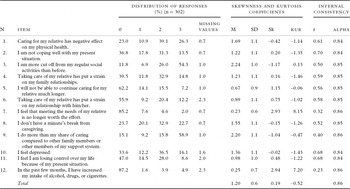
Table 1 shows the main descriptive and internal consistency data attached to the CRS. The mean value for the total score on the scale is 1.20 (SD = 0.64), which refers to a degree of intermediate agreement with the statements included on the scale (possible variance between 0 and 3) and, therefore, an expression of a medium–low level of strain. Items 7 and 12 stand out over the rest owing to their marked positive asymmetry (2.93 and 2.94) and kurtosis (8.15 and 7.20) respectively, and their elimination would cause the average value of the total scale to vary by two tenths of a point (M = 1.39). Likewise, these two items evidence correlation values below 0.35 with the total for the scale, although the elimination of either of these would help to improve the reliability of the scale (Cronbach's alpha), which has been 0.86. None of the remaining CRS items evidenced excessive asymmetric values (<–1; >+1), although seven of them evidenced asymmetric values with regard to kurtosis. In all the cases, the correlation values of the items with the total for the scale are more than 0.40 and the elimination of any of these would reduce the reliability of the total scale.
Descriptive data of each variable and internal consistency (Caregiver Risk Screen)

Notes. M: mean; SD: standard deviation; r: item-total correlation coefficient; Alpha: reliability coefficient if item deleted.
FACTOR structure
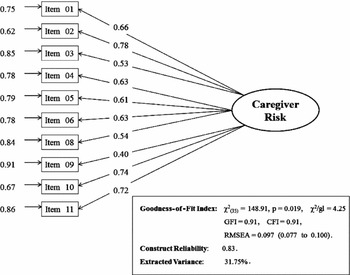
The FACTOR program (Lorenzo-Seva and Ferrando, Reference Lorenzo-Seva and Ferrando2006) was used to check the factorization criteria of the polychoric correlation matrix and to rate the optimum number of factors to be retained via Velicer's (MAP) and Parallel tests. The matrix determinant (0.0004), the KMO test (=0.87), and Bartlett's test of sphericity (χ2(66) = 1651.8; p < 0.001) enabled the factorization of the matrix. The MAP test indicates the appropriateness of retaining a single factor, whereas the Parallel test suggests retaining two factors. Due to the evidence of the scale construct, in addition to the authors’ recommendation (Guberman et al., Reference Guberman, Keefe, Fancey, Nahmiash and Barylak2001) for estimating a single score on the scale, the polychoric correlation matrix has been subjected to CFA using the EQS program (Bentler, Reference Bentler2004). The Unweighted Least-Square Estimation test and/or robust methods in the case of multi-varied non-normality have been used. Initially, a single-factor model was put to test with the participation of 12 items that make up the CRS (M1), showing lack of fit (χ2(54) = 200.3; p < 0.001; GFI = 0.89; CFI = 0.87; RMSEA = 0.091). The Wald test recommended eliminating items 7 and 12, and the Lagrange multiplier contrast gave no indication about the appropriateness of including new causal relationships or covariance. A new single-factor comprising 10 items was put to test using these indications (M2) which evidenced a better fit and was more parsimonious (Akaike Information Criterion of 92.3 and 78.9 for models M1 and M2 respectively), with the difference between both models being statistically significant (χ2M1–M2 = 51.4; df = 19; p < 0.001). Figure 1 shows the structural model for 10 items.
Structural model for 10 items, fit indexes for the model, construct reliability and extracted variance.

Although GFI and CFI indexes evidenced a suitable fit (>0.90), the RMSEA (=0.09) was hundredth point above the maximum decision value for a suitable fit. Given this solution and the Parallel Test retaining two factors, it was decided to subject the polychoric correlation matrix to an exploratory factor analysis, with two factors with values above unity being obtained. The first factor, with an eigenvalue of 4.79, explained 46.3% variance and was saturated by items 7, 5, 6, 12, 2, 11, 10, and 4; in the case of the second factor, with an eigenvalue of 1.36 (11.1% of explained variance), it was saturated by items 3, 9, 8, 1, 10, 11, 2, and 4. Note that items 2, 4, 10, and 11 share saturation levels in both factors with weights of over 0.35.
Concurrent and convergent validity
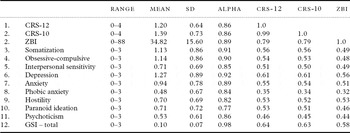
Table 2 shows the descriptive data and the correlation matrix between the total CRS scores in its version containing 10 (CRS-10) and 12 (CRS-12) items, the ZBI, and total indexes (GSI) of SCL-90-R. In all the cases, Cronbach's alpha levels (between 0.77 and 0.92) show high reliability, reaching an alpha value of 0.98 in the case of the GSI-total scale for SCL-90-R. The ZBI scale gives a mean value of 34.8 out of a possible range of 0 to 88 points, indicating a medium–low value of exhaustion or strain. The SCL-90-R inventory shows a higher average score on the depression (M = 1.3), obsessive–compulsive (M = 1.1), and somatization (M = 1.1) dimensions with anxiety values close to unity (M = 0.9). The correlation between the two versions of the CRS scale (12 versus 10 items) is practically unity, with the ZBI value proving to be 0.77 in both cases. Conversely, the correlation coefficients of the CRS using the SCL-90-R inventory have been statistically significant in all the cases, thus indicating a positive association and one of the very similar magnitudes when calculated using the CRS-10 or CRS-12. A positive and statistically significant association has also been found between the ZBI and SCL-90-R dimensions, although the size of the effect in all the cases is slightly lower than that obtained using the CRS.
Descriptive data and correlations between CRS versions of 10 and 12 items, ZBI, and SCL-90-R dimensions

Note: The correlation coefficients appear to be statistically significant (p < 0.05).
Discussion
A survey was carried out for the adaptation of the Spanish version and analysis of the psychometric features of the CRS, developed by Guberman et al. (Reference Guberman, Keefe, Fancey, Nahmiash and Barylak2001), with suitable results being obtained in terms of its internal consistency using a 10-item model adapted to the one-dimensional structure proposed by the authors. This was a pioneering survey within our context and the psychometric results obtained enabled us to assume that the CRS is indeed a suitable scale to detect the level of strain experienced by family caregivers.
In its original version, the scale consisted of 12 items, although the model that was ultimately used contained 10 items. As occurred with the original study (Guberman et al., Reference Guberman, Keefe, Fancey, Nahmiash and Barylak2001), items 7 and 12 evidenced great positive asymmetry, probably influenced by a social desirability bias. Thus, on a conceptual level, although these two items include the possible consequences of care maintained over time, their excessively direct formulation may affect participants’ responses by failing to reflect the true impact felt in this regard. Statements like, at times I have thought that the care I offer to my family member serves little purpose (which would refer to a situation of dejection with regard to care), or at times I have surprised myself by doing things that can harm me, like smoking or drinking more, spending more time on the mobile or the Internet. . . (escapist behavior to reduce the stress of care) might be susceptible to response bias. Nonetheless, the elimination of these two items does not alter the internal consistency of the total scale by any major extent insofar as it maintains the value of its reliability coefficient (Cronbach's alpha = 0.86), and the correlation coefficient of the total index for the scale calculated using the contribution of 10 or 12 items is practically unity (r = 0.99). The one-dimensional structure model tested via CFA also provides a better fit with the model that contains 10 items than that with 12 items.
In terms of the fit and factor structure of the CRS, although the factor weights of 10 items are acceptable (Lambda values > 0.40), the construct reliability is high (0.83) and the general and comparative fit indexes (GFI and CFI respectively) are suitable, but the fit based on parsimoniousness (RMSEA) is not optimum insofar as it is at levels above consensus limits (<0.08). This means that there is a considerable residual variance that remains unexplained by the model that can perhaps be assumed by another multidimensional structure model. Indeed, the parallel analysis carried out on the polychoric matrix of our data (Timmerman and Lorenzo-Seva, Reference Timmerman and Lorenzo-Seva2011) points to the existence of two main factors rather than one. The analysis of item distribution in these two factors is both revealing and consistent from a conceptual point of view. It shows certain symmetry with the stress model of the caregiver developed by Pearlin et al. (Reference Pearlin, Mullan, Semple and Skaff1990). This model identifies four inter-related domains that make up the caregiver's stress process. It is precisely the first factor that combines expressions related to what Pearlin et al. (Reference Pearlin, Mullan, Semple and Skaff1990) refer to as primary and secondary stressors and results of stress, whereas the second factor would include items related to modulating variables of stress (i.e., meaningful social relations).
On the other hand, the CRS has shown suitable concurrent validity as another tool for assessing strain experienced by the caregiver, namely, the ZBI, with a shared percentage variance of 59.29%. It also converges with dimensions assessed by SCL-90-R, which refers to emotional and symptomatic strain experienced by caregivers. Furthermore, the CRS tends to be associated with these emotional and psychopathological response constructs to a slightly greater extent than the ZBI. In other words, the score obtained by the CRS helps to explain more variance in the symptomatic dimensions than by using the ZBI. This result constitutes evidence that validates the use of the CRS to estimate the strain experienced by family caregivers who take care of dependent family members.
Although the psychometric results obtained from the CRS in its adaptation to Spanish are promising, we should remain cautious about the results and consider the limitations inherent in the survey. First, although the survey provides a sufficient sample (n = 302), the features of the (polytomic) measuring scale, noncompliance with distribution criteria, and the need to use the unweighted least-square method for estimating the model would require a greater sample. Nonetheless, access to this type of population is quite costly. In the course of our survey, the postal system was used to analyze responses from individuals who voluntarily answered our request: However, we do not have any information about individuals who decided not to take part, nor do we know whether they differ from those who took part in terms of basic variables. This is undoubtedly associated with a selection bias, which should be controlled in future studies. Moreover, the use of a transversal design does not enable us to assess the psychometric behavior of the scale in its entirety. Its measuring stability still needs to be analyzed (tests–retests), as does its sensitivity to change and its predictive and discriminant validity. All these tasks need to be carried out in successive surveys and would provide additional information to help take a proper decision about the use of the CRS.
In short, this survey provides pioneering results in terms of the adaptation of the Spanish version of CRS by indicating suitable internal consistency and fit to the theoretical dimensional structure proposed by the creators of the scale. Although these should be confirmed in new surveys, the results enable us to conclude that the CRS is a suitable tool for assessing and detecting strain in family caregivers in Spain, and is also a good starting point for future adaptations – if required – in other Spanish-speaking countries.
Conflict of interest
None.
Description of authors' roles
Silvia Martinez-Rodriguez and Nuria Ortiz-Marques designed the study and its implementation, data analysis, and writing of the paper. Ioseba Iraurgi and Maria Carrasco collaborated in data analysis, discussion, and writing of the paper. Jose J. Miguel collaborated in the adaptation of the scale.
Appendix
Caregiver Risk Screen (CRS) Items (Guberman et al., Reference Guberman, Keefe, Fancey, Nahmiash and Barylak2001)