1. Introduction
Capturing dynamic targets is a challenging task, requiring highly developed physical structures and nervous systems. For instance, a well-trained baseball player can capture a flying ball through eye-hand-body coordination [Reference Yang, Walker, Branson, Dai, Sun and Kang1]. When the biological systems come into contact or collision with dynamic targets, they utilize soft tissues (e.g., ligament and muscle) around the biological joints (e.g., shoulder and elbow), to deal with the impact force, ensuring their safety and stability [Reference Laschi, Mazzolai and Cianchetti2–Reference Xie, Yuan, Liu, Tian, Chen, Fu, Mao, Jin, Wang, He, Wang, Mo, Ding, Zhang, Laschi and Wen4]. At the beginning of contact or collision, compliant interaction is required to mitigate local stress concentrations and overloading, preventing the rebound of dynamic targets. As the contact area expands and impact force intensifies, higher stiffness and damping are required to absorb and dissipate the energy, avoiding serious structural deformation or failure. According to biomechanics, the stiffness and damping of the soft tissues have a dependence on the extent to which they are stretched [Reference Kuo and Deshpande5]. This variable mechanism optimizes the dynamic response of biological systems under varying impact conditions [Reference Song, Lan and Dai6], which can be summarized as “low stiffness and damping for low impact and high stiffness and damping for high impact.” In other words, biological systems can soften to perform actions requiring compliance and stiffen to bear a heavy impact load [Reference Hu, Song and Ma7].
Various works have been done to transfer the biological features to robotic grippers, yet most of them have focused on grasping static or quasi-static targets [Reference Liu, Sun, Fang, Li, Sun and Liu8]. The rigid ones, integrated with high-performance sensors and sophisticated active control algorithms, exhibited excellent performance in terms of controllability and load capacity [Reference Jia, Gardner and Mu9–Reference Kim, Shukla and Billard11]. Nonetheless, strong impacts during collisions may cause damage to the rigid robotic systems [Reference Vidyadhara, Tony, Gadde, Jana, Varun, Bhise, Sundaram and Ghose12]. Moreover, a slight deviation in positioning or orientation may lead to undesired collision and bounce of the dynamic targets, resulting in capture failure [Reference Huang, Wang, Meng and Liu13]. In the field of soft robotics [Reference Stroppa, Majeed, Batiya, Baran and Sarac14, Reference Rus and Tolley15], researchers utilized soft materials (such as silicone rubber [Reference Michael, Robert, Kevin, Robert and George16], hydrogels [Reference Lee, Song and Sun17], polyurethane [Reference Wallin, Pikul and Shepherd18], etc.) to design various functional soft robots (such as grasping [Reference Chen, Chen, Chen, Mao, Pan, Li, Liu, Min, Ding, Sun and Wen19], swimming [Reference Li, Wong, Shih, Guo, Wang, Liu, Wang, Liu, Yan, Wu, Yu, Chen, Liang, Xue, Wang, He, Wen, Tolley, Zhang, Laschi and Li20], jumping [Reference Chen, Yuan, Guo, Bai, Zhu, Liu, Pu, Xin, Peng, Luo, Wen and Sun21], etc.). They are expected to exhibit effective interaction in environmental settings. Like biological joints relying on soft tissues to reduce impacts, soft robots essentially do the same [Reference Trivedi, Rahn, Kier and Walker22]. Sinatra et al. developed an ultra-lightweight soft robotic gripper capable of nondestructive grasping and manipulation of fragile marine life such as jellyfish [Reference Sinatra, Teeple, Vogt, Parker, Gruber and Wood23]. This gripper achieves very low contact pressure through nanofiber-reinforced soft actuators, ensuring minimal harm to jellyfish species. Lin et al. developed a Venus flytrap-inspired soft gripper that can grasp fast-moving tennis balls by utilizing snap-through instability and trigger structures [Reference Lin, Zhang, Tang, Jiao, Wang, Wang, Zhong, Zhu, Hu, Yang and Zou24]. In our previous research, a multi-tentacle gripper inspired by a sea anemone was proposed to capture dynamic targets [Reference Yang, Walker, Branson, Dai, Sun and Kang1, Reference Yang, Ren, Yang, Wang, Wan and Kang25, Reference Yang, Zhou, Walker, Yang, Branson, Song, Dai and Kang26].
To endow soft robots with the ability to adapt to different loading conditions [Reference Shintake, Cacucciolo, Floreano and Shea27], adjustable stiffness or damping mechanisms/materials have been developed in recent years [Reference Haibin, Cheng, Junfeng and Guilin28–Reference Fu, Yu, Lin, Zheng and Gan34], such as jamming mechanisms, antagonistic mechanisms, and smart materials. Despite some advances in the research of soft grippers to grasp heavy objects [Reference Kim and Billard35], they are not comparable to biological systems in effectively buffering impacts when colliding with dynamic targets. The task of capturing dynamic targets requires fast perception of impact forces and real-time adjustment of stiffness and damping. In terms of perception, active detection, for example, embedded sensors, will encounter limitations in bandwidth constraints [Reference Wang, Wang, Luo, Wang and Song36]. In terms of actuation, although compliant/soft structures can provide good buffering performance, they lead to slow response to capture dynamic targets [Reference Liu, Luo, Wang, Song, Zhang, Tian and Hu37].
For a robotic system to capture dynamic targets with high kinetic energy, strong contact interaction is inevitable. The contact problem is characterized by a large range of velocity variation, short duration of contact, and great impact force [Reference Jia38]. Consequently, a thorough analysis of the contact dynamics is essential prior to the design of robotic grippers [Reference Zhao, Liu, Li and Wu39]. At present, many contact models have been proposed, taking the Hertz model as the theoretical basis [Reference Machado, Moreira, Flores and Lankarani40]. A commonly used contact force model considering the damping loss is the Kelvin–Voigt model, which used a linear damping to measure the energy loss [Reference Ramírez, Pöschel, Brilliantov and Schwager41]. Moreover, a number of nonlinear spring and damping models were proposed, which took material properties, geometry of contact surfaces, elastic compression, and initial contact velocities into consideration. Among these models, the Hunt–Crossley model can effectively explain the buffering of impact forces and the dissipation of energy during the impact contact process [Reference Hunt and Crossley42].
This paper proposes a passive variable stiffness and damping regulator (P-VSDR) that can be integrated into a robotic gripper and demonstrates its potential in impact buffering scenarios. The main contributions include: (1) This study reveals the nonlinear effects of stiffness and damping during the contact and collision to absorb the kinetic energy. A predefined profile for variable stiffness and damping enables low stiffness and damping for low impact scenarios and high stiffness and damping for high impact scenarios. (2) A P-VSDR, engineered as an impact buffer for a tendon-driven robotic gripper, is proposed. The P-VSDR utilizes passive nonlinear dynamics to enhance the buffering performance and response speed of the robotic gripper in handling dynamic targets.
The subsequent sections of this paper are organized as follows: Section 2 elucidates the fundamental principles governing impact contact dynamics. The mechanical design of the P-VSDR and the development of the robotic gripper prototype are detailed in Section 3. Section 4 establishes the kinematic and dynamic models for the gripper integrated with the P-VSDR. Subsequent to this, Section 5 presents a series of experiments to validate the performance of the proposed prototype. Conclusion and discussion are presented in Section 6.
2. Principle of the impact contact
In this section, the principle of variable stiffness and damping during contact is investigated to guide the design of the robotic gripper used for dynamic capture. The impact force under constant and variable stiffness and damping conditions was modeled based on two classical contact models: the Kelvin–Voigt and Hunt–Crossley models, as summarized in Table I.
The elastic compression and restoration process of two contacting surfaces.

2.1. Modeling of the impact force
The contact process was described by using a linear viscoelastic method (the Kelvin–Voigt model) and a nonlinear one (the Hunt–Crossley model), respectively. Figure 1 shows the elastic compression and restoration phases between two contacting surfaces of the objects, S i and S j . The indentation depth where the surfaces come into contact can be equivalently regarded as either a linear or nonlinear spring-damper system depending on the material properties [Reference Flores43]. In the elastic compression phase from time t 0 to t 1, the relative velocity gradually decreases, and the contact force gradually increases. The maximum contact force occurs at time t 1. In this process, part of the kinetic energy of the objects was stored in the spring, and the other part was dissipated by the damping. In the elastic restoration phase from time t 1 to t 2, the deformation between the contact objects starts to restore, and the contact force gradually decreases until it becomes 0 at time t 2. In this process, part of the elastic potential energy in the spring was converted into the kinetic energy of the objects, and the other part was dissipated through damping.
Mathematical descriptions and properties of the contact dynamic models.

In the Kelvin–Voigt and Hunt–Crossley models, the contact stiffness between the contacting surfaces S i and S j can be determined by considering their material properties and radius d of contact geometry. Assuming the Young’s modulus of S i and S j are E i and E j , and the Poisson’s ratios are ν i and ν j , respectively. The contact stiffness K between two contacting surfaces of objects is
 \begin{equation} K=\frac{4E_{i}E_{j}}{3\left(1-\nu _{i}^{2}\right)E_{i}+\left(1-\nu _{j}^{2}\right)E_{j}}\sqrt{\frac{d_{i}d_{j}}{d_{i}+d_{j}}} \end{equation}
The effective mass is
 \begin{equation} M=\frac{m_{i}m_{j}}{m_{i}+m_{j}} \end{equation}
where m i and m j represent the mass of S i and S j , respectively.
The damping coefficient of a spring-damper system describes the ability of energy dissipation during an impact process. The damping coefficient D can be calculated by
 \begin{equation} D=2\zeta \sqrt{KM} \end{equation}
where ζ is the damping ratio of the spring-damper system.
In the Hunt–Crossley model, C
r
is the restitution coefficient during the contact process,
 ${\dot{x}_{0}}$
is the relative initial velocities, and n is a nonlinear coefficient related to the material itself, typically taken as 1.5 [Reference Hunt and Crossley42].
2.2. Analysis of the impact force
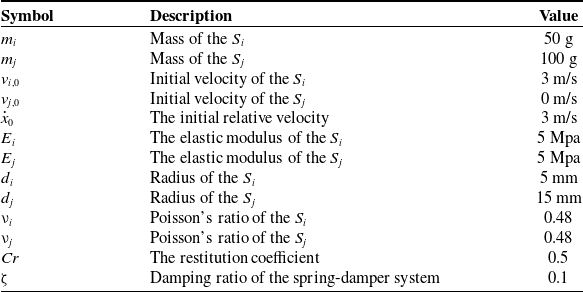
Numerical simulation of the contact process was performed based on the Kelvin–Voigt and Hunt–Crossley contact models, respectively. Here, we consider a scenario that the contact occurs between two spheres made of rubber, because rubber is a typical elastic material that can be characterized by the contact models. The parameters are presented in Table II.
List of simulation parameters in contact reaction.

Figure 2 illustrates the simulation results of impact buffering and energy dissipation, under the constant stiffness-damping conditions by using the Kelvin–Voigt model and the variable stiffness-damping conditions by using the Hunt–Crossley model. Figure 2(a) shows the impact force F
n
exhibiting a hysteresis loop. The area enveloped by the impact and restoration curves indicates the dissipated energy. When the two surfaces initially contact, the positive relative velocity
 ${\dot{x}}$
results in a positive damping force, while the indentation depth x is zero and the corresponding spring force is zero, causing the initial state of the impact force F
n
in the Kelvin–Voigt model to offset from the origin. Figure 2(b) illustrates the damping and stiffness as functions of indentation. It can be seen that a constant stiffness (8000 N/m) and a constant damping (3.2 Ns/m) are utilized in the Kelvin–Voigt model, while variable stiffness (increasing to approximately 1000N/m) and damping (increasing to approximately 4 Ns/m) are employed in the Hunt–Crossley model.
Comparison of contact dynamics: constant stiffness-damping (Kelvin–Voigt model) versus variable stiffness-damping (Hunt–Crossley model). (a) Impact force and dissipated energy with respect to indentation depth. (b) Variation of stiffness and damping in the two models. (c) Impact force as a function of time. (d) Kinetic energy of the dynamic target as a function of time.

Figure 2(c) presents a comparative analysis of the impact force F n across different models. During the contact process between the spheres S i and S j , the maximum impact force in the Kelvin–Voigt model reaches 43 N, with an approximate duration of contact of 0.006 s. However, in the Hunt–Crossley model, the maximum impact force is 18 N, with a duration of contact of about 0.02 s. In contrast to the constant stiffness of the Kelvin–Voigt model, the Hunt–Crossley model exhibits a superior ability to reduce peak impact forces and extend the duration of contact. These characteristics are crucial for mitigating the detrimental effects of impact force, enabling more effective energy distribution and dissipation throughout the collision process. This results in a more robust resistance to the potential for damage caused by dynamic loading conditions
The effects of variable stiffness and damping are also demonstrated from the viewpoint of energy. The ratio between the K i,0–K i and corresponding K i,0 is used to characterize the kinetic energy dissipation efficiencies η, as shown in Eq. (6).
 \begin{equation} K_{i,0}=\frac{1}{2}m_{i}{v_{i,0}}^{2},\,\quad K_{i}=\frac{1}{2}{m_{i,0}}^{2},\,\quad \eta =\frac{K_{i,0}-K_{i}}{K_{i,0}}\times 100\% \end{equation}
where K i,0 is the initial kinetic energy of the S i at the time of impact, K i is the kinetic energy of the S i at the time of separation, and K i,0–K i is the dissipated kinetic energy of the S i at the time of separation. Figure 2(d) compares the kinetic energy of the dynamic target S i obtained by the Kelvin–Voigt and Hunt–Crossley models. The dynamic target S i initially had a kinetic energy of 0.225J and was reduced to 0.125J by using the Kelvin–Voigt model, with the kinetic energy dissipation efficiency of 44.4%. However, the kinetic energy of the dynamic target was reduced to 0.098J by using the Hunt–Crossley model, with the kinetic energy dissipation efficiency of 56.4%. Compared to the constant damping characteristic of the Kelvin–Voigt model, the Hunt–Crossley model effectively enhances energy dissipation and extends the duration of impact engagement. This improved energy dissipation capacity plays a critical role in suppressing impact oscillations, thereby contributing to a more stable response for dynamic capture.
In the context of the Hunt–Crossley model, the deceleration in the increasing rate of stiffness during collision effectively prolongs the interaction time between objects, consequently attenuating peak impact forces. Simultaneously, the accelerated increase in damping reduces the elastic potential energy and enhances energy dissipation. This variable stiffness and damping approach, in contrast to a constant stiffness and damping configuration, provides substantial promise for improving impact buffering and energy dissipation for dynamic target capturing. At the beginning of dynamic target capturing, where minimal deformation and low impact forces are prevalent, reduced stiffness and damping help prevent an overly rigid system response, thereby mitigating the risk of target bouncing. As the process progresses into the later stages of dynamic target capturing, characterized by increased deformation and significant impact forces, elevated stiffness and damping become instrumental in expediting energy dissipation and suppressing the tendency for impact resonance.
Leveraging the principles of the Hunt–Crossley model, a tailored variable stiffness and damping mechanism for dynamic target capturing is proposed, inspired by the concept of “low stiffness and damping for low impact and high stiffness and damping for high impact,” to guide the design of our gripping mechanism.
3. Principle of the P-VSDR
The primary challenge in constructing a gripper for dynamic capture is to develop a compliant mechanism embedded with variable stiffness and damping. In this section, a P-VSDR was proposed by utilizing a special compliant structure that combines the nonlinear motion of tendons with linear elastic elements. The P-VSDR was then integrated into a robotic gripper to achieve impact buffering and energy dissipation for capturing dynamic targets.
3.1. Design methodology of the P-VSDR
The P-VSDR consists of a linear spring-damper unit and a nonlinear tendon-driven transmission unit, as shown in Fig. 3. The linear spring-damper unit is composed of a hydraulic cylinder and a bypass orifice. The hydraulic cylinder contains a piston rod and a linear spring. The nonlinear transmission unit is composed of a pulley, a guide rod, and a slider. One end of the tendon is fixed to the slider, while the other end is fixed to the piston rod via the pulley. Frictions from pulleys, sliders, and piston rods are reduced by using the ball and linear bearings, as well as the lubrication provided by the hydraulic oil in the cylinder; thus, frictions are assumed to be negligible in comparison to the dynamic impact during the capture process.
Working principle of the P-VSDR. (a) The initial state with no external impact load. (b) The compressing state due to external impact load F te . (c) The restoration state when external impact load vanishes.

When the impact force F te is applied to the slider, the slider moves along the guide rod in the direction of the impact force. At this time, the angle between the tendon and the slider, θ b , decreases. It is important to note that this change of the angle θ b is nonlinear. The impact force F te pulls out the piston rod via the tendon, causing the spring to compress and the hydraulic oil to flow back into the right chamber through the orifice. From the viewpoint of energy, the impact energy is partially transferred to the elastic energy in the spring, and partially dissipated by the orifice, as shown in Fig. 3(b). When the impact process is finished, the energy stored in the linear spring will be released, pushing the piston rod to the initial state. The hydraulic oil returns to the left chamber through the orifice, dissipating part of the energy stored in the linear spring again, thereby allowing the slider to return to its initial position, as shown in Fig. 3(c).
The slider moves along the guide rod with a displacement X t that can be expressed by the angle θ b as
 \begin{equation} {\boldsymbol{X}}_{t}=r_{ro}\left(\sin \theta _{b,0}-\sin \theta _{b}\right)+\frac{h_{ro}-r_{ro}\cos \theta _{b}}{\tan \theta _{b}}-\frac{h_{ro}-r_{ro}\cos \theta _{b,0}}{\tan \theta _{b,0}} \end{equation}
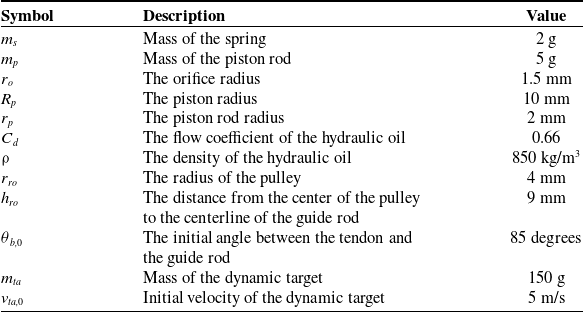
where r ro is the radius of the pulley, h ro is the distance from the center of the pulley to the centerline of the guide rod, and θ b,0 is the initial angle between the tendon and the guide rod.
The geometric relationship between the displacement L t of the piston rod and the angle θ b of the guide rod is
 \begin{equation} {\boldsymbol{L}}_{t}=\frac{\pi r_{ro}\left(\theta _{b,0}-\theta _{b}\right)}{180}+\frac{h_{ro}-r_{ro}\cos \theta _{b}}{\sin \theta _{b}}-\frac{h_{ro}-r_{ro}\cos \theta _{b,0}}{\sin \theta _{b,0}} \end{equation}
The resulting force on the slider is composed of the spring force F k and hydraulic force F d .
 \begin{align} {\boldsymbol{F}}_{k} &=k_{s}L_{t}\cos \theta _{b} \end{align}
 \begin{align} {\boldsymbol{F}}_{d} &=\frac{\pi \rho \cos \theta _{b}{R_{p}}^{2}\left({R_{p}}^{2}-{r_{p}}^{2}\right)^{2}}{2{C_{d}}^{2}{r_{o}}^{4}}\left(\left(\dot{{\boldsymbol{L}}}_{t,0}\right)^{2}-\frac{k_{s}{{\boldsymbol{L}}_{t}}^{2}\left(m_{s}+m_{p}\right)}{m_{s}m_{p}}\right) \end{align}
Thus, the horizontal force F te on the slider is
 \begin{equation} {\boldsymbol{F}}_{te}={\boldsymbol{F}}_{k}+{\boldsymbol{F}}_{d} \end{equation}
where k s is the stiffness of the liner spring in the left chamber of the hydraulic cylinder, C d represents the flow coefficient of the hydraulic oil through the orifice of orifice, ρ is the density of the hydraulic oil, R p is radius of the piston, r p is radius of the piston rod, r o is radius of the orifice, and m s and m p are the mass of the spring and the piston rod, respectively.
The ratio of the spring force change Δ F k to the corresponding slider displacement change Δ X t , as shown in Eq. (12), is used to characterize the output effective stiffness on the slider
 \begin{equation} K_{eff}=\frac{{\unicode[Arial]{x0394}} {\boldsymbol{F}}_{k}}{{\unicode[Arial]{x0394}} {\boldsymbol{X}}_{t}} \end{equation}
The ratio of the damping force change Δ
F
d
and the corresponding slider velocities change Δ
 ${\dot{{\boldsymbol{X}}}_{t}}$
, as shown in Eq. (13), is used to characterize the output effective damping coefficient on the slider
 \begin{equation} D_{eff}=\frac{{\unicode[Arial]{x0394}} {\boldsymbol{F}}_{d}}{{\unicode[Arial]{x0394}} \dot{{\boldsymbol{X}}}_{t}} \end{equation}
3.2. Simulated analysis of the variable stiffness and damping
According to Eq. (10)–(13), the variation of the effective stiffness K eff and damping coefficient D eff of the P-VSDR with respect to the geometric parameters (h ro , k s, and r o ) can be obtained and shown in Figs. 4 and 5.
The effective stiffness Keff of the P-VSDR with respect to structural parameters. (a) distance hr0 , (b) spring stiffness ks , (c) the orifice radius r0 .

The damping coefficient Deff of the P-VSDR with respect to structural parameters. (a) distance hr0 , (b) spring stiffness ks , (c) the orifice radius r0 .

In Fig. 4(a), the variation in the distance h r0 from the pulley center to the guide rod centerline has a negligible effect on the effective stiffness curve (i.e., the X t –K eff relationship) of the P-VSDR. Conversely, the effective stiffness curve is significantly influenced by the spring stiffness k s and the orifice radius r o . It can be seen from Fig. 4(b) and (c) that a decrease in the spring stiffness k s and an increase in the orifice radius r o both result in a reduced gradient of the effective stiffness curve. In summary, the effective stiffness of the P-VSDR, K eff, exhibits a nonlinear variation with respect to the displacement of the slider, X t . Initially, the slope is relatively large. However, as the displacement of the slider increases, the slope of the stiffness decreases. This behavior reflects the capability of the P-VSDR for mitigating peak impact forces and extending the duration of impact engagement, which is essential for capturing dynamic targets.
In Fig. 5, the effective damping curve (i.e., the X t –D eff relationship) is significantly influenced by those structural parameters including the distance h r0 from the pulley center to the guide rod centerline, the spring stiffness k s , and the orifice radius r o . It can be seen that a decrease in h r0, a reduction in k s , and an increase in r o all lead to a decreased gradient of the effective stiffness curve. In summary, Fig. 5 shows that the effective damping of the P-VSDR, D eff , increases with the displacement of the slider, X t . Unlike stiffness, the damping exhibits an increasing slope, which enhances the energy dissipation capabilities. This characteristic is critical for suppressing impact oscillations and contributes to a more stable system response under substantial impact loads, thereby improving the stability of the dynamic capture process.
It is worth noting that the nonlinearity of the stiffness and damping can be designed by altering spring stiffness k s and orifice radius r 0, as shown in Figs. 4 and 5. Optimal stiffness and damping profiles (i.e., optimized structural parameters) for a specific dynamic target can be obtained by defining an appropriate objective function, for example, maximum energy dissipation. Considering the actual components used for the fabrication of the P-VSDR, the main parameters listed in Table III were selected in the simulation and experiment.
List of simulation parameters in collision.

To understand the effectiveness of the P-VSDR in impact buffering and energy dissipation, a comparative analysis of the impact contact for two regulators was carried on: (1) The passive constant stiffness-damping regulator (P-CSDR) in which the tendon is directly attached to the linear spring-damper unit. (2) The P-VSDR in which the tendon is attached to the linear spring-damper unit through a nonlinear transmission unit.
For the P-CSDR, the impact force with respect to the slider displacement X t is shown in Fig. 6(a). The output effective stiffness of 100 N/m (equal to the stiffness of the linear spring) and damping of 0.98 Ns/m on the slider do not change with the slider displacement X t . It can be seen that the maximum impact force is 8.2 N. In the P-VSDR, the output effective stiffness and damping on the slider change in real-time with the slider displacement X t under the same simulation parameters (see Table III). In this case, the output effective stiffness and damping on the slider gradually approach the P-CSDR stiffness-damping value 100 N/m and 0.98 Ns/m as displacement X t increases, as shown in Fig. 6(b). The maximum impact force on the slider is reduced to 5.7 N. The area enveloped by the impact and restoration curves indicates the dissipated energy. It is 1.56 J in the P-VSDR while 0.84 J in the P-CSDR, as shown in Fig. 6(a). According to Eq. (6), the energy dissipation efficiency of 83.2% in the P-VSDR is greater than that of 44.8% in the P-CSDR.
Simulated comparison of the P-CSDR and P-VSDR. (a) Impact force and dissipated energy. (b) Variation of stiffness and damping in the P-CSDR and P-VSDR, respectively.

By comparing the simulation results in an impact process, it is found that the slider displacement and time in the P-VSDR are greater than that in the P-CSDR, while the impact force and energy dissipation are noticeably better than the results of the P-CSDR.
3.3. Design of the robotic gripper
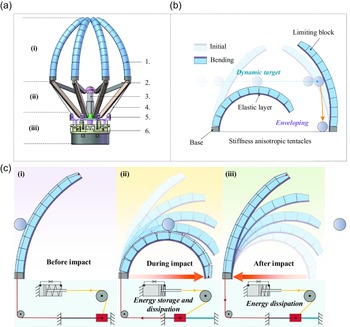
The robotic gripper developed in this section consists of a tentacle cluster capture mechanism, a deployable mechanism driven by a linear motor that opens and closes the gripper, and the passive nonlinear stiffness and damping regulators, which are shown in Fig. 7(a). Each tentacle is composed of an elastic layer on its ventral side and discrete limiting blocks on its dorsal side, as shown in Fig. 7(b). In comparison to other capture mechanisms (e.g., net, fingered gripper), the use of a tentacle cluster can achieve an omni-directional envelope to the dynamic target [Reference Yang, Zhou, Walker, Yang, Branson, Song, Dai and Kang26] and therefore improve the fault tolerance in the capture process.
Prototype of the robotic gripper. (a) The robotic gripper is mainly composed of (i) a cluster capture mechanism, (ii) a deployable mechanism, and (iii) the passive variable stiffness and damping regulators. 1. The tentacles 2. Links base. 3. Linear motor 4. Tendon 5. Guide pulley 6. P-VSDR. (b) Concept of the tentacle cluster with stiffness anisotropy and its strategy for capturing dynamic targets. (c) Three stages of the robotic gripper are (i) before the impact, (ii) during the impact, and (iii) after the impact and impact energy buffering and energy dissipation principles.

In this section, we integrate the proposed P-VSDR into the tentacle by connecting the tendon of the tentacle to the slider of the P-VSDR, as shown in Fig. 7(c). There are three states of the P-VSDR following the deformation of the tentacle:
-
1. Before the impact on the tentacle, the P-VSDR and the tentacles maintain the initial state, and stiffness and damping of the P-VSDR do not change, as shown in Fig. 7(c-i).
-
2. During the impact, the tentacles start bending, and the tension on the tendon increases. The impact force is transmitted through the tendon to the P-VSDR, which buffers the impact force to reduce the speed of the dynamic target, as shown in Fig. 7(c-ii). A part of the kinetic energy of the dynamic target is stored in the compressed spring within the hydraulic cylinder and the elastic deformation of the tentacle. The rest kinetic energy is dissipated through the damping orifice.
-
3. After the impact, the tentacle goes back to its initial position, and the tension on the tendon decreases. The energy stored in the spring and tentacle is released, leading to the reverse movement of the slider, and eventually dissipated by the orifice, as shown in Fig. 7(c-iii).
This regulator can passively vary the stiffness and damping level to accommodate the impact forces, eliminating the need for complex active sensing and feedback control. When contact just occurs, characterized by low impact, the tentacle operates in a low stiffness and damping configuration. This ensures safe engagement with the target while minimizing rebound. Then, both stiffness and damping gradually increase to prolong the interaction time. This effectively reduces peak impact forces and enhances energy dissipation.
4. Modeling of the robotic gripper equipped with P-VSDR
In this section, a dynamic model of the robotic gripper equipped with P-VSDR is established to analyze the impact buffering and energy dissipation behaviors.
4.1. Kinematic model of the tentacle
The limiting block n (n = 1, 2, 3, …, n) on a tentacle is denoted as block n , where block0 denotes the base. As shown in Fig. 8(a), block n-1, block n , and the elastic layer constitute a microelement segment n, referred to as Seg n . The spatial frame o 0-x 0 y 0 z 0 is fixed at the center of the base. A series of local frames o n -x n y n z n and o n-1-x n-1 y n-1 z n-1 are established at the location of the fixed point where each limiting block is connected to the elastic layer [Reference Yang, Zhou, Walker, Yang, Branson, Song, Dai and Kang26], as shown in Fig. 8(b). In each local frame, the x direction points to the position of the tendon hole, the y direction is parallel to the direction of the elastic layer, and the zdirection is tangent to the equivalent spatial curve of the elastic layer.
Kinematic model of the tentacle. (a) Frames of blocks and elastic layer. (b) Relationship between driving cables and routing holes.

Screw theory is utilized to provide an intuitive and concise description of the motion of the tentacle [Reference Walker44–Reference Ding, Yang and Dai47]. The analytic model of the proposed tentacle is deduced in Appendix A, where the theoretical explanation of the abovementioned kinematics is presented.
The transformation matrix of exponentials (POE) formula from the base to the impact Seg n of the tentacle is expressed as
 \begin{equation} e^{{\theta _{n}}\cdot {\hat{\xi }_{n}}}=\left[\begin{array}{ll} {\boldsymbol{r}}_{n} &\quad {\boldsymbol{p}}_{n}\\ {\textbf{0}} &\quad 1 \end{array}\right]\in SE\left(3\right) \end{equation}
The POE transformation matrix of the impact Seg n relative to the spatial frame can be computed as follows:
 \begin{equation} {\boldsymbol{T}}_{n,k}\left({\boldsymbol{q}}\right)=\left(\prod _{m=1}^{n-1}e^{{\theta _{m}}\cdot {\hat{\xi }_{m}}}\right)\cdot e^{{\theta _{n}}\cdot {\hat{\xi }_{n}}}{\boldsymbol{T}}_{n}\left(0\right)=\left[\begin{array}{ll} \boldsymbol{R}_{n,k} &\quad \boldsymbol{P}_{n,k}\\ {\textbf{0}} &\quad 1 \end{array}\right],k\in \left[0,L\right],n=1,2\cdots N_{Seg} \end{equation}
where
 $e^{{\theta _{n}}\cdot {\hat{\boldsymbol{\xi }}_{n}}}\in SE(3)$
is the screw motion of the Seg
n
,
 $\hat{\boldsymbol{\xi }}_{n}$
is the twist of the Seg
n
with respect to the Seg
n-1,
 $\boldsymbol{\xi }_{n}$
is the twist frame of the motion of the Seg
n
., and
T
(0) is the initial position and orientation of the tentacle at time 0.
When a dynamic target impacts the Seg n of the tentacle, the Seg n is deformed to form a constant-curvature mini-arc. The radius of this mini-arc is
 \begin{equation} D_{n}=\frac{l_{Seg}}{\theta _{n}} \end{equation}
Based on the deformed parameters of the elastic layer, the value of the change in the length of the tendon on Seg n can be obtained as follows:
 \begin{equation} te_{n}=\left[2\sin \left(\frac{\theta _{n}}{2}-\arctan \frac{L_{te}+d_{n}\theta _{te,0}}{2N\left(d_{n}+D_{n}\right)}\right)\sqrt{\left(\frac{L_{te}+d_{n}\theta _{te,0}}{2N}\right)^{2}+\left(d_{n}+D_{n}\right)^{2}}\right]\cos \left(\varphi _{n}\right)^{-1} \end{equation}
where d n is the distance from the tendon hole to the position of the frame center axis and θ te,0 is the initial deformation angle of the elastic layer.
The value of the total length change of the tendon is a function of the parameters
 $\boldsymbol{\theta }=[\theta _{1}\, \theta _{2}\cdots \theta _{n}\cdots \theta _{N}]^{T}$
and
 $\boldsymbol{\varphi }=[\varphi _{1}\, \varphi _{2}\cdots \varphi _{n}\cdots \varphi _{N}]^{T}$
with respect to the spatial configuration of the tentacle as follows:
 \begin{equation} X_{t}\left(\boldsymbol{\theta },\boldsymbol{\varphi }\right)=\sum _{n=1}^{N}te_{n} \end{equation}
4.2. Dynamic model of the tentacle
Assuming all tentacles have the same structure, in the model, we take a single tentacle as an example to analyze the contact dynamics. The tentacle will bend inward after being impacted by the dynamic target. Therefore, it is necessary to develop a dynamic model for the tentacle to judge whether the target can pass through the tentacles and be captured. Meanwhile, the established dynamic model can also be used to analyze the impact buffering and energy dissipation capabilities during the collision. In this section, an effective dynamic model based on the principle of virtual power is established [Reference Rone and Ben-Tzvi48, Reference Liu, Cai, Peng, Zhang and Wu49], which can achieve the calculation and simulation of impact force buffering and energy dissipation.
In this section, a contact dynamic model of the tentacle is established based on the principle of virtual power, which is presented in Appendix B. According to the forces of the tentacle that may be suffered, the virtual power equation of the system can be written as
 \begin{equation} \delta P_{b}^{I}+\delta P_{e}^{I}+\delta P_{e}+\delta P_{te}=\delta P_{g,b}+\delta P_{g,e}+\delta P_{imp} \end{equation}
Equation (19) can be rewritten as
 \begin{align} \delta \dot{\boldsymbol{q}}^{\mathrm{T}} & \left((\boldsymbol{M}_{b}\boldsymbol{+}\boldsymbol{M}_{e})\ddot{\boldsymbol{q}}\boldsymbol{+}\boldsymbol{F}_{e} +\boldsymbol{F}_{te}-\boldsymbol{Q}_{g,b}-\boldsymbol{Q}_{g,e}-\boldsymbol{Q}_{imp}\right) =0 \end{align}
 \begin{align} {\boldsymbol{M}} &={\boldsymbol{M}}_{b}\boldsymbol{+}{\boldsymbol{M}}_{e} \end{align}
where M represents the generalized mass matrix.
The contact dynamics of the whole system when a dynamic target with mass m impacts a tentacle is calculated as
 \begin{equation} \left\{\begin{array}{l} m\ddot{\boldsymbol{P}}_{n,k}+{\boldsymbol{F}}_{imp}=0\\[3pt] {\boldsymbol{M}}\ddot{\boldsymbol{q}}\boldsymbol{+}{\boldsymbol{F}}_{e}+{\boldsymbol{F}}_{te}-\boldsymbol{Q}_{g,b}-\boldsymbol{Q}_{g,e}-\boldsymbol{Q}_{imp}=0\\[3pt] \boldsymbol{P}_{n,k}\left(0\right)=0,\dot{\boldsymbol{P}}_{n,k}\left(0\right)=\boldsymbol{v}_{ta,0}\\[3pt] {\boldsymbol{q}}\left(0\right)=0,\dot{\boldsymbol{q}}\left(0\right)=0 \end{array}\right. \end{equation}
Simulation of the capture process. (a) Before the impact. (b)–(e) During the impact. (f) After the impact. (g) Impact force and target velocity when using the tentacle equipped with P-CSDR. (h) Impact force and target velocity when using the tentacle equipped with P-VSDR.

4.3. Simulation validation of the robotic gripper
In this section, the impact between the gripper and dynamic target in a plane is illustrated by simulation. Figure 9(a)–(f) depicts the dynamic target capture process involving a pair of tentacles equipped with P-VSDR:
-
(a) Before contact, the dynamic target is approaching the tentacle, which is in its initial state.
-
(b) Initial contact occurs when the dynamic target hits the dorsal side of one tentacle.
-
(c) The tentacle starts bending, and the impact force is relatively low; thus, the P-VSDR system responds with low stiffness and damping to gently absorb the initial impact.
-
(d) As the deformation of the tentacle and the impact force increases, the P-VSDR generates high stiffness and damping configuration to manage the growing impact forces.
-
(e) After the dynamic target has decelerated, it is intercepted by the ventral side of the other tentacle and falls into the gripper.
-
(f) The capture is completed, and the tentacles return to their initial state.
This sequence demonstrates the adaptive nature of the tentacle equipped with a P-VSDR, which can passively modulate its stiffness and damping.
Figure 9(g) and (h) shows the variations of impact force and target velocity by using the tentacle equipped with P-CSDR and P-VSDR, respectively. The dynamic target used for simulation has an initial velocity of 5 m/s, a radius of 15 mm, and a mass of 150 g. The entire process is in video S1 of the supplementary materials. It can be seen in Fig. 9(g) that the maximum impact force was 10.52 n with a target velocity of 3.01 m/s and the interaction time duration is 0.25 s. The energy dissipation efficiency, calculated with Eq. (6), was 63.76%. In contrast, Fig. 9(h) presents the results for a tentacle equipped with a P-VSDR, which results in a reduced maximum impact force of 6.13 n with a target velocity of 1.79 m/s, and the interaction lasts 0.5 s. The P-VSDR achieved a significantly higher energy dissipation efficiency of 87.18%. This comparative analysis of the simulation results shows the impact mitigation and energy dissipation capabilities of the P-VSDR-equipped tentacle, which are critical for the capture of dynamic targets.
5. Experimental validations
In this section, a series of experiments were carried out to evaluate the impact buffering and energy dissipation performance of tentacles equipped with P-VSDR.
Figure 10(a) shows a robotic gripper with tentacles uniformly arranged in a circular pattern, designed to form a “trap” for dynamic targets approaching from any direction. Eight P-VSDRs are mounted on the bottom of the tentacles accordingly. To provide a comparative analysis, the P-VSDR can be replaced by the P-CSDR as shown in Fig. 10(b).
Experimental platform for evaluating contact dynamics between a dynamic target and tentacles equipped with P-VSDR and P-CSDR. (a) The robotic gripper composed of tentacles with modular design. (b) Tentacles of the same structure are connected to P-VSDR and P-CSDR, respectively. (c) The experimental setup.

Figure 10(c) provides a schematic of the experimental setup, including the tentacle and a target launcher. The movement of the marker ball was recorded by a dynamic capture system (Mars1.3HW, NOKOV Science & Technology Co., Ltd.). The frame rate was set to 100 fps, and the resolution was 1280 × 1024 PPI.
5.1. Impact contact of the tentacle
Figure 11 illustrates a series of demonstrations involving a marker ball with a diameter of 20 mm and a mass of 115 g. The ball is propelled toward the tentacle with impact velocities of 1 m/s, 1.5 m/s, and 2 m/s. The term "impact time" refers to the moment when the marker ball makes contact with the tentacle for the first time, while "separation time" means the instant when the ball ceases contact and detaches from the tentacle. The time interval between them is defined as the "duration of contact."
A marker ball hit the tentacle equipped with P-CSDR and P-VSDR at impact velocities of 1 m/s, 1.5 m/s, and 2 m/s. (a) The contact process by using the P-CSDR with constant stiffness and damping. (b) The contact process by using the P-VSDR with variable stiffness and damping. (c) The velocity profiles of the marker ball. (d) The duration of contact. (e) The energy dissipation efficiency.

In Fig. 11(a), the initial high stiffness and damping of the P-CSDR result in quick contact and separation, causing the marker ball to rebound after impact. This behavior indicates a shorter interaction time and a higher peak force. In Fig. 11(b), the variable stiffness and damping of the P-VSDR extend the duration of contact, reducing the peak impact force and enabling smooth energy dissipation. It can be seen that the rebound of the marker ball is reduced as well.
Figure 11(c) provides the velocity profiles of the marker ball with impact velocities of 1 m/s, 1.5 m/s, and 2 m/s. It can be seen that the marker ball experiences a rapid velocity reduction at impact time in the case of P-CSDR. In contrast, if the P-VSDR is utilized, the marker ball exhibits velocity oscillations when contact occurs due to the low damping of the tentacle. These oscillations will be suppressed as the damping value increases. Furthermore, the variable stiffness prolongs the duration of contact between the marker ball and the tentacle. Video S2 in the supplementary materials shows the experiment process.
Figure 11(d) presents the duration of contact for the tentacle equipped with P-CSDR and P-VSDR, respectively, at impact velocities of 1 m/s, 1.5 m/s, and 2 m/s. The duration of contact for the tentacle equipped with P-CSDR is 350 ms, 270 ms, and 220 ms, whereas 640 ms, 590 ms, and 480 ms for the tentacle equipped with P-VSDR. These results show the capability of the P-VSDR to mitigate peak impact forces by prolonging the duration of contact. The extended duration of contact also provides the gripper more time to capture dynamic targets, thereby improving the success rate of the capture.
Figure 11(e) presents the energy dissipation efficiency of the tentacle integrated with P-CSDR and P-VSDR at impact velocities of 1 m/s, 1.5 m/s, and 2 m/s. According to Eq. (6), the P-CSDR achieves energy dissipation efficiencies of 60.31%, 59.04%, and 60.93%, respectively, with an average efficiency of 60%. In contrast, the P-VSDR achieves efficiencies of 68.64%, 83.46%, and 86.68%, with an average of 80%. These experimental results are consistent with the simulated results obtained from the dynamics model presented in Section 4.3. Notably, the P-VSDR enables a more efficient energy dissipation process, particularly for the target with high initial velocity.
5.2. Potential applications
In this section, the gripper was mounted on a continuum robot, as shown in Fig. 12(a), to demonstrate its dynamic capture capability.
The robotic gripper captures demonstrations. (a) Gripper mounted on a continuum arm. (b) Capturing a polyhedron. (c) Capturing a drone.

Figure 12(b) presents a demonstration of capturing a polyhedral target with a diameter of 82 mm and a mass of 116 g. The target was launched at initial velocities of 3 m/s, 4 m/s, and 5 m/s, with 20 capture attempts made at each velocity, achieving success rates of 90%, 95%, and 95%, respectively. Supplementary Video S3 illustrates that the gripper does not require precise trajectory measurement of the target; it only needs to intercept the dynamic target by putting the gripper approximately on the path of the target [Reference Yang, Zhou, Walker, Yang, Branson, Song, Dai and Kang26].
Another demonstration is to capture a drone. As shown in Fig. 12(c) and Supplementary Video S4, the drone, flying at velocities of 3 m/s, 6 m/s, and 9 m/s, was successfully captured. Twenty attempts were made at each speed, resulting in success rates of 60%, 75%, and 90%. This positive correlation between dynamic target velocity and success rate may be attributed to the enhanced kinetic energy at higher speeds, which helps the drone effectively travel through the tentacles of the gripper. This demonstration confirms the feasibility of utilizing the gripper for capturing dynamic targets.
6. Conclusion and discussion
This study addressed the challenges of dynamic capture by introducing a novel robotic gripper equipped with a P-VSDR. Unlike conventional rigid grippers that risk impact damage or rely on complex sensing and control systems and traditional soft grippers lacking of stiffness and damping for impact buffering, the proposed gripper offers a tailored approach to adjust the stiffness and damping during the contact.
By analyzing the Kelvin–Voigt and Hunt–Crossley models, it was found that reducing stiffness and damping at the initial stage of contact can minimize impact force, preventing the target from rebound. Then, increasing stiffness and damping at the later stage of contact will guarantee sufficient strength for capturing the target and dissipating kinetic energy.
The P-VSDR encapsulates this strategy by adopting a nonlinear tendon-driven transmission unit. Through simulations and experiments, it was validated that the P-VSDR effectively prolongs the duration of contact and reduces the peak impact force. As a result, the energy dissipation efficiency reaches 86.68%, which has a significant improvement in comparison to the one using constant stiffness and damping.
The passive mechanism used in this paper is suitable for tasks where rapid response and system reliability are priority, for example, capturing a dynamic target. Our future work will investigate active control based on the electric controller and sensors, enhancing system adaptability to deal with various scenarios and conditions.
Supplementary material
The supplementary material for this article can be found at https://doi.org/10.1017/S0263574725102105.
Author contribution
Conceptualization: S.Y., R.K.; methodology: S.Y., R.K.; validation: S.K., Z.S., R.K.; formal analysis: S.K.; investigation: S.K.; resources: R.K.; data curation: S.Y.; writing and review: S.K., Z.S., D.B., T.S., J.S., R.K.; supervision: R.K.; project administration: T.S., R.K.; and funding acquisition: J.D., R.K.
Financial support
This work was supported by the National Natural Science Foundation of China, Project No. 52375023.
Conflicts of interest
The authors declare none.
Appendix
A. Kinematic model of the tentacle based on screw theory
Assuming that the microsegments are all equal-curvature microarcs, the shape of Seg n can be expressed in terms of two sets of configuration parameters θ n and φ n , which form the spatial configuration vectors q of the tentacles as
 \begin{equation} {\boldsymbol{q}}=\left[\begin{array}{lllll} {\boldsymbol{q}}_{1}^{T} &\quad \cdots &\quad {\boldsymbol{q}}_{n}^{T} &\quad \cdots &\quad {\boldsymbol{q}}_{N}^{T} \end{array}\right]^{T} \end{equation}
where
 ${\boldsymbol{q}}_{n}^{T}$
is denoted as
 \begin{equation} {\boldsymbol{q}}_{n}^{T}=\left[\begin{array}{ll} \varphi _{n} &\quad \theta _{n} \end{array}\right]^{T} \end{equation}
The tentacle is equivalent to N equal curvature deformed microsegments tangent and connected the top to base, whose elastic layer can be conceptualized as the central backbone of the continuum robot, as shown in Fig. 8(b). The length of the Seg n elastic layer can be expressed as
 \begin{equation} l_{Seg}=\frac{L_{te}}{N} \end{equation}
where L te is the total length of the elastic layer.
Given the axis of rotation ω and point p on the axis, the twist of the circular motion can be obtained. For the Seg n of the tentacles, the twist of the geometry is expressed as
 \begin{equation} \boldsymbol{\xi }_{n}=\left[\begin{array}{llllll} -\sin \varphi _{n} &\quad \cos \varphi _{n} &\quad 0 &\quad 0 &\quad 0 &\quad \frac{l_{Seg}}{\theta _{n}} \end{array}\right]^{T} \end{equation}
If the Seg n of the tentacle is not deformation, the twist of the Seg n is
 \begin{equation} \boldsymbol{\xi }_{n}=\left[\begin{array}{llllll} 0 &\quad 0 &\quad 0 &\quad 0 &\quad 0 &\quad 1 \end{array}\right]^{T} \end{equation}
B. Dynamic model of the tentacle based on the principle of virtual power
According to the structure of the tentacle, it can be divided into the limiting block and the elastic layer. The virtual power of the tentacle can be given as follows:
(1) Virtual Power of the Inertial Force of the Limiting Block: The virtual power
 $\delta P_{b}^{I}$
of the inertial force of the limiting block is defined as
 \begin{equation} \delta P_{b}^{I}=\sum _{n=1}^{N}\delta {\dot{\boldsymbol{p}}_{n}}^{\textrm{T}}m_{b,n}\ddot{p}_{n}+\delta {\boldsymbol{\omega }_{n}}^{\textrm{T}}\left(\boldsymbol{J}_{n}^{c}\dot{\boldsymbol{\omega }}_{n}+\boldsymbol{\omega }_{n}\times \left(\boldsymbol{J}_{n}^{c}\boldsymbol{\omega }_{n}\right)\right)=\delta \dot{\boldsymbol{q}}^{\textrm{T}}\left({\boldsymbol{M}}_{b}\ddot{\boldsymbol{q}}\boldsymbol{+}\boldsymbol{Q}_{b}\right) \end{equation}
where
 $m_{b,n}$
and
 $\boldsymbol{J}_{n}^{c}$
are the mass and moment of inertia matrix of the Seg
n
limiting block, respectively.
M
b
and
Q
b
are the mass matrix and inertia force vector of the limiting block, respectively.
(2) Virtual Power of the Inertial Force of the Elastic Layer: The virtual power
 $\delta P_{e}^{I}$
of the inertial force of the elastic layer is defined as
 \begin{equation} \delta P_{e}^{I}=\sum _{n=1}^{N}\int _{0}^{l_{Seg}}\left(\left(\delta \dot{{\boldsymbol{r}}}_{n}^{s}\right)^{\textrm{T}}\ddot{{\boldsymbol{r}}}_{n}^{s}+\left(\delta \boldsymbol{\omega }_{n}^{s}\right)^{\textrm{T}}\left(\boldsymbol{J}_{n}^{s}\dot{\boldsymbol{\omega }}_{n}^{s}+\boldsymbol{\omega }_{n}^{s}\times \left(\boldsymbol{J}_{n}^{s}\boldsymbol{\omega }_{n}^{s}\right)\right)\right)\rho _{e}{\textrm{d}}s=\delta \dot{\boldsymbol{q}}^{\textrm{T}}\left({\boldsymbol{M}}_{e}\ddot{\boldsymbol{q}}\boldsymbol{+}\boldsymbol{Q}_{e}\right) \end{equation}
where the velocity vector
 $\dot{r}_{n}^{s}$
and angular velocity vector
 $\omega _{n}^{s}$
of the cross-section at arc length s on the centroid line of the elastic layer of the Seg
n
can be obtained.
 $\boldsymbol{J}_{n}^{s}$
denotes the moment of inertia matrix for the elastic layer of the Seg
n
with length
 $d_{n}^{s}$
in the deformed configuration. ρ
e
is the mass density of the cross-section of the elastic layer.
M
e
and
Q
e
are the mass matrix and inertia force vector of the elastic layer of the Seg
n
, respectively.
(3) Virtual Power of Elastic Forces of the Elastic Layer: The elastic effect of the elastic layer of a tentacle explains the forces and moments generated by deformation within the elastic layer. Therefore, the virtual power of the deformation stress and torsional stress of the elastic layer within this Seg n is generated as
 \begin{equation} \delta P_{e}=\frac{EI_{yy}}{l_{Seg}}\sum _{n=1}^{N}\theta _{n}\delta \dot{\theta }_{n}+\frac{GI_{zz}}{l_{Seg}}\sum _{n=1}^{N}\varphi _{n}\delta \dot{\varphi }_{n}=\delta \dot{\boldsymbol{q}}^{\textrm{T}}{\boldsymbol{F}}_{e} \end{equation}
where I yy represents the moment of inertia of the elastic layer cross-section about the neutral axis y, I zz represents the moment of inertia of the elastic layer cross-section about the neutral axis z, E represents the elastic modulus of the elastic layer, G is the shear modulus of the elastic layer, and F e represents the internal stress vector of the elastic layer.
(4) Virtual Power of the P-VSDR: The virtual power of the tension on the tendon caused by the P-VSDR is
 \begin{equation} \delta P_{te}={\boldsymbol{F}}_{te}\delta \dot{X}_{t}=\delta \dot{\boldsymbol{q}}^{\textrm{T}}{\boldsymbol{F}}_{te} \end{equation}
where F te represents the horizontal force on the slider.
(5) Virtual Power of Gravity of the Limiting Block: The center of mass of the limiting block is located at the fixed point where each limiting block is connected to the elastic layer. The virtual power of the gravity of the limiting block is defined by
 \begin{equation} \delta P_{g,b}=\sum _{n=1}^{N}\delta {\dot{\boldsymbol{p}}_{n}}{}^{\textrm{T}}m_{b,n}g=\delta \dot{\boldsymbol{q}}^{\textrm{T}}\boldsymbol{Q}_{g,b} \end{equation}
where Q g,b is the generalized gravity vector of the limiting block.
(6) Virtual Power of Gravity of the Elastic Layer: The virtual power of the gravity of the elastic layer is defined by
 \begin{equation} \delta P_{g,e}=\sum _{n=1}^{N}\int _{0}^{l_{Seg}}\left(\delta \dot{{\boldsymbol{r}}}_{n}^{s}\right)^{\textrm{T}}\rho _{e}{\textrm{gd}}s=\delta \dot{\boldsymbol{q}}^{\textrm{T}}\boldsymbol{Q}_{g,e} \end{equation}
where Q g,e is the generalized gravity vector of the elastic layer.
(7) Virtual Power of External Impact force: A concentrated impact force F imp acting on the centroid line at arc length k can be transformed into a distributed force F imp,d = F imp δ k (s-L k ) by introducing the Dirac delta function. Thus, the virtual power of external impact force can be calculated by
 \begin{equation} \delta P_{imp}=\sum _{n=1}^{N}\int _{o}^{l_{Seg}}\left(\delta \dot{{\boldsymbol{r}}}_{n}^{s}\right)^{\textrm{T}}{\boldsymbol{F}}_{imp,d}{\textrm{d}}s=\delta \dot{\boldsymbol{q}}^{\textrm{T}}\boldsymbol{Q}_{imp} \end{equation}
where Q imp is the generalized external impact force vector.