Introduction
The coronavirus disease 2019 (Covid-19) pandemic, which started in Wuhan, China, has affected 242 348 657 people worldwide to date and has claimed 4 927 723 lives as of 22 October 2021.1 The severe acute respiratory syndrome coronavirus-2 (SARS-CoV-2) virus classically homes to the upper respiratory system, which acts as a gateway to the lower respiratory system, and spreads predominantly by aerosol transmission. Though the lower respiratory system involvement is associated with much of the morbidity and mortality, the upper respiratory symptoms are often present in isolation or precede the onset of lower respiratory system symptoms. Therefore, quantitative documentation of upper respiratory tract manifestations is vital to help identify the disease symptoms early within the community, and possibly undertake testing and containment steps at an early stage in order to curb the community transmission.
There are well-documented differences in the disease characteristics and disease course between paediatric and adult patients. The disease in children usually behaves mildly with lower mortality (0.17 out of 100 000) compared with adult patients.Reference Bhopal, Bagaria, Olabi and Bhopal2 Severe illness has been reported to occur in almost 7 per cent of children compared with 26 per cent of adults.Reference Fu, Wang, Yuan, Chen, Ao and Fitzpatrick3 Nevertheless, this lower disease severity may still be associated with sustained transmission to those susceptible to more severe disease.
Because the upper aerodigestive tract serves as the sentinel to the entry of SARS-CoV-2, Covid-19 symptoms often begin with or are concomitantly present in the upper respiratory tract. The information on clinical aspects of the disease in children is still evolving and is quite limited compared with that in adults. The lower respiratory manifestations and systemic symptoms are well documented in the literature, but focused quantitative documentation regarding upper respiratory symptomatology is still lacking. Though ENT symptoms encountered in Covid-19 patients are unlikely to be life-threatening (as opposed to, for example, shortness of breath, pneumonia and acute respiratory distress syndrome), a close familiarity with the symptoms is vital to identify and isolate the affected individuals in a timely fashion. We conducted this meta-analysis to summarise the upper respiratory tract and otorhinolaryngological manifestations of Covid-19 in children.
Methods
We aimed to evaluate the pooled prevalence of 10 otorhinolaryngological symptoms: loss of smell, loss or alteration of taste, cough, nasal discharge, nasal blockage, hearing loss, vertigo, sore throat, throat pain and hoarseness.
Two authors (AS and MY) independently searched three databases (PubMed, Embase and Cochrane Central Register of Controlled Trials) for the relevant information published between December 2019 and June 2021. The search was conducted using three basic groups of terminologies or key words; the search terms related to: the infection being studied (Covid-19), the patient population (child*/pediatr*) and the otorhinolaryngological manifestations (ear/ oto* /cough/ hearing/ vertigo/ dizziness/ pharynx/ pharyng*/ throat/ larynx/ laryng*/ hoarse*/ taste/ smell/ olfact*/ nasal/ nose/ naso*/ rhino*/ sinus/ ageusia/ dysgeusia). The bibliographic information obtained from selected articles was also searched manually to include further relevant articles. The protocol was registered in the ‘Prospero’ International Prospective Register of Systematic Reviews (code: CRD42021230455), and we followed the Meta-analyses of Observational Studies in Epidemiology (‘MOOSE’) guidelines when reporting the findings.Reference Stroup, Berlin, Morton, Olkin, Williamson and Rennie4
Study selection
The complete search strategy (including Medical Subject Headings (MeSH) terms) can be found in Supplementary Table 1.
The inclusion criteria were: prospective or retrospective studies, or clinical trials, reporting otorhinolaryngological symptoms in the paediatric population (aged 18 years or younger). We excluded: (1) case reports or series reporting fewer than 20 patients; (2) review articles; (3) editorials, opinions, technical reports, and conference abstracts with insufficient information; and (4) studies involving all age groups where no separate paediatric data were available. Non-English-language articles and studies reporting solely on multisystem inflammatory syndrome in children were also excluded. Any discrepancies relating to study inclusion were resolved through discussion with a third reviewer (JMS). The Preferred Reporting Items for Systematic Reviews and Meta-analyses (‘PRISMA’) flowchart (Figure 1) depicts the process of study selection and inclusion.
The Preferred Reporting Items for Systematic Reviews and Meta-Analyses (‘PRISMA’) flowchart.

Data extraction and quality or bias assessment
Data were extracted using a well-structured, standardised proforma. Specifically, we documented the following: first author's name; year of publication; journal title; study setting and design; methods; study population; baseline demographic characteristics; details of intervention and control groups (in the case of clinical trials); case definition of Covid-19; prevalence of smell loss, taste loss or alteration, cough, nasal discharge, nasal blockage, hearing loss, vertigo, sore throat, throat pain, and hoarseness; and information for assessment of risk of bias. The risk of bias was evaluated using the scale by Hoy et al.Reference Hoy, Brooks, Woolf, Blyth, March and Bain5 Two investigators performed the risk of bias assessment independently (AS, MY), and any discrepancies encountered were resolved by discussion with a third reviewer (JMS). Wherever provided, the data on asymptomatic patients were also recorded.
Data synthesis and statistical analysis
We undertook a quantitative synthesis of the prevalence of various otolaryngological symptoms of Covid-19 in children from the included studies. The categorical data were expressed in percentages, while the continuous data were expressed as means and standard deviations. The statistical analysis was performed using Stata® version 14.2 software, and the analysed data were expressed as the numerical value of the pooled prevalence of the symptoms with 95 per cent confidence intervals (CIs).
The studies that did not report an outcome were excluded from the denominator for the pooled prevalence. Wherever explicitly stated as absent from the cohort, we considered zero prevalence towards the final pooled estimate.
Heterogeneity between studies was explored using I2 statistics, and the data were pooled using a random-effects model. A subgroup analysis was performed to explain any heterogeneity detected in the most prevalent symptoms (i.e. those with a pooled prevalence of more than 10 per cent).
A sensitivity analysis was performed to assess the effect of studies with a high risk of bias on final prevalence estimates. The funnel plot asymmetry and Egger's test were used to determine the publication bias.
Results
Study selection and characteristics
The search strategy produced 5271 results; 2299 duplicates were manually removed and 1692 were deemed ineligible by automation tools. The title and abstracts of 1280 records were screened manually and using Rayyan® software; the latter is an application designed to expedite the initial screening of abstracts and titles.Reference Ouzzani, Hammady, Fedorowicz and Elmagarmid6 Of the subsequent 170 retrieved reports, 68 were excluded after full-text review (Figure 1). Eventually, 102 publications, comprising 24 335 children with Covid-19, were included in the meta-analysis.Reference Prata-Barbosa, Lima-Setta, Santos, Lanziotti, Castro and Souza7–Reference Zheng, Wang, Zhang, Xie, Zhang and Wen108 The number of children enrolled in the individual studies ranged from 21 to 3213.
Table 1 provides the key characteristics of the included studies.Reference Prata-Barbosa, Lima-Setta, Santos, Lanziotti, Castro and Souza7–Reference Zheng, Wang, Zhang, Xie, Zhang and Wen108 Of the included studies, 22 (21.6 per cent) were from China, while 12 were from Turkey and 11 were from the USA. Most studies (n = 96) had provided clinical information for children only; the remaining six studies investigated both adult and paediatric populations but had provided the paediatric data separately.
Characteristics of included studies

y = years; CDC = Centers for Disease Control and Prevention; UAE = United Arab Emirates; PCR = polymerase chain reaction; RT-PCR = reverse transcriptase transcription polymerase chain reaction; Covid-19 = coronavirus disease 2019; SARS = severe acute respiratory syndrome or median with interquartile range
Retrospective reports (n = 76, 74.5 per cent) constituted the majority of studies, and nearly half (n = 48, 47 per cent) were multicentric studies. The diagnosis of Covid-19 was based on: reverse transcription polymerase chain reaction (n = 76, 74.5 per cent), a combination of clinical and laboratory parameters (n = 16, 15.7 per cent), or serology alone (n = 2). Eight studies lacked clear information on the method employed to confirm the Covid-19 diagnosis. The median age of participants was 7.8 years (interquartile range = 6, 10), and they ranged from newborns to 15.2 years. Both sexes were equally represented across the studies.
The risk of bias was moderate (n = 35) to high (n = 65) in almost all the eligible studies; only two studies were considered to have a low risk of bias. The lack of random selection of the sample and data collection from hospital records (not directly from study subjects) were the most commonly observed biases noted in the eligible studies.
Clinical symptoms
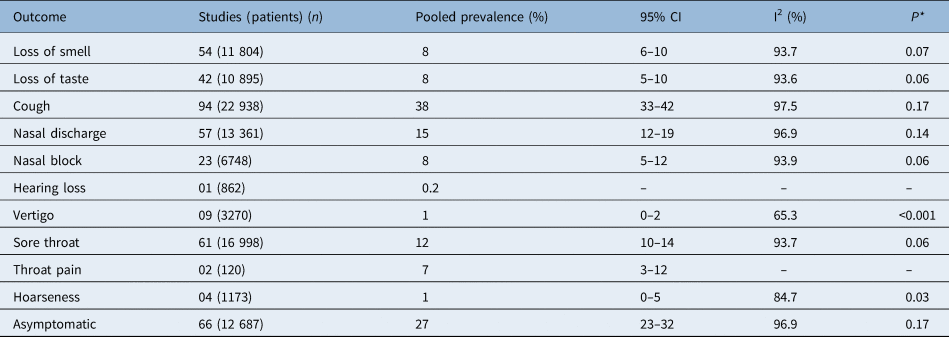
The commonest symptoms were cough, nasal discharge and sore throat (Figures 2–4, and Supplementary Figure 1). The pooled prevalence of cough was 38 per cent (95 per cent CI = 33–42; I2 = 97.5 per cent), while that of sore throat was 12 per cent (95 per cent CI = 10–14; I2 = 93.7 per cent). The prevalence of nasal discharge was 15 per cent (95 per cent CI = 12–19; I2 = 96.9 per cent; Table 2). The least commonly reported symptoms were hearing loss, throat pain and hoarseness, with fewer than five contributory studies for each symptom. Loss of taste or smell was less commonly reported, with an expectedly similar pooled prevalence of 8 per cent (95 per cent CI = 6–10 for smell and 5–10 for taste). Vertigo and hoarseness of voice had a much lower pooled prevalence of 1 per cent each. Table 2 shows the pooled prevalence of these 10 symptoms and the proportion of asymptomatic patients in the eligible studies.
Forest plot showing the pooled prevalence of cough. ES = effect size; CI = confidence interval; CDC = Centers for Disease Control and Prevention; Covid-19 = coronavirus disease 2019

Forest plot showing the pooled prevalence of nasal discharge. ES = effect size; CI = confidence interval; CDC = Centers for Disease Control and Prevention; Covid-19 = coronavirus disease 2019

Forest plot showing the pooled prevalence of sore throat. ES = effect size; CI = confidence interval; CDC = Centers for Disease Control and Prevention; Covid-19 = coronavirus disease 2019

Pooled prevalence of various otorhinolaryngological manifestations
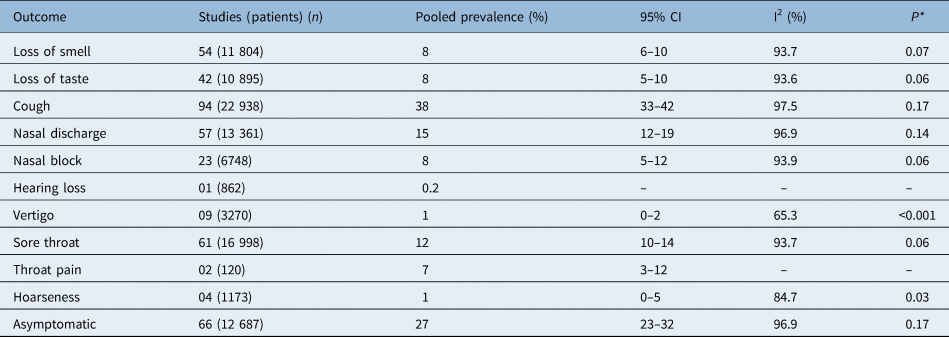
*P for heterogeneity. CI = confidence interval
Only 66 studies had information regarding the proportion of asymptomatic children, and the resultant estimate of 27 per cent (95 per cent CI = 23–32) was derived from information across 12 687 children.
Publication bias
The funnel plot suggested a reporting bias for anosmia but appeared symmetrical for cough (Figure 5). We also used Egger's test to assess the publication bias. While Egger's test for anosmia showed significant small study effects (p < 0.001), this was not the case for studies reporting cough (p = 0.14).
Funnel plot for studies reporting (a) anosmia and (b) cough.

Subgroup and sensitivity analysis
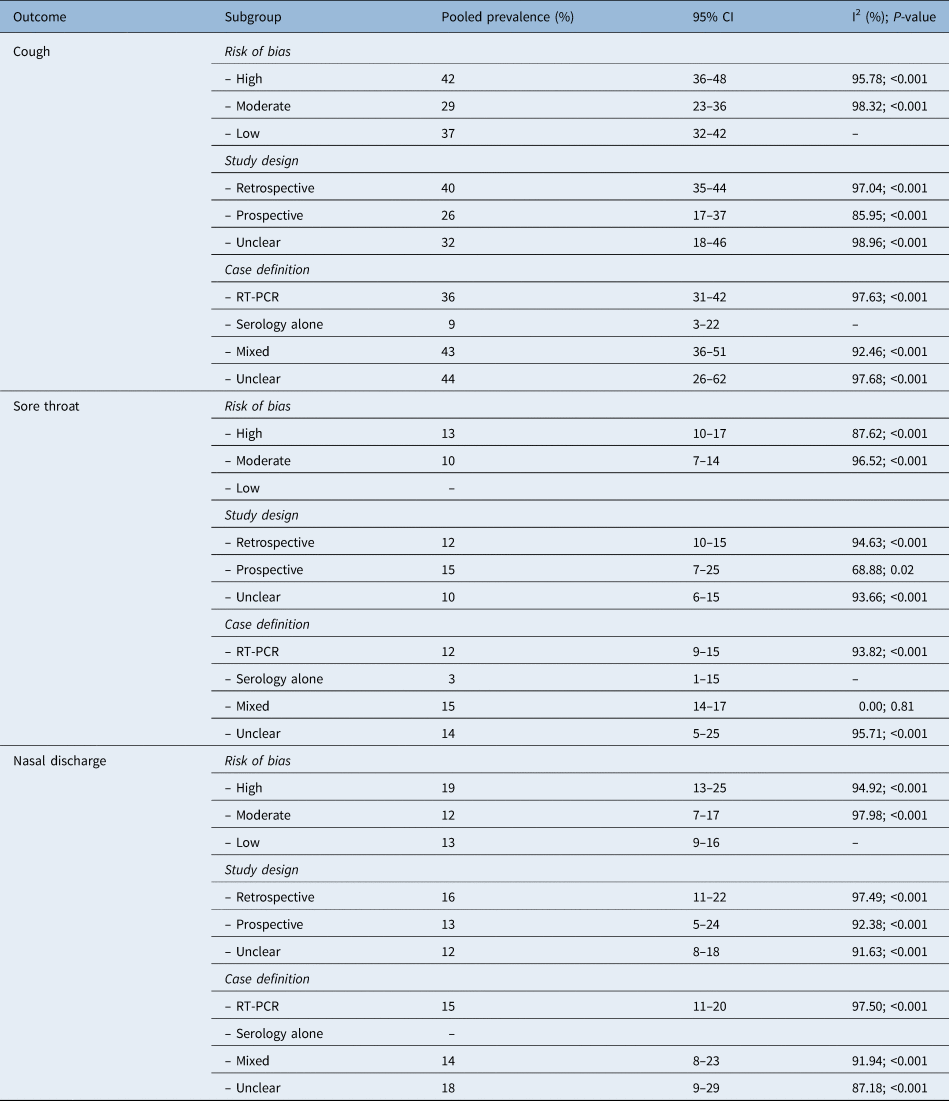
We performed subgroup analyses based on study design, case definition, and risk of bias for the three most prevalent symptoms: sore throat, cough and nasal discharge (Supplementary Figures 2–4 and Table 3). Only two studies had a low risk of bias, and pooled prevalence of cough and nasal discharge was 37 per cent (95 per cent CI = 32–42) and 13 per cent (95 per cent CI = 9–16), respectively, in these two studies.Reference Prata-Barbosa, Lima-Setta, Santos, Lanziotti, Castro and Souza7,Reference Hurst, Heston, Chambers, Cunningham, Price and Suarez8 Data on sore throat were limited to studies with moderate to high risk of bias. Sensitivity analysis, after the exclusion of studies with a high risk of bias, did not show a significant change in the pooled prevalence of sore throat (10 per cent (95 per cent CI = 7–14)) or nasal discharge (12 per cent (95 per cent CI = 8–17)). However, heterogeneity was significant for the pooled prevalence of cough, and the pooled prevalence was 30 per cent (95 per cent CI = 24–36) after the exclusion of studies with a high risk of bias.
Subgroup and sensitivity analysis for cough, sore throat and nasal discharge

CI = confidence interval; RT-PCR = reverse transcription polymerase chain reaction
The subgroup analyses based on study design and case definition also demonstrated significant heterogeneity (Table 3). The studies with mixed definitions of Covid-19, rather than based on reverse transcription polymerase chain reaction or serology alone, demonstrated more homogeneous results for the prevalence of sore throat (15 per cent (95 per cent CI = 14–17); I2 = 0 per cent, p = 0.01).
We also performed meta-regression analyses to assess the effect of the four different covariates (multicentric, sample size, risk of bias and study design) on the pooled estimates for cough, sore throat and nasal discharge. We did not observe any significant effect on the pooled estimates of these symptoms with meta-regression analyses (Supplementary Tables 2–4).
Discussion
The current meta-analysis summarises the pooled Covid-19 symptoms frequency and distribution values related to the otorhinolaryngological domain in 24 000 paediatric patients. The commonest otorhinolaryngological symptom was cough, followed by sore throat and nasal discharge. Previous reviewsReference Cui, Zhao, Zhang, Guo, Guo and Zheng109 have revealed the commonest presenting symptoms in children to be fever (pooled prevalence of 51 per cent; 95 per cent CI = 45–57) and cough (pooled prevalence of 41 per cent; 95 per cent CI = 35–47). By comparison, the commonest otorhinolaryngological symptoms noted in adult patients, by Qiu et al.,Reference Qiu, Yang, Liu, Wu, Cui and Mou110 were olfactory dysfunction (47 per cent), sneezing (27 per cent) and nasal congestion (19 per cent). These findings highlight the differences between the otolaryngological symptom profiles of children and adults.
Cough is a common symptom of Covid-19 infection that may arise with both upper and lower respiratory involvement. We found cough to be the commonest symptom, with a pooled prevalence of 38 per cent, as reported from 94 studies. This is similar to the findings of previous reports. Though severe lower respiratory involvement often manifests with accompanying symptoms, it may be difficult to localise the focus to the upper versus the lower respiratory tract in milder cases presenting with cough. Regardless, given the potential for significant aerosol generation, cough remains an important symptom for disease transmission. In addition, the high prevalence of cough in children suggests the potential for transmissibility to other vulnerable age groups and caregivers.
Given the frequent occurrence of common cold symptoms in children irrespective of Covid-19 infection, it is possible to mistake Covid-19 infection for common cold symptoms in this age group, leading to a higher propensity of community transmission. Compared with the common cold and allergic rhinitis, nasal symptoms are less frequent in Covid-19 patients.Reference Bruno, Locatello, Cilona, Fancello, Vultaggio and Maltagliati111 Rhinorrhoea and nasal congestion are reported in fewer than one-fifth of Covid-19 cases.Reference Cui, Zhao, Zhang, Guo, Guo and Zheng109 The present analysis showed the pooled prevalence of rhinorrhoea and congestion to be 15 per cent and 8 per cent, respectively.
Olfactory and taste dysfunction is one of the most familiar manifestations of Covid-19 encountered in adults. The high rate of olfactory symptoms correlates with the neurotropism exhibited by SARS-CoV-2 towards the neuroepithelium present in the olfactory cleft. These symptoms can occur in isolation without other nasal symptoms, they typically signal a milder disease course, and they are reversible in the majority of patients.Reference Nguyen, Hoang, Lagier, Raoult and Gautret112,Reference Moein, Hashemian, Tabarsi and Doty113 The meta-analysis by Qiu et al.,Reference Qiu, Yang, Liu, Wu, Cui and Mou110 involving 54 studies and 16 478 adult patients, revealed the pooled prevalence of olfactory symptoms to be 47 per cent (95 per cent CI = 29–65). However, in the paediatric age group, the olfactory and taste symptoms are relatively infrequent. A higher prevalence is noted in older children.Reference Hijazi, Alaraifi and Alsaab9 This may be attributed to an age-related biological difference, or may be secondary to the inability of the children to identify or communicate these symptoms effectively. Regarding the pooled incidence, these symptoms affected less than a tenth of infected children. A recent meta-analysis by Yan et al.Reference Yan, Qiu, Liu, Guo and Hu114 showed the prevalence of smell and taste disturbances in children to be 15 per cent and 9 per cent, respectively. Older age and female gender were associated with a higher prevalence of smell disturbances.
Laryngeal and otological symptoms have been infrequent in adult and paediatric populations, and were described as case reports or case series. The current report showed fewer than 10 per cent of the studies reporting on the presence or absence of these symptoms.Reference Kilic, Kalcioglu, Cag, Tuysuz, Pektas and Caskurlu115–Reference Azzam, Samy, Sefein and ElRouby119
The current analysis showed asymptomatic infections in almost a fourth of affected children. Previous reviews reported the proportion of asymptomatic infections as 40–45 per cent,Reference Oran and Topol120 while the pooled prevalence of asymptomatic cases was calculated to be 48 per cent by Syangtan et al. using a random effect model.Reference Syangtan, Bista, Dawadi, Rayamajhee, Shrestha and Tuladhar121 The same meta-analysis revealed the largest proportion of asymptomatic cases in children (49.6 per cent), followed by the adult (30.3 per cent) and elderly (16.9 per cent) populations. The prevalence of asymptomatic infections apparent from our data is lower (27 per cent). However, given that many asymptomatic infected individuals possibly never visited the hospital, we assume this percentage is larger than that reflected in the current data. Asymptomatic, equally infectious individuals are likely to continue spreading the infection in the community if not detected and isolated. The lower exposure rate for children compared with adults, secondary to the lack of workplace and travel-related exposures, may contribute to the lower predisposition of children to the viral infection. Once exposed, the children are equally likely as adults to acquire the infection.Reference Bi, Wu, Mei, Ye, Zou and Zhang122 However, the more favourable immunity profile, a different pattern of de novo angiotensin-converting enzyme 2 (ACE-2) receptor expression in the airway, or a different pattern of induction of the lower airway ACE-2 receptor after homing of the virus to the upper airways in children may underlie the higher rate of ‘asymptomatic’ infections.Reference Bunyavanich, Do and Vicencio123,Reference Fialkowski, Gernez, Arya, Weinacht, Kinane and Yonker124 The usual lack of associated co-morbidities in children is also protective.
Strength and limitations
This meta-analysis has certain limitations. The inclusion of English-only articles limited the results obtained. The prognostic importance of otorhinolaryngological manifestations could not be assessed because of the paucity of such studies in children. In addition, heterogeneity was significant, limiting the interpretation of pooled estimates. Despite these limitations, the current meta-analysis may serve as a helpful reference database for the pooled prevalence of otorhinolaryngological symptoms, with data obtained from over 100 studies enrolling over 24 000 children with Covid-19.
Conclusion
The commonest otorhinolaryngological manifestation of Covid-19 in paediatric patients was cough, followed by sore throat and nasal discharge. Anosmia and taste disturbances were less prevalent in children compared with adults based on the data available in the literature. Hearing loss, vertigo, throat pain and hoarseness were infrequently reported. Almost a fourth of the paediatric patients infected with Covid-19 were found to be asymptomatic.
Supplementary material
The supplementary material for this article can be found at https://doi.org/10.1017/S0022215122000536
Competing interests
None declared