Introduction
In correspondence to the general development in larger European cities towards more culturally and ethnically heterogeneous populations, an increased number of sociolinguistic studies on youth language have focused on contact situations. In particular, these works have been concerned with the development of vernacular speech styles in urban multicultural communities (for recent overviews of Scandinavian and European research see Quist & Svendsen Reference Quist and Svendsen2010 and Kern & Selting Reference Kern and Selting2012). Some of these studies include situated use and attitudinal aspects (such as Jonsson Reference Jonsson2007; Keim Reference Keim2007; Møller Reference Møller2009; Aarsæther Reference Aarsæther2010; Madsen Reference Madsen2012; and partly Quist Reference Quist2008). However, the speech of contemporary urban European youth has predominantly been studied from variationist research perspectives. A similar interest for the developments of new varieties in multicultural contexts can be found in work on youth language in urban African settings (see overview in Kießling & Mous Reference Kießling and Mous2004). In both European and African contexts a major focus has been linguistic descriptions of what has been considered new hybrid versions of a base language (in the European cases, the national majority language). Less attention has been paid to the processes through which these ways of speaking come to be considered varieties ideologically associated with particular values, how these processes are dynamic, and how speakers, as well as mass media and, indeed, researchers participate in such enregisterment (Agha Reference Agha2003, Reference Agha2007) of the contemporary youth styles (though see Jaspers Reference Jaspers2008; Newell Reference Newell2009; Madsen, Møller & Jørgensen Reference Madsen, Møller, Jørgensen, Madsen, Møller and Jørgensen2010; Madsen Reference Madsen2012).
Recent research on language use and youth styles within linguistic anthropology and linguistic ethnography documents how sociolinguistic indexicality often involve intersections of several social categories (Bucholtz Reference Bucholtz2004, Reference Bucholtz2011; Mendoza-Denton Reference Mendoza-Denton2008; Chun Reference Chun2011; Jaspers Reference Jaspers2011; Rampton Reference Rampton2011). These studies show how linguistic resources associated with, for instance, race or ethnicity might also invoke associations related to gender, sexuality, age, and social class. Yet a significant part of the variationist sociolinguistic research concerned with the speech of urban youth does not capture the complexity in the relationship between language, ethnicity, and other social categories. Sociolinguistic research focusing on how linguistic varieties are distributed and research concerned with situated linguistic practices or language ideologies, it could be argued, plainly reflect different perspectives on contemporary urban sociolinguistic processes and thereby answer different questions. However, I propose here, ethnographically informed research of linguistic practice and speakers’ language ideologies can contribute significantly to the interpretation of broader patterns of distribution and change of linguistic forms. In a Danish context, work statistically correlating linguistic features with social categories have found that new linguistic features are predominantly used by “multiethnic” male youth groups. These findings have led to the suggestion that gender and ethnicity are influential in the ongoing linguistic developments in the Danish capital (Maegaard Reference Maegaard2007; see Torgersen, Kerswill, & Fox Reference Torgersen, Kerswill, Fox and Hinskens2006 for similar findings in London). Besides, recent Danish sociolinguistic studies suggest that social status differences defined in the traditional sense, as belonging to a class of a certain educational and occupational level, have lost a clear connection to the idea of particular linguistic varieties. Hence, traditional class-related speech varieties do not appear relevant to the adolescents in current culturally diverse environments (e.g. Maegaard Reference Maegaard2007; Kristiansen Reference Kristiansen2009). Thus, it seems that within recent sociolinguistics there is a tendency to emphasize ethnicity and abandon social class as a differentiating category in relation to language use.
In this article, I employ a linguistic ethnographic perspective (Blackledge & Creese Reference Blackledge and Creese2010; Blommaert & Rampton Reference Blommaert and Rampton2011) and look into the speakers’ understandings of a contemporary urban speech style in Copenhagen that variationist research has identified as “multiethnic.” Drawing on a case study of a group of adolescents in a multicultural school, I demonstrate how social power differences are refracted in the overt metalinguistic activities of these adolescents in spite of the relatively homogenous (or hegemonic) sociolinguistic conditions of Danish society. I discuss the style's contrastive relation to a more standard way of speaking as it is ideologically constructed by the adolescent users. Finally, I argue that the ideological positioning of this speech style as a contrast to standard speech sheds new light on sociolinguist's understandings of the urban vernacular speech styles that have previously been characterized as primarily related to ethnic differences.
As an entry point for looking at the data in the light of the wider sociocultural conditions of their production, I initially provide a description of the major trends in the sociolinguistic developments in Denmark as well as a brief overview of the dominating macrodiscursive constructions of cultural diversity. Next, I introduce the data, their ethnographic and sociolinguistic context, and I consider Agha's (Reference Agha2007) theoretical framework for understanding situated metalinguistic activities in relation to wider sociolinguistic developments. Finally, I turn to discuss the adolescents’ explicit metalinguistic reflections on the contrasting ways of speaking that they label “integrated” and “street language.” Thus, my argument is that studying the speakers’ metalinguistic accounts as part of the enregisterment of contemporary Copenhagen speech styles contributes to Danish sociolinguistics by pointing to a significant sociolinguistic transformation of linguistic signs that used to be seen as related to migration, but are now related to social status as well. Yet, in comparison with other similar studies, these observations are of relevance to sociolinguistic developments in urban multicultural settings in other European contexts and beyond. Finally, the article contributes to sociolinguistic research on a more general level by demonstrating how a linguistic ethnographic study of language ideologies can improve our understanding of broader sociolinguistic developments typically approached from variationist perspectives.
Ethnicity, social class, and sociolinguistic development in Denmark
According to recent Danish sociolinguistics, cultural leveling has been the major development in Danish society during the twentieth century (e.g. Kristiansen & Jørgensen Reference Kristiansen and Jørgensen2003; Kristiansen Reference Kristiansen2009). The leveling is related to the political expansion of the Scandinavian welfare model resulting in relatively small socioeconomic and educational differences among the Danes (Brochmann & Hagelund Reference Brochmann and Hagelund2010). Furthermore, linguistic development in Denmark since the 1900s is characterized by a radical linguistic standardization. Kristiansen (Reference Kristiansen2009:168) suggests that Danish today is possibly more homogeneous than any other language with millions of speakers. This is closely related to a conservative standard language ideology, firmly governing linguistic attitudes and policies, evident in public discourse and education and resulting in orientations to linguistic uniformity (Kristiansen & Jørgensen Reference Kristiansen and Jørgensen2003). Currently, there is very little grammatical variation within speech observed around the country. Local “accents” are signified primarily by prosodic coloring, and the existing variation in segmental phonology is strongly dominated by developments within and spread from Copenhagen speech (Kristensen Reference Kristensen2003; Kristiansen Reference Kristiansen2009). Thus, recent Danish sociolinguistics emphasizes that the socio-economic and linguistic differences within Danish society have diminished throughout the twentieth century. Of course this does not mean that social class has never been considered a significant sociolinguistic variable. Brink & Lund (Reference Brink and Lund1975) describe the development of class-correlated variation in Copenhagen speech from the middle of the nineteenth century to the middle of the twentieth. Furthermore, the sound changes in Standard Danish has been characterized by innovation from the speakers that used to be considered working class and spoke what was formerly referred to by sociolinguistics as Low Copenhagen. This means that the primary pattern of change has been that former working-class speech forms eventually have become the new standard forms. Because of these sociolinguistic and societal developments, recent sociolinguistics gives up speech labels referring to social class relations and instead use the term “modern Copenhagen” when refering to speech containing features formerly associated with working-class speech and “conservative Copenhagen” when referring to speech containing forms formerly associated with middle-class speech (e.g. Jørgensen & Kristensen Reference Jørgensen and Kristensen1994; Kristiansen Reference Kristiansen2009).
At the same time, the most recent work on new linguistic developments in Copenhagen consider ethnicity particularly significant in current sociolinguistic variation because linguistic innovations are found among young speakers in ethnically diverse communities. In what follows, however, I argue that social status relations are still relevant. Indeed, if we consider young people's situated language use and metalinguistic reflections and employ an understanding of social categories as cultural and ideological interpretations rather than bounded (real) groups, there are good reasons for suggesting that it is an oversimplification to say that ethnicity is crucial just because it is ethnically mixed groups that introduce new features.
In line with an anthropological approach to sociolinguistics, I understand social class, ethnicity, and other social categories as sociocultural (and political) interpretations signified by certain cultural and linguistic practices rather than as existing bounded groups reflecting biological, place-related, or socioeconomic facts (see also Ortner Reference Ortner1998; Brubaker Reference Brubaker2004; Rampton Reference Rampton2006, Reference Rampton2011). According to Bradley (Reference Bradley1996:45), social class “is a label applied to a nexus of unequal lived relationships arising from the social organization of production, distribution, exchange and consumption,” and race and ethnicity are “social categories used to explain a highly complex set of territorial relationships” (Bradley Reference Bradley1996:19). Social class includes various aspects of occupation and employment hierarchies, income and wealth, lifestyle, and finally cultural practices (including linguistic) arising from these (Bradley Reference Bradley1996:45–46), whereas ethnicity involves the idea of territorial groups, nations states, and processes of migration and conquests (Bradley Reference Bradley1996:19–20). Class, then, can be seen as an awareness of a “high” and “low” societal stratification and ethnicity as an awareness of territorial belongings involving “inside/outside” relations. In a Danish context, indeed, ethnic interpretations imply a pervasive construction of in- and out-group relations, and in Danish public discourse cultural and ethnic differences are frequently debated whereas social status differences are more rarely discussed (Pedersen Reference Pedersen, Olwig and Pærregaard2007).
In Danish media and current policy-making a majority ethnocentric type of discourse has dominated public debates about cultural diversity (Rennison Reference Rennison2009). From this perspective, ethnic minorities (in particular those of Muslim background) are seen as one joint category, and differentiation is rarely made between different ethnicities or other differences within the collective of individuals typically referred to as bilinguals, minorities, new Danes, or foreigners (these category labels are also applied to youth born in Denmark with parents or grandparents born in particularly South Asian, Middle Eastern, and North African countries). An ethnocentric discourse on diversity is not an exclusively Danish phenomenon but characteristic of public debate and policy-making in a range of Western European countries (e.g. Blommaert & Verschueren Reference Blommaert and Verschueren1998; Extra, Spotti, & Van Avermaet Reference Extra, Spotti and van Avermaet2009). This tendency to homogenize and position minority members as one coherent out-group differs from tendencies in, for instance, American and British contexts where more specified racial and ethnic categorization has been a central part of public policy and administrative practices (Ortner Reference Ortner1998; Fanshawe & Sriskandarajah Reference Fanshawe and Sriskandarajah2010), and the majority-minority relation plays a part in the enregisterment of current urban speech styles among the adolescents we study.
Enregisterment
It is well documented in recent research on linguistic and cultural diversity that speakers in practice draw on their collective linguistic repertoires of resources to achieve their communicative aims in a given situation, and this is evident in the linguistic practices we observe among contemporary urban youth. Studies in such contexts have led to re-examinations of the traditional conceptions of a “language” or a “variety” as bounded sets of linguistic features, and it has become clear that speakers’ language use is not restricted by common associations of certain linguistic resources belonging to certain “varieties” or “languages.” Rather such concepts are representations of particular language ideologies (Blackledge & Creese Reference Blackledge and Creese2010; Jørgensen, Karrebæk, Madsen, & Møller Reference Jørgensen, Madsen and Møller2011), and like social categories, the idea of linguistic codes can fruitfully be seen as sociocultural and ideological constructions. Agha's theory of enregisterment appeals to this kind of approach to language with its emphasis on “processes and practices whereby performable signs become recognized (and regrouped) as belonging to distinct, differentially valorized semiotic registers by a population” (Agha Reference Agha2007:81), and it has been widely employed and discussed within the past few years of sociolinguistic research (e.g. Johnstone, Andrus, & Danielson Reference Johnstone, Andrus and Danielsen2006; Newell Reference Newell2009; Madsen et al. Reference Madsen, Møller, Jørgensen, Madsen, Møller and Jørgensen2010). The theory of enregisterment accounts for the processes through which linguistic codes (or in Agha's terms, registers) are constructed and take into consideration metapragmatic activities on various levels ranging from widely circulating media stereotypes to local speaker practices.
From an enregisterment perspective, speakers’ interactional use of different linguistic forms (re)creates the stereotypic indexical values of the used forms. Hence, in interactional use of resources associated with different registers, the stereotypical indexical values of the registers can be said to be brought into play and used for situational purposes. At the same time, the employment of linguistic resources continuously contributes to their enregisterment, and in this sense the indexical values of the linguistic features used are also (re)created. Johnstone et al. (Reference Johnstone, Andrus and Danielsen2006) differentiate between first-, second-, and third-order indexicality (building on Michael Silverstein) in relation to the enregisterment of “Pittsburghese” and thereby describe different stages in the process of sociolinguistic enregisterment. These include, in short, the development from a stage of an identifiable pattern of distributional correlation of a linguistic feature with particular social categories (first-order), to linguistic features being available for social work and style shifting on the basis of this correlational pattern (second-order) and, finally, the noticing of the second-order stylistic variation and the linguistic features becoming the topic of overt metapragmatic commentary (Johnstone et al. Reference Johnstone, Andrus and Danielsen2006:82). Thus, the construction, maintenance, and development of a register involve users’ overtly explicit evaluations, labeling, and descriptions of the register (corresponding to third-order indexicality) as well as their use of its characteristic features (first- or second-order indexicality). The data I discuss in this article can be characterized as such overt (third-order) metapragmatic discourse.
Data and ethnographic context
From 2009 to 2011 my colleagues and I have been conducting a collaborative study of linguistic practices in the everyday life of forty-eight grade-school children and adolescents in a Copenhagen public school (Madsen et al. Reference Madsen, Møller, Jørgensen, Madsen, Møller and Jørgensen2010). The overall focus of our research is to understand how language patterns and language norms are acquired, developed, and used in various everyday contexts. Most of the participants have a linguistic minority background and they live in a highly diverse area of the Danish capital. In the two classes we study, the percentage of students with minority background is seventy-five and eighty-two percent. Over two years, we conducted team-ethnographic fieldwork and collected data in a number of different settings: in school during classes and breaks, in youth clubs, at sports practices, in the local neighborhood, and in participants’ homes. The data include field diaries, largely unstructured qualitative interviews with the participants in groups and individually, as well as with teachers, parents, and club workers. We also recorded different kinds of conversations, both researcher-initiated and participants’ self-recordings. In addition, we collected written data in the form of protocols, student essays, and Facebook interactions. In my work, I focus primarily on nine key participants, which include five girls—Israh, Fadwa, Yasmin, Lamis, and Selma—and four boys—Isaam, Mahmoud, Bashaar and Shahid. But in this article only Isaam's interview is quoted. The participants were all born in Denmark or arrived as very young children. They were thirteen and fourteen years old when we began the field work.
The extracts I discuss are predominantly from the interviews with the key participants, and I discuss aspects of content as well as performance (specifically what could be described as exemplifying or demonstrating stylizations) during sequences characterized by overt metalinguistic reflection. The interviews took place about five months into our first year of fieldwork. The adolescents were invited in self-selected groups to the university, and we talked to them in one of our offices. The interview was ethnographic and semistructured. We all went through certain topics such as groups of friends in the class, leisure activities, and language, but we attempted to let the participants lead the conversation in the directions of their choice. The researcher usually initiated the topic of language by typically asking “in what way” or “how” the participants talked in various contexts (for instance, with the teachers, with friends, in the youth club).
During some of the first interviews, the participants introduced labels for two ways of speaking that differed from what they referred to as “normal.” One was integreret ‘integrated,’ and I discuss this register in the next section. The other register was referred to with varying labels: predominantly gadesprog ‘street language,’ but also perkeraccent or perkersprog (equivalent to ‘paki accent’ or ‘language’) or slang ‘slang.’ Perker is originally a derogative term used about immigrants, equivalent of ‘paki’ or ‘nigger.’ In in-group use, however, the term refers to a social category defined by ethnic minority status (in relation to the Danish mainstream society) across various ethnicities. Moreover, in local in-group use perker also invokes values of toughness and street credibility (Madsen Reference Madsen2008:214). In spite of the different naming practices, there was general agreement about the indexical values and the characteristic features of this register, which I discuss in the section on street language. I supplement the analyses of the interview sequences with extracts from two sets of written essays: “Language in my everyday life” (essay 1) and “Rules of language use” (essay 2). These essays were the results of two language-themed seminars during the first and second year of fieldwork led by two researchers from our team (the interviews were conducted before any of these seminars took place). The seminars were integrated into the curricular activities of the school classes we followed and they were intended as ways of contributing to the discussions in class in return for their willingness to take part in our studies. I have taken the entire corpus of written essays from the students in the two grade-school classes into consideration. The extracts I present are chosen as representative of the typical tendencies in the value ascriptions to the registers among the adolescents and, in addition, examples are included to reflect the width and variation of the stereotypic associations. The purpose of discussing the interview data is to build a qualitative argument pointing out social dimensions of language ideological constructions that have been overlooked in much previous research.Footnote 1
Integrated
Integrated speech was mainly presented as the way of speaking to adults, especially to and by teachers. In extract (1), Lamis explains to the interviewer how she used to speak in different ways to the teachers and her friends at school, but how she now attempts to speak and write integratedly.
(1) Lamis (Lam): female, 14, Tunisian background
Interviewer (And): male, late twenties, Danish background

In this sequence Lamis explains how she has started to write very integratedly. According to Lamis's representation, integrated writing and speaking is signified by more “fine” (or “posh”) words, and longer words such as “statements” or “unacceptable” (lines 21–34). Lamis's emphasis on relatively complex and abstract vocabulary as an important feature of the integrated register is also evident in extract (2), where Selma's stylized performance also reveals other associated values.
(2) Lamis (Lam) in group interview with:
Selma (Sel): female, 14, Turkish background; Yasmin (Yas): female, 14, Pakistani background; Tinna (Tin): female, 14, Icelandic background; Interviewer (Lia): female, early thirties, Danish background.

When the girls are asked how they speak to their teachers, they claim to speak integratedly. An exception to this may occur when they are angry with the teachers or “have a trip,” as Lamis puts it. In such situations “street language” may be used (lines 12–14). Throughout the sequence Selma demonstrates integrated speech with a stylized performance marked by a shrieky, high-pitched voice (in bold lines 6–7, 18, 21, 26). In her performance she emphasizes politeness with ritual phrases such as “have a nice day,” “have a nice weekend,” and “would you like to have some tea?”. The politeness, the tea offer, and the high-pitched, shrieky voice bring about stereotypical associations of higher class cultural practices. As in (2) above, Lamis underlines so-called “difficult words” as the significant trait of integrated speech (line 27), and Selma supports with the example of “impertinent” in line 31. As well as being exemplified with words like “impertinent” and “unacceptable,” integrated speech is related to reprimands or corrections of behavior typically performed by authority figures. So integrated speech appears associated with authority, control, and aversion to rudeness, combined with ritual politeness and higher class cultural practices.
More generally, when examples of vocabulary are presented in the interview accounts and the written essays, four main aspects are emphasized. About half of the examples in the essays are related to academic activities (e.g. “analyze,” “criticize,” “argue,” “curriculum,” “lecture”). The other half are almost equally divided between ritual politeness (e.g. “have a nice day,” “you're welcome,” etc.), relatively complex and abstract adjectives (e.g. “hypothetical,” fascinating,” “intelligent,” “well organized”), and finally, corrections of behavior as above.
With respect to the stylizations in extract (2), it is worth noting that the integrated performance is accompanied by quite a bit of ridicule in the girls’ representations, detectable, for instance, in the change of voice and the laughs following the examples of difficult words (lines 31–32). In this manner the girls present a certain distance to this register, and this is emphasized by Selma's jocular remark on not being able to “say it” in spite of practicing the difficult words “in front of the mirror” (lines 37–39).
In fact there are significant differences in the way the girls relate to the integrated register in their constructions during the interviews, and this appears to correspond to their school orientation more generally. Overall, Lamis and Yasmin (and Selma up to a point) presented a positive orientation to academic work and school achievement, both in their everyday social practices at school as well as in their representations in interviews. Although they ridiculed integrated speech in their stylized performances and did not present integrated as their “own” way of speaking (with the possible exception of Lamis in the individual interview, extract (1)), they still claimed to use the integrated register for certain purposes: speaking to teachers (or other adults) and writing in school. In contrast, there was another pair of girls who did not generally orient positively to school, and they claimed not to have access to the integrated register, as we see in the next extract.
(3) Fadwa (Fad) (female, 14, Iraqi background) in-group interview with:
Israh (Isr): female, 14, Jordanian background; Jamila (Jam): female, 14, Iraqi background; Interviewer (Ast): female, mid twenties, Danish-Norwegian background

Like the girls in extract (2), Fadwa and Israh present examples of integrated words, and these are related to academic activities (“analyse” and “problematize”), but their self-representations here emphasize a lack of competence with respect to the integrated register. They say they sometimes try, but “we can't” (lines 2–3), “we're not really good at all those words they're saying” (lines 4–6), and “we're not really good at stuff like that” (lines 16–17). Clearly, Israh is perfectly able to perform examples of integrated speech in the stylizations marked by extra distinctness (lines 10–12), but even so, the two of them jointly emphasize a distance from this register through the references to “them” (in this context, the teachers; line 2) and “we” (throughout the sequence). This identity construction is in line with the nonacademic personae they practice elsewhere.
When we asked the adolescents about speakers of integrated, most of them mentioned teachers, and initially, also the ethnic Danes among them as typical users. It did turn out after further discussion that in most cases their Danish classmates did not actually use many “difficult words.” However, it seemed that to the minority students participating in our study, the integrated register was also partly associated with Danish ethnicity: “But the integrated language one usually uses to teachers or other adults. It's to talk very beautifully and try to sound as Danish as possible” (Mark, 15, minority background, written essay 2).
In the following extract, Israh explains how she and Selma get a surprised reaction when they put on their integrated performance because, as Israh phrases it, she is “not like a real Dane.”
(4) Israh (Isr) and Interviewer (Ast)

But not all of the participants regarded integrated as predominantly a Danish register. In her essay Lamis presents an understanding of integrated as diassociated from the idea of a specific national language. Instead, speaking integrated seems related to stylistic adjustments.
But slang and integrated are also important, because there is some people who cannot tolerate listening to slang, then you have to be able to talk to them so that they are comfortable. But slang and integrated are not just in one language, but they are in English, Danish, Arabic, and all languages there exist.. :D (Lamis, written essay 1)
In a few of the essays we also find accounts of the use of “integrated Arabic”:
With my family I speak completely normal/integrated Arabic but when I speak to my cousins it is street language Arabic. When I speak to my family: I speak normal Arabic to my family, I also speak integrated Arabic to show respect. (Jamil, 15, minority background, written essay 2)
…but with my parents [I] speak integrated Arabic, like polite (Fadwa, 15, minority background, written essay 2)
In addition, some of the participants referred to Urdu as “the integrated Punjabi.” Finally, it is worth noting that several of the students of majority background also in their essays describe “integrated Danish” as a register relevant to their everyday encounters particularly with elderly adults and teachers. This listing of rules of language by a girl of Danish heritage is an example.
Speak integrated to people you need to show respect for
Speak normal to you relatives
Speak normal/street language to your school friends
Speak integrated to elderly to show respect.
(Marie, 15, majority background, written essay 2)
These observations suggest that “integrated” practices seem to be undergoing reinterpretation. Integrated as a term has originally been (and still most typically is) employed in dominant macrodiscourses on “integration as minorities’ adaption to majority society” from the ethnocentric perspective sketched above (e.g. Rennison Reference Rennison2009). So as a term in the Danish context, “integrated” carries traces of an association with “adaption to mainstream Danish cultural practices.” Here, however, we see integrated reinterpreted as conservative standard practices (respectful, polite, upscale) in a more general sense. In its use among these adolescents, the term is not tied exclusively to the “foreigner” and “Dane” categorizations typical of dominant integration discourses, even though it includes an ironic reference to these discourses.
In fact, there is an account in the written essays, which explicitly links successful integration (“well integrated”) to high socioeconomic status (“rich”).
Integrated can be used by everyone, by and large, but if one speaks integrated language one is considered polite, rich well integrated person because people who speak integrated are like that. (Isaam, 15, minority background, written essay 2)
From the overt metalinguistic reflections presented in the interviews and essays, we can see that there is an awareness among these Copenhagen adolescents of a register labeled ”integrated.” The enregisterment of “integrated” involves accounts or demonstrations of performable signs and stereotypical indexical values.
Performable signs: distinct pronunciation, abstract and academic vocabulary (long, fine words), high pitch, quiet and calm attitude, ritual politeness phrases
Stereotypical indexical values: higher class culture (wealth), sophistication, authority, emotional control and aversion to rudeness, academic skills, politeness and respect, (Danishness)
It appears part of a social school-positive practice to present integrated as an available linguistic resource, and part of a more school-resistant practice to emphasise distance to this register.
A slightly different use of the notion of integrated can be seen in extract (5). Here one of the male participants employ the term integrated in a characterization of the young youth club workers with minority background.
(5) Isaam (Isa): male, 14, Arabic background with interviewer (And)

In this extract, Isaam is asked how he speaks to Ilias and Ahmed in the youth club. Instead of answering the question directly, he mockingly describes the young minority club workers as “completely gone” “faggots” who “play really integrated” when the majority adult female youth club worker, Kirsten, is around. The expression “play integrated” invokes elements of fakeness, and in addition, the derogative term “faggots” brings out non-hetero-masculine associations. Thus, we might add “feminine,” “homosexual,” or at least “non-hetero-masculine” to the stereotypic indexical values locally ascribed to the integrated register. Exaggerated feminine associations were also evident in the girls’ stylized shrieky, high-pitched performance voice in extract (2), and in fact the gender-associations involved in these ongoing processes of enregisterment become even clearer when we turn to the register seen as contrasting with integrated, namely “street language.” Indeed, the relationship of opposition between integrated and street language was crucial to the enregisterment of each.
Street language
Street language was generally presented as the register the adolescents used to manage peer relations in school and leisure contexts. As with integrated, their metalinguistic reflections on street language often focused on vocabulary. In extract (6), Isaam emphasizes slang words in an exemplifying stylization of street language.
(6) Isaam (Isa); Interviewer (And)

In the beginning of this extract, Isaam claims to speak integratedly to teachers, and in fact more generally, he combined school-positive and streetwise practices in a similar way to the taekwondo practitioners described in Madsen (Reference Madsen2008; see also Stæhr Reference Stæhr2010 and Madsen Reference Madsen2012). So integrated seems to be a linguistic resource available to him. But when he is asked how he speaks with friends he answers with a stylized performance illustrating significant traits of street language: the swear word sgu (equivalent of ‘bloody’), the American slang expression “man” pronounced with American features (pitch raise and prolongation of the vowel), and prevocalic ‘t’ pronounced with affrication and palatalization (line 10). The interviewer repeats this t-pronunciation (line 12) and this display of recognition causes joint amusement. The affricated palatalized pronunciation of ‘t’ is a feature described by Maegaard (Reference Maegaard2007:164) as a new pronunciation feature associated with stylistic practices of “tough ethnically mixed boys” groups. Among the adolescents in the current study, Møller (Reference Møller2009) and Madsen et al. (Reference Madsen, Møller, Jørgensen, Madsen, Møller and Jørgensen2010) find that this t-pronunciation is also a marked feature stereotypically associated with speakers of Turkish background. But otherwise only a few of the indexical features overtly associated by our informants with integrated and street registers were related to pronunciation. The characterization of these registers focused largely on vocabulary, although we in line with other recent sociolinguistic studies in Copenhagen, have observed other pronunciation features characteristic of the speech style. These include initial uvular ‘r’ pronounced voiceless (Maegaard Reference Maegaard2007) and a characteristic prosody, which involves less use of the Danish stød (phonetically a form of laryngealization or creaky voice) and less contrast between short and long vowels compared to more standard pronunciations (Pharao & Hansen Reference Pharao and Hansen2006; Quist Reference Quist2008; see also Madsen Reference Madsen2012). But these features were not mentioned by the participants other than by some perhaps referred to as a “strange accent.”
Another significant practice associated with street language mentioned by several participants is the mixing of features generally considered to belong to different national languages, such as Danish, Arabic, Kurdish, Spanish, and Turkish. In extract (7), Israh describes how making up new words is considered part of the slang/perker (paki) language.
(7) Israh (ISR) with interviewer (Ast)

What Israh here refers to appears to be the polylingual behavior documented among Copenhagen youth in several of our recent studies of situated interactions (Ag Reference Ag2010; Stæhr Reference Stæhr2010; Jørgensen et al. Reference Jørgensen, Madsen and Møller2011). Polylingual practices are central to the street language register in the adolescents’ interview reports, as well as in sociolinguists’ observation of situated speech and in media constructions.
Based on participants’ accounts, the linguistic signs and practices associated with street language include slang, polylingual mixing, and creativity, as well as an example of a particular pronunciation feature. The value ascriptions related to this register are also brought about in the presentations by the adolescents. Lamis describes and performs street language in extract (8).
(8) Lamis (Lam) with interviewer (And)

Lamis does not primarily describe linguistic features when she is asked what street language is like. She does mention the rather unspecified pronunciation of a “strange accent” (line 8), but otherwise describes a “perker” attitude of showing off (lines 4–5). She performs a tough persona through her stylized utterance in lines 9–10 signalled by the deep voice and the pragmatic function of a challenge, and this value ascription of toughness corresponds to the use of the register observed in studies of situated interaction (Madsen Reference Madsen2008, Reference Madsen2012; Stæhr Reference Stæhr2010). In these studies, we find that features associated with street language are predominantly employed in peer interactions concerned with social negotiations of local status relations. Our studies also suggest that the “perker” attitude and its associated linguistic practice invoke traditional masculinity, and this chimes with research on similar linguistic practices in other urban European settings (e.g. “blattesvenska” in Stockholm in Jonsson Reference Jonsson2007 or Creole English in Rampton Reference Rampton1995). This association with masculinity does not mean that the street register is not employed by any females, and the girls who employ it also use other semiotic resources stereotypically associated with toughness and street credit. For instance, towards the end of their group interview, Fadwa and Israh co-construct self-representations based on narratives about fights they have been involved in, emphasizing how hard they have hit their opponents. But the girls who emphasize more traditional feminine values in their identity practices claim not to use street language at all (although Ag's (Reference Ag2010) study of their peer interactions reveals several instances where the street language features are actually used). In extract (9) we see another example of a girl distancing herself from street language and its associated tough “perker” attitude. Six months after the group interview, Lamis is interviewed again and she now explains how she tries to “remove” her “perker” attitude.
(9) Lamis (Lam) with interviewer (And)

In this account, Lamis relates ways of speaking to ways of being: “before I was very uh…” (lines 2–8). She further states that she has now pulled herself together—a “perker attitude” is not something one should be proud of, but rather try to get rid of. Lamis is a student who orients to academic achievement and she does not see the register associated with “perker” attitude as prestigious.
In the final extract, Isaam illustrates an identity aspect central to the ongoing enregisterment among the adolescents, namely the age-dimension.
(10) Isaam (Isa) with interviewer (And)

Here Isaam opposes “a person who is integrated” to “the young” (lines 1–5). He demonstrates the way “the young” speak by hypothetically quoting himself in interaction with a friend (Mahmoud), employing the characteristic t-pronunciation and a swear word. He opposes integrated to youthful behavior, and this is consistent with the other interview descriptions of integrated as a register employed by and with adults.
So in these accounts “street language” (“perker language” or “slang”) is continuously enregistered in the following way:
Performable signs: slang, swearing, affricated and palatalized t-pronunciation, polylingual practices, “strange accent,” linguistic creativity
Stereotypic indexical values: toughness, masculinity, youth, panethnic minority “street” culture, academic nonprestige
To summarize, the participants generally present resources of integrated and street language as relevant to their linguistic everyday practice. Lamis, Aisha, and Selma, who orient positively towards academic achievements, report a use of the integrated register to teachers, parents, and other adults. Fadwa and Israh, who do not orient towards academic skills, report a use of the register only in jocular ways (and claim to have a limited competence in using “integrated words”). The girls claim to use the street-language register to present an attitude of toughness. In front of the researchers, some of the girls claim not to use the street-language register at all and some girls claim mainly to use it to address boys. The boys among my key participants emphasize the use of the street-language register as a peer-group practice. Most of the adolescents also present the notion of “normal Danish,” which appears to be a socially unmarked way of speaking. Some participants refer to “normal Danish” as an alternative to street language and others as a contrast to integrated speech.
Concluding discussion
I have now discussed overt evaluations of language among Copenhagen youth and treated their metalinguistic reflections as part of the ongoing enregisterment of “integrated” and “street (or perker) language.” A range of different aspects of cultural practice have been drawn into this: ways of orienting to academic skills, ways of engaging with emotions, and typical interlocutors. In fact, the associations of these two registers seem to map on to a set of opposing binaries, shown in Table 1 below.
Value binaries associated with integrated and street.
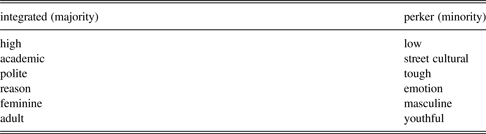
These binary value ascriptions allow us to link integrated and street language to the value system that previous Danish sociolinguistic studies associate with “conservative Copenhagen” and school-related standard ideology, where excellence is perceived in relation to “superiority” (Kristiansen Reference Kristiansen2009:189). According to Maegaard (Reference Maegaard2005) and Kristiansen (Reference Kristiansen2001, Reference Kristiansen2009) conservative Copenhagen speech—speech containing features traditionally seen as high-status—is associated with the stereotypic indexical values of intelligence, articulation, ambition, independence, rationality, and conscientiousness. The speech indexing these values are by our participants labelled integrated, and they present an understanding of the street language as belonging to the opposite end of a stylistic spectrum associated with contrasting values.
Of course, there can be significant differences between speakers’ reports about language use and their actual linguistic practice. The accounts presented here provide important insights into the speakers’ ideas about linguistic stereotypes, but the study of how linguistic stereotypes are brought into use for situated pragmatic functions in particular interactional contexts may add to and possibly alter the picture (Rampton Reference Rampton2006, Bucholtz Reference Bucholtz2011, and Jaspers Reference Jaspers2011 are good examples of this). In Madsen et al. (Reference Madsen, Møller, Jørgensen, Madsen, Møller and Jørgensen2010) we demonstrate that the adolescents do actively use features of street language and integrated as stylistic resources in their everyday conversations to signal frame shifts on various levels. It would extend the scope of this article to go into detailed analysis of our interactional data, but a brief summary of some interactional observations can inform the discussion of this ongoing enregisterment.
• Features of street language are used in relatively unmarked speech by boys who orient positively to school achievements at the same time as orienting to streetwise coolness. They increase the use of the street-language features in interactional sequences where school-related capital is negotiated and demonstrated and thereby achieve school competent identities in a nonnerdy way (see details in Madsen Reference Madsen2011, Madsen Reference Madsen2012).
• The participants inauthentically put on integrated voices in contexts where institutional inequalities are spotlighted. They do so by performing stylized speech characterized by a combination of marked conservative pronunciations with exaggerated expressions of agreement, enthusiasm, or politeness and vocabulary indexing sophistication/academic reflection in communicative contexts where norm transgressions and relations of power involving adult authorities of some kind are at play (Madsen Reference Madsen, Blackledge and Creese2013).
These observations, in fact, support the insights we have gained from our interview and essay data and show that stylistic features of street language and integrated in the adolescents’ everyday interactions are used to bring about relations of academic and street cultural values, as well as relations of inequality and authority.
Recent Danish sociolinguistics has suggested that social class relations have relatively little contemporary sociolinguistic significance, and instead, the discovery of new linguistic practices among youth in culturally and linguistically diverse environments has led to ethnicity being foregrounded. But the data I have discussed in this article shows that high/low stratification is indeed still relevant to contemporary Danish youth. In the values and privileges it evokes, integrated is enregistered as a conservative standard code, and street language is enregistered partly in opposition to this. Social status is profoundly interwoven with ethnicity, both in the metalinguistic descriptions and in the linguistic labels applied to these registers. As argued in the beginning of this article the foregrounding of ethnicity is not only characteristic of Danish studies of urban youth language, but a general European tendency, and considerations of how ethnicity intersects with social status relations and other social categories are likely to be relevant to work on contemporary urban speech styles in other contexts as well.
The data I have presented points to a significant sociolinguistic transformation. Linguistic signs that used to be seen as related to migration—identified as ethnic minority rather than majority on an insider/outsider dimension of comparison—are now related to status on a high/low dimension as well. This is particularly clear in our informants’ association of integrated with a notion of conservative standardness that carries across national language boundaries. In this way, our data document processes similar to the ones described by Rampton (Reference Rampton2011) in Britain, and there are comparable intersections of ethnicity and status relations in Chun (Reference Chun2011), Bucholtz (Reference Bucholtz2011), or Mendoza-Denton (Reference Mendoza-Denton2008), where the conception of race among American adolescents incorporates aspects of class (and gender). Jaspers (Reference Jaspers2011) also shows how in Belgium, minority adolescents’ stylizations of the traditional Antwerp dialect reconfigure its social meaning so that instead of simply being associated with hostility to migrants, it is used to spotlight institutional inequalities, positioning the young people within the dynamics of high/low stratification, not just inside/outside exclusion. So there is evidence from ethnographically informed studies of linguistic practice in several countries that linguistic styles once associated with migration and minorities are being actively mapped into social stratification and status. As Silverstein (Reference Silverstein and Schiffrin1985:220) notes, the object of study of a science of language should be “sign forms contextualised to situations of interested human use and mediated by the fact of cultural ideology,” and this case study reminds us that studying the language ideological dimension is as important a part of studying sociolinguistic processes as is descriptions of forms and linguistic practice.
Appendix: Transcription conventions
- [overlap]
overlapping speech
- LOUD
louder volume than surrounding utterances
- °silent°
lower volume than surrounding utterances
- xxx
unintelligible speech
- (questionable)
parts I am uncertain about
- ((comment))
my comments
- :
prolongation of preceding sound
- ↑
local pitch raise
- (.)
short pause
- (0.6)
timed pause
- stress
stress
- hhh
laughter breath
- mm
confirming
- mm mm
denying
- italics
English in original
- bold
stylized utterance