





Introduction
Rates of infection due to antimicrobial-resistant (AMR) organisms, including extended-spectrum beta-lactamase-producing Enterobacterales (ESBL-E), are increasing. 1,2 ESBL-E are a serious public health concern due to limited treatment options and their role in spreading multidrug resistance. In 2019, ESBL-E were associated with 198,000 hospitalizations and 9,000 deaths in the United States (US). 1
Despite the rising burden of disease, there is limited population-based data on the current epidemiology of ESBL-E infections in the US. In 2017, the Centers for Disease Control and Prevention’s (CDC) Emerging Infections Program (EIP) surveillance estimated an annual incidence of 199.7 ESBL-E cases per 100,000 population. Nearly all isolates were from a urinary source, 83% of which were associated with a urinary tract infection (UTI). Reference Duffy, Karlsson and Reses3
Although ESBL-E UTIs have historically been associated with healthcare settings, recent data suggest that an increasing proportion are community-associated (CA), occurring in patients without recent healthcare exposure. Reference Duffy, Karlsson and Reses3 Traditional risk factors, including recent antibiotic use, were not identified in most CA cases. These findings challenge the current understanding of risk factors for ESBL-E UTIs and highlight the need to better define community-level drivers of AMR.
Beyond individual risk factors, structural and community-level conditions may contribute to ESBL-E UTI risk, including barriers to healthcare access, antibiotic use, and living conditions that facilitate transmission. These factors are often difficult to measure at the individual level but can be quantified at the neighborhood level using tools such as the CDC’s Social Vulnerability Index (SVI). The SVI is a standardized measure of community vulnerability based on 16 U.S. Census variables across four domains: socioeconomic status, household composition, racial and ethnic minority status, and housing type and transportation. These four themes are combined into an overall composite score, with higher scores indicating greater vulnerability. While initially designed to guide emergency preparedness, the SVI is increasingly used to examine how structural and social conditions shape population-level health risks related to communicable diseases, including AMR infections. 4 Research examining the relationship between neighborhood-level vulnerability and the epidemiology of ESBL-E UTIs remains limited.
To better understand the epidemiology of CA ESBL-E UTIs, we first compared characteristics of CA and healthcare-associated (HCA) cases at the individual level. We then performed a census tract-level analysis to evaluate associations between ESBL-E UTI prevalence and SVI, stratified by epidemiologic classification. Our objective was to advance understanding of ESBL-E UTIs in the community setting to address the shifting epidemiology of this AMR pathogen, which is increasingly prevalent outside healthcare settings.
Methods
Case identification
We analyzed data from the CDC EIP ESBL-E population and laboratory–based surveillance in Monroe County, New York, from 2020 to 2023. Monroe County has a population of 759,443; 69% of residents are White, 16% Black or African American, 4% Asian; 19% are aged 65 or older. 5
An ESBL-E UTI case was defined as the isolation of Escherichia coli, Klebsiella pneumoniae, Klebsiella variicola, or Klebsiella oxytoca from a urine specimen collected from a surveillance area resident, demonstrating phenotypic resistance to ≥1 third-generation cephalosporin (ceftazidime, cefotaxime, or ceftriaxone) and non-resistance (susceptible or intermediate) to carbapenems.
Cases were identified at three catchment-area clinical laboratories through laboratory information system queries of isolates tested by Vitek or Phoenix automated testing instruments or Kirby-Bauer disk diffusion. Only the first isolate per patient during the study period was included to avoid case-to-case correlation. We did not distinguish between acute infections and colonization, though most cases arose from symptomatic individuals. This study was reviewed by the relevant institutional review boards and deemed non-research.
Individual characteristics
Demographic, clinical, and healthcare exposure data were abstracted through a comprehensive review of electronic health records (EHRs) from the county’s two major healthcare systems using a standardized case report form (CRF). 6 When outpatient provider notes were unavailable in the EHR, providers were contacted by fax to obtain missing CRF information.
Underlying medical conditions and risk factors for UTI and/or ESBL-E were recorded (detailed CRF provided in Supplemental Materials), including antibiotic exposure within 30 days of the culture collection, international travel, and recurrent UTIs (2 cases within 6 months or 3 within 1 year). Charlson Comorbidity Index (CCI) scores were calculated and categorized as low (0), medium (1–2), or high (≥3). Reference Charlson, Pompei, Ales and MacKenzie7 Cases were epidemiologically classified using standard CDC definitions. HCA cases had any of the following: acute care hospitalization, surgery, or overnight stay in a long-term care facility in the prior year; a urinary catheter or indwelling device present in the two days before culture; chronic dialysis; or culture collection ≥3 days after hospital admission. CA cases lacked documentation of these exposures.
Community measures
Case addresses were geocoded to the 2020 U.S. census-tract level using ArcGIS 10.2.2 and linked to the CDC’s 2020 SVI data for New York State. Each census tract received a percentile score (0–1) for each of the four themes and an overall composite score, with higher scores indicating greater vulnerability. Figure 1 shows a full breakdown of the SVI themes and variables included in this index.
Components of the CDC Social Vulnerability Index (SVI). Legend: Each of the 16 variables is ranked for all tracts, resulting in a percentile rank (0–1) for each variable. For each of the four themes, the individual variable percentiles are summed together. The sums for each theme are ordered, and a final percentile ranking (0 to 1) is calculated for each theme. The overall SVI score is calculated by summing the four theme-specific percentile sums. These combined sums are ordered, resulting in an overall composite SVI ranking where 0 represents the lowest vulnerability and 1 the highest. Source: Centers for Disease Control and Prevention/ATSDR Social Vulnerability Index (https://www.atsdr.cdc.gov/placeandhealth/svi/index.html). Reproduced from CDC.

Statistical analysis
Individual case characteristics were compared between epidemiologic classes using the χ2, Fisher’s exact test, or Wilcoxon Rank-Sum test where appropriate. Census tract ESBL-E UTI prevalence by epidemiologic class was calculated as CA or HCA cases per 1,000 population using 2020 US Census population estimates.
Generalized linear regression models were used to evaluate associations between SVI themes and ESBL-E UTI prevalence. Census tract prevalence rates for CA and HCA ESBL-E were modeled as a function of SVI, epidemiologic classification, and their interaction with HCA as the reference category. ESBL-E UTI prevalence rates were square root transformed to address skewness across the SVI percentiles. Due to significant multicollinearity among SVI themes, separate models were fit for each of the four themes and the composite SVI. The mean CA and HCA ESBL-E UTI prevalence per 1,000 residents for each census tract was estimated at the 10th, 25th, 50th, 75th, and 90th SVI percentiles for each theme. The 10th percentile represented low vulnerability, whereas the 90th percentile represented high vulnerability. Reference Abdul-Mutakabbir8 Analyses were conducted using SAS 9.4 (SAS Institute Inc., Cary, NC, USA). Additional details on the regression method, model coefficients, and outputs are available in the Supplemental Material.
Results
Individual-level analysis
Between 2020 and 2023, 3,100 ESBL-E UTI cases were identified. Of these, 1,621 (52.3%) were classified as CA, and 1,468 (47.4%) were HCA; 11 cases (0.3%) had no medical records available, could not be epidemiologically classified, and were excluded.
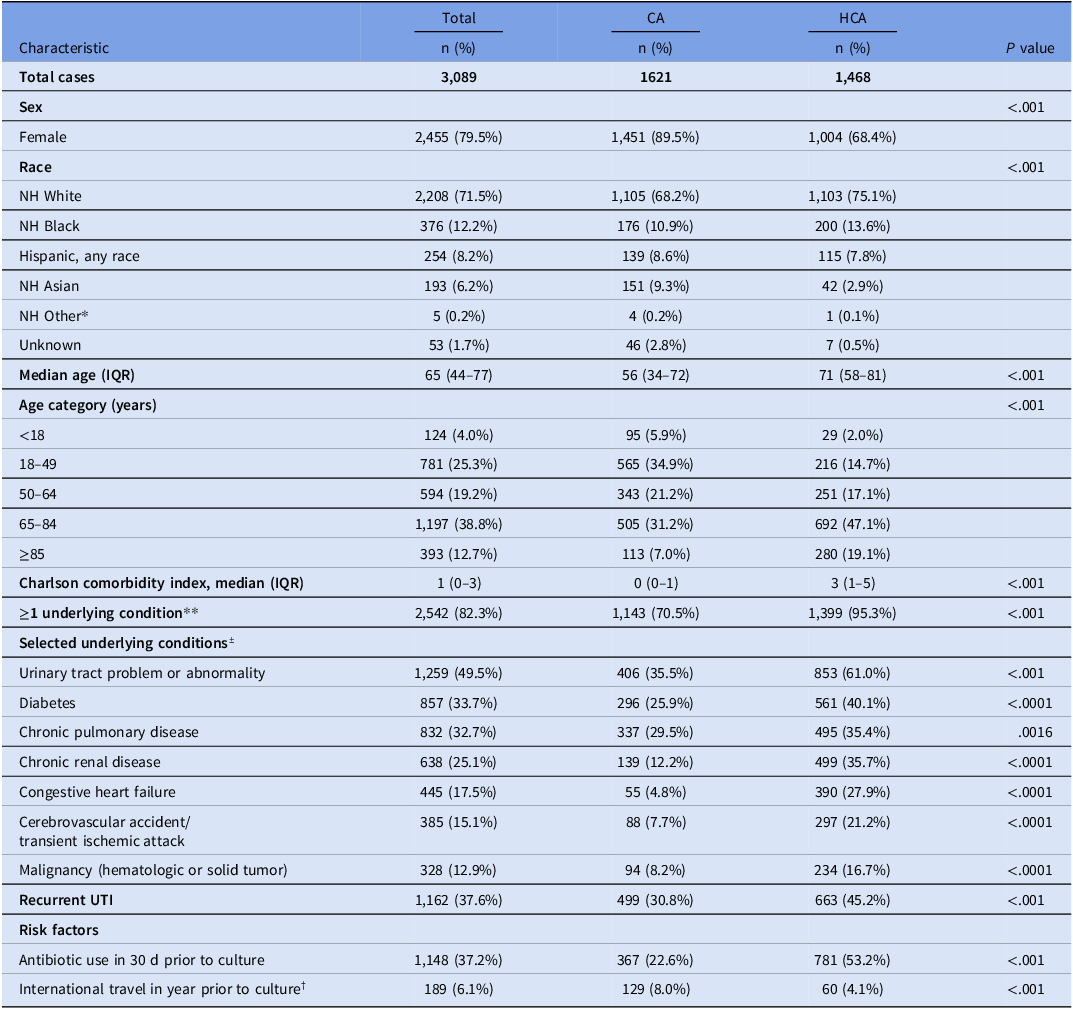
Compared to HCA cases, CA cases were younger [median age 56 (IQR 34–72) vs 71 (IQR 58–81), P < .001], more often female (89.5% vs 68.4%; P < .001), and had fewer comorbidities [median CCI 0 (IQR: 0–1) vs 3 (IQR: 1–5), P < .001]. The largest proportion of CA cases was among the 18–49 age group (34.9%), whereas the largest proportion of HCA cases was among those aged 65–84 (47.1%) (P < .001). Although both groups were predominantly White (CA: 68.2%; HCA: 75.1%), the race/ethnicity distribution differed between groups, driven by the overrepresentation of Asian individuals among CA cases (9.3% vs 2.9%) (P < .001). Additional case characteristics are provided in Table 1.
Demographic and clinical characteristics of extended-spectrum β-lactamase–Producing Enterobacterales cases by epidemiologic classification, Monroe County, NY 2020–2023

CA, community-associated; HCA, healthcare-associated; NH, non-Hispanic; *Hawaiian/Pacific Islander, Native American/Alaska Native **All underlying conditions are shown as the percentage of cases with that condition out of all cases with 1 or more underlying conditions.
±Additional underlying conditions included in the Charlson Comorbidity Index: Dementia, Previous MI, Peripheral vascular disease, Connective Tissue Disease, Hemiplegia/Paraplegia/Quadriplegia.
†Cases may have traveled to more than one country in the year prior.
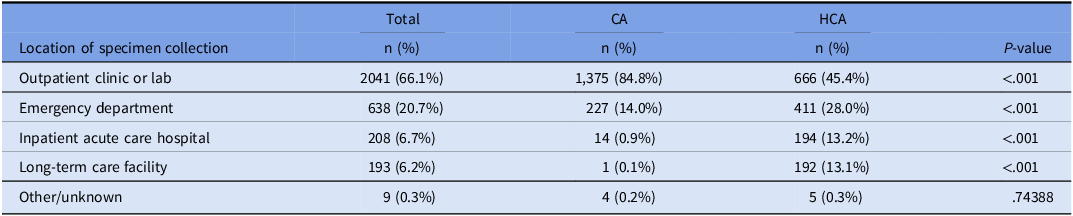
A significantly lower proportion of CA cases had documented underlying medical conditions than HCA cases (CA: 70.5%; HCA: 95.3%; P < .01). Among cases with an underlying condition, urinary tract abnormalities were the most prevalent condition (CA: 35.5%; HCA: 61.0%). Recurrent UTIs were also common in both groups (CA: 30.8%; HCA: 45.2%). Antibiotic use within the preceding 30 days was less frequent in CA cases compared to HCA cases (CA: 22.6%; HCA: 53.2%, P < .001). HCA cases were more often documented as colonized or with no identified infection (17.5% vs 6.4%, P < .001). CA cases were more likely to have a history of international travel within the year preceding culture (8.0% vs 4.1%, P < .001), with the most frequent travel to Southeast Asia (25.5%), Latin America/Caribbean (24.8%), and Middle East/North Africa (15.2%). Most specimens were collected in the outpatient setting regardless of epidemiologic classification (CA: 84.8%, HCA: 45.4%) (Table 2).
Location of extended-spectrum β-lactamase–Producing Enterobacterales urine specimen collection by epidemiologic classification

CA, community-associated; HCA, healthcare-associated.
Community-level analysis
Of the 210 Monroe County census tracts, 206 (98.1%) had a non-zero population and at least one ESBL-E urine isolate for inclusion in this analysis. The mean composite SVI for census tracts was 0.45 (SD = 0.31), corresponding to low–medium vulnerability. Composite SVI values ranged from 0.001 to 0.986, indicating that both very low-and very high-vulnerability tracts were represented. Overall, the prevalence of ESBL-E UTIs increased with greater vulnerability across selected themes, after controlling for epidemiologic classification.
The mean census tract ESBL-E UTI prevalence was 4.17 cases per 1,000 residents (SD = 2.05). ESBL-E UTI prevalence increased significantly with higher vulnerability for the composite SVI (β1 = 0.022, P = .034), Theme Two (household composition/disability; β1 = 0.044, P < .001), and Theme Four (housing type/transportation; β1 = 0.033, P = .009). In contrast, prevalence remained stable across vulnerability percentiles for Theme One (socioeconomic status; β1 = 0.00057, P = .954) and Theme Three (racial/ethnic minority status; β1 = 0.006, P = .642) (Supplemental Table 1).
ESBL-E UTI prevalence patterns differed between CA and HCA cases. The mean CA ESBL-E UTI prevalence rate among all census tracts was 1.43 cases (SD = 0.35), compared with 1.29 HCA cases per 1,000 population (SD = 0.54). The modeled CA ESBL-E UTI prevalence was consistently higher than HCA prevalence across all SVI themes (β2 range: 0.22–0.39, all P ≤.015) (Figure 2 and Supplemental Table 1).
Extended-spectrum β-Lactamase–Producing Enterobacterales rate estimates per 1,000 residents at the 10th, 25th, 50th, 75th, and 90th SVI percentiles with 95% confidence intervals by epidemiologic class and Social Vulnerability Index (SVI) theme.

Figure 2. Long description
Panel A shows case rates by overall SVI percentile, panel B shows Theme 1, Socioeconomic status, panel C shows Theme 2, Household characteristics, panel D shows Theme 3, Race and ethnic makeup, panel E shows Theme 4, Housing type and transportation.
The association between SVI and ESBL-E UTI prevalence also differed by epidemiologic classification. Significant interactions between SVI and epidemiologic classification were observed for the composite SVI and Theme Two (Composite SVI: β3 = −0.0336, P = .022; Theme Two: β3 = −0.0465, P = .0011) (Supplemental Table 1). As SVI increased, HCA prevalence increased, while CA prevalence remained stable (Figure 2). For example, HCA ESBL-E UTI prevalence increased from 1.20 cases (95% CI: 0.97–1.45) in the 10th (low vulnerability) percentile of Theme Two to 2.10 cases (95% CI: 1.85–2.37) in the 90th (high vulnerability) percentile (Figure 2, Supplemental Table 2). In contrast, CA ESBL-E UTI prevalence shifted only marginally from 2.08 (95% CI: 1.78–2.41) to 2.03 (95% CI: 1.78–2.29) cases across the same percentiles (Figure 2, Supplemental Table 2). A similar but non-significant trend was observed for Theme Four (β3 = −0.0332, P = .067). No significant interactions were observed for Theme One (β3 = −0.018, P = .197) or Theme Three (β3 = −0.020, P = .271). Regression parameters and Type II Sum of Squares results are presented in Supplemental Tables 1 and 3.
Discussion
This population-and laboratory-based study highlights distinct profiles of CA and HCA ESBL-E UTI using individual-and community-level analyses. CA ESBL-E UTI were more common in younger patients with fewer medical conditions, many of whom lacked traditional clinical risk factors for these infections. Furthermore, CA prevalence was relatively unaffected by changes in social vulnerability. In contrast, HCA prevalence increased in communities with higher levels of household vulnerability defined by factors such as older age, disability, single-parent households, and limited English proficiency. These patterns mirror the demographic and clinical profiles of HCA cases in our data: older adults with more comorbidities who are more likely to engage with healthcare facilities, thus potentially increasing exposure risk.
We observed several demographic differences between CA and HCA ESBL-E UTI cases. Asian individuals were overrepresented among all ESBL-E UTI cases and CA in particular, accounting for over 9% of cases despite representing only 4% of the Monroe County population. Travel may partially explain this finding, as Asian individuals accounted for 25% of CA cases with documented travel; 82% (27/33) of that travel was to Southeast Asia. Travel to regions with high ESBL-E prevalence, such as Asia, South America, and the Middle East, is a known risk factor for ESBL-E acquisition. Reference Tängdén, Cars, Melhus and Löwdin9 Carriage rates can reach 70% in some parts of Asia. Reference Tängdén, Cars, Melhus and Löwdin9–Reference Otter, Natale and Batra11 Cultural practices and food sources may also influence ESBL-E colonization and infection risk in patients without additional healthcare risk factors. Further investigation with larger sample sizes and disaggregated data may better inform this finding. Reference Islam, Khan, Kwon, Jang, Ro and Trinh-Shevrin12
In our study, 85% of CA cases were identified and managed in the outpatient setting, a group that is less represented in the existing literature. Over two-thirds of cases lacked recognized risk factors for UTIs, and most cases did not have documented recent antibiotic exposure. Although antibiotic exposure is a known risk factor for AMR in general, studies are inconsistent for ESBL-E and are limited to specimens collected at the hospital. Leistner et al. found no association between recent antibiotic exposure and ESBL-E colonization among patients identified on hospital admission in Germany. Reference Leistner, Meyer and Gastmeier13 In contrast, Goyal et al. observed a significant association between antibiotic exposure in the prior 3 months and ESBL-E growth in urine cultures at admission in a single US health system. Reference Goyal, Dean and Neill14 While recent antibiotic exposure was uncommon in our CA cohort, antibiotic use may still influence community ESBL-E epidemiology through selective pressure. Inappropriate prescribing of fluoroquinolones and cephalosporins has been associated with geographic variation in ESBL-producing E. coli. Reference Kubes and Fridkin15 These findings suggest that factors beyond recent individual antibiotic exposure likely contribute to CA ESBL-E UTIs.
At the community level, social vulnerability had a varying impact on CA and HCA ESBL-E UTI prevalence in our study. No association was observed between SVI and CA ESBL-E UTI prevalence, whereas HCA ESBL-E UTI prevalence increased with greater vulnerability. This was largely driven by SVI Theme 2, which comprises household composition and disability. One potential explanation is antibiotic “spillover,” the phenomenon where antibiotic use raises AMR prevalence in connected populations through transmission networks. Reference Olesen, Lipsitch and Grad16 In communities with higher household vulnerability, increased healthcare contact may facilitate transmission networks among high healthcare utilizing populations such as older adults and individuals with disabilities, contributing to higher HCA ESBL-E burden in the population. In contrast, the relatively stable CA ESBL-E UTI prevalence suggests that spillover into the broader community may be relatively limited.
The relationship between social vulnerability and ESBL-E in high-income countries is unclear in the existing literature, with studies showing positive, negative, and no associations. Examples include US-and Australia-based studies that found greater community-level socioeconomic deprivation was associated with higher prevalence of ESBL-E, without epidemiologic classification. Reference Brown, Henderson, Ruegsegger, Moody and van Duin17,Reference Ling, Cadavid-Restrepo, Furuya-Kanamori, Harris and Paterson18 However, another study in Australia found no significant relationship between socioeconomic disadvantage and ceftriaxone-resistant E. coli. Reference Chua and Stewardson19 Interestingly, two studies in France reported an inverse correlation between community-onset ESBL-E UTIs and social deprivation. Lower ESBL-E prevalence was observed in more deprived areas, a pattern different from that commonly described for other AMR organisms. Reference Paumier, Asquier-Khati and Thibaut20,Reference Larramendy, Gaultier, Fournier, Caillon, Moret and Beaudeau21
The absence of epidemiologic classification and differences in the community health indices used may further obscure associations between social vulnerability and ESBL-E UTI risk. A US study investigating community-level drivers of composite AMR (using several organisms, including ESBL-E) found a higher prevalence in socially vulnerable neighborhoods as identified by the Area Deprivation Index, but not when using the composite SVI. These disparate results suggest that different indicators of community vulnerability may capture distinct drivers of AMR. Reference Cooper, Beauchamp and Ingle22
The inconsistent or absent association between social vulnerability and CA ESBL-E UTI prevalence reflects the multifactorial nature of ESBL-E acquisition outside the healthcare setting. Several known or suspected drivers, such as international travel and antibiotic consumption, are often more common among individuals with higher socioeconomic status. Additional non-healthcare exposures, including food sources and environmental exposures such as agriculture, livestock, and water sources, are important potential vectors and may vary across sociodemographic and economic contexts. Reference Blaak, de Kruijf, Hamidjaja, van Hoek, de Roda Husman and Schets23–Reference Madec, Haenni, Nordmann and Poirel26 Household transmission from colonized family members or pets has also been described. Reference Damborg, Broens and Chomel27,Reference Ludden, Cormican, Vellinga, Johnson, Austin and Morris28 Consequently, commonly used health indices, such as the SVI, may not fully capture risk, particularly in communities experiencing structural vulnerability in other ways, such as adverse environmental exposures. Future studies should consider incorporating a One Health framework and complementary measures of structural vulnerability that better account for environmental drivers.
In summary, this population-based study shows that over half of ESBL-E urinary isolates were CA, largely affecting younger females with few comorbidities and limited traditional healthcare risk factors. These findings suggest that traditional HCA risk factors alone may not adequately identify patients at risk for CA ESBL-E UTI. Although we did not identify community-level SVI variables associated with increased CA ESBL-E UTI prevalence, clinicians should still consider ESBL-E in outpatients with UTI, particularly those with individual-level risk factors such as recurrent infections or recent international travel to high-prevalence regions. Emerging predictive models that incorporate prior infections, resistance history, and demographic factors may help identify patients at higher risk earlier in their course of care. Reference Shields, Cheng and Kponee-Shovein29
This study has several limitations. It was conducted in a single county in Western NY, which may limit generalizability to rural areas and other regions outside of NY. Secondly, our surveillance relies on clinical isolates, primarily from symptomatic individuals, and may therefore not capture the full burden of ESBL-E urine colonization in the community. Third, data collection relied on EHR documentation, meaning epidemiologic classification and risk factors may be incompletely captured; notably, individual insurance status was not recorded. Furthermore, prior antibiotics were captured only in the month prior to culture, which may have underestimated this risk. Additionally, although SVI has been increasingly applied in AMR research, it was not originally designed to measure infectious disease outcomes and therefore may not fully capture the community-level factors most relevant to AMR risk.
Despite these limitations, to our knowledge, this is the only US population-based study to rigorously define CA ESBL-E UTI using specimens collected across the spectrum of care to evaluate individual-and community-level drivers of disease. Our findings highlight the distinct epidemiologic characteristics of CA ESBL-E UTIs and the lack of a clear relationship between community-level prevalence and SVI. Taken together, these findings suggest that factors driving CA ESBL-E UTIs differ from those associated with healthcare exposure. Efforts to reduce ESBL-E UTIs should consider these differences and broader community and structural factors beyond those captured by the SVI.
Supplementary material
The supplementary material for this article can be found at https://doi.org/10.1017/ice.2026.10516.
Acknowledgments
We thank Christina Felsen, MPH, Elizabeth Anderson, MPH, and Lauren Nakamura for their critical review of the manuscript. The project described herein was supported by the University of Rochester Office of Health Equity Research. The content is solely the responsibility of the authors and does not necessarily represent the official views of the University of Rochester.
Financial support
This work was supported by a cooperative agreement from the Centers for Disease Control and Prevention, Emerging Infections Program (Agreement Number NU50CK000650).
Competing interests
Brenda L. Tesini reports honoraria from Merck for role on the editorial board of the Merck Manuals. Note that this is a distinct entity from the pharmaceutical branch. None of the other authors have any conflicts of interest.



 Open access

