Ping An Insurance (Zhongguo Ping An 中国平安), a big financial services company registered in Shenzhen, became widely known after a New York Times article reported that one of its largest share-holders is Yang Zhiyun 杨志云, the mother of China's former premier, Wen Jiabao 温家宝.Footnote 1 An examination of Ping An's public records reveals that it is probably one of the most politically connected firms in China: two of its board members used to work in the national government, five in local government including a vice-mayor of Shenzhen, and the firm's president is a delegate of the Chinese People's Political Consultative Conference. Ping An Insurance is not alone. As unveiled in the recent anti-corruption campaign in China, many firms have connections with powerful politicians – for example, China National Petroleum Corporation (Zhong Shiyou 中石油) and Zhou Yongkang 周永康, and Dalian Shide 大连实德 and Bo Xilai 薄熙来. The downfall of a politician in China is often preceded or followed by the fall of one or more companies.
However, despite the prevalence of politically connected firms in China, there is little comprehensive knowledge about them beyond anecdotes and case studies. This article presents a large-scale, systematic study of the country's politically connected firms. It was conducted by compiling a database of all the publicly traded firms in China in 1993, 2002 and 2012, through coding the biographies of hundreds of thousands of board members. I distinguish connections with seven political organizations: the national government, local government, the national parliament, local parliament, the National Party Congress, local Party congress, and the People's Liberation Army (PLA). A firm is defined as being connected if at least one of its board members is formerly or currently an employee or a member of these organizations.
I find that, first, political connections are ubiquitous among listed firms in China: almost 90 per cent of firms are connected. Second, firms are overwhelmingly connected with the government rather than the parliament, which is a more common form of connection in democracies. Third, while more firms are connected with local governments than with the national government, there has been a significant increase in the percentage of firms that are connected with the national government in the last 20 years. The proportion of firms connected with the national government has tripled between 1993 and 2012, whereas the proportion of firms connected with local governments has increased only by 30 per cent.
This last finding casts doubt on the popular argument that businesses in China have primarily relied on collusive relationships with local politicians. For example, David Wank has contended that, “private business operated in networks of personal ties centered on the local government. Personal ties with state agents enhance access to profit opportunities located in the state's bureaucracy and protect subsequent wealth accumulations” (my emphasis).Footnote 2
This article offers new data and methods to challenge this conventional wisdom. My interpretation of the trend is that local connections can make investors vulnerable by exposing them to political uncertainties. It is particularly the case in authoritarian regimes, where political processes are opaque and political winds quickly change direction, that business people can easily bet on the wrong side. Therefore, firms in a politically uncertain environment need to build robust connections to minimize political hazards. Connections with powerful and stable institutions, such as the national government, are less susceptible to political shocks.
There are two primary reasons why national connections are more robust than local connections. First, while local politicians must rotate across localities and, therefore, cannot stay in one place for a long time, central government officials are less frequently rotated.Footnote 3 Second, local officials are more likely to become targets of anti-corruption campaigns than central officials, so local connections are more vulnerable than central connections to shifts in political winds.Footnote 4
I am not arguing that firms have moved away from local connections but rather that many firms build both national and local connections. The diversification of connections provides double insurance for firms under uncertain political circumstances. My analysis shows that older and bigger firms are more likely to diversify their political connections.
To show empirically that national connections are more robust than local connections, this article presents an event study of the removal of Chen Liangyu 陈良宇, Party chief of Shanghai, in 2006. Around the time of the announcement of Chen's dismissal, firms that were connected only with the Shanghai local government experienced a significant five-day cumulative abnormal return of −2.34 per cent. The political earthquake caused a loss of US$830 million to locally connected firms. In contrast, firms connected only to the national government were unaffected.
This article contributes to the political connection literature by disaggregating different types and levels of connections and examining the various functions they serve. In addition, the findings challenge the conventional wisdom, which is based primarily on case studies that postulated that Chinese firms have overwhelmingly relied on “local protectionism,” and instead show that central connections are more important than previously believed.Footnote 5 While local protection is still important, it exposes firms to political risks in certain circumstances.
I also join the debate about whether the significance of guanxi 关系 (personal connections) has declined in China as a market economy is established.Footnote 6 My findings imply that the focus of future guanxi studies should shift from whether guanxi is important to what type of guanxi is important and why.
Data
I constructed a Chinese Listed Firms Database (CLFD) that includes the personnel and financial information of all listed firms in China in 1993, 2002 and 2012. One advantage of focusing on listed firms is that financial market data are often incredibly detailed and comprehensive compared to firm-level surveys that can only ask a limited number of questions and are subject to perception bias. In addition, the longitudinal nature of financial market data makes it possible to examine trends over time, which is the main purpose of this study, while long-term panel firm-level surveys are non-existent. However, one disadvantage is that non-listed firms are excluded from my sample. This might introduce selection bias to my analysis, but this study is concerned with the relative importance of national connections over time rather than the absolute level of importance in a given year. So, a sample of listed firms suits the purpose of the study well. Besides, listed firms are the biggest economic players and carry a disproportionate weight in the Chinese economy and politics, which makes the findings more indicative, if not more representative, than a random sample of firms.
China's stock market was established in 1991, and the number of listed firms increased from 53 in 1992 to 2,465 in 2012. I selected three years for data collection: 1993, 2002 and 2012. These years were selected because 1993 was the first year in which I could find a decent number of observations (there were only 53 listed firms in 1992), and 2002 and 2012 were both “transition” years in which the national leadership experienced successions. Furthermore, I chose a ten-year gap to ensure that there was adequate time for firms to replace old board members with new ones, so that I observe firm-level rather than individual-level changes – for example, a board member changes from a local people's congress delegate to a national delegate.Footnote 7 A total of 183, 1,224, and 2,465 companies were listed on the Shanghai and Shenzhen Stock Exchanges in 1993, 2002, and 2012, respectively. I obtained the biographical information of over 67,000 board members (chairperson, president, vice-president, CEO, executive director, non-executive director, or secretary) in all of the companies from Wind Info, a leading integrated service provider of financial data based in Shanghai.Footnote 8 I checked the reliability and consistency of the Wind data using public information found in a random sample of companies' annual reports to verify their accuracy. I then manually coded the career information of each board member in each firm to determine if a member is politically connected.Footnote 9 This “board” approach is consistent with the identification of political connections in the previous literature.Footnote 10
Different from previous studies that only examine one type or level of connection,Footnote 11 I distinguish between seven types of connections. A board member could be connected with one of the following organizations: the national government, a local government (from province to township), the national parliament (including the National People's Congress and the Chinese People's Political Consultative Conference), a local parliament (including a local people's congress and local people's political consultative conference), the National CCP Congress, a local CCP congress, or the PLA.
The rationale for disaggregating the different types and levels of connections is that there are different logics behind these connections. Political connections with the government can be supplied by politicians who “descend from heaven” through retirement. In China, Deng Xiaoping 邓小平 carefully and gradually enforced policies and norms for cadre retirement in the late 1970s.Footnote 12 Many officials also resign from public office to take a corporate job for two reasons.Footnote 13 One is simply that not everyone gets promoted to the top in the bureaucracy;Footnote 14 the second is the difference in the salaries of public and private sector jobs.Footnote 15
Another way to establish political connections is for business people to enter politics (“wealth into power”).Footnote 16 Legislatures in autocracies have intentionally incorporated opposition forces, including the business class, into politics to co-opt potential threats to the regime.Footnote 17 In China, the CCP has aggressively involved private entrepreneurs in politics by making them Party members or people's congress representatives. These “red capitalists” are shown to be more sympathetic than non-Party members to the authoritarian regime.Footnote 18
The reason to distinguish national connections from local connections is because there exist different incentive structures for politicians under a decentralized versus centralized system,Footnote 19 and as Andrei Shleifer and Robert Vishny have shown, “decentralized corruption” is more costly for society than “centralized corruption.”Footnote 20
A board member is identified as being connected with one of these organizations if he or she was previously or is currently an employee or a member. A person could have multiple connections – for example, a mayor who has resigned may also have been a local people's congress representative. I define government connections very strictly, and exclude any semi-governmental organizations such as research institutes affiliated with a government organization.Footnote 21 A company is connected if one of the company's board members is connected.
Trends
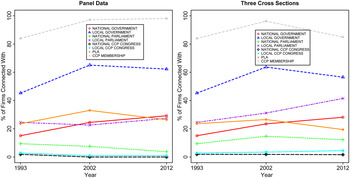
The time-series cross-sectional nature of the data allows for it to be arranged in two different ways. One is to construct a panel dataset of firms in 1993, 2002 and 2012 to track the same set of firms over time. The second is to examine three cross sections. Both procedures give similar results. First, most Chinese listed firms have political connections of some sort. If a firm is defined as being connected if at least one of its board members is connected with at least one of those seven organizations, then almost 90 per cent of firms are connected. Second, firms are overwhelmingly connected with the government rather than with the parliament, which is a more common form of connection in democracies.Footnote 22 Third, while it is still the case that more firms are connected with local governments than with the national government, which is consistent with the “local protectionism” argument, there has been a significant increase in the percentage of firms that are connected with the national government in the last 20 years. Both the panel and the three cross sections show that the proportion of firms connected with the national government has tripled between 1993 and 2012, whereas the proportion of firms connected with local governments has increased by only 30 per cent. The higher percentage of firms connected with the local government might simply be owing to the fact that there is a greater supply of retired or resigned local officials than there is of central officials, given the larger pool of the former. As calculated by Yuen Yuen Ang, the number of local officials (at province level and below) is four times that of central officials in most years between 1954 and 1998.Footnote 23 Adjusted for the availability, the demand for national officials has increased even more dramatically over the last 20 years. Figure 1 presents some of the key results.Footnote 24
Connections of Chinese Publicly Traded Firms, 1993, 2002 and 2012

In the analysis above, the political connection variable is coded as binary. An alternative measure is the degree of connectedness of a firm, for example the number of connections per firm. Table A13 in the web appendix shows the trend using the alternative measure, which is very similar to Figure 1.Footnote 25
One might wonder whether the increase has been driven by an increase in state-owned enterprises (SOEs) in the sample. While it is true that the state often appoints SOE managers, and many SOE managers are former bureaucrats,Footnote 26 the data actually show a decrease in SOEs from 1993 to 2012. The average state-owned share among all listed firms in 1993 was 38.23 per cent; this number decreased to 36.03 per cent in 2002, and further decreased to 7.88 per cent in 2012. If we look at the percentage of listed firms that had the state as their ultimate shareholder, the number was 43.40 per cent in 1993, 38.81 per cent in 2002, and 6.22 per cent in 2012.
Where did China stand in comparison with other countries/regions? I compared my 2012 measure of connection with the national government with Mara Faccio's measure of connection with a minister or members of parliament (my measure is a subset of Faccio's).Footnote 27 The highest ranked country in her sample was Russia, with 12 per cent of firms connected, while in China 12.25 per cent of firms were connected. China was also much higher than the usual suspects of highly connected countries, such as Indonesia (7.79 per cent), Thailand (8.24 per cent), Malaysia (5.17 per cent) and Italy (10.30 per cent); other BRICS states, including Brazil (0.00 per cent), India (2.29 per cent) and South Africa (0.00 per cent); other post-communist states, including the Czech Republic (0.00 per cent), Hungary (3.70 per cent) and Poland (0.00 per cent); the rest of East Asia, such as Japan (1.29 per cent), South Korea (2.24 per cent), Hong Kong (0.74 per cent), Taiwan (0.84 per cent) and Singapore (7.86 per cent); and developed democracies, including the United States (0.08 per cent), the United Kingdom (7.17 per cent) and Germany (1.31 per cent).
A couple of caveats need to be borne in mind. My measure of connections is far from comprehensive. First, in some instances, politicians' families may control firms through share-holding, nominee accounts, or shell entities. As the aforementioned New York Times article shows, the mother of China's former premier, Wen Jiabao, was a large shareholder in Ping An Insurance.Footnote 28 However, there is no comprehensive and accurate disclosed finance information on Chinese politicians. Nonetheless, my “board” approach can produce results that resonate largely with unobserved connections. For example, using the “board” procedure, Ping An Insurance is coded as a highly connected firm, with two board members connected with the national government, five connected with local governments, and one connected with the national parliament. Second, there are many ways to build a connection, such as through friendship, marriage, and bribery. I only focus on a direct measure that is observable for all firms.
Characteristics of connected firms
What are the characteristics of politically connected firms? I compared connected and non-connected firms along the following dimensions using the 2012 cross section: assets, profit, return on assets, tax, leverage, and state-owned share. Accounting data for Chinese listed companies were taken from the China Securities Market and Accounting Research (CSMAR).Footnote 29
ASSETS is defined as the natural log of total assets. PROFIT is defined as the natural log of the total profits of a firm. Return on assets (ROA) is the ratio of a company's net income prior to financing costs to total assets × 100. TAX is calculated as the ratio of tax and fees to total profit × 100. Leverage is a proxy for access to debt financing. LEVERAGE is defined as the ratio of long-term debt to total assets × 100. State-owned share (SOE SHARE) is defined as the ratio of state-owned shares to total shares × 100.
I then conducted regression analysis using one of the aforementioned variables as the dependent variable and one of the connection variables as the independent variable. The ordinary least squares (OLS) regression being performed is:
 $${Y_i} = {\rm \alpha} + \beta CONNECTION_i + {\bf XB} + \mathop \sum \nolimits {INDUSTRY} + {{\rm \epsilon} _i}, $$
where Y i is one of the variables measuring the characteristics of firm i, including ASSETS, PROFIT, ROA, TAX, LEVERAGE, and SOE SHARE. CONNECTION i is one of the dummy variables measuring the connectedness of firm i. X includes a group of controls, including AGE, all the characteristic variables except the dependent variable, and the firm's geographic distance to Beijing (DISTANCE TO BEIJING). INDUSTRY is the industry fixed effects to control for cross-industry variance. I calculate the standard errors of the estimates clustered at the provincial level to avoid overstating the precision of my estimation.Footnote 30
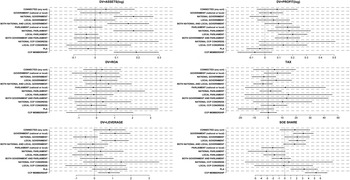
Figure 2 summarizes the results of 78 regressions, highlighting the effects of various connection variables, with one line representing a separate regression.Footnote 31 Since most firms are connected with the government (either national or local), let us first focus on the effects of government connections. First, firms connected with the national government have significantly bigger ASSETS and SOE SHARE than firms unconnected with the national government. However, national government connections do not make a difference to firms' PROFIT, ROA, TAX, and LEVERAGE. This implies that bigger, state-owned firms are more likely to be connected with the national government. Second, firms connected with local governments have significantly higher LEVERAGE and SOE SHARE than firms unconnected with local governments; local government connections do not differentiate firms by ASSETS, PROFIT, ROA, and TAX. This finding is in line with previous studies that found political connections to be important for firms to obtain loans.Footnote 32
Characteristics of Chinese Connected Firms, 2012

As for other types of connections, firms connected with parliament (either national or local) have a significantly higher level of PROFIT but a lower level of SOE SHARE, suggesting that “red capitalists” are disproportionally made up of private entrepreneurs and that they are usually from more profitable firms, which is consistent with the findings in prior studies.Footnote 33 I do not find any differences between firms connected and unconnected with the CCP Congress (either national or local), but this is probably owing to the small number of connected firms. In addition, firms that have former PLA members on their boards have more SOE SHARE, and firms that have at least one CCP member on their boards have bigger ASSETS, higher LEVERAGE, and SOE SHARE.
Another way to examine the data is to see what kind of firm is more likely to have political connections. In the following analysis, I switch the dependent and independent variables to investigate the determinants of political connections. Specifically, the dependent variable CONNECTION is an ordinal variable that has the values of 1 through to 4, indicating no government connection, only local government connection, only national government connection, and both national and local government connection, respectively. A higher value implies more robust connections. I then use ordered probit to predict CONNECTION using a set of firm-level variables, including AGE, ASSETS, PROFIT, LEVERAGE, TAX, ROA, SOE, and DISTANCE TO BEIJING. The results (Table A14 in the web appendix) show that older, bigger (measured by ASSETS), and state-owned firms are likely to have stronger connections, and firms located further away from Beijing are less likely to have strong connections.
These relationships are obviously only correlational rather than causal. It might be that bigger and more profitable firms have more resources to hire connected politicians (or politicians prefer to take jobs in bigger firms), or political connections help firms grow larger and more profitable. The next section will provide an interpretation for the results.
Why Are National Connections Robust?
Connections between politicians and businesses are not a unique, contemporary Chinese phenomenon. Dick Cheney, before he was elected America's 46th vice-president, was chairman and CEO of Halliburton Company, one of the world's largest oilfield service companies. Silvio Berlusconi had built a property-and-media empire and reinvigorated one of the world's greatest soccer clubs, AC Milan, before he was elected Italy's prime minister. Political connections exist everywhere around the globe from Hitler's Germany,Footnote 34 Suharto's Indonesia,Footnote 35 Mahathir's Malaysia,Footnote 36 to Great Britain,Footnote 37 and the United States.Footnote 38 In a cross-national study of politically connected firms, Faccio found connections that exist in 35 of the 47 countries in her sample.Footnote 39
However, political connections in China have some interesting characteristics and have experienced noticeable changes in the last two decades, as shown in the previous section. The finding that Chinese listed firms have been increasingly connected with the national government as opposed to local governments is puzzling given the overwhelming literature that focuses on local protectionism.Footnote 40 I interpret this as Chinese firms' need to build robust connections that are powerful and stable under uncertain political circumstances, and as a result of China's economic reforms.
Powerful connections
There are several secular trends in the Chinese economy and polity that incentivize firms to build more connections with the national government as the latter has become more powerful. If we characterize the first half of China's economic reforms in the last three decades as “decentralization,” which was designed to encourage local officials to ally with entrepreneurs to develop the local economy and thus support the bold reform initiatives of Beijing,Footnote 41 then starting in the mid-1990s, the reforms have shown signs of “recentralization.”Footnote 42 The turning point was the 1994 fiscal reform that shifted part of the tax-collecting authority from provinces to the centre.Footnote 43 This reform made local governments and economic actors more dependent on the centre for fiscal transfers and tax deductions.Footnote 44
Another change occurred in the late 1990s when China's then-premier, Zhu Rongji 朱镕基, started to push for state-sector downsizing. A policy termed “grasping the large, letting the small go” was implemented to privatize small, inefficient SOEs while at the same time strengthening the state control of big, profitable SOEs in critical industries.Footnote 45
In addition, Beijing also centralized its power to examine and approve major construction projects. In 1998, the old soviet-style State Planning Commission was renamed the State Development and Planning Commission, and then in 2003, it was transformed into the National Development and Reform Commission (Guojia fazhan yu gaige weiyuanhui 国家发展与改革委员会) and granted broad administrative and planning power over the Chinese economy. For example, a central government document issued in 2004 required that the opening of a coal mine producing more than 500,000 tons of coal per year should be approved by Beijing rather than by a local government, and similar bars were applied to a wide range of projects, from gas and electric to highways and tobacco production.Footnote 46
After over 30 years of industrialization, the sheer size of the Chinese economy and the number of large companies have increased dramatically. China's aggregate GDP world ranking has jumped from 15th in 1978 to second in 2013, and the number of Chinese firms on Fortune's 500, a list of the 500 largest companies in the world, has increased from three in 1995 to 95 in 2013.Footnote 47 As a consequence, big firms are no longer satisfied with only accessing local markets; they want to gain access to the national market. For example, for Shanghai Automotive Industry Corporation (SAIC), having a close relationship with the Shanghai municipal government would put the firm in a position to ensure that the Shanghai taxi fleet was almost entirely composed of SAIC Santanas; however, it would do nothing to help the firm break down barriers to the Hubei market and sell more Santanas after it had saturated the Shanghai taxi market.Footnote 48
The Chinese political system also motivates firms to build connections with the national government. Beijing still has the prerogative to appoint, rotate and remove provincial-level officials.Footnote 49 The nomenklatura power gives the centre both ex ante and ex post mechanisms to influence local politics.Footnote 50
These stylized facts about the Chinese economy and polity cast doubt on conventional models that focused on the local state's role in China's economic development, be it “local corporatism,”Footnote 51 “local protectionism”Footnote 52 or “federalism: Chinese style.”Footnote 53 As Dali Yang has pointed out, they have “gone too far.”Footnote 54 We expect to see a broader coalition built by firms and a more active and powerful role played by the national state in China's economic transitions.
Stable connections
National connections are also more stable than local connections for two reasons. First, as a control mechanism of the centre, Chinese local officials are constantly rotated around equally-ranked positions. For example, the Party chief of Fujian may be appointed as Party chief of Shanghai after working in Fujian for more than five years. Yasheng Huang has listed two rationales for this practice.Footnote 55 One is that “Rotation curbs factionalism by requiring the rotated officials to work with new officials.” A second rationale is that “rotation conveys information to the control level that is otherwise unavailable.” For example, the malpractices of the former Fujian Party chief can be detected by his successor and reported to the centre.
However, rotation of local politicians can cause partial regime changes at the local level. Because of prevalent factionalism in the appointment of officials,Footnote 56 as political winds shift, a partial regime change often follows a major official's departure. In a systematic study of political clientelism, Ang estimated that when a provincial leadership transition occurs, it will cause a change of 0.51 public employees per 1,000 residents, or 22,813 positions in the bureaucracy, on average.Footnote 57
Therefore, rotation of local officials exposes firms that build connections only with the local government to political uncertainties. In contrast, national officials are less frequently rotated. As Huang showed, because central bureaucrats' outputs are more visible to the centre, and ministerial appointment decisions are based more on expertise specialization, rotation is rarely applied to them.Footnote 58 In a dataset devised by Huang, of the 70 new Party secretaries appointed between 1985 and 1995, 11 (15.7 per cent) had served as Party secretaries or governors in other provinces immediately prior to assuming their current posts.Footnote 59 However, for ministerial officials, rotation is seldom applied. Of the 64 new appointments between 1984 and 1995, only one minister had clearly arrived immediately from another ministry.
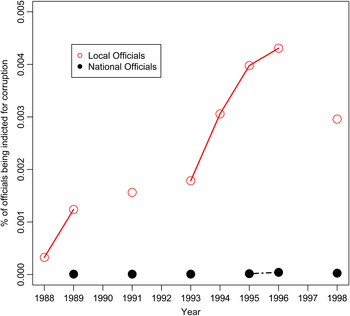
A second reason why national connections are more stable than local connections is that local officials are more likely to be targeted during anti-corruption campaigns. Figure 3 shows the percentages of local and national officials that have been indicted for corruption from 1988 to 1998.Footnote 60 The probability of a local government official being caught for corruption is approximately 200 times that of a central government official. A possible explanation for this discrepancy is the need for autocrats to maintain elite unity at the top level,Footnote 61 or it could be owing to the centre's blame-shifting strategy, which is aimed at ensuring that the national government enjoys a high level of trust among the masses.Footnote 62
Percentages of Local and National Officials Indicted for Corruption, 1988–1998

Are National Connections Robust?
To show that firms that have connections with the national government are less vulnerable to political shocks, I examined how a corruption scandal affected the market values of connected and unconnected firms. The corruption scandal selected was one of the most significant political events of the last 20 years in China: the removal of Shanghai Party chief, Chen Liangyu, in September 2006. There are a couple of reasons why I chose to analyse the Chen Liangyu event. First, although there have been many investigations into corruption investigations, as discussed earlier, there are very few cases that have caused a regime change that is significant enough to allow for the impact of such an event to be examined systematically. Given the limited number of listed firms, I needed an event big enough to generate a political earthquake.Footnote 63 Second, for an approach that estimates the impact of an event on the stock market to work, the event must be exogenous and surprising. There have been many corruption scandals that were endogenous to political connections, and information about dismissals has often been leaked before any official announcements were made, as was the case for most of the events during the recent anti-corruption campaign; these cases rule out the use of such an approach.Footnote 64
On Monday, 25 September 2006, the Chinese official media announced the dismissal and detention of Chen Liangyu because of his involvement in the Shanghai social security fund scandal.Footnote 65 Chen made his last public appearance as the Shanghai Party boss on the evening of 23 September, and news of his purge was kept strictly confidential before 25 September.Footnote 66 Chen Liangyu's downfall involved decisions made by people at the very top. The available evidence shows that it was owing to his misallocation of social security funds; some observers believe that his fall was because of his resistance to central policies.Footnote 67 Neither of these reasons has a connection to firms hiring former politicians.
One might argue that examining how national connections are immune to a local political shock is not strong evidence that national connections are more robust. As I discussed earlier, national connections are more robust not because firms connected with the national government are unsusceptible to political shocks (they are actually susceptible to national shocks); however, the key is that local political shocks happen far more often than national shocks. So, from a long-term perspective, connecting with the national government is a much safer strategy for firms.
Procedure
I conducted an event study to estimate the impact of Chen's fall on firms registered in Shanghai. Event studies use financial market data to measure the impact of a specific event on the value of a firm. The rationale of such a study is based on the fact that, “given rationality in the marketplace, the effects of an event will be reflected immediately in security prices.”Footnote 68 Event studies have been widely applied to a variety of economic events such as mergers and acquisitions, earnings announcements, issues of new debt or equity and announcements of macro-economic variables such as trade deficits.Footnote 69 Event studies have recently gained popularity in the study of political events.Footnote 70
A total of 121 companies registered in Shanghai that have daily return data were listed on the Shanghai Stock Exchange or the Shenzhen Stock Exchange in 2006. I obtained the biographical information of all 2,346 board members of these companies from Wind Info. I then followed the same procedure, as discussed above, and manually coded the career information of each board member in each firm to determine whether a member was politically connected.Footnote 71
This procedure gave me four types of firms: (1) firms unconnected with the government (either national or local); (2) firms connected with only the local government; (3) firms connected with only the national government; and (4) firms connected with both the national and local governments. There were firms that were connected with other political organizations as well, such as parliament or the CCP congress, but I will focus on government connections in the following analysis. Table 1 summarizes the frequencies of these four types.
Four Types of Firms in Shanghai, 2006

I followed the standard event study procedure to estimate the market-adjusted cumulative abnormal return for the five-day period (event window) around the event date (days −2 to +2).Footnote 72 The event date for Chen's removal is straightforward: 25 September 2006, the day of the announcement and the first trading day after his last public appearance.Footnote 73 I estimated the abnormal return and cumulative abnormal return during the event window [−2, 2] using the standard event study methodology. Normal return is the expected return without conditioning on the event taking place. Abnormal return (AR) is defined as the actual ex post return of security during the event window [−2, 2], minus the normal return of the firm during the event window [−2, 2]. The estimation window [−110, −10] was used to estimate the normal return based on the “market model”:
 $$NORMAL\; RETUR{N_{it}} = {{\rm \alpha} _i} + {\beta _i}MARKET\;RETUR{N_{mt}} + {{\rm \epsilon} _{it}}, $$
where NORMAL RETURN
it
and MARKET RETURN
mt
are the period-t (in this case [−110, −10]) returns on security i and the market portfolio, respectively, and ε
it
is the zero mean disturbance term with variance of
 $\mathop \sum \nolimits_\epsilon ^2\!. $
α
i
and β
i
are the parameters of the market model.
With the estimated parameters
 $\widehat{{{{\rm \alpha} _i}}}$
and
 $\widehat{{{\beta _i}}}$
, the AR is:
 $$A{R_{i\tau}} = RETUR{N_{i\tau}} -\widehat{{{{\rm \alpha} _i}}} - \widehat{{{\beta _i}}}NORMAL\; RETUR{N_{m\tau}}, $$
where RETURN iτ is the daily return of stock i during event window τ ([−2, 2]), and NORMAL RETURN mτ is the estimated normal return based on Equation (1) during event window τ.
The cumulative abnormal return (CAR) is the sum of the abnormal return during the event window,
 $$CA{R_{i\tau}} \left( {{\tau _1},\; {\tau _2}} \right) = \mathop \sum \limits_{\tau = {\tau _1}}^{{\tau _2}} A{R_{i\tau}}. $$
Results
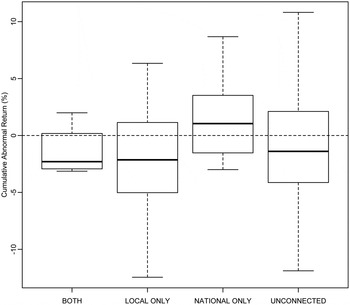
The CAR has a mean of −1.13 per cent, with a standard deviation of 4.76 per cent. Figure 4 shows a simple box-plot of the average CARs across different categories of firms.Footnote 74 Firms connected only with the local government had a significant CAR of −2.34 per cent, firms connected with both the national and local governments had a significant CAR of −2.23 per cent, unconnected firms had an insignificant CAR of −0.81 per cent, and firms connected with only the national government had an insignificant CAR of 1.98 per cent.
Mean CARs across Different Categories of Firms During the Chen Liangyu Event

These descriptive statistics imply that firms were the most vulnerable if they were connected with only the local government. Because Chen Liangyu spent his whole career in Shanghai, his removal caused a quasi-earthquake in Shanghai that affected firms with only local connections. Firms connected with both the national and local governments were also negatively affected: their super-majoritarian connections exposed them to risks at both levels. In contrast, unconnected firms and firms connected with only the national government were largely unaffected.
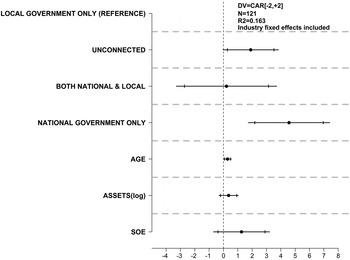
The following specification is OLS estimated to test whether the differences between these categories are significant:
 $$\eqalign{CA{R_{i\tau}} &= {\rm \alpha} + {\beta _1}UNCONNECTE{D_i} \cr & \quad+ {\beta _2}BOTH\; NATIONAL\& LOCA{L_i} \cr & \quad+ {\beta _3}NATIONAL\; GOVERNMENT\; ONL{Y_i} \cr & \quad+ {\bf XB} + {{\rm \epsilon} _{i\tau}}\comma } $$
where CAR iτ is the estimated cumulative abnormal return of firm i during event window τ ([−2, 2]), UNCONNECTED i is an indicator measuring whether firm i was unconnected with the government (either national or local), BOTH NATIONAL&LOCALi is an indicator measuring whether firm i was connected with both the national and local governments, and NATIONAL GOVERNMENT ONLY i is an indicator measuring whether firm i was connected with only the national government. Obviously, the reference group is firms connected with only the local government. X includes a number of controls such as AGE to consider the maturity of a firm, ASSETS to control for size, SOE, and industry fixed effects to control for sectoral variations.Footnote 75 Robust standard errors are estimated to tackle heteroskedasticity.
Figure 5 presents the results.Footnote 76 The black dots are the estimated coefficients, the lines are the 95 per cent confidence intervals, and the small bars are the 90 per cent confidence intervals. As it shows, around the time when Chen was removed, compared to firms connected with only the local government (reference group), unconnected firms experienced a five-day CAR of 1.90 per cent, and this difference is significant at the 0.1 level. Firms connected with both the national and local governments are not significantly different from those connected only with the local government. Firms that had connections with only the national government experienced a significant CAR of 4.57 per cent.
Categories of Firms and Their Relative CARs

As for the controls, I found that older firms lost less than new firms during the shock. However, size and ownership of firms did not make a difference to their market values during the shock.
The results suggest that firms are much better off if they are unconnected, or connected with only the national government, in the face of a local political shock. However, unconnected firms, although they do not incur the costs, also do not benefit from political connections. Building connections with the national government is a safe, beneficial strategy.
Concluding Remarks
Social scientists have long been interested in how investors cope with uncertainties.Footnote 77 A popular argument is that investors in a weak rule-of-law regime rely on political connections to substitute for formal legal protection.Footnote 78 However, political connections can make investors vulnerable by exposing them to political uncertainties.
Relying on a large dataset of Chinese listed firms, I show that although local connections are still the most prevalent form of political connections, firms in China have increasingly built connections with the national government. The reasons are twofold. First, national connections are more powerful as the Chinese polity has been centralized in the latter half of the reform era and the Chinese economy has become too big for local governments to control. Second, national connections are more stable because local officials are constantly rotated and more likely to be targeted during anti-corruption campaigns. Building connections with the national government therefore provides a more robust form of protection for businesses under a weak rule-of-law regime.
The findings shed light on our understanding of the role of the state in development and coalition-building in authoritarian regimes. The “developmental state” literature championed the benefits of the state being “embedded” in the economy.Footnote 79 However, as I show, the embeddedness also exposes firms to political risks that are common in authoritarian regimes, and firms must strategize as to which institutions they want to be connected to. I have also disaggregated “the state” by level, which was often fused in prior studies of developmental states.
In addition, this paper also contributes to the theory of political coalitions. While the existing literature has focused on the size of coalitions,Footnote 80 I show that members of a coalition are important. Firms do not necessarily rationalize along the lines of either “super-majoritarian” coalitions or minimal winning-coalitions; they must build coalitions with robust institutions that are powerful and stable.
Acknowledgement
I want to thank Stephan Haggard, Avery Goldstein, Ed Mansfield, Matt Levendusky, Marc Meredith, Julia Gray, Alex Weisiger, Guy Grossman, John Yasuda, Xin Sun and Dong Zhang for helpful comments and Yuen Yuen Ang for sharing cadre data. Yu Zeng, Biyang Zhang, Shuhao Fan, Xinyi Yang and Luyue Luo have provided excellent research assistance. All errors remain my own.
Biographical note
Yuhua Wang is an assistant professor in the department of government at Harvard University. His research has focused on state institutions and state–business relations in China. Yuhua is the author of Tying the Autocrat's Hands: The Rise of the Rule of Law in China (Cambridge University Press, 2015). Yuhua received BA and MA degrees from Peking University in 2003 and 2006, and a PhD in political science from the University of Michigan in 2011. From 2011 to 2015, Yuhua was assistant professor of political science at the University of Pennsylvania.