Introduction
The study of urban landscapes and their constituent features has been explicitly linked to the types of agents (organizations and individuals) responsible for their creation. ‘Each pursues particular goals, the nature of which can result in conflict over the form of the built environment. It is important therefore to understand the motives underlying the behaviour of these key agents.’Footnote 1 This article explores a process of decision-making in a post-catastrophe urban landscape relating to a building type that bears considerable social significance, visual importance and contribution to local – and indeed national – identity: the church.
The treatment of war-damaged churches has been of some interest throughout the twentieth centuryFootnote 2 and, with the recent reconstruction of Dresden's Frauenkirche, into the present century. The furious debates about the fate of what had been, for several decades, a pile of rubble in the centre of DresdenFootnote 3 crystallized some of the issues that were debated half a century earlier: what to do with prominent structures that had received substantial war damage? Adaptive reuse, symbolic preservation, reconstructive recreation, stabilization of the ruins and honest delineation of the new insertions are among the choices that emerged repeatedly in such circumstances, advocated by different individuals and institutions.
These circumstances are thus common after a disaster strikes any settlement, imposing the need for crisis-response decision-making. An extensive literature has developed around responses to crisis, including reactions to destruction of the built fabric in cities. Most work on the latter deals with the impacts of different types of destruction, the contrasts between various approaches to recovery from such a crisis, the mechanisms for implementing this recovery or with the planning for this implementation.Footnote 4 The decision-making related to the ways of acting in the face of such destruction has generally not been the explicit focus of such studies. This article aims to help fill this gap, using as a case-study one circumstance of destruction aimed at one geographic area during one period, concentrating on the varying fates associated with one particular building type: we focus on the outcomes of World War II bomb damage to churches in the City of London.
Many other cities had bomb-damaged churches and needed to take similar decisions; but the concentration in the City, and the survival of records from a series of decision-making bodies, makes this a very suitable case for examination.
English churches in wartime
The context for this example of decision-making is the changing status of the Church of England by the time of the wartime bomb damage. During the inter-war period, the church advocated social reforms and became involved in planning issues, especially with respect to housing conditions; it claimed influence in matters of politics and economics; and there was even some explicit discussion of the church's role during and after the conflict that was clearly imminent.Footnote 5 Yet the church had become less popular; indeed, some members of the public were shocked by the liberal attitudes of senior churchmen,Footnote 6 and there had been a longstanding societal move away from church attendance and support. Hodson, a wartime diarist, noted the lack of attendance and a contemporary report stating that 90 per cent of the population seldom or never attended church.Footnote 7 A broader survey by Mass Observation, albeit in only one London borough, suggested a widespread public dislike of the established church as an organization.Footnote 8 In inner cities, this decline in support was accompanied by a fall in resident parish populations.
The scale of damage and loss to ecclesiastical buildings during World War II was considerable, but is not easy to uncover with any accuracy. By 1944, at the start of the V1/V2 raids on south-east England, the War Damage Commission stated that nationally nearly 14,000 churches and other ecclesiastical buildings had suffered various degrees of damage.Footnote 9 Despite such alarmingly large overall figures, ‘many reports of damage to churches prove, on sifting, to amount only to stripped tiles or slates, or the loss of valueless stained glass’.Footnote 10
There was a high density of historic church buildings in medieval cities such as the City of London, and they were vulnerable to both high explosive and incendiary bombs. Many in the City were felt to be of particular cultural value, contributors even perhaps to national identity. In particular, there were those designed by Christopher Wren following the 1666 Great Fire of London.Footnote 11 The intensity of pre-war redevelopment in the City had already begun to demolish churches whose numbers of resident worshippers were falling fast. The problem faced after the end of the war was, in fact, no new thing.Footnote 12 The process of decision-making in terms of church redundancy and demolition was different, but still generated vociferous objection: in that ‘last crisis some twenty years ago . . . the then Bishop of London and his advisers (who should have been their champion) sought profitably to destroy a number of them as “redundant”’.Footnote 13
Wartime responses to war damage
By the end of the war, the scale of the problem for the diocese of London as a whole was substantial. Of 701 churches, 624 were damaged, and of these 91 were completely destroyed.Footnote 14 Indeed, during the Blitz ‘there were parts of London where “not only the Church of England but organised religion of every kind is for all intents and purposes extinct”’.Footnote 15
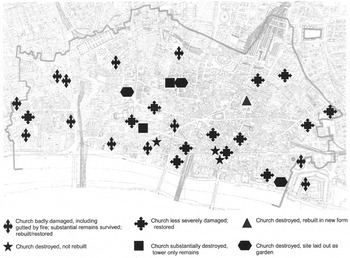
The extent of the damage within the City of London itself was mapped by Holden and Holford's report on reconstruction planning, published in 1951.Footnote 16 We estimate that four churches were totally destroyed, two remained essentially as towers only, more substantial remains of nine were left, and a further six were gutted by fire. Of Wren's 32 City churches remaining by the start of the war, only 15 remained substantially undamaged by the war's end. However, this is our own evaluation of a range of contemporary and more recent documents and illustrations, since contemporary reports and publications frequently use terms such as ‘totally destroyed’, when incendiaries had burned the roof and interior fittings, but walls and tower remained apparently little-damaged according to a range of graphical evidence (Figure 1). There appears to be a clear propaganda or morale rationale in some uses of texts and images. Yet, even very recent publications including local and architectural histories, and academic works, perpetuate these misinterpretations.Footnote 17
Substantial survivals of St Bride's, Fleet Street, ‘completely gutted’ (photographed in March 1941 by Bedford Lemere, © English Heritage).

Given the urgency of coping with damaged structures in the immediate aftermath of raids, there was little time to evaluate their structural condition. Anything considered potentially dangerous was often summarily cleared, usually by military personnel, especially the Royal Engineers and Pioneer Corps.Footnote 18 Thus, structures that survived the explosive or fire damage were, in many cases, subsequently lost. Little of the medieval masonry survived the clearance. In fact, the city engineer, F.J. Forty, took the most immediate response in London to the bomb and fire damage. Here, as elsewhere,
demolition squads were in readiness to bring down anything considered dangerous. Fortunately, the City Engineer . . . took it upon himself to offer help to the incumbents of the damaged churches. He also gave instructions to all his demolition squads to safeguard the walls of all the churches, and to leave their debris untouched . . . It is only fair to say that Mr Forty's timely intervention not only saved the remains of these venerable buildings; it inspired architects and incumbents to do the right thing. As a result walls and monuments as well as important architectural features were saved.Footnote 19
Nevertheless, a senior member of the Ancient Monuments Branch was commenting in early 1941 that the burned-out churches were vulnerable because their sites had not been secured, although ‘at last the gravity of the situation has been realised in the responsible quarters’.Footnote 20 The church as a whole was aware of this problem and was involved with the Royal Institute of British Architects (RIBA) and others in exploring how expert advice could be immediately provided.
Financing the rebuilding: the War Damage Acts
The funding of war repairs was a central government function, via bureaucratic processes requiring estimates of damage, claims, inspections and so on. The level of payment during and after the war determined, to a very considerable extent, the nature of the restoration or rebuilding work and hence the outcome of decision-making processes.Footnote 21 This is a significant issue given the declining state of church finances at the time. In some cases, local, and occasionally international, fund-raising was able to supplement the official payments.
The War Damage Acts set up the War Damage Commission to decide upon claims for compensation for war damage. The various Christian churches jointly established a committee chaired by the bishop of London to negotiate suitable procedures and rates of payment to be applied equitably to all of the churches. Normal market value comparisons were impossible, as the market value of a church was felt to be ‘too hypothetical to be capable of precise ascertainment’.Footnote 22
The church payments were to be assessed on the smaller of ‘the reasonable cost of the “plain repair” of the war damage’, or ‘the reasonable net cost of building a “plain substitute church”’. The key point was the word ‘plain’.
‘Plain’ is to be interpreted as implying that unnecessary ornamentation has been omitted and allowance made for undue size and serious defects in the old building, and ‘plain substitute’ church as the sort of building in type and size which might reasonably be erected on the site of the damaged building by the denomination if it were paying for the bill from its own funds and were neither financially embarrassed nor unduly rich.Footnote 23
It was also agreed that some exceptional cases might merit special treatment; for example, ‘where the war-damaged building was, and notwithstanding the war damage remains, for architectural, historic or other reasons, of special importance. In such a case it may be in the public interest to secure exact reinstatement.’ In general, it was intended that original materials would be matched even if ornamentation would not; and thus ‘repair of modern style would be made only where it would not be out of harmony’.Footnote 24 This left some room for negotiation, and hence delay. New organizations became involved, including the Ministry of Town and Country Planning and Ministry of Works, where for example it was noted that ‘the War Damage Commission would make no payments without consulting us’.Footnote 25
The wartime diocesan response
The then bishop of London, Geoffrey Fisher, was described as an ‘adroit politician’ who ‘showed courtesy, skill and determination in defeating ultra-conservative attitudes’ in his diocese.Footnote 26 Fisher (1887–1972) had a background in education, being previously headmaster of Repton then, with no parish experience, bishop of Chester and bishop of London in 1939. In addition to organizational reforms, in which he met ‘determined opposition from the provost of Eton and some intransigent priests’, he ‘played an important part in the formation of the metropolitan area reconstruction committee . . . and served as chairman of the churches’ main war damage committee’.Footnote 27 He was thus experienced in the politics and bureaucracy of the church, and quickly gained wide and direct experience of the effects of war in the metropolis and further afield.
Fisher promptly set up a series of committees in response to the damage that became evident even early in the London Blitz. He formed and chaired the bishop of London's Committee for London Churches, ‘an interim body dealing with practical matters such as the storage of treasures and the protection of ruins’.Footnote 28 A further committee, the bishop of London's War Damage Committee, was set up to authorize repairs and make grants, although it seems to have been short-lived as no records survive in Lambeth Palace Library after 1941.Footnote 29
Also in 1941, and most significantly, the bishop appointed a Commission on City Churches, chaired by Lord Merriman, to review the issue of the City churches in relation to post-war reconstruction in the City. It first met on 7 October 1941. Baron Frank Merriman (1880–1962) was a well-known senior high court judge.Footnote 30 The commission's terms of reference were very specific and make it clear that the bishop was concerned with the efficient management of the diocese, not solely with the architectural or historical merit of these churches, nor the psychological effect of their bombing. The commission was therefore
to inquire into and consider questions of policy concerning the churches in the City of London in relation to general problems of reconstruction after the present war having regard to their spiritual function, to their historical and architectural claims, to their place in the life of the City and to other relevant factors, and in connection with such consideration to examine (a) the working of the City Church Fund; (b) the sources and the distribution of the income of the City Livings.Footnote 31
Points (a) and (b) relate to the financing of the church including the parish priests, reinforcing its significance as an issue for the church at the time. It has been claimedFootnote 32 that responsibility for this diocesan action lies with the Society for the Protection of Ancient Buildings (SPAB), which was concerned at needless demolition rather than stabilization of damaged buildings, and urged the bishop to take action. Certainly, its chairman, Lord Esher, wrote to The Times on the subject a couple of weeks before the bishop's War Damage Committee was formed.Footnote 33 Letters to The Times were then an effective means of provoking official action. An influential SPAB member, the architect H.S. Goodhart-Rendel, had beaten Esher to the public with an article in Country Life, and followed Esher's letter with a radio broadcast, reprinted in The Listener.Footnote 34 SPAB did form its own Committee for London Churches, and must have had some influence.Footnote 35 Nevertheless, the bishop's hands-on approach during the war years makes it inconceivable that he would not have responded to these issues, even without Esher's pressure.
The commission is an interesting example of post-catastrophe decision-making. Its minute books are available in the London Guildhall library, although other diocesan records remain uncatalogued.Footnote 36 It was clearly a very establishment group (Table 1). Maclagan (1879–1951), for example, was director of the Victoria and Albert Museum from 1924, and was noted for ‘the fastidious precision of his scholarship and the wide range of his perceptions as a connoisseur’.Footnote 37 His involvement with church matters is shown by provision of space for the Central Council for the Care of Churches, which was headquartered in the Museum during his time in office. Advice on historic buildings came from Ansell, president of the RIBA, and Clapham, who had been on the staff of the Royal Commission on Historical Monuments (England) since 1912, was currently secretary to the commissioners, and had recently become president of the Society of Antiquaries of London.Footnote 38 Financial advice came from Campbell, president of the British Bankers’ Association, director of the National Provincial Bank and of London Assurance.Footnote 39 Sharpe, Don and Matthews were senior church officials. Several commission members published high-profile commentaries on the problem of church restoration during the commission's deliberations.Footnote 40
Membership of the Bishop's Commission on City Churches

Source: Bishop's Commission on City Churches, The City Churches: Interim Report (London, 1944), 14; Bishop's Commission on City Churches, The City Churches: Final Report (London, 1946), 17.
The commission immediately – in October 1941, about the end of the main Blitz – moved to categorize all City churches in terms of their interest and state of damage.Footnote 41 The minutes simply note that there were four categories of value, with no explanation as to how the categorization took place. However, the full commission shortly thereafter noted that ‘spiritual value’ had not been taken into account in this exercise.Footnote 42
The commission was deeply engaged with views from the various parishes – the ‘stakeholders’ in modern terms. For example, it received a 1,000-signature petition from the parishioners of St Andrew-by-the-Wardrobe asking that their church should be rebuilt,Footnote 43 and also met a number of clergy and parish representatives, particularly from those churches identified as being at risk.Footnote 44 In this respect, the rapidly declining resident population of the inner city was a particular problem even before the war.
Interestingly, some of the clergy did not fight hard – or at all – to save their churches. For example, the vicar of Christ Church Newgate Street noted that ‘it would be difficult to justify the rebuilding of Christ Church, unless there was a possibility again of a congregation on Sunday’. He noted its Wren design and historical connections; but that ‘He did not believe they would be justified in rebuilding all the damaged churches, and it was for the people who had to face the new City of London to say which should be rebuilt rather than for one like himself who only had his experience of the past.’Footnote 45 However, when the commission received what it considered to be premature and unsolicited plans for rebuilding St Swithun London Stone, its parochial authorities were thanked but warned of the need for further discussion ‘before any architect was employed to prepare plans’.Footnote 46 These plans were ignored. Likewise, although rather later, the bishop refused to allow individual parishes to mount appeals for funds for rebuilding.Footnote 47 Clearly, neither the commission nor the bishop were prepared to allow parish-level activity or any mobilization of wider public opinion to influence their decision-making process. Neither is it clear whether the stakeholder views they actively sought significantly influenced their deliberations – only in a couple of cases was an early view subsequently changed.
By mid-1943 the commission was in discussions with Rev. Dr S.A. Eley, secretary of the London Diocesan Fund, on diocese finance and reconstruction. Eley urged that ‘the City should not be seen in isolation from the whole Diocese, in terms of spending extra money on better restoration’; that meant more than the War Damage Commission's permitted ‘plain substitute building’.Footnote 48 ‘A limited number of City churches, for specific reasons, might be restored to their original grandeur . . . but a scheme to restore everything that could be restored . . . would, he thought, arouse much opposition.’Footnote 49 Cost and fairness should drive selectivity. The financial constraints of wartime and rationing, together with uncertainty about post-war circumstances, evidently influenced a decision-making process that would clearly have implications for work extending for many years after the war.
The commission therefore paid considerable attention to diocesan finance and structure, as well as to the views of those whose churches – indeed parishes – were likely to be affected by decisions to rebuild, restore or sell. But the commission's consultation was limited and strictly controlled. This was in every sense a ‘top-down’ process, expert-driven, and very low on any scale of wider involvement in decision-making.Footnote 50 Strangely, though, there is no record of the commission receiving specific expert advice on the structure of the damaged churches. However, nationally, it had been advised that each church should appoint an architectural consultant to offer immediate advice on any damage.Footnote 51 Although such reports may have been available, this is unminuted. With the RIBA president as a member, perhaps the commission felt itself suitably informed. The only architects from whom the commission received either verbal or written submissions were A.E. Richardson and H.S. Goodhart-Rendel – both past presidents of the RIBA, but here representing public pressure groups: the newly formed (and still extant) Friends of the City Churches, and those arguing for bombed churches to be used as war memorial gardens (see below).
Although concentrating largely upon the question of church funding through tithes, the commission's interim report of 1944 was notable for the statement, as a matter of principle,
that no Wren church, not already destroyed, nor damaged beyond the possibility of satisfactory restoration, should be removed, except in a case of most urgent necessity, and after all the schemes for entire or partial preservation have been fully considered. Furthermore, in view of the scarcity and historical value of the churches which survived the Great Fire of 1666, that all those churches should be retained as far as possible entire.Footnote 52
In this clear response to a historical and cultural, rather than purely religious, matter, the commission was in line with the views of the Friends of the City Churches. It is an evidently aesthetic, culturally informed response that might outweigh purely ecclesiastical considerations. This may appear inconsistent in light of the full commission's earlier comment to its subcommittee about not taking ‘spiritual considerations’ into account.
Following the interim report of the Bishop's Commission in 1944, there seems to have been little consultation or action on the damaged churches, save for manuscript alteration of the earlier lists when further damage occurred, as with the V1 strike on St Michael, Paternoster Royal, in 1944.Footnote 53 Issues of church finance dominated. However, external factors delayed the report's definitive publication until 1946. Chief among these was that Bishop Fisher became archbishop of Canterbury in 1945 on the sudden death of Archbishop Temple and was replaced by Bishop William Wand. Wand had ‘outstanding qualities of leadership and administration’, having previously been archbishop of Brisbane and bishop of Bath and Wells. As a prominent Anglo-Catholic, however, some groups were hostile to him and his reforms in London.Footnote 54 He continued Fisher's restructuring of the diocese and allowed the organizations that Fisher had put in place to deal with the damaged churches to continue their activities. Despite his elevation, Fisher retained an interest in the issues of London, as at a well-attended meeting of parish priests, patrons (those who could nominate a priest to a vacancy) and others in mid-1945, it was he who explained the proposals in the draft final report.Footnote 55 Again, however, this was purely an internal church meeting, with parish priests and those with historic powers to nominate priests.
The post-war responses to war damage
Debates on the fate of damaged churches
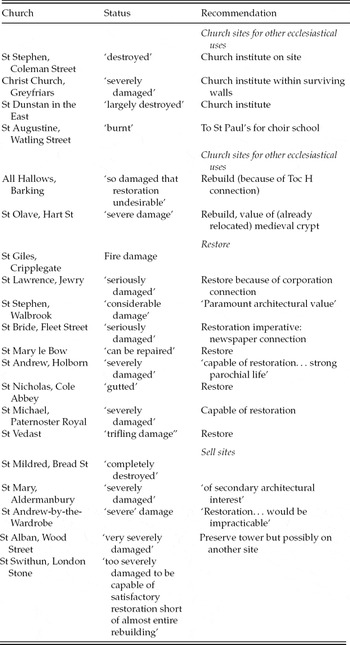
Parts II and III of the final report of the Bishop's Commission in 1946 dealt, in only eight small-format pages, with each of the badly damaged churches. The remainder, some 16 pages, covers church finance through tithes and the City church fund.Footnote 56 It comes to significant conclusions apparently based largely on aesthetic grounds, the rationales for which are not explored in any detail. For example, St Stephen, Coleman Street, ‘has been destroyed’ and ‘since restoration in its old form cannot be justified on either architectural or economic grounds’, the site was to be developed as a church institute.Footnote 57 In contrast, and for a reason associated solely with a recent church-related (although not specifically ecclesiastical) use, the commission found that All Hallows, Barking, ‘has been so damaged that restoration in the architectural sense may well be said to be undesirable, it being a medieval building, but its claim to rebuilding as the parent church of Toc H seems to us unanswerable’.Footnote 58 Luckily for the burned-out St Bride's, ‘its close connection with the newspaper world makes its restoration imperative’.Footnote 59 But why this should be so, and why restoration rather than demolition and rebuilding, is not explained in the minutes or report.
In short, the commission suggested that four church sites should be used for new ecclesiastical uses; two should be rebuilt; nine should be restored; and five should not be rebuilt but the sites sold to finance other church projects (Table 2; Figure 2). Interestingly, the new bishop ‘pointed out that the report was a conservative one. He was glad of that.’Footnote 60 Even so, it was controversial and its recommendations would be expensive to implement. A letter to the Manchester Guardian, for example, discussed the ‘strong antiquarian opposition’ to attempts to remove surplus churches, and described the report as ‘reverent conservatism tinged with expediency’.Footnote 61 The rector of one of the churches affected was critical of the way in which the clergy were told of the final decisions: ‘lined up’ and ‘warned of their fate at the fag end of a rapidly read draft of the report, and were pledged to silence pending its publication’, a ‘crude, or, it might even be suggested, callous’ approach.Footnote 62 Unsurprisingly, the Friends of the City Churches argued against the sale of sites.Footnote 63 However, with publication of its final report, the commission faded away, and other bodies became more significant in the decision-making process.
Recommendations for the damaged churches

Source: Bishop's Commission on City Churches, The City Churches: Final Report of the Bishop of London's Commission (London, 1946).
City churches, ‘destroyed’, rebuilt or restored.

At the end of the war, a diocese-wide Reorganization Committee was set up. It suggested that, across the whole diocese, 83 parishes were to be amalgamated. The Reorganization Committee was instructed by the bishop to consider very carefully the advice offered by the Bishop's Commission on City Churches, and it accepted its recommendations. In the City itself, this committee also recognized the problems of a low resident population and consequent under-use of many churches. The 46 pre-war parishes and churches would be reduced to 15; 6 churches were considered so far destroyed as not to be repairable, and their sites were to be sold; the 21 repairable or undamaged churches that were not to be retained as parish churches were to have a new status, as ‘ward churches’, and were to develop particular links with their civil wards, with other organizations, and with the civic life of the City in general.Footnote 64
In 1947, the Bishop's Committee for London Churches – supposedly more concerned with the actual restoration of damaged churches – discussed the final report of the Bishop's Commission, together with the draft diocesan reorganization scheme. The bishop said he would find it difficult ‘to decide not to keep a church which the commission had recommended to be retained’. Another member (of both committee and commission), Sir Eric Maclagan, ‘urged that the architectural importance of certain churches warranted rebuilding, whatever schemes of amalgamation might be proposed’.Footnote 65 Again – in his view at least – wider cultural considerations could clearly outweigh ecclesiastical requirements.
The reorganization scheme attracted significant criticism; for example, of its scale,
a close examination of the Report reveals that the 83 parishes to be amalgamated include only a proportion of the churches destroyed by enemy action. We are told that 91 [churches] were totally destroyed but the 83 named include many which received only minor damage. From an architectural and historical point of view all the 91 are lost to London, and to these must be added those which are to be pulled down. The resulting total seems to be in the neighbourhood of 130.Footnote 66
One aspect of the proposals that generated particular – and strongly negative – publicity was the suggestion that some sites of badly damaged churches should be sold for commercial development, and the income used to support church activities elsewhere in the diocese. In his 1947 BBC broadcast, Goodhart-Rendel protested that ‘the Church authorities, tempted by swollen site values, have been selling for total demolition as many churches as public opinion would allow them to do. The Germans have lately assisted in this liquidation with some vigour’.Footnote 67 And, in the words of an Architects’ Journal editorial, ‘The sites of the nine completely wrecked churches must be considered not merely as a matter with which the Ecclesiastical Commissioners are concerned. They must be regarded as amenities which can benefit the whole City and not be sold on the open market for any business concern to treat as it likes.’Footnote 68
The Committee for London Churches also had a number of communications with the City's district surveyor, who was keen to demolish the damaged tower of St Swithun, London Stone, on public safety grounds. He was persuaded not to do so; indeed, a later architectural report stated that the structure was largely sound.Footnote 69 A number of individual churches were reviewed, including the ‘practically undamaged’ St Margaret, Lothbury, which the Bank of England sought to purchase and demolish. The Bank was informed that it was ‘most improbable that the Bishop's Committee would agree to pulling down another City church’.Footnote 70
In mid-1948, in an undated report marked ‘secret’, the committee recommended that, in addition to the churches that the commission wished to demolish, St Augustine, Watling Street, and St Stephen, Coleman Street, should be demolished and their sites sold. This recommendation was passed to the diocese on a 5:3 majority with one abstention.Footnote 71 This clearly indicates, although as normal the minutes themselves do not, that this was a contested process of decision-making. Neither do the minutes explain the reasoning behind this reversal of earlier recommendations. There were strongly held opposing views even amongst the establishment membership of the committee.
In 1951, the committee engaged with the Royal Fine Art Commission (RFAC), the Ministry of Town and Country Planning and the Ancient Monuments Branch about the fate of several sites. The RFAC felt that St Mary, Aldermanbury, was ‘of exceptional architectural quality’ but the chief inspector of ancient monuments disagreed: it was ‘not outstanding’. Likewise, the RFAC felt that St Swithun, London Stone, should be rebuilt, while the ministries did not. However, all agreed that St Stephen, Coleman Street, should not be restored.Footnote 72 Again, this provides evidence of disagreement in the decision-making process; this time amongst the expert bodies consulted. Thereafter these minutes cease.
The rationales given for some of these decisions seem inconsistent, both at the time and in retrospect. Neither did actual action necessarily follow promulgated decision. For example, ‘aspects of the [Reorganization] Committee's proposals may not escape criticism. The recommendation that St Andrew-by-the-Wardrobe and St Swithin Cannon-street [i.e. St Swithun, London Stone] should not be rebuilt seems hard to explain. The fabric of each has survived as much as, for example, St Lawrence Jewry.’Footnote 73 Whereas St Swithin did disappear, the eventual retention of St Andrew is hard to explain with the records available, especially as its restoration was deemed ‘impracticable’ and the eminent architect Banister Fletcher had cast doubt on the foundations.Footnote 74 St Mary, Aldermanbury, ‘should go’ but did not at this time, although this church was subject to two applications to purchase, remove overseas, and reconstruct, and it is now in Fulton, USA, in part as a memorial to Sir Winston Churchill.Footnote 75
Debates on the design of restoration and rebuilding
Once the decision on whether or not to repair or restore had been made, the impact of the restricted war damage payments on the scale and nature of restoration or rebuilding, already mentioned, came into play. Different churches also obviously had somewhat different requirements of their buildings.Footnote 76
One suggestion was that ‘The over-riding problem of the styles in which new churches should be built is the concern of all religious bodies alike.’Footnote 77 Even if this is over-stated, there is clear evidence of wider engagement in stylistic issues. This was common even where damage was repairable; although the architect C. Nicholson wrote that
There will certainly be controversy between people who would like everything to be put back as it was and those who are inclined to welcome the opportunity of making changes. Where only slight damage has been suffered a policy of conservative repair would certainly seem right . . . In cases where churches of historic or artistic interest have been so seriously damaged as to require anything like complete rebuilding, the desire for exact reproduction will be felt very strongly.Footnote 78
Nevertheless, Nicholson cautioned that ‘churches are for use and not for ornament’. This meant, and he used the example of some of Wren's City churches, that ‘it would seem questionable whether any restoration should be attempted on the original lines’ even though these were generally well known for the post-fire churches, ‘if this involves the deliberate construction of useless reproductions of obsolete arrangements’, some of which may have been removed or altered by previous generations. An overly archaeological approach, seeking to reinstate the original, would inevitably destroy more recent features. ‘There is some danger therefore that in the general post-war reconstruction a good deal of comparatively modern work may be destroyed simply because it happens to be comparatively modern in spite of the fact that it may possess considerable intrinsic merits.’Footnote 79
Nicholson's arguments were characteristic of many contemporary publications – many of which were polemics, and including comments in the mass media – strongly arguing for contemporary designs using new structural materials, i.e. the modern style, rather than any return to the long tradition of classical, and even longer tradition of gothic, churches in the UK.
The historian Arthur Bryant wrote personally to Lord Reith (then minister for reconstruction) in March 1941, i.e. immediately following the major damage to London churches, stating that
one thing I do hope when it comes to rebuilding churches, that we will not do what the French did in 1919: hand the job over to a number of enterprising and experimentally-minded young atheist architects. The weird, unreal, gimcrack creations that arose in the midst of devastated Somme villages as a result have never ceased to haunt my mind as an example of what happens when those with no faith try to create an expression of faith. It was like setting pacifists to design battleships.Footnote 80
It seems likely that the French lesson was learned, but whether this was deliberate on the part of the diocese is unknown. It is clear that the diocese, including the bishop and his commission and committees, avoided any official pronouncement on this specific issue; yet because of this, the influence of polemicists and opinion-formers outside the church organization begins to be more clearly evident here.
Church sites re-used as ruins and gardens
That the decision-making debate was not wholly restricted to the bishop's formally constituted organizations and those selected to give evidence is shown by the idea of using bombed church remnants and sites as gardens and memorials. A very different strand of debate about the future of some, at least, of the church ruins emerged in a much more public manner. For example, there was the publication of a letter in The Times in 1944 signed by a range of high-powered figures of the artistic and intellectual establishment, and a slim but widely circulated and reviewed book, Bombed Churches as War Memorials (Figure 3).Footnote 81 Although aimed more widely, the City churches were the principal illustrations for this publicity.
Proposal for retention of bombed ruins of Christ Church, Greyfriars, as a memorial garden (reproduced from Architectural Press, Bombed Churches as War Memorials (London, 1945)).

This high-profile argument was influential in some quarters. Certainly, some sites were retained as public gardens and memorials, including St Mary, Aldermanbury, and Christ Church, Newgate Street, while the churchyard of St Swithun, London Stone, remains too. However, the Bishop's Commission was most reluctant to offer any support for schemes that might undermine the potential sale of redundant church sites, with Merriman stating forthrightly that ‘the provision of a garden would create a difficulty because the sites of churches not to be rebuilt must be made available for sale to provide money’.Footnote 82 The ministry was also reluctant: ‘no attempt should be made to create open spaces around churches which were designed for sites surrounded by buildings’, although ‘where towers and steeples are preserved, the rest of the site should be kept as open space and the remains of the church laid out as an Ancient Monument’.Footnote 83
This aspect of wider public and influential professional advocacy therefore succeeded only indirectly, at some distance in time from the original catastrophe, and where sites were transferred to the local authority, usually on payment from the War Damage Commission.
The interaction between the church authorities and other stakeholders
The rapid response of the church to the bomb damage is interesting in the context of the church's wider responses to war issues. Clearly, in some quarters there was a strong feeling that the church should not be involved in the war, as seen by Harold Nicolson's outburst to the BBC Board: ‘I wish the clergy would keep their mouths shut about the war. It is none of their business.’Footnote 84 However the church could hardly ignore the direct and indirect impacts of war on its buildings, congregations, staff and its place in public life.
The government had a slower response, partly driven by the post-war economy. Although a total compensation of £40.5 million was negotiated for bomb damage to churches, ‘payments were not completed until the early 1960s, and this left many congregations with roofless churches and no sites for rebuilding’ for a couple of decades.Footnote 85
On behalf of his diocese and indeed the wider church, the bishop of London was responsible for making best use of its assets, and to consider how best to use limited resources at a time of crisis and rationing to perform its prime function. Bishop Fisher certainly did so at a difficult time by speedily commissioning these various organizations, as did his successor Bishop Wand by implementing their recommendations. Neither the church nor the diocese had any compulsion to pay special heed to the additional social, historical and other values placed upon religious buildings by a wider society – especially when that society was becoming less overtly religious, and when these values were not supported by additional funding. This is a significant point in considering the ‘special’ status accorded to church buildings by society generally, and the approach of the church authorities in response to the state of its building stock after bombing, and its restoration or otherwise after the war.
In fact the explicit attention paid from the bishop downwards to these wider, not specifically religion driven, concerns is remarkable at such a time of stress, scarce resources and falling church attendance. The Reorganization Committee, indeed, ‘had to consider on the one hand the unique, artistic, architectural and historical heritage of the city churches, as well as their intimate connection with the corporate life of the city and the importance of the spiritual and social work with which they were associated’.Footnote 86
The instant response, to form a series of committees, may seem unduly bureaucratic today but was probably the most positive action possible at the time. Little save for ‘tidying up’ could be done owing to restrictions on funding via the War Damage Commission, and rationing of building material that continued until 1954–55. In retrospect, the number of committees is perhaps large and their specific remits difficult to disentangle; but they provided some thoughtful and considered responses – and one must presume (given the surprising lack of evidence regarding this) that they had appropriate expert architectural advice.
But, as in many cases of post-catastrophe replanning, this was also seen to some extent as an opportunity. The changes to parish populations would be even more significant if the City, County and Greater London Plans of Professor Sir Patrick Abercrombie and his former students were implemented: this made some churches and their infrastructures uneconomic – to use a term that some would, then as now, see as inappropriate. Lutyens had expressed concern even in 1941 when he wrote about the future of bombed churches that ‘I fear the “Church” may try to make money!’Footnote 87 Always outspoken, the architect and environmental activist Clough Williams-Ellis also hinted that the diocese's approach to the threat of damage was equivocal, for the same reason:
I know that it has been widely asserted – and believed – that the destruction of the City Churches by an alien agency was so welcome in certain influential quarters as a convenient solution to an awkward problem, so fortunate a release from reluctantly accepted responsibilities, that lay warnings, recommendations, and offers with regard to fire-watching and precautions generally were brusquely rejected.Footnote 88
In examining the activities of these various groups set up by the bishop, and their interactions with ‘stakeholders’ from parishioners to government ministries, some conflicts become evident. The commission and committee did not always agree, for example over St Alban, Wood Street; most strikingly St Andrew, Holborn (‘restore because of evangelical tradition in parish’ as opposed to ‘no ecclesiastical case for restoration’); St Augustine, Watling Street, which was not demolished and sold as the committee suggested; and St Mary, Aldermanbury, where both commission and committee advocated demolition and sale, where the Ministries and Royal Fine Art Commission suggested retention, but which was eventually exported to the USA.
Likewise St Swithun, London Stone, was the subject of conflict between the bishop's organizations and civil servants, including the city surveyor. This is well shown by this memo about St Swithun's tower:
I should very much have liked to preserve the tower of St Swithuns but Mr Digney takes the view that the Church has already made a number of sacrifices and to preserve the Tower would make the small site on which it stands practically valueless. I still have in mind Mr Lansbury's dictum on a similar case that he doubted if it were really all right for the Church of England to have the best of this world and the next and to turn the House of God into a dry goods store. This view does not perhaps represent a common viewpoint.Footnote 89
The tower did decay further until all accepted that total loss was inevitable.Footnote 90 Although an interesting example, the spire was ‘increasingly less significant as the taller new buildings grow in number’.Footnote 91 By 1957, total demolition was accepted. That led to the telling response ‘This is another lesson in how effluxion of time solves problems of historic buildings, not always as we would have wished.’Footnote 92
The wide range of factors explored by the commission in particular is striking, as is – given its origins and membership – the suggestion that the first categorization into four quality bands undertaken by its subcommittee had ‘not taken spiritual value’ into account. Subsequent evidence on parochial life and activity – or the lack of it – did sway the commission's views in a couple of cases. Consideration of diocesan structure and finance was far more important. Significantly, the commission argued against the suggestion, promoted by others, that sites of demolished churches should be retained as memorials and public open space. The diocese needed income from sales to pay for restorations, for other diocesan activities perhaps even outside the narrow confines of the City, and for new activities such as the suggested church institutes, most of which were never built.
The responses to the destruction of the City of London churches as an exemplar of post-catastrophe decision-making
The discrepancies between the multiple intentions, as well as the range of outcomes, are a reflection of contradictory interests that were involved in the decision-making processes and the factors that were considered in the making of these decisions. For instance, public safety in relation to precarious ruins was clearly a concern for all, but this concern varied greatly as a basis for deciding what to do with damaged buildings. Some saw it as a priority that trumps all (especially in a situation where many buildings were damaged daily and required a response), whereas others balanced the structural conditions of such buildings with other considerations such as their historic, symbolic or even spiritual role. As another example, the potential reuse of church remains for other purposes, such as church institutes, green spaces, contemplative memorials or even commercial functions, was debated in almost every case and was often implemented differently from original proposals as multiple perspectives representing fundamentally conflicted values and visions clashed. Pre-war questioning of under-use and expensive maintenance of churches underlay the decision-making processes after many suffered costly war damage.
In all such decision-making processes, some are unheard in the process and some dissatisfied with the outcome. However, unless articulate, well connected and given to writing for publication, we know little of these views. One articulate unhappy voice was the novelist Mrs Robert Henrey. Her little-known commentary on this period notes her concern over the continuing decay of her local church, St Mary, Aldermanbury, in comparison to expensive and high-quality restorations taking place elsewhere.Footnote 93 The wider public views of these ‘special’ buildings as memorials to the catastrophe of war, both in the City of London and in many other British and European cities, was not actually a consideration for these quickly organized committees formed during the early years of the conflict itself. That interpretation came rather later, and (as is shown by the debate over gardens) was not well received by a diocese intent on delivering its main function to existing and new worshippers.
The catastrophe of wartime destruction was the catalyst for a series of changes that were probably inevitable given pre-war trends in population movement and development within the City. The process charted here was consultative to a limited degree; it produced a series of widely contested reports spurring national press coverage and public debate; and the vast majority of the recommendations of commission and committee were acted upon. But there was substantial delay in actually implementing these recommendations, even for restoration and rebuilding, owing largely to events outside the diocese's control, including the national economic circumstances in the immediate post-war period. This was a brave attempt at decision-making overtaken, as many such attempts are, by the wider fallout of the catastrophe itself.