Introduction
Species of organisms with sexual reproduction are delimited by reproductive isolation, although organisms are generally defined and described based on morphological features (Walker, Reference Walker1964; Jinbo et al., Reference Jinbo, Kato and Ito2011). The concept of cryptic species refers to biological species that cannot be easily recognized based on morphological criteria and are misclassified under the same name but show reproductive isolation (Walker, Reference Walker1964; Bickford et al., Reference Bickford, Lohman, Sodhi, Ng, Meier, Winker, Ingram and Das2007). The correct identification of species has an impact on diverse research fields; for instance, this information is fundamental to the design and implementation of integrated management programmes for pests and biological control in applied entomology (Kikkert et al., Reference Kikkert, Hoepting, Wu, Wang, Baur and Shelton2006; Bickford et al., Reference Bickford, Lohman, Sodhi, Ng, Meier, Winker, Ingram and Das2007; Zhang et al., Reference Zhang, Meng, Min, Qiao and Wan2012).
According to different authors (Bush, Reference Bush1975; Berlocher & Feder, Reference Berlocher and Feder2002), the specialized relationship between insects and host plants is considered a driver of evolutionary diversification in phytophagous insects. Adaptation to the microhabitat, selective mating in the host plant and colonization of a new host plant have been suggested to determine the reproductive isolation associated with the host (Bush, Reference Bush1975; Turelli et al., Reference Turelli, Barton and Coyne2001; Thomas et al., Reference Thomas, Bethenod, Pelozuelo, Frérot, Bourguet and Pitnick2003). Speciation promoted by adaptation to a host can result in populations categorized as cryptic species (Via, Reference Via1999; Stireman III et al., Reference Stireman, Nason and Heard2005; Bickford et al., Reference Bickford, Lohman, Sodhi, Ng, Meier, Winker, Ingram and Das2007; Dorchin et al., Reference Dorchin, Scott, Clarkin, Luongo, Jordan and Abrahamson2009). Usually, genetic evidence, such as analysis of the region known as the DNA barcode, is used to support the formation of cryptic species. In these cases, these potentially cryptic species are morphologically indistinguishable but can be genetically differentiated (Hebert et al., Reference Hebert, Cywinska and Ball2003; Bickford et al., Reference Bickford, Lohman, Sodhi, Ng, Meier, Winker, Ingram and Das2007; Dorchin et al., Reference Dorchin, Scott, Clarkin, Luongo, Jordan and Abrahamson2009; Jinbo et al., Reference Jinbo, Kato and Ito2011).
Molecular tools have been used to discern complexes of cryptic species in taxa with a wide distribution range and a low dispersion capacity (Bickford et al., Reference Bickford, Lohman, Sodhi, Ng, Meier, Winker, Ingram and Das2007). These cryptic species cannot be differentiated using morphology-based taxonomy. Moreover, the case of widely distributed species with a low dispersion capacity can be explained by anthropogenic transport in some cases (Pérez-Portela et al., Reference Pérez-Portela, Arranz, Rius and Turon2013), which can lead to population differentiation through geographic distance and allopatric speciation via founder effects (Bush, Reference Bush1975).
In Cecidomyiidae, a study conducted by Mathur et al. (Reference Mathur, Cook, Sinclair and Fitzpatrick2012) in sympatric populations of Dasineura oxycoccana (Johnson) using the DNA barcode region (cytochrome oxidase I gene; COI) revealed high genetic differentiation between individuals from blueberry (Vaccinium corymbosum L.) and cranberry (Vaccinium macrocarpon Aiton), which indicated that the insect underwent a specialization process for the host plant and cryptic speciation. Dorchin et al. (Reference Dorchin, Scott, Clarkin, Luongo, Jordan and Abrahamson2009) demonstrated genetic differentiation of the COI gene associated with the hosts Solidago rugosa Mill. and Solidago gigantea Aiton in Dasineura folliculi Felt. Analysis of the same region of the mitochondrial DNA corroborated that a similar specialization phenomenon associated with the host occurred in another cecidomyiid species (Asphondylia borrichiae Rossi & Strong) (Stokes et al., Reference Stokes, Stiling, Gilg and Rossi2012); in that study, genetic divergence was found between the sympatric populations associated with the hosts Borrichia frutescens L., Iva frutescens L. and Iva imbricata Walter.
The DNA barcoding (COI gene) is generally an effective tool for species identification, population genetic studies and the differentiation of genetic variants associated with specific hosts in phytophagous insects (Hebert et al., Reference Hebert, Cywinska and Ball2003, Reference Hebert, Penton, Burns, Janzen and Hallwachs2004; Mathur et al., Reference Mathur, Cook, Sinclair and Fitzpatrick2012). However, in the nuclear genome, the second internal transcribed spacer (ITS2) of the rDNA is used as a complement to COI in population genetic studies due to its variability at the intraspecific level and between close species (Collins & Paskewitz, Reference Collins and Paskewitz1996; Ji et al., Reference Ji, Zhang and He2003; Zhang & Hewitt, Reference Zhang and Hewitt2003; Yao et al., Reference Yao, Song, Liu, Luo, Han, Li, Pang, Xu, Zhu and Xiao2010).
Prodiplosis longifila Gagné (Diptera: Cecidomyiidae) is a neotropical polyphagous insect distributed in North America (United States (USA)) and South America (Colombia (COL), Ecuador (ECU) and Peru) (Gagné, Reference Gagné1994; Valarezo et al., Reference Valarezo, Canarte, Navarrete and Arias de Lopez2003; Gagné & Jaschhof, Reference Gagné and Jaschhof2014). Its geographic origin is unknown, and the certainty surrounding this species reported in South America is low due to its small size and fragility and the complexity associated with the identification of this species based on its morphology. To date, few comparative studies have been developed at the population level to elucidate whether P. longifila in the USA and South America correspond to the same species or whether an allopatric differentiation process has occurred.
Approximately 34 host species of P. longifila have been reported in 15 different families of plants (Valarezo et al., Reference Valarezo, Canarte, Navarrete and Arias de Lopez2003; Gagné & Jaschhof, Reference Gagné and Jaschhof2014). Due to its economic impact on agriculture (Hernandez et al., Reference Hernandez, Guzman, Martínez-Arias, Manzano and Selvaraj2015), P. longifila has been recently included in the European and Mediterranean Plant Protection Organization (EPPO) alert list. This insect in the larval stage generates damage derived from feeding on host plants (Dent, Reference Dent2000; Hernandez et al., Reference Hernandez, Guzman, Martínez-Arias, Manzano and Selvaraj2015), such as tomato (Solanum lycopersicum L.), where larvae feed on the fruits, leaves and flower buds; sweet pepper (Capsicum annuum L.), where the larvae feed on the tender fruits; and Tahiti lime (Citrus × latifolia Tanaka ex Q. Jiménez), where the damage caused by the larvae feeding on the reproductive organs of the flowers lead to premature drop of the flowers (Hernandez et al., Reference Hernandez, Guzman, Martínez-Arias, Manzano and Selvaraj2015). The wide range of host plants reported for P. longifila, which include hosts from distant phytochemical groups, may suggest unrecognized cryptic diversity in this group, perhaps due to the lack of morphological differentiation, or that the insects are a product of a recent diversification process (Hernandez et al., Reference Hernandez, Guzman, Martínez-Arias, Manzano and Selvaraj2015). In this case, the use of molecular markers, such the COI gene and the ITS2 region, would allow inference of the evolutionary and demographic processes that have occurred in P. longifila.
Due to uncertainty about the identity of the species found in South America and the wide range of hosts reported for this species, the main objectives of this study were to determine whether the North American and South American populations of P. longifila were the same species or whether a population differentiation process occurred by geographic distance, resulting in speciation, and to establish whether the P. longifila populations associated with different host plants showed genetic differences related to adaptation processes to specific hosts, which might suggest the presence of cryptic species.
Materials and methods
Obtaining insects
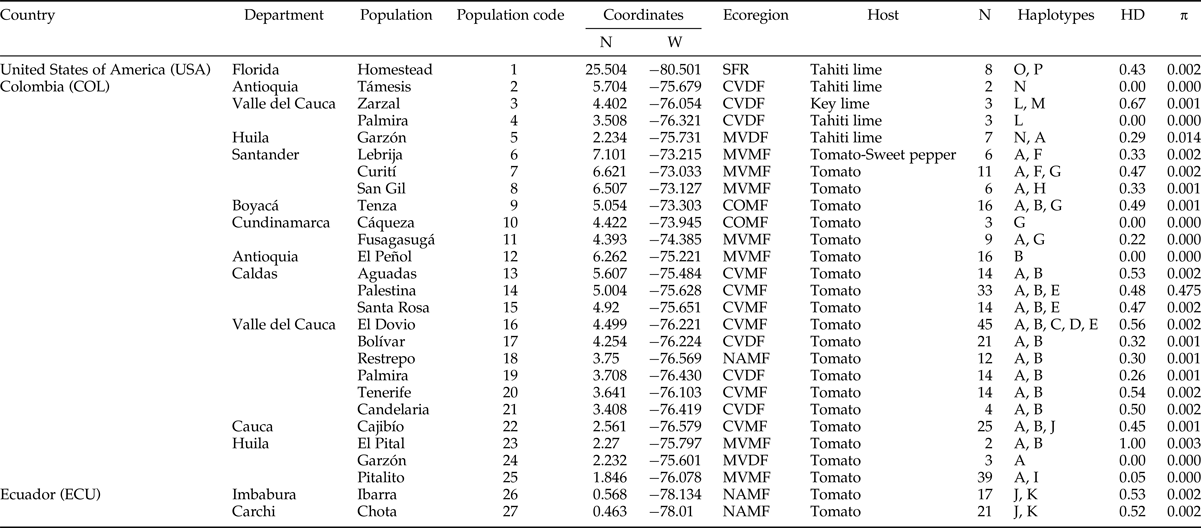
The larval sampling to obtain the adults of P. longifila used in the study was conducted in 11 departments in COL and two provinces of ECU (table 1) in tomato (S. lycopersicum), potato (Solanum tuberosum L.), sweet pepper (C. annuum), asparagus (Asparagus officinalis L.), key lime (Citrus × aurantiifolia (Christm.) Swingle (pro. sp.)) and Tahiti lime (Citrus × latifolia) crops. Additionally, adult specimens were obtained from Homestead Florida, USA (provided by Dr Jorge E. Peña of the Tropical Research and Education Centre, Institute of Food and Agricultural Sciences (IFAS) at the University of Florida, Homestead, FL, USA). Larvae found in plant material with symptoms of infestation by P. longifila were raised in the laboratory according to the protocol of Hernandez et al. (Reference Hernandez, Guzman, Martínez-Arias, Manzano and Selvaraj2015) until the emergence of adults. The taxonomic determination of the species was performed based on the male morphology according to Gagné (Reference Gagné1986a), flagellomeres with regular circumfila, the gonopods articulate dorsoventrally and gonostylus narrow with short setulae basodorsally, wing length 1.5–1.7 mm.
Characterization of Prodiplosis longifila populations using COI sequences.

Number of sequenced specimens (N), haplotype diversity (HD), nucleotide diversity (π).
Obtaining sequences
The thorax and legs of each specimen morphologically identified as P. longifila were used for genomic DNA extraction following the protocol for animal tissue of the DNeasy Blood & Tissue kit (QIAGEN). The obtained DNA was quantified using a NanoDrop 2000 spectrophotometer. A 700 base pair (bp) fragment of the mitochondrial COI gene was amplified by PCR using the universal primers LCO1490 (5′ GGTCAACAAATCATAAAGATATTGG-3′) and HCO2198 (5′-TAAACTTCAGGGTGACCAAAAAATCA-3′) (Folmer et al., Reference Folmer, Black, Hoeh and Lutz1994) in a 25 µl amplification cocktail containing 1× PCR buffer solution, 2 mM MgCl2, 0.05 mM dNTPs, 0.25 µM each primer, 1 U of Taq DNA polymerase and 5–10 ng of DNA. The PCR reaction was performed as follows: an initial denaturation step for 5 min at 92°C, followed by 35 cycles consisting of 30 s at 94°C, 1 min at 52°C and 1 min at 72°C and a final extension step for 5 min at 72°C. The amplification of the ITS2 of the rDNA was performed with primers 5.8F (5′-TGTGAACTGCAGGACACATG-3′) and 28R (5′-ATGCTTAAATTTAGGGGGTA-3′) (Collins & Paskewitz, Reference Collins and Paskewitz1996). For this purpose, the 25 µl amplification cocktail contained 1× PCR buffer solution, 2.5 mM MgCl2, 0.2 mM dNTPs, 0.2 µM each primer, 1 U of Taq DNA polymerase and 5–10 ng of DNA. The PCR conditions were as follows: an initial denaturation step for 5 min at 92°C, followed by 35 cycles consisting of 30 s at 94°C, 30 s at 52°C and 30 s at 72°C and a final extension step for 5 min at 72°C. Bidirectional sequencing was performed using a specialized provider. The obtained COI and ITS2 sequences were edited with BioEdit 7.0.9 (Hall, Reference Hall1999), and alignments were generated with Mega 6 (Edgar, Reference Edgar2004; Tamura et al., Reference Tamura, Stecher, Peterson, Filipski and Kumar2013). The sequence of each unique haplotype was deposited in GenBank under a unique accession number (COI: MF314842, KM350200, KM350201, MF314843, MF314844, MF314845, KM350205, KM350206, MF314846, MF314847, KM350193, KM350194, KM350196, KM350198, KM350199 and ITS2: MF314848 and KM998071).
Data analysis
The P. longifila populations under study were grouped into seven ecoregions according to Olson et al. (Reference Olson, Dinerstein, Wikramanayake, Burgess, Powell, Underwood, D'amico, Itoua, Strand and Morrison2001) to illustrate the haplotype distribution that occurred in the sampled geographical range. These ecoregions were South Florida Rocklands (SFR), Cauca Valley Montane Forest (CVMF), Cauca Valley Dry Forest (CVDF), Magdalena Valley Montane Forest (MVMF), Magdalena Valley Dry Forest (MVDF), Northwestern Andean Montane Forest (NAMF) and Cordillera Oriental Montane Forest (COMF). The haplotype diversity (HD) and nucleotide diversity (π) were estimated using DnaSP v5. (Librado & Rozas, Reference Librado and Rozas2009) for each population.
Phylogenetic inference: maximum likelihood method and haplotype network
To infer the evolutionary relationships between the P. longifila populations, a phylogeny was constructed using the maximum likelihood (ML) method. The analysis of the COI regions was performed using the Hasegawa–Kishino–Yano (1985) model with a γ distribution (HKY + G), whereas the analysis of ITS2 was performed using the HKY (1985) model. Both models were selected under the Bayesian information criterion with the program jModelTest 2.0 (Guindon & Gascuel, Reference Guindon and Gascuel2003; Darriba et al., Reference Darriba, Taboada, Doallo and Posada2012). The phylogenetic inference was performed with the Mega 6 program (Tamura et al., Reference Tamura, Stecher, Peterson, Filipski and Kumar2013) using the species Dasineura sp. (GenBank accession numbers COI KY474549 and ITS2 KY474550) and Prodiplosis floricola Felt (Diptera: Cecidomyiidae) (GenBank accession numbers COI KP744382, KP744387, KP744391 and ITS2 KM998068, KM998069, KM998070) as outgroup. A haplotype network was built using median-joining with NETWORK 4.6.1.3 (Watterson & Guess, Reference Watterson and Guess1977; Posada & Crandall, Reference Posada and Crandall2001) to estimate the intraspecific genealogy.
Isolation by geographic distance: determination of the genetic distance between the North American and South American specimens
To corroborate whether P. longifila from South America was genetically distinct from the specimens found in the USA, the genetic distances among the haplotypes found in each geographic region were estimated. These distances were calculated for COI and ITS2 under Kimura's two-parameter (K2P) model of nucleotide substitution using Mega 6 (Tamura et al., Reference Tamura, Stecher, Peterson, Filipski and Kumar2013). Mantel's test was used to establish whether the obtained genetic distances could be explained by geographic distance. For this analysis, geographic distance and genetic distance matrices were used to estimate the correlation between the geographic and genetic distances calculated between the North and the South American specimens using the GenAlex 6.501 software (Peakall & Smouse, Reference Peakall and Smouse2006).
Host specialization: genetic analysis of populations from different crops in South America
The haplotype compositions of the specimens from different crops were compared to determine whether specialization of P. longifila had occurred on a specific host plant. The HD and nucleotide diversity (π) were estimated using DnaSP v5. (Librado & Rozas, Reference Librado and Rozas2009) for each host. The genetic distance was estimated under the K2P model using Mega 6 (Tamura et al., Reference Tamura, Stecher, Peterson, Filipski and Kumar2013) for the crop-specific haplogroups.
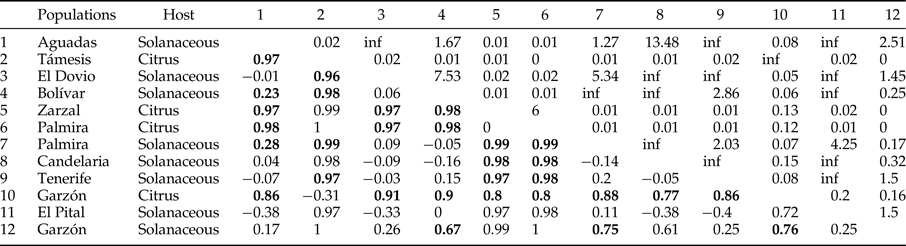
A hierarchical analysis of molecular variance (AMOVA) was performed to assess the genetic structure of the populations due to their ecoregional setting using the Arlequin 3.11 package (Excoffier et al., Reference Excoffier, Laval and Schneider2005). To establish whether population genetic differentiation was attributable to the host crop, 12 sympatric populations of P. longifila that colonized different hosts were evaluated using a hierarchical AMOVA with Arlequin 3.11 (Excoffier et al., Reference Excoffier, Laval and Schneider2005). Although cecidomyiids are known to have limited dispersion capabilities, according to Miao et al. (Reference Miao, Wu, Gong, He, Duan and Jiang2013), cecidomyiids like Sitodiplosis mosellana (Géhin) could use air currents to move into trajectory distances as far as 25 and 107 km. By using QGIS 2.18.12 (QGIS Development Team, 2017), we define the set of sympatric populations among which insect movement was likely, with a 50 km buffer and the resulting maximum distance between the populations in each group selected were <25 km. Four groups were established as follows: 1. Támesis citrus – Aguadas tomato; 2. Zarzal citrus – El Dovio and Bolívar tomato; 3. Palmira citrus – Palmira, Candelaria and Tenerife tomato and 4. Garzón citrus – Garzón and El Pital tomato. To determine whether a genetic structure existed among populations established in different crops and to establish whether specialization on a host crop was a barrier to gene flow among P. longifila populations, the fixation index (F ST) values and number of migrants (N M) between pairs of populations from different hosts were estimated using Arlequin 3.11 (Excoffier et al., Reference Excoffier, Laval and Schneider2005).
Results
Twenty-four populations of P. longifila were sampled in COL in the citrus Tahiti lime and key lime crops and in the solanaceous tomato and sweet pepper crops. In ECU, P. longifila was found in two tomato populations (table 1, fig. 1). P. longifila was more frequently sampled on citrus, 10 out of 14 flowering sampled citrus crops had P. longifila larvae (71.4%) whereas 50 out of 77 sampled tomato crops had P. longifila larvae (64.9%). A total of 368 P. longifila COI sequences and 108 P. longifila ITS2 sequences were obtained. The COI marker was used for the population characterization analysis because it showed higher polymorphisms, with 16 haplotypes (A–P) compared to ITS2, which revealed only two haplotypes (ITS2-a and ITS2-b). The ITS2-a haplotype was found in all P. longifila populations in COL and ECU, whereas ITS2-b was only present in the Homestead population in the USA.
Distribution of COI haplotypes for Prodiplosis longifila in the USA, COL and ECU. Grey dots correspond to populations of the insect established in citrus, and black dots are populations in solanaceous.

The COI haplotypes (known as A and B) were most frequent among specimens obtained from the tomato host, with a wide distribution in COL; these haplotypes were found in 90% (A) and 65% (B) of the sampled populations for this crop, whereas the remaining haplotypes had frequencies below 50% (table 1, fig. 1). The sampled populations in ECU originated in the NAMF region, showed a unique haplotype known as K and shared the J haplotype with the Cajibío population located in southwestern COL in the CVMF region. The F, H and I haplotypes were unique to the MVMF region in COL, whereas the G haplotype was distributed in the MVMF and COMF regions in northeastern COL. The E haplotype was exclusive to the CVMF region in western COL.
Among the obtained citrus populations, three haplotypes were found in COL. Of these three haplotypes, the L and M haplotypes were distributed in the Palmira and Zarzal populations in the CVDF region and the N haplotype was found in Támesis in the CVDF region in northwestern COL and in Garzón in the MVDF region in southwestern COL (table 1, fig. 1). The O and P haplotypes were exclusive to Florida in the USA.
Phylogenetic inference
The reconstruction of the phylogeny using the COI marker resulted in two main clades. The first clade was composed of haplotypes of P. longifila specimens obtained from Tahiti lime in Florida (USA), and the second clade corresponded to South American specimens (COL and ECU) and was divided into two large branches; the first branch was composed of Colombian specimens obtained from Tahiti lime and key lime (citrus), and the second branch included specimens from tomato and sweet pepper hosts (solanaceous) (fig. 2a). When performing the phylogenetic inference for the ITS2 marker, the two large clades obtained for COI were retrieved and differentiated the North American from the South American specimens; however, the South American subgroups associated with citrus could not be differentiated from the subgroups associated with tomato (fig. 2b).
Phylogenetic relationships of Prodiplosis longifila based on 368 COI sequences (A) and 108 ITS2 sequences (B). The topologies are based on the ML method.

The COI haplotype network discriminated four haplogroups that coincided with the clades retrieved from the phylogenetic inference using the same marker (fig. 3). The first haplogroup was composed of the A–K haplotypes associated with the solanaceous species. A second haplogroup was composed of the L and M haplotypes, which were strictly associated with citrus in COL. The N haplotype associated to citrus crops in COL, formed another group. The O and P haplotypes were exclusive to Tahiti lime in the USA and formed an independent haplogroup. Using the information obtained from the estimated network, we could not infer an intermediate haplotype that explained the relationship between the haplogroups associated with citrus and the haplogroups associated with the solanaceous species.
Haplotype network inferred by the median-joining method for 16 Prodiplosis longifila haplotypes. The P. longifila populations represented in the network were grouped into ecoregions according to Olson et al. (Reference Olson, Dinerstein, Wikramanayake, Burgess, Powell, Underwood, D'amico, Itoua, Strand and Morrison2001).

The genetic distances within each haplogroup were estimated to establish homogeneity of the defined haplotype groups. At the gene level, the specimens identified as P. longifila from the USA constituted a well-defined haplogroup with an intra-group genetic distance of 0.46%. The specimens identified morphologically as belonging to this species in COL and ECU obtained from solanaceous hosts showed an intra-group genetic distance of 0.45%. The intra-group genetic distance of the P. longifila specimens in COL associated with citrus was 0.15%.
Genetic structure by geographic isolation
The genetic distances (based on COI) obtained from the comparison between the USA and South American specimens showed a mean value of 6.12%, whereas the genetic distance among these groups for the ITS2 marker was 0.3%.
Based on Mantel's test, there was a positive correlation between the geographic distances and genetic distances among the populations (R xy = 0.326; P (r xy-r and ≥r xy-data) = 0.010), which indicated that the South American and North American populations resulted from a process of isolation based on geographic distance, resulting in unique haplotypes that were not shared between these geographic regions.
Genetic structure by host specialization
In South America, we found that the P. longifila specimens from citrus showed a haplotypic composition different from the specimens derived from solanaceous hosts (table 2). The specimens obtained from solanaceous hosts showed 11 haplotypes, with the A and B haplotypes having the highest representation; conversely, the remaining haplotypes were infrequent and/or unique for some populations. The specimens with citrus hosts showed three exclusive haplotypes that were not shared with the specimens from solanaceous hosts (table 2). Generally, haplotypes were not shared between insects from different hosts, with the exception of one individual from Tahiti lime that presented haplotype A (table 2). The genetic distances established among the COI haplogroups associated with different hosts differed by 5.75%.
Haplotype composition of Prodiplosis longifila in different hosts in COL/ECU, number of sequences (N), haplotype diversity (HD), nucleotide diversity (π), frequencies of each haplotype are given as percentages.

There was no significant population structuring detected between ecoregions (F CT = 0.080, P = 0.100), although populations within groups showed significant variation (F SC = 0.238, P < 0.05; F ST = 0.306, P < 0.05). In the hierarchical AMOVA, the host effect explained almost all of the variation found in the data. The F SC values showed strong genetic differentiation between the sympatric populations obtained from citrus and tomato within the four established groups (table 3).
Nested analysis of molecular variance (AMOVA), 1000 permutations.

The paired F ST and N M values among the populations analysed by AMOVA (table 4) showed that the P. longifila populations established in citrus showed high genetic differentiation (close to one) compared with the populations of this insect established in solanaceous hosts, and the number of migrants (N M) per generation was close to zero. Conversely, the populations from Támesis and Garzón had low population differentiation values (close to zero) and an estimated number of migrants per generation that tended to infinity. A similar outcome between the Palmira and Zarzal populations (F ST close to zero and N M = 6) was found. However, high population differentiation occurred between these populations even though the insects colonized the same host (citrus). Among the populations that colonized solanaceous hosts, the F ST values were close to zero and the N M was generally greater than one.
In the area above the diagonal, the number of migrants (N M) is indicated among the populations analysed under AMOVA.

The F ST values among the analysed populations are indicated in the area below the diagonal. The significant F ST values are shown in bold font (P-value < 0.05).
Discussion
Genetic differentiation through geographic distance in P. longifila populations
Previous studies concluded that Cecidomyiids had a low dispersion capacity and that wind was the natural medium for their dispersion (Pendleton & Teetes, Reference Pendleton and Teetes1994; Withers et al., Reference Withers, Harris and Madie1997). Contarinia sorghicola (Coquillett) is passively transported by the wind up to 400 m (Pendleton & Teetes, Reference Pendleton and Teetes1994), with a dispersion rate of 90 m2 h−1 (Lampo & Medialdea, Reference Lampo and Medialdea1994). The females of Mayetiola destructor (Say) are capable of moving between 1 and 27 m while looking for a host to oviposit (Withers et al., Reference Withers, Harris and Madie1997).
According to Bolnick & Fitzpatrick (Reference Bolnick and Fitzpatrick2007), geographic isolation may occur when the geographic distance among populations is a barrier that prevents the dispersion of individuals. The P. longifila specimens from the USA and the insect populations in COL and ECU were isolated by geographic distances that prevented the passive dispersion of individuals between these populations (Pendleton & Teetes, Reference Pendleton and Teetes1994; Withers et al., Reference Withers, Harris and Madie1997); therefore, any gene flow and interchange found between established populations of this insect (which have a low displacement capacity) could only be explained by anthropic activities (Guillemaud et al., Reference Guillemaud, Ciosi, Lombaert and Estoup2011; Pérez-Portela et al., Reference Pérez-Portela, Arranz, Rius and Turon2013; Richards et al., Reference Richards, Shanafelt and Fenichel2014). In this case, no gene interchange existed between the populations established in the USA and the populations established in COL/ECU, since no common haplotypes were found with any of the markers used. Additionally, the phylogenetic analysis showed divergent clades associated with the place of origin (USA and COL/ECU), and their genetic distances were greater than the distances expected by intraspecific variation in the COI marker (Hebert et al., Reference Hebert, Cywinska and Ball2003). Conversely, the low intraspecific variation found in the ITS2 marker was consistent with the findings of Zhang & Hewitt (Reference Zhang and Hewitt2003), who indicated that this region of the nuclear genome could be highly conserved according to the taxonomic group under study. Mito-nuclear discordance has been observed in insects (Toews & Brelsford, Reference Toews and Brelsford2012), and adaptive and sex-biased processes are some of the most frequent explanations for this discordance. In the case of cecidomyiids, studies suggest that the female is the one that performs the dispersion (Miao et al., Reference Miao, Wu, Gong, He, Duan and Jiang2013), and it is known that it is the female that selects the host for oviposition, so that the matrilineal marker can reflect in this case the history of population structuring.
Mantel's test indicated that the genetic distances estimated between the P. longifila populations in the USA and COL/ECU could be explained by the geographic distances, which supported the hypothesis of differentiation by geographic isolation. The results indicate that a process of differentiation by geographic isolation has occurred and that no inter-population connectivity by anthropic transport exists (Guillemaud et al., Reference Guillemaud, Ciosi, Lombaert and Estoup2011; Richards et al., Reference Richards, Shanafelt and Fenichel2014).
Genetic differentiation through specialization on a host
In Cecidomyiidae, cryptic speciation resulting from host specialization has been reported for the sympatric populations of D. oxycoccana associated with V. macrocarpon and V. corymbosum (Cook et al., Reference Cook, Ozeroff, Fitzpatrick and Roitberg2011; Mathur et al., Reference Mathur, Cook, Sinclair and Fitzpatrick2012) and in D. folliculi with S. rugosa and S. gigantea (Dorchin et al., Reference Dorchin, Scott, Clarkin, Luongo, Jordan and Abrahamson2009). These studies used genetic evidence (COI region) to complement cross-breeding tests between individuals from populations of different hosts, direct assays of oviposition preference and other natural history aspects of the insects on their host plants to conclude that reproductive isolation clearly resulted in the formation of cryptic species. In the cecidomyiid A. borrichiae (Stokes et al., Reference Stokes, Stiling, Gilg and Rossi2012), whose populations are associated with B. frutescens, I. frutescens and I. imbricata, the formation of races associated with the host has been suggested because the results indicate the presence of gene flow among the populations of different hosts and reproductive isolation has not been fully demonstrated.
In P. longifila, the results obtained from the analysis of the haplotypic composition of specimens whose hosts were citrus or solanaceous showed exclusive haplotypes for each host. Additionally, the results of the phylogenetic inference obtained by ML and the haplotype network showed differentiation among specimens by host origin and the formation of haplogroups associated with different hosts. The above results indirectly suggest the fidelity of some insects for a particular host. Thus, the insects of citrus populations would have difficulty ovipositing in solanaceous hosts and vice versa, because both hosts belong to distant phytochemical groups, which greatly influences their choice for oviposition (Kanno & Harris, Reference Kanno and Harris2000). Host fidelity for oviposition is considered an important factor facilitating the genetic differentiation process among sympatric populations, because the female predisposes its offspring to cross-breed in the same host (Dorchin et al., Reference Dorchin, Scott, Clarkin, Luongo, Jordan and Abrahamson2009). The genetic differentiation found among P. longifila insects from different hosts was greater than would be expected for intraspecific variation for COI according to Hebert et al. (Reference Hebert, Cywinska and Ball2003) and was more in line with interspecific variation values, suggesting that different cryptic species lacked the morphological features necessary to distinguish between them.
When analysing the population dynamics of each host independently, we found that gene flow existed among populations associated with solanaceous hosts and among populations separated by geographic distances that exceeded the natural dispersion range reported for other cecidomyiids (Pendleton & Teetes, Reference Pendleton and Teetes1994; Withers et al., Reference Withers, Harris and Madie1997). The F ST values reported here are generally not significantly different from zero, which suggests anthropogenic transport among these populations. Among the P. longifila populations associated with citrus, gene flow exists only between Támesis and Garzón and between Zarzal and Palmira; however, this phenomenon may be a product of anthropogenic dispersion, since the large genetic differentiation exhibited by haplotype N compared with haplotypes L and M indicates that these haplotypes belong to two different lineages. Furthermore, the Támesis and Garzón populations were not a product of the same introduction that colonized citrus in the Zarzal and Palmira populations. For P. longifila, anthropogenic dispersion can occur by transport of plant material with larvae from the nursery (Gagné, Reference Gagné1986b; Sylven & Lövgren, Reference Sylven and Lövgren1995; Hernandez et al., Reference Hernandez, Guzman, Martínez-Arias, Manzano and Selvaraj2015).
Although some of the sympatric populations were categorized in different ecoregions, no population structuring attributable to this factor was detected. Due to agricultural expansion, there has been a homogenization of the landscape; the biotic features on which Olson et al. (Reference Olson, Dinerstein, Wikramanayake, Burgess, Powell, Underwood, D'amico, Itoua, Strand and Morrison2001) established the ecoregions do not persist in the areas sampled in COL (Aide et al., Reference Aide, Clark, Grau, López-Carr, Levy, Redo, Bonilla-Moheno, Riner, Andrade-Núñez and Muñiz2013; Pizano & Garcia, Reference Pizano and Garcia2014). The population analysis that compared the sympatric populations established in different host plants supported the hypothesis of genetic differentiation by specialization on a host. The AMOVA showed that almost all of the genetic variation was due to differences among populations that colonized different host plants. Additionally, these populations had strong population structures, which were products of the absence of shared haplotypes among specimens of different hosts and the large genetic distance among the characteristic haplotypes of each group. Therefore, the population structure is significantly high between pairs of insect populations of different crops, their gene flow is null and is supported by the estimated number of migrants, which tends to be zero.
The sympatric speciation process in phytophagous insects may occur from the formation of races associated with hosts whose reproductive isolation is emerging, with gene flow still present between these races (Via, Reference Via2001; Drès & Mallet, Reference Drès and Mallet2002; Bolnick & Fitzpatrick, Reference Bolnick and Fitzpatrick2007). This process of differentiation among populations does not necessarily involve morphological changes. Therefore, this process can lead to the formation of cryptic species in certain groups with reproductive isolation (Drès & Mallet, Reference Drès and Mallet2002; Stireman et al., Reference Stireman, Nason and Heard2005). The COI analysis supports the hypothesis that P. longifila has undergone a population differentiation process in South America that has led to the formation of cryptic species. Supporting this hypothesis are the signs of host fidelity suggested by the haplotypic composition among populations of different hosts and the number of migrants per generation found among populations of different crops (close to zero), which demonstrate a reproductive isolation process among these groups. Moreover, Hernandez et al. (Reference Hernandez, Guzman, Martínez-Arias, Manzano and Selvaraj2015) reported that P. longifila oviposits in the floral buds of citrus plants and that their larvae fed on the reproductive structures, whereas in solanaceous crops, the insects exploit the host plant differently by ovipositing and feeding on the leaf buds, floral structures and fruit. This finding supports the proposal that the P. longifila group has cryptic species. However, evidence for reproductive isolation such as experimental matings and information on the natural history of these populations must be obtained to definitively conclude that P. longifila in South America is a complex of cryptic species (Drès & Mallet, Reference Drès and Mallet2002; Bolnick & Fitzpatrick, Reference Bolnick and Fitzpatrick2007; Dorchin et al., Reference Dorchin, Scott, Clarkin, Luongo, Jordan and Abrahamson2009).
The results obtained in this study demonstrate divergent clades attributable to geographic distance and host specificity. The North American and South American specimens of P. longifila are genetically distinct, and the molecular markers used suggest that a differentiation process by geographic distance has occurred. The formation of cryptic species associated with hosts in the taxon under study in South America is suggested. Finally, the DNA barcode (COI) is a useful tool to complement the morphological taxonomic identification of P. longifila. Although the ITS2 marker is not recommended for population genetic studies of Prodiplosis, it is useful as a complement to the COI region as a DNA barcode.
Acknowledgements
To Raymond Gagné from the United States Department of Agriculture, Agricultural Research Service (ARS-USDA) for confirming the morphological identification of P. longifila and P. floricola. To Jorge E. Peña from the Tropical Research and Education Centre, Institute of Food and Agricultural Sciences (IFAS), University of Florida, Homestead, Florida, USA. To Universidad Nacional de Colombia Sede Palmira (HERMES 14974), Universidad del Valle and Departamento Administrativo de Ciencia, Tecnología e Innovación COLCIENCIAS, for the co-funding of Project 1120-521 ‘Determination of Biotypes in Prodiplosis and Prediction of their Geographic Distribution in Colombia’. To COLCIENCIAS and Universidad del Valle for the scholarship 566-2012: Young Researchers and Innovators Program, Work Plan No. p-2012-2423 ‘Determination of Biotypes in Tostón Prodiplosis Longifila (Diptera: Cecidomyiidae) in Colombia using the DNA Barcode’. Finally, the authors thank the farmers and agricultural companies for allowing them to sample Prodiplosis in their solanaceous and citrus crops.