Introduction
On January 25, 2018, around 07:00 AM, a 5-car train containing 300 passengers derailed in Pioltello, a town in the eastern suburbs of Milan in Lombardy region. The Emergency Medical Service Metropolitan Operative Center (EMS-MOC) in Milan declared a Mass Casualty Incident (MCI) at 7:07 AM. A major task performed by the EMS-MOC in a MCI is the activation of the nearest and most appropriate hospitals.
In Lombardy, a legal provision classifies trauma centers into 4 levels, in accordance with their specific competencies and capabilities (e.g., on duty, on call, unavailable) 1 :
-
CTS (Centro Traumi ad Alta Specializzazione) comparable to a Level I Trauma Center
-
CTZ-NCH (Centro Traumi di Zona con Neurochirurgia) comparable to a Level II Trauma Center with Neurosurgery
-
CTZ-noNCH (Centro Traumi di Zona senza Neurochirurgia) comparable to a Level II Trauma Center without Neurosurgery
-
PST (Pronto Soccorso per Traumi) comparable to a Level III Trauma Center
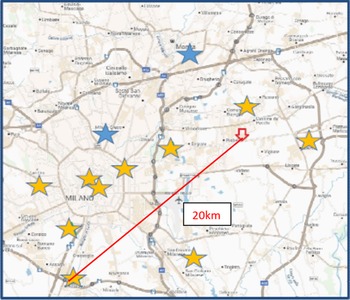
There were 12 hospitals involved in the management of the victims. All were located within a 20 kilometer radius of the scene of the accident (see Figure 1).
Map of the site of the incident (red arrow) and of the 12 hospitals alerted (stars): in blue the CTS (Level 1Trauma Center), in yellow the other hospitals.

Materials and Methods
This report compares the impact on surge capacity of different procedures implemented by hospitals in their MCI plan (Emergency Plan for Massive Afflux of Casualties—PEMAF).
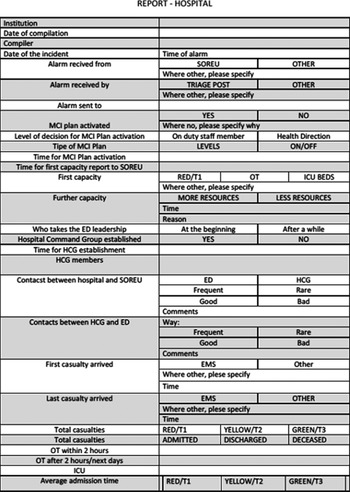
This retrospective study was based on the EMS report and data collected by the authors from participating hospitals using a qualitative questionnaire that was distributed via email and requested back in 1 week. To describe the activity of the hospitals, a commission made of representatives of the EMS-MOC and of the hospitals agreed upon a standardized form (Figure 2) able to collect most of the information regarding the ‘first step’ response.
Hospital report form.

Results
Hospitals
Of the 12 hospitals involved, only 10 returned the completed form within 1 week. A form was incomplete, so 9 responses were included in the data analysis.
Alarm
All 9 hospitals received the MCI alert from the EMS-MOC. According to the reported times for alert, the EMS-MOC alerted the biggest hospitals (CTS and CTZ-NCH) closest to the scene first, then the smallest closest hospitals (CTZ-noNCH and PST) and finally the other farther hospitals.
In 8 of the 9 hospitals, the alert first arrived at the TRIAGE area in the Emergency Department (ED). In 1 case, the alert from EMS-MOC first reached the Intensive Care Unit (ICU) and from there was forwarded to the Medical Service Direction, who decided to activate the hospital MCI plan.
Activation of the MCI Plan
The decision to activate the MCI plan was made by the Medical Director in 2 hospitals, while in the remaining 7 hospitals, the decision was made in the ED by a staff member on duty (the senior surgeon in 6 cases). The activation of the MCI plan was faster (immediately at the time of alert or within 15 minutes) when the decision was made by the staff on duty in the ED, while it took more time (up to 40 minutes) when the decision was made by the Medical Director.
Capacity
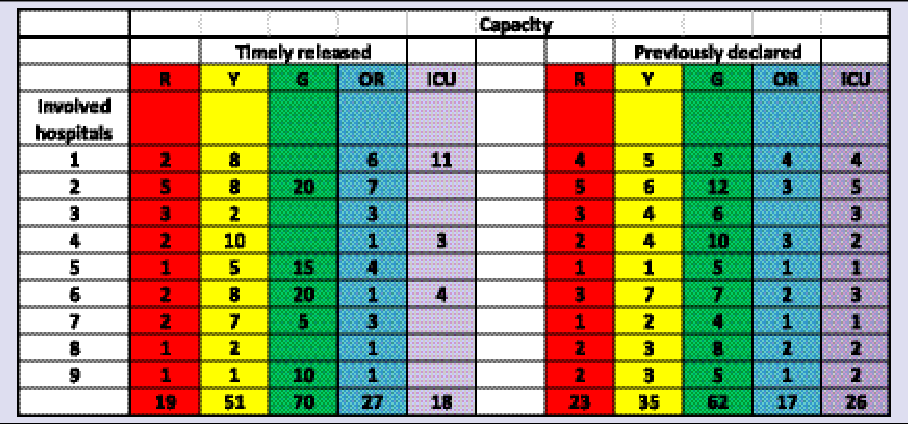
Out of 9 responding hospitals, 6 reported capacity information to EMS-MOC. In half of these (n = 3), the capacity report was given within 15 minutes; in the other half, the report on capacity information took up to 60 minutes. The initial capacity for severely injured patients (red code) was high, with available capacity for resources such as Operating Rooms (OR) and Intensive Care Unit (ICU) beds. The capacity increased overtime, due to the freezing of elective activities and discharging of patients from ICU beds. The capacity of all the hospitals was never exceeded. It should be noted that based on earlier hospital reports to the Health Authorities in case of activation of the MCI plan, hospital capacity was larger than expected. Only the very early capacity for severely injured patients (red code) resulted in less than previously declared values in few cases (hospital 1). In Table 1, the comparison of the previously declared and the timely released capacity by hospitals is shown.
Comparison between hospital capacities

Abbreviations: R, red; Y, yellow; G, green; OR, operating room; ICU, intensive care unit.
Leadership of the Operations
In all hospitals, the ED Director or delegate (i.e., the senior doctor on duty in the ED) led ED operations after activation of the MCI.
Hospital Command Group (HCG)
Within approximately 45 minutes (range: 25 to 75 minutes), the HCG was established in all the hospitals. In most cases the HCG included representatives from the Medical Service Direction, the Heads of the Critical Clinical Departments and the Nurse Coordinators. Other members of the HCG included Heads of non-clinical services, like maintenance and communication.
Communication
Communication between the EMS-MOC and the EDs was perceived as effective while communication between the EMS-MOC and HCGs was perceived as ineffective. A total of 7 out of 9 respondents’ hospitals reported that EMS-MOC preferred to talk directly to the ED. In 5 cases, this communication has been described as frequent and appropriate. Communication between the HCGs and the EDs is described as very effective. In all 9 hospitals, the preferred way of communication between HCG and EDs is the internal telephone land-line, while in 5 cases, the use of personal or institutional mobile phones is reported. A respondent reported the use of a VHF radio system for internal communication. In-person communication also occurred frequently (e.g., members of the HCG going to the ED or vice-versa).
Patients
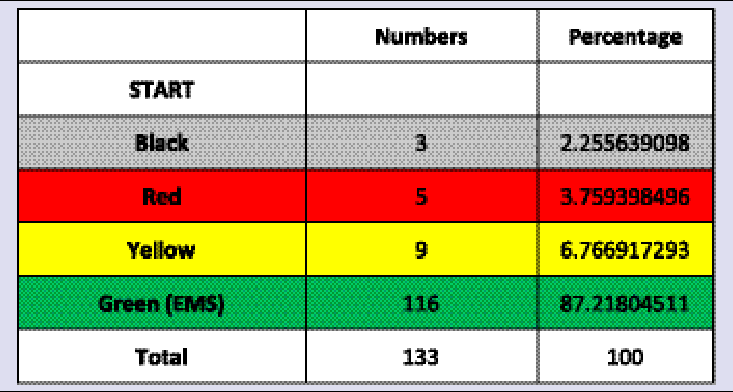
A total of 133 patients have been managed by the EMS. According to START triage (the triage routinely used by EMS in Lombardy in case of MCI), 3 patients (2.25%) were dead at the time of access to scene by medics (black code), 5 (3.75%) were red (highest priority to evacuation), 9 (6.76%) were yellow (intermediate priority) and 116 (87.24%) were green (low priority). Out of the total 133 patients 78 (58.64%) were hospitalized. From the data made available by the Railway Lombardy Company, the passengers of the train were around 300; it is supposed that some 170 (56.6%) passengers did not pass through the evaluation of the EMS.
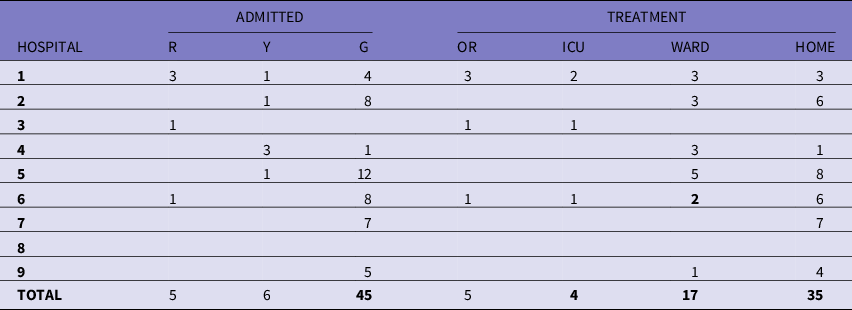
All the 5 red code patients went to the OR and 4 of them needed ICU after surgery. Of the 9 yellow code patients, at least 6 were admitted to ward; none needed the OR or ICU. Some of the green code patients needed to be admitted, but the majority was sent home the same day.
In Table 2, the patients and their severity according to START triage is shown.
Patients and their severity according with START triage

Table 3 shows the distribution and treatment received by the hospitalized patients in the 9 study hospitals. Note that the number of patients admitted differs from the ones declared by EMS (Table 2); this is because we do not have the data for 3 hospitals.
Patients admitted in hospital, and respective treatment received

Abbreviations: R, red; Y, yellow; G, green; OR, operating room; ICU, intensive care unit.
A total of 8 out of 9 responding hospitals reported that the first patient arrived through the EMS. In 1 case, in the hospital nearest to the scene (Level III Trauma Center), the first patient self-presented; he was mildly injured (green code) and was the first to reach a hospital 90 minutes after the incident. The first patient arriving at the largest hospital closest to the scene (Level II Trauma Center with Neurosurgery) was severely injured (red code) and arrived almost 2 hours after the injury. This hospital received 3 of the 5 severely injured patients; 2 of which went to the OR within 2 hours from their arrival to the hospital and were subsequently admitted in the ICU. In some cases, hospitals continued to receive self-presenting victims of the incident through the day and in the following days. These patients were typically mildly injured (green code) or suffering from emotional shock. The railway police took 2 people to the hospital where they were subjected to toxicological investigation for forensic purposes.
Timeline of the Incident
The incident was first narrated to EMS-MOC by a passenger of the derailed train through mobile phone at 06:59 AM. A few minutes after (07:03 AM), the news was confirmed again by phone, by the Control Room of the Italian Railway Company. A Major Incident was declared immediately (07:07 AM), even before the arrival of the first ambulance (BLS – Basic Life Support) at 07:21 AM. At the same time, the fast car arrived at the scene with the advanced team (ALS – Advanced Life Support) that started scene management including sectoralization, triage and the establishment of an Advanced Command Post (ACP) with representatives of the other emergency agencies on ground (fire fighters and police). The first severely injured patient (red code) was evacuated from scene at 08:31 AM, 70 minutes after the arrival of the first ambulance. This patient arrived at the nearest trauma center at 08:50 AM. The first patient to reach the hospital (08:28 AM) was a mildly injured one (green code), and reported to the hospital nearest to the scene, without passing through the EMS filter. At 10:22 AM, the scene was cleared of all casualties and hospital deactivation started.
The last patient who presented to the hospital the same day of the incident was at 06:00 PM. It was reported that some people also showed up at hospitals complaining that they were involved in the incident in the following days.
Discussion
The analysis of the event and of the report forms returned by the hospitals shows that a standardized form allowed the evaluation of the hospital response to the incident, but this form can be improved and institutionalized.
The post-hoc analysis showed that there was an over-activation of hospital resources by EMS-MOC with respect to the real demand, as well as an over-response by the hospital network because of the activation of their internal MCI plan. It must be emphasized that the expected number of casualties in such a scenario is much greater than the real figure. The real figures of injured people came late due to the problem of accessibility of the train, in particular the most damaged cars. In the context of a metropolitan area, with several hospitals available, it may be correct to alert more resources at an early stage and then to downgrade later on, to avoid underestimating the required response. Of course, the downgrading should be as early as possible, to allow hospitals to resume ordinary activities. The communication to withdraw the state of emergency seems to have failed in this event, as several hospitals reported that they were not informed when the scene was cleared from casualties, so that they could have begun deactivation. It is also true that this over-response by hospitals could be avoided with a step-by-step activation of the MCI plan, dependent on the actual arrival of victims, instead of an ‘all-or-none,’ perhaps implementing to a ‘standby’ phase in anticipation of patient arrival before mobilizing all available resources and freezing all ordinary activities.
The EMS was very active in managing the incident as evidenced by the very few patients who bypassed the filter of the pre-hospital system (‘wild patients’). Despite this, as reported in other events, Reference Turégano-Fuentes, Pérez-Díaz and Sanz-Sánchez2 ‘wild patients’ are always a possibility and in fact the first patient to reach a hospital was self-presented.
The management of the incident by EMS was effective in terms of distribution of the patients; in fact, they were spread throughout all the alerted hospitals, none of which exceeded their capacity. Actually it is exactly the opposite: the timely released capacity during the incident was greater than the one previously declared by hospitals to the Health Authorities in case of activation of the MCI plan. This can be explained by the time and day of incident, that took place early morning in a working day, when the medical personnel on duty is double, because of the changing between the night and the morning shifts and operating rooms and staff are already present inside the hospital, preparing for the daily ordinary surgical interventions to start.
The fact that the initial timely released capacity for severely injured patients (red code) was smaller than the previously declared numbers can be explained by taking into consideration that the ordinary capacity for the severely traumatized patients is low and it takes time to surge up to the declared numbers in case of activation of the MCI plan. Moreover, the few ordinary specialized resources for these types of patients can be already busy, and this reduces the capacity. Reference Faccincani, Della Corte and Sesana3
The overall outcome was quite satisfactory; no mortalities except for those on scene (a total of 3). Despite this, the time for the first severe patient (first red code) to arrive at the hospital was particularly long, especially when taking into consideration that this hospital is just 10 kilometers away from the scene and almost 2 hours went by from the alert to admission. This can be easily explained by the long extrication time, although we do not have the exact figures to be clear, but the most wrecked cars and inside these, the most injured patients, were very difficult to reach because of the rough terrain around the accident and the damage to the cars. Regardless, the time for evacuation of the first red code patient should be as short as possible.
The long time between the alarm and the arrival of the patients did allow the hospitals to fully mobilize, but it must be noted that in some cases the process of activating the MCI plan took too long (up to 60 minutes), especially where the level of decision was not with the staff on duty in the ED. We support the idea that the level of decision should be with staff present in the hospital at all times. A higher level of decision (Medical Service Direction) could eventually be called on to share the responsibility, but the decision itself should be the prerogative of staff on duty. During non-working hours, a fully functional HCG takes too long (up to 75 minutes in this event) to be set up.
The report from the hospitals does not indicate whether the priority given in the scene using triage START was confirmed or not at the patient’s arrival at the ED. At least we know there were 5 red code patients in the scene and 5 as well in the hospitals (no under or over-triage regarding the most severely injured). Regarding the treatment received, it has to be underlined that all the 5 severely injured patients (red codes) went to the OR (100%) and then 4 of them (80%) to the ICU. Numbers are too small to draw statistically significant conclusions, but it appears evident that the difference with what is reported from other traumatic events, where the percentage of red code patients that need OR varies between 10 and 20%. Reference Turégano-Fuentes, Caba-Doussoux and Jover-Navalón4,Reference Raux, Carli and Lapostolle5 This could be due to the relative small number of severe casualties and the long time on scene, the EMS was able to better evaluate the patients. Although all hospitals in the Lombardy Region Trauma System are obligated by law to have a MCI plan, 6 not all of them have a program to review, exercise and train the personnel involved. It is interesting to note that the hospitals that reported the first capacity report to EMS-MOC within 15 minutes from the alarm have all initiated an educational program on MCI management with the use of the MACSIM simulation tool. Reference Lennquist Montán, Hreckovski and Dobson7
During the meeting organized by EMS with the participation of EMS-MOC and all the involved hospitals to review the management of the event, there were reports of an undue, inordinate flow of telephone calls reaching EMS-MOC from hospitals, overwhelming the telephone operators and detracting time and resources from their main tasks. EMS-MOC preferred to keep the communication with the ED and not with the HCG and this is why the hospitals complained the HCG was a bit left behind. This issue should be warmly addressed by hospitals. There should be a single communication line with the EMS-MOC for the whole hospital, preferably maintained for the whole duration of the emergency. Communication between the EMS and the hospitals during a MCI should be carefully addressed: 1 line and 1 flow should be in place to avoid many requests of information coming from hospitals interfering with the pre-hospital management. The line and flow of communication should be clear inside the hospital as well. Back-up systems such as VHF radios and information carriers should always be available, and heads of communication and maintenance departments, responsible in part for the MCI response planning and implementation, should be included as members of the HCG.
The hospital departments in charge of communication and maintenance should be involved in the preparation of the MCI plan and represented in the HCG during an emergency, but it seems from the reports that only a few hospitals included them.
Conclusion
In the reported Pioltello train incident, EMS-MOC referred patients to all available hospitals and distributed the casualties in order to avoid overload. The analysis of this MCI through a standardized report form allowed us to overview the effectiveness of the EMS-Hospital organization in the metropolitan area of Milan. The MCI plan was effective in meeting the requirements of the event, and should be regularly updated and implemented. The prerogative to activate the MCI plan should stay with the staff on duty at all times and a higher level of decision (Medical Service Direction) could be on call to share the responsibility. Waiting for people on call to reach the hospital and be fully operational (Hospital Command Group) before activating the MCI plan could cost too much time and this could prove fatal in the case of scenes of events very close to the hospital, particularly if patients self-present to the hospital bypassing the pre-hospital system (‘wild patients’). An over-activation of the hospitals involved in the management of a MCI, based on the services ultimately needed, is preferable to an under-estimation of resources needed for effective response. Activation should be scaled down based on a plan established prior to the activation. Communication in MCI is always a concern, so from the analysis of this incident, EMS developed a proposal to send a communication liaison officer to each involved hospital to ensure a direct, and secure line of communication. In Lombardy, there is a legal obligation for all hospitals which are part of the Trauma System to have a MCI plan. This plan should be updated and exercised through simulations. The analysis of this MCI showed that hospitals that underwent an educational program for MCI management for the staff performed better.