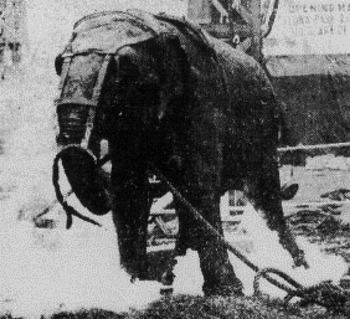
It was a cold winter afternoon just after New Year's Day in 1903 when Topsy the Elephant met her demise. Hundreds of men, women, and children gathered in Luna Park at Coney Island to see the spectacle, paying a quarter a piece to do so. Several workers led the six-ton animal from her stable and across the park grounds to the bridge that led to a large scaffold, which had been built in the center of a lake expressly for this purpose. Once on the bridge, however, Topsy stopped and absolutely refused to budge. As the crowds waited with anticipation, the execution site had to be dismantled and reconstructed in the main park grounds. There, with the elephant finally placed upon a makeshift stage, workers clamped electrodes to her feet. She at first kicked them off but eventually began to cooperate, lifting her limbs to allow the men to fasten the various ropes and chains and wires that would end her life. Lest the electrodes failed, workers placed a large noose around her neck, attached to a pulley connected to a nearby steam engine. As a third precaution, the park veterinarian fed the elephant her last meal, carrots loaded with cyanide. Then, from a small house 100 feet away, an electrician from the Edison Company hit the switch, and 6,600 volts of electricity coursed through Topsy's enormous body. She lurched forward, her body rigid, pulling taut the chains and rope that bound her. The current was turned off within seconds, and Topsy fell to the ground. In a flash, the great beast was dead. She died by electrocution before the cyanide could take effect.Footnote 1
Topsy, thirty-six years old at the time of her death, had once been known as the beloved “baby elephant”—the first baby elephant to be held in captivity in the United States. However, lately she had become dangerous and unruly. In the previous three years, as a performer in the Adam Forepaugh Circus, she had killed three men, leading her owners to sell her to Luna Park. There her bad temper continued, and her new owners claimed they had no choice but to put her down. They did so, however, not by killing her quietly out of public view; rather, they staged an elaborate mock execution. They had initially planned to hang the elephant and built the scaffolding in order to replicate a gallows for a public hanging. After the American Society for the Prevention of Cruelty to Animals (ASPCA) objected, however, they turned to electrocution, a method deemed quicker and more humane than hanging, and hired electricians from Edison's company to carry it out.
News accounts of the event continued the conceit, deeming Topsy's electrocution an “execution” and claiming that the elephant had “paid the death penalty” for the “three murders” she had committed. The New York World reported, quite earnestly, that the elephant showed visible signs of contrition and repentance for her crimes. The elephant also revealed “grave apprehension as to what the occasion meant” and “seemed to realize the solemnity of the situation.” That Topsy refused to be led to the spot of execution, so that the men had to move the equipment to her, was viewed as a further sign that she knew what awaited her. The many spectators, who the papers said had made a “holiday” of the day, crowding onto the grounds of the park and standing on rooftops “with breathless excitement,” were at the same time, moved to “pity” upon seeing the elephant's docility at the moment of her death.Footnote 2 Motion-picture camera operators from Edison's film company were on hand to capture the event, which was released soon after with the title, “Electrocution of the Baby Elephant, ‘Topsy.’”Footnote 3 (See Figure 1.) The killing of Topsy appeared at once to be a somber occasion meant to provide redress for the tragic deaths the elephant had caused and another entertaining spectacle at Coney Island, one to be relived at motion-picture exhibitions around the country.
“The Electrocution of Topsy the Elephant.” Edison Film Company, 1903.

The electrocution of Topsy was extraordinary but hardly exceptional. It was one of a number of remarkable and curious incidents that occurred at the turn of the last century: the publicized killing of “mad” or “murderous” circus elephants. From the 1880s through the 1920s, executions were carried out or nearly carried out upon at least thirty-six elephants.Footnote 4 Some of these unfortunate creatures were hanged from railroad cranes or strangled with nooses, others were shot by firing squads or local “hunters,” and in several cases, as with Topsy, officials attempted to electrocute the condemned elephants. It would be easy to dismiss these killings as incidental outbursts of a crueler age largely indifferent to the suffering of animals. What is most unusual about these executions, however, is not that dangerous elephants were put to death, but that they were often done so publicly and that reporters and witnesses used the language of crime, remorse, and punishment to talk about them. Even those killings done privately, performed by circus managers and trainers beyond the public eye, were frequently reported in similar kinds of anthropomorphic terms. Elephants were killed not because the officials who condemned them were insensitive to animal suffering; rather, they saw these elephants as all too human—criminalized and exoticized, but human.
Indeed, the executions of elephants can reveal much about turn-of-the-century ideas regarding crime and retribution. Complex and often contradictory conceptions of criminal behavior emerged in this period, which produced a good deal of turmoil over what constituted criminal justice. In many cultures, animal rituals, from blood sacrifices to blood sports, have acted as a means through which human groups play out social conflicts or symbolically subdue threats to the social order. Historian Robert Darnton, for instance, has shown how a grisly cat massacre outside a French printing shop in the 1730s can act as a “point of entry” into shopworkers' mentalities toward unjust working conditions and a rigid social hierarchy. Similarly, scholars have maintained that Spanish bullfighting is more than a sensational sport; it can mirror and convey cultural ideas about, alternatively, masculine dominance, political conflicts within Spanish society, or Spanish nationalism. In his famous study of Balinese cockfighting, anthropologist Clifford Geertz revealed the ways in which the fights were complex rituals through which Balinese men organized their ideas about social status, death, masculinity, kinship, and loss, among other things, into “an encompassing structure.” Blood sports like cockfighting and dogfighting served similar purposes in the United States.Footnote 5
Rituals in which animals were tried and executed for murderous crimes have also had a long and varied history, most notably in medieval Europe, where it was not unusual through the seventeenth century for domestic animals to be prosecuted before magistrates and executed publicly for fatal injuries upon humans. Vermin such as insects, mice, or rats were tried in ecclesiastical courts for bringing pestilence or simply irritation upon communities.Footnote 6 Although learned elites in this period considered animals to be insensate and irrational beings, folk beliefs attributed human characteristics to them, including the possession of an independent will that rendered them morally culpable for their actions. Historians have situated these executions within the particular context of medieval ideas about law and retributive justice. They could be viewed, for instance, as a manifestation of the Judeo-Christian belief that man held dominion over animals. When an animal killed a human being, it had subverted the natural hierarchy, which then needed to be restored through the animal's ritual death. These prosecutions, furthermore, affirmed God's law as universal by ensuring that animals were subject to it just as humans were.Footnote 7 Psychologist Nicholas Humphrey, viewing medieval animal trials anthropologically, has posited that they allowed people to assert “cognitive control,” or a sense of moral order, in the face of senseless, accidental deaths. By prosecuting the offending animal, grieving people made sense of “inexplicable events by redefining them as crimes.”Footnote 8
It is unlikely that the execution of elephants in late Victorian America represented the lingering presence of these medieval traditions. The European practice of prosecuting domestic animals had largely ended by the eighteenth century, and there is no evidence that other animals besides elephants were subject to mock trials and executions in this period. Instead, elephant executions should be understood as phenomena of their social and cultural environment. As Geertz makes clear, these kinds of animal slaughters do not disrupt social structures, alter cultural behaviors, or shift cultural values; rather, they throw everyday experiences and values into stark relief by rendering those experiences and values into spectacle dramas. Through these dramas, ordinary life is made, in Geertz's words, “meaningful—visible, tangible, graspable—‘real’ in an ideational sense.”Footnote 9 In this vein, the extraordinary sensationalism of elephant killings can serve as a point of entry into popular responses to and feelings about crime and punishment during the transition between the Victorian and modern eras.
In particular, they dramatized public conflicts that were erupting in response to the state's attempts to suppress popular impulses for vengeance by sanitizing criminal executions and removing them from public view. These conflicts coincided with cultural tensions over the moral accountability of criminals emerging at this same time—tensions that the narratives surrounding elephant executions made manifest. The murderous criminal in popular discourse was an object of fear and derision, someone whom the public clamored to see suffer with his life. At the same time, he could be a figure deserving of human sympathy, someone who might not be fully responsible for his own actions or who had lost control of terrible impulses that we all struggle to contain. Dangerous elephants took on particular symbolic value amid these clashing discourses, as they were perceived as both monstrous threats to public safety and pitiful and mistreated creatures.
Elephant executions were not simply folk rituals that expressed popular values and desires over and against modern legal and social proscriptions, however. They were, after all, commercial and often profit-driven affairs that spilled over from the modern circus. As such, they were performances that were entertaining at the same time that they were deadly serious. With them, the circus stage and execution site were metonymically exchanged, both brimming with violent danger and cathartic pleasure. These twinned feelings of danger and pleasure were also connected to turn-of-the-century notions of race and white supremacy. These executions, like the circus itself, offered symbolic representations of human domination over the natural world and, by extension, all that was murderous and rapacious within us. That sense of mastery, for many white Americans, was inseparable from their sense of racial superiority.
Rituals of Retribution in the Age of Private Executions
To be sure, elephant executions were more common in this period because there were more elephants in the United States. Circuses had developed into large, corporate enterprises by the end of the nineteenth century, the largest of which might have over two dozen elephants.Footnote 10 Under the strain of captivity and regular performances, elephants were increasingly likely to become violent. A 1921 article in the Saturday Evening Post reported, for instance, that circus elephants went “mad” and needed to be put to death at least once a year.Footnote 11 Even in the 1990s, by which time elephant trainers and caretakers were under great social pressure not to mistreat their animals—they no longer used hooks or hot irons to control them, for example – elephants killed nine zoo or circus workers.Footnote 12
But the way in which elephants were put to death and the way in which popular accounts portrayed those deaths underwent a marked shift beginning in the 1880s. In the antebellum period when circus elephants rampaged or killed humans, officials were likely to sell them to zoos or to other circuses if the animals had not been shot immediately. Violent elephants in this earlier period did create public sensations—there were several spectacular incidents in the early nineteenth century, both in the United States and abroad, when elephants broke loose and rampaged through city streets, only to be subdued by gunfire.Footnote 13 Reports of these incidents, however, tended to treat the elephants as wild animals, extraordinary beasts out of place on city streets. There was little of the anthropomorphizing apparent in later accounts of elephant attacks, nor did officials or reporters represent the death of the elephant in terms of criminal executions.
In 1883, however, the killing of a vicious elephant in P.T. Barnum's show became the focus of a number of news accounts, which labored over details of how circus trainers attempted to subdue the animal before shooting him to death. The elephant, named Pilot, was described as “quarrelsome” and full of “spite” for his keeper, his glare “malicious.” In describing his wicked character, the New York Times mimicked common accounts of criminals with tongue-in-cheek humor. “He had no regard for religion or morals,” the piece read, “he played marbles on Sunday in his youth and drank beer in his maturity, and in every way has made a horrible example of himself for little pachyderms who read elephantine Sunday-school books to profit by.” Later accounts of elephant killings showed more sincerity, but the stories about Pilot revealed a new fascination with unruly elephants.Footnote 14
Two years later an elephant was put to death in a staged, public execution for the first time. When Albert, also owned by P.T. Barnum, killed his keeper in Nashua, New Hampshire, circus officials planned an execution by firing squad in nearby Keene. The beast was chained to four trees, and his heart and brain were marked with chalk. Thirty-three men from the local “Light Guards” then aimed and shot their rifles while 2,000 spectators applauded his “instantaneous” death with “shouts and cheers.” The sensationalism of the event was intended to bring publicity to the Barnum and Bailey Circus, where Albert was one of the largest and most valuable performers. The story of his execution appeared in newspapers throughout the country, and Barnum and his partners donated Albert's remains to the Smithsonian Institution.Footnote 15 The public killing of Albert in this way became a theatrical extension of the modern circus. Indeed, circuses regularly called attention to the potential danger of “rogue” animals as part of the spectacular thrill that circuses offered. As Janet Davis has pointed out, circuses played up stories of animals attacking their trainers or escaping from their confines as a means to magnify the skill and valor of showmen and to allow circusgoers the “imagined pleasures” of hunting and mastering these dangerous beasts.Footnote 16
The elephant execution also allowed spectators the imagined pleasure of witnessing a public execution—and that of an especially frightening and dangerous criminal. Officials not only staged these killings as they might a public execution, but reporters used the language of crime and retribution to describe them, as they did with Topsy's electrocution. When Tip, confined to the menagerie in Central Park after killing several of his keepers in the Adam Forepaugh Circus, continued to threaten and injure his keepers, the park commissioners “tried and convicted” him. According to the New York Times, the “jury of four turned down their thumbs” and read his “indictment” for murder. After the elephant was publicly poisoned in a long, drawn-out, and torturous affair, another New York paper announced that “like a murderer on the scaffold, Tip … was executed.”Footnote 17 Reports like these were satirical, yet they conveyed an element of gravity as dramas of justice meted out and moral order restored, especially compared to the blatantly mocking coverage of Pilot's death, discussed above.
That circus owners, news reporters, and members of the public chose to frame these killings within the language and trappings of legal trials and public executions takes on significance in light of the fact that they occurred when most states had largely ended the practice of public executions, a process that many American resisted. In making executions private, civic authorities in part attempted to restrain the role of retributive justice in criminal jurisprudence and restrict what they considered the public's primitive desire for revenge. Many Americans, however, remained eager to witness crime avenged and participate in what they saw as the restoration of social order that the execution represented. In this context, elephant executions could act as a satisfying outlet for these desires, serving as ritual dramas of retribution over and against the modernizing state. To be sure, many who attended and reported these executions seemed to delight in the sheer spectacle of the matter, but people also wanted them to have redeeming moral value and stand as lessons in criminal accountability.
The ritual of public execution emerged along with the formation of the modern state in Europe in the sixteenth and seventeenth centuries as a means for state authorities to manage or contain popular desires for vengeance against heinous crimes. For the most egregious of crimes, the public execution acted not only as a means of social control, removing the criminal from the social body and deterring future crimes; it also ratified the state's power to punish crimes on behalf of the community and the aggrieved parties, “the people” broadly conceived. Although this ritual appears gruesome by today's standards, the formality of the execution, with the erection of scaffolding and the presentations of speeches and sermons, was actually meant to displace traditions of retaliatory justice, exchanging what were viewed as bloodthirsty desires for vengeance with solemnity, decorum, and order. To serve these roles, executions needed to be public and terrifying. The spectacle of the hanging stood as a frightening warning to the crowds of onlookers, but just as importantly, it stood as a blunt reassertion of state power, which the criminal act had momentarily eclipsed. The spectacle of it thus ensured that the restoration of state power was made visible on the condemned's pained body and that it was witnessed and thereby legitimized.Footnote 18
Public executions also served as religious ceremonies, in which clergymen offered prayers upon the condemned's soul, and the convicted criminal gave often lengthy spiritual confessions of his own sin and remorse. These testimonials gave further validity to the execution by assuring the crowd that the condemned understood hanging as the rightful punishment for his crime. Moreover, this focus on the spiritual condition of the condemned assumed that the criminal was part of the community, a fellow sinner with whom witnesses might identify or whom they might pity. Although by no means wanting to share the condemned's fate, onlookers might emulate his spiritual journey to redemption. Crime, in this context, was imagined as a sinful act deriving from innate and universal human depravity, something everyone was potentially capable of and could be potentially saved from.Footnote 19
Retribution still remained an important element of public executions, but its emotional potency was contained through the solemnity of the ritual. Retributive justice as a moral principle emphasizes the debt a criminal owes to his victims, as well as society at large, and demands that the criminal suffer a penalty proportional to the offense he inflicted. Proponents argue that through retributive justice, a society expresses the value of what it holds as morally right by punishing with full force what it regards as wrong. That expression of moral value is based in deep feeling—grief, fear, and outrage—that demands public recognition. The symbols and rituals surrounding criminal punishment thus serve as the means through which the emotions created by an offense are given credence.Footnote 20 These principles were central to the ritual of the public execution. Through witnessing the suffering and death of the criminal, people could fulfill their thirst for personal vengeance and feel reassured that justice had been meted out. They were often eager to hear the condemned's confessions of remorse, perhaps less from concern for the state of his soul than for the sense that his suffering had moral value and that there was, as part of the execution, a public acknowledgment of right and wrong. As David Brion Davis has said, among its many functions, the execution provided “an emotional release from the profound anxiety and resentment often excited by crime.” Through the execution, the moral confusion that crime inevitably produced could be confronted, and some kind of meaning could be drawn from it.Footnote 21
This primal aspect of the execution ritual, however, increasingly came to discomfit cultural elites by the late eighteenth and early nineteenth centuries. In both the United States and western Europe, the emergence of liberal sentimentalism led to an increased sensitivity to human suffering, while the spread of Christian romanticism placed new emphasis on the power of human reformation, at least among the genteel classes, many of whom came to believe that vengeance deserved no place in the criminal justice system. In the United States, the movement to abolish capital punishment made strong headway by the mid-nineteenth century as legislation to overturn the death penalty was introduced in every northern state by the Civil War.Footnote 22
However, even as this abolition movement was gaining steam in the antebellum period, executions became more spectacular events. With the advent of railroads and the publicity afforded through newspapers and broadsheets, hanging-day crowds grew larger and subsequently more boisterous. Civic leaders and other elites expressed concern that these crowds appeared not to be witnessing the hanging in somber reflection on the terrible consequences of crime and sin but rather treated them as morbid entertainment. Instead of containing the desire for vengeance, these displays, critics feared, only encouraged bloodlust. Reformers further worried that public executions excited the crudest sensibilities of the public and polluted people's moral senses; that rather than deterring crime and restoring social order, executions aggravated criminal tendencies and contributed to social disorder.Footnote 23 For these reasons, the movement to abolish public executions emerged as a successful compromise to ending capital punishment altogether. It did not stem as much from humanitarian concern for the condemned as it did from anxieties over social disorder and the upsetting presence of purportedly savage impulses within a civilized, modern society. Calls for private hangings began in the 1820s, and by the late nineteenth century most states had passed legislation ending the tradition of the public execution, hanging criminals behind jail-yard enclosures or prison walls before a group of carefully selected witnesses.Footnote 24
This move away from public executions provoked considerable opposition, however. Local officials, especially in rural areas, tended to ignore state laws, allowing public or semi-public executions even into the twentieth century, long after they had been legally abolished. Those who did attempt to bar the public from hangings often met with anger and outright resistance. In localities across the country eager spectators bribed and cajoled officials, climbed trees, rooftops, and telephone poles, or in some cases tore down enclosures to witness executions. Crowds numbering in the thousands continued to congregate on hanging days, and in a number of cases, armed guards were necessary to keep them away from the gallows. Pennsylvania was the first state to abolish public executions in 1834, but as late as 1897, a sheriff in Mansfield, Pennsylvania, overseeing the execution of a white man convicted of murdering his wife, was inundated with requests to view the hanging. Although the sheriff limited the witnesses to fifty people, citizens crowded against the fence that enclosed the gallows, peering through knotholes to catch a glimpse of the murderer's demise. Afterward, they were allowed to tour the gallows. The local paper lamented the fact that “people seemed to regard the execution as a holiday.”Footnote 25 These kinds of events persisted in southern localities even longer. For instance, when Ben Williams was executed in Raleigh, North Carolina, in 1906, crowds pressed against the enclosure in the jail yard and stood atop surrounding buildings, trees, and telegraph poles to see the hanging. As Williams was led to the enclosed gallows, “the waiting throng in the jail yard surged behind him like the crowd clamoring at the tent-gate of a circus,” reported the Raleigh News and Observer.Footnote 26
Incidents like these only began to subside when executions were brought under state, rather than local, authority and criminals were executed indoors at state prisons, a process that began in northeastern states in the last half of the nineteenth century and was not completed in many southern states until the mid-twentieth century. Even then crowds regularly appeared outside prison walls, not to protest the execution as happened in later decades, but to continue in some form the hanging-day tradition. To satisfy this popular demand and create a vicarious spectacle for the public, newspapers, particularly the burgeoning tabloid press, offered more sensationalistic accounts of executions, describing in excruciating detail the condemned's final moments.Footnote 27 This popular desire to witness executions was no doubt motivated in part by morbid curiosity.Footnote 28 But many of the spectators who continued to gather around jail yards and prisons on hanging days were also stirred by notions of retaliatory justice. It was not enough to know that the criminal paid with his life; moral satisfaction was also gained, and a sense of social order restored, by witnessing his suffering and imagining his remorse at the moment of his painful demise.
It was precisely that impulse for revenge that civic leaders and reformers in the Progressive Era, like antebellum reformers before them, wanted to strip from the criminal justice system. To them, executions represented a mob mentality, formalized and legitimized but no less savage. Even those who still supported capital punishment sought to make the practice as humane and as sanitized as possible, advocating, for example, the electric chair as an efficient and painless alternative to hanging. These proponents, as well as those who still advocated public executions, continued to see the value in the state managing popular desires for vengeance through the execution ritual. Eradicating the death penalty, they feared, would only lead to more vigilantism and, in particular, more spectacle lynchings. In fact, in a number of cases, southern judges and sheriffs arranged for public or semi-public executions precisely to avoid mob action in their communities.Footnote 29
Elephant executions emerged amid this public furor over capital punishment and the demise of the public execution. Members of the public clamored for the chance to witness these killings and sought news of them with the same eagerness as they had attended criminal executions and lynchings. Although, as was the case with Topsy's death, these were commercialized spectacles, news reports reminded readers that they were somber and serious affairs through which brutal “crimes” were avenged and public safety restored. Just as in human executions, when the public waited expectantly for the condemned's remorseful confession, elephant executions involved not merely a visual display of violence, but a narrative of justice and redemption.
Sometimes officials went as far to hope that the executions might stand as terrifying deterrence to other elephants. The “man-killing” elephant, Dick, was executed in the basement of Madison Square Garden before his fellow circus elephants. “The capital punishment was to be a lesson, a warning to them,” reported the Chicago Tribune. When Nick, of the Barnum and Bailey Circus, became increasingly difficult to control, circus managers had him strangled with a noose “in view of all the other elephants, possibly as a sort of warning to them of the result of disobedience.”Footnote 30 Officials were then understandably perplexed and disappointed when the witnessing elephants looked on without concern. When Columbia, the offspring of Jumbo and the first elephant to be born in captivity in the United States, had become unruly and dangerous, she was “condemned to death” and executed by strangulation at Barnum's headquarters in Connecticut before twenty-one other elephants, including her mother. “If the other elephants understood the execution of Columbia, they did not show it in a violent manner,” noted the New York Times. “Even Babe, the mother, looked on indifferently, as did the others.”Footnote 31
Some of this reportage might certainly have been sardonic—though in many cases a certain sincerity is apparent. However, even as satire, reporters were commenting on popular understandings of criminal punishment and on the salacious and maudlin ways the press tended to cover crime. Moreover, the events themselves certainly would have mattered to many of the people involved. Owners may have been most concerned with profit, but trainers and keepers were attached to the animals. When interviewed, they expressed grief over the animals' deaths and sought rational, human-like explanations for their murderous rage, such as jealousy, frustration, or anger. It is hard to believe that they condoned and participated in the executions as a joke. On the contrary, the ritual of execution accorded the elephant some dignity; it was the logical extension of perceiving his violence not as an animalistic impulse, but as a murder, with motive and intention.
Still, the tone of these news accounts was in accord with the tenor of sensationalistic journalism of the period.Footnote 32 In the late nineteenth century, newspapers, especially the newly emerged tabloid press, began paying more attention to scandalous stories of crime and murder, relating them in excruciating detail. Historians have interpreted this interest in the sensational as a byproduct of a modern, industrial age. Advances in print technology, as well as a growing urban readership, allowed print media to flourish and appeal to popular interest in gruesome and frightening tales. Public interest in the morbid intensified amid the social anxiety that urban environments generated, particularly the fear that one could fall victim to crime at any time. Urbanization actually led to a decrease in homicide rates, a fact that perhaps amplified the import of any particular act of criminal violence. In this context, crime stories became real-life melodramas that represented violent acts within clear narratives of right and wrong.Footnote 33 News reports recounting acts of elephant aggression often repeated popular tropes of sensationalistic journalism; and just as newspapers began offering detailed accounts of criminal executions in the late nineteenth century, so did they linger over the details of elephant executions.
Elephants and Turn-of-the-Century Conceptions of the Criminal
The anthropomorphism of these accounts makes particular sense in the light of a late Victorian fascination with elephants. Although most circuses had a menagerie of wild animals, elephants were the most celebrated and beloved of circus performers.Footnote 34 Turn-of-the-century Americans were more likely to attribute human qualities to the behavior of elephants than to other wild animals. Because of their preternatural memories and the attachments they showed to their keepers and kin, especially the capacity to mourn, elephants were considered to be more intelligent and emotional—more humanlike—than other circus animals. Despite the fact that the face of an elephant is comparatively unhuman-like and inscrutable, all sorts of human qualities were projected onto it: loyalty, remorse, sadness, fear, and excitement.Footnote 35
At the same time, elephants were an exotic curiosity. “Seeing the elephant” was a popular idiom throughout the nineteenth century that referred to beholding something wondrous and spectacular. The term derived from the stir that the first elephant to arrive in America caused as it was brought on tour up and down the eastern seaboard in 1796. As if to calm spectators' fears about this new wondrous oddity, one advertisement proclaimed the pachyderm, known as the Crowninshield elephant, “the most respectable animal in the world” and maintained that “by his intelligence, makes as near an approach to man, as matter can approach spirit.”Footnote 36 By the 1840s, Gold Rushers began using the phrase “seeing the elephant” to describe their adventures. It subsequently came to refer variously to dreams of riches, to any great achievement or tribulation, or simply to something on the cutting edge. By the turn of the century, the phrase came to connote illicit or forbidden pleasures. Some prohibitionists even termed whiskey an “elephant” run amok that rampaged through communities wreaking terrifying destruction, too large and powerful to be restrained. It was common folklore that elephants enjoyed whiskey.Footnote 37
P.T. Barnum capitalized on the contradictory and expansive meanings that Americans imposed on elephants when he brought Jumbo from London in 1885. Although the London Zoo sold Jumbo because he had become temperamental and potentially dangerous, Barnum promoted him as at once a majestic wonder, a lovable pet, and after he was killed supposedly trying to save a younger elephant from an oncoming train, a courageous hero. Jumbo soon became an immensely popular symbol of America itself. Jumbo's offspring, Columbia, was even named for the nation.Footnote 38 Well before Jumbo, many Americans had already embraced the elephant as a symbol of patriotic strength and virtue, as seen in part by Thomas Nast's popularization of it as the icon for the Republican Party in 1874.Footnote 39
Still, even as they were the objects of popular fascination, elephants were also seen as dangerous, racial others. That is, on the flipside of their exotic allure lay the sense that they were savage and potentially unruly beasts—from, not incidentally, the same countries and continents toward which western imperialistic desires and aims were directed. Although most circus elephants hailed from India, African elephants, like Jumbo, often attracted the most attention not only because they were larger in size, but also because they were considered harder to tame and domesticate. They were seen to embody a savagery also associated with African people.Footnote 40 Just as circus owners played up the danger of their elephants, tales of big-game hunting in Africa often described elephants as particularly vicious, which exalted the bravery and skill of western hunters. Elephants did represent the largest animal that man had come to control, but they were neither the most ferocious animal in the jungle, nor the most difficult to capture and shoot. As George Orwell explained in his 1936 anti-imperialist essay, “Shooting the Elephant,” elephants—a metaphor for colonized peoples—had to be represented as more powerful and more capable of evil than they actually were in order to justify colonial mastery over them.Footnote 41
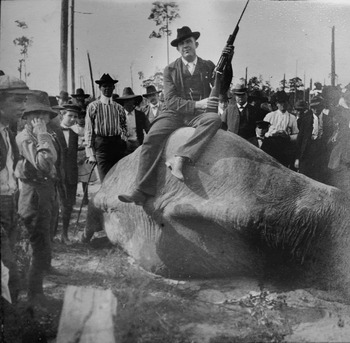
Some elephant executions even played out like big-game hunts, with armed citizens chasing the beasts through the streets. When Floto the elephant began rampaging through the circus lot in the town of Orange, in southeast Texas, “the whole city took up arms in a jiffy,” according to a story by Frank Braden in Illustrated World. A local hardware store “threw open its doors to all responsible persons, issuing rifles and ammunition,” and armed men descended on the lot, riddling Floto's body with bullets. “The news of the great elephant hunt and kill was on the wires within the hour,” reported Braden. “Armed Texans had bagged the mightiest specimen of man-killing game ever known within the borders of the Lone Star state.”Footnote 42 Big-game hunting had allure in all regions of the country. However, it is not surprising that several of these elephant hunting spectacles happened in southern towns like Orange, considering the particular racial and gendered significance hunting held in southern culture, where hunting had remained a part of everyday life, for sport and subsistence. Hunting had long served as a ritual through which white men displayed masculine dominance and power, not only over the natural creatures they killed, but also over women, who were excluded from the hunt, and African Americans, who traditionally played subservient roles within it. The frenzied excitement that the hunt could generate became outlets for masculine aggression and even ferocious beastliness, which the rules of civilized society forced into restraint.Footnote 43 As they did in Orange, local men chased down and shot unruly elephants in Valdosta, Georgia, in 1902 and in Hartsfield, South Carolina, in 1914. In Valdosta, a band of men engaged in all-night pursuit through the countryside of a circus elephant named Gypsy, who had killed her trainer after a circus performance. After finally felling her with a rifle in the early daylight hours, the men gathered around her corpse for a trophy photograph, a visual testament to their mastery of the ferocious beast. (See Figure 2.) Her skin and bones were then saved as souvenirs.Footnote 44
The police chief of Valdosta, Georgia, sits atop the slain elephant, Gypsy, 1902. Courtesy of Georgia Archives, Vanishing Georgia Collection, low049.

The language of human domination over dangerous savagery seeped into the reportage of elephant executions. This perception of elephants was not particularly new. One of the first elephants in the United States was, according to folklore, perceived to be a direct threat to the moral order. Old Bet, as she was called, was beloved by audiences when she toured the countryside in 1816 but was shot by a farmer in Maine, supposedly enraged that townspeople were spending their money on something so frivolous as looking at an elephant. Some accounts inflated one angry farmer into a band of moral crusaders, who considered the display of an elephant as salacious as the most risqué theater. The story of Old Bet may be apocryphal, but even as a myth, it speaks to the ways in which elephants were at once deemed both lovable and menacing.Footnote 45 This paradox was even bound up in the phrase, “seeing the elephant,” which implied an activity that was wondrous and satisfying, but also lascivious. A rogue elephant, one that literally crashed through the boundaries of its captivity, made apparent that despite the illusion of the circus, the savage cannot be tamed.
It was precisely because elephants were familiar creatures with which audiences could identify—and at the same time mysterious and potentially threatening—that they held ritual value and that executing them could hold such powerful compensatory force.Footnote 46 For audiences to derive both pleasure and satisfaction from an ersatz execution, the condemned needed to be both humanlike, capable of accountability and remorse, and a mighty and monstrous force that needed to be subdued and destroyed. Indeed, because the public killings of “murderous” and “crazed” elephants were framed in anthrocentric terms, they also represented mastery of all that was beastly in humans: the forbidden, the illicit, and criminal.
These ideas about elephants were part of a larger reconfiguration of the relationship between human and animal that was taking place throughout the nineteenth century, one that had significant implications for the ways in which criminality came to be understood. Humanitarian sensibilities had led Victorians to develop a sentimental attachment to animals, as seen in the emergence of vegetarianism, the formation of the ASPCA and other animal welfare organizations, and especially in the keeping of pets. It also became easier to sentimentalize animals in an industrial age when they played less of a role in economic life. Within the context of Victorian domestic ideology, animals came to be seen as helpless and dependent creatures, much like children, who were deserving of protection and care. In addition, the rise of Lamarckian and then Darwinian understanding of human evolution helped to foster a sense of kinship with animals. As people began to recognize the animal rooted within themselves, they, in turn, began to notice human qualities within animals.Footnote 47 The emergence of both zoos and circuses at this time provided a means for Americans to observe and interact with animals in sentimental ways, especially wild animals that they otherwise would have no access to. As James Turner has noted, this new attachment to animals was emblematic of larger romantic or nostalgic ideals about nature in the face of rapid urbanization. Animals were seen as creatures of real feeling in contrast to the emotional sterility and rationalism of the industrial order, thus acting as a “psychological bulwark against the onslaught of modernization.”Footnote 48 People tended to project onto animals ideal qualities that they felt they were losing as they became further removed from natural settings—so dogs were praised for their loyalty, cats for their independence, and so forth.
Even as people began sentimentalizing animals in this way, they inversely came to associate the worst about themselves with animals. The most dreadful human impulses and desires were imagined as the beast within that civil and moral restraints should quell. This notion of human animality held particular force in a culture in which African Americans and other racial minorities were routinely likened to animals as a means to justify their subjugation. It also, relatedly, came to have bearing on the developing science of criminology in the late nineteenth century. Influenced by Darwinian conceptions of the human kinship with animals, criminologists, most famously the Italian Cesare Lombroso, claimed that the physical characteristics of convicted criminals closely resembled those of our primitive ancestors, the great apes. In this view, the criminal-minded were physiologically more animal-like than the law-abiding. They were driven by primal impulses not out of moral choice, but because their criminality was biologically bred into them.Footnote 49
In similar fashion, popular crime literature and the tabloid press in the Victorian age had come to represent murderous criminals as monstrous and wicked beings, whose crimes lay beyond the realm of human understanding. This view marked a shift from earlier conceptions of criminality as an element of wretched sinfulness with which the public could potentially empathize, a conception that religious authorities saw as crucial to the ritual of public execution. Both Enlightenment thought and the liberal Protestantism of the nineteenth century, however, replaced a Calvinist emphasis on inherent human sinfulness with a trust in essential human goodness and rationality. In that scheme, horrifying criminal acts were not only incomprehensible, but inhuman. The criminal mind represented a horrendous aberration of human nature, a vision of criminality that, as Karen Halttunen has shown, became the basis for Victorian gothic and horror fiction.Footnote 50 This conception affected the ways in which the public engaged with and viewed criminal executions, further leading elites to want to seize control of them.
Although criminologists like Lombroso perceived criminality to be the product of innate and inherited traits, they did not lack empathy or understanding for the criminal. Rather, they believed that because criminals acted on irrational and irrepressible impulses, they could not be fully morally culpable for their actions. In the Progressive Era, this kind of biological determinism came to compete with theories that criminality was a state of mind caused by poor environments and spiritual malnourishment. Criminality was therefore akin to a treatable disease. Social reformers who espoused this view looked for the roots of delinquent behavior not in the criminal's innate qualities, but in his background, in the negative effects of poverty on personality development, and in the cruelty, abuse, or neglect that the criminal might have suffered as a child. This interest in the role of life circumstances in shaping the criminal mind was not new, as reformers in the early nineteenth century had similarly emphasized various environmental factors that led to criminal behavior. Ideas about criminality in that period reflected new secular conceptions of human nature, which led the public to look for rational explanations of crime, as evident in the attention paid to criminal motives both in trials and popular crime literature. Overall, Enlightenment understandings of human nature led to a confidence in human malleability, the idea that the mind can be shaped and molded. Such a view then came to inform new ideas about criminal punishment. If environment could create a criminal, then, with the right kind of social institutions, such as penitentiaries, it could also reform the criminal.Footnote 51
Progressive reformers adopted this same view of human malleability, though in addition to reforming the criminal, they sought to address the adverse environments that produced criminals. They also placed increasing emphasis on individual development and psychology, reflecting findings in the fields of neurology and psychiatry. Both biological and environmental explanations for criminal behavior supported arguments for the humane treatment and rehabilitation of criminals, as well as innovations like probation and parole. Significantly, this new empathy for criminals was largely reserved for whites, as black criminals were still regularly imagined as dangerous and incorrigible brutes.Footnote 52 Moreover, these conceptions of criminality dovetailed with a Victorian sentimental notion, popular with the genteel classes since the mid-nineteenth century, that animals, like children, were by nature innocent creatures, faultless of any wrongdoing. In turn, if animals acted violently or viciously, it was due to cruel treatment that they must have suffered.Footnote 53
In this context, it was not farfetched for people to perceive enraged elephants not simply as animals, but as criminals. The popular discourse surrounding both elephant rampages and executions were imbued with all the cultural contradictions and ambiguities surrounding turn-of-the-century ideas about criminality and animality. Traces of popular Gothic horror tales can be seen in stories about murderous elephants that were often described as “monstrous” or “demonic.” To prosecute and kill such a beast was not an act of cruelty, but an exercise of social control and criminal justice. At the same time, these stories also reported the sadness and dismay that trainers, reformers, or other witnesses felt toward animals they thought had been mistreated and for whom they felt great affection. Often these two points of view were articulated in the same breath.
Trials and punishments for mad, murderous beasts also happened against the backdrop of prominent criminal trials in the late nineteenth century, in which prosecutors and defense attorneys argued over the legal culpability of those who had seemingly little control over their moral actions. “Moral insanity” in the mid-nineteenth century became a legal term referring to a mental state in which the murderer appeared otherwise rational but could not be held accountable for his crimes because they had arisen out of dark impulses beyond his control. As Charles Rosenberg has shown, by the 1880s there was a popular revolt against the overuse of “moral insanity” in criminal cases, through which, it was feared, loathsome murderers were escaping the death penalty. Psychiatrists themselves were divided over whether moral insanity absolved criminals of any accountability, even as they argued that insanity reflected not an alien, immutable state of mind but a deviant variation on normal psychology that could be cured.Footnote 54
In holding elephants morally culpable for the people they killed, these executions were, in some sense, rejecting common medical and legal understandings of criminality. Reports recognized that the elephants held humanlike moral traits, such as sympathy, grief, and love, yet they were driven by animal instincts and impulses that led them to act out in horrifically violent ways. At the same time, there existed a strong public desire to make the elephants pay for these killings as if they were crimes. A retributive sense of justice demanded it, despite any sympathy and affection the public might hold for the beasts.
Man versus Beast: Technology and Spectacle in the Modern Age
In at least one instance, a public execution of an elephant was planned in order to re-create an actual execution. One of the most infamous criminals at the turn of the century was anarchist Leon Czolgosz, who assassinated President McKinley at the Pan-American Exposition in Buffalo, New York, in early September 1901. In less than two months Czolgosz was tried, sentenced, and executed by electrocution. His execution, which took place in late October 1901 at Auburn Prison in upstate New York, was performed within the prison walls before only about twenty witnesses. Shocked and grieving over the president's death, Americans around the country were eager for news and details of the assassin's execution. Their enthusiasm was undoubtedly infused with ethnic prejudice. News reports made much of Czolgosz's foreign origins, his radical political beliefs, and his lack of Christian faith, integrating all three characteristics into a general portrait of moral culpability. Reporters expressed surprise, for instance, that Czolgosz spoke “perfect English,” even though he was born in Detroit, Michigan, to Polish parents.Footnote 55 Indeed, prosecutors at his trial played up the assassin's alien character and moral deviancy. The defense, however, pleaded for public sympathy, arguing that Czolgosz was a victim of a grueling industrial environment that had driven him insane.Footnote 56
The defense's appeals went unheeded; the public wanted blood. Even before the trial, threats of lynching hounded the assassin from the moment of his arrest. After the trial, as he arrived at Auburn Prison for the execution, crowds of people surrounded him, hooting and yelling, some shouting, “Kill him, kill him, throw a brick at him!” A mob in a town in Long Island even hanged Czolgosz in effigy before a crowd of over 1,000 people. Newspapers appealed to popular desires to see the execution by including drawings and detailed descriptions of Czolgosz's dying moments.Footnote 57 Edison's film company produced a “realistic imitation” of the execution in “The Execution of Czolgosz” and released it within days after Czolgosz's death.Footnote 58
In early November, just over a week after Czolgosz's execution, showman Frank Bostock decided to have Jumbo II, who was part of Bostock's show at the Pan-American Exposition, publicly electrocuted in the exposition stadium. Jumbo II had attacked and injured two keepers and a bystander and needed to be removed. But in having the elephant electrocuted, at the very exposition where McKinley was shot down, Bostock clearly meant to capitalize on the clamor surrounding the assassination. Jumbo II was even initially to receive the same voltage of electricity as Czolgosz (1,800 volts), which was then to be increased until the elephant died. Bostock advertised the “public execution” in the local papers and commissioned trains to bring spectators to the exposition grounds. Although an admission of fifty cents was charged, advertisements assured readers that the “public execution” was serious business and for the purpose of “public safety.” To be sure, Bostock was undoubtedly attempting to recoup his losses from an elephant who could no longer perform, and the 1,000 spectators who arrived at the stadium might have been drawn to the scene by morbid curiosity or perverse pleasure. Nonetheless, the entire event alluded to recent memories of the slain president and the justice meted out to his assassin.Footnote 59 Following so closely on the heels of these events, audiences would not have perceived the electrocution of Jumbo as simply a thrilling attraction; rather the spectacle evoked a more complicated narrative of crime, social disorder, and retribution. It also allowed spectators to witness vicariously Czolgosz's death and the ostensible restoration of social order that his death represented—a witnessing the state had otherwise denied them.
In the case of Jumbo II, the state—or at least local elites—denied the crowd once again. Bostock canceled the public execution, sending throngs of spectators home and refunding their money after he received “requests” from the mayor, the acting director of the exposition, and other officials to halt the spectacle. Replaying the same shift to private executions that New York had undergone in the decades previous, Bostock's company announced, according to one report, “that the sentence of death should be carried out at sundown with no witnesses.”Footnote 60 The move to halt Bostock's show stemmed less from a humanitarian concern for Jumbo's life or even the potential cruelty of electrocution as a method of execution as it did the unseemliness of a public execution. Although, as noted, there was a vocal movement to abolish the death penalty at the turn of the century, most civic leaders and reformers approved of the practice but sought to make it as humane and orderly as possible.
Electrocution, in this way, was promoted as a civilized alternative to the barbarism of hanging. Having been first performed in 1890 on William Kemmler at Auburn Prison, electrocution was still a novel and potentially frightening technology in 1901. Kemmler's execution had been a gruesome affair. The electric chair failed to kill Kemmler immediately, and he was left lingering in pain, his skin burned, as witnesses fled from the room in horror. After several more successful electrocutions, however, promoters continued to tout electrocution as more efficient and more respectable than hanging—as a safe harnessing of electricity's lethal power for the relatively painless removal of the criminal from society.Footnote 61 Electrocution was acceptable enough that animal welfare activists voiced no objection to its use on murderous elephants. Agents for the ASPCA, as noted above, deemed the electrocution of Topsy in 1903 “to be in every way humane,” though they had protested when circus officials initially planned to hang the elephant on a scaffold.Footnote 62
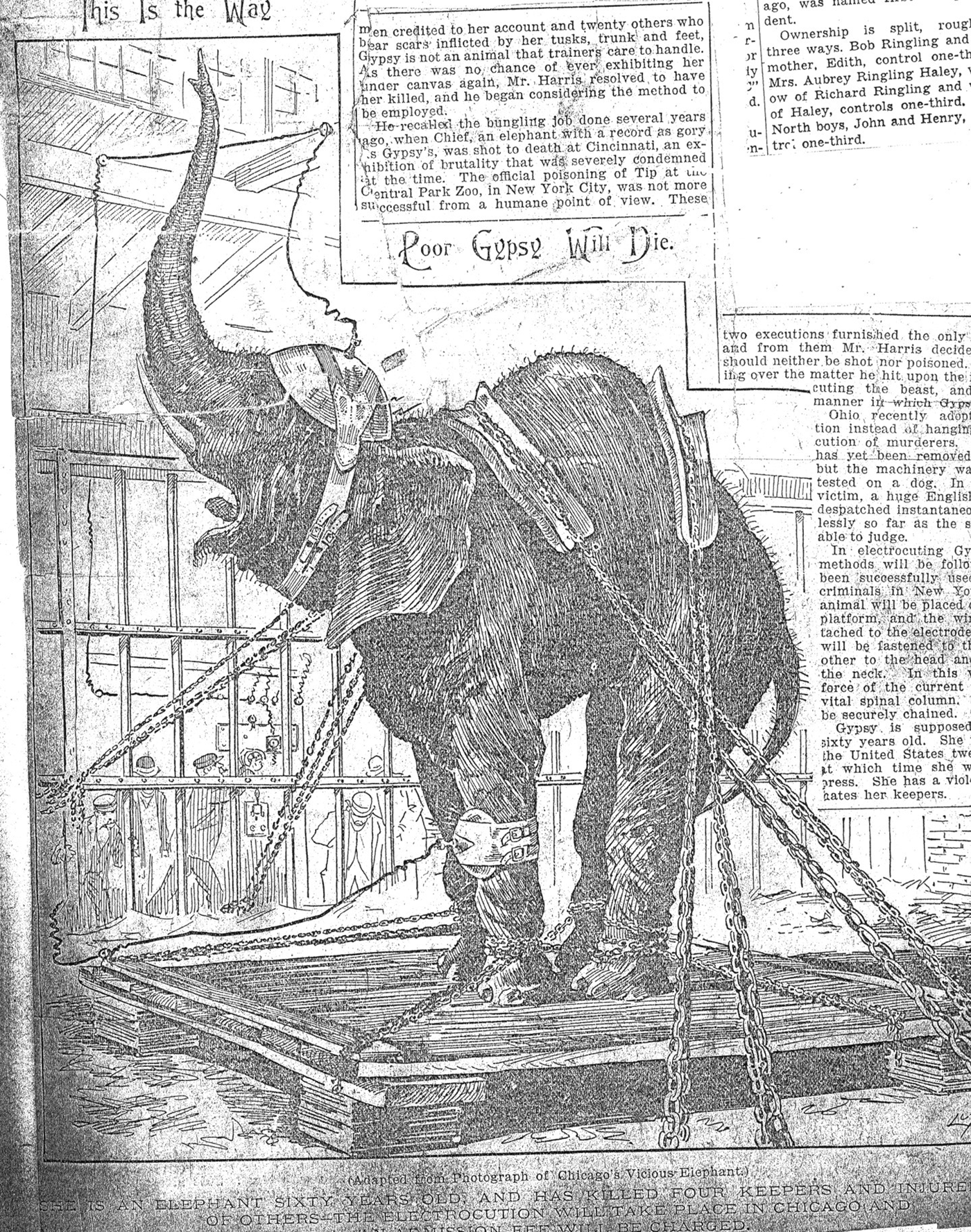
Bostock was not the first circus owner to want to stage a public electrocution only to be thwarted by those who thought profiting from such a spectacle was unseemly. In 1896, the owners of Gypsy the elephant, who had escaped from the W. H. Harris Nickel-Plate Circus winter headquarters in Chicago and then killed her keeper, planned to electrocute the beast at a local arena and charge admission. Gypsy had become increasingly unruly, having killed six people in previous years. The Chicago Tribune reported that the circus had “sentenced her to be electrocuted” and “hoped to have an enormous crowd of people present to witness the dying agonies of the beast.” The paper pointedly called the execution a “bull fight, modified, modernized, and simplified.” Indeed the circus could not get a legal permit for the event after members of the Illinois Humane Society and other public officials objected not to Gypsy's electrocution, but to the public spectacle of it. The president of the Humane Society told the Tribune, “I suppose electrocution is a humane method of killing,” but he called the proposed public execution “barbarous” and “revolting.” He added later that “the idea of charging admission to see the death agonies of the great brute is inhuman, in bad taste, and not conducive to public morals.” Chicago's commissioner of public works protested that the planned exhibition was “better suited to Mexico than to Chicago,” referring to the sport of bullfighting.Footnote 63 A newspaper drawing entitled “This Is the Way Poor Gypsy Will Die,” showed the elephant strapped to electrical wires with a tear running down her face, her trunk in the air and her mouth agape in anguish.Footnote 64 (See Figure 3.) The accompanying article was not critical of the electrocution, so presumably Gypsy was imagined as crying not from pain but out of remorse for her crimes or shame from her lack of dignity. Still wanting to recoup his losses, Gypsy's owner then offered the “man-killing beast” to the Cuban insurgents to use in fighting against Spain, a proposal that was apparently denied. It is likely that the circus decided to keep Gypsy, and she was the same elephant who was felled by the band of hunters in Valdosta, Georgia, six years later.Footnote 65
“This Is the Way Poor Gypsy Will Die.” The imagined execution of Gypsy in Chicago, 1896. Clipping in Vertical File Folder, Elephants, Parkinson Library and Research Center, Circus World Museum, Baraboo, WI.

As was the case with Jumbo II in Buffalo and Topsy at Coney Island, the concern of city officials and animal rights advocates was not with the execution of the elephant, but the notion that a circus would turn it into a public and commercial spectacle. This may seem surprising, but humane societies tended to focus in this period on the needless suffering of animals, particularly for profit; that a dangerous animal would have to be put to death did not disturb them. Animal advocates paid much attention to sports like dog fighting and bullfighting, in the latter case not because of the death of the bull, but because of the suffering inflicted on the horses and because the fight was presented as commercial entertainment. These concerns also explain why they approved of electrocution as the most humane way to kill the elephant, as electrocution was widely assumed to be the least cruel and most efficient method to end life.
Certain citizens did object to even the killing of Gypsy, though their voices carried little weight in the affair. A Buddhist gentleman from Ceylon, from where Gypsy herself hailed, arrived at the offices of the Chicago Tribune to make a plea for Gypsy's life, saying that to “kill her would be a crime.” Asking that the elephant be returned to her homeland, the gentleman protested that “she has been brought here against her will to gratify the curiosity and minister to the pleasure of the people.” Moreover, an anonymous advocate on Gypsy's behalf wrote to the Illinois Humane Society asking it to draw attention to the elephant's plight and pleading for her life. Reflecting sentimental ideas about animal natures, the letter writer attributed Gypsy's murderous rage to the “carelessness and cruelty of her keepers” and accused the circus of wanting to execute her out of selfishness and greed. Gypsy's good character, the writer attested, was evident in the elephant's apparent distaste for alcohol and those who drank, giving her the nickname, “the Prohibition Elephant,” an inversion of the popular lore that elephants had a taste for whiskey.Footnote 66
The outcries surrounding the proposed public executions of both Gypsy and Jumbo II in many ways rehearsed the same arguments made against the public execution of human criminals. If the reason for capital punishment was to maintain the social order, then the execution had to moderate the potential unruliness and bloodthirstiness of the public. As for Jumbo II, his life was ultimately spared when the 4,000 volts sent through his body in a semi-private execution had little effect. Reports assured sensitive readers that the shock merely “tickled” the beast. “Jumbo wagged his tail … looked pleased and trumpeted a bit,” noted the New York Herald.Footnote 67 When it appeared Jumbo had thwarted the attempts on his life, the crowd of witnesses began to “cheer the elephant” and mock the electricians. The “crowd” who had witnessed the event, according to the Buffalo Express, “changed from a serious throng of spectators to a jeering and joking mob.” Jumbo was led back to the midway, where he would rejoin the show.Footnote 68
The crowd's reaction speaks to the ways in which spectators were aware that the execution was a performance—a reenactment of a criminal execution that they understood as serious up until the moment the reenactment failed. The joke was that Jumbo II had upended the logic of the performance. He had triumphed over what turn-of-the-century audiences would have understood as the most terrifying and deadliest human technology to date. Electrocution represented the quintessence of a modern, civilized society, the magnificent human mastery of natural power. As Jürgen Martschukat has argued, although electricity was a natural force, nineteenth-century Americans considered its power to be awesome and mysterious, even supernatural. Scientists' ability to harness that power for social benefit and improvement was seen as a sublime achievement of modern civilization. The electric chair, which supposedly could execute criminals without apparent pain or suffering, represented the supreme conquest of electricity's lethal current. For this reason, officials preferred electrocution to other potentially painless methods of execution, such as poison; electrocution appeared safe and humane, yet was still terrifying enough to act as a deterrent.Footnote 69
The public electrocution of Jumbo II—and that of Topsy two years later—served to demonstrate and celebrate this latest human triumph.Footnote 70 After all, because executions by electric chair were always conducted safely behind prison doors, most Americans would never see a criminal electrocution. They were, however, curious, especially because electricity and its threatening effects—shocks, fires, and sparks—were becoming increasingly part of their everyday lives. The electric chair was placed on exhibit at New York's Dime Museum and at the 1893 Chicago World's Fair. It also became a popular sideshow exhibit at carnivals, at which performers were shocked with astonishing levels of voltage.Footnote 71 Because Jumbo II withstood his electrocution with supposedly just a “tickle,” the whole affair became similarly carnivalesque, as the expected hierarchy of power between man and beast was overturned. As Thomas Laqueur has argued, this kind of boisterous, carnival atmosphere was a long-standing element of criminal executions; through laughter and derision, the crowds and prisoners could subvert the state's control over the event. The failure of a hanging to kill a prisoner caused particular unease for state authorities.Footnote 72
The attempted execution of Jumbo II was not the first time animals had been used to demonstrate electricity's lethal power. In 1888, officials at the Adam Forepaugh circus wanted to kill the elephant Chief with electric shock but were not sure of how many volts he would need nor where to place the electrodes. News reports deemed Chief a “wicked pachyderm” who had been “sentenced to death” for “the murder of seven men.” When electrocuting the beast failed, a noose was tied around his neck, and he was strangled to death.Footnote 73 The following year, P.T. Barnum invited Thomas Edison to his headquarters in Bridgeport, Connecticut, so the inventor could experiment with the effects of electric current on circus animals. An item in the New York Tribune paid particular attention to the effects of the current on the elephants, who “seemed to enjoy their new sensations hugely.”Footnote 74 It should be noted that Edison had previously conducted experiments on stray dogs before the ASPCA intervened. There is no evidence that animal welfare activists objected to the tests made on Barnum's animals. But the association between electric power and elephants predated these events. The electric dynamo exhibited at the 1881 Paris Exposition was brought to Europe in the same boat that later brought Jumbo to America. For this reason, the two became associated, and the dynamo came to be known as “jumbo.”Footnote 75
These electrocution stories also underscore the ways in which elephant executions served not only as spectacular displays of human mastery over beast, but of modern technology's role in that mastery. Most elephants were not electrocuted, but even those executions in which elephants were hanged from cranes and railroad derricks or shot down with rifles exhibited the ingenuity and muscle of modern technology. In that sense, these were not simply archaic rituals reaching into the modern era; they were themselves in and of a certain kind of modern ritual, abetted by industrial technologies and publicized and exploited through tabloid journalism. They thus reveal more than a cultural tension between traditions of popular justice and newer ideas of humane criminal punishment. They also indicate how that tension could be exploited for commercial amusement, taking on cultural force as a form of modern spectacle.
As Janet Davis has argued, circuses at the turn of the century were themselves sites for “contradictory cultural production.” On the one hand, they stood as “cultural icons” of the modern era, representing the vast expansion of national, imperial, and industrial power of the United States. As the country expanded through the spread of the railroad and opening of new commercial markets, so did circuses. They incorporated the values and standards of big business with an industrial workforce and prospered from the interest in visual stimulation associated with the modern era. But the modern circus also embodied much of the cultural ambivalence about these changes. Its clowns and sideshows evoked the transgressive tradition of carnival, challenging in jest many of the social norms of the era, whereas its exhibitions featuring animals and “primitive” people, as well as its wild west shows, suggested a nostalgia for a pre-industrial past.Footnote 76 Elephant executions, as a sort of sideshow of the circus, represented a similar kind of ambiguity.Footnote 77 They put on display modern technological domination over the natural world, a technological domination that also allowed for and justified white racial mastery over the primitive and the savage. At the same time, they resurrected the traditional spectacle of the public execution that was performed and witnessed in resistance to modern notions of what civilized criminal punishment should entail.
Race, Beastliness, and Elephant Killing as Lynching
Although elephant executions were becoming largely obsolete in the Northeast and large urban areas by around 1910, they still occurred in rural areas, particularly in the South, through the 1920s, a trend that mirrors the demise of public executions. The majority of elephant executions took place in cities between the 1890s and early 1900s, with about nine occurring between 1900 and 1903. Later executions in the 1910s and 1920s tended to happen in smaller towns in the South and Midwest.Footnote 78 Northern states centralized capital punishment and shielded it in state prisons from public view beginning in the 1890s. In the South, public or semi-public executions continued in many localities into the early twentieth century, the last taking place in Kentucky as late as 1936. This lag was due to more resilient traditions of localism and popular sovereignty in the South, as well as to the centrality of white supremacy to southern culture. Because white southerners linked the idea of social order so closely to the control of black crime, they were more eager to enforce criminal punishment within their own communities and, moreover, were less likely to be concerned that black criminals were treated humanely. These same factors can explain, in part, why southerners perpetrated lynchings to a far greater degree than other Americans in the late nineteenth and early twentieth centuries.Footnote 79
The connections between lynching and the execution of elephants, especially when the latter took place in southern localities, were not lost on contemporary observers.Footnote 80 Elephant executions took place, after all, during the same period in which lynchings committed against African Americans were all too conspicuous, and some observers believed lynchings themselves to be a response to the making of executions private—outbursts in which citizens wrested control over criminal punishment away from the state. Elephant executions were always framed within the language of the legal prosecution of crime, but unlike medieval animal executions, they were extralegal affairs and in that sense were lynchings, which themselves were commonly justified through appeals to lawfulness.
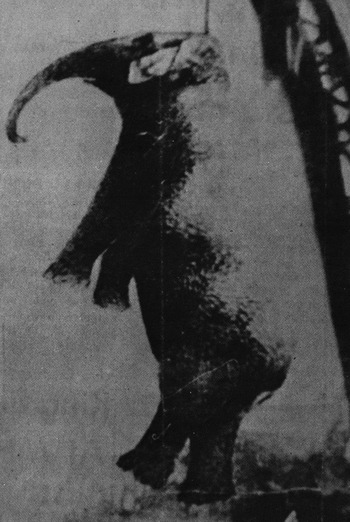
The 1916 execution of Mary the elephant in Erwin, Tennessee, is perhaps the most well-known of southern elephant killings. As one might expect, those who have written about Mary's hanging have associated it not with public executions, but with the ritual of lynching.Footnote 81 During a circus day parade in nearby Kingston, Mary had crushed and killed her trainer to the horror of the watching crowd. After outraged townspeople in Kingston and the surrounding area demanded vengeance, circus officials agreed to have her killed and hanged her from a railroad crane before a large group of spectators. A photographic rendering of the event circulated through town and was reprinted in several national news outlets.Footnote 82 (See Figure 4.)
The Hanging of Mary, Erwin, TN, 1917. Courtesy of Tennessee State Library and Archives.

A community's demand for vengeance against a rampaging and crazed “beast,” who was then hanged before a throng of spectators, certainly echoes, in familiar and eerie form, lynching practices. One explanation for elephant rampages in fact paralleled white supremacist, pro-lynching rhetoric, which claimed that black men, released from the taming influences of slavery, were reverting to a savage, hypersexual state. Elephants' potential for “madness” was sometimes attributed to “must,” a sexual frenzy that beset male elephants. According to a 1902 article from a Mississippi paper, must was a “jungle fever” that caused “the tamest brute to become crazed.” (Most circus elephants, however, including those who went “mad,” were female. Circuses preferred female elephants because they were considered less dangerous).Footnote 83
In this context, it is not surprising that folklorist Thomas Burton found that Erwin residents, in remembering Mary's execution, conflated it with the 1918 lynching of a black man, Thomas Devert. Accused of attempted rape on a white child, Devert was shot to death and then brought to the black section of town. African American residents were lined up and forced to watch as the mob burned Devert's body on a pile of crossties.Footnote 84 Several residents falsely believed that Mary's “negro keepers” were hanged with her, and others insisted that Mary was burned on the pile of crossties.Footnote 85 The lynching of Devert and the killing of Mary had become interchangeable in the local consciousness. Both represented spectacular displays of white communal power and rule over the social order. Elephant executions, indeed, call attention to the dehumanizing racism that both ignited and bolstered the practice of lynching.
However, viewed in the context of earlier elephant executions, the picture of southern elephant executions becomes more complicated. Residents of Erwin, after all, termed the killing of Mary not a lynching—despite the associations with Devert's death—but a justified and necessary execution that avenged a crime and restored social order. They thus used the same language that observers of northern elephant executions had. As one man told Burton, “We did not sit in judgment on [Mary's] fate and I don't believe any of those who witnessed the event felt it was inhumane under the circumstances. She paid for her crimes as anyone else would” (emphasis added).Footnote 86 This sentiment reflected a popular understanding among its defenders that lynching was not an unlawful practice, but rather a legitimate extension of state power. In this context, the conflation of Devert's lynching and Mary's execution not only dehumanized Devert, but it also humanized Mary. Like other elephants who met a similar fate, Mary was a beloved performer—one audiences identified with—who, in her “madness” had lost her right to live.
Similarly, when the elephant Black Diamond killed a woman in Corsicana, Texas, in 1929, reports deemed him a “mad” and “monstrous” brute. According to one account, “the townspeople persistently demanded the death of Diamond, and their clamoring grew louder when the elephant's reputation as a killer had been circulated among them.” His handlers led him through town on a “death march” before bringing him to a clearing, where before hundreds of spectators, he was felled by “volley after volley” of machine-gun fire. At the same time, accounts attributed Black Diamond's “madness” to jealousy. The “love-crazed” beast was supposedly resentful that his beloved former keeper was showing attention to a woman, and he lashed out at her and the keeper in anger. It was decided that he would be killed by firing squad after circus officials, who considered Diamond their “pet,” deemed it the most “humane” method. As one witness recalled, “There was not one who did not shed a tear. An awful sinner, A terrible animal! Yet, somehow, we loved him.”Footnote 87
Elephant executions were sometimes deemed “lynchings” but only by those who wanted to discredit them and, by extension, lynching. As Christopher Waldrep has shown, lynching had transformed by the early twentieth century, largely through the efforts of anti-lynching activists, from a term denoting an act of community-sanctioned justice to one signifying white supremacist brutality. Activists came to use the word lynching as a political weapon to discredit vigilante practices as barbaric perversions of justice.Footnote 88 The National Association for the Advancement of Colored People, for this reason, showed interest in the killing of Mary, requesting copies of the photograph for their lynching files.Footnote 89 When the townspeople of Hartsville, South Carolina, shot down an escaped circus elephant in 1914, the local paper framed it as a “big-game shooting,” in which “an exceedingly robust female elephant was the victim of an attack by citizens of the community armed with guns and other weapons,” much the way similar hunts in Orange, Texas, and Valdosta, Georgia, were represented. Billboard Magazine published a photograph of the aftermath, showing a group of men surrounding the dead elephant, and titled it, “An Elephant Hunt in South Carolina.” The anti-lynching paper, the Columbia State, however, wrote a sardonic editorial in which it condemned the shooting as a “lynching” on a helpless “woman elephant who dared to walk alone.” (Literary Digest reprinted the piece, re-titling it “Lynching a Feminist.”) “It has been ‘quite some time’… since we have lynched a negro in South Carolina,” noted the article. “Let it be hoped that it will be ‘quite some time’ longer before another individual of that race of animals that lives longest, and grows biggest, and makes most for the joy of little children, and works hardest, and asks less of rations, shall be lynched on the highway in this state.”Footnote 90 It is understandable why the paper would interpret the killing as a lynching, because lynchings many times played out as rituals hunts and captures with posses, equipped with guns and dogs, pursuing accused black criminals through fields and woods.
Still, in an inversion of pro-lynching rhetoric that figured black men as beasts, this particular anti-lynching argument relied upon an anthropomorphizing of the elephant. “We trust that the citizens in this foray are ashamed of themselves,” added the State in condemning any “environment” in which it was acceptable for “men and boys … armed to the teeth” to commit such cruelty on an otherwise innocent being.Footnote 91 That the residents of Hartsville considered the lynching of an elephant a sport, an entertainment for the masses, only magnified the sense that lynching was a primitive, bloodthirsty practice. Even more so, by calling the killing a cruel attack on a “woman elephant,” the State appropriated pro-lynching rhetoric that defended mob violence as necessary to protect the purity of white women and twisted it to highlight the masculine brutality of lynching. The State's editorial speaks to the ways in which, to many progressives, retributive justice was anathema to civilized society, a notion that was central to anti-lynching rhetoric. Nevertheless, although it was on the decline in these decades, its persistence into the twentieth century signifies how powerful the idea was that crime should be avenged publicly and that people had a rightful interest in seeing justice enacted, especially in the case of racial minorities, imagined in white supremacist rhetoric as beastly and savage.
That these same ideas were given full expression through elephant executions that were often extensions of the circus—already a place where Americans indulged their desires to witness men conquering dangerous beasts—only gave them further legitimacy. The overlaps between elephant killings, lynching, and the circus also make manifest the ways in which these notions of popular justice could be so readily co-opted as commercial entertainment. The execution of elephants, like the practice of lynching itself, thus reflected fully neither modernity nor traditional custom but rather represented a moment when pre-modern punishments collided both with new ideas about crime and with modern spectacle.