Introduction
Weeds are the greatest constraint to yields in most cropping systems, causing an estimated 43% in losses globally (Oerke Reference Oerke2006). Herbicides provide a highly effective and operative tool to control weeds, allowing yields to be achieved efficiently with less energy than mechanical practices (i.e., removal by tillage), apart from offering flexibility in application timing during much of the crop cycle (Baastians et al. Reference Baastians, Paolini and Baumann2008). Because of high adoption of selective synthetic herbicides over the past few decades, development of productive management strategies that maintain stable yields over time while minimizing negative effects on the environment are needed (Doré et al. Reference Doré, Makowski, Malézieuxc, Munier-Jolaind, Tchamitchiane and Tittonell2011; Tilman et al. Reference Tilman, Cassman, Matson, Naylor and Polasky2002). From 1990 to 2005, the world agrochemical market grew at an annual rate of 17%, with herbicides being representative of approximately 50% of the total growth (Uttley Reference Uttley2009; Zhang et al. Reference Zhang, Jiang and Ou2011). In Argentina, the use of herbicides increased approximately 250% from 2000 to 2015 (from USD$480 to $1,750 million) (CASAFE 2015).
Changes in the weed spectrum are generally a result of niches created by a weed management program that favors perpetuation of one or several weed species over others, including those that have evolved herbicide resistance (Norsworthy et al. Reference Norsworthy, Bond and Scott2013). Over-reliance on herbicides can quickly lead to widespread occurrence of herbicide-resistant weeds (Heap and Duke Reference Heap and Duke2018), as well as potential negative effects on human health (Myers et al. Reference Myers, Antoniou, Blumberg, Carroll, Colborn, Everett, Hansen, Landrigan, Lanphear, Mesnage, Vandenberg, vom Saal, Welshons and Benbrook2016).
Genetically modified crops have been adopted in many countries. The global area of biotechnology crops has increased approximately 112-fold from 1.7 million hectares in 1996 to 189.8 million hectares in 2017 in 24 countries. This makes biotechnology crops the fastest adopted crop technology in recent times (ISAAA 2017). In Argentina, genetically modified crops resistant to glyphosate (RR), especially soybean [Glycine max (L.) Merr.], have been rapidly adopted by farmers because of simplicity of use provided by a single herbicide (glyphosate), high weed control efficacy, and lower weed control costs relative to alternatives (Qaim and Traxler Reference Qaim and Traxler2005; Scursoni and Satorre Reference Scursoni and Satorre2010). With the RR technology, herbicide costs for weed management in soybean decreased from US$34 to $19 per hectare. However, some consequences related to the increase of the area cultivated with RR soybean were reduction of crop rotation and herbicides diversity, production of soybean in areas where the crop should not be grown, a decrease in species diversity over time, and a steady increase of weed problems (i.e., herbicide resistance) (de la Fuente et al. Reference de la Fuente, Suarez and Ghersa2006; Heap and Duke Reference Heap and Duke2018). In Canada, these negative consequences and unsustainable use of the technology led some farmers to reconsider their weed control systems (Blackshaw et al. Reference Blackshaw, Beckie, Molnar, Entz and Moyer2005). For instance, it is well established that integrated weed management systems have the potential to reduce herbicide use and provide a more robust and long-term weed management solution (Buhler Reference Buhler1999).
Weed management surveys conducted in the midsouthern United States highlight that herbicide resistance management practices at the grower level most often focus specifically on an herbicide, with the most frequently adopted practices being proper herbicide timing, no weeds at planting, application of herbicides with multiple effective modes of action, use of full labeled herbicide rates, and prevention of crop weed seed production (Riar et al. Reference Riar, Norsworthy, Steckel, Stephenson, Eubank, Bond and Scott2013a). In contrast, the least important practices, as perceived by the same group, were cultural and mechanical practices such as manual weed removal, tillage (including disking, cultivation, or deep tillage), narrow row spacing of crops, use of cover crops, and altered planting dates (Riar et al. Reference Riar, Norsworthy, Steckel, Stephenson, Eubank, Bond and Scott2013a).
Weed management surveys are useful tools for understanding levels of adoption of production practices and their impact on weed populations, and provide an opportunity to identify research and educational needs of producers and crop advisors to ensure greater adoption of sustainable practices (Norsworthy et al. Reference Norsworthy, Bond and Scott2013). Unfortunately, weed management surveys in Argentina have been lacking; hence, surveys were conducted across the crop production regions of the country with the objectives to identify the main weed species problems and assess the use of chemical and nonchemical weed management practices.
Materials and Methods
A web-based survey was developed and distributed in 2016. All attendees of the Argentinean Weed Science Society were invited by email to complete an online survey questionnaire. The Argentinean Weed Science Society comprises producers and crop advisors across Argentina. A total of 85 survey questionnaires were completed across the main crop production areas in Argentina. Each of the respondents represented an average of 5,000 ha of crop production.
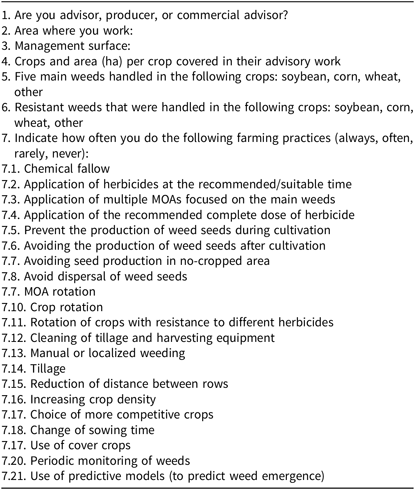
The survey questionnaire contained 28 questions (Table 1). Information about location, area, and crops covered by each respondent was requested, in addition to a list of the top five weeds in their production area, including herbicide-resistant weeds in all crops grown. Respondents were asked to list the weeds specific to a crop such as soybean, corn (Zea mays L.), and wheat (Triticum aestivum L.). The seventh question was designed to understand the frequency with which certain agronomic practices were being used in the region. Respondents could choose from four adoption categories: always, often, sometimes, or never.
Questionnaire sent to commercial advisors, producers, and consultants. a

a Abbreviation: MOA, mode of action.
A ranking for adoption of farming practices was performed that considered the frequency for each practice. In addition, the ranking of most problematic weed for each area was solely based on the number of times each weed was mentioned by respondents.
Results and Discussion
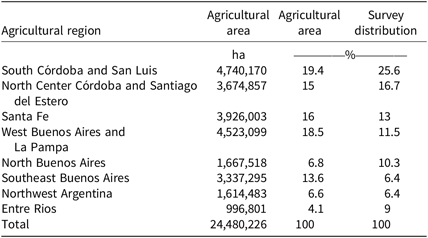
Soybean, corn, sunflower (Helianthus annuus L.), wheat, and barley (Hordeum vulgare L.) were grown on approximately 36 M ha in the 2016–2017 growing season, with soybean being the most important grain crop in the regions of Buenos Aires, Córdoba, and Santa Fe (SubSecretaría de Agroindustria 2017). The survey covered 24 M ha (66% of the agriculture area) and was representative of the main production regions. For instance, 42.3% of the surveys corresponded to Córdoba and limiting provinces of San Luis and Santiago del Estero, representing 34.4% of the agricultural area (Table 2). In addition, commercial advisors, producers, and consultants represented 22%, 31%, and 47% of the respondents, respectively.
Agricultural regions of Argentina, area represented, and distribution of the surveys by region.

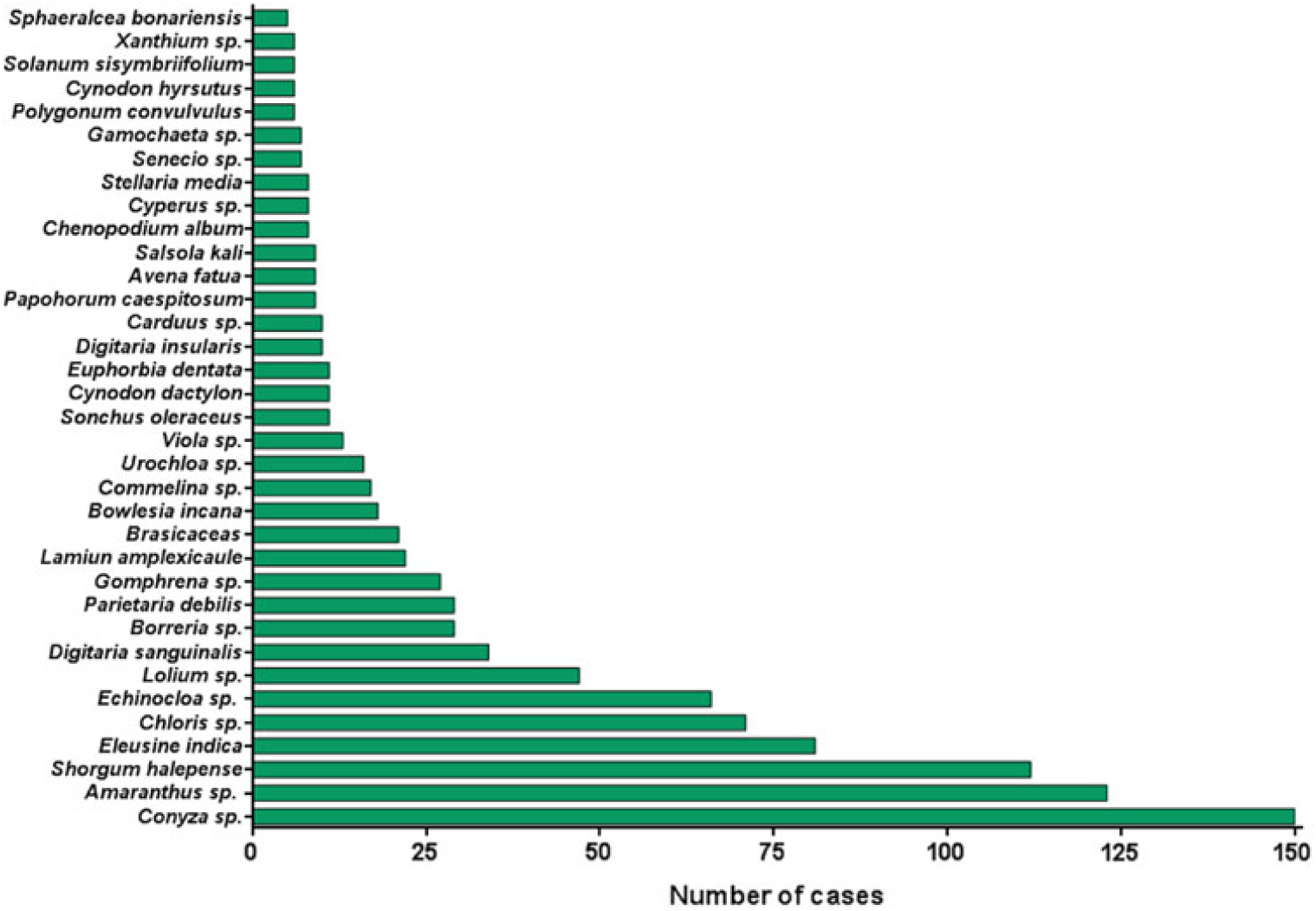
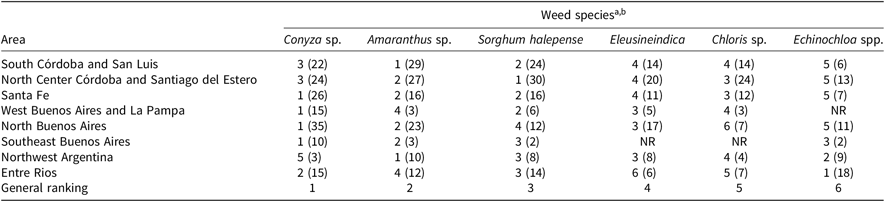
Greater than 90% of the grain crops in Argentina are sown in a no-tillage system (ReTAA 2017). The establishment of different weed species depends on the edaphic and environmental conditions that favor their dispersion, germination, emergence, and survival. In this context, a large proportion of grass species, wind-dispersed species, or perennials are expected in no-tillage environments (Froud-Williams Reference Froud-Williams, Altieri and Liebman1988). Similarly, Tuesca and Puricelli (Reference Tuesca and Puricelli2007) documented higher abundance of annual grass weeds in no-tillage plots than in conventional systems. According to our survey, the six species considered as the most important weeds in the cropping systems of Argentina were two broadleaf species: fleabane and pigweed; and four grasses: johnsongrass, goosegrass, fingergrass, and barnyardgrass (Figure 1). Interestingly, pigweed and johnsongrass were mentioned in all the areas. Fleabane was the most important in four of the eight areas surveyed, pigweed in two, and johnsongrass and barnyardgrass in one (Table 3).
Importance of weed species in all production regions of Argentina, considering the times each one was reported. In cases without species identification, only the genus was registered.

Ranking of main weed species by area of study and by total area surveyed.

a Numbers in parentheses are number of mentions in surveys, by area.
b Abbreviation: NR, species not registered.
Results from this survey agree with data published by Asociación Argentina de Productores en Siembra Directa (2017) regarding the area covered by glyphosate-resistant species in Argentina. Particularly, from 24 resistant cases of weeds in Argentina, 16 were resistant to glyphosate, showing the relation between problematic management and resistance. This agrees with the findings of Riar et al. (Reference Riar, Norsworthy, Steckel, Stephenson, Eubank and Scott2013b) in the United States in that respondents desired research and educational priorities for better weed management in soybean, with three-fourths of the consultants stating the need for improved management of glyphosate-resistant and glyphosate-tolerant weed species. Of the consultants surveyed, 81% indicated the need for better management of glyphosate-resistant weeds. Although the species mentioned in this survey as most important were frequent in crops before the implementation of no-tillage system and glyphosate-resistant crops (de la Fuente et al. Reference de la Fuente, Suarez and Ghersa2006), their relative importance increased due to the occurrence of resistance biotypes in the past decade (Heap Reference Heap2018). Fleabane increased significantly in abundance since the introduction of no-tillage, mainly in fallow-soybean rotation during several agricultural cycles (Vigna et al. Reference Vigna, Papa, Ponsa, Bedmar, Guevara, Rainero, Olea, Gigón, Isitilart, López, Arguissain, Picapietra, Fernandez, Leguizamón and Acciaresi2014), because this weed begins establishment in autumn and continues until the end of spring and beginning of summer. No tillage, winter fallow, and control based only on herbicides are factors that contribute to the growth of fleabane populations (Metzler Reference Metzler2014).
The six most important weeds from this survey, except for fingergrass, were reported as resistant to glyphosate in Argentina (Heap Reference Heap2018). Johnsongrass was the first case of glyphosate resistance, and it was reported 10 years after introduction of glyphosate-resistant soybean in Salta Province in northwest Argentina (Delucchi et al. Reference Delucchi, Nisensohn and Tuesca2005). Interestingly, Muñoz and Scursoni (Reference Muñoz and Scursoni2015) registered higher fecundity in johnsongrass growing in the north of the country compared with the Pampa area. Thus, resistance evolution may be faster in the north than in the Pampa. In addition, a biotype with multiple resistance to glyphosate and haloxyfop-methyl and others with resistance to haloxyfop-methyl were reported in the Pampa area in 2015 (Heap Reference Heap2018). Interestingly, there were no records of resistance to clethodim, although some populations have shown low susceptibility to this herbicide (Muñoz et al. Reference Muñoz, Morello and Scursoni2018). Pigweed was also reported in Argentina as resistant to other herbicides, such as the acetolactate synthase inhibitors chlorimuron-ethyl and imazethapyr, and the auxinic herbicides 2,4-D and dicamba. In addition, other weeds naturally tolerant of but without resistance to glyphosate were mentioned as troublesome weeds with regional importance and included strawberry globe amaranth (Gomphrena perennis L.) and whitehead broom [Borreria verticillata (L.) G. Mey.] in Cordoba, Santa Fe, and Santiago del Estero province located at the center of the Pampa area.
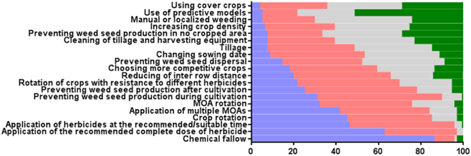
Greater than 50% of respondents mainly used practices related to herbicide application to control weeds. The most frequent practices reported were chemical fallow (86%), full herbicide rates (62%), proper herbicide timing (46%), multiple herbicide modes of action (41%), and rotation of multiple effective modes of action (32%). Among nonchemical practices, the adoption ranking was as follows: crop rotation (45%), avoiding seed production during (31%) and after (25%) crop cycle, narrow row spacing (19%), and cultivars with greater competitive ability (18%). Less than 15% of respondents reported increased crop densities and changed sowing date to reduce weed interference. Interestingly, periodic monitoring of weeds and crop rotation were always applied by 55% of respondents (Figure 2).
Use of weed management practices expressed as a percentage of the following categories: always, often, rarely, and never (color coded violet, red, gray, and green; respectively). MOA, mode of action.

The rotation of herbicides with different modes of action should be applied to delay the evolution of species resistant to certain herbicides (Scursoni and Vila Aiub Reference Scursoni, Vila Aiub, Satorre, Kruk and Fuente2016). However, only 35% of respondents always applied this practice. In addition, crop rotation was routinely practiced (45%), but cover crops were only used 5% of the time (Figure 2). However, interest in cover crops is increasing because of the difficulty to control certain weeds such as fleabane, pellitory (Parietaria debilis G. Forst.), bloodleaf (Iresine diffusa Humb. & Bonpl. ex Willd.), or field pansy (Viola arvensis Murray) during the fallow and also to reduce herbicide application (Faccini and Puricelli Reference Faccini and Puricelli2007). Field experiments west of Buenos Aires Province showed that fleabane, prostrate knotweed (Polygonum aviculare L.) and henbit (Lamium amplexicaule L.) were not observed in cover crops but were present with density of 8 plants m− 2 in bare soils (Kruk Reference Kruk2015).
It is surprising that agronomic practices that do not represent a high cost for farmers in Argentina, such as cleaning equipment, changing sowing time, increasing crop density, reducing row spacing, or choosing more competitive cultivars, are not frequently applied. Many local studies show the effect of reducing row distance or increasing crop density on weed growth, competition, and fecundity (Puricelli et al. Reference Puricelli, Orioli and Sabbatini2002; Satorre and Kruk Reference Satorre, Kruk, Satorre, Kruk and de la Fuente2016; Scursoni and Satorre Reference Scursoni and Satorre2005).
Results from the survey are substantially similar to those registered by Riar et al. (Reference Riar, Norsworthy, Steckel, Stephenson, Eubank, Bond and Scott2013a) in the midsouthern United States, where proper herbicide timing, starting clean (i.e., no weeds at planting), applying multiple effective herbicide modes of action, and use of full labeled herbicide rates are the most frequent and important practices to control weeds. Conversely, narrow-row crops, cover crops, or altered sowing time are the least important practices. Cost, time constraints, lack of labor or trained employees, availability of equipment, complacency, herbicide-related concerns, and profitability were the most important obstacles for the adoption of those practices (Riar et al. Reference Riar, Norsworthy, Steckel, Stephenson, Eubank, Bond and Scott2013a).
One assumption is that an important obstacle to the adoption of weed management strategies is mainly related to the transfer of knowledge to application. In Argentinean crop production systems, the concept of control is predominant over management, partially due to the production system being mostly based on rented fields with no focus on long-term land improvement, such as weed control. In this context, it is necessary to increase the knowledge of decision makers who usually receive most of their information from commercial advisors and also to modify the conditions and timing for land rental (G Duarte, personal communication). Moreover, although industry support will likely continue for some research, federal and state funding must be available and enough to support resistance-management projects for which private funding is not available or insufficient. In addition, it would be advisable to obtain a certification of agrochemical use by professional agronomists to reduce selection of resistant populations through the recommendation of herbicides with different sites of action. The long-term economic benefits of weed management are certain; however, many growers, out of necessity, focus on immediate economic benefits. Growers on rented land often focus their attention on the economic returns of the current crop and are much less concerned with the long-term effects of management decisions on land they may not farm the following year (Norsworthy et al. Reference Norsworthy, Ward, Shaw, Llewellyn, Nichols, Webster, Bradley, Frisvold, Powles, Burgos, Witt and Barrett2012; Norsworthy et al. Reference Norsworthy, Bond and Scott2013).
In conclusion, so far, the approach in Argentina to reduce the effect of weeds on crops is not based on long-term objectives but on empiric short-term decisions, prioritizing short-term profit instead of long-term use of resources. Social interest is growing regarding the consequences of agricultural practices such as agrochemical applications near urban areas or watercourses and resulting contamination. It is important to consider such concerns as priorities. Knowledge transfer and research that quantifies the negative consequences of unsustainable practices should be priorities in the immediate future.
Chemical weed management is the strategy used the most in the agricultural areas of Argentina, whereas low cost and effective nonchemical options for weed management, such as cover crops or cleaning tillage and harvesting equipment, are scarcely used. These results generate the challenge of increasing knowledge transfer to advisors and producers by encouraging the use of appropriate chemical options and proven nonchemical weed management practices.
Author ORCIDs
Julio Alejandro Scursoni https://orcid.org/0000-0002-6991-6848.
Acknowledgments
This work was financially supported by Fondo para la Investigación Científica y Tecnológica, Argentina (PICT-2013-2620). We thank all those who kindly responded to the requested survey. No conflicts of interest have been declared.