Introduction
The bacterial species Escherichia coli is part of the normal microbial flora of the gastrointestinal tract of mammals and birds.
However, certain strains have been associated with gastrointestinal diseases in both humans and animals. These E coli strains have been categorised into pathogenicity groups based on their virulence properties.Reference Caprioli, Morabito, Brugere and Oswald1, Reference Nataro and Kaper2
One of these groups is characterised by the production of potent cytotoxins that inhibit protein synthesis within eukaryotic cells. These toxins are variously termed verotoxins, because of their activity on Vero cells, and Shiga toxins, because of their similarity to the toxin produced by Shigella dysenteriae.
Enterohaemorrhagic E coli constitute a subset of serotypes of verotoxin-producing E coli, which has been firmly associated with bloody diarrhoea and haemolytic uraemic syndrome in industrialised countries.Reference Nataro and Kaper2–Reference Griffin and Tauxe4 The majority of disease cases worldwide are caused by strains of serotype O157. However, recently there has been an increasing number of reports of infections caused by enterohaemorrhagic E coli strains belonging to serogroups other than O157, such as O26, O111, O103 and O145.Reference Nataro and Kaper2, Reference Scheiring, Andreoli and Zimmerhackl5, Reference Tozzi, Caprioli, Minelli, Gianviti, De Petris and Edefonti6 Verotoxin, which is produced by enterohaemorrhagic E coli in the intestine and subsequently absorbed into the blood stream, is the major virulence factor responsible for the microvascular endothelial injury that underlies the pathophysiology of haemolytic uraemic syndrome.Reference Gerber, Karch, Allerberger, Verweyen and Zimmerhackl7
Haemolytic uraemic syndrome is characterised by the triad of haemolytic anaemia, acute renal failure and thrombocytopenia. Once a person is infected with enterohaemorrhagic E coli, their risk of progressing to haemolytic uraemic syndrome depends on the infecting enterohaemorrhagic E coli serotype. In patients infected with enterohaemorrhagic E coli O157, the prevalence of haemolytic uraemic syndrome has been reported to be 15 per cent.Reference Tarr, Gordon and Chandler8 The commoner extra-renal complications of haemolytic uraemic syndrome are encephalopathy, ischaemic colitis, cardiomyopathy and pancreatitis. The reported mortality rate for haemolytic uraemic syndrome is 3 to 5 per cent, with death nearly always associated with severe extra-renal pathology, including severe central nervous system disease.Reference Siegler and Oakes9 Sensorineural hearing loss has not been previously reported as a complication of haemolytic uraemic syndrome.
Herein, we present the cases of two children with enterohaemorrhagic E coli infection associated with profound sensorineural hearing loss, who subsequently underwent cochlear implantation to restore hearing.
Case reports
Case one
A previously healthy, four-year-old girl was admitted to hospital in August 2006 with bloody diarrhoea. Escherichia coli O157 was detected in her stool. She was diagnosed with haemolytic uraemic syndrome, and received dialysis and ventilator assistance with tracheal intubation. She slowly recovered over two months, but seemingly lost interest in her surroundings.
Five months after hospital discharge, she was referred to an otolaryngologist because of suspected hearing loss. Pure tone audiometry revealed mild sensorineural hearing loss.
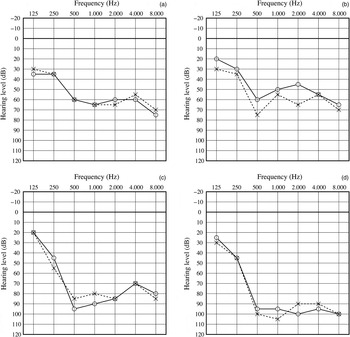
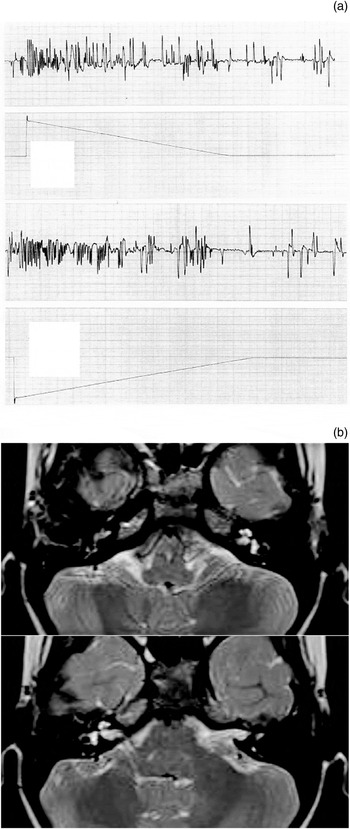
Within six months of otolaryngological referral, the child's hearing loss had progressed to profound sensorineural hearing loss (Figure 1), and she was fitted with hearing aids bilaterally. However, the efficacy of these hearing aids was poor: the child's recognition scores for monosyllabic words and sentences, with bilateral aiding and without visual cues, were 23 and 47 per cent, respectively (Table I). She showed normal vestibular function on both sides, assessed with caloric tests and damped-rotational chair tests (Figure 2a).
Pure tone audiometric results for case one, showing progressive hearing change at successive time points after disease onset: (a) 7 months; (b) 8 months; (c) 10 months; and (d) 13 months.

Case one investigations: (a) damped-rotational chair test result, showing good response during rotation, for both right and left rotations; and (b) axial magnetic resonance imaging study showing normal cochleae and cochlear nerves.

Speech perception test results

Data represent hearing perception scores (%). CI = cochlear implantation; HA = hearing aid; R = right ear; L = left ear; bilat = bilateral; V = visual cues
At this stage, computed tomography (CT) and magnetic resonance imaging (MRI) studies showed normal appearances for the middle ear, inner ear and internal auditory meatus (Figure 2b).
At the age of seven years, the child underwent implantation with a Cochlear Nucleus CI24RE(CA) device (Cochlear Corp, Sydney, Australia) in the right ear. There was no cochlear ossification. All electrodes were inserted, and a good post-operative neural response was obtained using telemetry.
At her seven-month post-operative evaluation, the patient's hearing perception scores for monosyllabic words and sentences, using the cochlear implant only, were 77 and 98 per cent, respectively, at 65 dB (Table I); moreover, she could easily follow a conversation even with unfamiliar speakers.
Case two
A previously healthy, three-year-old boy was admitted to a university hospital in October 2008 with fever, abdominal pain and bloody diarrhoea. One day after admission, he was diagnosed with haemolytic uraemic syndrome, due to the presence of haemolytic anaemia, acute renal failure and thrombocytopenia. His urinary outcome declined drastically, requiring peritoneal dialysis; however, 10 hours later removal of blood fluid was found to be insufficient, and echocardiographic images showed decreased cardiac function.
He was transferred to an intensive care unit where he immediately suffered a seizure and cardiac arrest, but was successfully resuscitated. He received haemodialysis for 46 days and was then switched back to peritoneal dialysis.
Two weeks after restarting peritoneal dialysis, the child complained of a sudden headache. A head CT scan showed intracerebral haemorrhage and infarction in both occipital lobes. Escherichia coli O111 was detected in the patient's stool.
Three months after admission to hospital, the patient was slowly recovering and was started on a rehabilitation programme for swallowing and walking (he had a mild residual gait disorder).
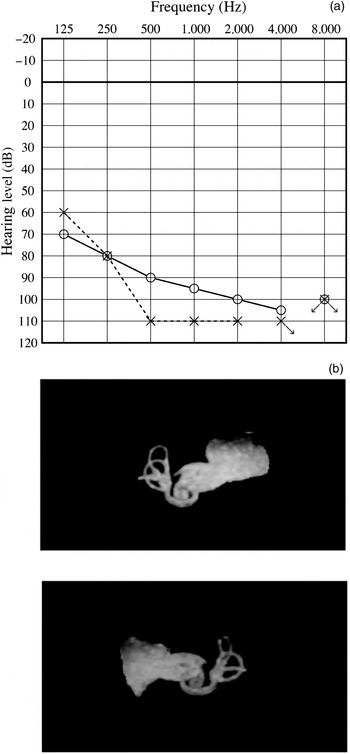
One year after the onset of disease, the patient seemed to have lost interest in his environment. He was diagnosed with profound sensorineural hearing loss and was fitted with bilateral hearing aids (Figure 3a). At that stage, his recognition scores for monosyllabic words, with bilateral hearing aids, was 0 per cent without visual cues and 68 per cent with visual cues (Table I). Computed tomography and MRI studies showed normal middle and inner ears and normal internal auditory meatuses (Figure 3b).
Case two investigations: (a) pure tone audiometry results before cochlear implantation; and (b) three-dimensional magnetic resonance imaging study showing normal inner ears.

Two years and seven months later, the child underwent cochlear implantation with a PulsarCI100 Standard device (Med-El, Innsbruck, Austria) in the left ear. All electrodes were inserted, and further assessments via telemetry showed normal auditory nerve responses and electrically evoked auditory brainstem responses via the cochlear implant.
After cochlear implantation, the child's hearing recovered well. Audiometry revealed a 40 dB hearing level with the implant activated. The child achieved monosyllabic word scores of 92 per cent with auditory input alone (Table 1).
Discussion
This is the first report of secondary, profound, sensorineural hearing loss after recovery from haemolytic uraemic syndrome caused by enterohaemorrhagic E coli.
Based on our two cases, we suggest that enterohaemorrhagic E coli associated hearing loss has the following four characteristics: (1) progression is possible even after recovery from haemolytic uraemic syndrome; (2) high-frequency hearing seems to be at greater risk of impairment than low-frequency hearing; (3) vestibular function may not be affected; and (4) cochlear implantation is a good choice for restoration of hearing function.
The good outcome of cochlear implantation in the presented cases implies the presence of peripheral cochlear impairment which may be due to a pathogenic lesion. No cochlear calcification was seen in either of our two cases, implying that the cause of enterohaemorrhagic E coli associated hearing loss is not cochlear inflammation (as in meningitis-induced hearing loss).
We suggest the following two mechanisms of enterohaemorrhagic E coli associated hearing loss.
• This is the first report of secondary, profound, sensorineural hearing loss after recovery from haemolytic uraemic syndrome due to enterohaemorrhagic Escherichia coli
• Such hearing loss can progress despite recovery from haemolytic uraemic syndrome
• High-frequency hearing is at higher risk
• Cochlear implantation can restore hearing function
First, verotoxin may directly cause cochlear cell death by blocking protein synthesis.Reference Karpman, Sartz and Johnson10 Verotoxin contains several binding sites for its glycosphingolipid receptor Gb3, which is present on endothelial cells. After binding to the Gb3 receptor on the cell surface, verotoxin is endocytosed and transported in a retrograde fashion to the Golgi apparatus and the endoplasmic reticulum. It is then translocated to the cytosol where it inactivates ribosomes, thereby causing cell death.Reference Sandvig11 The localisation of Gb3 receptors in the inner ear is unknown at present. In our first case, vestibular function was well preserved, which may imply that Gb3 receptors are predominantly located in the cochlea rather than the vestibule.
The second possible mechanism for the observed hearing loss is disruption of cochlear blood supply due to thrombotic microangiopathy secondary to haemolytic uraemic syndrome. Verotoxin damages endothelial cells; this damage may potentiate cochlear microvascular thrombosis by activating the blood coagulation cascade.Reference Zheng and Sadler12 In animal experiments, cochlear ischaemia causes hearing loss in the higher frequencies, a finding compatible with our two cases.Reference Lin, Wei, Tsai, Kao, Lai and Hsu13
We acknowledge that, even if both these hypothesised mechanisms were in action simultaneously, this still would not explain all the above four characteristics of enterohaemorrhagic E coli associated hearing loss. In particular, the observed progression of hearing loss may be caused by other mechanisms, such as cytokines or reactive oxygen species.
In 2011, outbreaks of enterohaemorrhagic E coli occurred in several countries, including Japan and Germany, and many patients suffered from haemolytic uraemic syndrome.Reference Frank, Werber, Cramer, Askar, Faber and An Der Heiden14 Our two cases indicate that enterohaemorrhagic E coli associated hearing loss can occur as a result of extra-renal complications of severe haemolytic uraemic syndrome. Severe haemolytic uraemic syndrome is sometimes accompanied by central nervous system manifestations associated with encephalopathy, which can delay the diagnosis of hearing loss. Some of the 2011 cases were misdiagnosed with psychiatric illness, without investigation for hearing loss.
In light of the two cases reported above, we recommend follow-up investigation of the auditory function of survivors of haemolytic uraemic syndrome, especially children. If hearing is lost, cochlear implantation may enable effective restoration.
Conclusion
This is the first report of secondary hearing loss after recovery from haemolytic uraemic syndrome caused by enterohaemorrhagic E coli. Although the mechanism of enterohaemorrhagic E coli induced hearing loss is unknown, cochlear implantation appears to be a good choice for hearing restoration.
Acknowledgement
The authors are grateful to Prof Masae Shiroma and Ms Chieko Enomoto for cochlear implant mapping and auditory education for the reported children. We also thank Dr Keiko Sugasawa for diagnosing hearing loss in the second case. This work was supported by the Japanese Society for the Promotion of Science Kakenhi scheme (grant number 22791627).