Memory impairment and depression are both debilitating and widely prevalent conditions that afflict many older adults. According to meta-analytic estimates, the prevalence of depression and memory-related conditions [i.e. mild cognitive impairment (MCI)] is at 23.6% (Li et al. Reference Li, Zhang, Shao, Qi and Tian2014) and 12.7% (Nie et al. Reference Nie, Xu, Liu, Zhang, Lei, Hui, Zhang and Wu2011) respectively. Relatedly, previous research has documented significant associations between the severity of these two conditions (McDermott & Ebmeier, Reference McDermott and Ebmeier2009). Not surprisingly, both conditions were also reported to commonly co-occur among older adults (Rock et al. Reference Rock, Roiser, Riedel and Blackwell2014). It should be noted that such co-occurrence of depression and memory deficits are not exclusive to the older population; they have been observed among younger adults as well (Basso & Bornstein, Reference Basso and Bornstein1999; Baune et al. Reference Baune, Fuhr, Air and Hering2014). Nevertheless, the current research will focus on the older adult population exclusively to avoid the age-related confounds in the etiology, onset, course, comorbid conditions and associated neuropathology of depression (Lebowitz et al. Reference Lebowitz, Pearson, Schneider, Reynolds, Alexopoulos, Bruce, Conwell, Katz, Meyers and Morrison1997).
The widely documented associations between depressive symptoms and memory have engendered several theories on the direction of the association between depressive symptoms and memory impairment. Some theories hypothesized that depression leads to memory impairment. For instance, the chronic inflammation and lifestyle changes (i.e. diet, physical activity and social engagement) that occur in depression as a result of chronic stress were theorized to predispose one to develop memory impairment in the context of dementia (Leonard, Reference Leonard2007; Saczynski et al. Reference Saczynski, Beiser, Seshadri, Auerbach, Wolf and Au2010). While other theories have hypothesized the reverse – that memory impairment leads to depressive symptoms. One of the most common explanations has been that depressive symptoms are psychological reactions to the perception of memory decline (Bassuk et al. Reference Bassuk, Berkman and Wypij1998). These directional hypotheses can also be framed in terms of the stability of memory impairment in depression; neurocognitive impairment in depression have often been conceptualized as state and/or trait-related phenomenon (Hasselbalch et al. Reference Hasselbalch, Knorr and Kessing2011). Briefly, state markers are observable only during the acute stage of a depressive episode and are thought to reflect pathophysiological processes in depression, whereas trait markers indicate a pre-existing vulnerability to depression. If memory impairment was shown to predict subsequent depressive symptoms, it would suggest memory impairment to be a trait marker in depression. It is important to distinguish between state or trait markers, as the former would help predict treatment response and guide the choice of intervention (Maalouf et al. Reference Maalouf, Brent, Clark, Tavitian, McHugh, Sahakian and Phillips2011).
Longitudinal findings in support of these directional hypotheses have been mixed. These findings came primarily from cross-lagged panel studies which enable one to make inferences on the direction of associations. They have shown either that memory impairment predicts subsequent depressive symptoms (Perrino et al. Reference Perrino, Mason, Brown, Spokane and Szapocznik2008; Brailean et al. Reference Brailean, Aartsen, Muniz-Terrera, Prince, Prina, Comijs, Huisman and Beekman2017) or depressive symptoms predict subsequent memory impairments (Gerstorf et al. Reference Gerstorf, Hoppmann, Kadlec and McArdle2009; Zahodne et al. Reference Zahodne, Wall, Schupf, Mayeux, Manly, Stern and Brickman2015), but not both directions. Furthermore, one study did not even find a significant longitudinal association between memory and depressive symptoms in either direction (Bunce et al. Reference Bunce, Batterham, Christensen and Mackinnon2014). Crucially, these cross-lagged studies varied considerably in terms of follow-up duration (i.e. the time between baseline and subsequent wave(s) of data collection), ranging from one to 13 years. It is unclear if the duration of follow-up may have had an influence on the predicted outcome.
To these ends, the present study aimed to clarify the directional associations between memory impairment and depressive symptoms among the elderly on two levels – in the current sample of participants and across studies via a meta-analysis. In the first, we examined the cross-lagged relationships between memory and depressive symptoms among elderly Asian community-dwellers. This cross-lagged study will not only add to the existing pool of evidence, but it also allows one to observe if the previously documented longitudinal associations between memory impairments and depressive symptoms apply to non-western contexts as well. This is important given that all previous cross-lagged studies in this area were carried out with western samples and significant cross-cultural differences in both memory (Paige et al. Reference Paige, Ksander, Johndro and Gutchess2017) and depressive symptoms (Guerra et al. Reference Guerra, Prina, Ferri, Acosta, Gallardo, Huang, Jacob, Jimenez-Velazquez, Llibre Rodriguez, Liu, Salas, Sosa, Williams, Uwakwe and Prince2016) have been reported previously. Additionally, unlike previous cross-lagged studies, the follow-up duration varied across participants in the present study. By varying the follow-up duration across participants, this allowed us to determine if the follow-up duration had a significant influence on subsequent predicted outcomes. Next, we are interested in determining where the overall weight of the evidence lies in terms of the direction of influence between memory impairment and depressive symptoms. As such, we carried out a meta-analysis to synthesize existing cross-lagged findings (including the present) on memory impairment and depressive symptoms. This meta-analysis will also enable one to observe the impact of various follow-up durations across studies. Although previous studies have found significant cross-lagged associations in either direction, but not both within the study, collectively, these studies suggest that both directions of association are plausible. In view of this and the various directional explanations, such as chronic inflammation, lifestyle changes and reaction to perceived memory decline, we hypothesized that bidirectional cross-lagged associations exist between memory and depressive symptoms in the present sample and the meta-analysis of previously reported cross-lagged effects. That is, baseline depressive symptoms predict subsequent memory ability after controlling for baseline memory ability; likewise, baseline memory predicts subsequent depressive symptoms after controlling for baseline depressive symptoms.
Methods
Measures
The 15-item version (Sheikh & Yesavage, Reference Sheikh and Yesavage1986) of the Geriatric Depression Scale (GDS) was used to assess the depressive symptoms. The GDS consisted of 15 yes/no questions, each worth a point, giving a maximum total score of 15. Higher scores correspond to higher levels of depressive symptoms. This scale had previously exhibited good psychometric validity using the cutoff of 4/5 in the local context (Nyunt et al. Reference Nyunt, Fones, Niti and Ng2009).
The Rey Auditory Verbal Learning Test (RAVLT; Rey, Reference Rey1941) was used to assess verbal immediate and delayed recall, as well as recognition memory. Participants were given a list of 15 unrelated words (list A) to learn and immediately recall aloud over five learning trials (Immediate Recall). Subsequently, an interference list of 15 unrelated words (list B) was presented only once for the participants to learn and recall immediately, following which, the participants were instructed to recall aloud the words from list A. Approximately 30 min later, they were again asked to recall aloud the words from list A (Delayed Recall). Finally, they were given a list of 50 words, comprising of list A, list B and 20 new distractor words, from which to identify the original 15 words (Recognition). This test has been used in previous aging cohort studies within the local context (Feng et al. Reference Feng, Ng, Chuah, Niti and Kua2006, Reference Feng, Li, Yap, Kua and Ng2009).
Participants and procedures
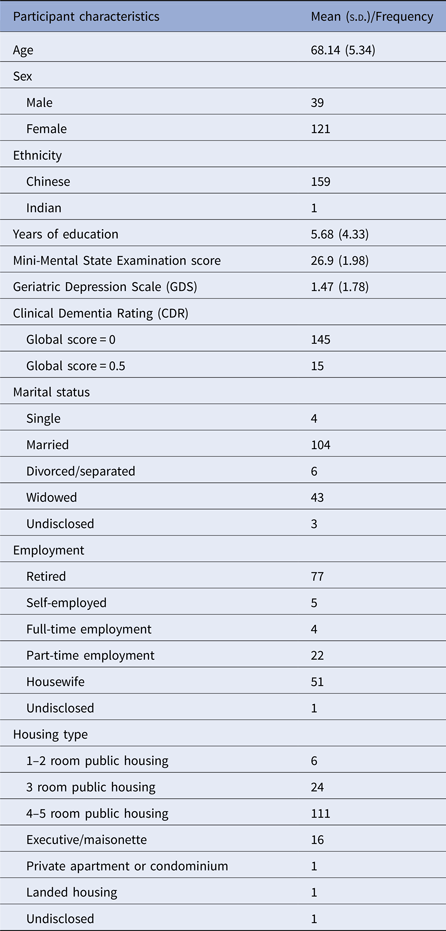
The community-dwelling elderly participants of the current study came from the Aging in a Community Environment Study cohort (Feng, Reference Feng and Pachana2015). This cohort study had previously obtained ethics approval from a university's Institutional Review Board. Details regarding the recruitment, which was carried out from 2011 to 2016, inclusion criteria and tests administration procedures in this cohort study have been described elsewhere (Yu et al. Reference Yu, Mahendran, Rawtaer, Kua and Feng2016). Following this cohort study, participants were subsequently invited to participate in four different interventions (mindfulness, horticultural intervention, choral singing, art and music reminiscence). The respective ethics approvals for these intervention studies have been granted by various Institutional Review Boards. The baseline data for these intervention studies were then used as the time 2 follow-up data in the present study. Participants were administered the RAVLT and GDS, among other tests, both at baseline and at time 2 follow-up. Due to the different participant recruitment dates in the original cohort study and the different start dates of the various interventions, the follow-up duration varied across participants. A total of 169 participants had valid data for the purpose of the current study. From this pool, we excluded eight participants who had present or previous psychiatric diagnoses and one participant with a Clinical Dementia Rating (CDR) of 1 (all other participants had either 0 or 0.5). None of the remaining participants had any present or previous neurological diagnoses. The average follow-up duration across participants was 1.93 years (s.d. = 1.03; range: 0.28 to 4.81). The participant characteristics of the final included 160 participants are shown in Table 1.
Participants’ characteristics at baseline

Statistical analysis
A cross-lagged model involving GDS and the latent factor of memory – with loadings from the three RAVLT components, was analyzed. Age, sex and follow-up period were included as covariates in the model. Prior to the cross-lagged panel analysis, the longitudinal invariance of the memory latent factor was tested by comparing the unconstrained and longitudinally-invariant models (equal factor loadings across time) via confirmatory factor analysis (CFA). Subsequently, a cross-lagged panel analysis was carried out on the longitudinally-invariant model via structural equation modeling. Robust maximum likelihood was used for parameters estimation. These analyses were carried out with the R package lavaan (Rosseel, Reference Rosseel2012). The Root Mean Square Error of Approximation (RMSEA), Comparative Fit Index (CFI), Standardized Root Mean square Residual (SRMR), Akaike Information Criterion (AIC) and Bayesian Information Criterion (BIC) was used to assess model fit. RMSEA values of <0.05 were considered good fit (Browne & Cudeck, Reference Browne, Cudeck, Bollen and Long1993). CFI values > 0.95 were considered a very good fit. SRMR values < 0.08 are indicative of an acceptable model (Hu & Bentler, Reference Hu and Bentler1999). Lower information criterion values correspond to better fit. The χ2 test of difference was used to compare the fit between models. Correlations between variables were examined using Pearson correlation coefficients. Statistical significance was set at p < 0.05. All analyses were performed in R 3.4.0.
Meta-analysis
A search was carried out on PubMed using the following keyword entry: (memory[Text Word] Or Cognition[Text Word] OR cognitive[Text Word]) AND (depressive[Text Word] OR depression[Text Word]) AND (cross lagged[Text Word] OR autoregressive[Text Word] OR cross domain[Text Word]). This search was carried out on 16 July 2017 and had generated 56 results. Among these results, five studies were relevant to the objectives of the current study; they were thus included into the meta-analysis. Four of them had cross-lagged analyses involving measures of memory and depressive symptoms (Gerstorf et al. Reference Gerstorf, Hoppmann, Kadlec and McArdle2009; Bunce et al. Reference Bunce, Batterham, Christensen and Mackinnon2014; Zahodne et al. Reference Zahodne, Stern and Manly2014; Brailean et al. Reference Brailean, Aartsen, Muniz-Terrera, Prince, Prina, Comijs, Huisman and Beekman2017). The fifth was a cross-lagged study on depressive symptoms and cognition (Perrino et al. Reference Perrino, Mason, Brown, Spokane and Szapocznik2008). The latter was a latent variable with loadings from the California Verbal Learning Test, Fuld Object Memory Evaluation, and Color Trails Test. Given that the two memory tests, relative to the Color Trails Test, loaded very heavily on to this latent variable (⩾0.73), we decided to include this study into the meta-analyses. Due to the fact that multiple outcome measures or time points were included in each study, a total of 13 effect-sizes for each of the two directions of association (memory→depressive symptoms and depressive symptoms→memory) were extracted from these studies. The regression coefficients, both unstandardized (B) or standardized (β), and their standard errors (s.e.) were extracted from these studies. If Bs were reported within a study, they were converted to βs by multiplying them by the fraction of s.d.predictor/s.d.outcome. Since these studies had only provided descriptive statistics for the baseline time-point, the s.d. of the outcome variable at baseline was used with the assumption that the s.d.s at baseline and follow-up were approximately equal. Further details on how the βs and their respective s.e.s were obtained in cases where they were not explicitly reported are described in online Supplementary Table S1. These 13 βs for each of the cross-lagged directions, together with those of the present study were meta-analyzed. Ideally, the correlation coefficients (r) should be extracted and meta-analyzed; however, none of the included studies had provided correlation matrices of the relevant variables. Nevertheless, previous research has shown that βs are highly correlated with rs, even in the presence of multiple covariates (Peterson & Brown, Reference Peterson and Brown2005; Bowman, Reference Bowman2012).
Given the multiple effect-sizes per study, a multilevel meta-analytic approach was adopted. Unlike the traditional random-effects model, this approach does not require the effect-sizes to be independent of each other. Instead, an intermediate level was included to model the dependence among multiple effect-sizes within studies (Konstantopoulos, Reference Konstantopoulos2011). On top of that, we used a mixed-effects model to include follow-up duration, age and gender distribution (%male) as covariates. The proposed three-level mixed effects model is given by:
 $$\eqalign{& y_{ij} = \beta _0 + \beta _1 \times {\rm follow}\,{\rm up \; duratio}{\rm n}_{ij} + \beta _2 \times {\rm ag}{\rm e}_{ij} \cr & \qquad + \beta _3 \times \% \,{\rm mal}{\rm e}_{ij} + u_{(2)ij} + u_{(3)j} + e_{ij} \cr & u_{{\rm (2)}ij} \sim N(0,\,\tau _2^2 ) \cr & u_{{\rm (3)}j} \sim N(0,\,\tau _3^2 )} $$
where y ij, represents to the ith effect-size in the jth study; β 0, represents the intercept; β 1, β 2 and β 3, represent the slopes of their respective covariates; u (2)ij, represents the level-2 heterogeneity variance; u (3)j, represents the level-3 heterogeneity variance.
Each effect-size was weighted by its precision (i.e. sampling variance = s.e.β2; Becker & Wu, Reference Becker and Wu2007). The meta-analysis was carried out using the R package metaSEM (Cheung, Reference Cheung2015). Heterogeneity in the models was assessed with the Q statistic. A significant Q statistic suggests that the variability among the effect-sizes is larger than what is expected from subject sampling error alone.
Results
Cross-lagged analyses
CFA suggested that both the unconstrained and longitudinal invariant model fitted well as indicated by their fit indices. These fit indices are reported in the online Supplementary Table S2. Furthermore, the χ2 test of the difference between both models was not significant (∆χ2 = 4.38, ∆df = 2, p = 0.11), suggesting that the longitudinal invariance of the memory factor did not significantly worsen the fit of the model. Henceforth, the longitudinal-invariant model was used for subsequent analyses.
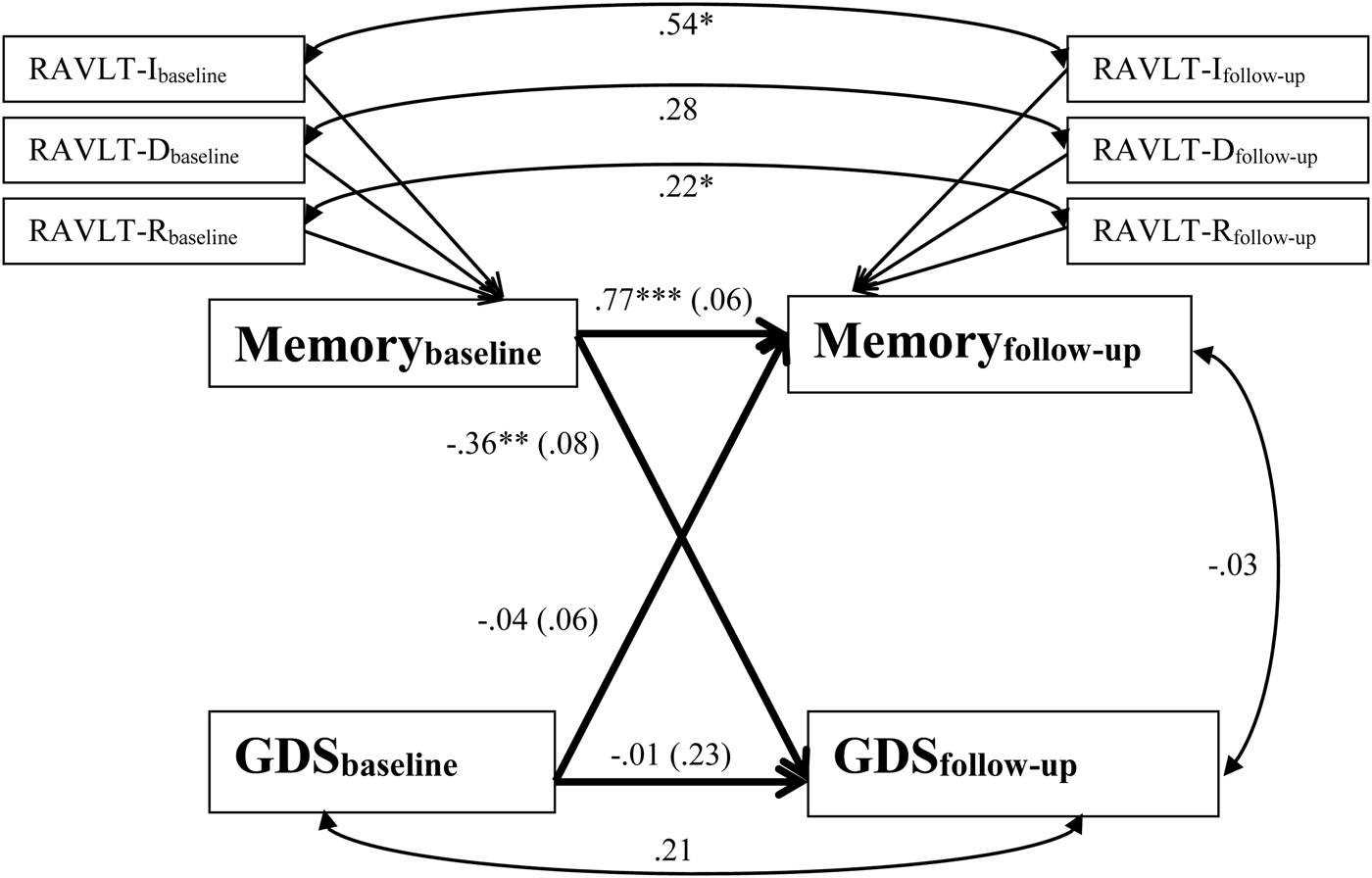
The descriptive statistics and bivariate Pearson correlations of all studied variables are reported in the online Supplementary Table S3. The results of the cross-lagged model are presented in Fig. 1. There was a significant cross-lagged effect – lower baseline memory scores were significantly associated with higher GDS scores at follow-up after controlling for baseline GDS scores (p = 0.005). However, the reverse effect was not statistically significant – baseline GDS scores did not significantly predict memory at follow-up after controlling for baseline memory (p = 0.49). The autoregressive path was significant for memory (p < 0.001) but not for GDS scores (p = 0.98). None of the covariates were significant with the exception of age in the depressive symptoms→memory model (β age = −0.22, s.e. = 0.06, p < 0.001).
Robust maximum-likelihood estimation of the cross-lagged model with age, sex and follow-up duration included as covariates. Figures in parentheses represent standard errors of the estimates. Straight lines represent regression paths. Curve lines represent residual covariance. GDS, Geriatric Depression Scale; RAVLT, Rey Auditory Verbal Learning Test; I, Immediate recall; D, Delayed recall; R, Recognition. *p > 0.05, **p > 0.01, ***p > 0.001.

Two similar cross-lagged models, with the inclusion of years of education and CDR scores (separately) as covariates, was tested. In this model, the inclusion of these covariates had resulted in unsatisfactory fit indices; the χ2 test of difference between the models with and without education or CDR scores as covariates was significant; (education: ∆χ2 = 38.01, ∆df = 6, p < 0.001; CDR scores: ∆χ2 = 21.43, ∆df = 6, p = 0.002) scores suggesting that the inclusion of the education or covariate had significantly worsened the fit of the model. Nevertheless, the cross-lagged effect of baseline memory predicting subsequent GDS scores remained significant (ps ⩽ 0.009), and the reverse effect remained statistically non-significant (ps ⩾ 0.36). The fit statistics and the results of this model are reported in the online Supplementary Figs S1 and S2.
Meta-analysis
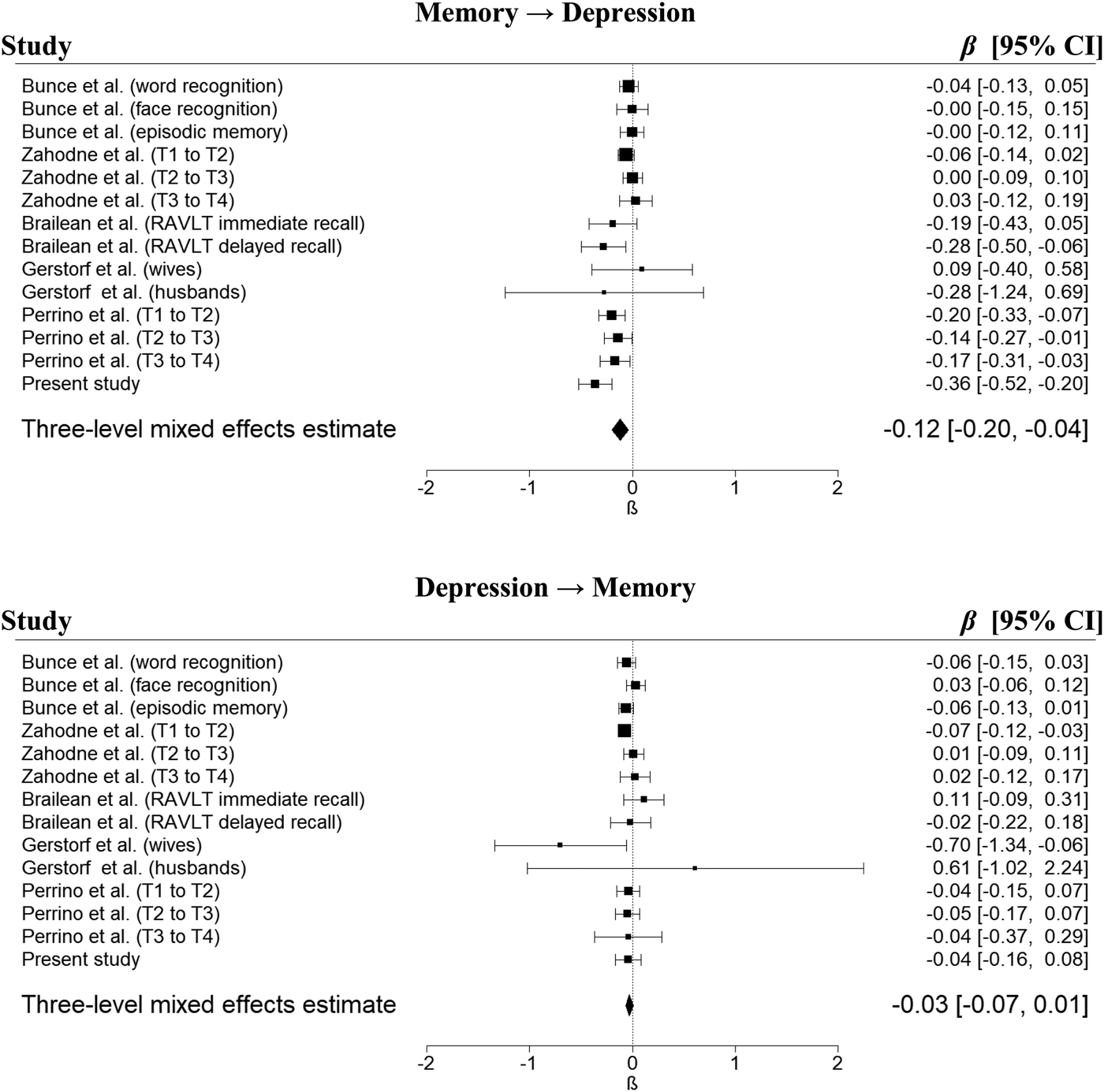
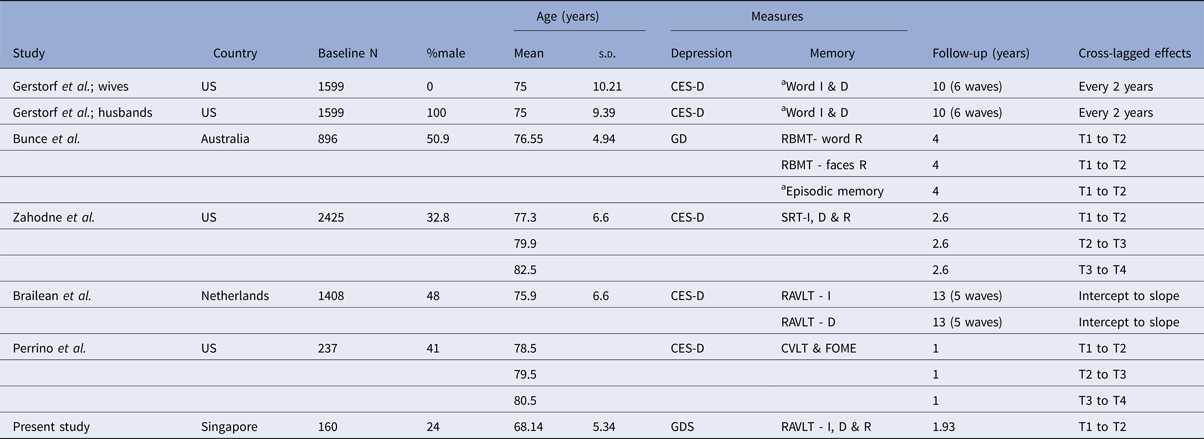
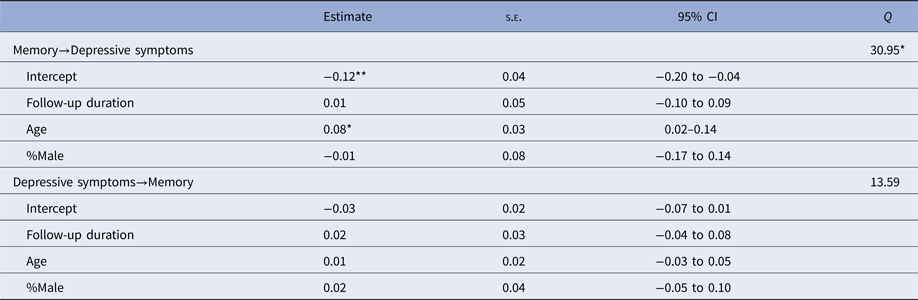
The summary information of all meta-analyzed studies (total N = 8324) and their effect-sizes are shown in Table 2 and Fig. 2, respectively. The results of the meta-analyses are shown in Table 3. The pooled cross-lagged effect for memory→depressive symptoms was significant as indicated by the significant intercept; specifically, poorer memory abilities were associated with higher levels of depressive symptoms at follow-up. However, that of the reverse cross-lagged effect (i.e. depressive symptoms→memory), was not significant. Age was a significant covariate in the memory→depressive symptoms model. There was significant heterogeneity in the memory→depressive symptoms model, as indicated by the significant Q statistic. We obtained highly similar results via the exclusion of the present study's cross-lagged effects [Memory→Depressive symptoms: β 0 = −0.10, p = 0.020, s.e. = 0.04, CI (−0.19 to −0.02); Depressive symptoms→Memory: β 0 = −0.02, p = 0.412, s.e. = 0.02, CI (−0.06 to −0.02)], suggesting that the inclusion of the present study did not significantly skew the pooled estimates.
Forest plots of meta-analyzed cross-lagged effects.

Summary information of meta-analyzed studies

N, sample size; s.d., Standard Deviation; CES-D, Center for Epidemiologic Studies Depression Scale; GD, Goldberg Depression Scale; GDS, Geriatric Depression Scale; Rivermead Behavioural Memory Test; SRT, Selective Reminding Test; RAVLT, Rey Auditory Verbal Learning Test; I, Immediate recall; D, Delayed recall; R, Recognition; CVLT, California Verbal Learning Test; FOME, Fuld Object Memory Evaluation; T, Time.
a Study did not specify which test battery was used.
Results of the meta-analyses

s.e., standard error; CI, confidence interval.
*p < 0.05; **p < 0.01.
Discussion
The current study set out to examine the direction of longitudinal associations between depressive symptoms and memory impairment, in the current sample of community-dwelling older adults, as well as across studies via a meta-analysis. For the former, our results indicated that lower baseline memory ability significant predicted higher levels of depressive symptoms at follow-up, after controlling for baseline depressive symptoms. However, the reverse cross-lagged effect was not significant – baseline depressive symptoms were not associated with subsequent memory ability after controlling for baseline memory ability. Furthermore, the different follow-up durations across the study's participants did not have a significant influence on subsequent predicted outcomes. The results of the meta-analysis were highly consistent with these results. Using a three-way mixed effects model to pool 14 effect-sizes from six studies, our pooled estimates similarly indicated that lower baseline memory was significantly associated with more severe depressive symptoms at follow-up, but not vice-versa. Likewise, the different follow-up durations across studies did not seem to have a significant effect in the mixed effects model. Taken together, regardless of the duration of follow-up, the weight of the evidence suggests a unidirectional relationship between memory impairment and depressive symptoms, with former leading to the latter but not vice-versa.
Although the memory→depressive symptoms association was significant in the meta-analysis, it should be noted that significant heterogeneity across studies, as indicated by the Q statistic, was observed. The significant age covariate in the model suggests that age differences across studies partially accounted for the variance in the model. Specifically, older age was associated with a smaller memory→depressive symptoms association in the meta-analysis. We speculate that with older age, the perception of memory decline becomes a much more accepted reality (Bieman-Copland & Ryan, Reference Bieman-Copland and Ryan1998) and hence, does not elicit as much of a psychological reaction in the form of depression, as one would observe on a younger individual experiencing memory decline. Interestingly, this influence of age on the memory→depressive symptoms association was not observed in the current sample. Perhaps, the younger participants and their smaller age range in the current sample would render it difficult to detect such an age effect. Future studies may consider using a longitudinal cohort with a larger age range to verify on the influence of age on such directional associations.
The hypothesis of memory impairment predicting subsequent depressive symptoms has rarely been studied outside these cross-lagged studies. Nevertheless, instead of memory impairment per se, two studies have looked at how pre-existing neurocognitive diagnoses would influence subsequent levels of depressive symptoms. In the first, researchers followed depressed elderly home residents with and without dementia for a year and found no significant differences in the follow-up levels of depressive symptoms between both groups of residents (Janzing et al. Reference Janzing, Teunisse, Bouwens, van ‘t Hof and Zitman2000). It should be noted that the high baseline levels of depressive symptoms may attenuate differences in subsequent depressive symptoms between residents with and without dementia. Indeed, another study (Snowden et al. Reference Snowden, Atkins, Steinman, Bell, Bryant, Copeland and Fitzpatrick2015), utilizing a large sample, found that non-depressed participants with MCI or dementia, relative to healthy controls, were almost two times more likely to be diagnosed with depression 2 years later. Despite the differences in methodology, such a finding is largely consistent with our results relating to baseline memory impairment predicting subsequent depressive symptoms among non-depressed older adults.
A lot more research has been carried out on the reverse hypothesis–baseline depressive symptoms predicting subsequent neurocognitive diagnoses. In general, our results and those of previous research in this area differed to a large extent. In Panza et al.'s (Reference Panza, Frisardi, Capurso, D'Introno, Colacicco, Imbimbo, Santamato, Vendemiale, Seripa, Pilotto, Capurso and Solfrizzi2010) review of late-life depression, MCI and dementia, there was not a consensus on whether depression had increased the risk of subsequent MCI or dementia diagnoses. They observed that some studies reported a higher risk of developing MCI or dementia among depressed individuals [e.g. Lopez et al. (Reference Lopez, Jagust, Dulberg, Becker, DeKosky, Fitzpatrick, Breitner, Lyketsos, Jones, Kawas, Carlson and Kuller2003)], while others did not (e.g. Panza et al. (Reference Panza, D'Introno, Colacicco, Capurso, Del Parigi, Caselli, Todarello, Pellicani, Santamato and Scapic-chio2008)). In the present study, using a more quantitative approach of operationalizing memory decline via memory test scores instead of diagnostic labels, not only did we find that depressive symptoms did not significantly predict subsequent memory decline, but we also observed that the meta-analyzed evidence has been relatively homogeneous, with most of the included studies reporting only minute and non-significant effects. Panza et al. further explained that the conflicting findings might be attributed a few methodological differences across studies, with one of them being the follow-up duration. In the present meta-analysis, our results were not significantly heterogeneous despite the vastly different follow-up durations among the included studies. Furthermore, our results also showed that the follow-up duration did not have a significant impact on subsequent memory decline across participants in our cross-lagged study as well as across studies in the meta-analysis. Perhaps these conflicting findings may be related to the fact that MCI or dementia diagnoses may not be directly comparable with the objective memory test scores studied in the current research. Although memory assessments were conducted as part of these diagnoses, some of these diagnoses, such as in nonamnestic MCI and Frontotemporal Dementia, do not require the presence of memory impairment. Furthermore, the implementation of these diagnoses is subjected to a high degree of heterogeneity. Indeed, as acknowledged by Petersen et al. (Reference Petersen, Caracciolo, Brayne, Gauthier, Jelic and Fratiglioni2014) the heterogeneous implementation of the MCI criteria remains a major unresolved issue that is contributing to the unwanted variability in research findings. In addition to these concerns, Panza et al. also suggested other confounding methodological differences such as the assessment of depression, education and sample type (population v. hospital-based), which we were unable to study systematically in the current research. It is plausible that the differences in findings between those of the current research and those reviewed by Panza et al. may be attributed to these unstudied confounding variables. Future meta-analytic research may consider controlling for these variables as covariates when more relevant studies become available.
These findings present some implications in the clinical context. Firstly, they highlighted the increased vulnerability of developing depressive symptoms among memory-impaired aged individuals. While memory impairment alone can significantly impair one's daily functioning, having comorbid depressive symptoms would further exacerbate this impairment across several activities of daily living (de Paula et al. Reference de Paula, Diniz, Bicalho, Albuquerque, Nicolato, de Moraes, Romano-Silva and Malloy-Diniz2015). Thus, the need for clinicians to address mood-related concerns that may arise as a result of the perceived decline in memory (Bassuk et al. Reference Bassuk, Berkman and Wypij1998) cannot be understated. Psychotherapeutic approaches that work on the client's self-esteem via building a supportive therapeutic alliance or facilitating problem-solving in daily contexts would be helpful to tackle such cases of depressive symptoms comorbid with cognitive impairments (Wang & Blazer, Reference Wang and Blazer2015). These psychotherapeutic strategies can be easily incorporated into existing pharmacological or cognitive remediation/training interventions aimed at improving the cognitive functioning of elderly individuals. Next, in showing that memory impairment predicts subsequent depressive symptoms, we have provided evidence to illustrate memory impairment as a trait marker of depression. This would suggest that memory impairment, relative to state markers, is less likely to predict treatment response in depression. Hence, it important for clinicians not to be too preoccupied with such trait-related memory impairments in depression treatment, and instead focus on state markers such as those related to executive function impairment (Maalouf et al. Reference Maalouf, Brent, Clark, Tavitian, McHugh, Sahakian and Phillips2011).
The current research is subjected to some limitations. First, the sample size in the cross-lagged study was relatively small. Second, the current cross-lagged study together with those included in the meta-analysis used mostly healthy community samples instead of clinical subjects. Hence, this may limit the generalization of these findings to older adults with severe depression and memory impairments, such as those diagnosed with major depressive disorder and dementia. Third, we observed that relative to the other studies included in the meta-analysis, we have a much lower proportion of men. Perhaps the inclusion of participants who were interested and willing to participate in the subsequent interventions had inadvertently engendered a selection bias. These interventions may appeal much more to females than males for various reasons. Consequently, such selection biases would also limit the generalizability of the results. Finally, the repeated assessments of memory using list learning tests, such as the RAVLT, are subjected to practice effects (Gavett et al. Reference Gavett, Gurnani, Saurman, Chapman, Steinberg, Martin, Chaisson, Mez, Tripodis and Stern2016). Furthermore, in the current study as we vary the duration of follow-up, it is expected that such practice effects would correspondingly vary as well; participants with a shorter follow-up duration would probably have a stronger practice effect than those who had a longer follow-up duration. Nevertheless, as our results from the current sample and meta-analysis have shown, the follow-up duration did not emerge as a significant covariate; this would suggest that the varying levels of practice effects were perhaps not large enough to have a significant impact on the results.
Supplementary material
The supplementary material for this article can be found at https://doi.org/10.1017/S0033291717003154.
Acknowledgements
This work is supported by the National University of Singapore Virtual Institute for the Study of Ageing [grant number VG-8]; the Alice Lim Memorial Fund, Singapore [grant number ALMFA/2010]; the National Medical Research Council of Singapore [grant number NMRC/TA/0053/2016]; the Training and Research Academy at Jurong Point, Singapore; the Lee Kim Tah Holdings Ltd., Singapore; the Kwan Im Thong Hood Cho Temple, Singapore; and the Presbyterian Community Services, Singapore.
Declaration of Interest
None.
Ethical standards
The authors assert that all procedures contributing to this work comply with the ethical standards of the relevant national and institutional committees on human experimentation and with the Helsinki Declaration of 1975, as revised in 2008.