Violence against parents and teachers by adolescents has special significance because it is directed against those who should be sources of physical and psychological well-being, safety and authority for adolescents. Violence by adolescents at home and in school appears to be on the increase, or at least there is greater public awareness of it as a result of mass-media exposure and the publication of court data and surveys. North American rates of aggression toward parents range between 5 and 20% (Gallagher, Reference Gallagher2008; Pagani et al., Reference Pagani, Tremblay, Nagin, Zoccolillo, Vitaro and McDuff2004). Similarly, schools have become the focus of violence in recent years, those directly affected being not only students (bullying), but also teachers, as the targets of adolescent violence. In Israel, Khoury-Kassabri, Astor, and Benbenishty (2009) found that while almost a third of all students in their sample reported at least one form of violence (physical and/or verbal violence) against peers, one in five reported violence against teachers.
The importance of family and school in the development of violent behaviors in adolescence is well documented (Bischof, Stith, & Whitney, Reference Bischof, Stith and Withney1995; LeFlore, Reference LeFlore1988). Nevertheless, the majority of studies focus exclusively on one context, family or school, though the school and the family are interlinked systems that influence adolescents’ development in a complementary fashion. Hirschi’s (Reference Hirschi1969) control theory advances the view that young people strongly attached to parents, peers and school, and who believe in social values and norms, are at less risk of engaging in delinquent and violent behavior inside and outside of school. Moreover, delinquency in teenagers is associated with attitudes to authority but not with their moral development (Tarry & Emler, Reference Tarry and Emler2007). In that study, adolescents with a negative attitude towards authority tended to report committing more antisocial behaviors. Antisocial behavior is defined as socially undesirable behavior, such as aggression, intimidation or destructive activities.
Gender appears to be an important variable to take into account when analyzing violent behaviors in adolescents. As regards the victims of child-to-parent violence, most studies agree unequivocally that mothers are far more often the victims of abuse from their children when the violence is severe, with research in the judicial context reporting that mothers are victims more frequently than fathers (Kennair & Mellor, Reference Kennair and Mellor2007; Walsh & Krienert, 2007). As for those committing the violence, in serious assaults males are more likely to be perpetrators than females, while in verbal aggression there is far less difference between males and females (and indeed possibly none) (Gallagher, Reference Gallagher2008). Some studies have found that girls display more violent behavior in the home than outside the home, while boys are far more likely to be violent towards strangers (Burman, Brown, Tisdall, & Batchelor, Reference Burman, Brown, Tisdall and Batchelor2001; Cairns, Peterson, & Neckerman, Reference Cairns, Peterson and Neckerman1988). Following the developmental perspective on the onset and course of violence against parents, children often start around 10 to 13 years old, but the seriousness of the violence increases as the child becomes physically bigger (Gallagher, Reference Gallagher2007).
Family environment and aggression towards parents
Different family environmental factors have been described as relevant risk factors in the development of parent abuse, the most widely studied variables being parenting styles (permissiveness and lack of boundaries versus excessively authoritarian parenting style) and intra-family violence (parent-to-child violence and marital violence) (Cottrell & Monk, Reference Cottrell and Monk2004; Gallagher, Reference Gallagher2008; Mahoney & Donnelly, 2000). Intra-family conflictive interaction patterns, and particularly violence between family members, are factors that have been widely studied in relation to adolescent aggression in general. Specifically, in the case of parent abuse, witnessing marital violence has been identified as a decisive factor for future son-to-mother violence (Cottrell & Monk, Reference Cottrell and Monk2004; Ulman & Straus, Reference Ulman and Straus2003). Langhinrichsen-Rohling and Neidig (1995), however, suggest that there could also be gender differences, since they found that girls who witnessed more parental aggression were less likely to be violent toward their parents than boys.
Likewise, the hypothesis of the bi-directionality of domestic violence is currently gaining momentum: it would appear that the violence parents commit on their children is related to violence by children against parents (Brezina, Reference Brezina1999; Mahoney & Donnelly, 2000), especially in the case of boys (Ibabe & Jaureguizar, Reference Ibabe and Jaureguizar2011). Patterson’s (Reference Patterson and McCord1995) coercion model gives a theoretical perspective to these findings, fitting similarly for boys and girls. This model proposes a 4-step process to explain how both parents and children are active participants in their interactions (Patterson, Reference Patterson and McCord1995; Patterson, Reid, & Dishion, Reference Patterson, Reid and Dishion1992). First, the parent requests the child to perform a behavior or scolds the child for misbehavior (Step 1). Next, the child responds to the parent’s request with an aversive behavior (e.g., whining or yelling) (Step 2). In Step 3, which is the crucial stage, the negative parent–child interaction can occur: if the parent stops the request, the child wins, so that the child has escaped from the parent’s request. Finally, in Step 4, the child withdraws the aversive behavior immediately after the parent terminates the request, thus reinforcing the parent’s withdrawal of the request. Therefore, as the coercion model suggests, children’s behavior influences parents’ behavior and parents’ behavior influences that of their children. This model could also be used to explain child-to-parent violence from a bidirectional point of view. Moreover, it is suggested that some forms of parent abuse may escalate through a cycle of family violence and conflict, beginning with relatively harmless family discord and increasing in frequency and severity through more harmful behaviors, eventually culminating in parricide (Walsh & Krienert, Reference Walsh and Krienert2009).
Positive child-parent relationships could be a protective factor for child-to-parent violence. One of the most widely used and validated instruments for the assessment of family functioning, is the Family Environment Scale (FES) (Moos & Moos, Reference Moos and Moos1981). Various studies using the FES have found that delinquent adolescents perceive their families as having less cohesiveness, lower levels of independence, less active-recreational orientation, and less expressiveness than those of non-delinquents (Bischof et al., Reference Bischof, Stith and Withney1995; LeFlore, Reference LeFlore1988).
Classroom environment and aggression towards teachers
In the classroom environment two main interpersonal violent behaviors could be identified: violence against peers and violence against teachers. This study focuses on violence against teachers, which has attracted less research than violence against peers. Taking into account the limited research on this topic, below we describe protective and risk classroom environmental factors in relation to aggressive behaviors in the school context in general.
The teacher-child relationship has been identified as an important dimension of the school environment, since many studies report that aggressive children are likely to have negative relationships with their teachers (Birch & Ladd, Reference Birch and Ladd1998; Herrero, Estévez, & Musitu, Reference Herrero, Estévez and Musitu2006), and are at risk of later engagement in delinquent behavior (Walker, Stiller, Severson, Feil, & Golly, Reference Walker, Stiller, Severson, Feil and Golly1998). In general, negative school environment has been linked to behavioral maladjustment in adolescence (e.g., Estévez, Musitu, & Herrero, Reference Estévez, Musitu and Herrero2005; Murray & Murray, Reference Murray and Murray2004) and to the victimization of teachers (Steffgen & Ewen, Reference Steffgen and Ewen2007), though further research is needed in this area.
Among the protective factors of school environment, school bond or connectedness could be a protective factor against engaging in early delinquency. The “connectedness” construct is defined as “the extent to which students feel personally accepted, respected, included, and supported by others in the school social environment” (Goodenow, Reference Goodenow1993, p.80). Feeling “connectedness” to school reduces the likelihood of an adolescent starting to engage in a pattern of problem behavior involving aspects such as delinquency and violence, gang membership, substance use and school dropout (Dornbusch, Erickson, Laird, & Wong, Reference Dornbusch, Erickson, Laird and Wong2001; Sprott, Jenkins, & Doob, Reference Sprott, Jenkins and Doob2005). School organization may also be a protective factor. Together with the study by Gottfredson, Gottfredson, Payne, and Gottfredson (Reference Gottfredson, Gottfredson, Payne and Gottfredson2005), the results from the U.S.A. National Study of Delinquency Prevention in Schools (a survey conducted in 1997 and 1998) found that schools in which students perceived clarity of rules and disciplinary consistency from the school personnel had less delinquent behavior and less student victimization, regardless of the type of school and community. Nevertheless, it should be pointed out that this association was not found in the case of teacher victimization. Perceptions of discipline management would most likely affect potential perpetrators of school crime, but further research is needed to explain why this association does not extend to teacher abuse.
The interlinked influence of family and school environment on adolescents’ violent behavior
Some research has focused on the combined study of these two contexts for a better understanding of adolescents’ aggressive behavior. In a study on young people in situations of risk of social deviance, results showed that juveniles poorly adjusted to the family context presented, among other characteristics, low school involvement and a higher rate of disruptive behaviors in the classroom (Arce, Fariña, Seijo, Novo, & Vázquez, Reference Arce, Fariña, Seijo, Novo and Vázquez2004). Patterson et al. (Reference Patterson, Reid and Dishion1992) postulated that a child who has received abundant negative reinforcement for aversive behaviors and little positive reinforcement for appropriate behaviors at home is likely to encounter major difficulties in school settings (academic performance and peer relationships).
Some authors focused on the socio-educational context of adolescents who abuse their parents (Pagani, Larocque, Vitaro, & Tremblay, Reference Pagani, Larocque, Vitaro and Tremblay2003; Pagani et al., Reference Pagani, Tremblay, Nagin, Zoccolillo, Vitaro and McDuff2004), finding that disruptive behaviors as a child at school constituted an important predictive factor for aggression by adolescents against their mothers. Moreover, Shochet, Homel, Cockshaw, and Montgomery (2008) stress the importance of family environment, reporting that parent attachment (affective quality of the relationship) significantly predicted the adolescent’s school connectedness, while other research found an indirect relationship between parents’ perception about school and adolescents’ violent behavior in the classroom: parents’ perception about school was related to children’s attitude towards school, and this was directly associated with school violence (Cava, Musitu, & Murgui, Reference Cava, Musitu and Murgui2006).
The social development model (SDM) postulated by Catalano and Hawkins (Reference Catalano, Hawkins and Hawkins1996) provides an explanatory framework for the progression of antisocial behavior in children and adolescents. Antisocial behavior results when a child is bonded to immediate socializing units of family, school, community or peers which hold antisocial beliefs or values. As far as protective factors of antisocial behavior are concerned, Catalano and Hawkins (Reference Catalano, Hawkins and Hawkins1996) identified three categories: individual characteristics (a positive social orientation, high intelligence and a resilient temperament), social bonding (warm, affective relationships and commitment to conventional lines of action), and healthy beliefs and clear standards for behavior. Other likely protective factors include being female, religiosity, emotion control, belief in the moral order, and attachment to mother and father (Hemphill, Toumbourou, & Catalano, Reference Hemphill, Toumbourou and Catalano2005).
There is little research on the interrelation between positive family and school environment and the importance of each context for adolescents’ violent behavior. As far as we know, there are no published studies that have analyzed child-to-parent violence and student-to-teacher violence simultaneously. Given that the incidence of these types of violence is increasing throughout the world (Gallagher, Reference Gallagher2008; Khoury-Kassabri et al., Reference Khoury-Kassabri, Astor and Benbenishty2009), it would be interesting to explore the relationship between violence against authority (parents and teachers) and antisocial behavior in general. Thus, the current study focuses on two types of violent act—violence toward parents and violence toward teachers—and examines how they are associated with positive family and school environments. Taking into account the influence of family and school environment on the development of antisocial behavior (Catalano & Hawkins, Reference Catalano, Hawkins and Hawkins1996), we hypothesized that the positive family and school environment would predict adolescents’ violent behavior towards parents and teachers through the adolescent’s antisocial profile. We decided to test this hypothesis using Structural Equation Modeling. Specifically, we expected (a) negative associations between positive family and classroom environments, respectively, and antisocial behavior, (b) negative associations between positive family and classroom environments and parent and teacher abuse, respectively, and (c) a positive association between antisocial behavior and violence against authority. Finally, we hypothesized that positive family environment would contribute more than positive school environment to reducing antisocial behavior. According to Emler, Ohana, and Dickinson (Reference Emler, Ohana, Dickinson, Duveen and Lloyd1990), children learn to respect the authority of parents, and this establishes the adolescent’s behavior toward authority in other contexts.
Method
Participants
Participants in the study were 687 students from five urban secondary schools in the province of Gipuzkoa (Spain), of both sexes (50.1% were boys) and aged between 12 and 16 (M = 14.7; SD = 1.2). Average number of brothers or sisters was 1.28, and 4% were immigrants. Half of the sample (49.9%) was from public (state) schools and the rest were from state-subsidized (grant-assisted) private schools. Eighty-four per cent (84%) lived in nuclear families, 7% in single-mother families, less than 1% in single-father families, and 8% in other types of family (reconstituted families, extended families and others).
Instruments
The Family Environment Scale (FES; Moos & Moos, 1981; Spanish version adapted by TEA Ediciones, 1984). The FES is a 90-item scale measuring people’s perceptions of their current family environments. It consists of 10 subscales grouped to form three domains: (a) Relationship, with three subscales: cohesion (the degree of commitment and support family members provide for each other), expressiveness (the extent to which family members are encouraged to express their feelings directly) and conflict (the amount of openly expressed anger and conflict among family members). (b) Personal growth, with five subscales: independence (the extent to which family members are assertive and self-sufficient and make their own decisions), achievement orientation (how much activities are cast in an achievement-oriented or competitive framework), intellectual-cultural orientation (level of interest in political, intellectual and cultural activities), active-recreational orientation (amount of participation in social and recreational activities) and moral-religious emphasis (emphasis on ethical and religious issues and values). (c) System maintenance, with two subscales: organization (the level of planning that is put into family activities and responsibilities) and control (the amount of set rules and procedures used in the running of family life). Higher scores on each of the subscales indicate better-functioning families, except in the case of the conflict subscale, where they indicate family dysfunction. Test-retest reliabilities for the 10 subscales were calculated by Moos and Moos (Reference Moos and Moos1994) at 2-month, 3-month, and 12-month intervals, and ranged from .52 to .91. In this study the internal consistency coefficients (KR-20) yielded wide-ranging values (conflict = .94 and control = .11), and the average internal consistency was .40. However, the internal consistencies for the subscales that were actually used in the structural model were quite acceptable (coefficient KR-20 for Cohesion = .86, Conflict = .94, Organization = .58).
The Classroom Environment Scale (CES; Moos & Trickett, 1974; Spanish version adapted by Fernández-Ballesteros & Sierra, 1984). The 90 items of the CES look at classroom environment in terms of four broad domains comprising 9 subscales: (a) Personal relationships, with three subscales: involvement (student attentiveness and participation), Affiliation (student friendship and mutuality) and Teacher Support (teacher assistance and concern); (b) Personal growth, with two subscales: Task orientation (emphasis on completing planned activities) and Competition (for grades and recognition); (c) Maintenance dimensions, with three subscales: order and organization (orderliness of student behaviors and class activities), rule clarity (the extent to which clear rules are established), and teacher control (rule enforcement); and (d) Innovative (innovation, the amount of unusual and varied learning activities). Higher scores on each of the subscales indicate better-functioning classrooms. Moos and Trickett (Reference Moos and Trickett1974) verified profile stability for the CES subscales over a 6-week interval and reported test-retest reliabilities of .72 to .90. The internal consistency coefficients (KR-20) obtained in the Spanish adaptation of the CES ranged from .81 in the teacher support subscale to .25 in the task orientation subscale (average coefficient was .58) (Fernandez-Ballesteros & Sierra, 1984). In the current study the internal consistency coefficients (KR-20) obtained varied from .78 (rule clarity) to .17 (task orientation), and the average coefficient was .62. However, the subscales that were actually used in the structural model presented quite acceptable internal consistency (Involvement = .62, Affiliation = .64, Teacher Support = .67, Order = .65), except the Task Orientation subscale, which presented a coefficient KR-20 = .17.
Antisocial and Criminal Behavior Scale AC
Spanish version of ASB (Antisocial Behavior Scales) by Allsopp and Feldman (Reference Allsopp and Feldman1976), adapted by Seisdedos (Reference Seisdedos1988). This instrument consists of two 20-item scales with dichotomous response format, and assesses both anti-social behavior (that which deviates from social norms and conventions) and criminal behavior (that which is outside the law). In this study alpha reliability coefficients for the two subscales were .89 and .91, respectively.
Violent Behavior toward Authority Figures Scale
We developed this 9-item scale on physically and psychologically violent behavior against parents and teachers. Adolescents indicated the frequency with which they behaved violently against parents and teachers Footnote 1 on a 5-point Likert scale (See Appendix Scale). Frequency response options are 1 = Never, 2 = Hardly ever, 3 = Sometimes, 4 = Frequently, and 5 = Almost always. For the current sample, alpha reliability coefficients for these subscales of parents and teachers were .65 and .78, respectively. Maximum likelihood exploratory factor analysis was performed on 9 items. The number of factors based on the standard eigenvalues > 1 criterion was two. These factors accounted for 49% and 32% of the total variance. The solution was rotated using Oblimin. The first factor was defined by six items reflecting violent behavior and negative attitude to teachers (e.g., “I hit him/her, trying to make out it is a joke, e.g., pushing him/her off the chair”), while the second factor was defined by three items referring to violent behavior and negative attitude to parents (e.g., “During quarrels with my parents, I have on at least one occasion pushed or hit them”). A confirmatory factor analysis (CFA) was applied with two latent factors (violent behavior toward teachers and parents), and showed a reasonably good fit to the data based on the robust method (normalized coefficient of kurtosis; Yuan, Lambert, & Fouladi, Reference Yuan, Lambert and Fouladi2004) = 90.91; Y-B χ2 (26, N = 684) = 58.86, CFI = .96, NNFI = .94, IFI = .96, RMSEA = .043).
Procedure
For the data collection, we first contacted 10 Secondary Schools in Gipuzkoa (Spain), taking into account the type of school (public or grant-assisted private) and the linguistic model (students in the Basque Country) may choose between monolingual –just Spanish or just Basque– and bilingual models –Spanish and Basque). Five schools that confirmed their availability and the willingness of their staff to collaborate in the research finally participated. Before the data collection, head teachers were given detailed information about the objectives of the research in a one-hour presentation. A letter describing the study was sent to the parents requesting that they indicate in writing if they did not want their child to participate in the research. Participants were given guarantees of the confidentiality and anonymity of their responses. In the classroom, the instructions for each questionnaire were read aloud before the students filled them out. The questionnaires were administered during normal class time in one-hour sessions during the month of May 2007. When the data analyses were complete, head teachers of the schools were sent a report on the main results of the study.
Data analysis
First of all, univariate analysis of observed variables was carried out. Parent abuse and teacher abuse variables included both physical and psychological violence. Next, a structural equation model was specified for measuring the effect of the family and school environments on antisocial behavior and on violence against parents and teachers. The first-order latent variables included in this structural model were: Positive Family Environment (indicators: cohesion, conflict Footnote 2 and organization), Positive Classroom Environment (indicators: involvement, affiliation, teacher support, task orientation and order), and Violence against Authority (indicators: violence towards parents and violence towards teachers). Some of the originally hypothesized indicators from the FES and CES scales of family environment and classroom environment were discarded due to their low factor loadings (≤ .30) on family environment or school environment.
EQS 6.1 (Structural Equation Program) was used to assess the adequacy of the proposed model. A number of fit indexes were calculated, including: (a) the overall χ2 (b) the comparative fit index (CFI) (c) the Bentler-Bonnet non-normed fit index (NNFI) (d) Bollen’s fit index (IFI) and (e) the root mean square error of approximation (RMSEA). The statistical indicator was chi-square (χ2), which assessed the difference between the proposed and the saturated models. The practical indexes used were IFI, CFI and NNFI; a value higher than .90 was expected for these indicators (Bentler, Reference Bentler2006). RMSEA index was used to measure the reasonable error of approximation in terms of goodness of fit, requiring a value under .06 (Hu & Bentler, Reference Hu and Bentler1999).
A total of 395 students had complete data in the analyses. The rest of the participants had some missing data (N = 292), however, a single missing score being the most typical pattern (51%). The analysis was carried out with full information maximum likelihood (e.g., Arbuckle, Reference Arbuckle, Marcoulides and Schumacker1996; Jamshidian & Bentler, Reference Jamshidian and Bentler1998). While the maximum likelihood estimates were accepted, since the Yuan, Lambert, and Fouladi (Reference Yuan, Lambert and Fouladi2004) normalized coefficient of kurtosis exceeded 10.0 in all analyses, the associated model test statistics and standard errors were corrected for nonnormality using the Yuan and Bentler (Reference Yuan, Bentler, Sobel and Becker2000) robust methodology. Although fit indices based on normal theory and robust statistics were very similar, we report both of them. Nonnormality was substantially driven by two variables which, as expected, have highly non-normal marginal distributions. The violence against parents variable had skew of 2.3 and kurtosis of 6.02, while violence against teachers had skew of 1.44 and kurtosis of 1.82, which in both cases reflected that most students exhibited few or no violent tendencies.
Results
The parent and teacher abuse variables were dichotomized. As the scale of violent behaviors had a frequency response format (1 = Never, 2 = Hardly ever, 3 = Sometimes, 4 = Frequently, and 5 = Almost always), participants who chose option 2 or higher on any item of the parent abuse or teacher abuse subscale were considered as violent towards parent or teacher. About 10% of the children in this study had been physically violent to a parent Footnote 3 at some time in the past year, and 10% to teachers, but 2% of children had battered both parents and teachers.
Comparisons of means were made using t-test analysis according to gender of child and type of authority (parent vs. teacher). Although there was no significant difference between boys and girls as perpetrators of physical abuse of parents, boys (13%) were more violent with their teachers than girls (8%), t(612.53) = −2.2, p = .03, d = −.13, 95% CI [−.24, −.04]. Just over half the girls were psychologically abusive toward their parents (52%), which is significantly greater than the 39% of boys that were psychologically abusive toward them, t(648.96) = 3.1, p = .002, d = .40, 95% CI [.14, .65].
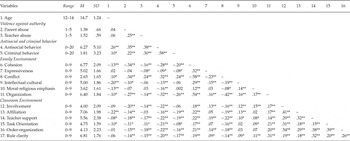
To examine the relationships and influences, we first computed the correlations for the study variables of violence (see Table 1). The first column in Table 1 indicates that age is related especially to antisocial behavior (r = .26, p < .001), intellectual-cultural orientation in the family (r = −.20, p < .001) and school affiliation (r = −.22, p < .001). The second column shows that parent abuse is positively related to teacher abuse (r = .25, p < .001), antisocial behavior (r = .35, p < .001), criminal behavior (r = .22, p < .001), and family conflict (r = .34, p < .001). However, three family environmental variables are negatively associated with violence against parents: cohesion (r = −.34, p < .001), intellectual-cultural orientation (r = −.10, p < .05) and organization (r = −.27, p < .001). Moreover, six positive classroom environment variables are inversely related to parent abuse: involvement (r = −.20, p < .001), affiliation (r = −.14, p < .001), teacher support (r = −.18, p < .001), task orientation (r = −.11, p < .05), order-organization (r = −.15, p < .001) and rule clarity (r = −.14, p < .001).
Means and standard deviations for observed variables and interrelations

Note:
*p < .05. **p < .001
As shown in the third column, teacher abuse is positively related to antisocial behavior (r = .38, p < .001) and criminal behavior (r = .22, p < .001). Correlations between teacher abuse and family environmental variables are found: negatively to cohesion (r = −.16, p < .001), expressiveness (r = −.08, p < .05) and organization (r = −.14, p < .001), and positively to conflict (r = .24, p < .001). On the other hand, five school environment variables are negatively associated with teacher abuse: involvement (r = −.14, p < .001), teacher support (r = −.17, p < .001), task orientation (r = −.11, p < .05), order-organization (r = −.18, p < .001) and rule clarity (r = −.15, p < .001). In addition, antisocial behavior is significantly related to all variables analyzed, as shown in the fourth column of Table 1, but particularly to criminal behavior (r = .58, p < .001).
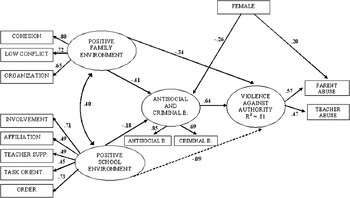
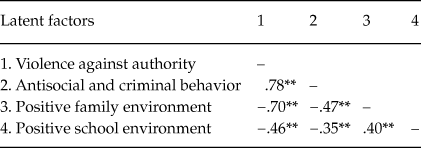
An initial confirmatory factor analysis (CFA) assessed the adequacy of the hypothesized measurement model and the associations among the latent variables. All factor loadings were significant (p < .001). Fit indexes for the CFA model were all adequate: ML χ2 (48, N = 687) = 159.42, CFI = .92, NNFI = .90, IFI = .92, RMSEA =. 064; Yuan-Bentler χ2 (48, N = 687) = 149.58; CFI = .92, NNFI = .90, IFI = .93 RMSEA = .056. Table 2 reports correlations among the latent factors; all were significant, p < .001. The model showed a reasonably good fit to the data based on normal theory: ML χ2 (58, N = 687) = 186.79. The practical goodness of fit indicators (CFI = .94; NNFI = .92; IFI = .94; RMSEA = .057) also support the data for this model. However, these results improved a little with a robust method. The Yuan and Bentler (Reference Yuan, Bentler, Sobel and Becker2000) chi-square scaled method was 5 points lower, χ2 (58, N = 687) = 181.63, though the practical goodness of fit indicators were similar (CFI = .94; NNFI = .92; IFI = .94; RMSEA = .056. Results of the structural model are shown in Figure 1. An alternative model based on a latent factor, Problem Behavior Syndrome (antisocial behavior, criminal behavior, parent abuse and teacher abuse as indicators), showed poorer fit than the previous model, ML χ2 (60, N = 687) = 202.57; CFI = .94; NNFI = .92; IFI = .94; RMSEA = .059.
Structural model of predictors of violence against parents and teachers. Y-B χ2 = 181.63, p < .0001, CFI = .94, RMSEA = .56 Circles represent latent variables and rectangles observed variables. For simplification, residual error variables are not shown in the figure. When the line is continuous, structural coefficients and factor loadings were significant (p < .001). ANTISOCIAL AND CRIMINAL B. = Antisocial and Criminal Behavior; TEACHER SUPP. = Teacher Support; TASK ORIENT. = Task Orientation.

Correlations among latent factors

The results for family and school environment indicated that, on the one hand, family environment had direct effects on violence against authority (β = −.34, p < .001) and indirect effects through antisocial behavior (β = −.26, p < .001), and antisocial behavior predicted violence against authority with its two indicators of violence toward parents and toward teachers (β = .64, p < .001), while school environment also had direct effects on violent behavior against authority (β = −.09, p < .001) and indirect effects through antisocial behavior (β = −.11, p < .001). We also found an indirect effect of family environment on parent abuse (β = −.15, p < .001), and of school environment on teacher abuse (β = −.05, p < .01).
On the other hand, family environment (β = −.41, p < .001) and school environment (β = −.18, p < .001) predicted antisocial behavior, and the results showed an interrelation between the two types of environment (family and school) (r = .40, p < .001). This model accounted for 81% of the variance in violence against authority.
Gender of adolescents was a significant predictor for antisocial and criminal behavior (β = −.26, p < .001) and parent abuse (β = .20, p < .001), but there were no significant differences for teacher abuse. Congruent with this result, it was found that antisocial behavior was more frequent in boys (M = 7.27) than in girls (M = 5.33), t(625) = 4.83, p < .001, d = .39, 95% CI [1.15, 2.73]. Nevertheless, violent behaviors (including physical and psychological abuse) against parents were slightly more frequent in girls (M = 1.51) than in boys (M = 1.38), t(663) = 2.42, p < .05, d = .19, 95% CI [−.24, −.02]. In the structural model when gender (female) was included as a predictor of positive school environment it was significant (β = .08, p < .001), but it was not a significant predictor of positive family environment. Specifically, the perception of school order-organization was higher in girls (M = 4.30) than in boys (M = 3.96), t(639.65) = −1.96, p = .05, d = .34, 95% CI [.69, .001], as well as rule clarity t(647) = −2.31, p = .02, d = .32, 95% CI [.59, .05] (girls M = 6.97 and boys M = 6.65).
Discussion
The present study set out to analyze the role of perceived family and classroom environments in the prediction of violent behaviors against authority, and to examine the relationships among these variables and antisocial behavior. According to our structural equation model, antisocial behavior predicted violent behaviors against authority, but positive family and school environments also showed themselves to have protective direct effects. Both social contexts appear to play important roles in antisocial behavior, though with different strengths. Moreover, an indirect effect of family environment on parent abuse was found.
Protective factors of family environment on antisocial behavior and parent abuse
As we hypothesized, inverse associations between the positive family environment and antisocial behavior were found. Many other studies have found similar results about the association between family relationships and antisocial behaviors. Romano, Tremblay, Boulerice, and Swisher (Reference Romano, Tremblay, Boulerice and Swisher2005) found that family dysfunction, mother hostility and mother depressed mood were associated with physical aggression in 2 to 11-year-old children. Following the Social Development Model postulated by Catalano and Hawkins (Reference Catalano, Hawkins and Hawkins1996) on the development of antisocial (and prosocial) behavior, a risk factor and a protective factor in the family context are conflict and high parental monitoring, respectively.
Furthermore, the hypothesis on violence against parents was confirmed, since positive family environment seems to be a relevant protective factor for child-to-parent violence. Similarly, Paulson, Coombs, and Landsverk (1990), found that abusive children appear significantly less likely to report that they have a close relationship with their parents. According to Pagani et al. (Reference Pagani, Larocque, Vitaro and Tremblay2003), better parent-child relationship was associated with reduced risk of both verbal and physical abuse from adolescent to mother. In addition, results of this study indicate that planning of family activities and quantity of family rules seem to be relevant as protective factors for adolescents’ violence at home and for antisocial behavior in general. Coherent with this finding, low family management (including parental monitoring and supervision) is one variable that has been a key factor in research on family processes and violence (e.g., Haapasalo & Tremblay, Reference Haapasalo and Tremblay1994; Wilson, 1980).
Protective factors of school environment for antisocial behavior and teacher abuse
As expected, positive school environment (or classroom climate) is a protective factor for antisocial behavior. Research generally supports the hypothesis that bonding to school is a protective factor against early delinquency (Catalano & Hawkins, Reference Catalano, Hawkins and Hawkins1996; Dornbusch et al., Reference Dornbusch, Erickson, Laird and Wong2001; Hirschi, Reference Hirschi1969; Sprott et al., Reference Sprott, Jenkins and Doob2005). Adolescents who show negative attitudes to formal figures and institutions, such as teachers and the school context, are more likely to participate in aggressive and antisocial activities (Loeber, Reference Loeber and Hawkins1996). However, in the current study positive classroom environment was a poor predictor of teacher abuse. Congruent with this finding, Gottfredson et al. (Reference Gottfredson, Gottfredson, Payne and Gottfredson2005) did not find any association between rule clarity and consistent discipline in school and teacher victimization. In a similar study, Khoury-Kassabri et al. (Reference Khoury-Kassabri, Astor and Benbenishty2009) reported that school climate characteristics were very weakly associated with level of violence toward teachers. They believe that the factors examined in their study (teachers’ supportive relationships with students, students’ participation, and school policy) might be more relevant to student victimization than to teacher victimization. It should be noted that these dimensions are very similar to the subscales of the current study (personal relationship, personal growth, and maintenance and change). In conclusion, enhancing student-teacher relationships and school organization may provide guarantees as a strategy for reducing delinquent behavior, but we cannot be sure that it will reduce teacher abuse. Furthermore, the relationship between peer victimization and teacher victimization could shed more light on this kind of violence against authority figures in school.
Interlinked influence of family and school environments
As expected, positive family environment was a more important protective factor for antisocial behavior than positive classroom environment. The present study confirms the interlinked influence of family and school environments on adolescents’ violent behaviors. Family conflict and classroom involvement were negatively associated. Likewise, Shochet et al. (2008), found that the affective quality of the parent-child relationship predicted the adolescent’s school connectedness.
Our hypothesis on a positive association between antisocial behavior and violence against authority was verified. According to our structural model, antisocial behavior is an important predictor of violence against authority. This result is consistent with Tarry and Emler’s (Reference Tarry and Emler2007) findings that adolescents with a negative attitude towards authority tended to report more antisocial behaviors. In addition, antisocial behavior has a mediating effect between family and classroom environments and violence against authority. Moreover, in our model family and classroom environments had some direct effects on antisocial behavior. Hirsch’s (1969) control theory explains how young people weakly attached to parents and to school are at increased risk of engaging in delinquent behavior. When the family and classroom environments are inappropriate, adolescents will tend to show more antisocial behavior in general, and specifically, more behavior against authority. Nevertheless, as we had hypothesized, family environment was a better predictor than classroom environment of both antisocial and violent behavior against authority.
Exploratory analysis on gender differences showed that antisocial behavior was more frequent in boys than in girls. There is considerable evidence that boys are more likely than girls to engage in both aggressive and nonaggressive antisocial behaviors (e.g., Keenan & Shaw, Reference Keenan and Shaw1997; Tremblay et al., Reference Tremblay, Boulerice, Harden, McDuff, Perusse, Pihl, Zoccolillo, Cappe and Fellegi1996). Nevertheless, psychological violence against parents was more frequent in girls than in boys. Some studies have found that females are more likely to be verbally and emotionally abusive toward their parents but males are more likely to be physically abusive (Bobic, Reference Bobic2004; Nock & Kazdin, Reference Nock and Kazdin2002). However, boys were slightly more likely to be physically abusive toward their teachers. Gender differences in the development of social cognition may help to explain gender differences in crime and violence (Bennett, Farrington, & Huesmann, Reference Bennett, Farrington and Huesmann2005, p. 263).
In conclusion, the development of violent behavior is influenced by multiple factors, including those located in the family and school experiences (e.g., Hawkins, Arthur, & Catalano, Reference Hawkins, Arthur, Catalano, Tonry and Farrington1995). The novelty of our study resides in the investigation of family and school contexts together and in the confirmation of some environmental factors from the family and the classroom as protective factors for adolescents’ violence against authority. Variables from relationship and order-organization dimensions were the most important areas of family and school that predicted violence against authority. Moreover, the importance of family environment over school environment for antisocial and violent behavior in adolescents was confirmed. The relations between antisocial behavior and violence against authority imply additional associations that are not currently specified, and underscore the importance of the Social Development Model for child-to-parent and child-to-teacher violence. Specifically, social bonding and clear standards for behavior identified by Catalano and Hawkins (Reference Catalano, Hawkins and Hawkins1996) as protective factors for antisocial behavior appear to be relevant. In the present study all the significant variables were associated with social bonding and order/organization.
The main limitation of this study is the nature of the data available. No causal inferences can be made from them, given that it is a cross-sectional study, and all variables have the same source, since they are derived from the self-reports of the young people in the sample. The anti-social behavior variable is treated as an outcome to be explained, potentially, by variations in family and classroom environments. However, it is possible that children who are more hostile to family or school will, as a result, perceive the environment of their family and classroom more negatively (and will be more likely to be hostile and aggressive toward their parents and teachers). Another limitation of the study is that the degree to which violence depended on parent’s sex was not analyzed, because the instrument for measuring child-to-parent violence does not differentiate between violence toward mothers or fathers. Future studies should make this differentiation, as well as the differentiation by sex of the teacher. Finally, the majority of FES and CES subscales presented internal consistency indexes under the desirable level (α < .70), and the task orientation subscale had rather low internal consistency.
Even so, the results of this study could be of considerable importance from a policy and prevention perspective in relation to adolescent violence. Intervention efforts to reduce rates of adolescent violence should focus on helping parents manage conflictive relationships with their children – or at least on educating them about the importance of buffering children from exposure to conflict (Maikovich, Jaffee, Odgers, & Gallop, Reference Maikovich, Jaffee, Odgers and Gallop2008) – and on presenting strategies for improving family cohesion and organization. Children should never find arguments at home to justify their violent behaviors, and parents should teach them that aggressive behaviors are inappropriate (Orue & Calvete, Reference Orue and Calvete2012). Likewise, since classroom relationship predicted antisocial behavior, schools should work hard to improve the classroom environment (teacher-student relationships and classroom organization), with particular emphasis on nurturing those environments that involve students who are having difficulties at home. Furthermore, future research might explore whether these results are verified with offender data, and it would also be helpful to replicate them in other countries.
Appendix Scale