Introduction
The general otorhinolaryngologist's practice is diverse and will vary according to experience, location and subspecialist interest. Most practitioners will undertake upper airway endoscopy as a means of excluding malignant pathology or obtaining a biopsy of suspicious lesions. Those with a more specialist interest may perform surgery to improve the voice, in patients with such conditions as benign vocal fold lesions and vocal fold paralysis. A limited number of laryngologists perform laser excision of malignant lesions, and airway-modifying procedures.
The literature provides supportive evidence for the use of specific laryngeal techniques, such as: injection laryngoplasty for vocal fold palsy;Reference Brandenburg, Kirkham and Koschkee1 laser and microsurgical techniques for benign vocal fold lesions;Reference Courey, Garrett and Ossoff2–Reference Geyer, Ledda, Tan, Brennan and Puxeddu4 and laser surgery for laryngeal cancer.Reference Steiner5 Such studies have been produced by specialist centres within research settings. The outcome of such techniques when performed by general otolaryngologists has yet to be established.
Airway endoscopy and instrumentation carries the risk of detrimental vocal effects. While a change in voice may be expected following biopsy or resection for malignancy, and after procedures undertaken for diagnostic purposes or benign disease, practitioners should be able to demonstrate an acceptable outcome in terms of vocal morbidity.
In the present study, we aimed to develop a minimum endolaryngeal surgery dataset which could be used to determine best practice in the treatment of voice disorders, and which could also be applied to general laryngology practice as an audit tool.
Materials and methods
Dataset design
First, a core set of parameters was identified which would best describe endolaryngeal surgery patients, procedures and outcomes. A minimum dataset was constructed incorporating patient demographics, diagnosis, procedure type and procedure aim. Clinical and operative details were recorded in an open dataset. The surgeon was also asked to indicate the aim of the procedure, from the following options: obtaining a biopsy, excluding pathology, improving voice or airway, or resecting a tumour.
In an attempt to simplify data collection, data fields were limited to enable a hard copy pro forma occupying only a single side of A4 size paper. We believed that increasing the duration or complexity of data recording by the user would result in less complete data collection. Thus, data fields were presented on a single, structured form (Appendix 1); once the form was complete, data were transferred to an electronic database by non-clinical staff.
In addition to clinically generated data, the patients' perceived vocal morbidity was assessed using a self-reported questionnaire, administered pre-operatively and three months post-operatively. The Voice Symptom ScaleReference Deary, Wilson, Carding and MacKenzie6 was used, as it could be applied routinely both pre- and post-operatively. This self-reported measure of laryngeal and pharyngeal symptomatology has been shown to be valid, reliable and sensitive to change.Reference Steen, MacKenzie, Carding, Webb, Deary and Wilson7, Reference Webb, Carding, Deary, MacKenzie, Steen and Wilson8 This questionnaire was administered at the pre-assessment unit prior to the day of surgery, and also posted out to patients three and six months following surgery. Any non-responders were sent a second mailing.
Clinical study
The use of the above-described minimum dataset was piloted in a prospective study of consecutive patients presenting for endoscopic laryngeal surgery to a single laryngologist over a two-year period (9 May 2007 to 20 May 2009). All data were entered into a Microsoft Access database for analysis.
As results were non-parametric, the Wilcoxon rank sum test was used to analyse related variables.
Ethical considerations
As this study audited standard clinical practice, ethical approval from the regional ethics committee was not required.
Results and analysis
During the study period, 272 patients were recruited (136 men and 136 women). The mean patient age was 57.6 years. All 272 patients had complete clinical datasets. However, as expected, patient-reported data were less complete, with 250 patients (92 per cent) successfully completing a pre-operative Voice Symptom Scale questionnaire.
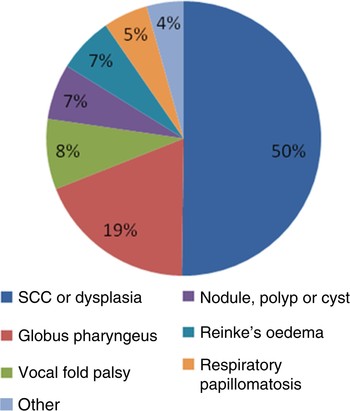
Patients' diagnostic groupings are shown in Figure 1.
Diagnostic groupings (n = 272 patients). SCC = squamous cell carcinoma

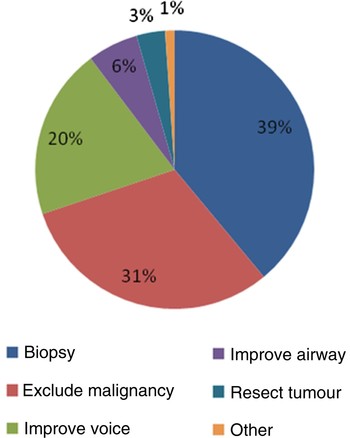
The aims of patients' procedures are shown in Figure 2.
Procedure aims (n = 272 patients).

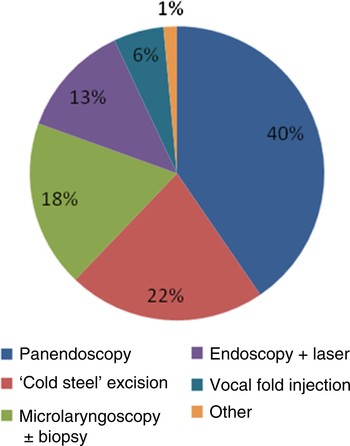
The types of procedures are shown in Figure 3. A range of procedures was performed, including panendoscopy, microlaryngoscopy with and without laser, ‘cold steel’ excision, and vocal fold injection.
Procedure types (n = 272 patients).

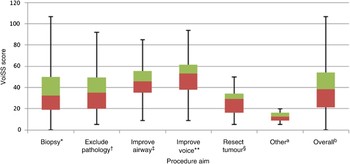
Pre-operative Voice Symptom Scale scores were recorded for 250 patients. These results are displayed, grouped by diagnosis, in Figure 4.
Patients' pre-operative Voice Symptom Scale scores, by procedure aim. n = *96, †78, ‡15, **50, §9, a2 and b250.

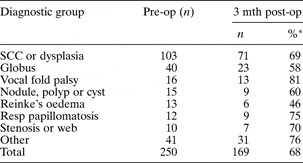
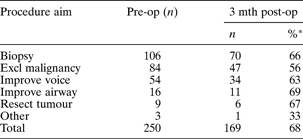
Of these 250 patients, 169 (68 per cent) returned a completed Voice Symptom Scale questionnaire three months post-operatively.
Patients' response rates varied by diagnostic group and procedure aim (Tables I and II). High three-month response rates were noted for patients diagnosed with vocal fold palsy, respiratory papillomatosis, and stenosis or web. Lower three-month response rates were noted for patients with Reinke's oedema and globus pharyngeus. High three-month response rates were noted for patients undergoing surgery aiming to biopsy lesions, resect tumour or improve the airway, while lower response rates were noted for patients undergoing procedures aiming to exclude pathology.
Patients completing VoiSS questionnaire, by diagnostic group

*Percentage of pre-operative (pre-op) responders. VoiSS = Voice Symptom Scale; mth = month; post-op = post-operative; SCC = squamous cell carcinoma; resp = respiratory
Patients completing VoiSS questionnaire, by procedure aim
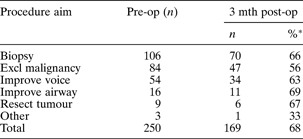
*Percentage of pre-operative (pre-op) responders. VoiSS = Voice Symptom Scale; mth = month; post-op = post-operative; excl = exclude
The low numbers in each diagnostic group made patient response rates difficult to interpret when categorised by diagnosis, although three-month response rates for patients of all diagnoses, except those with Reinke's oedema, were fairly consistent at 58–81 per cent. When categorised by procedure aim, patients' three-month response rates again had a fairly narrow range, 56–69 per cent.
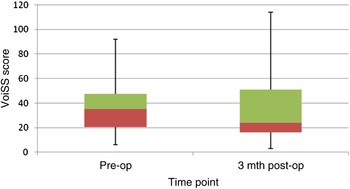
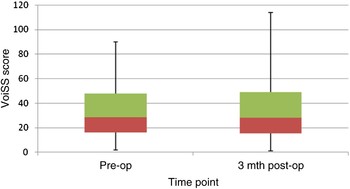
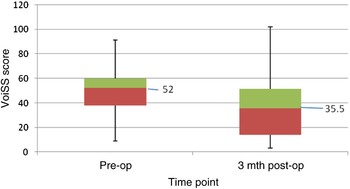
Figures 5 to 7 show pre-operative and three-month post-operative Voice Symptom Scale scores for patients undergoing surgery to exclude pathology, to obtain a biopsy or to improve their voice.
Pre-operative (pre-op) and three-month post-operative (3 mth post-op) Voice Symptom Scale scores in patients undergoing surgery to exclude pathology.

Pre-operative (pre-op) and three-month post-operative (3 mth post-op) Voice Symptom Scale scores in patients undergoing surgery to obtain a biopsy.

Pre-operative (pre-op) and three-month post-operative (3 mth post-op) Voice Symptom Scale scores in patients undergoing surgery to improve their voice. Numbers indicate median VoiSS scores.

Patients undergoing surgery in order to improve their voice had a statistically significant improvement in Voice Symptom Scale scores at three months, compared with pre-operative measurements (p = 0.01). No statistically significant change in Voice Symptom Scale score was noted for patients undergoing surgery for any other reason.
Discussion
Endolaryngeal surgery forms a large part of the general otolaryngologist's practice. However, little is known about the demographics, procedure types or surgical outcomes of patients undergoing endolaryngeal surgery in such generalist practice.
As surgical education develops, trainees are more often expected to achieve competency-based goals. Furthermore, trained practitioners are now favouring methods of outcome assessment that lend themselves to recertification and revalidation.
Unlike other previously published endolaryngeal surgical series, this study collected data on all central aspects of endolaryngeal surgical practice. Clinical and surgical data were collected for all patients. A Voice Symptom Scale questionnaire was completed pre-operatively by 92 per cent of patients, of whom 68 per cent returned a completed questionnaire three months post-operatively.
We recorded patients' diagnoses, procedure types and procedure aims, enabling other results to be grouped and analysed under these headings. We analysed patients' responses rates by procedure aim and by diagnosis, although the numbers in the latter group of categories were small.
We did not exclude patients with diagnoses which may have affected outcome. For example, when undertaking outcomes analysis, we did not exclude patients with respiratory papillomatosis from the patient group undergoing surgery with the aim of voice improvement, although papillomatosis patients were likely to do poorly compared with those with vocal fold palsies, nodules and polyps. Likewise, patients who went on to receive treatment for head and neck cancer were not excluded from the patient group undergoing surgery to obtain a biopsy, although clearly such a diagnosis would be likely to affect outcome.
Patients' three-month response rates varied according to the aim of their surgery. Although a 68 per cent response rate to a postal questionnaire is acceptable, an increase would be desirable. The introduction of standardised patient follow up at three and six months, with collection of self-reported measures of vocal morbidity as part of the out-patient visit, would encourage incorporation of outcomes auditing into routine clinical practice, and could result in higher response rates.
Although previous studies have presented outcome data obtained from disease-specific research trials conducted within specialists units, outcomes for the general laryngologist remain largely unreported. One of the difficulties of collecting such data is the heterogeneity of patients and clinical practice within a general laryngology practice. Furthermore, the complex nature of endolaryngeal surgery makes outcomes difficult to monitor in a comparable fashion.
Scottish data indicate that over 3182 endoscopic laryngeal procedures were performed in that country in 2007–2008 (NHS Scotland Information Services, personal communication). This suggests that such procedures form a significant part of ENT practice, and as such should be audited as part of a clinical governance commitment. Indeed, ENT UK has identified microlaryngeal surgery as a potential indicator procedure for recertification and revalidation of laryngology practice (Personal Communication: ENT UK Head and Neck Group). The Microlaryngeal patient population includes a wide range of ages presenting with benign or malignant disease. Furthermore, procedures vary from examination under anaesthesia to laser resections, and may be investigative, curative or occasionally palliative. This heterogeneity of practice makes data collection challenging and comparative outcomes auditing difficult.
Many specialties have developed minimum datasets to standardise data collection.Reference Maughan, Morris, Forman and Quirke9, Reference Thomas, Emberton and Mundy10 Otolaryngologists have developed minimum datasets which are specific for disease,Reference Johnson11 out-patient procedureReference Singh and Lyons12 and surgical intervention.Reference Dutt and Pahor13 By developing a minimum dataset for endolaryngeal surgery, we hope to assist characterisation of general laryngology practice and to facilitate comparative audit within the specialty.
In the present study, our aim was to produce a research tool which would be quick to complete and would provide accurate information on a large group of patients. To construct this dataset, we first identified the relevant clinical and operative information required for each case, and then incorporated the relevant data fields into an easily accessible datasheet. We also added to the datasheet fields for pre- and post-operative scores derived from the Voice Symptom Scale questionnaire, a validated, patient-reported outcome measure.
The results from this two-year study suggest that our minimum dataset allows information to be reliably recorded for all patients presenting for endolaryngeal surgery. Post-operatively, we undertook multiple questionnaire mailings to achieve acceptable return rates. The Voice Symptom Scale questionnaire appeared to provide a reliable pre-operative assessment of vocal morbidity, and also generated useful follow-up data three months post-operatively.
• Within general laryngology practice, heterogeneity of patients and treatments makes data collection challenging
• Little evidence is available on endolaryngeal surgical outcomes within general laryngology practice
• Standardising data collection would allow collaboration between practitioners
• The presented minimum dataset for endolaryngeal surgery allows collection of relevant and usable data, which can be used to analyse practice and outcomes
• This dataset could be used in both research and audit settings
This study reflects a single surgeon's practice within a university teaching hospital. The described minimum dataset enables subgroup analysis by patient diagnosis, although the individual laryngologist will find that numbers within such diagnostic groupings are small. However, as experience with this dataset grows, and as collaborative efforts are reported, it is hoped that more extensive information will become available for subgroup analysis.
The outcomes from this pilot study certainly indicate trends that might be expected. Patients undergoing procedures intended to improve their voices reported a statistically significant reduction in Voice Symptom Scale scores; we consider this to reflect a clinically significant improvement in vocal morbidity. Patients undergoing surgery in order to exclude pathology or to obtain a biopsy had no statistically significant change in Voice Symptom Scale score. Larger patient numbers would enable further analysis of this type.
In order for any minimum dataset to be accepted, it must be relevant, usable and capable of producing reliable results. We employed a structured pro forma presented on a single A4 sheet. This presentation minimised the surgeon's time spent on data entry, but still allowed sufficient information to be collected.
Electronic copies of the minimum dataset, for personal use or collaboration, may be obtained from http://www.entscotland.org, or directly from the corresponding author via the e-mail address below.
Conclusion
Modern surgical practice requires audit of activity and outcome. This has been difficult to achieve for general laryngologists due to the heterogeneity of their practice. We have developed a succinct, relevant and usable minimum dataset which can characterise both surgical activity and clinical outcomes at three months. In a research setting, this tool could be used to determine best practice; it could also be used as an endolaryngeal surgery audit tool for the purposes of recertification and revalidation.
Appendix 1. Minimum dataset for endolaryngeal surgery
Patient ID label:
Date of surgery:
Primary diagnosis:
Pre-op VoiSS score:
Aim of procedure (including subsequent treatment)
– Improve voice quality
– Improve airway
– Obtain biopsy with no deterioration in voice
– Exclude malignancy
– Resect tumour
– Other:
Procedure:
3-month post-operative VoiSS score: