Hydatina zonata commonly called paper bubble shell is a rare form and known to be endemic to the Indo-Pacific region. The species was earlier reported from India from Chennai, Pamban, Kundukkal Point and Mandapam (Satyamurti, Reference Satyamurti1952; Sundaram, Reference Sundaram1969) along the south-east coast, and once from Gujarat (Menon et al., Reference Menon, Datta and Das Gupta1961) on the north-west coast. While a few reports exist of empty H. zonata washed ashore (Satyamurti, Reference Satyamurti1952), the present finding is the first record of a live form from the north-east coast.
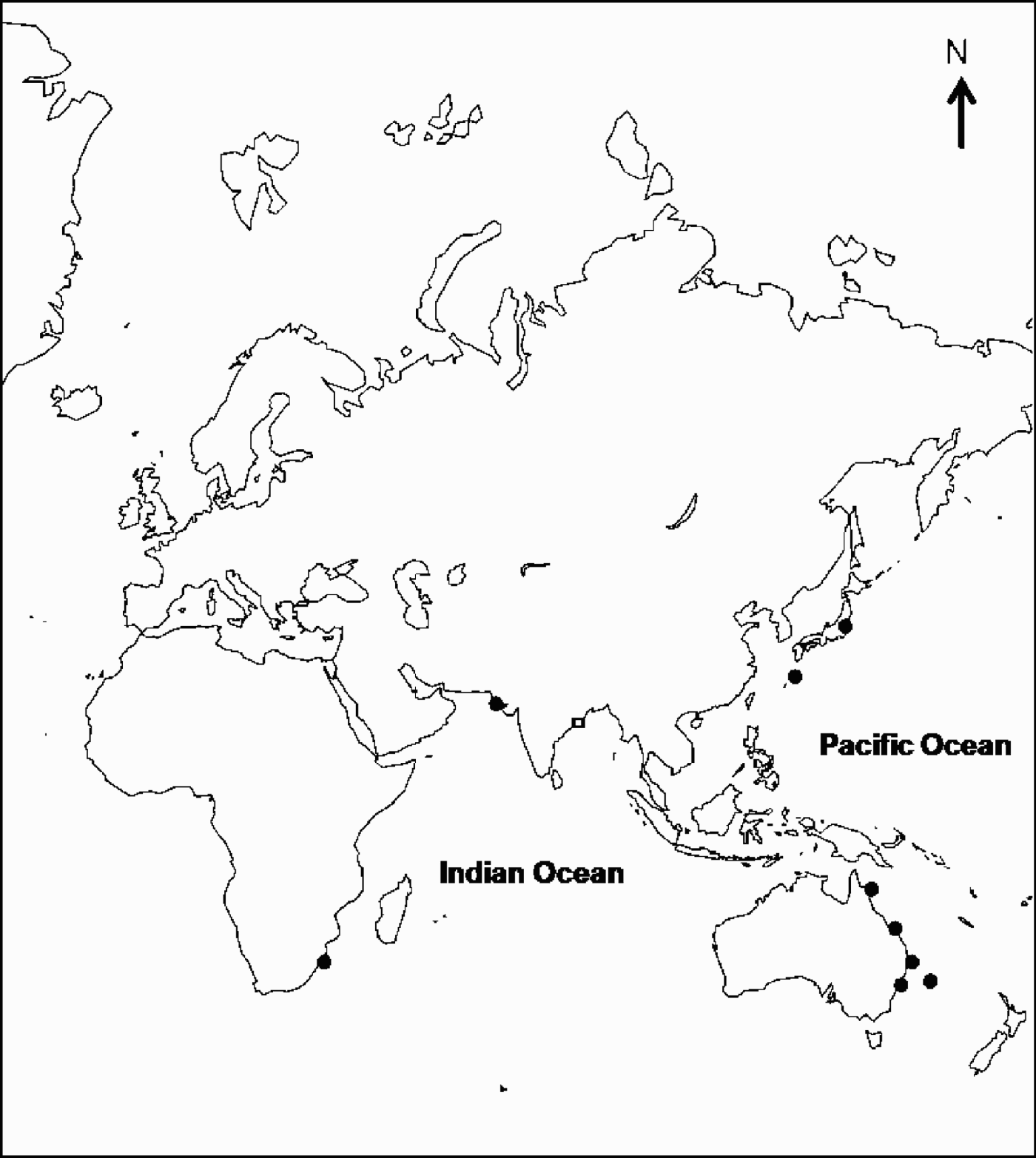
The Global Biodiversity Information Facility (2009) cited that H. zonata is reported from South Africa, Australia, India (west coast of India), the Philippines and Japan (Figure 1). Rudman (Reference Rudman1972) studied the anatomy of the genus Hydatina and the functioning of the mantle cavity and alimentary canal. Voskuil (Reference Voskuil1995) gave an account of living species of the genus Hydatina from the Marquesa Islands (e.g. H. physis, H. vesicaria, H. albocincta, H. zonata and H. amplustre) with the description of a new species viz., Hydatina exquisita sp nov.
Distribution of Hydatina zonata in the Indo-Pacific region. Filled circles denote the earlier records and the open square depicts a new report from the north-east coast of India.

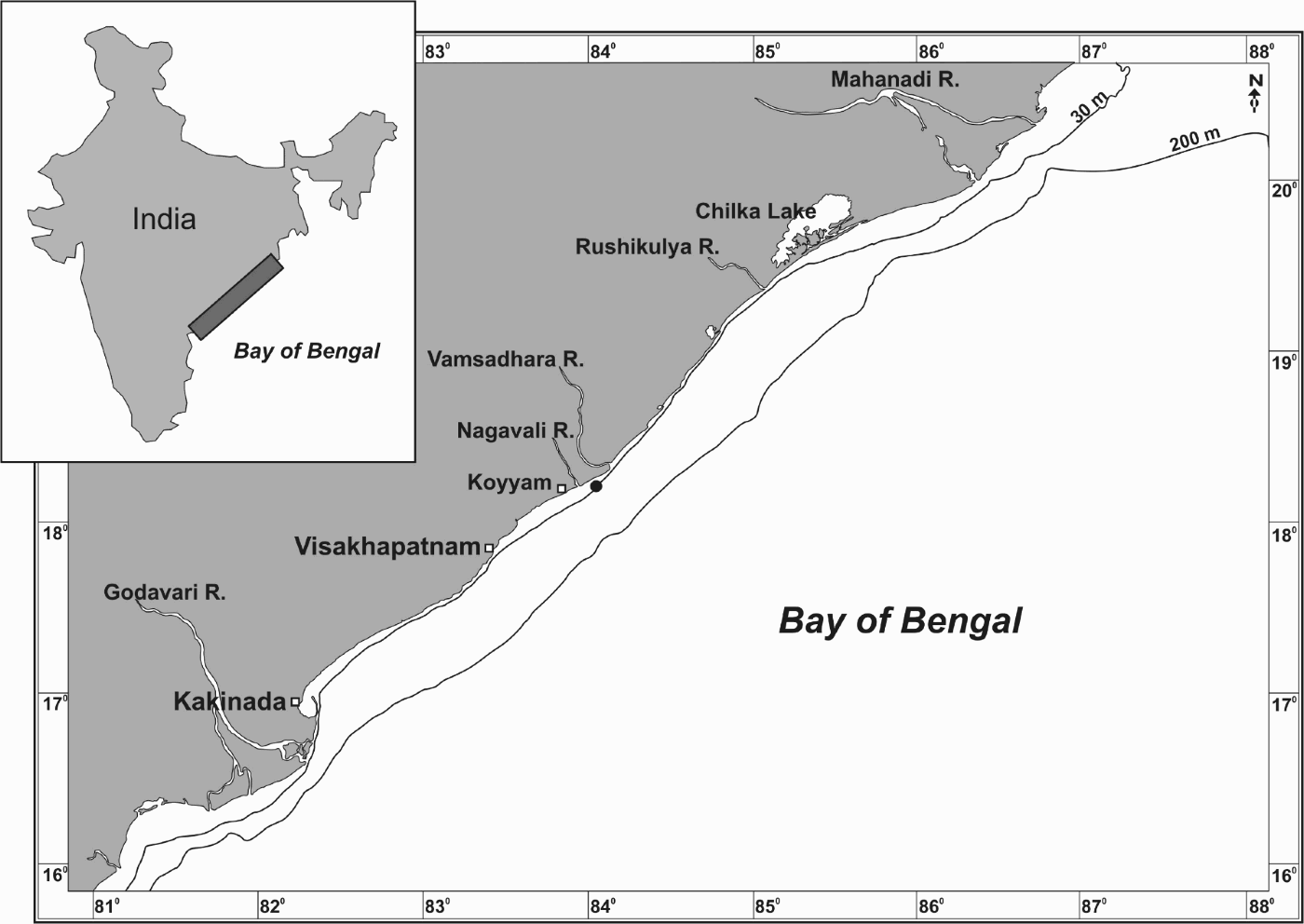
While engaged in a study on marine molluscs from the Indian north-east shelf, we have come across in trawl catches a single individual of Hydatina zonata (Lightfoot, Reference Lightfoot1786), uncommon for this coast until now, at a depth of 30 m (silty sediment) off Koyyam (18°09′58″N 83°52′12″E) in Andhra Pradesh where the River Vamsadhara opens into the Bay of Bengal (Figure 2). Hydatina zonata was noticed along with several cones (up to 6 individuals) namely Conus loroisii Kiener, 1845 and C. figulinus Linnaeus, 1758. All were living specimens and are vermivorous. Subba Rao (Reference Subba Rao2003) reported that hydatids are vermivorous, feeding exclusively on cirratulid ploychaetes. It is noteworthy that Ganesh & Raman (Reference Ganesh and Raman2007) observed high abundance of cirratulids polychaetes on the Indian north-east shelf along with other families viz., spionids, pilargids and cossurids, where the sediment texture is in silty (silty-clay or clayey-silt). This could be related to preference for polychaete/cirratulid ground by the bubble shells and cones (Conus loroisii and C. Figulinus—both are also vermivorous) at least for the time of study.
Map showing the sampling site.

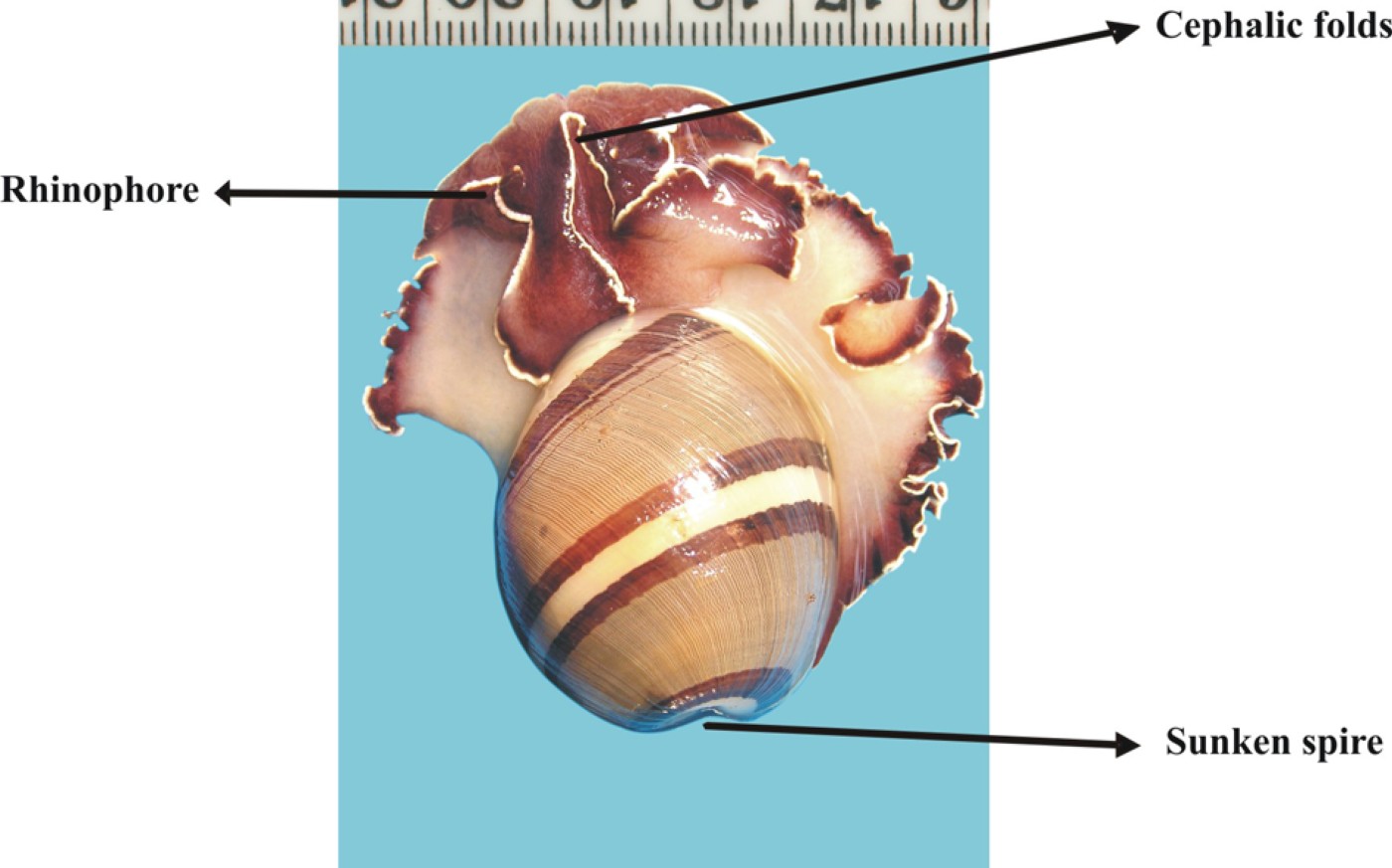
Hydatina zonata.

DESCRIPTION
Shell ovoid, fragile and thin, light straw colour with dark brown broad spiral band enclosing white, one near its sunken spire, another in the middle of the body whorl and third one at its lower part. Suture is deep, aperture broad, thin, sharp and surface smooth. Foot is very large, broad and extends beyond the shell while moving. Cephalic shield has two pairs of anterior lobes. Rhinophores are long and broad. The border of the foot, rhinophores, and cephalic shield are margined with white colour, followed by dark chocolate and gradually lighter in the middle. Lower part of the foot is light brown.
Measurements: shell length 34 mm; width 30 mm.
Hydatina occur at depths between 10 and 50 m in fine sand. The species was reported earlier as Hydatina velum (Gmelin, 1791) which is its synonym.
ACKNOWLEDGEMENTS
This work was carried out with financial assistance provided by the Ministry of Environment and Forests, Government of India. We are grateful to the Director, Centre for Marine Living Resources & Ecology, Ministry of Earth Sciences, Kochi for encouragement. Facilities at the Marine Biological Laboratory, Andhra University were utilized.