Introduction
Soybean (Glycine max) is a globally important legume, providing essential protein for human consumption and livestock feed, while also contributing significantly to biofuel production and soil nitrogen fixation (Pagano and Miransari, Reference Pagano and Miransari2016). However, soybean aphids (Aphis glycines) (Hemiptera: Aphididae), invasive pests native to Asia, cause devastating yield losses of 40-60% through direct feeding and viral transmission. In major producing regions (USA, Brazil, Argentina, China), aphid outbreaks reduce seed quality and photosynthetic capacity, resulting in billions of dollars in losses annually (Masuda and Goldsmith, Reference Masuda and Goldsmith2009). Climate change exacerbates this threat by expanding the aphid’s geographic range and reproductive window (Hullé et al., Reference Hullé, d’Acier, Bankhead-Dronnet and Harrington2010; Skendžić et al., Reference Skendžić, Zovko, Živković, Lešić and Lemić2021; Rahman et al., Reference Rahman, Rostás and Vosteen2025). Current reliance on chemical insecticides such as pyrethroids and neonicotinoids offers rapid suppression but escalates resistance development in aphid populations with repeated use (Bass et al., Reference Bass, Puinean, Zimmer, Denholm, Field, Foster, Gutbrod, Nauen, Slater and Williamson2014; Kaleem Ullah et al., Reference Kaleem Ullah, Gao, Sikandar and Wu2023). Moreover, non-target effects on pollinators and beneficial arthropods raise ecological concerns, while residue limits pose challenges for international trade (Liang et al., Reference Liang, Xiao, Ojo, Chao, Ahmad, Alam, Abbas, Abdelhafez, Rahman and Khan2025). Therefore, sustainable alternatives are urgently needed to protect both crop yields and ecosystem integrity in soybean agroecosystems.
Integrated pest management (IPM) combines biological control (e.g. parasitoid wasps), resistant cultivars, and cultural practices, yet efficacy remains inconsistent against rapidly adapting aphid biotypes (Bansal and Michel, Reference Bansal and Michel2015; Ali et al., Reference Ali, Munawar, Abbas, Khan, Ghramh, Li, Chen and Bayram2025). While soybean forms mutualistic associations with rhizobia and arbuscular mycorrhizal (AM) fungi to facilitate nitrogen fixation (Pagano and Miransari, Reference Pagano and Miransari2016), these interactions do not deter aphid infestations. Silicon (Si), a natural plant defence elicitor, offers promise by reinforcing host resistance through both physical and biochemical mechanisms. Recent studies highlight the superior efficacy of silica nanoparticles (SiNPs) over bulk silica due to their enhanced foliar adhesion, uptake efficiency, and reactivity at the nano-scale (Reynolds et al., Reference Reynolds, Padula, Zeng and Gurr2016; Kumar and Bhandari, Reference Kumar and Bhandari2022; Kumar et al., Reference Kumar, Choudhary, Kaur, Singh, Guha, Choudhary, Sonkar, Mehta and Husen2025; Mukarram et al., Reference Mukarram, Corpas and Lux2025).
Physically, SiNPs promote lignin and suberin deposition in plant cell walls, reducing palatability and tissue digestibility for phloem-feeding insects such as aphids (Ali and Bijay-Singh, Reference Ali and Bijay-Singh2025; Bathoova et al., Reference Bathoova, Svubova, Gimes, Kostolani, Slovakova and Martinka2025). Biochemically, they prime plant defence by activating the jasmonic acid (JA) signalling pathway, enhancing systemic resistance and inducing key secondary metabolites, including phenolics and terpenoids (Ye et al., Reference Ye, Song, Long, Wang, Baerson, Pan, Zhu-Salzman, Xie, Cai and Luo2013; Vivancos et al., Reference Vivancos, Labbé, Menzies and Bélanger2015; Hall et al., Reference Hall, Waterman, Vandegeer, Hartley and Johnson2019). Moreover, SiNPs stimulate herbivore-induced plant volatiles (HIPVs) that attract natural enemies, reinforcing tritrophic interactions as observed in rice and cucumber systems (Kvedaras et al., Reference Kvedaras, An, Choi and Gurr2010; Reynolds et al., Reference Reynolds, Padula, Zeng and Gurr2016). Besides pest deterrence, SiNPs also confer abiotic stress resilience by improving photosynthetic efficiency, root hydraulic conductivity, and antioxidant enzyme activities (Superoxide Dismutase (SOD), Catalase (CAT), Ascorbate Peroxidase (APX)), ultimately enhancing plant vigour under stress (Gupta et al., Reference Gupta, Sahoo, Anwar, Nongpiur, Deshmukh, Pareek and Singla-Pareek2021; Riaz et al., Reference Riaz, Kamran, Fahad and Wang2023; Mukarram et al., Reference Mukarram, Khan, Kurjak, Lux and Corpas2023, Reference Mukarram, Corpas and Lux2025). Despite these promising properties, the application of SiNPs in soybean systems remains underexplored, particularly regarding their influence on aphid fitness, behaviour, and soybean growth parameters.
This study aimed to: (1) quantify SiNPs effects on soybean aphid survival, fecundity, and weight gain; (2) evaluate feeding preference and olfactory responses to detect behavioural avoidance; (3) measure changes in soybean growth parameters (height, leaf dimensions, root/shoot biomass); and (4) identify concentration-dependent trade-offs between pest suppression and plant development. We hypothesised that SiNPs would suppress aphid performance and concurrently enhance plant vigour. Experiments spanned six assays: aphid fecundity, mortality, feeding choice (preference), weight gain, Y-tube olfactometry, and comprehensive plant morphometrics. This study investigates the effects of SiNPs on soybean aphid performance and plant growth, providing insight into their potential role in sustainable IPM.
Materials and methods
Insects
A colony of aphids, soybean aphids (Aphis glycines) (Hemiptera: Aphididae), was established from a field population collected at the Teaching and Research Base of Jilin Agricultural University. Aphids were reared on soybean seedlings in insect treatment cages (60 × 60 × 60 cm) under controlled environmental conditions (20 ± 2 ℃, 50 ± 10% relative humidity (RH), photoperiod 16 L: 8 D).
Plants
Soybean seeds were obtained from the Soybean Research Institute of Jilin Academy of Agricultural Sciences and were individually planted in a 7 cm pot filled with soil (Huazhidu Garden & Horticulture Co., Ltd., Hebei Province, China). Plants were grown under controlled environmental conditions (22 ± 2 ℃, 50 ± 10% RH, photoperiod 16 L: 8 D), and experiments used plants at the three-leaf stage.
SiNP characterisation
The SiNPs used in this study were purchased in powder form (purity 99.8% SiO₂) from Hongwu Material Technology Co., Ltd. (Guangzhou, Guangdong, China). To verify the manufacturer’s specifications and determine their physicochemical properties, the SiNPs were characterised by Shanghai Fuda Testing Technology Group Co., Ltd. Scanning Electron Microscopy (SEM) confirmed nanoscale size and spherical-to-subspherical morphology, with primary diameters of 36.14, 48.61, 51.37, and 56.38 nm, slightly larger than the manufacturer’s stated range, likely due to partial aggregation in aqueous suspension (fig. 1). Surface charge and colloidal stability were measured by dynamic light scattering (DLS) using a nanoparticle size and zeta-potential analyser. The zeta potential was −38.9 mV, indicating high electrostatic repulsion and a stable dispersion. These results confirm that the SiNPs possess nanoscale uniformity, high chemical purity, and excellent suspension stability.
Scanning electron microscopy (SEM) image of the silicon nanoparticles (SiNPs) used in this study.

Plant treatment
The treatment method was adapted from Ali et al. (Reference Ali, Wei, Mahamood, Zhou, King, Zhou and Shamsi2023). Plants were sprayed with an aqueous solution of SiNPs at four different concentrations: 0.25, 0.50, 0.75, and 1 mM. Control plants were treated with distilled (deionised) water. For treatment, an Oshide spray bottle (100 mL; Zhengzhou Xinrui Tongda Metal and Material Co., Ltd., Zhengzhou, China) was used to apply the SiNPs solution. Five trigger pulls (400 μL per plant) were applied from a distance of 30 cm. The 7-day interval between SiNP application and aphid introduction was selected based on both our preliminary trials, which showed significant differences in the studied parameters, and on literature precedent. Previous studies have reported that notable metabolic and biochemical changes in plants induced by SiNPs occur within this timeframe (Zhao et al., Reference Zhao, Wang, Zhang, Zheng, Li, Cao, Cao and Huang2022; Zhou et al., Reference Zhou, Liu, Sun, Li, Yang, Jia, Cai, Zhu, Yin and Liu2022). To prevent cross-treatment interactions, control and SiNPs-treated plants were placed in separate rooms under identical environmental conditions (20 ± 2°C, 45 ± 5% RH, 16 L: 8 D photoperiod).
Plant growth traits
Soybean plants at the three-leaf stage were used to evaluate the effects of nano-silica (SiNP) treatments on plant growth. Plants were grown under controlled environmental conditions (20 ± 2°C, 40 ± 10 % RH, 16 L: 8 D photoperiod) and subjected to five treatments: control (untreated) and four SiNP concentrations (0.25, 0.50, 0.75, and 1.0 mM), with ten replicates per treatment. The following growth parameters were measured before treatment and one week after application: plant height, measured as the vertical distance from the soil surface to the apex of the longest stem; leaf length (base to tip) and leaf width (maximum perpendicular distance) on the longest fully expanded leaf. After the final assessment, plants were harvested to determine root length (from the root-shoot junction to the tip of the longest root), fresh biomass of shoots and roots, and dry biomass following drying at 80°C for 24 h to a constant weight (Mukarram et al., Reference Mukarram, Khan and Corpas2021).
Aphid performance (survival and fecundity)
Survival and fecundity of A. glycines were evaluated by confining ten adult apterous aphids in a single clip cage (25 mm diameter) attached to the abaxial surface of a leaf of treated and control plants. Plants were maintained for 48 h in controlled environment rooms (20 ± 2°C, 50 ± 10% RH, 16 L: 8 D photoperiod). After this period, the number of surviving adults and produced were recorded (n = 15 replicates per treatment).
Aphid population
To evaluate population growth, three newly developed adult apterous A. glycines were transferred to each soybean plant (control and treated). Each plant was individually enclosed with a ventilated transparent plastic cup (5 cm diameter × 15 cm height) and maintained under controlled environmental conditions (20 ± 1 °C, 40 ± 10% RH, 16 L: 8 D photoperiod) for 7 days to allow for extended feeding and reproduction. The total number of aphids (adults and nymphs) on each plant was then counted (n = 15 replicates per treatment).
Aphid preference bioassay
The feeding preference of adult aphids was assessed using a choice bioassay with leaf discs from SiNP-treated plants. One week after treatment, five leaf discs (25 mm diameter), one from each treatment (control, 0.25, 0.50, 0.75, 1.0 mM SiNPs), were placed equidistantly on moistened filter paper in a 20-cm Petri dish. Fifty starved (2 h) adult apterous A. glycines were released at the centre. Sealed dishes were maintained under controlled conditions (20 ± 1°C, 40 ± 10% RH, 16 L:8D), and the number of aphids settled on each disc was recorded after 24 h (Kumar et al., Reference Kumar, Atri, Sangha and Banga2011). All discs were from comparable leaf positions to ensure uniformity (n = 10 replicates).
Aphid weight gain
To determine the effect of SiNPs treatment on aphid weight gain, nymphs were obtained from adults that had fed on treated or control plants for 24-h period. For each replicate, ten of these newly produced nymphs were collectively weighed in a 1.5 mL Eppendorf tubes using an electronic to obtain an initial weight. The nymph group was then placed back onto its respective plant. After 7 days, aphids were recollected and reweighed to calculate weight gain (final – initial weight). Ten replicates were conducted per treatment.
Olfactometer assay
A Y-tube olfactometer (10 cm stem, 15 cm arms, 2 cm internal diameter), was used to evaluate the behavioural responses of adult apterous A. glycines to volatiles from SiNP-treated plants. Charcoal-filtered air was maintained at 200 mL/min into each arm, connected via PTFE tube to two glass jars (30 × 20 cm) serving as odor chambers, one containing a SiNP-treated plant and the other an untreated control. Before testing, all apparatuses were cleaned with 70% ethanol, and aphids were acclimatised to experimental conditions for 1 h. In each replicate, ten adult soybean aphids were released at the Y-tube base and observed for 10 min. A choice was recorded if an aphid moved at least one-third into either arm (Ahmad et al., Reference Ahmad, Ali, Alam, Abbas, Huang, Zhao, Hamza, Ali, Khan and Ghramh2025; Yang et al., Reference Yang, Ali, Ahmad, Yang, Huang, Zhao, Alam, Khan, Ghramh and Rahman2025). To control for positional bias, odor sources and olfactometer arms were swapped every three replicates. The experiment included four independent series (0.25, 0.50, 0.75, and 1.0 mM SiNPs vs. control), with 30 replicates per concentration using fresh plants and aphids each time.
Statistical analyses
The datasets were recorded as either count, ratio, or decimal data and were modelled using a generalised linear model with Poisson binomial and Gaussian distributions, respectively, depending on their nature (Faraway, Reference Faraway2016 ;Dunn and Smyth, Reference Dunn and Smyth2018). The number of aphids choosing between olfactometer arms were treated as a preference index (PI = (T-C)/(T + C), where T is treatment, and C is control), which was afterwards subjected to one sample t-test. Anova function of car package generated model statistics. Multiple comparison tests using the Tukey approach via the glht function from the multcomp package facilitated group comparisons. All figures were derived using the facilities of the package ggplot2 (Wickham et al., Reference Wickham, Chang, Henry, Pedersen, Takahashi, Wilke, Woo, Yutani, Dunnington and van den Brand2025) with the help of several other packages such as dplyr, officer, and rvg. All statistical evaluations were made in R (v4.5.0) using Rstudio (v2025.05.0) (R Core Team, 2025).
Results
Aphid survival and weight gain
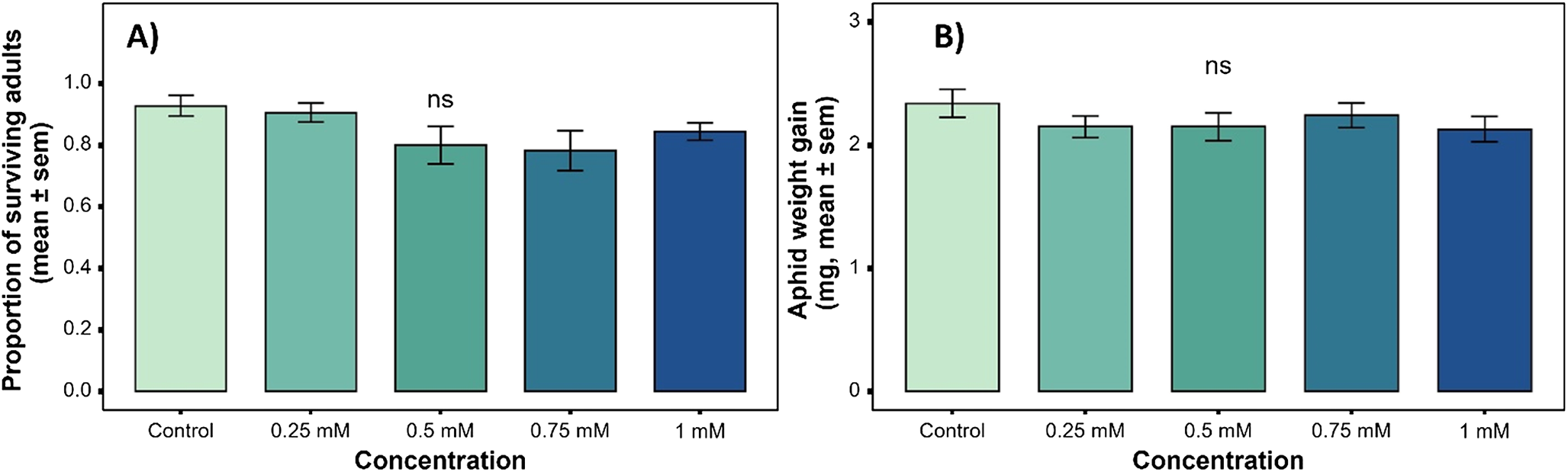
The proportion of surviving aphids (χ24 = 8.33, P = 0.080) (mean; 0.5 mM = 0.80 ± 0.061; control = 0.93 ± 0.033) and aphid weight gain (χ24 = 0.14, P = 0.998) (mean; 1 mM = 2.13 ± 0.103; control = 2.34 ± 0.115) were not significantly affected by SINPs treatments (fig. 2).
The proportion of surviving Aphis glycines and weight gain of Aphis glycines on soybean (Glycine max) plants treated with different concentrations of silicon nanoparticles (SiNPs). The annotation ‘ns’ indicates no significant difference between concentrations.

Aphid fecundity
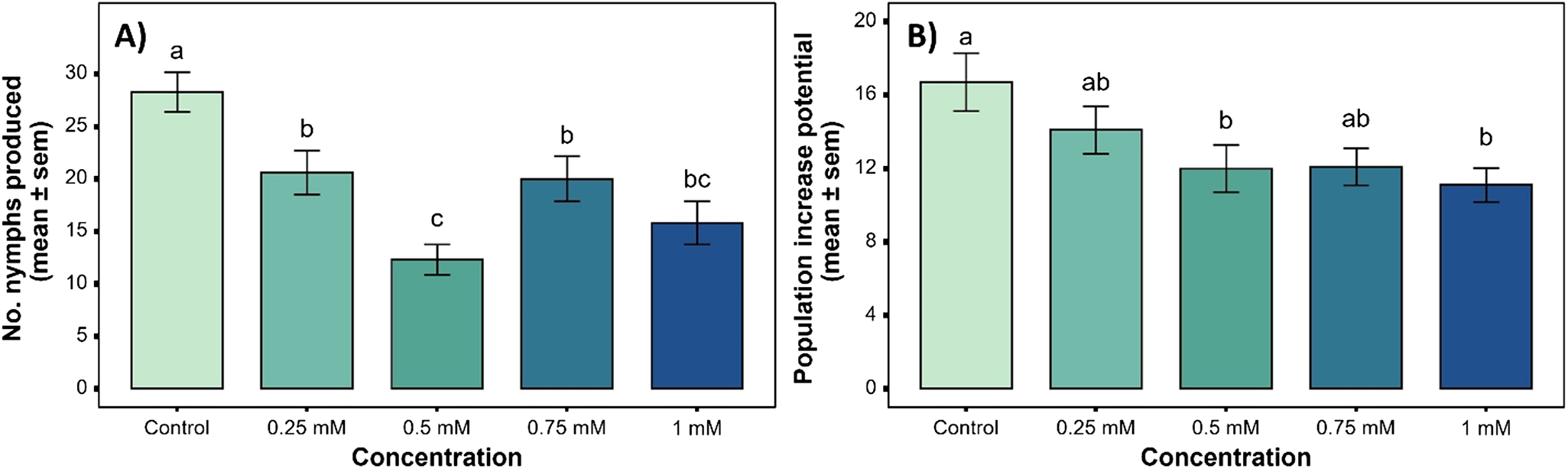
Silica treatments significantly affected nymphal production (χ24 = 73.67, P < 0.001) (mean; 0.5 mM = 12.3 ± 1.438; control = 28.3 ± 1.89) and population increase potential (χ24 = 14.76, P = 0.005) (mean; 1 mM = 11.1 ± 0.91; control = 16.7 ± 1.58) of A. glycines aphids on soybean (G. max) plants. For example, the total number of nymphs produced per cage was reduced by all SiNP treatments (fig. 3A). Similarly, 0.5 and 1.0 mM concentrations of SiNPs reduced the population increase potential of A. glycines (fig. 3B).
Fecundity as the number of nymphs produced (A) and population increase potential of Aphis glycines on soybean (Glycine max) plants treated with different concentrations of silicon nanoparticles (SiNPs). Different lowercase letters indicate significant differences between treatments.

Aphid settlement
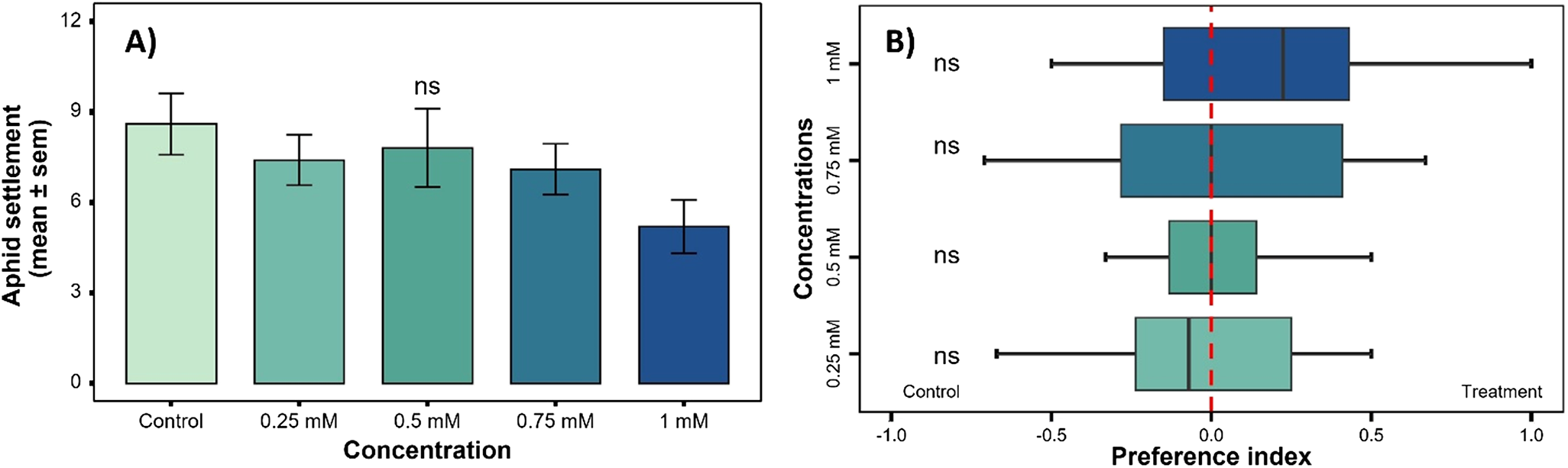
Neither settlement on (χ24 = 9.27, P = 0.055) (mean; 1 mM = 5.2 ± 0.89; control = 8.6 ± 1.02) nor the behavioural responses to (0.25 mM; t9 = − 0.55, P = 0.597, 0.5 mM; t9 = 0.43, P = 0.677, 0.75 mM, t9 = 0.14, P = 0.890 and 1 mM; t9 = 1.15, P = 0.279) host plants were significantly affected by SiNP treatments (fig. 4).
Aphid settlement on (A) and behavioural responses to (B) host. Soybean (Glycine max) plants treated with different concentrations of SiNPs. The annotation ‘ns’ means there was not any significant difference between concentrations.

Plant traits: change in leaf length and weight along with total plant height
The changes in above ground parts of host plant traits such as leaf width (χ24 = 45.43, P < 0.001)) (mean; 1 mM = 1.00 ± 0.104; 0.75 mM = 0.23 ± 0.044) and total height (χ24 = 17.99, P = 0.001) (mean; 1 mM = 2.48 ± 0.233; control = 4.00 ± 0.253) were significantly affected by SINPs treatments such that leaf width were increased with highest concentration while the two of highest concentrations reduced the total plant height (fig. 5). Treatment effect was not statistically significant for leaf length (χ24 = 7.76, P = 0.101) (mean; 1 mM = 0.85 ± 0.085; 0.75 mM = 0.50 ± 0.094).
Changes in leaf length (A) and width (B) along with plant total height (C) treated with different concentrations of SINPs. The annotation ‘ns’ means there was not any significant difference between concentrations. Different lower cases depict the differences between treatments.

Plant traits: dry stem weight and total plant weight
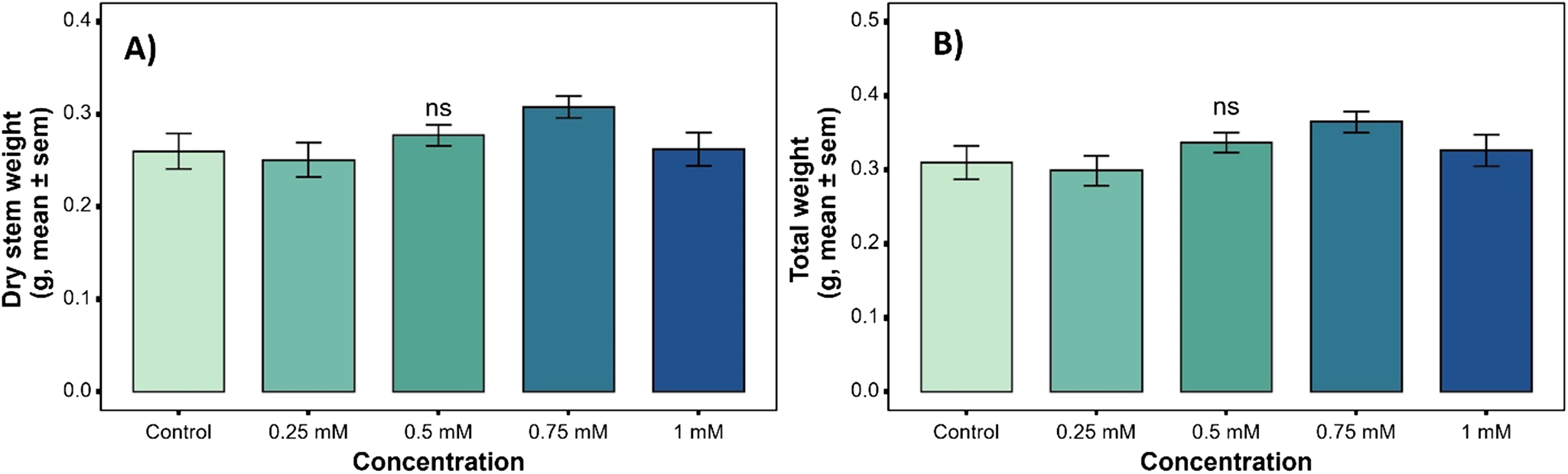
Dry stem weight (χ24 = 7.72, P = 0.102) (mean; 0.25 mM = 0.25 ± 0.019; 0.75 mM = 0.31 ± 0.012) and total plant weight (χ24 = 7.33, P = 0.119) (mean; 0.25 mM = 0.30 ± 0.020; 0.75 mM = 0.37 ± 0.014) were not significantly affected by SINPs treatments (fig. 6).
Dry stem weight (A) and total plant weight (B) upon SINPs treatments. The annotation ‘ns’ means there was not any significant difference between concentrations.

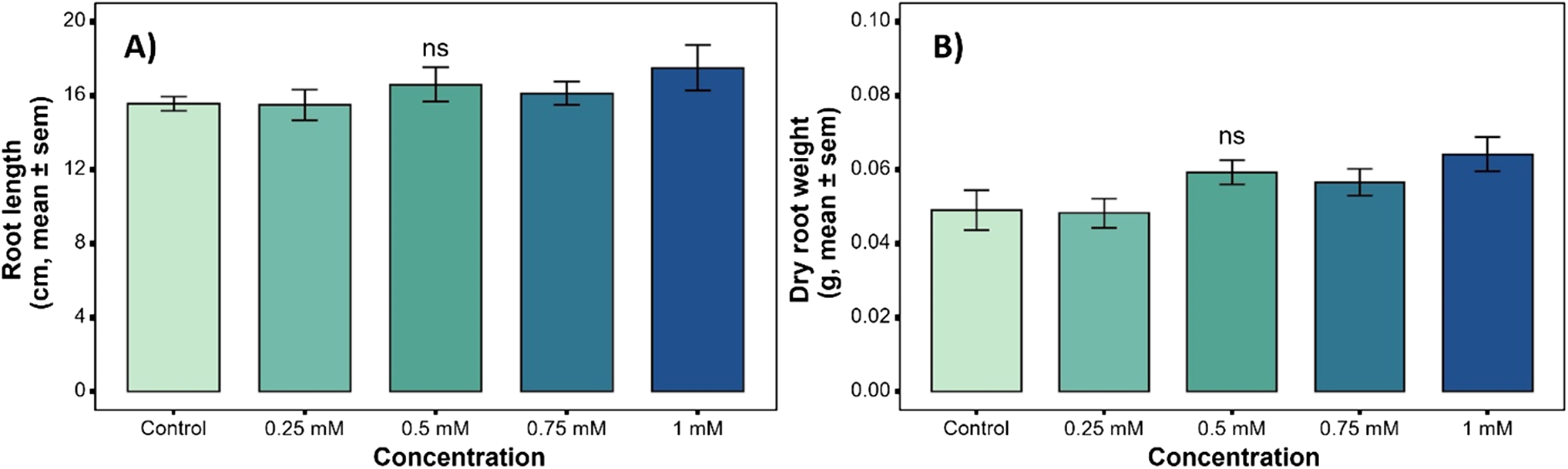
Root length χ24 = 3.84, P = 0.428) (mean; 0.25 mM = 15.50 ± 0.818; 1 mM = 17.50 ± 1.223) was not significantly affected by SiNP treatments (fig. 6). The treatment effect on dry root weight was statistically significant (χ24 = 10.323, P = 0.0359) (mean; 0.25 mM = 0.048 ± 0.0039; 1 mM = 0.064 ± 0.0046), while multiple comparison tests (Tukey) did not differentiate the treatments (fig. 7).
Root length (A) and dry root weight (B) upon SiNP treatments. The annotation ‘ns’ means there was not any significant difference between concentrations.

Discussion
This study demonstrates that SiNPs effectively suppress soybean aphid reproduction without triggering behavioural avoidance, though plant growth responses reveal complex trade-offs. Our hypothesis was partially supported: all SiNP concentrations (0.25–1 mmol/L) significantly impaired aphid fecundity and population growth potential, validating the pest control objective, without affecting survival, weight gain, or host-seeking behaviour. This absence of repellency is advantageous, as it could prevent pest dispersal and keep the population concentrated for sustained exposure to SiNPs and enhanced impact of natural enemies, a tritrophic benefit aligned with findings that SiNP-treated plants can enhance predator attraction like Paederus fuscipes via upregulated HIPVs (Thabet et al., Reference Thabet, Boraei, Galal, El-Samahy, Mousa, Zhang, Tuda, Helmy, Wen and Nozaki2021; Verma et al., Reference Verma, Song, Tian, Guo, Chen, Zhong, Nikpay, Singh, Rajput and Singh2021; Kanakhara et al., Reference Kanakhara, Panneerselvam, Packirisamy and Ezil Vendan2025). This non-repellent, reproduction-targeted mode of action is not without precedent; for example, mechanical damage in Brassica plants significantly suppressed aphid fecundity and settlement without eliciting a strong repellent response in a choice assay (Ali et al., Reference Ali, Mukarram, Abbas, Umar, Fleischer and Mohamed2024). This mode of action is consistent with Ji et al. (Reference Ji, Wang, Xue, Chen, Guo, Xiao and Wang2023), who also reported reduced aphid reproduction without noted repellency following nanosilica application.
The observed reproductive suppression likely stems from multiple mechanisms. SiNPs likely strengthen plant defences through physical barrier formation and induction of jasmonate signalling pathways, but direct physical actions are also plausible. Shoaib et al. (Reference Shoaib, Elabasy, Waqas, Lin, Cheng, Zhang and Shi2018) demonstrated that amorphous SiO₂ nanoparticles caused larval mortality in Plutella xylostella (Lepidoptera: Plutellidae) through cuticular disruption and dehydration and spiracles blockage. Similarly, Abd El-Wahab and El-Bendary (Reference Abd El-Wahab and El-Bendary2016) found that nano-silica hydrophilic sprays induced near-complete aphid mortality via direct contact toxicity, acting as a ‘physical and mechanical barrier’. These effects likely result from nanoparticle structure, and hygroscopic properties. This mechanical resistance is biochemically complemented by silicon’s ability to reconfigure plant metabolism, as shown by Jiang et al. (Reference Jiang, Qi, Wang, Liu, Han, Li and Wang2023), where tetraethyl orthosilicate (TEOS) silicon dramatically reduced wheat aphid density by depleting free amino acids and increasing soluble sugars and leaf silicon content, metabolic shifts aligning with nanosilica’s capacity to activate defensive enzymes.
Plant responses highlight a crucial trade-off between growth and defence allocation induced by SiNPs. The increase in leaf width at higher concentrations suggests improved photosynthetic potential and structural integrity, consistent with findings that nanosilica enhances gas exchange under stress (Hassan et al., Reference Hassan, Ajaj, Gaballah, Ogbaga, Kalaji, Hatterman-Valenti and Alam-Eldein2022). The concomitant reduction in plant height likely reflects a physiological reallocation of resources into defence (e.g. silicon deposition, defence compound synthesis) rather than vertical growth, a phenomenon supported by other silicon studies (Verma et al., Reference Verma, Song, Tian, Guo, Chen, Zhong, Nikpay, Singh, Rajput and Singh2021; Kanakhara et al., Reference Kanakhara, Panneerselvam, Packirisamy and Ezil Vendan2025) and Namjoyan et al. (Reference Namjoyan, Sorooshzadeh, Rajabi and Aghaalikhani2020), who reported silicon-induced changes in transpiration. Critically, the stability of shoot and root biomass demonstrates that this morphological shift did not compromise overall biomass accumulation, a key indicator of productivity and yield potential. Thabet et al. (Reference Thabet, Boraei, Galal, El-Samahy, Mousa, Zhang, Tuda, Helmy, Wen and Nozaki2021) found that even at 400 mg/L, SiNPs inhibited root elongation without affecting shoot parameters, underscoring the importance of concentration and delivery mode. The efficacy of SiNPs is formulation-dependent, with dust-based formulations showing stronger contact toxicity due to increased adherence (Abd El-Wahab and El-Bendary, Reference Abd El-Wahab and El-Bendary2016; Shoaib et al., Reference Shoaib, Elabasy, Waqas, Lin, Cheng, Zhang and Shi2018), insights critical for optimising field applications.
Although this study provides valuable insights into silicon-enhanced resistance against A. glycines, it is limited to a single soybean cultivar under controlled conditions. Genotypic variation in silicon uptake and defence responses (Kanakhara et al., Reference Kanakhara, Panneerselvam, Packirisamy and Ezil Vendan2025) suggests broader investigations are needed. Additionally, while findings imply plant-mediated impacts, direct physiological mechanisms (e.g. reproductive disruption) and the role of natural enemy were not assessed, despite evidence that silicon enhances defence metabolites (Khan and Siddiqui, Reference Khan and Siddiqui2020) and improves biological control (Kvedaras et al., Reference Kvedaras, An, Choi and Gurr2010). Long-term studies should address potential resistance development and environmental safety, and silicon accumulation in soil systems.
In conclusion, our laboratory findings suggest that SiNPs can suppress aphid populations by affecting reproduction without inducing behavioural avoidance. Their effect appears primarily suppressive rather than lethal, reducing population growth rather than causing immediate mortality. This partial suppression, along with ecological compatibility, indicates that SiNPs may be a component of a broader IPM strategy rather than a standalone solution. While the biomass preservation is encouraging, observed changes in plant morphology highlight the need for further agronomic investigation. This proof-of-concept under controlled conditions suggests that future studies could explore field validation, economic feasibility, delivery optimisation, and integration with other IPM tactics (e.g. biological control, resistant varieties) to better assess their potential for sustainable pest management.
Author’s contribution
Yunliang Ji: Conceptualisation, Methodology, Experiments, Writing-Original Draft; Reziwanguli Sulaiman: Methodology, Experiments, XiYao Xue: Methodology, Experiments, Li Bo: Methodology, Experiments; Han Xiao: Review and editing; Wang Dongze: Writing Review and Editing; Vol Oberemok: Review and editing; Mohammad Mukarram: Review and editing; Jamin Ali: Conceptualisation, Methodology, Experiments, Writing-Original Draft, Methodology; Adil Tonga: Conceptualisation, Writing-Original Draft, Data Analysis, Visualisation and Data Curation; Qiyun Li: Conceptualisation, Supervision, Funding, Project Administration, Resources, and Writing-Review and Editing; Rizhao Chen: Conceptualisation, Supervision, Funding, Project Administration, Resources, and Writing-Review and Editing.
Financial support
This work was supported by the Ministry of Science and Technology of China (2022YFD1500701).
Competing interests
The authors declare that they have no conflict of interest.
Data availability statement
Available upon reasonable request.