Introduction
Among scholars of South Asia, it is now regarded as a commonplace that the advent of formal colonial rule under the English East India Company brought with it a ‘rule of property’ that was more nominal than real. While the early colonial state may have proclaimed its commitment to creating a regime of private capitalist property, in actuality it delivered little of the sort. Not only did the Company's rule of law fail to suddenly disencumber property by freeing land into the market, it actively re-encumbered it in new ways—especially through its administration of Hindu personal law.Footnote 1 Relatedly, it is now conventional to hold that the British rule of property was premised on a fundamental mistake about the nature of private land rights in the subcontinent. Referring to the Madras Presidency, for example, Nicholas Dirks observes that in pre-colonial times rights involved heritable ‘shares’ in land recognized by and routinely redistributed through the intervention of kingly authority. With their ‘very different view of property rights’, Dirks continues, the British ‘misunderstood all this’ and instead assumed that ‘the owner must be either the cultivator or the king, thus creating many of the classificatory problematics of the land systems debates in the late eighteenth and early nineteenth centuries’.Footnote 2
Contemporary scholarship has thus emphasized that the early colonial state's founding rule of property was beset on all sides by a theory-practice divide.Footnote 3 The Company neither accurately represented the varieties of land control that existed during pre-colonial times, nor did it show much allegiance to its own oft-proclaimed ideal of rendering the freedom of property absolute. While this way of seeing things has challenged competing views about the revolutionary effects of the colonial rule of property,Footnote 4 it is hardly unprecedented. In fact, the idea that ‘property in India existed not as some independent entity but rather in the context of social and political relations’Footnote 5 became increasingly prominent among colonial administrator-intellectuals themselves, especially in the years after the transfer of power from Company to Crown in 1858. Of course, to some degree the late-nineteenth-century incarnation of this idea had deeper roots in skepticism about the colonial rule of property that had developed already in the lead up to and immediate aftermath of the permanent settlement of 1793 in Bengal, which witnessed the province's revenue demand being fixed in perpetuity. No sooner had Governor General Cornwallis selected Bengal's zamindar-magnates to bestow such security of expectation upon than earlier warnings claiming the zamindars were no more than tax-collecting intermediaries reappeared as condemnations of the failure of the so-called Cornwallis system.
Yet, even if earlier such criticism facilitated the triumph of the alternative ryotwari system outside of Bengal after 1814,Footnote 6 it seldom extended beyond asking whether the Company erred in its decision about who to designate as the subcontinent's ‘true proprietors’. Early dissatisfaction with the Cornwallis system thus crystallized around an allegation that the zamindars had been wrongly envisioned as improving English-style landlords. Consequently, the reticence about property's rule that followed from this allegation was markedly different from the revisionist assessment of the late nineteenth century. After 1860, increasingly discernible was instead the sense that earlier British colonial administrators had erred in assuming that the concept of property itself could be made to fit land control practices so particularized and disparate as those in India. Of course, the revisionist stance was never a condemnation of the colonial enterprise as a whole. Almost invariably, revisionist critics saw the Company's settlement policies as a necessary evil required to bring about a ‘modern’ form of landed property, even if ex nihilo; this can be gleaned from the larger context that gave rise to the revisionist temperament, marked as it was by mounting agrarian disturbance throughout the subcontinent. Especially after the Bengal Rent Act of 1859, it was a growing need to recognize sub-ownership rights that underlay the newfound emphasis on the theory-practice divide in which the colonial rule of property was seen to have been caught.Footnote 7
Yet even as late-nineteenth-century colonial administrator-intellectuals questioned the applicability of the ‘English concept’ of property to Indian land systems, their revisionism rarely led them to doubt the coherence of the concept itself. This was especially notable given the escalating controversy that was engulfing property in the metropolitan world after 1850, not only by its socialist critics but also increasingly from within the more conventional circles of Western legal thought. In this latter regard, in fact, most significant was not the rise of the well-known theory—most often attributed to Henry Maine—that property originated in ‘ancient law’ as a collective rather than individual institution,Footnote 8 but the dissolution of the idea that ‘the’ right to property constituted any single and distinct right at all. From the middle of the century, within the Anglo-common law as well as the continental legal mainstream, it was increasingly a view of the property right—and by extension, legal right more generally—as relative, disaggregable, and immaterial—rather than absolute, unitary, and physicalist—that was on the ascent. As I discuss further below, this relative, disaggregable, and immaterial view of the property right emerged from a larger transnational movement of juridical ideas after 1850 that went hand in hand with a deepening ethos of legal scientism. At least from the standpoint of the Western legal mainstream, this de-physicalized view of the property right marked both the culmination and the beginning of the eclipse of the high nineteenth century's apolitical ideal of the law's rule.
By the time it became triumphant in India during the late nineteenth century, therefore, the revisionist notion that English concepts of land control were bound to have been more theoretical than real in the subcontinent made for a thesis that insulated the colonial rule of law from the more withering critique of property that was simultaneously developing in the metropolitan world. Suggesting as much is that in the decades after the dissolution of the Company's government in 1858, the revisionist thesis proliferated through an increasingly prevalent discourse about the ‘proprietary’ nature of rights in the subcontinent.Footnote 9 Of course, such a locution was not entirely unprecedented, having already appeared within colonial discourse prior to the second half of the nineteenth century. However, during the first few decades of the Crown's rule, from 1858, claims about the ‘proprietary’ nature of rights in India not only became more widespread within colonial discourse, they also began to shift in meaning, gravitating more clearly toward what I have been calling the new revisionism of the day.
While at times Maine himself made mention of property as a ‘bundle of rights’,Footnote 10 as I discuss in the final main section of this article, there was no one who more clearly channelled the discourse of proprietary right, in specific, than judge and pre-eminent expert on Indian agrarian relations Baden Henry Baden-Powell. In his 1892 masterwork, The Land Systems of British India, for example, Baden-Powell observed that ‘[t]he first thing that will strike the student is the use of the term “proprietary right” in these pages and in Indian Revenue books generally’. This was because the term ‘does not occur in text-books on English law or jurisprudence’, instead being something of a neologism in Baden-Powell's estimation which had been adapted to the peculiarities of the Indian situation.Footnote 11 One of my major goals in this article, therefore, is to show that in this new focus on the merely ‘proprietary’ character of rights under the Company's rule what we are really hearing is the stifled echo of a much louder revolution of ideas that was taking place in the Anglo-common law mainstream, by which Western legal and political thinkers were being forced to question the coherence of the very concept of property itself. Following important work by historians and legal scholars of the Anglo-common law and continental legal worlds, I identify this revolution of ideas in terms of the rise and globalization of ‘classical legal thought’ after 1850.
As I argue, colonial thinkers like Baden-Powell responded to classical legal thought's concept of property by turning inward. In so doing they stifled the critique inherent within the de-physicalized view of the property right, thus staving off the crisis of confidence in the ‘non-political’ nature of the rule of law that such critique precipitated in so much of the West. Instead, in the subcontinent colonial thinkers focused on the recalcitrance of Indian land control practices in the face of ‘English’ ideas. In place of the denaturing analysis of legal right that would signal classical legal thought's culmination (and, paradoxically, the beginning of its end as well) in the central domains of the Anglo-common law world, colonial thinkers in India advanced their revisionist account of the Company's rule of property. In the process, they obscured the wider causal antecedents that were forcing the colonial state to expand the variety of subordinate agrarian rights it was willing to recognize in the wake of the 1859 Bengal Rent Act.
As the article discusses, among these causal antecedents were material factors that were specific to the shifting political economy of Company versus Crown rule. This, however, should not be taken to suggest that such specificities made for the only structural underpinning to the expanded recognition of subordinate agrarian rights in the subcontinent. No less important—and a good deal more apparent—is the devastating experience of Victorian-era famines,Footnote 12 which clearly stoked anxieties about the destabilization of the countryside and the need to ostensibly guarantee ‘tenant’ rights, whether in India or elsewhere, Ireland being the most prominent counterpart example.Footnote 13 For my own purposes, however, of greatest interest are the ideal factors that implicitly aligned the growing clamour for subordinate rights in the agrarian context with the new view of property in classical legal thought. With specific reference to India, this was because such factors ushered a passage towards a theory of property as relative, disaggregable, and immaterial, not from the starting point of the West's absolute, unitary, and physicalist view of the property right, but instead, as I show, from a peculiarly colonial set of ideas under the Company about property as command over land rent.
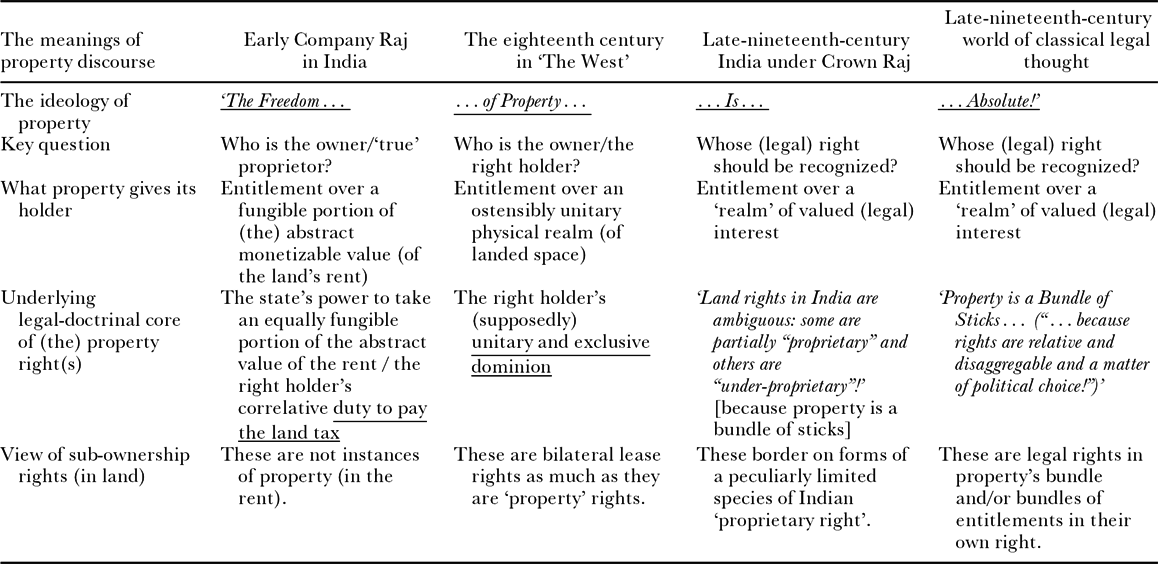
Before proceeding, however, I summarize the article's overall argument about the shifting nature of property discourse in colonial India versus the Anglo-common law mainstream in Table 1.
The shifting content of property discourse in the colony and metropole during the long nineteenth century

Property, ‘proprietary’ right, and political economy under the Company's Raj
By the terms of Regulation I of 1793, the sum that could be ‘assessed’ upon the lands of the ‘zemindars, independent talukdars and other actual proprietors of land paying revenue to Government’ in ‘Bengal, Bahar and Orissa’ was to be ‘fixed for ever’.Footnote 14 Both Regulation I as well as the companion provisions concurrently enacted by the governor general's council were elaborated through further pronouncements about the ‘proprietary rights’ of those to whom they were addressed. Rather than to proclaim the limited or only partial applicability of alien concepts to Indian land control practices, however, in this context the phrase was simply used interchangeably with ‘property’, ‘the property right’, or ‘the right to property’. This is why in the lead-up to the permanent settlement chief revenue accountant, the famed James Grant, warned against anointing the zamindars with such a designation and falling prey to the danger of construing ‘generick’ Indian terms ‘to express the particular English ideas of proprietary land-holder’.Footnote 15 In issuing his warning, Grant's point was to emphasize that in an Asiatic territory like India, it was not viable to identify either the zamindar or the raiyat with the English proprietor, the only reasonable option instead being to ‘assign to the sovereign’ the ‘proprietary rights and functions of a British freeholder’.Footnote 16
If there was something that stood out about the recurrence of the notion of ‘proprietary right’ in the discourse of the early colonial state, then, it was that it amplified a relatively obscure strand of the concept's meaning. While it was not unheard of to come across the idea used interchangeably with ‘property’ in the wider English-language world at or prior to the time when Grant was writing, it was still relatively infrequent, especially in texts focusing on law and jurisprudence. For example, the term ‘proprietary’/‘proprietory’ holds little utility for a figure as important as the jurist Edward Coke. In his famed seventeenth-century treatise, The Institutes of the Laws of England, reference to any class of ‘proprietary’ rights is almost entirely absent, with the phrase seeming to appear with no greater frequency in his Reports, which Coke started to compile in the last decades of the sixteenth century.Footnote 17 Even by the latter eighteenth century, in Blackstone's celebrated Commentaries on the Laws of England—the four books of which were published between 1765 and 1769—‘proprietary’ appears sparingly, only some half dozen times; and when it does appear, it occurs most often in the context of Blackstone's discussion of the ‘proprietary colonies’ of North America or their ‘proprietary governments’.Footnote 18
It is the latter usage, in fact, that represents the main form in which the phrase appeared in the English-speaking world in general prior to the second half of the nineteenth century. As one also finds in Edmund Burke's usage, for example, the term was usually invoked in order to distinguish colonies with ‘proprietary’ from ‘royal’ or ‘charter’ governments.Footnote 19 Even during the beginning of Company rule in India, it was often this latter usage or some closely related extension of it that predominated. For example, in James Mill's six-volume History of British India, which appeared between 1817 and 1818, ‘proprietary’ occurs just as frequently to describe the nature of colonial authority as it does in its capacity as a synonym for ‘the right to property’.Footnote 20 Regardless of exactly how the notion of ‘proprietary right’ came to initially proliferate within the discourse of the early colonial state, by the end of the first decade of the nineteenth century increasing controversy began to surround the concept. Especially important in prompting this development was the Company's assumption of more direct responsibility for its revenue administration in the Madras Presidency, which occurred concurrently with the immediate aftermath of the permanent settlement in Bengal. In the south of India, however, in the two decades after 1793 the Company's administration remained in flux. It was not until 1815, therefore, that official opinion definitively came to favour settling directly with the ostensible cultivators of the soil in most of the Presidency.Footnote 21
Yet in this context, too, concern was primarily focused on the question of who to designate as proprietors in Madras, not on the gap between the idea of property and Indian practice, much less the idea's incoherency or indeterminacy. As envisioned by famed Governor of Madras Thomas Munro, for example, the early rationale for ryotwari settlement was that in India, in contrast to England, the landlord and the cultivator were ‘[t]he same person, with very few exceptions’. This was because ‘[t]he landlord must always cultivate his own fields; and hence the collections must always be made directly from the cultivator in his quality of landlord’. Consequently, as Munro continued, no ‘person between the cultivator and the revenue officer’ could be left ‘without a creation of zemindars, who must themselves in time become, either petty princes, or cultivators’.Footnote 22
That it was a major aspiration of the Company Raj to render property or its equivalent, the proprietary right, ‘absolute’ should not be doubted. Whatever the gap between aspiration and implementation, therefore, it is problematic to conclude, as historian David Washbrook so memorably has, that the Company's rule of property was a ‘pure farce’ of theory because it failed to subject land entirely to market discipline in practice.Footnote 23 Such a view is liable to mislead as much as it is to illuminate, given that there was no single or monolithic ‘theory’ of property from which to measure deviations of ‘practice’. Of course, this is not to deny that the right the Company sought to render ‘absolute’ was highly circumscribed. Nor is it even to deny that the right's underlying basis was a version of the ‘command over the surplus crop or better still the cash it generated’ that was the hallmark of land relations under the ancien régime of the Mughals.Footnote 24 To deny that the Company's rule of property was ‘pure farce’, in other words, is neither a way of being vague about the basic nature of pre-colonial land control nor of overplaying choice where the Company's weakness and strategic imperatives left it with little.Footnote 25 It is, however, to say that in order to fully reckon with the implications of recharacterizing control over surplus in terms of the notion of ‘property’ we must attend to the specificity of the doctrinal regime of entitlement that was used to effect this process of redescription.
Of course, to adopt such a point of view is to leave it to go without saying that at the legal-doctrinal level property must be understood as an extended web of sub-concepts for parsing land control rather than simply a name into which non-Western practices of controlling land can be ‘translated’ with as much or as little success as any other practices in the non-West can be through reference to whatever other such unitary terms.Footnote 26 Without regarding property in such a manner, we will continue to miss what made the rhetoric of freeing property in India so unique. In turn, we will also continue to miss the very different juridical footing this created in the Company's India—as compared to the Anglo-common law mainstream—for potentially extrapolating a notion of legal right in general from the notion of the property right in particular. This is because what made rights talk in early colonial India coherent—and different from rights talk in the West at the same time—was that it was inspired by a notion of property drawn much more from the incipient discourse of classical political economy than from law and jurisprudence. As a result, the key feature according to which right-holding came to be doctrinally defined was the officially designated proprietor's entitlement over the land's rent rather than his ostensibly unitary control over physical space.
Understood as the flow of monetizable value that issued from the land rather than the land itself, classical political economy's implicit idea of property did not necessarily entail rent in strictly Ricardian terms as the differential between the land's productive capacity and its margin of production. This point is especially worth keeping in mind given that it is not one that scholars of South Asia have generally understood when emphasizing the importance of David Ricardo's ‘law of rent’ for nineteenth-century India. Following Eric Stokes’ canonical account in The English Utilitarians and India, historians have long focused on colonial officialdom's conviction—based on the elder Mill's influence—that rent was ‘a special portion of wealth, distinct from profits or wages’ that could be ‘determined in an exact scientific manner’ and hence maximally taxed by the state.Footnote 27 However, in a context in which it was entirely unclear whether the land played host to ‘landlords’, let alone capitalist farmers who were not labouring cultivators, making good on classical political economy's implicit idea of property did not require strictly differentiating the principal income shares of the three main classes that pre-marginalist economic thinkers in the West were preoccupied with. Even notwithstanding the failure of so-called utilitarian administrators to arrive at a genuinely ‘scientific’ procedure for calculating rent in the Ricardian sense after 1820,Footnote 28 it was the more general idea of rent as a flow of abstract monetizable value that issued from the land that was of greatest importance.Footnote 29
Ultimately, therefore, it was not any focus on a specific quantum of value distinct from profits and wages that was determinative of the unique structure of legal entitlement in the Company's India.Footnote 30 Rather, it was the way in which Company officialdom seized on the more general idea of rent, in the process effectively abstracting property into a sum of component revenue flows into which the land's produce could be converted. Based on this implicit debt to classical political economy, moreover, the colonial state's founding rule of property systematically blurred the line between the rights and duties the Raj sought to juridify. Whether in the theory of zamindari, ryotwari, or mahalwari settlement, what the proprietor—be it a natural individual or a village collective—obtained was the guarantee of a fixed proportion of an inherently fungible flow of value.Footnote 31 Under this type of legal regime, the individual's property right (in the rent) simply became the other side of an equally juridified duty to subtract no less fungible a proportional quantity therefrom as the ‘land revenue’ or ‘tax’ that was owed back to the state. This remained the case, moreover, even under the mature version of the ryotwari system, which was reconceived by the elder Mill and his acolytes as a scheme of sovereign ‘ownership’ and cultivator ‘leasehold’. In either case, however—whether regarded as a leaseholder or a proprietor—the raiyat held an ostensibly unitary and physical dominion over landed space no more than did the zamindar in the Cornwallis system. As much can be gleaned from the fact that even if not a rent appropriator on the scale of the zamindar, the government-designated raiyat was rarely the actual cultivator of the soil.Footnote 32 Likewise, even in the wake of Mill's reconceptualization of the ryotwari system, much the same is suggested by the confusion that persisted about whether the raiyat's payment was to be considered a ‘rent’ (in the ordinary sense of the term) or a tax on the ‘rent’ (in the Ricardian sense of the term).
Even if precociously ‘modern’ relative to the theory of property that was being elaborated in the incipient discipline of classical political economy, the property right that the Company recognized was retrograde relative to its legal-doctrinal structure precisely because it was not ‘feudal’ enough.Footnote 33 That is to say, the doctrinal structure of entitlement was indicative of the Company's effective failure to predicate its rule on the same conflation of property with jurisdiction that was taking place almost simultaneously within the legal cultures of the West. Of course, such an assertion may strike the reader as odd, for it is conventional to understand the distinguishing feature of landed property under capitalism to be the disappearance of extra-economic powers of ‘feudal’ jurisdiction from the capitalist owner's hands. While certainly true up to a point, such a conception misses the substantial difference that existed between property as a concept in law and property as a concept in economic thought. In what should be seen as the true intellectual foundation of legal modernity in the common and civil law mainstream, it was the highly intuitive notion of property as an actual or ‘physical’ realm of quasi-sovereign dominion (modelled on a jurisdiction) that was key.Footnote 34 Only through such a notion was it possible to translate Enlightenment-era natural rights discourse into an administratively viable form as an ostensibly absolute doctrinal power to exclude.Footnote 35 In turn, moreover, only through the archetype of a physical realm over which the legal owner was sovereign did it become all too easy for the doctrinal idea of the property right in particular to become the template for a much wider (bourgeois) notion of legal right in general. Broadly speaking, therefore, in the West there was ample reason for legal rights to increasingly be seen as ontologically distinct entities. From the second half of the eighteenth century it had already become possible to imagine that ‘the’ right to property was synonymous with something that was discrete and irreducibly real, given its objective referent in the form of the enclosed physical space from which the owner could ostensibly exclude all comers in the true fashion of a jurisdiction-wielding dominion holder.Footnote 36
Property, proprietary right, and the political economy of Crown rule
Just because the Company's founding discourse of absolute property in India proved distinct in its doctrinal instantiation of right as compared to that which was emerging at roughly the same time in the Anglo-common law mainstream, this does not mean it failed to serve its own purposes. To the contrary, the focus on entitlement over the land's rent was surely conducive to the most basic imperative of the Company's rule. After all, the main task of government that defined the transition from trader to sovereign involved formally re-centralizing political administration by designating more clear-cut nodes of official tax obligation. Under the Company's Raj, therefore, endowing the property right with definitional substance primarily through reference to the proprietor's concomitant duty of land revenue payment made a great deal of sense. Most obviously, it rendered the Company's discourse of property perfectly well-suited to ‘intensifying’ what Washbrook has so memorably called the early colonial state's ‘bastardized’ version of the Mughal empire's own political economy of surplus appropriation.Footnote 37
However, as historians of agrarian India have observed, the land revenue demand was not destined to remain forever central to British colonialism in the subcontinent. By the time of the transfer of power from Company to Crown in 1858, there had begun a long-term decline in the importance of direct taxation as a mechanism for extracting surplus from Indian agriculture. More specifically, this decline was made manifest through a diminution of the land tax relative both to the total level of agricultural outputFootnote 38 and to other available revenue sources as new forms of indirect taxation began to take on greater importance.Footnote 39 At the most basic level, the diminishing importance of the land revenue was linked to the fact that the rate of tax could not just be raised overnight. In turn, the state's demand could also not very easily be made to keep pace with a general inflation that saw prices doubling in many parts of the subcontinent over a period of just a few years during the 1850s.Footnote 40 Because this rise in the price level was, on average, sustained for the whole period from 1870 to 1930, the disparity between the nominal and real revenue rate was a long-term phenomenon.Footnote 41 Consequently, once the land tax started to retreat in importance it was destined never to regain the primacy it once had.
At the same time, the rise in the price level was not the only cause eroding surplus appropriation through the older mechanism of ‘the state's revenue onslaught’ and the attendant ‘rent offensive’ to which it had given rise during the first half of the nineteenth century.Footnote 42 Even as the colonial state's tax demand was decreasing in importance as a direct conduit for siphoning the wealth of agrarian society into the government fisc by the last few decades of the nineteenth century, other indirect channels for appropriating the land's productive value were taking on increasing significance. Above all, as Sugata Bose notes, it was the ‘credit mechanism’ that assumed ‘pre-eminence in extracting the surplus’ from approximately 1870 until the beginning of the great depression in 1930.Footnote 43 Overall the general rise in the price level after 1850 and the larger process of agricultural commercialization it was tied up with produced results that were decidedly more mixed than a net decline in the real burden of the state's land revenue demand alone. Alongside the sizeable number of urban intermediaries, traditional trading groups, and relatively well-to-do agriculturalists who captured new opportunities for profit, there were those whose survival was more dependent on low prices for food and other basic commodities. For such individuals, increasing integration into the world market meant greater economic volatility and hence greater instability in meeting basic needs. Periods of decline in the 1870s and the 1890s in global demand for the types of higher-value cash crops many small producers had turned to had the potential to prove disastrous. In such times, crises became dramatically evident through surges of famine and other forms of agrarian distress.Footnote 44 In all, integration into the world market meant that so-called ‘rich peasants’ whose control over land was secure and significant enough in scale to garner a surplus tended to gain through increasing returns on their capital, while conditions for smaller holders or subsistence agriculturalists continued to seriously fluctuate, both from locale to locale and over seasonal and secular time.Footnote 45
With regard to legal evolution, however, the most important consequence of all of this was to set the stage for a shift away from the older context that the Company had inaugurated after 1757 through its focus on property in the rent. The dynamic of change was driven by the marked controversy that was being aroused within the colonial public sphere as a result of the new credit-based mechanism of surplus extraction, with outcry steadily increasing over the condition of the peasant at the hands of the Indian moneylender. In official eyes the latter became the source of actual or impending ruin, whether because he stood directly behind the peasant's misery or indirectly, where it was the indebted landlord that was the proximal cause of agrarian distress. Throughout Britain's India, therefore, after 1857 a similar anxiety underwrote the dramatic upsurge in legislative measures to protect various new classes of agrarian subordinates from eviction and rent enhancement by their moneyed or ‘propertied’ superiors.Footnote 46
It was in Bengal that the first inkling of these measures emerged with the Rent Act of 1859, which extended to a limited sub-segment of the higher peasantry modest protections against increases in the payments demanded of them. This regime was strengthened considerably, even if it was in ways still targeted toward the more privileged ranks of landed society, through the Bengal Tenancy Act of 1885. Elsewhere in India varying levels of protection for occupancy rights, rights against rent enhancement, and the like followed suit or were concurrent with these measures in Bengal. These included the milder Oudh Tenancy Act of 1868; the Punjab Tenancy Act of 1868, which was comprehensively revised in 1887 and then again in 1898 in the wake of the passage of the 1885 Act in Bengal; in Punjab, the even more important Land Alienation Act of 1901, which prohibited outright transfers of land from statutorily designated ‘agriculturalists’ to statutorily designated ‘non-agriculturalists’ (with the intended referent of the latter term wrongly imagined to be strictly urban rentiers); the equally momentous Deccan Agriculturalists’ Relief Act of 1879, which followed in the wake of agrarian riots against Marwari moneylenders in and around Poona that stunned colonial officialdom; the Central Provinces Tenancy Act of 1883, which was revised so as to become India's most comprehensive such act in 1898; the Malabar Tenancy Act of 1887, which was revised in 1900; the Bombay Khoti Leases Act of 1865 and provisions within the Khoti Settlement Act of 1880, which were updated substantially in the revised Settlement Act of 1904; the North Western Provinces Tenancy Act of 1901, which built on provisions passed earlier in 1873; and, through certain of its provisions, the Madras Estates Land Act of 1908.
Of course, especially where it took the form of occupancy right, the recognition of such new forms of ‘proprietary’ entitlement may have simply reinstated many of the problems that plagued the original forms of property (in the rent) that had been recognized under the Company. This is because it was still higher-tier land controllers who were being privileged over actual cultivators. Likewise, it is also true that this surge in the recognition of sub-ownership rights under the Crown's rule may have been consistent with earlier strands within the critique of the Cornwallis system. Indeed, earlier in the century there were those who sought to justify ryotwari settlement by emphasizing that it would repair the zamindari system's arbitrary way of dividing the ‘occupancy’ from the ‘proprietary’ right,Footnote 47 thereby allegedly having turned the latter into little more ‘than a right to collect from the cultivators’.Footnote 48 Yet even so, through the various legislative measures expanding subordinate rights after 1860 the ostensible concern for the oppression of the peasant was underwriting a juridification of agrarian social relations far exceeding any that was effectuated through the Company's administration of property in the rent.
With this expansion of tenancy and occupancy entitlements after the Bengal Rent Act of 1859, the rule of colonial law in the subcontinent was finally acquiring a version of the property right better suited to serving as a model for a distinctly legal kind of right in general. Moreover, by the time this was taking place, in the late-nineteenth century, it was no longer an equivalence between propertied entitlement and any ostensibly unitary and exclusive landed realm of its holder's absolute dominion that was apt to be struck in the Crown's India. Rather, it was an equivalence between propertied entitlement and whatever given realm of legal interest—regardless of how circumscribed or expansive it might be—that was being recognized through these various provisions for agrarian reform.Footnote 49 Ultimately, then, the ostensibly anti-landlord and anti-moneylender measures that sprung up throughout India after 1860 expanded the compass of what could be recognized as a legal entitlement well beyond property in the land's rent alone. The overall effect of this was to formally assemble under the rubric of a much expanded notion of ‘proprietary’ (or ‘under-proprietary’) right norms that varied widely in content, whether focused on curbing the ability to enhance rent, limiting eviction, prohibiting the transfer of indebted lands, defining criteria for different classes of tenancy, or tacitly allowing adjudicators to look to the ‘equities’ of the bargains made between agrarian debtors and their creditors.Footnote 50
The proliferation of agrarian rights under the Crown’s Raj and the globalization of classical legal thought
The diffusion of officially recognized forms of right in the Crown's India beyond the compass of property in the land's rent was indebted to more than just the declining significance of the land revenue demand. Just as important were prominent new intellectual currents appearing within an increasingly global culture of law and legal thought after 1850. This set of intellectual antecedents to the reconceptualization of legal rights as realms of valued interest proved crucial not only to the expansion of ‘proprietary’ rights in India but to the emergence of debates on tenant right elsewhere as well—Ireland, as noted earlier, being the most obvious example. Among these currents, three in particular are worth briefly describing in further detail.
First, by the mid nineteenth century there was an increasingly prominent commitment to legal scientism that characterized both metropolitan and colonial legal cultures. While the demand for a new human science of ‘the law’ was closely tied up with the ideal of the judge as impartial adjudicator, it also resulted from the feeling that there was a need for systematizing scrutiny into a uniquely legal object of inquiry. Importantly, this desire for scientific inquiry into the law followed from more than just the ongoing legacy of utilitarianism within colonial administration that first achieved prominence in and around the 1830s.Footnote 51 No less important was the great adversary of utilitarian jurisprudence, namely the so-called historical school of jurisprudence that was spearheaded in the English-speaking world by Sir Henry Maine. This is not to say that there was no real difference between the historical tradition and the neo-utilitarian approach of its ‘analytical’ rival, which was propagated in the late-nineteenth-century Anglophone world through the influence of John Austin and his disciples. However, what united historical and analytical jurists was much more significant than what divided them. Both, for example, shared a commitment to the idea that the law constituted its own, largely self-contained object of examination. In turn, each approach became no more (and no less) than a necessary lens for truly understanding the systematicity of jurisprudence's common object, in both its diachronic and synchronic dimensions.
In late-nineteenth-century India the commitment to legal scientism thus bridged the divide separating Maine's disciples from positivists who were fellow conservatives, like James Fitzjames Stephen, as well as other analytical legists of a more politically liberal variety.Footnote 52 Additionally, there were also those—both Indians and Europeans alike—whose taxonomizing energies were directed at uncovering the place of the native ‘personal law’ within the larger legal object, the structure and function of which was believed to require scientific scrutiny.Footnote 53 Not surprisingly, then, even where Maine's influence was greatest—in the Punjab—there was an active awareness that the scientific method could be brought to bear on the law in two different ways. For Charles Tupper, a Mainean who was important in the effort to redact Punjabi custom, it was precisely because the law was so obviously an object amenable to logico-deductive analysis that it had to stand capable of examination through his own preferred empirico-inductive approach as well. Tupper explained this point in an address he gave as vice chancellor of the Punjab University:
[a]nalytical jurisprudence and that kind of comparative jurisprudence which is its immediate offspring are indeed scientific in the same sense that Euclid is scientific or the pure political economy of Ricardo or of parts of the treatise by John Stuart Mill. Certain postulates are taken for granted, to certain terms definite meanings are annexed, and a coherent body of doctrine is built up which commands assent so long as we do not challenge its first principles. But the comparative method as described by Sir Henry Maine is scientific in the same sense that the methods of biology are scientific. Indeed, if in the passage I have quoted we substitute for ‘facts, ideas, and customs’ the famous words ‘genera and species’, and for ‘historical records’ ‘the geological and embryological records’, we have, I think, an accurate description of a part of the actual method of biology . . . I hope I have made clear the affiliation of the various studies which may be grouped under the general name of ‘jurisprudence’. Analytical jurisprudence generates comparative jurisprudence of the first [and more restricted] kind [involved in comparing mature legal systems]; historical jurisprudence touched by the electric current of modern science, generates comparative jurisprudence of the second kind; and all—analytical, historical, and comparative jurisprudence—combine to form scientific jurisprudence considered as a branch of sociology.Footnote 54
As for the second major current within the global intellectual culture of the law to which the expansion of agrarian rights in the Crown's India bears an unacknowledged debt, it is the rise of what can be called classical legal thought.Footnote 55 While sometimes misunderstood as a form of legal laissez-faire that made for an era of formalistic jurisprudence, classical legal thought is better envisioned as a rhetorical and attitudinal style based on a set of assumptions about the underlying ontology of the legal. Taken as such, classical legal thought should be understood to encompass the commitment to legal scientism as one of its several defining features, and the ontology that classical thinkers assumed should be understood as both cause and effect of the reifying tendency inherent within a ‘scientific’ approach to the ‘nature’ of legal phenomena.
Because classical legal thought was one and the same neither with the growth of legal positivism nor with ‘codification’, its fundamental premise was not that law was the will of the sovereign legislator. Rather, as a view about the ontology of the legal, the core tenet of classical legal thought was that the law was a concrete whole capable of being abstracted because it was comprised of a small number of basic elements. Key among these were elements like ‘right’, ‘duty’, ‘power’, and the ‘will’. As legal scholar Duncan Kennedy has noted about the last of these in particular, the preoccupation with the element of will did not come from any particular ‘political or moral philosophy’ that classical thinkers adhered to; nor did it come from any determinate ‘positive historical or sociological theory’ that they all shared. Rather, the emphasis on ‘the will’ followed from the implicit tendency to regard legal reasoning as a process of ‘identify[ing] the rules that should follow from consensus in favor of the goal of individual self-realization’. According to Kennedy, reasoning on the basis of the will thus became a means for ‘guid[ing] the scholarly reconceptualization, reorganization, and reform of private law rules, in what the participants understood as an apolitical rationalization project’.Footnote 56 While the notion of will thus shared in the classical liberal view that the law should do no more than facilitate the autonomous self-assertion of the juridical individual, it would be a mistake to regard classical legal thought as inherently voluntarist. Rather, every bit as much as it was about advancing the purported self-realization of the private legal person, classical legal thought was also about facilitating the public will of the state considered as a juridical individual in its own right.Footnote 57
From this classical notion of will it is a short step to the last of the late-nineteenth-century currents within the global intellectual culture of the law that anticipated the expansion of subordinate agrarian rights in India and of advocacy for tenant right elsewhere as well. This is because for classical legal thinkers the ‘will’ would eventually take over from ‘right’ as the key element in their implicit ontology.Footnote 58 Therefore, if legal modernity in the West was cemented in the late eighteenth century on the discursive foundation of property as an ostensibly absolute right of physical dominion over a unitary realm of landed space, a century later it was the absolute freedom of action of the will within its immaterial realm of legal interest that was most important. In turn, the key problem was no longer about discerning who had the right to property so as to be counted the true owner/proprietor/right holder. Rather, it was about making the will—whether of the private or the public juridical person—sovereign within its own metaphorical domain, regardless of how circumscribed or expansive it might be. According to this viewpoint, legal rights were still reified as part of the ontologically distinct elemental basis of the law. What changed, however, was that they were no longer supposed to be claims to the irreducible materiality of an ostensibly unitary and absolute landed dominion, with its allegedly fixed rather than negotiable boundaries.
By the early twentieth century, in fact, this latter sequence of thoughts was even coming to be known within the mainstream of the Anglo-common law world as the ‘bundle of sticks’ view of property.Footnote 59 As the moniker suggests, according to the bundle of sticks view ‘the’ right to property was no longer considered to constitute any one discrete right at all, only a series of separable legal entitlements. More specifically, the bundle of sticks view was an amalgamation of two separate ideas. On the one hand, there was the notion that had been building since the mid nineteenth century about the divisibility of the property right into various mutually disaggregable incidents, no one or the other of which constituted the true essence of ownership. On the other hand, during the same period there was also a dawning belief that the property right did not comprise a relation between a person and a thing—whether a material thing like a supposedly unitary and bounded realm of landed dominion or even just some immaterial realm of legal interest. Rather, more to the point was that property was now thought to be a relation between persons. Accordingly, the individual's property right increasingly appeared to be relative rather than absolute because of the way it bound its holders to other social actors. In fact, by the early twentieth century concern with the relational quality of property went beyond simply emphasizing that rights consisted of the doctrinal power to exclude other persons en masse, as inhabitants of a world at large. Instead, the relativity of right came ever more to mean that property was seen to align its holder to innumerable others individually, as bearers of counterpart duties that had been tacitly imposed upon them through equally numerous acts of political choice.Footnote 60 Any specific property right was held, therefore, only in the face of the various countervailing property rights that could just as well have been created for those others to hold in the same realm of interest had different political choices been made. As should be apparent, it was especially in this last respect that the relativization of the property right was implicitly connected to its de-physicalization and disaggregation. After all, if property was a collection of right-duty relations comprising an immaterial realm of juridical interaction, it was most definitely not a unitary dominion over contiguously bounded bits of physical space. In turn, it became all the more evident that the various sticks in the property bundle could just as well be pulled apart and rearranged in any number of ways and between any number of hands.
Understanding the revisionist discourse of proprietary right in the Crown's India: Baden-Powell as an exemplar of classical legal thought
Given the evident correspondence between the rise of new forms of de jure propertied interest under the Crown and the larger shifts in the global intellectual culture of the law described above, it becomes notable that events in the subcontinent were not generally seen to be part of a wider trend. To the contrary, it was at this time that the history of the colonial encounter with Indian agrarian society was being re-written as one that, in effect, could not have originated but through concession to what limited species of ‘proprietary’ right was indigenous to the subcontinent. This view was spelled out by Baden Henry Baden-Powell both in his encyclopedic Land Systems of British India and elsewhere in his writings. In a shorter work on the same subject, for example, he reiterated his contention that ‘[t]he Indian “proprietary right” is a thing sui generis’—a ‘term [that] is not used in English text-books’.Footnote 61 The true predecessor of the contemporary emphasis on the gap between colonial theorizing and Indian realities, the late-nineteenth-century revisionist understanding of the rule of property that Baden-Powell espoused, has too long gone unnoticed by historians of South Asia. Instead, so much has it been assimilated into our historiographical common sense that the default tendency has been to treat a work like Land Systems always as a secondary and rarely, if ever, as a primary source.Footnote 62
While Land Systems appeared only in 1892, by the time of its publication Baden-Powell already had a long career as a functionary in the Crown's government. The second of 14 children born to Oxford professor of geometry and liberal Anglican theologian Reverend Baden Powell, Baden Henry Baden-Powell was born in 1841, 16 years before his better-known half-brother, Robert Stephenson Baden-Powell, the founder of the Boy Scouts. Brought up partly in Ireland and educated at the St Paul's School in London, Baden Henry entered the Indian Civil Service in 1860 and made his way to the subcontinent in 1861, at the age of 20. He remained in India until he retired in 1889, approximately 12 years before his death in 1901.Footnote 63 After an initial decade spent in several different roles, including as a judge on the Punjab Small Cause Court, in 1870 Baden-Powell was appointed by the Indian Forest Department to serve as the province's conservator of forests. In his last decade in India, during which he remained in the Punjab, Baden-Powell served first as a division judge starting in 1881, then as a commissioner of division, and finally as a judge on the province's Chief Court. Land Systems was, thus, a culmination of more than three decades of experience in the subcontinent, and it was from this vantage point that Baden-Powell elaborated on the ‘proprietary’ nature of land rights in India. As he noted, ‘the use of such a phrase’ was:
due to the feeling that we rarely acknowledge anything like a complete unfettered right vested in any one person. The interest in the soil has come to be virtually shared between two or even more grades . . . It is true that, in many cases, only one person is called ‘landlord’ or ‘actual proprietor’ but his right is limited; the rest of the right, so to speak, is in the hands of the other grades, even though they are called ‘tenants’, or by some vague title such as ‘tenure-holders’. In many cases, as we have seen, this division of right is accentuated by the use of terms like ‘sub-proprietor’ or ‘proprietor of his holding’. ‘The proprietary right’ seems then a natural expression for the interest held by a landlord, when that interest is not the entire ‘bundle of rights’ (which in the aggregate make up an absolute or complete estate) but only some of them, the remainder being enjoyed by other persons.Footnote 64
Of course, in expressing this revisionist stance Baden-Powell was picking up on strands of argument sometimes present within the critique of the Cornwallis system at the outset of the century. As mentioned previously, among early advocates of ryotwari settlement there were those for whom the most important justification of the system was that it would repair the arbitrary way in which zamindari settlement divided the ‘occupancy’ from the ‘proprietary’ right.Footnote 65 During Baden-Powell's era, however, the emphasis upon the possessory and other bases of right-holding had become markedly intensified. More important still, with the ongoing expansion of sub-ownership rights under the Crown's rule something else had changed as well. In the context of the late-nineteenth-century revisionist view of the colonial rule of property, the point was no longer simply that possession could be used as proof that the raiyat's was the ‘true’ claim to ‘the proprietary right’ (over the land's rent) that the Company had juridified. Rather, the point was now that possession, possessory occupancy, and the whole host of other tenurial interests that could be found in the subcontinent might be considered ‘proprietary’ rights in their own regard. Even if merely ‘sub-proprietary’, moreover, the fundamental point remained: such rights were to be taken as indicative of the fact that agrarian entitlements in India fell far short of ‘property’ in the full sense of the English juridical term, a state of affairs which revisionists further suggested had been demonstrated already in the history of the Cornwallis system.
Both in surveying recent developments and in looking back on the history of colonial rule, therefore, late-nineteenth-century observers all too easily looked past the insistence of their own forebears on a notion of property as command over rent. In the supposed reality of a merely ‘proprietary’ form of right in the subcontinent they instead saw only the special imprimatur of a uniquely Indian social context in which land control practices self-evidently outstripped a notion of property that was held to be otherwise clearly applicable in the West. Accordingly, Baden-Powell envisioned revenue settlement everywhere in the Company's India as if it could do no more than ultimately aspire to what was bound to become a rule of the merely ‘proprietary’ type of rights that the subcontinent allowed. For example, noting that ‘[t]o say that a man is “proprietor”, and that he is the “malguzar” or revenue-payer, are, in our official literature, practically synonymous’, Baden-Powell remarked that:
even in Madras and Bombay, where . . . no landlord body had grown up over the village cultivators, so that they could not be regarded as a jointly responsible proprietary of the whole, the individual occupants were nevertheless vested . . . with a definite, transferable, and heritable right, subject to the revenue demand: and this, for most practical purposes, is undistinguishable from a proprietary title.Footnote 66
Such disavowal of a will on the Company's part to a more full-fledged rule of property, however, was belied by the deeper analytic Baden-Powell was implicitly channelling in order to reach the above conclusion. This is because it was only on its surface that the revisionist view equating proprietary right with a uniquely Indian pattern of fragmented authority over land followed from a knowledge of the empirical specificities of the agrarian subcontinent. Contrary to what administrator-intellectuals suggested, the view followed equally from the shifting sands that were giving rise to the bundle of sticks view of property within the Anglo-common law mainstream.
Even in the thought of someone so careful as Baden-Powell, however, this deeper analytic came only flickeringly into the light. In fact, his mention of the ‘entire bundle of rights’ in the excerpt quoted earlier is one of the only times in Land Systems when the broader intellectual currents informing his analysis are made at all explicit.Footnote 67 That for Baden-Powell a logic of property drawn from classical legal thought was implicit, however, is made clearer if we turn to some of his less celebrated writings. In his 1882 Manual of Jurisprudence for Forest Officers,Footnote 68 for example, he opens the work tellingly with several chapters on ‘the General Law’, these, themselves, beginning with an initial chapter on ‘General Notions Regarding Property’. In 1893's Course of Lectures the same approach was expanded in both scope and sophistication.Footnote 69 Read in tandem, these two works reveal both Baden-Powell's debt to the ethos of legal scientism as well as the quite different understanding of the relationship between property, right, and law that underlay his assessment of what it was that was transpiring in the Crown's India with the recognition of new types of agrarian rights. He thus commenced the Lectures by explaining that it was because forests were often yet to be made property that there first needed to be clarity on what property itself was. This was only natural, Baden-Powell explained, because in ‘law, as in every other science or art, we begin with very simple and elementary conceptions’, science being ‘after all, only common knowledge systematized and arranged’.Footnote 70 He then urged that care was needed in attending to ‘the variety of ways in which we speak of “property”,—indicating by our phraseology certain peculiarities connected with the legal idea of ownership, which perhaps we do not very clearly apprehend’.Footnote 71 The student of India had to remain particularly vigilant, he instructed, since (s)he was more likely to have ‘heard such a phrase as—“This forest is the property of Government, but such and such villages or individuals have rights in it.”’Footnote 72 However, the most elementary turn of phrase that Baden-Powell thought merited correction if the concept of property was to be cleansed of its ambiguity was that by which it could be ‘used to signify both the thing owned and the right of ownership’. In this vein, he suggested that in place of the latter usage there should be made a distinction between property as ‘the subject of the right’ and ownership as ‘the right over it’.Footnote 73
In both Land System and the works on forest law we see more than just a view driven by an expert knowledge of the empirical specificities of land control practices in the subcontinent. To the contrary, Baden-Powell's ideas closely tracked the decline not only of the Company's founding idea of property in the rent in India but also of the conceptualization of ‘the’ right to property as absolute, unitary, and physicalist in the West. In the colonial and metropolitan domains alike, each of these older respective views was now being replaced by the classical idea of the right to property—and, by extension, legal right more generally—as relative, disaggregable, and immaterial. It was not by accident, therefore, that during Baden-Powell's time in India the meaning of ‘proprietary right’ was shifting precisely toward these three new defining qualities. No more was it accidental that the frequency of reference to ‘proprietary right’ was markedly increasing in colonial discourse during the very same period, after appearing only in the more selective ways it had previously. Although certain strands of earlier usage—particularly that by which ‘proprietary right’ became a synonym for ‘the right to property’—harboured an original meaning that was specific to the discourse of the Company's India, the same was not the case once the concept became a proxy for the bundle of sticks view of property. By the early twentieth century both the locution and the idea underlying it—namely, that rights represented socially relational arrangements of immaterial ‘proprietary’ control over their objects—had passed into English-language discourse more generally. Well beyond the Crown's India, therefore, by 1890 it was becoming common for ‘proprietary right’ to stand for the relative, disaggregable, and immaterial ‘nature’ of property interests in the law in general.
That property was relative, for example, figured prominently in the opening pages of Baden-Powell's lectures on Forest Law where he set out a general proposal for conceiving of rights as creations of ‘the law—written, unwritten, or customary’. As he explained, whatever its form when ‘the law. . .declares or recognizes’ a right in ‘one or more persons’, it does so only while thereby marking out ‘a corresponding duty or obligation lying on one or more other persons’.Footnote 74 Therefore, he continued:
not only is there always an obligation corresponding to a right (for you cannot have a right without someone also being obliged to respect it); but also these rights and obligations are (when they arise out of human dealings) in many cases reciprocal, i.e., not only does one person have a right and the other an obligation, but vice versa, the person who has the obligation has also a right. If A. enters into an agreement with B. that B. shall take £1 and make a box for A.; A. has the right to B.'s services in making the box, and also to the box itself when finished; and B. has the obligation to make the box and hand it over; but then again B. has the reciprocal right to get £1 and A. has the obligation to pay it.Footnote 75
It was through this same lens—in which all rights appeared to be constitutive of relations between persons—that Baden-Powell highlighted what he said was one of the most fundamental tenets of forest law. This tenet, he explained, followed ‘on the same principle [that] the owner of any property is obliged [to]’ and required that the holder of a right in forest lands ‘use the same in such a way as not to injure his neighbours or endanger the welfare of the whole community’. Ultimately, therefore, it was a reminder that ‘[f]orest rights’, could only ‘be exercised, within certain limits’.Footnote 76
Equally did Baden-Powell draw on the idea that property was disaggregable as well. As he explained in his Manual of Jurisprudence for Forest Officers, though ‘property’ (or ‘ownership’, as he preferred) was often spoken of ‘as if it was a simple’ thing, it was always internally a ‘composite’ of many such things—meaning many such rights (and duties).Footnote 77 These he divided into two basic categories of rights that persons ostensibly held over things, including, first, the right of ‘possession’ and, second, a whole series of other ‘rights enjoyed by one party on or over the property of another’.Footnote 78 Yet even with respect to the disaggregability of property, Baden-Powell still betrayed a divided consciousness about the source of his analysis. On the one hand, he pointed to the ‘conflicting circumstances’ of the subcontinent as having made ‘the proprietary right’ that was recognized by ‘British law . . . far from . . . absolute’.Footnote 79 More specifically, he claimed, the fact that ‘[t]he native idea had not formulated such a thing as the status of a “proprietor”’Footnote 80 meant that in the subcontinent there developed different ‘strata’ or ‘grades’ of proprietary right.Footnote 81 On the other hand, like classical thinkers more generally, he was also well acquainted with the neo-Roman law jurisprudence pioneered by early-nineteenth-century German thinkers like Friedrich Carl von Savigny. Accordingly, his earlier quoted assertion about the ‘composite’ nature of property was staked on the authority of ‘the Roman lawyer’, to whom he attributed the idea that ownership was ‘the bundle of all possible rights which, together, make up an absolutely unrestrained enjoyment’.Footnote 82 For Baden-Powell the necessary consequence of this insight was that he who was casually called ‘owner’ usually had ‘something less than the absolute or perfectly full enjoyment of his property’. Instead, other of the rights ‘mak[ing] up a perfect . . . ownership’ were liable to have been ‘detached and vested in other persons’.Footnote 83
Nowhere more than in relation to the classification of subordinate tenures, however, did it become evident that there was a tension in Baden-Powell's thought between his debt to the new logic of property in classical legal thought and his insistence that English concepts could scarce be used to describe a country to which even the most basic category of ‘India’, itself, could not be applied ‘properly’.Footnote 84 This is because it was not just the messy empirical facts of Indian social structure that made it so hard to distinguish proprietary from under-proprietary tenures. Rather, it was in the very nature of the bundle of sticks analytic that underlay the late-nineteenth-century discourse of proprietary right in India to make it profoundly difficult to undertake any such line drawing exercise definitively. Too often, affirming the ‘proprietary’ character of a tenure became a hopelessly indeterminate affair. On the one hand, doing so could involve highlighting some ‘possessory’ essence of the right in a way that was ultimately no more than question begging (as to what qualified as ‘true’ possession). On the other, drawing lines around the truly ‘proprietary’ based on some other non-possessory stick in property's bundle could prove equally problematic; invariably, it degenerated into a largely ad hoc process of determining exactly which other disaggregated interest in land was to be counted as essential.
Discounting the idea that in Oudh only the taluqdars had proprietary claims, for example, Baden-Powell insisted that reference to the mere ‘sub-tenure’ of lower-tier members of the agrarian hierarchy ‘do[es] not really impose any complication’. It was true that ‘under these different “sub-tenures” the landlord parted with certain individual sticks out of the bundle which together made up the totality of the enjoyment of full ownership’. However, as Baden-Powell asserted, even if ‘subordinat[ed] to the [rights of the] Taluqdar or overlord’ and even if non-possessory, ‘[s]uch separated rights’ could all the same be considered ‘in their nature proprietary’.Footnote 85 Other examples, however—especially those involving declarations about the ‘under-proprietary’ character of a tenure—illustrated how tenuous a conclusion this was. For example, one general basis for classifying claims as under-proprietary was to assert that the tenure comprised no more than a (de facto) right of ‘contract’ on grounds of its binding only two parties rather than empowering either against the world at large, as a genuinely proprietary right might be thought of as doing. Flying in the face of any such idea, however, was the view that ‘[t]he root of all the early tenant difficulties in Bengal was, just as in Ireland, the inability of authorities to contemplate a relation which they might call a “tenancy” if they pleased, but which was founded on status, not on contract’.Footnote 86
The two horns of the dilemma posed by subordinate tenures were perfectly visible when Baden-Powell considered the rule espoused in 1859's Bengal Rent Act making occupancy rights contingent on 12 years of continuous presence on the land (which became the basis for debating similar measures throughout India). On this issue, Baden-Powell professed that he could see nothing in the nature of legal right itself that negated either of the two potential ‘case[s that could be] stated on both sides’, for and against recognizing occupancy tenure as a genuinely proprietary right. Thus, he opined:
[t]hose who favoured the landlords’ view would urge that it was unfair to the Zamindars and other proprietors now saddled with the responsibility, strict and unbending, for the revenue that was to be paid in good years and bad alike, to tie their hands, and to refuse them the full benefit of their lands by creating an artificial right in the tenantry; such a rule would be to virtually deprive the landlord of the best share of his proprietary rights. If it was wise of Government to recognize the proprietary right at all, it must be wise also to recognize the full legal and logical consequences of that right . . . On the other side the advocate of the tenant would reply: The new landlords confessedly owe their position to the gift of Government; why should they get all? why should not the benefits conferred be equally divided between the raiyats on the soil and the ‘proprietors’?Footnote 87
Despite this admission, in the end Baden-Powell again deferred to the unique nature of Indian circumstance to explain why both sides—for and against juridifying the occupancy right—seemed plausible. Ultimately, he concluded, the real reason the clashing positions could not ‘in truth’ be ‘theoretically determined’ was that ‘the idea of landlord and tenant, as we conceive the terms, and the consequences which flow from it, have no natural counterpart in Indian custom’.Footnote 88
Not surprisingly, the ambivalence Baden-Powell displayed about what ‘Indian custom’ demanded was a recurrent feature of his reasoning about tenant right in other contexts as well. His discussion of colonial Ajmer, with its preservation of ‘the features of Rajput organization’, is notable in this regard. In the context of the first book of the second volume of Land Systems, which focused on the collective village-based mahalwari revenue settlements of the North Western Provinces, Baden-Powell stopped to reflect more generally on the effects that British rule was having on the area. In this vein he remarked on ‘how inevitably changes of time and circumstance modify land-tenures, without any conscious act on the part of the authorities’.Footnote 89 When he went on to consider the position of the cultivator on the Rajput chief's own estate, however, he was left to conclude only that ‘[o]ut of these facts the reader may weave any theory . . . which he pleases’. For ‘it is only when such a state of things exists under direct English authorities that we are obliged to try and translate the facts into the language of Acts and Regulations’; and only upon doing so, ‘insensibly and gradually’ do such facts ‘assume the features and the incidents of Western institutions’. Ultimately, he declared, ‘[t]hat is why the Ajmer cultivator is a member of a “proprietary community”, and his brother in the next-door Rajput state is a “tenant”, or whatever else we may please to call him’.Footnote 90
In light of the above, one can hardly regard it as surprising that Baden-Powell emphasized the ‘mysterious and unintelligible darkness’ that Indian land tenures made for in the eyes of colonial officials. Nonetheless, we should not fail to see how misleading his doing so can be.Footnote 91 As we have seen, the more that rights were capable of being imagined as circumscribed ‘realms’ of legal interest that could be held even without commanding full dominion, the more it made sense to see subordinate tenure holders as proprietors in their own right. All the more did this become so amid the mounting agrarian distress that characterized the last decades of the nineteenth century in the colonial subcontinent.
At the same time, we should also not fail to see how ironic it was for Baden-Powell to attribute the difficulty of determining whether subordinate tenures were ‘proprietary’ or ‘sub-proprietary’ primarily to the exceptionalism of Indian tradition. This is because debates about tenant right became an important channel through which the notion of ‘proprietary right’ passed out of India into the wider English-speaking world; and in breaching the permeable discursive boundary of the colonial subcontinent, ever more did the notion of ‘proprietary right’ become a ready shorthand for abbreviating the complex series of arguments by which legal entitlements in general came to be regarded as relative, disaggregable, and immaterial. In fact, the controversies that had been transpiring in Ireland alone were sufficient to give the lie to Baden-Powell's assertion that ‘proprietary right’ was a concept never to be found in the ‘text-books on English law or jurisprudence’.Footnote 92 With the meagre protections set out in the First Irish Land Act of 1870 it was already common to envision the custom of Ulster in terms of a tenant right that was ‘of a quasi-proprietary kind’ even if ‘far short of a[n English] copyhold, or a right of occupancy in some points of capital importance’.Footnote 93 Ten years later, by the time that more robust protections were passed with the second Irish Land Act of 1881 the ‘quasi’ descriptor was just as easily dropped in favour of affirming that the interests attributed to certain classes of tenants were, indeed, forms of ‘proprietary right’Footnote 94 or simply, as per a slightly longer-standing usage, ‘peasant proprietary’.Footnote 95
Indeed, it was not solely in the Irish context nor even just in debates about tenant right that the concept of ‘proprietary right’ was increasingly becoming a placeholder for the de-physicalized view of legal right in general among classical thinkers. Through prominent works of general jurisprudence dating from the last years of the nineteenth century, ‘proprietary right’ was being made into a standard term of reference well beyond the subcontinent. The colonial origins of our modern notion of the ‘proprietary’ are thus clearly revealed in works from this period by the likes of ‘scientific’ jurists such as William Markby,Footnote 96 Thomas Erskine Holland,Footnote 97 and Sir Frederick Pollock.Footnote 98 Holland, for example, wrote explicitly of ‘proprietary rights’ in order to clarify that entitlements to property fundamentally involved relations not between the ‘Person and all outward objects, as Things’ but between ‘him and other people’.Footnote 99 Likewise did he presage contemporary legal scholarsFootnote 100 when he spoke of ‘degrees of proprietary right’ in order to clarify that legal entitlements could vary widely in the incidents they conferred—ranging from ‘absolute ownership to a narrowly limited power of user’.Footnote 101 Not only did each of these jurists—all classical legal thinkers—readily display their awareness of or direct acquaintance with India and its colonial legal system; their ‘scientific’ aspirations/pretensions invariably led them to a brand of jurisprudence that had a broad generalizing appeal given its devotion to abstracting the ‘basic elements’ or ‘first principles’ of ‘the law’.Footnote 102
Conclusion
If the shifting conception of property as a basis of legal right remained obscured in Baden-Powell's thinking, it was much more opaque within the thought of the various others—partisans and adversaries alike—who were involved in what historian Peter RobbFootnote 103 has called the pro-peasant resurgence in India during the 1870s and 1880s.Footnote 104 Moreover, in the hands of less accomplished thinkers, the decidedly classical notion that property was a bundle of sticks appeared much less than it did in Baden-Powell's work as a means of denaturing the law. In this respect, even notwithstanding its generalization into the wider English-language world, the notion of ‘proprietary right’ retained a different role in the colonial subcontinent as compared to that which it came to play within the Anglo-common law mainstream. For even in Baden-Powell's thought the bundle of sticks view appeared only as a kind of inexplicit warning to the uninitiated about the complexities of ‘knowing’ Indian agrarian society. Under the Crown's Raj the real significance of the vision of rights in classical legal thought was, thus, bound to remain obscured at the very same time that it was laying the basis for a much broader legalization of nationalist politics in general, once more showing how a belief in Indian exceptionalism proved functional to the colonial enterprise. After all, if the peculiarities according to which land relations in the subcontinent had been parsed could be thought by colonial officials to have derived strictly from the nature of Indian reality itself, this only reinforced the sense that British rule was about managing cultural difference more than it was about anything else.