Introduction
Much research has suggested that learners’ mindsets (or implicit theories; Dweck, Reference Dweck1999; Dweck & Leggett, Reference Dweck and Leggett1988; Dweck & Yeager, Reference Dweck and Yeager2019) predict their achievement goals, self-regulation, anxiety, and responses to challenges (see Brunette et al., Reference Burnette, O’Boyle, VanEpps, Pollack and Finkel2013 for a meta-analysis). Research in the second language (L2) context has also demonstrated that learners with fixed mindsets (sometimes called entity theories) regarding their linguistic intelligence, who believe it is immutable, tend to endorse performance goals, to feel anxious about and avoid challenges, and to be less resilient (e.g., Bai & Wang, Reference Bai and Wang2021; Khajavy et al., Reference Khajavy, MacIntyre and Hariri2020; Lou & Noels, Reference Lou and Noels2019a; Mercer & Ryan, Reference Mercer and Ryan2010; Papi et al., Reference Papi, Rios, Pelt and Ozdemir2019; Sato, Reference Sato2021). In contrast, learners with growth mindsets (or incremental theories), who believe their ability can be improved through practice, are more likely to set mastery goals, use adaptive self-regulation strategies, feel more confident, and persist more in the face of challenges. Recently, drawing from complexity theory (Larsen-Freeman, Reference Larsen-Freeman and Atkinson2011; Hiver & Papi, Reference Hiver, Papi, Lamb, Csizér, Henry and Ryan2019), researchers argued that mindsets do not act alone; instead, mindsets and their related motivational factors are systematically intertwined in a meaning system (hereafter, mindset system) that guides learners to make sense of and respond to different learning situations (Lou & Noels, Reference Lou and Noels2019b; adapted from Dweck & Yeager, Reference Dweck and Yeager2019). In this study, we used latent profile analysis to examine the complex mindset system and its relations with learners’ engagement and achievement in foreign/second language (L2) classroom.
Although no study in language learning has examined students’ mindset system profiles, psychologists Dweck and Molden (Reference Dweck, Molden, Elliot and Dweck2013) argued that about 40% of students tend to endorse a growth mindset, 40% a fixed mindset, and about 20% are mixed with regard to their general intelligence. Paralleling this observation, many mindset studies (see Chiu et al., Reference Chiu, Hong and Dweck1997; Claro et al., Reference Claro, Paunesku and Dweck2016; Dweck et al., Reference Dweck, Chiu and Hong1995; Hong et al., Reference Hong, Chiu, Dweck, Lin and Wan1999) employ a methodological strategy of selecting participants who scored high and low on the mindset scale to examine the effect of mindsets. This reductionist methodological approach has been criticized by language researchers, who instead suggest that language learners’ mindsets are multifaceted and that most L2 learners cannot be simply categorized as fixed or growth (Haukås & Mercer, Reference Haukås and Mercer2021; Irie et al., Reference Irie, Ryan and Mercer2018; Lou & Noels, Reference Lou, Noels, Lamb, Csizér, Henry and Ryan2019c; Mercer & Ryan, Reference Mercer and Ryan2010). However, little research has focused on learners who endorsed a mixed mindset, even though Dweck (Reference Dweck2015) more recently suggested that “we’re all a mixture of fixed and growth mindsets” (p. 2). Is it true that most people endorse a mix of both mindsets? What are the characteristics of learners with mixed mindsets? Do these learners simply occupy a middle ground in their goals and other mindset-related concepts? This study will explore these unanswered questions regarding L2 learners’ mindset systems.
Literature Review
Language Mindsets Systems
Research on mindsets focuses on how people’s beliefs regarding the malleability of intelligence and other human attributes, such as language aptitude, predict different motivational, resilience, and achievement patterns. Dweck and her colleagues proposed that mindsets, goal orientations, and responses to challenges relate to one another systematically and work together as a cognitive-affective system that guides people to assign meaning and react to events (Dweck & Molden, Reference Dweck, Molden, Elliot and Dweck2013; Hong et al., Reference Hong, Chiu, Dweck, Lin and Wan1999). Although the mindset system is argued to function as a whole, researchers have suggested that mindsets are the core ontological and epistemological beliefs about human nature and learning that anchor the other constructs within the system. Accordingly, research mainly focuses on path models, including longitudinal (e.g., Blackwell et al., Reference Blackwell, Trzesniewski and Dweck2007; Lee & Seo, Reference Lee and Seo2019) and experimental or intervention studies (e.g., Lou & Noels, Reference Lou and Noels2016; Yeager et al., Reference Yeager, Hanselman, Walton, Murray, Crosnoe, Muller and Dweck2019) to examine the role of mindsets in shaping learning outcomes through other constructs in the mindset systems (Dweck & Yeager, Reference Dweck and Yeager2019; Robins & Pals, Reference Robins and Pals2002). For example, Lou and Noels (Reference Lou and Noels2016, Reference Lou and Noels2017) tested the “mindsets–goal orientation–responses to challenges” path model and found that growth mindsets positively predicted mastery goals (i.e., goals focusing on improvement and learning process; Elliot & Church, Reference Elliot and Church1997) and mastery-oriented responses to challenges such as seeking feedback and persistence in learning tasks (see also Burnette et al., Reference Burnette, O’Boyle, VanEpps, Pollack and Finkel2013; Cutumisu & Lou, Reference Cutumisu and Lou2020; Dweck & Yeager, Reference Dweck and Yeager2019; Papi et al., Reference Papi, Bondarenko, Wawire, Jiang and Zhou2020). In contrast, fixed mindsets have been associated with setting performance-approach (goals focused on outperforming others or showing off ability) or performance-avoidance goals (i.e., goals focused on avoiding failures or being seen as incompetent), and helpless strategies such as looking for easier, possibly less effective, tasks (Hong et al., Reference Hong, Chiu, Dweck, Lin and Wan1999). In summary, the fixed versus growth mindset-based systems lead to distinct patterns of motivation and learning behaviors.
Research in L2 also generally supports the proposed links within the mindset system (e.g., Bai & Wang, Reference Bai and Wang2021; Khajavy et al., Reference Khajavy, MacIntyre and Hariri2020; Lou & Noels, Reference Lou and Noels2019a; Mercer & Ryan, Reference Mercer and Ryan2010; Papi et al., Reference Papi, Rios, Pelt and Ozdemir2019; Sato, Reference Sato2021; Zarrinabadi et al., Reference Zarrinabadi, Lou and Shirzad2021). For example, experimental studies have demonstrated that foreign language learners with growth (vs. fixed) mindsets were more likely to endorse mastery goals and were more persistent during challenges (Lou & Noels, Reference Lou and Noels2017; Papi et al., Reference Papi, Rios, Pelt and Ozdemir2019). Language researchers have also focused on language anxiety, or the feeling of apprehension when using the target language, as part of the mindset system (Lou & Noels, Reference Lou and Noels2020a; Ozdemir & Papi, Reference Ozdemir and Papi2021). When the situation of language learning and using becomes challenging, those who endorsed fixed (vs. growth) mindsets are more anxious. For example, they are more worried about being judged or making mistakes when using the language (Lou & Noels, Reference Lou and Noels2019a). One method of dealing with anxiety-provoking challenges is positive reappraisal, a form of meaning-based adaptive coping through which the individual reframes negative events as valuable (e.g., seeing challenges as learning opportunities; Chaffee et al., Reference Chaffee, Noels and McEown2014). Learners with growth mindsets tend to positively reappraise challenging situations as opportunities (Lou & Noels, Reference Lou and Noels2020b). Therefore, in this study, we integrated goal orientations, as well as cognitive and emotional responses to challenges (i.e., positive reappraisal, language anxiety, and persistence) as interrelated constructs within the mindset system that guides learners’ engagement and achievement in the classroom. In this study, engagement refers to the learners’ investment toward and concentration on studying in the language classroom (Salmela-Aro & Upadyaya, Reference Salmela-Aro and Upadyaya2014). We focus on engagement and grades as outcomes because these are two major manifestations of learners’ active involvement in learning and language proficiency, respectively (Hiver et al., Reference Hiver, Al-Hoorie and Mercer2020; Noels et al., Reference Noels, Lou, Vargas Lascano, Lamb, Csizér, Henry and Ryan2019; Oga-Baldwin, Reference Oga-Baldwin2019; Yun et al., Reference Yun, Hiver and Al-Hoorie2018). If the mindset system plays a role in the L2 learning process, it should be reflected in learners’ engagement in the classroom and their grades (see also Khajavy et al. Reference Khajavy, MacIntyre and Hariri2020; Sato Reference Sato2021).
Despite the promise of mindset theory for understanding learners’ engagement and achievement in L2, some researchers have questioned the importance of the mindsets and suggested that mindsets are in fact only weakly associated with achievement goals (Burgoyne et al., Reference Burgoyne, Hambrick and Macnamara2020) and that growth mindsets are associated with only small gains in achievement (see Sisk et al., Reference Sisk, Burgoyne, Sun, Butler and Macnamara2018 for a meta-analysis). For example, a national study of 5,018 students in the United Kingdom showed that an intervention to promote growth mindsets had virtually no effect on students’ achievement (Foliano et al., Reference Foliano, Rolfe, Buzzeo, Runge and Wilkinson2019). Therefore, additional research is needed to systematically examine the connections between mindsets and other relevant motivational constructs. One possibility is that mindsets do not act alone, but function in combination with other constructs in this cognitive-affective system to interactively predict achievement outcomes (Dweck & Yeager, Reference Dweck and Yeager2019). Furthermore, distinct combinations of mindsets and related concepts might be associated with particular learner characteristics and learning outcomes. A person-centered approach is the key to exploring this possibility.
A Person-Centered Approach to the Mindset System
A person-centered analytic approach offers a different angle for understanding the mindset system. Instead of focusing on the role of mindsets in predicting different relevant constructs, this approach addresses how mindsets and other associated concepts, such as goal orientations and responses to adversity, combine within individuals, allowing researchers to group individuals based on their common profiles of shared characteristics (Marsh et al., Reference Marsh, Lüdtke, Trautwein and Morin2009; Pastor et al., Reference Pastor, Barron, Miller and Davis2007). This method can help researchers understand the meaningful combinations of mindset with relevant cognitive-affective concepts within individuals, and how this mindset system functions as a whole in predicting learning outcomes. The person-centered approach also provides the opportunity to investigate the characteristics and percentage of learners who respond in a manner that is consistent or inconsistent with the theoretical expectations, which can provide implications for understanding the theory’s generalizability and practical implications for identifying more targeted learners.
So far, no studies have examined mindset profiles within the domain of L2, but we identified three published studies using a person-centered approach with mindsets in the domains of science (Chen, Reference Chen2012; Chen & Tutwiler, Reference Chen and Tutwiler2017), math (Yu & McLellan, Reference Yu and McLellan2020), and language arts/first language literacy (Yu & McLellan, Reference Yu and McLellan2020). First, Chen (Reference Chen2012) identified four profiles based on high school students’ science mindsets and epistemic beliefs about the nature of science. The majority of students were in the profiles with strong growth mindsets, which were also characterized by high levels of mastery goals. Students in the high fixed mindset were also identified, and these students also reported low mastery goals and high performance-avoidance goals. However, students in the mixed mindset profile (medium on mindsets overall) reported even lower mastery goal endorsement than those in the fixed profile. This study provided the first evidence regarding the complex relations between mindset profile and goals orientations. Second, Chen and Tutwiler (Reference Chen and Tutwiler2017) identified two profiles among middle and high school students. They identified a growth profile (55%), which was characterized by a strong growth mindset, high mastery goal, and low performance goals. They also identified a moderate profile (45%), characterized by a moderate agreement with fixed and growth mindsets, as well as mastery, performance-approach, and performance-avoidance goals. Unlike Chen (Reference Chen2012), they did not find a dominant fixed-mindset profile with performance-approach and -avoidance goals. Most recently, Yu and McLellan (Reference Yu and McLellan2020) examined secondary schoolers’ mindset systems in math and English in the United Kingdom and identified four profiles based on a comprehensive set of mindset-based variables, including goal orientations, persistence, self-handicapping, and beliefs about effort. Specifically, a majority of participants in this study fell into two profiles that are consistent with the mindset-goal link: growth-mastery and fixed-performance profiles. However, Yu and McLellan (Reference Yu and McLellan2020) also identified two smaller profiles that were inconsistent with the mindset-goal links: A growth-competitive profile with growth mindset accompanied by both strong mastery and strong performance-approach goals, and a disengaged profile with a fixed mindset but low endorsement of mastery and performance goals.
Overall, these studies consistently identified one growth profile characterized by a high endorsement of both growth mindset and mastery goals (Chen, Reference Chen2012; Chen & Tutwiler, Reference Chen and Tutwiler2017; Yu & McLellan, Reference Yu and McLellan2020). However, these three studies highlight that the endorsement of performance goals may have more complicated relations with mindsets. Such complexity is reflected in the diversity of profile solutions across different studies: a profile with mixed mindsets but relatively high performance-oriented goals (Chen & Tutwiler Reference Chen and Tutwiler2017), a profile with high levels of growth mindset and performance goals (Yu & McLellan, Reference Yu and McLellan2020), and a profile with high levels of fixed mindsets without the endorsement of performance goals (Yu & McLellan, Reference Yu and McLellan2020).
These results are not surprising considering that in variable-centered studies, mindsets tend to correlate only weakly with achievement goals (e.g., rs = .19, and –.15 for mastery and performance goals; see Burnette et al., Reference Burnette, O’Boyle, VanEpps, Pollack and Finkel2013 for a meta-analysis). It is plausible that mindsets and goals (as well as other related constructs) do not have a linear, one-to-one relation. For example, some students with growth mindsets may concurrently endorse performance goals (Chen, Reference Chen2012). This complexity of the mindset-system also reflects the research on achievement goal profiles, where person-centered approaches are more common (e.g., Daniels et al., Reference Daniels, Haynes, Stupnisky, Perry, Newall and Pekrun2008; Linnenbrink-Garcia et al., Reference Linnenbrink-Garcia, Wormington, Snyder, Riggsbee, Perez, Ben-Eliyahu and Hill2018; Pastor et al., Reference Pastor, Barron, Miller and Davis2007). As such, some students may have either dominant mastery or performance goal orientation that is in line with fixed and growth mindsets, respectively, but others may endorse multiple goals, which is not posited in current mindset theory (Dweck & Yeager, Reference Dweck and Yeager2019). Taken together, the three mindset studies using a person-centered approach only partly supported the idea that students can be categorized to have a growth mindset, a fixed mindset, or mixed mindset (Dweck & Molden, Reference Dweck, Molden, Elliot and Dweck2013). There is evidence supporting two distinct fixed versus growth profiles (Chen, Reference Chen2012; Yu & Mclellan, Reference Yu and McLellan2020), as well as separate evidence supporting a mixed profile (Chen & Tutwiler, Reference Chen and Tutwiler2017).
Research Questions
This research extends previous research on language mindsets using a person-centered approach to the language mindset system by examining a more comprehensive set of mindset-related indicators within the mindset system, as well as the applicability of this approach to understanding learners’ engagement and achievement. In this study, we include language mindset-related constructs (i.e., goal orientations, persistence, language anxiety, and positive reappraisals in challenges) into the investigation of the mindset systems. We included these indicators because they are argued to be distinct from but systematically interconnected with foreign language mindsets, and because they are expected to jointly predict learners’ engagement and achievement (Blackwell et al., Reference Blackwell, Trzesniewski and Dweck2007; Dweck & Yeager, Reference Dweck and Yeager2019; Lou & Noels, Reference Lou and Noels2019b). We labelled them “mindset systems” because we maintain that mindsets reflect deep-seated ontological and epistemological beliefs about the nature of human beings as linguistic animals and the nature of language acquisition. These beliefs are fundamental beliefs that orient behavior especially in the learning context (Schommer, Reference Schommer, Garner and Alexander1994). Moreover, mindsets influence other variables within the profiles theoretically and empirically. For example, the mindsets-goals-responses model suggests that goals and responses are driven by mindsets (Lou & Noels, Reference Lou and Noels2017).
Using these constructs, we conduct profile analyses to investigate the content of university students’ mindset-based systems in language classes. We also examine whether learners’ characteristics can predict students’ membership in different profiles. Gender, years of foreign language learning experience, and perceived skill level in their foreign language are important learner characteristics in understanding their motivation and achievement in foreign language courses (Chaffee et al., Reference Chaffee, Lou, Noels and Katz2020a; Oga-Baldwin & Nakata, Reference Oga-Baldwin and Nakata2017). Including these learner characteristics in understanding profile memberships can provide potential practical implications for identifying more targeted instruction or interventions for different groups of learners. Specifically, we investigated the following research questions.
RQ1. Can distinct, coherent profiles of the mindset system be identified among university-level foreign language learners?
RQ2. How do different profiles based on mindset systems predict learners’ engagement and performance in their language classes?
RQ3. How can profiles based on mindset systems in language classrooms be described by learners’ characteristics (e.g., gender, language learning experience, and skill levels in the language) and the level of their language class?
Based on previous research and theoretical discussion regarding mindset systems (Dweck & Molden, Reference Dweck, Molden, Elliot and Dweck2013; Yu & McLellan, Reference Yu and McLellan2020), we expect to identify at least three profiles, representing two extreme ends of the fixed versus growth systems, and at least one profile that is qualitatively different from fixed and growth systems (e.g., Chen & Tutwiler, Reference Chen and Tutwiler2017; Yu & McLellan, Reference Yu and McLellan2020). According to research showing that mindsets indirectly predict engagement and achievement through associated constructs such as goals and persistence (e.g., Blackwell et al., Reference Blackwell, Trzesniewski and Dweck2007; Lee & Seo, Reference Lee and Seo2019), we hypothesize that profiles with a growth mindset (accompanied with mastery goals, persistence, and positive reappraisal in challenges) will be associated with the highest engagement and achievement. In contrast, profiles with a fixed mindset will show the poorest engagement and achievement. Given that prior research suggesting learners in a multiple-goal profile performed as well as those with a dominant-mastery-goal profile, it is possible that those with mixed mindset, if identified, will perform as well as those in the growth profile and better than those in the fixed-mindset profile (Daniels et al., Reference Daniels, Haynes, Stupnisky, Perry, Newall and Pekrun2008; Yu & McLellan, Reference Yu and McLellan2020). Finally, regarding individual differences, given the prevalence of stereotypes that women and girls are better at language learning (Chaffee et al., Reference Chaffee, Lou, Noels and Katz2020a) and evidence that women and girls are more motivated in language learning (Oga-Baldwin & Nakata, Reference Oga-Baldwin and Nakata2017), we hypothesize that women are more likely to be in the growth-mindset profile compared to men. We also expect that those with more experience learning the target language (e.g., those who started learning from high school), those in high-level language classes, and those with higher language skill levels are more likely to be identified in the growth profile.
Method
Participants and Procedure
At the beginning of an academic semester, we recruited 234 first-year students (75% women; age range from 17 to 34 years, M age = 19.07, SD age = 2.10) from a western Canadian university. The participants were recruited through a psychology research subject pool or an advertisement in their language course. The participants had diverse ethnic backgrounds: 50.4% reported a European background, 12.4% East Asian, 7.7% Indigenous, 6.4% South Asian, 6.0% with mixed ethnic background, 4.3% Middle Eastern, 3.0% African, 1.7% Latin American, and 0.9% South East Asian (7% of participants did not report their ethnic background). The participants were all enrolled in an accredited language course, including French (n = 62; 26.5%), Spanish (n = 45; 19.2%), German (n = 27; 11.5%), Italian (n = 17; 7.3%), American Sign Language (n = 14; 6.0%), Chinese (n = 21; 5.6%), Japanese (n = 13; 5.6%), Korean (n = 8; 3.4%), and others (n = 36; 15.3%). Most participants were taking an introductory level (level 1) course (n = 154), followed by level 2 (n = 62), level 3 (n =10) and level 4 (n = 6), with two participants not reporting the course level. All the language courses from which participants were recruited focused on linguistic skills (i.e., not cultural studies or literature). Students at the university usually met for 3 to 5 hours per week over a 13-week semester (with the addition of a final examination period). Ten participants reported that English was not their first language. The participants completed an online questionnaire about language learning in a computer lab, following an informed consent protocol. This procedure was approved by the university’s Research Ethics Board.
Measures
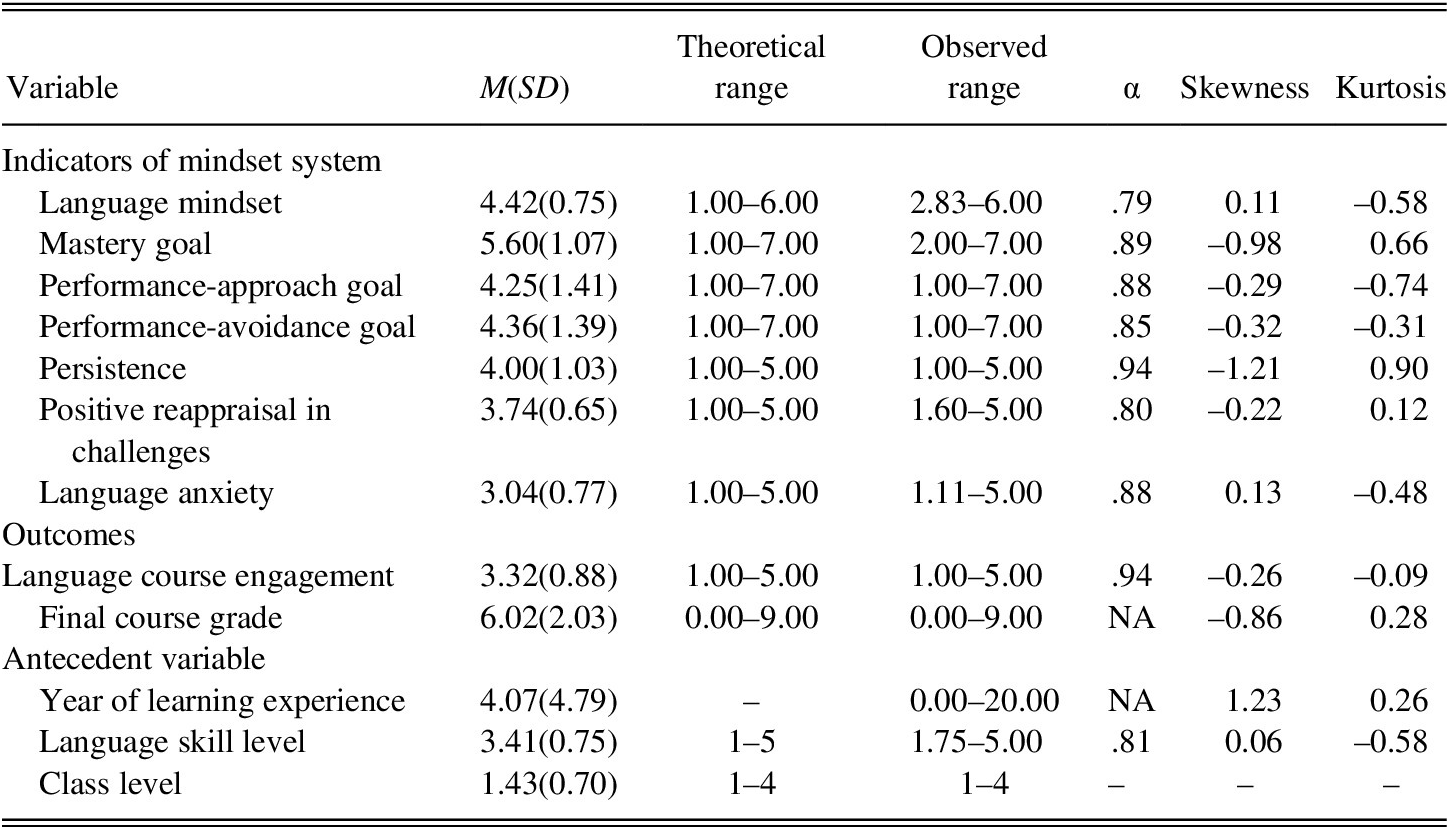
The participants reported the language they were studying, and all the measures mentioned in the following text were tailored to refer to that specific language. The descriptive statistics, including range, mean, standard deviation (SD), reliability, skewness, and kurtosis for all the measures are reported in Table 1. For future replications, all materials and analysis codes are attached as an online supplement and uploaded on https://osf.io/57ahw/.
Descriptive statistics of observed variables

Language Mindsets
We used the subscale of mindsets about second language aptitude from the Language Mindset Inventory (Lou & Noels, Reference Lou and Noels2017). This subscale is adapted from Dweck’s implicit theories of intelligence measure (Dweck, Reference Dweck1999). We focused on the L2 language mindset subscale because this subscale most directly reflects language mindsets related to L2 learning. The other two subscales, which concern general language learning and age sensitivity about L2 learning, were excluded as tangential to our research questions. The participants responded to six items (e.g., “You can always improve how good you are at learning new languages.” “To a large extent, your ability to learn new languages is innate and you can’t change much.”) on a 6-point scale (1 = strongly disagree to 6 = strongly agree; α = .79).Footnote 1
Classroom Achievement Goal Orientation
We used Elliot and Church’s achievement goal measure (Reference Elliot and Church1997) to assess learners’ goal orientations in the language course. This scale includes six items for each three dimensions, including mastery goals (e.g., “I desire to completely master the material presented in my [L2] class.”), performance-approach goals (e.g., “It is important to me to do well compared to others in my [L2] class”), and performance-avoidance goals (e.g., “I just want to avoid doing poorly in my [L2] class.”). The participants responded on a 7-point scale (1 = not at all true of me to 7 = very true of me). Each dimension was found reliable (Cronbach’s α = .89, .88, and .85, for mastery, performance-approach, and performance-avoidance, respectively).
Persistence in Foreign Language Learning
Persistence was measured using the intention to continue second language (L2) studies scale (five items; Noels et al., Reference Noels, Pelletier, Clément and Vallerand2000) on a 5-ponit scale (1 = Never to 5 = Always). Sample items are: “I want to continue to learn [L2]” (positively worded) and “I would like to give up learning [L2]” (negatively worded). This measure displays strong reliability (Cronbach’s α = .94).
Language Anxiety
We used the Language Class Anxiety Scale (Gardner, Reference Gardner, Masgoret, Tennant and Mihic2004) to assess learners’ anxiety about using their [L2] in the classroom. The participants responded on a 5-point scale to indicate their agreement on 10 items (e.g., “I get nervous when I am speaking in my [L2] class.”; 1= strongly disagree, to 5 = strongly agree; Cronbach’s α = .88).
Positive Reappraisal in Language Learning
The reappraisal scale (Wrosch et al., Reference Wrosch, Heckhausen and Lachman2000) was adapted to the language learning context (five items; e.g., “In my [L2] studies, I can find something positive, even in the worst situations”). Participants responded on a 5-point scale about how they feel in the context of their [L2] class (1= not at all, to 5 = a lot; Cronbach’s α = .80).
Foreign Language Course Engagement
The Schoolwork Engage Inventory (Salmela-Aro & Upadyaya, Reference Salmela-Aro and Upadyaya2014) measured learners’ engagement. This measure includes three subdimensions: energy (three items; e.g., “I feel strong and vigorous when I am studying [L2]”), dedication (three items; e.g., “I find my [L2] coursework full of meaning and purpose”), and absorption (three items; e.g., “I feel happy when I am studying [L2] intensively), which were collapsed for analysis. The participants indicated how often these items described their engagement in their language class on a 5-point scale (1 = never to 5 = always; Cronbach’s α = .94). Consistent with a recent study supporting a one-factor model (García-Ros et al., Reference García-Ros, Pérez-González, Tomás and Fernández2018), a CFA suggested that a one-factor model fit the data well (χ2 = 45.22, df = 26, p = .01, CFI = .983, RMSEA = .056, SRMR = .027). The standardized factor loadings were between .62 and .88 (see Table S1 in Appendix).
End-of-Semester FL Course Grades
At the end of the questionnaire, participants were provided with a voluntary consent form to provide the researchers with information to collect their final target-language course grades from the university. The grades of consenting students were obtained after the end of the semester during which they filled out the questionnaire. Letter grades provided by the university were coded from 0 (Fail) to 9 (A+ or “excellent”).
Antecedents
The participants reported their gender (1= male, 0 = female), year of learning experience of the [L2], level of the language course (1 to 4), whether they learned English as their second language (i.e., ESL status), and their current skill level of their second language. Specifically, the participants responded on a 5-point scale (1 = not at all to 5 = very well) regarding their skills in understanding, reading, writing, and speaking/communicating (Cronbach’s α = .81).
Analytic Strategy
We used Mplus 8.0 (Muthén & Muthén, Reference Muthén and Muthén1998–2017) to carry out our analyses in three steps. Missing values were handled using full information maximum likelihood estimation (Enders & Bandalos, Reference Enders and Bandalos2001; Little & Rubin, Reference Little and Rubin2019). Missing values were less than 2.8% and Little’s MCAR test showed that the missing is completely at random (ꭓ 2 = 32.12, df = 40, p = 81). Moreover, missingness on grades (43%) was not significantly associated with other variables.
Measurement Model
We examined the factor structure of variables within the mindset system using Exploratory Structural Equation Modelling (ESEM; Asparouhov & Muthen, Reference Asparouhov and Muthén2009; Mai et al., Reference Mai, Zhang and Wen2018). The ESEM approach combines features of exploratory factor analysis (EFA) and confirmatory factor analysis (CFA). As such, items were specified as loading onto specific factors and cross-loadings were freely estimated but constrained to be close to zero. Research shows that, compared with CFA, ESEM is a better approach for examining complex constructs (Yu & McLellan, Reference Yu and McLellan2020) because it provides model fit indices, reduces factor correlations, and has increased statistical power (see Litalien et al., Reference Litalien, Morin, Gagné, Vallerand, Losier and Ryan2017; Marsh et al., Reference Marsh, Liem, Martin, Morin and Nagengast2011). Good model fit was determined based on the comparative fit index (CFI > .90), the root mean square error of approximation (RMSEA ≤ .06), and the standardized root mean square residual (SRMR ≤ .08; Kline, Reference Kline2015).
Latent Profile Analysis
We performed latent profile analyses based on the factor scores retained from the ESEM solutions (see also Morin et al., Reference Morin, Boudrias, Marsh, Madore and Desrumaux2016). The latent profile analysis is a model-based variant (i.e., it uses a probabilistic model, which provides statistical tests to assess model fit) of the conventional cluster analysis (e.g., based on distance using K-means) to recover groups from observed data. Latent profile analysis is a top-down approach, whereas cluster analysis is a bottom-up approach. Latent profile analysis is also more flexible because latent profile analysis enables researchers to do confirmatory, between-group analysis and to include covariates to understand group memberships (Hagenaars & McCutcheon, Reference Hagenaars and McCutcheon2002). A maximum likelihood estimator with robust standard errors (MLR) was used to estimate each profile model, starting with a two-profile solution, and proceeding up to a five-profile solution. The best profile was selected based on fit indices of Akaike Information Criteria (AIC), Bayesian Information Criteria (BIC), and the sample size adjusted BIC (aBIC), with lower values indicating better fit (Nylund et al., Reference Nylund, Asparouhov and Muthén2007). We also employed Lo–Mendell–Rubin likelihood ratio test (LMR; Lo et al., Reference Lo, Mendell and Rubin2001) to help choose the best model (significant p values indicate that the k profile better fits than k-1 profile). In addition, a larger than .80 entropy value (ranges between 0 and 1) indicates a more confident classification. Because solutions with a larger number of profiles often produce better fit statistics, we also considered the interpretability and parsimony of different models, such that if no further change in the interpretation when more profiles were added, then the most parsimonious model was preferred if it was also consistent with the aforementioned criteria (Nylund et al., Reference Nylund, Asparouhov and Muthén2007).
Outcome Model and Antecedent Model of Latent Profiles
Based on the best profile solution, both grade and engagement outcomes were included simultaneously as distal outcomes using the manual three-step Bolck–Croon–Hagenaars (BCH) approach (Asparouhov & Muthén, Reference Asparouhov and Muthén2021; Bolck et al., Reference Bolck, Croon and Hagenaars2004). The BCH approach accounts for classification error and is relatively resistant to shifts in the profile membership from Step 1 to Step 3 compared to other methods for testing outcome model. Using the latent profile analysis described in the preceding text (Step 1), the BCH approach can include distal outcomes and/or covariates, which generates a new data file with the BHC weights that reflect the error correction (Step 2). In the last step, the BCH model used the previously weighted data to estimate relationships between group membership and other variables (Step 3; see Appendix for code). Using the same approach, we also examine whether the profile predicted outcomes while controlling for language learning experience, language skills, and gender. Finally, all antecedent variables were included simultaneously using the R3STEP command to predict group membership (Asparouhov & Muthén, Reference Asparouhov and Muthén2021).
Results
Measurement Models and Preliminary Analysis
The results of the exploratory structural equation modelling model (ESEM) supported the hypothesized factor structure of each indicator within the mindset system. The model fit the data well (ꭓ2 = 1092.06, df = 659, p < .001, CFI = .92, RMSEA = .05, SRMR = .03; see Table S2 in Appendix for factor loadings). All the items defining each factor were internally consistent (αs ≥ .79) and all factors were generally normally distributed (skewness between −0.98 and 1.24, kurtosis between –0.74 and 0.90). We did not observe significant gender differences in any variable, ts = –1.95 to .076, ps ≥ .052.
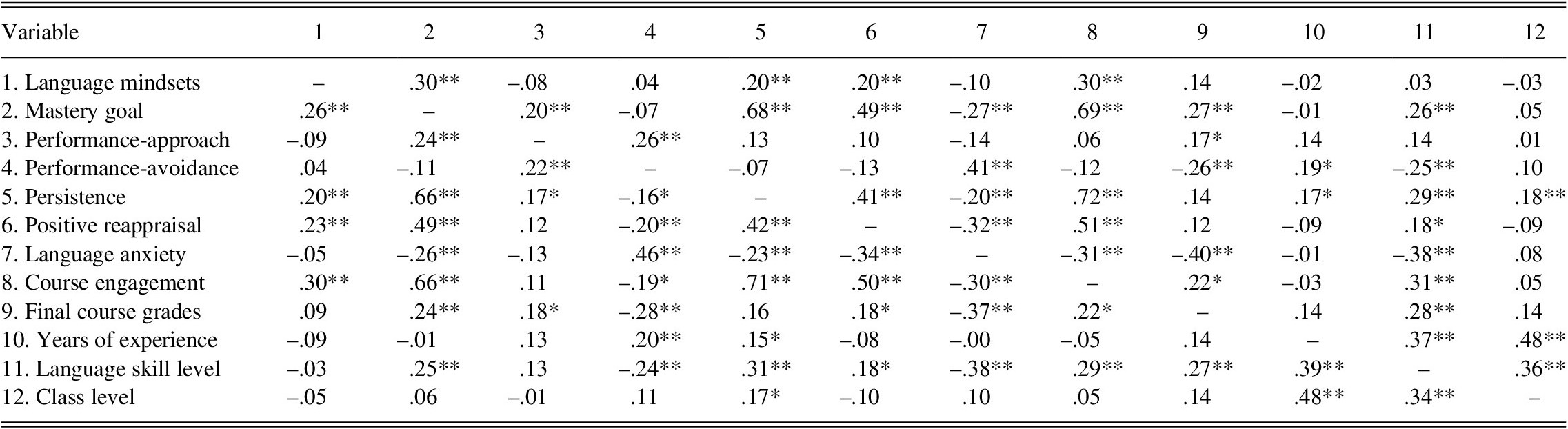
Table 2 presents the intercorrelations among variables. The correlations based on observed variables (below diagonal) and latent scores (above diagonal) are similar. Consistent with mindset theory (Dweck & Yeager, Reference Dweck and Yeager2019), growth (vs. fixed) mindsets were positively correlated with mastery goals (r = .26, p < .001). However, we found that mindsets were not significantly correlated with performance-approach or performance-avoidance goals (|r|s ≤ .09). Moreover, mindsets were positively correlated with persistence, positive reappraisal, and class engagement, but not significantly correlated with language anxiety and end-of-semester grade. Consistent with achievement goal theory, mastery goal was positively correlated with persistence, positive reappraisal, class engagement, and final course grades, whereas performance-avoidance goal showed an opposite pattern. Performance approach goals were positively correlated with both mastery and performance-avoidance goals, as well as course grades, but not with other variables. In summary, although the correlations were generally consistent with mindset theory and achievement goal theory, mindsets were not significantly correlated with performance goals, suggesting that the link between mindsets and achievement goals is not straightforward.
Observed variable correlations (below diagonal) and latent correlations (above diagonal)

* |r| >.15 and p < .05; **|r| ≥ .20 and p < .01 (2-tailed test).
Latent Profile Analysis
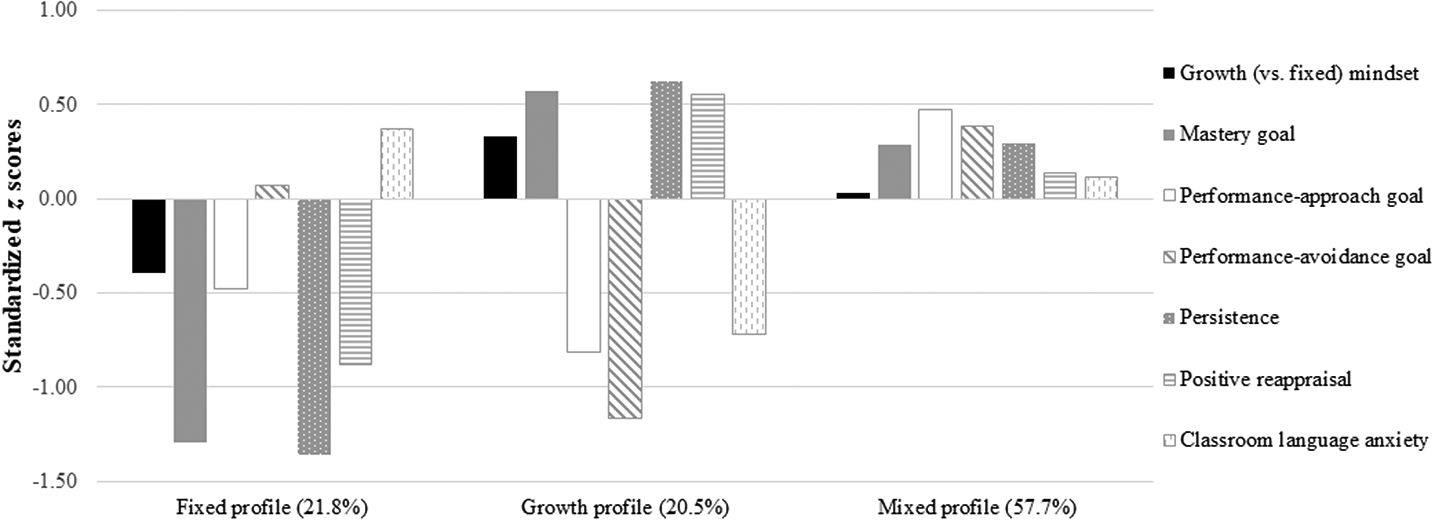
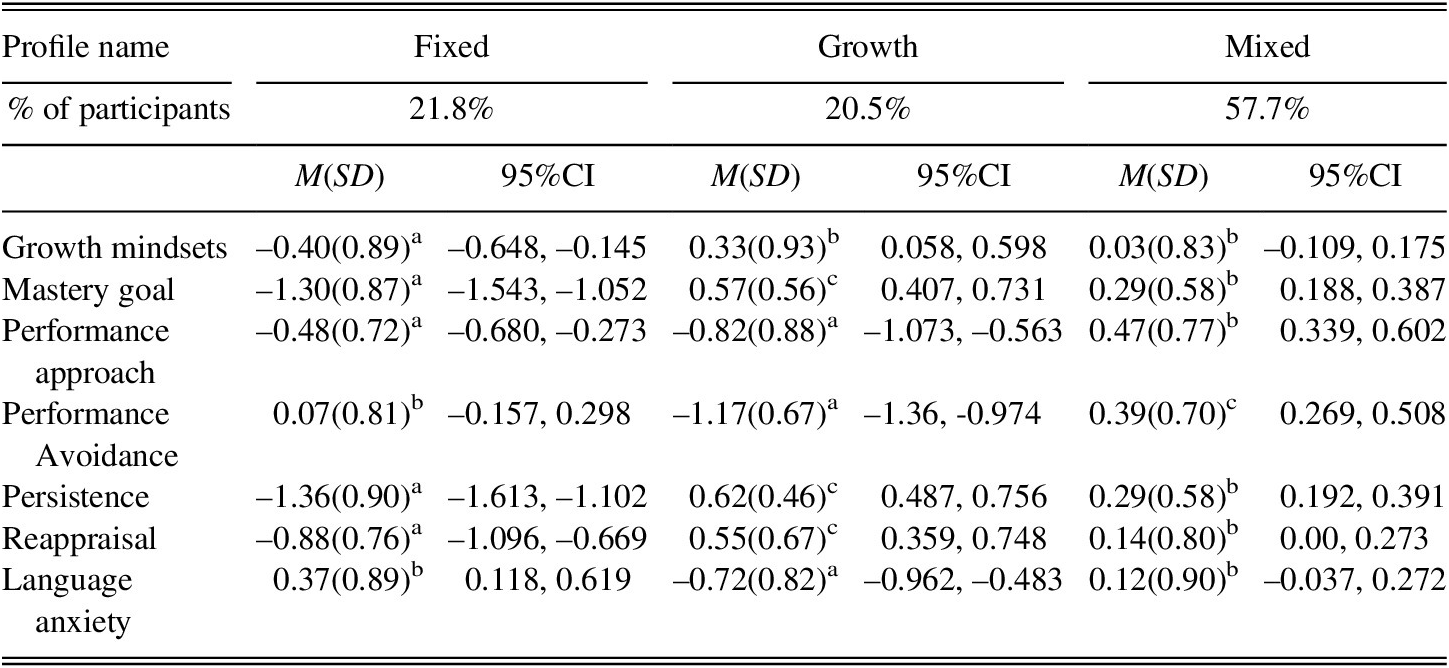
Table 3 provides fit indices for the two-through five-profile solutions. AIC, BIC, and aBIC values decreased between two-profile and three-profile solutions (∆AIC, ∆BIC, and ∆aBIC = 59.62, 31.98, and 57.34). These values also decreased between three- and four-profile solutions, but the decreases were not as large (∆AIC, ∆BIC, and ∆aBIC = 53.72, 26.07, and 51.44). Moreover, the BIC increased after the four-profile solution, suggesting the five-profile solution was not better than the four-profile solution. Thus, simply based on fit indices, both three- and four-profile solutions fit the data well. The p-value of the LMR showed that the two-profile solution is better than the one-profile solution; the three-profile is only slightly better than the two-profile solution (p = .10); but the four-profile solution is no better than the three-profile solution. Further support for the three-profile solution was evidenced by the fact that the four- and five-profile solutions extracted profiles consisting of less than or equal to 7% of the total sample. Finally, we examined the distinctiveness of the profiles from the three- and four-profile solutions. For the three-profile solution, all profiles were distinct in terms of shape (i.e., the pattern of mean scores of most variables differ, as shown in Figure 1; see also Table 4 for post hoc test results). In the four-profile solution, two profiles reflected very small differences in shape (the relative pattern of two profiles are similar but differ slightly in elevation; see Table S3 in Appendix). Compared to the three-profile solution, the four-profile solution did not provide a theoretically meaningful or qualitatively distinct profile. Therefore, considering the fit indices and based on parsimony and interpretation, we selected the three-profile model (entropy = .801).
Fit indices for mindset-based system profile solutions

Note: LL = log-likelihood; AIC = Akaike Information Criteria; BIC = Bayesian Information Criterion; aBIC = adjusted BIC; LMR-LRT = Lo-Mendell-Rubin adjusted likelihood ratio test. The best model is bolded.
Three-profile solution for mindset-based meaning system.
Note: A higher, positive z-score indicated a stronger endorsement of the corresponding factor, whereas a lower, negative z-score indicated a weaker endorsement of the factor.

Post-hoc analysis of profile differences all indicator variables (three-profile solution)

Note: The z scores are based on latent factor scores.
abcDifferent superscripts in the same row represent significantly different values (p < .05). The details of the post hoc tests are presented in Table S5 in the Appendix.
As shown in Figure 1, we labeled the three profiles as fixed, growth, and mixed profiles. The fixed profile and growth profile represent 21.8% and 20.5% of the participants, respectively. The differences between these two profiles were distinctive, representing the opposite end of the mindset systems. Consistent with variable-centered correlations, learners in the fixed-mindset profile reported low mastery goals, persistence, positive reappraisal, but high language anxiety and performance avoidance goals than those in the growth profile. Although learners in the fixed-mindset profile did not report a significantly higher performance-approach goal (p = .08), the values were slightly higher than those in the growth-mindset profile group. In summary, the fixed and growth mindsets profile groupings were consistent with the findings of much research that used a variable-centered approach.
The majority of learners (57.7%), however, fell within the mixed profile group. We named this group of learners as mixed not only because they endorse both mindsets but also they pursue multiple goals in their language studies—strong performance-approach and -avoidance goals and a relatively strong mastery goal—yet they were relatively persistent but anxious in using languages. Specifically, learners in the mixed profile endorsed a stronger growth mindset than those in the fixed profile, but their scores did not differ significantly from the growth mindset profile. Nevertheless, their mindset z-score is close to 0, suggesting this group of learners did not have a distinctive mindset within the current sample. A supplementary post hoc analysis that separated the fixed and growth mindset items as two dimensions showed that the students in the mixed profile endorsed high fixed and growth mindsets, which further support the idea that they have relatively “mixed” mindsets. Specifically, students in the mixed profile endorsed equally high growth mindsets as students in the growth profile (Mdiff = –.04, p = .97) and higher than students in the fixed profile (Mdiff = .66, p =.001). They also endorse equally high fixed mindsets as students in the fixed profile (Mdiff = –.29, p = .25) and higher than students in the fixed profile (Mdiff = .44, p = .033; see Table S4 in Appendix for details).
Moreover, the pattern of this mixed profile was particularly distinguished from the other two profiles in their endorsement of all three achievement goals. Specifically, learners in the mixed profile endorsed stronger performance-approach and -avoidance goals than either the fixed or growth profiles groups. Learners with the mixed profile also endorsed mastery goals more strongly than those in the fixed profile but more weakly than those in the growth profile. Moreover, their anxiety is similar to students in the fixed profile, but significantly higher than those in the growth profile. Finally, their persistence and positive reappraisal were in between and significantly different from the fixed and growth profiles.
In summary, our profile solution generally supported the mindset theory (Dweck & Yeager, Reference Dweck and Yeager2019) by showing a distinction between the two ends of the mindset system in mastery goals, persistence, positive reappraisal, and language anxiety. However, consistent with the variable-centered results that mindsets and performance goals did not have clear linear connections, we found that those in the mixed profile endorsed strongest performance-approach and -avoidance goals, even more than those in the fixed profile.
Model and Antecedent Model of Latent Profiles
Outcomes of profiles based on the mindset system
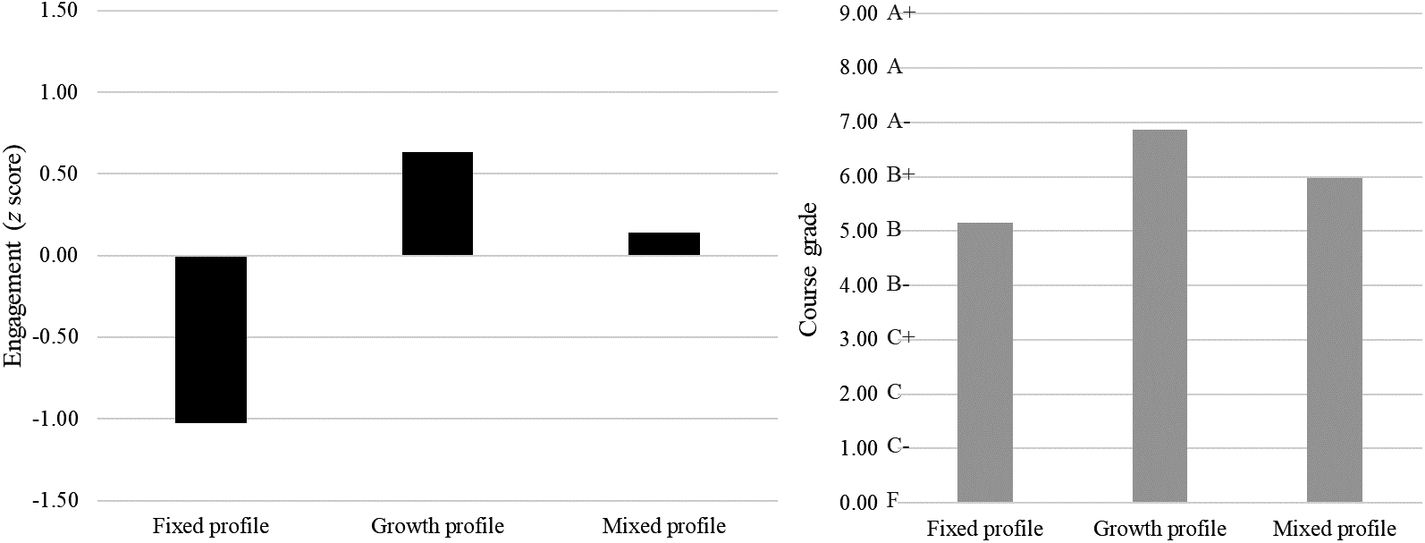
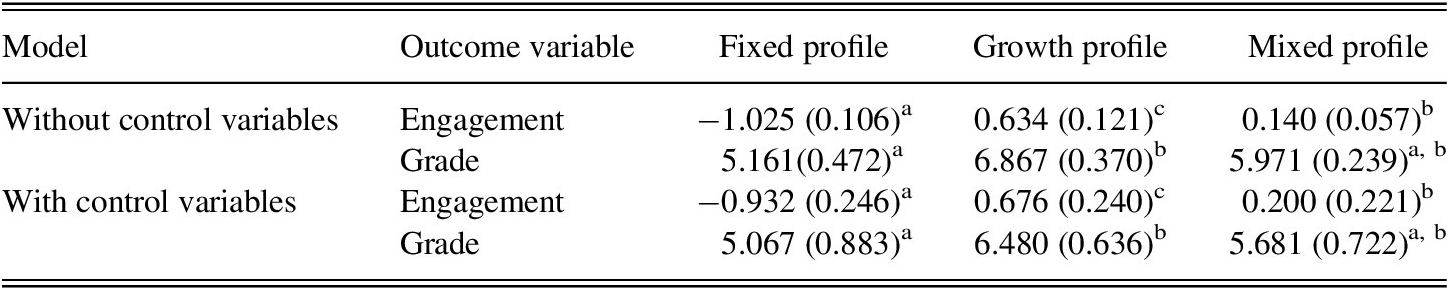
Figure 2 presents the means for engagement and course grade for each profile (see also Table 5). We found that engagement was significantly different across profiles: learners in the growth profile showed the highest engagement, followed by mixed profile, and then fixed profile. Specifically, learners in the growth profile reported 0.49 SD higher on the standardized engagement score than those in the mixed profile (Wald ꭓ2 = 3.48, p < .001) and 1.52 SD higher than those in the fixed profile (Wald ꭓ2 =10.28, p < .001); learners in the mixed profile reported engagement scores 1.17 SD higher than those in the fixed profile (Wald ꭓ2 = 1.17, p < .001), a large effect size. We also found that learners in the growth profile received letter grades of approximately A–, 1.71 grade increments higher than those in the fixed profile (whose grades were around B), Wald ꭓ2 = 2.83, p = .005. However, those in the mixed profile (with grades around B+) were not significantly different from those in the other two profiles: they received 0.81 letter-grades higher those in the fixed profile, Wald ꭓ2 = 1.48, p = .14, and 0.90 grades lower than those in the growth profile, Wald ꭓ2 = 1.90, p = .058.
Differences of engagement (left) and grades (right) for the three mindset-system profiles.

Means and standard error for engagement and course grade for each profile with (above) and without (below) control variables.

Note: The outcome of engagement is based on the factor score of engagement. Control variable includes gender, language experience, perceived language skills, ESL status, and class level.
Values with different superscripts in the same row represent significantly different values.
When controlling for prior experience learning the language, gender, and L2 skills, similar results were observed for engagement and grades (see Table 5). Together, the results demonstrated that the mindset-based profile predicted language learners’ engagement and grade, even controlling for their language skills and experience. The growth profile was more engaged and performed better in their language classes compared to the fixed profile. Although learners in the mixed profile were more engaged than those in the fixed profile and less engaged than those in the growth profile, their grades were not significantly different from either.
Antecedents of mindset profiles
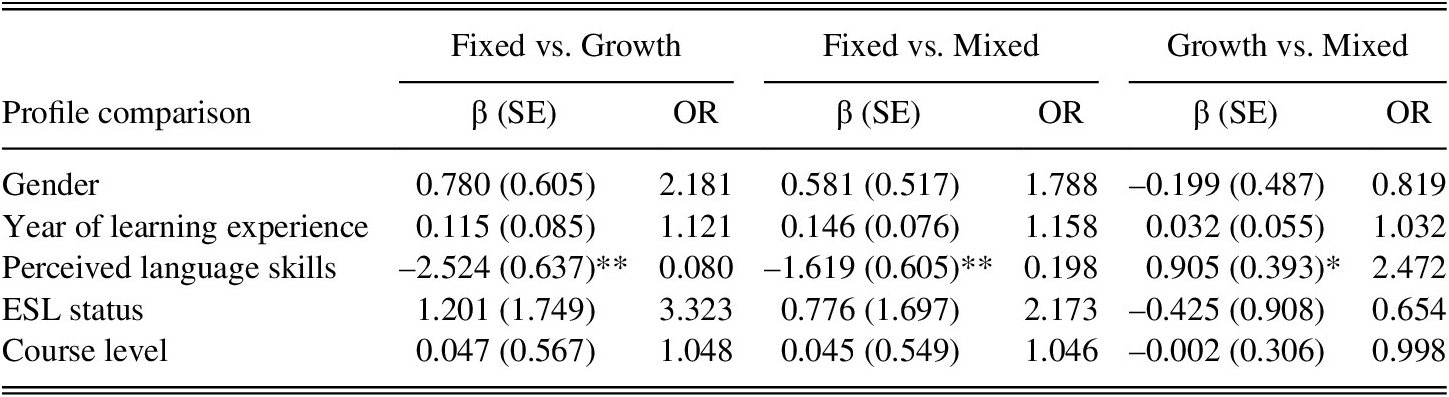
Table 6 presents the multinomial logistic regressions for the effect of antecedents on the likelihood of profile memberships. Consistent with the bivariate correlations, gender did not predict profile membership. We found that language skills predicted learners’ memberships in different profiles: Learners who reported being more competent were less likely to be in the fixed profile, relative to both growth and mixed profiles. Specifically, those who scored 1 SD higher on perceived competence were 12.5 (1/0.08) times more likely to be in the growth profile than in the fixed profile and 5.05 (1/0.198) times more likely to be in the mixed profile than in the fixed profile. Also, learners who reported being more competent were also more likely to be in the growth profile, relative to the mixed profile. Specifically, those who scored 1 SD higher on perceived competence are 2.47 times more likely to be in the growth profile than in the mixed profile. We found that year of learning experience, ESL status, and the level of the language course did not significantly predict learners’ profile memberships. In summary, learners’ perception of their language skills predicted their mindset-system profiles, but gender, year of learning experience, ESL status, and course level play a minimal role in predicting memberships.
Joint group membership prediction with multinomial logistic regression

Note: OR = odds ratio.
*p < .05. **p < .01.
Discussion
The language mindset system is argued to be multifaceted and differently manifested across diverse people (Lou & Noels, Reference Lou, Noels, Lamb, Csizér, Henry and Ryan2019c); however, the conventional strategy for measuring mindsets and related constructs in relation to engagement and achievement uses a variable-centered approach that is less able to capture this complexity. The current study examined university-level foreign language learners’ mindset system at a university in Canada and identified three groupings of language learners for whom their language mindset combines in a unique way with goals, coping, anxiety, and persistence in a complex nomological system. Similar to prior studies in other educational domains (Chen, Reference Chen2012; Chen & Tutwiler, Reference Chen and Tutwiler2017; Yu & McLellan, Reference Yu and McLellan2020), we identified one profile in which there was a concurrent endorsement of growth mindsets and mastery goals. In our sample, this growth profile was also characterized by high persistence, high use of positive reappraisal, and low language anxiety. Consistent with Yu and McLellan’ study (Reference Yu and McLellan2020) but not with Chen and Tutwiler’s (Reference Chen and Tutwiler2017), we also identified a fixed profile that was significantly different from the growth profile in several respects. Learners with fixed mindsets displayed relatively maladaptive motivational patterns, as characterized by a relatively high performance-avoidance goal and anxiety, and low mastery goals, persistence, and reappraisal. Finally, we identified a third profile with relatively mixed mindsets and goal orientations (i.e., high endorsement of all goal orientations), a high level of anxiety, and moderate levels of persistence, reappraisal. This profile represented the majority of learners (57.7%), whose motivation cannot be easily predicted or understood by conventional mindset theory. These findings suggest that educators cannot simply expect learners to fit neatly into either a growth or fixed motivational profile.
Language Mindset System
Consistent with mindset theory (Dweck & Yeager, Reference Dweck and Yeager2019), we found that learners in fixed and growth profiles showed differing patterns in other motivational constructs. Compared to learners in the fixed mindset group, learners in the growth mindset group were more likely to set mastery goals, less likely to set performance-avoidance goals, more persistent in language learning, more likely to positively reappraise challenges, and felt less anxious about using the language in the classroom. However, we did not find significant differences (p = .08) between fixed profile and growth profile students on performance-approach goals, which is consistent with the results of a prior study using a variable-centered approach (Lou & Noels, Reference Lou and Noels2017). This may be because fixed mindset students set performance-approach only when they also perceive themselves to have high competence. Moreover, we found that learners in the growth profile were more engaged and achieved better end-of-semester grades on average (A– vs. B) than learners in the fixed profile. These findings support the claim that a growth mindset is linked to adaptive outcomes, whereas a fixed mindset is linked to maladaptive outcomes (Dweck & Yeager, Reference Dweck and Yeager2019). There are also consistent findings in many earlier mindset studies (see Chiu et al., Reference Chiu, Hong and Dweck1997; Dweck et al., Reference Dweck, Chiu and Hong1995; Hong et al., Reference Hong, Chiu, Dweck, Lin and Wan1999) in which comparisons were made between learners who scored high and low on the mindset scale.
Although the findings show that there are some learners who fit into either of these two clear-cut profiles, the profile analyses importantly showed that almost 60% of these university-level learners were in the mixed profile in the domain of foreign language learning. This finding supports the argument from language researchers that most learners cannot be simply categorized into fixed or growth mindsets (Irie et al., Reference Irie, Ryan and Mercer2018; Mercer & Ryan, Reference Mercer and Ryan2010). Learners in the mixed profile had distinct characteristics: they were characterized by their endorsement of multiple goals, and they had the highest performance-approach and -avoidance goals of any learner profile. Although learners in the mixed profile reported the highest endorsement of both performance goals, their language class anxiety was similar to those in the fixed profile but higher than those in the growth profile. These learners also reported moderate persistence and positive reappraisal, scoring between the fixed and growth profiles. Thus, being in the mixed profile was not as adaptive as the growth profile (whose members were also characterized by a predominant mastery goal) but was more adaptive than fixed profile membership (with its dominant avoidance goal) in terms persistence, reappraisal, and engagement.
The Implications of Mindset System in Language Learning
Regarding the differential outcomes associated with these profiles, learners in the growth profile were the most engaged and performed better in their language classes compared to learners in the fixed profile, even after controlling self-perceptions of language skills and other predictors. These findings suggest that the differences between fixed- and growth-profile learners on engagement and grades are not due to their perceived language skills. Although learners in the mixed profile were more engaged than those in fixed profiles and less engaged than those in the growth profile, their grades were not significantly different from either. This finding is consistent with previous achievement goal studies showing that multiple-goals and mastery-oriented learners had similar levels of achievement (Daniels et al., Reference Daniels, Haynes, Stupnisky, Perry, Newall and Pekrun2008). Even though mixed-profile learners were less engaged, endorsing both mastery and performance goals may not undermine learners’ performance. It is also possible that mastery goals may override the negative effects of performance goals on grades, such that having a mastery goal is beneficial for performance, even if learners still set performance goals.
The only individual difference variable that showed a significant relation with learners’ profile was learners’ perception of their skill in the target language, with learners with stronger language skills more likely to be in the growth profile. Although stereotypes that men are less competent than women in foreign language learning are prevalent, the present findings showed that gender was not significantly correlated with language mindsets. It is possible that university men are not likely to feel threatened by gender stereotypes about their foreign language ability (e.g., Chaffee et al., Reference Chaffee, Lou and Noels2020b). Similarly, learners’ years of study in a foreign language, or whether English was their second language also played little role in their mindset profile membership. It is possible that how learners perceived their language skills over the course of language studying, rather than how many years or what language they studied, are more critical in mindset formation. Indeed, previous research showed that learners with stronger language competence were more likely to endorse growth mindsets (Lou & Noels, Reference Lou and Noels2020b). However, the same study also showed that the link between perceived competence and growth mindsets was more substantial for novice learners. Future studies may explore how different antecedent variables may interact with each other in predicting mindset profiles.
Our findings provide alternative explanations for previous inconsistent findings regarding the applications of mindset theory in learning outcomes (e.g., Burgoyne et al., Reference Burgoyne, Hambrick and Macnamara2020; Sisk et al., Reference Sisk, Burgoyne, Sun, Butler and Macnamara2018). Consistent with previous studies, we found that learners’ mindsets (alone) at best only weakly predict grades (see also Sisk et al., Reference Sisk, Burgoyne, Sun, Butler and Macnamara2018). However, learners with fixed and growth mindset system profiles did show clear differences in grades. Therefore, we maintain that a growth mindset does not act alone in predicting learning outcomes, but instead, interacts with other motivational components that together predict achievement. As such, mindsets may be better theorized as part of a complex system (cf. Hiver & Papi, Reference Hiver, Papi, Lamb, Csizér, Henry and Ryan2019; Larsen-Freeman, Reference Larsen-Freeman and Atkinson2011), in which mindsets are interconnected with other related cognitions and affect. This finding appears to support earlier arguments that, in actuality, mindsets and associated factors continually interact in meaningful ways to create learning experiences, impacting learners’ engagement in the classroom and success in learning (Lou & Noels, Reference Lou, Noels, Lamb, Csizér, Henry and Ryan2019c). To capture the effects of mindsets, examining them in concert with achievement goals, persistence, reappraisal, and anxiety allowed us to see a clearer picture of their implications for learning outcomes.
We observed unexpected nonsignificant correlations between mindsets and both types of performance goals, though this finding was consistent with Burgoyne et al. (Reference Burgoyne, Hambrick and Macnamara2020). This finding can also be further understood through the profile differences, where students with mixed mindsets are likely to endorsed multiple goals. When comparing learners with distinct fixed and growth profiles, those in the growth profile endorsed significantly higher mastery goals and lower performance-avoidance goals than those in the fixed mindset profile. However, the differences were obscured by the presence of learners with mixed mindsets. Because these learners tend to adopt multiple goals, they may show distinct motivational patterns that are not simply in between those of learners with fixed or growth mindsets.
In summary, mindsets matter when considered as part of a nomological network/system. We observed that the mindset system is more complex than previously described in variable-centered research. When research focuses on fixed and growth learners and excludes learners with mixed mindsets in analyses (e.g., Chiu et al., Reference Chiu, Hong and Dweck1997; Claro et al., Reference Claro, Paunesku and Dweck2016; Dweck et al., Reference Dweck, Chiu and Hong1995; Hong et al., Reference Hong, Chiu, Dweck, Lin and Wan1999), researchers could misrepresent the whole mindset system by neglecting the majority of learners who have distinct goal orientations. Most learners in our study reported complex belief systems that did not fall into either fixed or growth mindset systems. Therefore, future language mindset research should consider (at least) three groups of learners in variable-centered approaches, and consider nonlinear relations between mindsets and other variables. Whereas research to date provides much insight into the motivational dynamics of learners committed to either a growth or fixed mindset, investigations learners with a mixed profile could usefully examine how people juggle their beliefs and goals with competing situational demands on a moment-to-moment basis as well as over time and across development. Future research may continue to understand nonlinear relations between aspects of a dynamic mindset system.
Practical Implications
Our findings provide important educational implications. First, language educators should avoid categorizing all learners as either fixed or growth mindset learners. We observed that the largest proportion of FL learners held mixed mindsets. These learners may present performance goals and anxiety in the classrooms similar to students with fixed mindsets. Given that mixed-mindset learners have relatively indistinct beliefs, they might be sensitive to situational cues that prime one or the other belief system (Lanvers, Reference Lanvers2020; Molway & Mutton, Reference Molway and Mutton2020). Moreover, categorizing learners based on their mindsets can be dangerous if it leads educators to blame learners for poor performance (“you do not have a growth mindset”; Dweck, Reference Dweck2015).
Because learners’ engagement and achievement are predicted by multiple constructs, focusing teaching interventions solely on mindsets might be uninformative as well as inaccurate. To promote learners’ engagement and achievement, it might be more appropriate to help learners reflect on multiple aspects of the growth mindset system—not just about sheer effort but also about how to adapt to challenges (Dweck & Yeager, Reference Dweck and Yeager2019). Our findings suggest that rather than mindset alone, fostering the “growth mindset system” as a whole (i.e., including other related constructs such as mastery goals and positive responses to challenges) may lead to more engaging learning experiences and higher language proficiency. For example, intervention research may consider not just the “what” of mindsets to teach learners that success comes from effort, but also incorporating “how” aspects such as guiding learners to set mastery goals and reconstrue failure in a positive light as a part of the learning process (i.e., positive reappraisal).
Our findings suggest that future interventions should focus on learners with lower perceptions of their skills in the language they are learning, given that these learners are more likely to fall into the fixed mindsets profile. Even after controlling for their perceived language skills, learners in the fixed mindset profile were least engaged in their class and received lower grades than learners in the growth mindset profile.
Limitations and Future Directions for Research
Some limitations of this study should be addressed in future studies. First, this study investigated mindsets and a limited set of relevant constructs; it did not take into consideration other related cognitions and affect, such as attribution style, effort beliefs, enjoyment, that could be associated with mindsets (cf. Chen et al., Reference Chen2012; Dweck & Yeager, Reference Dweck and Yeager2019; Zhang et al., Reference Zhang, Lou, Noels, Daniels, Gregersen and Mercer2021). Future research may integrate a more comprehensive set of mindset-related constructs to understand language learners’ mindset profiles.
Second, although the grades we used as an indicator of language proficiency were collected after the end of the term during which learners were surveyed, providing some temporal insight into how motivational constructs predict later language proficiency, readers should be mindful that the present study does not provide causal evidence for links between mindset profiles and proficiency. Future research could expand the scope of the present study by examining the trajectory and change of profiles over time. Given that language learning is a long-term process, learners’ mindsets and mindset-profile may change over time as competency levels (or, conversely, course difficulty levels) increase. On a shorter time frame, an idiodynamic study (cf. MacIntyre, Reference MacIntyre2012) could be particularly helpful for examining whether and how those people with mixed mindsets shift their ways of thinking over a short period and/or during a specific activity.
Third, although the participants in this study were learners from diverse backgrounds, this study focused on foreign language learners in a university in Canada. Future studies could examine the mindset system among learners belonging to different age groups or educational levels, as well as among learners in different ethnolinguistic contexts. Such attention to context can help researchers better understand variations in the mindset systems in language learning. Examining the influence of the learning environment (Haimovitz & Dweck, Reference Haimovitz and Dweck2017; Shirvan et al., Reference Shirvan, Lou and Taherian2021) or the influence of experimental manipulations on mindsets and related constructs would allow researchers to see how the mindset-profiles change in responses to the environment or experimental manipulations, as well as evaluating whether new profiles emerge over time or in different contexts. For example, recent research suggests that learners change their mindsets and related constructs based on teachers’ feedback and how they perceive their teachers’ mindsets (e.g., Lou & Noels, Reference Lou and Noels2020c). It is possible that learners with mixed mindsets can be influenced by teachers’ feedback and shift to either fixed or growth profiles over time. Such an investigation would provide more insight into understanding the origin and development of different mindset systems as well as the process of how the mindset-system functions as a whole. Furthermore, future research can examine whether and how interventions that aim to change learners’ mindset-system can improve their proficiency over time.
Conclusion
This investigation is the first empirical study to contribute to understanding the heterogeneity of language mindset systems among foreign language learners, as well as their relationships with perceived foreign language skills, engagement, and proficiency. Our findings support the idea that the mindset system is composed of multiple factors that guide learning outcomes (Dweck & Yeager, Reference Dweck and Yeager2019). Fixed and growth profiles represented opposing mindset systems, in that they were characterized by contrasting patterns of goals, reappraisal, anxiety, and persistence. Moreover, although growth mindsets alone did not directly predict language proficiency, learners in the growth profile were consistently most engaged in language classes and achieved the highest proficiency. Most learners, however, were not part of these two groups and were mixed in their mindsets and pursue multiple-goal orientations. These learners were more engaged than those in the fixed profile and less engaged than those in the growth profile, but their grades were not significantly different from either. When researchers categorize learners into “growth- versus fixed-mindset learners” to describe the role of mindsets on a variety of motivational patterns, we may neglect many learners whose mindset system does not fit simply into either category, despite the prevalence and utility of the comparisons between fixed and growth mindsets in the literature. Together, this research highlights that a person-centered approach to a mindset motivational system (that integrated mindsets and relevant constructs) can complement existing literature on the mindset theory to understand learners’ engagement and achievement in a new language, as well as the need to pay more attention to learners with a mixed mindset system.
Supplementary Materials
To view supplementary material for this article, please visit http://doi.org/10.1017/S0272263121000401.