Interspecific kleptoparasitism is defined as the stealing of already-acquired items from other species (Brockmann & Barnard Reference BROCKMANN and BARNARD1979). This type of competitive exploitation between species is widespread among the animal kingdom. Despite being a major force driving the evolution of biotic interactions, few taxa (mostly birds and arthropods) have received significant attention (Iyengar Reference IYENGAR2008). So far, only two examples of interspecific kleptoparasitism have been described in tropical reptiles (Varanus komodoensis vs feral Canis lupus; Auffenberg Reference AUFFENBERG1981; Boa constrictor vs Ameiva ameiva; McConchie & Wilkinson Reference MCCONCHIE and WILKINSON2004).
On Réunion, the Manapany day gecko Phelsuma inexpectata and the honeybee Apis mellifera both forage on the inflorescences of the palm tree Latania lontaroides. While investigating potential competitive interactions between these two species, we observed an unexpected interaction. On many occasions, the gekkonid lizard has been observed robbing and eating pollen pellets from foraging honeybee workers. In the present study, we describe the kleptoparasitic behaviour of P. inexpectata, estimate its frequency and briefly discuss its potential adaptive significance.
Phelsuma inexpectata (Mertens) (Gekkonidae) is a species endemic to Réunion, Indian Ocean. Its current distribution is restricted to an 11-km long littoral fringe in the south of the island (Sanchez & Probst Reference SANCHEZ and PROBST2011). This diurnal and arboreal species inhabits coastal vegetation. Its diet mainly consists of arthropods, fruit, nectar and pollen (Deso et al. Reference DESO, PROBST, SANCHEZ and INEICH2008). In its remaining habitat, negative interactions with other species, such as interference or exploitative competition, could play a major role in the decline of this Phelsuma species (Sanchez et al. Reference SANCHEZ, PROBST and DESO2009).
Latania lontaroides (Gaertn.) H.E. Moore (Arecaceae) is endemic to Réunion. This palm tree species is almost extinct in its natural habitat, i.e. coastal ecosystems, but frequently used as an ornamental plant on Réunion (Lavergne et al. Reference LAVERGNE, DURET and GIGORD2004). It grows up to 12 m high, and is a dioecious species. Once a year, male produce thousands of yellow cup-like staminate flowers (12 mm in diameter, 32 stamens) that grow in clusters on inflorescences (30–45 cm long) (Bosser et al. Reference BOSSER, CADET, GUEHO and MARAIS1984). During the bloom period, inflorescences are daily visited by several hundreds of foraging honeybees (pers. obs.).
Based on both morphological (Schneider Reference SCHNEIDER1989) and genetic criteria (Franck et al. Reference FRANCK, GARNERY, LOISEAU, OLDROYD, HEPBURN, SOLIGNAC and CORNUET2001) the honeybee from Réunion has been described as Apis mellifera unicolor (Latreille) (Apidae), the subspecies endemic to Madagascar. This generalist pollinator is widespread throughout the island with more than 20 000 domestic hives documented in 2012 (O. Esnault, pers. comm.).
Observations were undertaken in Manapany-les-Bains (21°22′16″S, 55°35′10″E) where the largest known population of the Manapany day gecko occurs (Sanchez & Probst Reference SANCHEZ and PROBST2011). In this urbanized site, we focused our attention on geckos inhabiting young L. lontaroides that are planted every 5 m along a coastal road.
The study was conducted from 27 April to 6 May 2012, during L. lontaroides flowering period, and observations were carried out and from 7h30 to 15h00, during the main activity periods of P. inexpectata and A. mellifera species (pers. obs.). Gecko–honeybee interactions were recorded with a digital video camera (Sony DCR-SR90, Sony, Japan) so that rapid subtle movements could be observable later. The video camera and observers were at the greatest possible distance (2 m on average) to minimize observer effects (Kerr et al. Reference KERR, BULL and MACKAY2004). Only one gecko was followed per observation and the same individual never monitored twice in a row. Once observed on inflorescences (1.5–1.8 m high) in presence of honeybees, each gecko was filmed during a 20-min period. Yet, geckos often escaped from view behind the inflorescences or on palms, where there was no honeybee to interact with. The length of ‘informative’ observation sequences, i.e. when both gecko and honeybees were present on the inflorescences and therefore potentially interacting, were therefore often much shorter. Based on ‘informative’ video records only, we noted the total number of attempted and successful thefts and estimated the frequency of this kleptoparasite behaviour. Failure is defined as an attempt without removal of pollen, and success as an attempt with at least a piece of the pollen pellet collected. Identification of each gecko was done a posteriori, based on video records by using both head and dorsal colour patterns and injury positions (Wanger et al. Reference WANGER, MOTZKE, FURRER, BROOK and GRUBER2009). Males were recognized by their larger size and their green-blue highlighted colour on the dorsum; females by the presence of endolymphatic sacs on each side of the neck and their duller colour (Sanchez et al. Reference SANCHEZ, PROBST and DESO2009).
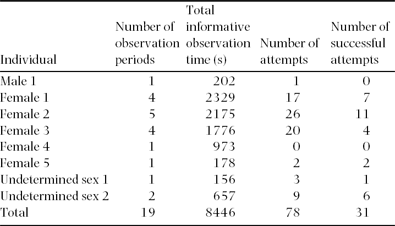
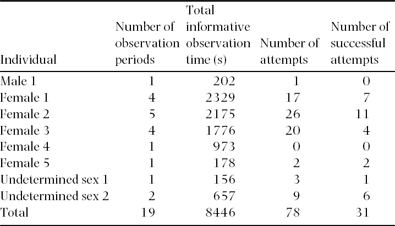
We recorded gecko–honeybee interactions during 19 observation periods (lasting from 20 s to 20 min). Geckos were clearly observed robbing and eating pollen from foraging honeybees. Geckos sought for the honeybee corbicula load, approaching honeybees from the side or the back of the insect. Then, if the honeybee did not fly off, the gecko easily removed a piece or the entire pollen pellet (Supplementary Material). Honeybees were never observed being aggressive towards geckos. Their responses, when they occurred, were limited to flying off from inflorescences. During the 140 min of ‘informative’ video records (gecko and honeybees potentially interacting on inflorescences), a total of 78 attempts were recorded, at least 40% were successful (Table 1). Based on ‘informative’ video records, a total of eight different adult geckos were identified. Seven of them attempted pollen theft. Note that the only female that was not observed attempting pollen theft was observed only once during our study. Both males and females displayed kleptoparasitic behaviour, whatever the observation period. With an average of one attempted theft every 2 min during the 140-min observation period, this kleptoparasitic behaviour is therefore far from being anecdotal.
Video observations of kleptoparasitism by Phelsuma inexpectata on honeybees on Réunion. The geckos were robbing the honeybees (Apis mellifera) of Latania lontaroides pollen. For each gecko identified are given: the number of observation periods recorded, the total ‘informative’ observation time, the total number of attempts and the number of successful thefts.
Pollen thefts from foraging honeybees have previously been observed in arthropods (Jean Reference JEAN2005, Maeta et al. Reference MAETA, GOUKON, SUGIRA and MIYANAGA1996); this is the first report of pollen-pellet thefts by a vertebrate species. This observation confirms that pollen, containing up to 25% protein, diverse vitamins, minerals, amino acid, carotenoid (Campos et al. Reference CAMPOS, BOGDANOV, ALMEIDA-MURADIAN, SZCZESNA, MANCEBO, FRIGERIO and FERREIRA2008), could be an important component of the gecko diet. It also reveals that P. inexpectata would gain from A. mellifera presence, rather than undergo strong negative effects of a potential competition, at least on L. lontaroides inflorescences.
For kleptoparasitim to be profitable and evolve, the benefit (energy gained) must exceed the cost (energy expenditure and risk of injury from the host) (Iyengar Reference IYENGAR2008). Based on our observations, the risk of injury from the host seems very low and the cost for the gecko is therefore limited to energy expenditure. Geckos face the energy expenditure trade-offs between independent foraging (collecting directly pollen grains from flowers) versus kleptoparasitism (robbing pollen pellets from honeybees). During our behavioural survey, geckos were never observed collecting pollen directly from L. lontaroides flowers, even when honeybees were not present on inflorescences. Geckos only forage for L. lontaroides pollen already acquired by honeybees. Two non-exclusive adaptive hypotheses could be proposed: (1) ‘Bee’ pollen presents antibacterial and anti-fungicidal proprieties (Carpes et al. Reference CARPES, BEGNINI, DE ALENCAR and MASSON2007) that could significantly increase gecko's fitness. Indeed, honeybees combine collected pollen grains (fine powder-like material) with nectar and regurgitated honey to accumulate it as pellets in pollen baskets (Hodges Reference HODGES1974). Geckos would gain essential nutritional elements and enzymes from pollen already acquired by honeybees. (2) If honeybees forage successively on different floral resources and produce mixed pellets (Craig & Stewart Reference CRAIG and STEWART1988, Hodges Reference HODGES1974), geckos inhabiting L. lontaroides could benefit from a polyfloral pollen diet without the cost of foraging. A study conducted by Alaux et al. (Reference ALAUX, DUCLOZ, CRAUSER and LE CONTE2010) demonstrated that in honeybees, polyfloral pollen diet induced higher immunocompetence levels compared with monofloral diets. Comparative studies of both L. lontaroides pollen and ‘bee’ pollen composition would help in understanding why P. inexpectata does not directly collect pollen grains on L. lontaroides flowers.
Lastly, even though the gecko was in close proximity to the honeybee when stealing pollen, the honeybee was never aggressive towards the gecko. As suggested by Barnard (Reference BARNARD and Barnard1984) to explain the apparent ‘tolerance’ of some hosts involved in kleptoparasitic interactions, here honeybees might not attack kleptoparasites because the cost of defence is greater than the cost of ‘evasion’ or the cost of collecting more pollen. Given the high density of hosts, the relatively low density of kleptoparasites and the abundance of resources at this period, costs associated with gecko kleptoparasitic behaviour at the honeybee-colony level might be almost insignificant and difficult to estimate. Further quantitative studies on behavioural interactions between Phelsuma geckos and honeybees on L. lontaroides and other plant species, at different seasons, are required to have a better understanding of ecological conditions promoting kleptoparasitism in P. inexpectata. Attention should be paid to other Phelsuma species, especially those from the monophyletic Mascarenes group (Rocha et al. Reference ROCHA, VENCES, GLAW, POSADA and HARRIS2009, Reference ROCHA, RÖSLER, GEHRING, GLAW, POSADA, HARRIS and VENCES2010), to examine the origin of such a specialized behaviour and investigate the evolution of this singular kleptoparasite–host interaction.
SUPPLEMENTARY MATERIAL
For supplementary material for this article, please visit http://dx.doi.org/10.1017/S0266467413000229
ACKNOWLEDGEMENTS
We thank R. P. Jean for literature references on pollen thefts, D. Strasberg, L. Humeau, T. Pailler and C. Lavergne for information on the biology of Latania lontaroides, O. Esnault for information on the number of domestic hives, I. Henry for technical help during field work, and all the members of team five of the PVBMT laboratory for lending the video camera. We are grateful to M. Fricou for help preparing video sequences that are presented in supplementary material. We thank F. Guérin for comments on the manuscript. We are grateful to two anonymous reviewers for their helpful corrections, comments and suggestions on the manuscript.