“Death to Tchotchkes!”—Gary Shteyngart in Unpacking My Library
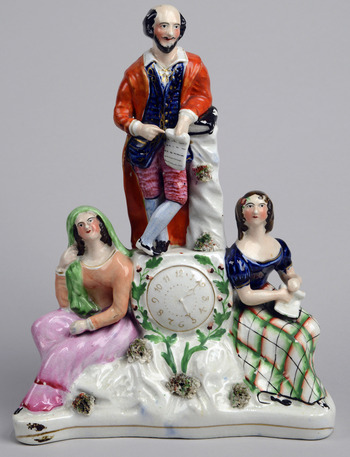
Atop a raised pedestal leans the man himself (Fig. 1). He wears pink breeches, white hose, an orange cloak draped open to the ground, and a blue jerkin beneath it, from which a muslin-colored shirt protrudes, these last two liberally gilded. His posture is in obvious if distant emulation of the Kent and Scheemakers memorial in the Poets' Corner of Westminster Abbey: the left elbow rests on a closed book with gilt-edged pages, the legs are crossed at the knee, and the ball of the left foot is perched in front of the right, jauntily askew, a position that makes the paint loss of its black slipper especially pronounced. Both hands rest at waist level, one clutching a page of manuscript at which the other points. The pose is puzzling, since the “writing” that appears there is just a scrawl of lines and dashes that shows where text ought to be, but conspicuously isn't. Left to index nothing that anyone has bothered to transcribe, the gesture is a lazy indication of literary noteworthiness, not unlike the women who sit at the poet's feet, gazing upward in an attitude of vague, noncommittal reverence. They might be heroines from the plays or they might not be; their contrasting costumes and identical expressions convey nothing beyond the usual laudatory relation of figural base to subject.Footnote 1 Between them, garlanded with oak leaves and acorns, is the dial of a clock, its numbers and hands painted into place with the same gold that decorates the author's ensemble. The time is, and forever shall be, nine minutes past five.
“William Shakespeare as The clock Shakespeare.” Courtesy of the Folger Shakespeare Library.

In Still Life with Oysters and Lemon, Mark Doty describes the feeling of being “drawn into the orbit” of a work of art and “held there, instructed.”Footnote 2 His “faith that if we look and look we will be surprised and we will be rewarded” is surely the creed of every museum curator, as is his luminous declension of this looking's “overall effect”: “a sense of tenderness toward experience, of being held within an intimacy with the things of the world.”Footnote 3 But for scholars especially, the ethos of attentiveness that Doty describes, for which the renewed attachment of self to world is the reward, amounts to a discomfiting arrangement. As Montaigne writes in his famous description of the state of exception that conditions his tribe, “Most men's minds require foreign matter to exercise and enliven them; mine has rather need of it to sit still and repose itself.”Footnote 4 To maintain the mentality necessary for the writing of his Essais, Montaigne retreated for a decade into the tower room of his custom-built library, a landmark of self-éloignement by architectural means: “'Tis there that I am in my kingdom, and there I endeavour to make myself an absolute monarch, and to sequester this one corner from all society, conjugal, filial, and civil.”Footnote 5
It is against this construction of the library, as the site of disentanglement from the distraction of “foreign matter,” that I counterpoise the Staffordshire figure of “William Shakespeare as the clock Shakespeare,” the quaintly unidiomatic title that the Folger Shakespeare Library assigns to the object described. In the short space of this essay, I use the earthenware “clock” as a paradigmatic example of the Folger's collection of English pottery Shakespeareana, a collection that is distinguished both for its extensive array of figures relating to Shakespeare and post-Restoration English theatrical performance, and for its unorthodoxy, not to say intransigence, as library matter. My aim is to consider the causes of this plight before suggesting some possible uses for a resource that isn't governed by a clear indexical or evidential function.
The predicament of the Staffordshire figure has been touched on elsewhere, in cultural analyses that show the difficulty of bringing its class of object in line with the principles of scholarly research. Widely scorned as triumphs of sentiment over judgment, ornament over content, and commodification over art or craft, Staffordshire toys, dolls, and ponies (the respective terms given to small and large human subjects and animal figures) were a secondary output of the assorted pottery works that grew up in tandem with the expanding English taste for tea.Footnote 6 In their heyday, which lasted from the late 1830s to Queen Victoria's Jubilee (in 1887), they were peddled in stalls, fairgrounds, and holiday resorts across the country at prices that put them within easy grasp of the laboring class.Footnote 7 Their antipathy to critical use is first and foremost a function of their mass production. Generally unsigned and unmarked, they lack the means to be traced across a given artisan's oeuvre or a given factory's output, rendering them difficult to historicize with any particularity. Produced in haste to feed a novelty market, they likewise evade and embarrass aesthetic critique. The “charm” retroactively attributed to them by collectors is therefore not a mark of principled valuation, but an accident of their cheap manufacture. Forged in molds that were kept in use long after they lost their shape, then hastily painted to affix some measure of the detail lacking in the sculpted object, the figures are characterized by cartoonlike features (dot-shaped eyes, graffiti moustaches) overlaid onto a bland, white, glazed surface. The gestalt of this juxtaposition conforms surprisingly neatly to Sianne Ngai's account of cuteness—a quality that evinces from objects that are similarly small, round, soothingly edgeless, “commercially produced,” and “deeply associated with the infantile and the feminine.”Footnote 8 Hence, in an article on Staffordshire spaniels for the décor magazine Victorian Homes, the answer to the question of how such “relics of a long-passed Victorian vogue” have “somehow managed to continue to resonate with modern sensibilities” is the adorableness of the particular figure's expression (“cuddly or fierce, whimpering or smug, curious or proud”), which proves indissociable from its easy purchasability (“Buy a single one to be your ever-constant, patiently listening best friend or buy an entire pack to liven up the household”).Footnote 9
Little wonder, then, that studies of the form often begin by confessing an unwillingness to consider it, such as, “But why should we take such inglorious examples of Victorian kitsch seriously?”Footnote 10 For scholars, the appreciative matrix of cuteness, which Ngai describes as a “special kind of attention paid solely to an object's appearance or ‘aspect’ (as opposed to its origin, identity, or function)”Footnote 11 is anathema, a transformation of the intellectual practice of identification and interpretation into a sentimental experience. Yet in the face of an object so indifferent to claims of origin, authorship, utility, or artistry, what reason can there be but a “purely personal and quite useless preoccupation” to linger there? For F. S. Schwarzbach, whose essay “Twelve Ways of Looking at a Staffordshire Figurine” is motivated by the desire to turn this unprofessional interest into a more sanctioned line of thought, the effort to look differently proves oddly circular, insofar as the set of orienting questions posed at the outset—“why such a thing might have been produced, who might have bought it, and what cultural work it might have performed”Footnote 12—repeats, unanswered, at the essay's close:
One problem for me is that there are still areas of interest attaching to the figurine that I have not examined. For example, I would want to know more about who designed these figures … ; who purchased them and why; and how they were incorporated into daily life in the homes in which they were displayed.Footnote 13
Even as he seeks a materialist criticism that would replace commodity critique (“As with Air Nikes, so too Staffordshire figurines”) with the “creative work” of “cherish[ing]” the “commonplace,”Footnote 14 Schwarzbach demonstrates the difficulty of finding academic purchase for the “areas of interest attaching to the figurine.”
Still, if the Staffordshire figure is a problem en soi—a remainder of a witless consumerism as well as a reminder of the inadequacy of this account—it is its placement on the library shelf that truly jars the scholarly mentality. For members of the literary-academic set, the occupation of this space by any “nonbook object” is liable to be taken as a transgression of first principles, or as Rebecca Goldstein says in Leah Price's Unpacking My Library: Writers and Their Books, a “category mistake.”Footnote 15 The distinction of such an object as “William Shakespeare as the clock Shakespeare” is its express and exquisite antipathy to the categorizing process that structures a library environment. Partly to blame for this impression is the current higgledy-piggledy array of the Folger's Staffordshire and pottery collection, a circumstance forced by infrastructure maintenance. Beginning in the summer of 2014, the air handling units in the Folger's art vault were hauled out for renovation in order to lower the humidity of the library's preservation environment. For the interim, the vault's contents were dispersed wherever appropriate space could be found, which is why the Shakespeare “clock” is currently shelved inside one of the glass cabinets built into the empaneled walls of the Founders’ Room, where it is thronged by sundry Falstaffs, Hamlets, and Richard the Thirds.
This redistribution of the Folger's ceramics collection is bound to perturb an organizational system devised to ensure “that for any new [work], its logical place already exists.”Footnote 16 Any user of a library knows that its shelves orchestrate meaningful spatial relations. Proximity and distance, to say nothing of sequences, gaps, and stops, are all orderly assertions relative to a series of preestablished informational domains. But the pottery figures clumped together in the display cases of the Founders’ Room not only abandon this spatial logic, they seem to overthrow it, by presenting multiple iterations of objects fundamentally unsuited to this classificatory process. For example, inside the same cabinet as the Poet's Corner “clock” are two more porcelain Shakespeares in the same pose (in fact, there are at least ten more of these downstairs in a separate display, but the two close at hand suffice to illustrate the problem). One is all-over white, whereas the other is painted in a cacophony of multicolored patterns (turquoise breeches festooned with gold polka dots, a navy and coral chinoiserie jacket, a pink and burgundy cape). Manifestly, then, these objects are distinct from each other, yet the nature of their respective differences seems either too cosmetic, in the case of color variation, or too inane, in the case of the addition to the figure of a nonfunctioning clock, to justify either their grouping together, as variations in a series, or their standing apart, as singular creations. The term Scott Herring uses to describe the resulting and rather discomfiting effect is “redundabundance,” coined by an anticlutter evangelist to condemn the “unrestricted desire and ability to obtain more and more of what you already have too much of.”Footnote 17 Especially when set against the exalting geometry of the library proper, where every work has its place within an abecedarium of human thought, the pottery collection takes on the cast of its diametrical opposite, the unsortable mass.Footnote 18
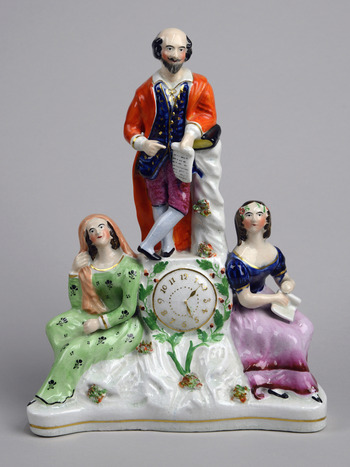
One expression of the library's existentially fraught relation to this collection is a previous attempt to cull it. After the last birthday centennial, the Folger put up for sale “two Derby porcelain and Staffordshire statuettes of Shakespeare” (each a standing figure in white costume, leaning upon a pile of volumes” [Lot 118]), as well as a “Staffordshire statuette of Shakespeare … wearing a white costume and ermine-trimmed cloak, resting with one elbow on pedestal” (Lot 125), and a “Staffordshire statuette of Shakespeare,” described only as “Type of the preceding” (Lot 126).Footnote 19 Whether these four Poet's Corner Shakespeares were successfully de-accessioned is hard to tell, since another expression of the same problem is the impossibility of cataloging such objects very clearly. Although “Type of the preceding” is a particularly fine case in point, this difficulty is more disconcerting to the library than to the auction house. In Hamnet, the Folger's online catalog, pottery Shakespeares appear under a variety of titles, some specific (“William Shakespeare Staffordshire pottery figure decorated in polychrome and gold. Oblong base with rounded ends has ‘Shakespeare’ in gold script”), some not (“Shakspere [realia]”).Footnote 20 The work of distinguishing one object from another is therefore displaced to the “Notes” category, though under this heading too, the indexicality of the information is limited by the fact that the figures share so many key features. Often the only distinguishing trait of a “bare-headed,” “Staffordshire pottery, polychrome-decorated figure,” “leaning on a pedestal,” with the “right leg crossed in front of [the] left” is the color of its cloak or the number of books on which its hand rests. Consequently, capturing the object within the library system means abandoning a robust form of classification for a childlike task of spot-the-difference. The gap between these quidditative processes is suggested by the fact that there are more pottery Shakespeares in the Folger's collection than there are Hamnet catalog entries for them. In fact, the Shakespeare “clock” turns out to refer to two objects under a single title. The figure in the Founders’ Room has a doppelgänger that sits (for now) in a glass case next to the steel door of the vault, near the open stacks (see Figure 2). Dissimilar only in the color of the attire of the women on its plinth, this iteration of “William Shakespeare as the clock Shakespare” eludes an organizational system hard pressed to catch the seemingly endless permutations of a single form.
A second Shakespeare “Clock.” Courtesy Folger Shakespeare Library.

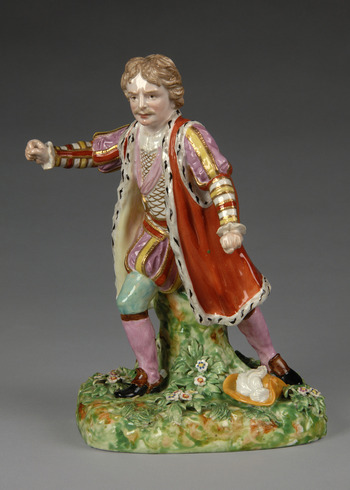
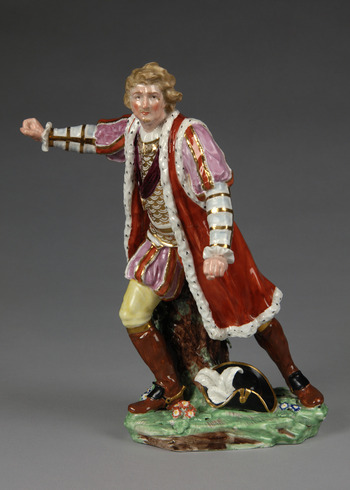
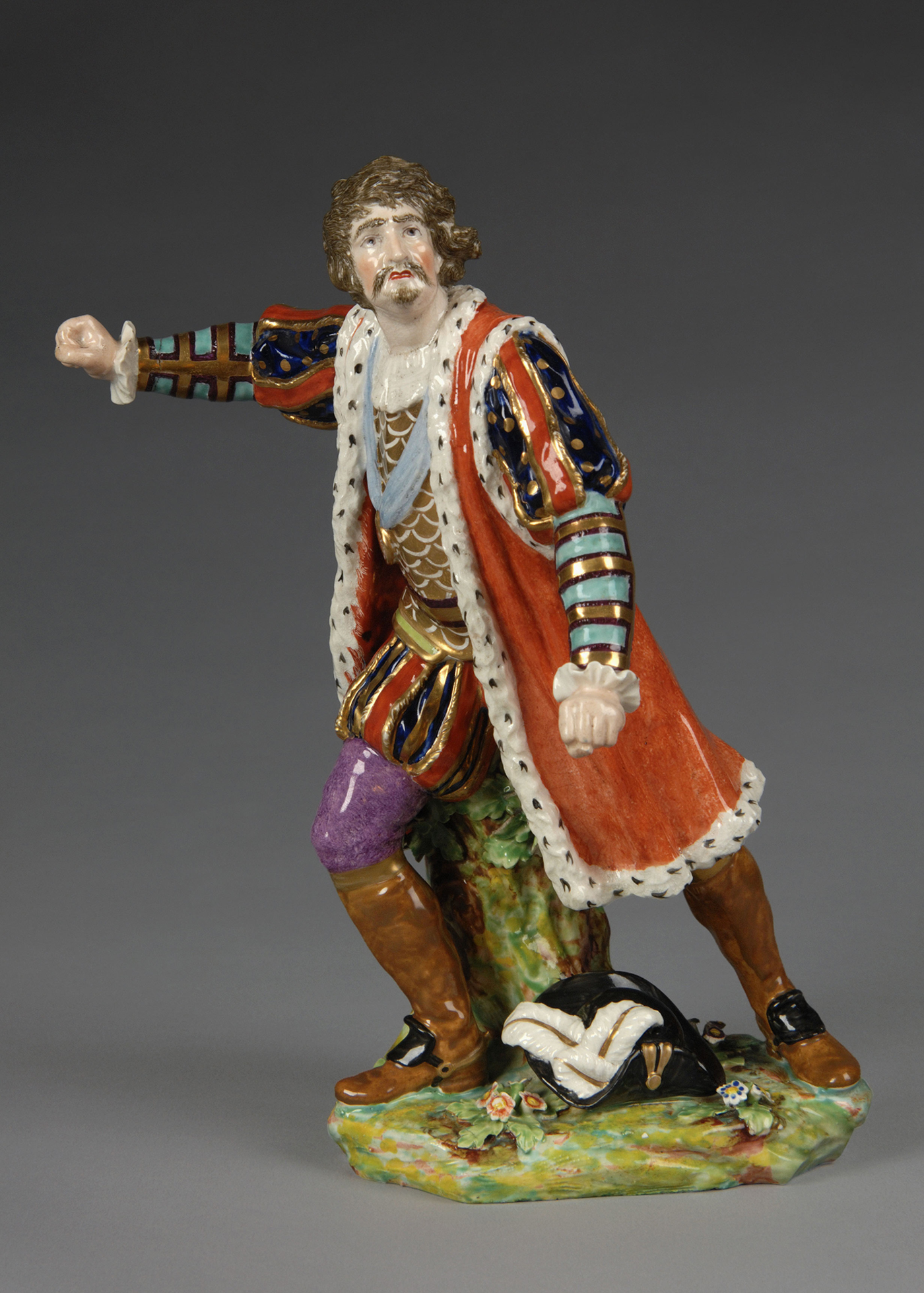
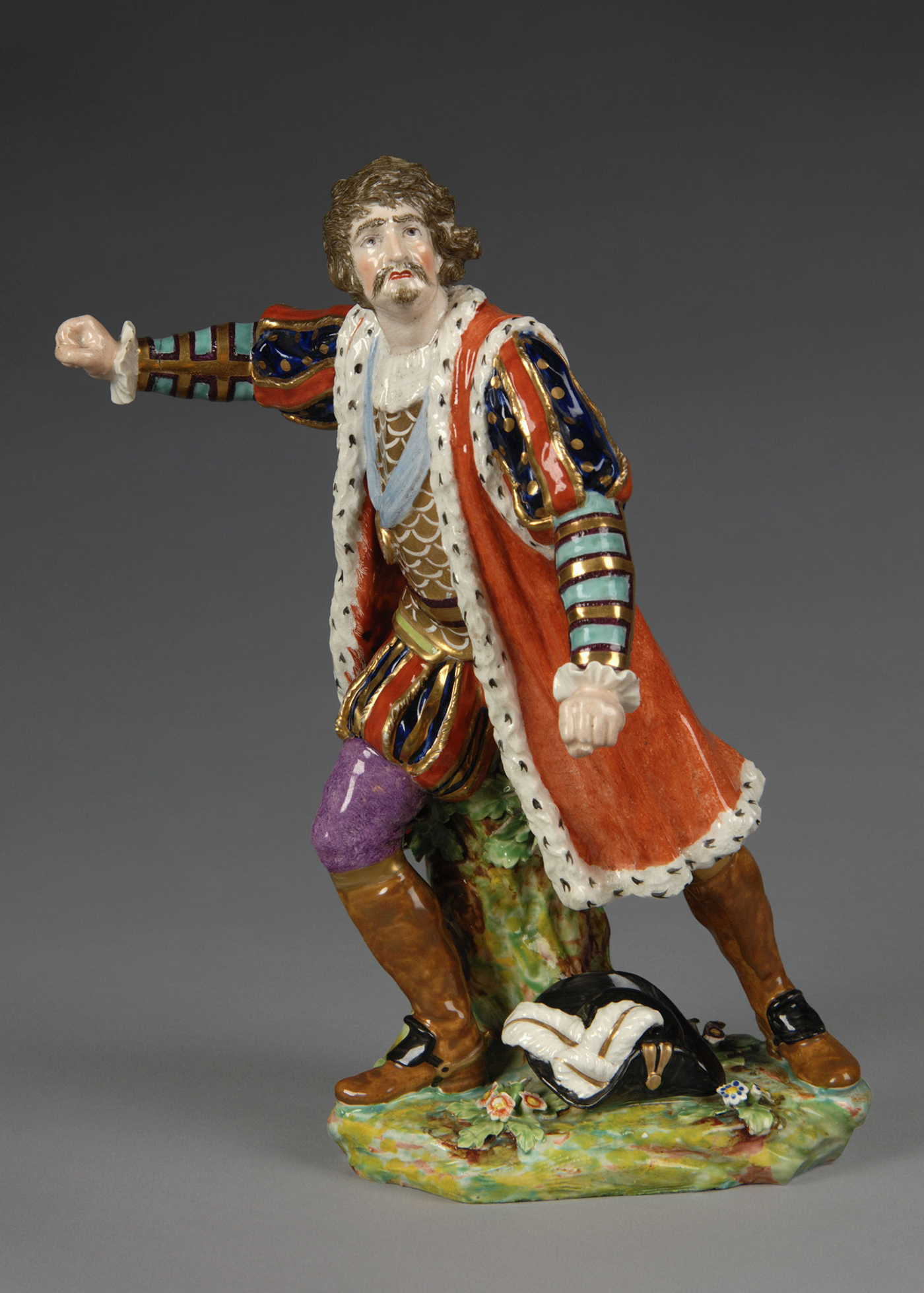
Yet even this does not sufficiently convey the contrariety of the pottery figure to its status as a library holding, for as it turns out, the sort of negligible difference that goes untracked between the Shakespeare “clocks”—in this case, a green dress rather than a pink and orange one or a pink skirt rather than a plaid one—can mark significant variation. At the Folger, three lavish Derby figures of Richard III serve as a case in point. According to their catalog entries, one represents David Garrick in the role, another Edmund Kean, and the last John Philip Kemble (see Figs. 3–5). Set side by side, they can be distinguished by Garrick's pink socks, Kemble's rosebud mouth, and Kean's dark, drooping mustache. But encountered separately, without the advantage of close comparison, they are bound to seem like three examples of the same object.
Derby Porcelain figure of David Garrick as Richard III, ca. 1775–80. Courtesy Folger Shakespeare Library.

Derby Porcelain figure of John Phillip Kemble as Richard III, ca. 1790. Courtesy Folger Shakespeare Library.

Derby Porcelain figure of Edmund Kean as Richard III, ca. 1815. Courtesy Folger Shakespeare Library.
This similitude is a well-known feature of pottery figures, since manufacturers often re-used old forms to produce new subjects. As a photograph in Gordon Pugh's “definitive” Staffordshire catalog illustrates, one need only protrude the hairline and a Shakespeare becomes a Milton. Replace his scroll with a sword and lengthen his pants, and he becomes a Garibaldi.Footnote 21 Hence, with minor effort and at small expense, pottery works feed the taste for infinite variety among a public too uninformed or too undiscriminating to notice the physiognomic sameness of the figures they buy. Such an account seems blinkered on two counts, however. First, it does little to explain the Derby King Richards, which were pricey objets de vertu even at the time of their issue and not hastily executed for cheap sale. Second, it fails to acknowledge the frankness with which porcelain portrait figures across all price points shrug off their portrait function.Footnote 22 To say that the public did not notice the indifferent representationality of the figures it bought is to ignore the fact that those figures were grouped together at the vendor's stall, their comparison frankly encouraged, and the insufficient basis for it plain to see. It is also to ignore the fact that indefensible lookalikes, such as Shakespeare and Garibaldi, were sometimes sold in pairs, their undifferentiation an apparent selling point.Footnote 23 To chalk up this homomorphism to a side effect of cut-rate production is therefore to miss how pottery figures are a means of turning the question of “What (or who) is it?” into a question not worth a conclusive answer. By rendering identity a superficial trait, relegated to the thinnest veneer of particularity (such as a boot's color or the shade of a painted-on mustache), they shed their mimetic purpose.
Put simply, then, pottery figures are bad evidence of theatrical history because they are not about what they are about. Given their unpredictable relation of form to content, it would be foolhardy to extrapolate from the lunging stance of the figure of Kean, for example, that he showed great agility in the role or even that his Richard was clad in scarlet. The figure does not express, or does not trouble itself too much about whether it is properly expressing, a referential relation to the actor's performance. The less obvious and more interesting corollary, however, is the public's investment in pottery portraits of historical figures that are patently unevidential. This turn away from indexicality produces a clear break with the library system and explains why so many writers, from Montaigne to Goldstein, see banishing tchotchkes from their bookshelves as a way of banishing distraction from their thoughts. But as Schwarzbach suggests, the “incorporat[ion]” of figures “into daily life” is a choice no less meaningful, if less storied. By way of a conclusion, I will therefore turn (and return) to two Staffordshire figures, to suggest some pleasures or purposes that might attach to their distraction from a more systemized order of things.
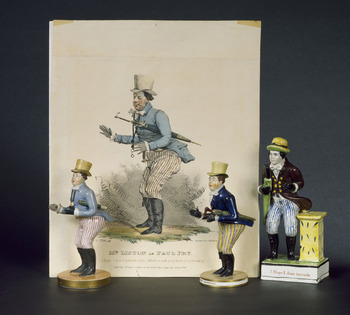
The first is of a stocky man in a yellow hat, a cutaway jacket, striped pants, and high black boots, holding a green umbrella (see Fig. 6). It depicts John Liston in the role of Paul Pry, the principal character from an eponymous farce by John Poole that premiered in 1825 and held the stage, on and off, for another forty years. The play has long since left the repertoire, but the figure was so ubiquitous that it survives in strong numbers; at the Folger, five Paul Prys can be found on a single shelf, the gift of a collector named Babette Craven with a particular interest in Liston collectibles. The Pry squat is so iconic—the hands reaching forward, the knees slightly bent, and the bottom stuck out, like a skier at the gate—that unlike the Derby Richards, Staffordshire representations of Liston in this role seem designed to capture something of his specific physicality. Yet in light of the quotation that often appears on the figure's base—“I hope I don't intrude”—this similitude seems less about the faithful recording of an act of personation than the preservation of the character's signature gesture, namely, his interruption of the scene at hand. Pry, as his name denotes, is a busybody with a habit of leaving behind his umbrella in order to enter rooms and conversations from which he would normally be debarred. Caught on the verge of this intrusion in a self-effacing crouch that also suggests the compression (and imminent release) of a coiled spring, the figure is therefore a distillation in miniature of the breaking off of something beyond the scope of the object's recollection—an epitome, in pottery form, of discontinuance.
John Liston as Paul Pry in Chamberlain's Worcester, Derby, and Staffordshire pottery; backed by a lithograph of the same subject by J. W. Gear published in 1825. Courtesy Folger Shakespeare Library.

In the same vein, though perhaps even more explicitly, “William Shakespeare as the clock Shakespeare” suggests an interference with the solemn order of time. As the Staffordshire expert Pugh proves, the figure is in fact a copy of a clock that that was featured in an exhibition of “Select Specimens of British Manufactures and Decorative Arts”; a description and an illustration of it appears in the Illustrated London News.Footnote 24 The difference, of course, is that the original “Shakespeare Clock,” furnished with internal “works” by Benjamin Vulliamy (clockmaker to George III), was designed to keep time, whereas the Staffordshire copy has no such functionality. Moreover, its figurality is no less impinged. In the original, time is designed to flow “between Joy and Grief,” the allegorical roles assigned to the two women who flank the clock face, which to the journalist is a prompt to remember such Shakespearean epitomes as, “Joy absent, grief is present for that time,” and “The time of life is short; / To spend that shortness basely were too long, / If life did ride upon a dial's point, / Still ending at th'arrival of an hour.”Footnote 25 The Staffordshire copy, on the other hand, is so much removed from this mnemonic structure that not only does it dispense with the clock's allegorical framework, it translates its Shakespearean text into the graphical equivalent of “blah, blah, blah,” as if to denote the erasure of the famous (if slightly mangled) lines from The Tempest featured on the Poets' Corner statue:
The effect of all this aggressive effacement is to quiet the chimes at midnight. In contrast to more finely wrought memorials of Shakespeare, devised to remind the viewer of time's swift passage, the humble pottery simulacra of these objects supplant a temporal order conditioned on loss and disappearance with a cheerful assertion of survival. Perhaps the strongest register of this reversal is the matter of the object itself. Made of ostentatiously fragile stuff and relegated to the status of cheap and replaceable ephemera, the earthenware figure is a perfect example of the entropy to which Prospero says we are all entailed. Its customary location on the parlor mantel only heightens the expectation that it is destined to ashes and dust. The mere fact of its endurance is therefore a revocation of the end promised and moralized by Shakespeare and quoters of Shakespeare, leaving the object to serve as an outlet from the clockwork certainty of the progression and desolation of time.
By this disordering of the most fundamental of humanity's structuring principals, Ngai finds that cute objects exhibit a poetic acuity. The hypostasized caesuras represented by the figures of Paul Pry and the Shakespeare “clock” puncture the evidential system that makes objects testimony to the passage of time, turning history into a condition from which it is possible to escape. While within the precincts of a research library such a notion looks like a pointless distraction, in the working-class households where Staffordshire figures were treasured, the prospect of being held in an intimacy with an object that holds history in abeyance is more likely to be found an attractive one. It remains for another day and another sort of article to develop this argument. But if the archive is, as Foucault famously writes, “first the law of what can be said”Footnote 26 in a given discipline, then the Folger's collection of Staffordshire and other pottery figures opens up a history of distraction from history in the original sense: a forcible disruption or pulling asunder of the way things were, or had to be.