

Introduction
Following the financial crisis and the Eurozone's ensuing sovereign debt problems, the EU moved to consolidate the regulatory framework overseeing the banking system. The regime, previously based on a network of cooperation among national regulators, was significantly strengthened, and a standalone agency—the European Banking Authority (EBA)—was formed in 2011. In line with developments in other regulatory domains, where we have seen the “mushrooming” of agency governance,Footnote 1 this new body was given a legal standing, a set of powers and resources, and a mandate. The EBA is responsible for writing the technical standards governing banking in the single market. It sits at the center of a complex system of multilevel regulatory governance (MLRG), spanning from the EU's legislative arena down to the regulatory regimes of the member states—an arrangement that can be seen as a manifestation of the broader phenomenon of complex governance structures in the EU.Footnote 2 This institutional landscape became more complex in 2014, when, as part of the development of the Single Supervisory Mechanism (SSM), the European Central Bank (ECB) became the lead supervisor of around 130 of the eurozone's largest banks.Footnote 3
Various facets of this regulatory system have been studied. The circumstances of the latest crisis-driven phase of its development have been examined in detailFootnote 4; we also have a good understanding of the preferences of the member states, and of their regulators, during this period.Footnote 5 At a more detailed level, Maggetti and Gilardi have examined the dynamics shaping the domestic adoption of the standards produced by this new apparatus (Reference Maggetti and Gilardi2014). However, with few exceptions, there has been less research into the interactions between market actors and the supranational regulator at the center of this system to date; that is to say, we know relatively little about regulatory engagement by banks in the multilevel system, and how they move between domestic and European arenas. As banks represent an important constituency for the EBA—alongside its political principals and other public bodies—it could be said that by overlooking their engagement, we are missing an important part of the functioning of this agency.
The aim of this paper is to examine how the features of the EBA shape banks’ engagement with it, and in so doing, we contribute to the themes of the special issue by studying how banks interact with policymakers across the multiple levels of their landscape. This engagement goes beyond participation in formal consultations and encompasses banks’ efforts to forge stable connections with their regulator, contribute to dialogue on the design or implementation of rules, and so on. Like many other types of stakeholder, banks are adept at moving around the opportunity structure afforded by the EU's system of governance, engaging with regulatory bodies at various levels.Footnote 6 However, we argue that engagement by banks rests on the agency in question having certain characteristics. For firms to have an incentive to set about forging strong links with their regulator, it must exercise some form of authority over them (writing rules or standards, supervising, or enforcing); but additionally the firms must view it as a viable and worthwhile partner. This viability, we argue, is a function of the regulator's credibility, its legitimacy, and its transparency.
We rest our analysis on two theoretical claims. First, dialogue between firms and regulators is a vital component of a well-functioning regulatory regime: when of a sufficient stability, it facilitates a rich exchange of information and constructive cooperation over rule-making and implementation. In these situations, both parties learn to work together in a mutually beneficial arrangement, and what then emerges can be thought of as a “regulatory order”—more than just a set of institutions and a body of rules, but also a dense web of practices linking members of the regulatory community together. In this sense, dialogue is normatively desirable, contributing to the development of a robust and efficient regulatory regime. Second, the trio of credibility, legitimacy, and transparency are grounded in the extensive literature on the operation of such agencies at the national level. However, they are cast in a different light when viewed in the EU context: the multilevel nature of this system, and the dispersion of roles and lines of authority across multiple venues, push us to consider carefully how credibility, legitimacy, and transparency are manifested.
The findings presented are based on two data sets. We analyzed consultation documents submitted by public and private sector stakeholders; official reports from various bodies, including the European CommissionFootnote 7 and the ParliamentFootnote 8; and notes from public hearings. We also conducted thirty-two elite interviews between 2013 and 2016, with staff from the major British banks (eleven), their German counterparts (three), the British and German trade associations (seven each), and the EBA (four). Many of the interview subjects had cross-cutting expertise, having worked for the national authorities of their countries or for several different firms or organizations, and were medium- to high-ranking staff selected for their involvement in regulatory engagement. The combined data were analyzed to extract the key themes pertaining to the theoretical framework, and this allowed us to build a coherent, theoretically-grounded narrative explaining regulatory relationships at the European level. The presentation of the findings uses quotes from interviews and extracts from documents, to illustrate the main points.
This paper proceeds as follows. In section two, we develop a theoretical framework to guide our analysis. Next, we set out the structure and functions of the EBA in more detail, as well as the broader institutional system in which it operates. In section four, we deploy the theoretical framework to study banks’ engagement with their European regulator. Finally, we discuss the findings and conclude.
Theoretical framework
Regulation, engagement, and interdependence
Regulatory relationships are marked by information asymmetries, whereby firms are better informed about the operation of their markets than regulators. To overcome such problems, and to achieve effective control of firms’ behavior and to fulfil their own mandates, regulators seek to foster strong links with their regulatees.Footnote 9 Firms reciprocate, devoting time and effort to building stable relationships with their regulators,Footnote 10 and from these links, we see the development of a resource dependency between the two.Footnote 11 Both parties obtain access to valuable information: firms provide expertise to aid in the development of regulatory policy and the writing of specific standards,Footnote 12 which is invaluable for the regulator, since to develop a proprietary capacity to generate it would be enormously costly (and, indeed, almost impossible, since the most up-to-date knowledge can only be held by market actors themselves). In return, firms gain insight into the future trajectory of regulatory policy: of change in supervisory practices, of the tone or scope of forthcoming standards, and on principles to be followed in enforcement decisions. Perhaps most valuable in a day-to-day sense, they can gain clarification on questions of implementation of current policies—particularly important in complex regulatory scenarios, where ambiguity abounds. Importantly, the exchange also facilitates a learning mechanism, through which both parties become embraced in a close working partnership.Footnote 13 They learn not only details about each other's procedures and outputs, but also how to sustain the relationship; in other words, norms of behavior emerge, which guide the conduct of firms and of the agency,Footnote 14 and thus, a regulatory order develops.
Importantly, we take this interaction to be vital to the efficient working of the regulatory regime and, so, normatively desirable: information provided by firms contributes to the writing of practicable and effective rules, while the insights firms gain from the regulator into the development of policy facilitate rational decision-making in a context of relative certainty about the regulatory environment. The cooperation that emerges as part of this regulatory order enables the regime to achieve the twin aims of controlling firms’ behavior, while fostering a stable regulatory environment.
However, efforts on the part of firms to forge close relationships with their regulator do not emerge automatically; rather, we suggest that they are a function of certain qualities of the agency in question. Straightforwardly, the starting point is the authority it wields over firms, and this is usually thought of in terms of the three roles ascribed to regulators: standard-setting, monitoring, and behavior modification.Footnote 15 Thus, to be worth engaging with, the regulator should be responsible for some, or all, of these (writing rules, supervising behavior against those rules, and enforcing compliance) and should have adequate capacity to do so. Above these concerns, though, firms’ willingness to engage with their regulator is shaped by the qualities it exhibits in the way it carries out those roles: firms are concerned not only with what the regulator does, but also with how it does it.
What makes for a good relationship between firms and their regulator?
We now draw on the extensive literature on regulatory governance at the national level to identify three such qualities in detail. However, it is important to note that these qualities—or our understanding of how these qualities are manifested—must be flexed when considering their application to the EU's multilevel system.
Beyond a simple functional assessment of the authority the regulator wields, firms’ willingness to engage is shaped by considerations of its credibility, legitimacy, and transparency. The first of these is often associated with the regulator's independence, and, using a principal-agent framework, a large body of work has studied the intricacies of functional and formal independence and the implications for the regulator's efficacy of it being restricted.Footnote 16 For our purposes, credibility and independence are considered with reference to the clarity of the regulator's role and its relationship with those above it in the chain of delegation: issues can arise when the agency serves several masters—resulting in a shifting zone of discretion and thus an unclear, unstable role.Footnote 17 Likewise, the regulator's position vis-à-vis other public bodies operating in its regulatory domain is important, as tensions can emerge where several agencies compete for authority over the same market, or police different aspects of it (a specialist product regulator versus an overarching competition regulator, for example). The position is a function of both a clear separation of remits between the regulator and other bodies, and of the resources—financial and human—it holds. In our multilevel context, it is likely that these inter-institutional aspects of credibility will be key, since European regulatory agencies exist in a complex and de-centered institutional environment in which lines of delegation are often blurred.Footnote 18
Next, firms’ perceptions of the regulator's legitimacy are important. Like others in the study of public administration, this concept is protean and elusive, but a differentiation is often made between “input” and “output” variations.Footnote 19 The former relates to the participation by citizens and civil society (alongside business) in the processes of governance, so that a regulator can be seen as legitimate if grounded in a chain of delegation stretching back to voters. In contrast, the latter speaks to the effectiveness of regulatory agencies in a “problem-solving” sense; such a consideration is closely related to what has been termed “new,”Footnote 20 or “extended,”Footnote 21 accountability, under which a regulator is primarily answerable to market actors for its performance. This output legitimacy is essentially reputational, resting on the efficiency with which the agency carries out its tasks and on its ability to make good, predictable decisions and correct errors.Footnote 22 While steps have been taken to bolster the input legitimacy of supranational regulators,Footnote 23 we argue that in our empirical context, the concern for output legitimacy is more important in shaping banks’ willingness to engage, given the highly technical nature of this policy area. Meanwhile, it is also likely that this legitimacy is put under stress by the division of labor present in the EU's multilevel system, since regulatory tasks are dispersed among various institutions.
The final consideration is of the regulator's transparency. This is closely related to the notion of accountability,Footnote 24 and in the broader public administration, literature has been a feature of debates on trust and responsivenessFootnote 25; in the EU context, it has been discussed as a key desideratum of agency governance.Footnote 26 For our purposes, we relate this specifically to the policies in place to render regulatory activities open to review by stakeholders,Footnote 27 with two dimensions. The first concerns the transparency of the processes through which regulatory standards are written, or enforcement decisions made: either by allowing stakeholders to participate in, or at least observe, these procedures as they occur; or by publicly disclosing information (minutes of discussions, evidence used, et cetera) about them afterwards.Footnote 28 The second dimension is organizational transparency: an openness about the agency's internal hierarchy and chain of command. We argue that for firms this remains a key factor in shaping their efforts to engage: a lack of transparency can hamper the development of relationships between firms and their regulators, since—at a basic level—an opaque organizational structure, or set of procedures, leaves them unsure of how to initiate contact. Again, though, we suggest that the complex form of European regulators, as “agencified networks,”Footnote 29 may cause their transparency in both dimensions to suffer.
Summary: good bank-regulator relationships in a multilevel context
Where banks are able to build good relationships with their regulator, the resulting interdependence contributes to a robust and efficient regulatory regime. Their engagement with their regulator, in turn, rests on the latter exhibiting three interconnected qualities—it should be credible, legitimate, and transparent—and each of these can be identified, in practical terms, with reference to a set of arrangements within and around the regulator. Thus, inter-institutional credibility arises from clear reporting lines to political principals and a clearly-defined and stable remit (which also demarcates the regulator's tasks from those performed by others in its environment). Similarly, strong resource endowments and working practices contribute to the regulator's output legitimacy, and policies aimed at making its rule-making processes and internal hierarchies visible to stakeholders increase transparency. However, while each of these desiderata has a firm foundation in the study of domestic regulatory governance, we should be aware that the complexities of the EU's institutional system may challenge the way in which they actually operate.
The institutional landscape
The domain of financial regulation is an example of the broader processes of evolutionFootnote 30 and agencificationFootnote 31 present in the EU. Although the legislative framework stretches back to the 1970s, the development of the associated institutions did not get under way for many decades; instead, regulatory capacity remained in the hands of the member states, who seemed wary of ceding control over their financial systems to the supranational level. During the 1990s the impetus to develop financial regulation at the supranational level waned, as attention focused instead on establishing the euro, until the process was re-energized by the Financial Services Action Plan in 2001. This contained both a package of legislation to be passed and recommendations for the development of a set of institutions at the EU level, and, thus, the Committee of European Banking Supervisors (CEBS) was formed in 2004: a standing group of the heads of member states’ bank regulators charged with providing input on legislative processes and acting as a venue in which best practices could be shared.
In the early stages, then, institutional capacity at the EU level was weak, with solutions based on informal networks being preferred. With time, and following a delicate interplay between supranational actors and member state governments after the financial crisis of 2007–9, this arrangement of soft law diffusion was hardened. The legislative framework for financial regulation was considerably expanded and strengthened—with a notable switch towards regulations rather than directives—and the associated institutional structure underwent a similar formalization. As a result, the CEBS was crystallized into the European Banking Authority in 2011.Footnote 32
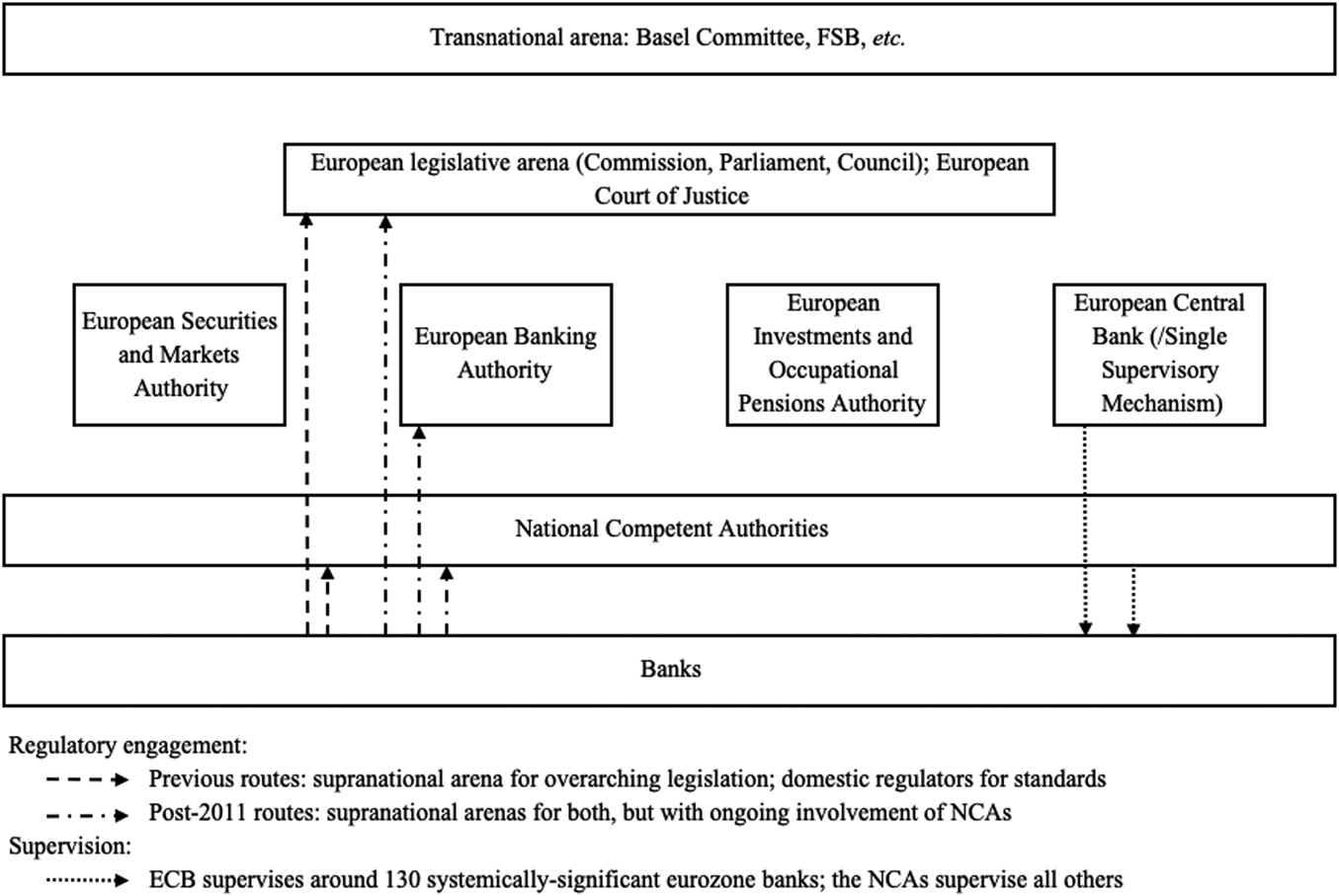
Three aspects of this agency are pertinent to the current discussion. First, most obviously, the EBA's institutional form makes it stand in clear contrast to its predecessor. Where CEBS had a weak institutional basis and limited resources,Footnote 33 the EBA is a fully-fledged agency, with powers, a remit, and a distinct legal personality. Second, the EBA has delegated to it a wide set of tasks: it drafts technical standards,Footnote 34 drives convergence in the supervisory practices of national authorities, issues binding decisions in the case of disagreements between them, makes recommendations and expresses opinions,Footnote 35 and can—in crisis situations—issue individual supervisory decisions.Footnote 36 Third, it is embedded in a system comprising of several interlocking components (see figure 1). In the EU's legislative arena high-level policy is enshrined in EU law. Below this sit the EBA, two other similar bodies overseeing the insurance and securities markets (the European Insurance and Occupational Pensions Authority and the European Securities and Markets Authority), and the ECB, as the focal point of the SSM—a key pillar of the efforts towards more integrated financial regulation and supervision, which followed the sovereign debt crisis. The lowest level contains the national regulatory bodies of the member states (referred to as “National Competent Authorities,” or NCAs). In fulfilling its tasks, the EBA must work closely with the other standard-setting bodies, as well as institutions engaged in supervision at either the supranational (ECB) or the domestic (NCA) level. While there is a division of labor between them, the EBA's roles combine to make it the locus of regulatory, and particularly rule-making, authority in the overall system of EU bank regulation.
The EBA in its institutional environment

What we see here is a system of multilevel regulatory governance, which has arisen from a double delegationFootnote 37—from national governments to their independent agencies, and from the EU to its own supranational regulators. The system is characterized by complex chains of principal-agent relationships,Footnote 38 creating multiple lines of accountability manifesting a combination of both political and legal accountability, and less tangible, more “social” forms.Footnote 39 Finally, the division of labor between institutions—the EBA, its fellow sectoral rule-making bodies, the ECB, and the NCAs—creates the potential for overlapping competences (and, so, tension); and the complexity increases further if we consider the role of international coordinating, or standard-setting, bodies, such as the Basel Committee.
These three aspects have a bearing on the present discussion as they inform us both that the EBA is a more viable venue for banks’ engagement than CEBS was before it, and that it is embedded in a complex opportunity structure, which banks must navigate. The standing of the EBA as an agency in its own right creates a “pull” from the center of the MLRG system, drawing banks’ attention towards it. Thus, the basic requirement set out in our theoretical discussion—for a regulator to wield authority over firms—is present, and, so we now turn to the more complicated matter of the EBA's qualities.
Regulatory relationships at the EBA
The earlier theoretical discussion set out our position on the importance and desirability of dialogue between firms and regulators, framed in terms of the interdependence, which underpins a robust and efficient regulatory regime. We also argued that for firms to engage with their regulator, the latter needed to display certain qualities. In this empirical section, we analyze the EBA in the light of this framework, drawing on themes present in the data pertaining to its three components.
Credibility
The first of the three focuses on the regulator's credibility and independence, where a stable and well-defined remit and a clear relationship with its political principals are needed. Further, the regulator's resources—whether financial or human—are important in enabling it to “hold its own,” vis-à-vis other public bodies in its domain. Where these various arrangements are in place, and calibrated in such a way as to forge and maintain the regulator's credibility, firms will view it as a viable target for engagement.
For the EBA, though, interview respondents reported that its role in the overall regulatory process has long been problematic. Although by design this is clear—drafting technical standards in support of legislative frameworks—in reality there was ambiguity surrounding the timing and scope of its activities. For example, difficulties arose during the work on the Fourth Capital Requirements Directive (the largest legislative package the EBA has worked on to date): the initial draft was issued by the Commission in 2011, and the resulting legislation was eventually approved and printed in the Official Journal in the summer of 2013, but the EBA's work programs of 2012 and 2013 had already committed it to delivering technical standards in support of an as-yet-unfinished text. During this period, extensive and often bitter debates took place in the legislative arena, over issues such as bonus caps or the application of the leverage ratio,Footnote 40 and this resulted in an unstable legislative foundation on which the EBA was to work. A response to the 2013 Commission consultation on the EU's regulatory framework by a British trade body stated that the EBA was constrained by a “lack of clarity (including that created by unresolved political disagreements),”Footnote 41 and as a result of such tensions, the EBA hearings that ran at this time often began with a caveat that the “level one text was still to be finalized.”Footnote 42
Meanwhile, the relationship with the EBA's political masters was inconsistent, leading to uncertainty about the size and stability of its zone of discretion. The European Parliament's committee responsible for financial regulation became increasingly forthright in questioning draft standards submitted by the EBA. This pressure rose in the period following the European Parliament elections in 2014, and a similar trend could be seen in the Commission's handling of draft rules.Footnote 43 Meanwhile, as the legislation progressed from the Fourth Capital Requirements Directive (in 2013) to the Bank Resolution and Recovery Directive (in 2014), the framework texts included more and more detail, as the drafters in the legislative arena began to encroach on the EBA's technical remit.
This lack of clarity undermined the EBA as a venue for regulatory engagement. Mindful of the discussions continuing at the legislative level, the banks focused their efforts on the relevant parts of the Commission and the Parliament: the working groups, expert committees, and key officials. A lobbyist explained that “we could see which way the wind was blowing, and were clear that ultimately what would determine the maximum of what was possible was the CRDIV text … so obviously we talked to the people in the DG.”Footnote 44 There was also an extent to which banks’ use of these political channels represented a gaming of the system, as they actively sought to re-open regulatory issues, by appealing to the higher level drafters of the framework document to have the scope of the issue redefined. This was a particularly useful approach when banks were seeking to defend some national specificity in their regulatory model—which the EBA was unable to account for in its rule making.Footnote 45
Meanwhile, problems were caused for the EBA by the presence on the European regulatory circuit of two powerful national institutions: the regulatory authorities of the UK and of Germany. The situation can most easily be grasped with reference to the varying levels of resources among the three. The EBA has weak holdings of financial and human resources, with a budget of only €36.5 million and a staff of only 169.Footnote 46 In comparison, the British regulator has a budget of £236 million and around 1,000 staffFootnote 47; and the German regulator has a budget of €242 million and around 2,500 staff.Footnote 48 More importantly, though, these national regulators are far longer established: in the UK, the statutory regulatory structure dates back to the creation of the Financial Services Authority in 1997,Footnote 49 and the new body established following the financial crisis—the Prudential Regulatory Authority—inherited many of the key staff, ensuring a continuity of expertise. In Germany, the formal institutionalization of bank regulation is older still, as the federal banking regulator—the Bundesaufsichtsamt für das Kreditwesen (BAKred)—was formed in 1961. In 2002 it was merged with other bodies responsible for insurance markets and securities firms into a single, unified agency—Bundesanstalt für Finanzdienstleistungsaufsicht (BaFin)—which survived the financial crisis: a protracted debate about the reform of the dual-institutional arrangement came to nothing, as the complex nature of German policymaking, with its many veto points and interlocking institutions, frustrated attempts to bring about change.Footnote 50
But it is not just age that matters. As well as being the largest in Europe, the British and German banking sectors are also, perhaps, the most advanced and complex; and as a result, their respective national regulators have extensive holdings of expertise and knowledge concerning many areas of complex banking products and financial instruments. The PRA and BaFin are seen as centers of regulatory know-how by the banks of their own sectors, but also by foreign banks and by other regulators. In contrast, the EBA's expertise base is not only thinner, but also drawn from the many member states in Europe with comparatively less developed banking markets. Interview subjects reported that the national regulators are held in much higher regard—on the basis of policy knowledge—than the EBA.Footnote 51 Overall, the national regulators are stronger in capacity, continuity, and credibility than the EBA.
Indeed, it is likely that the EBA's recent relocation from London to ParisFootnote 52—as a result of the UK's vote to leave the EU—will unleash two sets of changes to the relationships between banks, the national authorities, and the EBA. First, at a basic level, Brexit may potentially strengthen the attractiveness of the PRA for UK banks seeking to engage on matters of EU regulation, while the physical relocation of the EBA to Paris may raise staffing challenges, which weaken the EBA in the short run. More fundamentally, since the rise of the SSM, the EBA has functioned as something of a bridge between the Eurozone members and the “outs,” ensuring that the regulatory preferences of the UK, and of its banks, are represented on the European stage. With the departure of the EU's largest financial center, the need for such a bridge is diminished, and so the standing of the SSM may well rise, undermining the institutional credibility of the EBA yet further.
Legitimacy
The second element of the framework focuses on output legitimacy, and we proposed that arrangements are needed that promote resource holdings and working practices, which enable the regulator to efficiently draft practicable standards, and to make reliable and predicable regulatory decisions. Where such arrangements are in place, the reputation for efficiency that emerges makes the regulator a worthwhile interlocutor for firms.
The EBA's financial and human resources, as we have seen, are weak, but further issues were caused in this regard by its internal working practices. With so few staff dedicated to writing rules, it instead draws in secondees from the national authorities, and this approach to staffing led to several specific difficulties. A report commissioned in 2013 by the European Parliament noted that the EBA struggles to attract staff of sufficient caliber and experience, commenting that a secondment is “not seen as a significant step in their career.”Footnote 53 This observation was echoed by interview participants, who stated that secondees are often relatively junior regulators, with little experience in drafting standards or with little knowledge of the complexities of certain banking markets, and that to overcome this, more senior staff often have to be brought in on an ad hoc basis.Footnote 54 In response to a European Commission consultation exercise in 2013, a British trade body called for staffing levels to be increased, and suggested that this could perhaps be achieved by increasing the direct funding of the EBA from the EU's community budget.Footnote 55
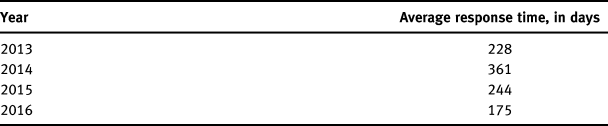
These staffing patterns had consequences for banks’ perceptions of the EBA's outputs. For example, it established a “question-and-answer” procedure, whereby banks could submit a written question through its website and receive a detailed response from EBA staff. Over 1,300 such questions have been raised to date,Footnote 56 and a review of the timespans involved shows responses took an average of 252 days (see table 1). This slow turnaround caused obvious problems for the banks, with one respondent explaining that “two successive quarters of reported numbers were wrong—and we knew it—by the time we got an answer.”Footnote 57 Similar sentiments were expressed during the 2017 European Commission consultation.Footnote 58
Average response times to questions

Source: Calculations based on records of questions from EBA website.
Elsewhere, an interviewee remarked: “… we see quite shoddy work [and] then there's a public hearing and they're left in this almost indefensible position where what they've written is complete nonsense, and so … we say ‘x or y won't work because of a, b, c, d, e …’ and they'll nod and take notes.”Footnote 59 It has also resulted in an ever-growing body of reporting templates through which information is submitted to the EBA: it requests large amounts of raw data on banks’ positions, inventories, and so on, and interview subjects remarked that they were sending huge volumes—“gigabytes worth”—of data to the EBA, far more than they suspected it was actually able to usefully analyze.Footnote 60 For the banks, the issue is that finding, verifying, and sending that data is itself a hugely costly and complex task, as the German bank NordLB noted in a consultation response:
a third of the required data can already be generated today from the existing items and information in the consolidated financial statements; another third of the data is not available in the requested form and, from a current perspective, can only be produced manually at great expense; and a further third of the data requirements is not currently available and can only be produced at very great expense or cannot be produced with the current accounting systems. (Norddeutsche Landesbank, 2012)
Finally, the problems with the EBA's stress testing exercises have harmed perceptions of its effectiveness. Following one such exercise in 2011 several banks that had passed the examination went on to collapse (such as the Franco-Belgian firm Dexia), or to need state bailouts very soon afterwards. The episode was derided by analysts, investors, and European leadersFootnote 61; and the German regulatory authority was moved to warn that the EBA risked “falling into disrepute at the very start of its activities.”Footnote 62 The European Parliament report also highlighted the tension between the EBA as the coordinating body and the actual efforts committed by the national authoritiesFootnote 63; later, similar issues arose in the round of testing conducted in 2016, when critics pointed to the omission of Greek and Portuguese banks, and to the lack of an analysis of the impact of negative interest rates, as major weaknesses in the methodology applied.Footnote 64 Meanwhile, as the SSM developed, the ECB began to contribute to the EBA's stress testing exercises, and indeed to conduct its own; with this, the need for consistency of stress test recommendations increased, in order to avoid the risk of double jeopardy. Nonetheless, the two institutions’ stress tests have been conducted on different pools of banks, using different calculation methodologies and including different “stresses.” This, in turn, has undermined perceptions of the EBA's effectiveness.
Transparency
Finally, the third element focuses on transparency. Here, good arrangements push the regulator to be open about its internal hierarchy and about its rule-making processes; to put it colloquially, firms need to be able to know who they should be contacting and to understand how rules are being made.
However, interviewees often described the EBA as “opaque” or “unapproachable,” with several linking this opacity to its approach to staffing. Secondees are recruited into small working groups to draft a specific standard, and when the task is complete, the group is disbanded. A result of this is a very high level of staff turnover, and interviewees frequently spoke of difficulty in identifying staff responsible for certain areas of policy; as one put it, “it's like building a puzzle, but at the time you are close to the completion of the puzzle, you know, the responsibilities have changed again, and there's someone else.”Footnote 65 Indeed, the EBA's relocation will bring about a transition period during which its personnel will change, compounding this issue further.
Likewise, issues arose around both the transparency and the robustness of the procedures governing the EBA's consultation practices. The European Parliament report remarked that “in certain cases, the three month timeline outlined in the General Principles of Consultation has not been adhered to”Footnote 66; while the Commission's report called on the EBA to “enhance the transparency of the regulatory process.”Footnote 67 Similar concerns were raised several years later, when stakeholders were invited by the Commission to participate in a review of the European regulatory architecture in 2017.Footnote 68 Among interviewees, this concern was expressed as a common perception that in between the drafting stages and the final output the national authorities would leave their imprint on the standard by exerting quiet leverage in the board of supervisors.Footnote 69 The lack of transparency surrounding this channel of influence left the banks feeling undermined and circumvented by discussions taking place behind closed doors. These difficulties were even worse for many of the smaller banks and associations, without large offices in London. For them, the problems of structural or procedural opacity were compounded by the simple fact of distance: working with a known, local authority was by far preferable to travelling to London and trying to get to grips on an impenetrable, constantly shifting regulator.
Out-maneuvered, above and below
The EBA resides in a shifting zone of discretion, with its role in the policymaking process and its relationship with its political principals lacking in clarity. Meanwhile, its weak resources—and in particular its lack of institutional memory—put it at a disadvantage relative to the national authorities, which remain centers of regulatory expertise. Its working practices—mainly its reliance on small working groups and the ad hoc use of senior staff brought in on secondment—frustrated banks, and, in their eyes, contributed to the various failings, such as the slow response times in the Q&A process and the flawed stress tests. Third, problems of non-transparency were present, both with respect to the EBA's institutional structure (with its use of small working groups leading to high staff turnover) and to its processes (with suspicions that national authorities were out-maneuvering the results of public consultations in the final board meetings). Collectively, these issues meant that devoting effort to building strong links with the EBA was trumped by continued activity in the legislative arena, particularly as victories could be achieved there, which would materially shape the regulatory (rule-making) debates further downstream; and by continued engagement with national authorities. Overall, this suggests that the EBA's position in the multilevel system of regulatory governance leaves it at a structural disadvantage compared to the other venues available to banks—both above and below it.
These findings are also significant in light of the normative desirability of engagement. The empirical analysis of the EBA has shown several areas of weakness in the EBA's resources, working practices, and inter-institutional relationships, meaning that the qualities needed to foster dialogue are lacking. The resulting fragmented nature of banks’ engagement with the EBA risks undermining the EU's regulatory regime for banking.
Conclusion
The centralization of regulatory authority at the European level following the creation of the EBA in 2011 had a consequence for the institutional landscape in which banks communicate their preferences to policymakers. Previously, banks had engaged with EU institutions over legislation and with domestic regulators over detailed standards, whereas now there was a distinct pull for banks to combine their efforts on the European stage. This paper set out to examine how the features of the EBA shape banks’ engagement with it.
Our theoretical approach began with the premise that such engagement of a regulator by firms is a precursor to the development of stable dialogue, in which both parties gain valuable access to informational goods held by the other; the resulting interdependence then contributes to the robustness and efficiency of the overall regime. However, engagement does not arise automatically, and instead relies on the regulator demonstrating certain qualities. Moving beyond a basic consideration of the authority it might wield over firms (arising from it performing some combination of standard-setting, supervision, and enforcement), we argued that the regulator must also exhibit certain qualities in the conduct of its work in order to encourage the emergence of stable engagement by firms. These, we proposed, were credibility, legitimacy, and transparency. Importantly, though, we also suggested that these qualities are likely to be stressed by the complexities present in the EU's system of multilevel regulatory governance.
Our empirical analysis found banks’ limited engagement with the EBA arose from a confluence of factors concerning the regulator and its environment. Its working practices, and the problems connected to its high staff turnover—particularly its poor institutional memory—arose from its resource weakness, and these issues served to undermine the credibility of the EBA in the eyes of the banks. The problems with the agency's transparency left banks not knowing how, or where, to attempt to build links. The inefficiency of its rule-making procedures (involving a great deal of duplication of work) and of its Q&A processes relating to public consultations harmed its legitimacy. Meanwhile, the features of the multilevel regulatory governance system weakened firms’ incentives to engage. At the lower level, the relative strength of the national authorities—particularly their holdings of expertise—meant that banks continued to prefer working with their home agencies. At the upper, the blurring of the EBA's independence by its political masters, and the lack of clarity around its role (with the rise of the SSM in 2014, and now with Brexit), encouraged banks to prioritize engagement with the legislative arena. Banks have been unwilling, and unable, to build close and stable links with the EBA, and their engagement is actually tipped towards tried-and-trusted venues—namely, the domestic scene and the European legislative bodies. This means that the key mechanism, which should facilitate the development of a strategic working relationship and support a process of learning among both parties, is absent.
These findings have three sets of implications. First, from a theoretical perspective, they fill a gap in our knowledge of the operation of European agency governance by shedding light on the conditions under which firms engage with their supranational regulator. Such engagement is heavily dependent on firms’ perceptions of the European regulator, in particular, concerning its resources, efficiency, and openness; and, more broadly, the stability and clarity of its overall position in the multilevel system of regulatory governance. Where the qualities are weak or problematic, the incentive on the part of firms to engage is undermined.
Secondly, the issues found here suggest that European agency governance remains hamstrung by poor resource endowments and by difficulties caused by the distribution of regulatory tasks among actors across various levels. Given the timespan involved, from the EBA's formation in 2011 to the present date, it seems these issues are actually structural, rather than transitory, and thus, it seems that a particular assessment of 2011 still stands: the EU has adopted the “agency form, but not yet the reality of agency governance.”Footnote 70 This has an implication for the development of a European regulatory order—while the institutions and the rules are present, the strong relationships and rich dialogue between firms and regulators are not.
The final implication flows from this, and refers more specifically to European financial sector governance. Here, early studies of the regulatory networks (as they were at the time) in the financial sector concluded that although they nominally had a “technical” role, they were often pulled into “para-political” activities, either by private actors (chiefly banks) or by powerful national regulators.Footnote 71 The step towards agencification—demonstrated by the creation of the EBA—was intended to formalize this mechanismFootnote 72; yet as we have seen, the ability of banks to circumvent the EBA, and the targeting of the Commission and the Parliament to re-open regulatory discussions by challenging the framing of the legislative texts, show the continuing fluidity of the mechanisms of financial sector governance—a fluidity that will persist as the relationships between the ECB, the EBA and the national authorities are shaken up by Brexit. This multilevel regulatory complexity, we argue, will continue to hinder the efficient development of genuinely European standards and so cause problems in the regulatory apparatus of banking union.