Introduction
Taking care of community-dwelling people with dementia is a burdensome task for informal caregivers. For some decades, research has shown that caregivers of people with dementia visit healthcare professionals more frequently, have more mental health problems, and also frequently suffer from more social isolation than caregivers of people with other chronic conditions (Eagles et al., Reference Eagles, Craig, Rawlinson, Restall, Beattie and Besson1987; Pot et al., Reference Pot, Deeg and van Dyck1997; Butler, Reference Butler2008). More than 80% of the caregivers of persons with Alzheimer's disease (AD) state that they frequently experience high levels of stress (Alzheimer Nederland, 2010) and half report that they suffer from depression (World Alzheimer Report, 2009). Exhaustion and overburdening of caregivers are major reasons for the institutionalization of people with dementia (Dunkin and Anderson-Hanley, Reference Dunkin and Anderson-Hanley1998).
However, institutionalized care is starting to come under pressure. The number of places and professional caregivers in nursing homes is not expected to grow at the same rate as the expected increase of people with dementia in the coming decades. In fact, a relative decrease is expected. The demand on informal caregivers to support people with dementia at home will therefore increase. It is important for informal caregivers to develop and maintain competence in this challenging task, as their help is crucial in order for people with dementia to remain at home as long as possible (Andren and Elmstahl, Reference Andren and Elmstahl2008).
Many caregivers who experience burden and mental health problems are known not to utilize support services to meet their needs. Reasons behind this are that asking for help feels like an acknowledgement that one is incompetent as a caregiver; caregivers may also be so overburdened that they do not have the energy to participate in time-consuming interventions (having to travel outside the home is often a barrier to participation), or they may not be aware of the care and support available (van der Roest et al., Reference van der Roest, Meiland, Jonker and Dröes2010).
A telephone support intervention was developed to provide tailored support that is easily accessible to the growing number of caregivers. Previous research has shown that provision of customized information by telephone results in positive outcomes on burden, depression, and social support for informal caregivers of people with dementia (Finkel et al., Reference Finkel, Czaja, Schulz, Martinovich, Harris and Pezzuto2007). Another study showed that telephone support could meet four specific needs of dementia caregivers satisfactorily: the need for information and education, the need for referral to other sources of support, the need for emotional support, and the need for easily accessible caregiver support (Salfi et al., Reference Salfi, Ploeg and Black2005).
Telephone support is an intervention that enables caregivers to receive support in their own homes, making it easily accessible to a large group of caregivers, including those who are not able to travel to support groups. Furthermore, telephone support is an alternative for caregivers of people with dementia for whom other services are not available locally (Goodman and Pynoos, Reference Goodman and Pynoos1990). Telephone coaching also has the added value of being personalized to the specific concerns of the caregiver. This is not always possible in a group setting, such as caregiver education groups.
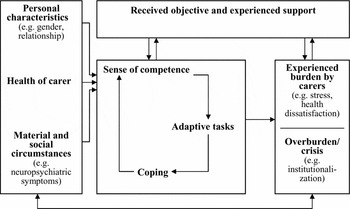
One of the theoretical frameworks on which caregiver support interventions are based is the “Model of Determinants of Subjective Burden of Caregivers of Persons with Dementia” by Dröes et al. (Reference Dröes, Lindeman, Breebaart, van Tilburg and Dröes1996) (Figure 1) (also described in Meiland et al., Reference Meiland, Kat, van Tilburg, Jonker and Dröes2005). This model integrates determinants of caregiver burden with the general stress-appraisal-coping theory of Lazarus and Folkman (Reference Lazarus and Folkman1984) and the crisis model of Moos and Tsu (Reference Moos, Tsu and Moos2004). Dröes et al. (Reference Dröes, Lindeman, Breebaart, van Tilburg and Dröes1996) assumed that both the person with dementia and their caregiver have to deal with general adaptive tasks as a consequence of dementia. Adaptive tasks for the caregiver include coping with the disabilities and changes in behavior and mood of the person with dementia, maintaining a positive self-image, preserving an emotional balance, and keeping up social relationships. Whether these tasks lead to (over)burden or negative physical, psychological or social consequences depends mainly on the way individual caregivers are able to cope with them, and the sense of competence they experience as a result of this. The model also describes how factors such as personal characteristics, health, and material and social circumstances, as well as the emotional, practical, and social support received, might influence the way caregivers cope with adaptive tasks.
Model of determinants of subjective burden of carers of persons with dementia.

In the Amersfoort/Leusden region of The Netherlands, a new intervention called Dementelcoach was initiated to provide emotional, social, and practical support for caregivers of people with dementia. The intervention comprised telephone calls once every two to three weeks between caregivers and telephone coaches, lasting approximately 45 minutes and covering issues caregivers wanted to discuss. Professional caregivers were trained to become telephone coaches so they could provide the appropriate support that caregivers needed and, if relevant, refer them to other care and support services.
By providing this support, the Dementelcoach intervention aims to increase the support experienced by informal caregivers and enhance their ability to cope with the consequences of dementia. Based on the described model, it is expected that this intervention will have a positive effect on the sense of competence, the experienced burden, and health complaints of informal caregivers of people with dementia.
This paper describes the evaluation of the Dementelcoach intervention. The study focused on two different goals. The primary goal was to determine the effect of telephone coaching on the burden and mental health problems of caregivers of people with dementia who live at home. According to Smits et al. (Reference Smits, de Lange, Dröes, Meiland, Vernooij-Dassen and Pot2007), combined interventions that address both the caregiver and the person with dementia are more effective than single interventions. It was expected that telephone coaching in combination with psychogeriatric day care for the person with dementia would be more effective than telephone coaching for the carer only. We therefore aimed to evaluate both the Dementelcoach as a single intervention and Dementelcoach in combination with day care. A second goal was to evaluate the Dementelcoach intervention with respect to the type of support delivered by the coaches.
Methods
Design
A controlled trial with a pre-test/post-test comparison group design was conducted to study the effect of telephone coaching on the informal caregivers. Two intervention groups (experimental groups), the first receiving telephone coaching and the second telephone coaching in combination with respite care (psychogeriatric day care for the person with dementia), were compared with a comparison group which received respite care only. Two measurements were conducted in each of the three groups, one at T0 (at the start of telephone coaching or day care), and one after 20 weeks (T1).
Satisfaction with the telephone intervention was evaluated among informal caregivers who received telephone coaching 16 weeks after the start of the coaching by means of a customer satisfaction questionnaire.
To evaluate the content of the intervention, all coaches registered the type of support actually delivered during the telephone coaching calls.
Intervention
During the intervention period, informal caregivers in the experimental groups received approximately 10 telephone calls from the telephone coaches: one every two to three weeks. During these calls, the coaches provided emotional, social, and practical support for approximately 30 minutes. The telephone coaches were professional caregivers who worked in healthcare settings, had experience in psychogeriatric care, and had completed the training for telephone coaching (Telkamp and de Koning, Reference Telkamp and de Koning2008). During this training, the coaches learned how to advise and support the informal caregivers in using effective coping strategies in different areas of experience, such as coping with behavioral changes in the person with dementia and with feelings of loss (Meerveld et al., Reference Meerveld, Schumacher, Krijger, Bal and Nies2004). The training also involved roleplaying exercises and teaching the professional caregivers how to record the problems that informal caregivers mentioned during the telecoaching and the support they gave on the phone. The entire training program was supported by a written practical guide including all aspects of the telephone coaching training (Telkamp and de Koning, Reference Telkamp and de Koning2008). After five coaching sessions (or when they requested it themselves), the telecoaches received a coach-to-coach session, during which coaching skills were discussed and feedback was given by the trainer.
Informal caregivers in the comparison group were those caring for people with dementia who had recently started attending psychogeriatric day care (within the last month). The psychogeriatric day care centers provided care for between 16 and 33 people with dementia per day, with each person attending for two to three days a week. The day care centers that participated in the study provided a range of activities for the people with dementia (crafts, music, sports, and gardening) as well as discussion groups about dementia (with themes such as “accepting dementia” and “coping with dementia”). Care was provided by professionals, for example, activity leaders, psychologists, and nurse assistants. All-day care centers organized meetings with the informal caregiver at least twice a year to discuss the changing needs of the person with dementia.
Setting and participants
The study was carried out among informal caregivers of people with dementia who lived in the regions of Amersfoort-Leusden, Utrecht, Amsterdam, and Laren and Huizen in The Netherlands. The criterion for inclusion in the study was that the participants had to be informal caregivers of people with dementia who lived at home. Caregivers were recruited for the study through announcements of the Dementelcoach project in local newspapers and via psychogeriatric day care centers in the selected regions. Professional caregivers were recruited from organizations that took part in the regional dementia network at Amersfoort-Leusden.
Measuring instruments
Background characteristics of participants in the study
Background and context characteristics, such as age, gender, relationship with the person with dementia, and hours of caregiving by the informal caregiver, were recorded to describe the characteristics of the informal caregivers.
The caregiver management strategy was assessed by means of a questionnaire on ways of caring for a person with dementia. Based on these items, a caring, supportive, or confrontational strategy was derived (de Vugt et al., Reference de Vugt2004). The caregivers’ use of healthcare services and medication was recorded by the informal caregivers in a diary. Physical illnesses of the informal caregivers, as well as medical problems and the occurrence of important life events, were also recorded at baseline and post-test. Several background characteristics of the people with dementia were recorded, such as age, gender, living situation (living alone or co-residency), type of dementia, and time since diagnosis. To assess the severity of dementia, the Brief Cognitive Rating Scale (BCRS) was used (Reisberg and Ferris, Reference Reisberg and Ferris1988). The BCRS measures cognitive functioning among five domains: concentration, recent memory, past memory, orientation and functioning, and self-care. Based on the BCRS scores, the Global Dementia Scale (GDS) was used to calculate the stage of dementia (Reisberg et al., Reference Reisberg, Ferris, de Leon and Crook1982).
To record the neuropsychiatric symptoms in people with dementia, we used the Neuropsychiatric Inventory (NPI; α = 0.88; Cummings et al., Reference Cummings, Mega, Gray, Rosenberg-Thompson, Carusi and Gornbein1994). The NPI includes ten domains which measure severity (3-point scale) and frequency (4-point scale) of behavioral and psychological symptoms as well as the emotional impact of the symptoms on the caregivers.
Primary outcome measures by informal caregivers
To assess the outcome measure “experienced burden” by informal caregivers, we used the Short Sense of Competence Scale (SSCQ; ρ = 0.76; Vernooij-Dassen et al., Reference Vernooij-Dassen, Felling, Brummelkamp, Dauzenberg, van den Bos and Grol1999). This is a seven-item questionnaire that assesses feelings of being capable of caring for a person with dementia on a 5-point scale by questions such as: “I feel strained in my interaction with my . . .” and “I feel that the present situation with my . . . does not allow me as much privacy as I'd like.” Low scores indicate low feelings of competence, thus indicating a higher burden.
To make an inventory of the mental health problems of informal caregivers, we used the General Health Questionnaire (GHQ-28; α = 0.93; Koeter and Ormel, Reference Koeter and Ormel1991). The GHQ-28 consists of 28 items and has four subscales: somatic symptoms, anxiety and insomnia, social dysfunction, and severe depression. The instrument contains questions such as: “Have you recently felt that you're ill?” or “Have you recently lost much sleep over worry?”. Higher scores indicate more symptoms and thus a poorer mental health.
Measures to evaluate the content of the intervention
A questionnaire was composed to assess the caregivers’ satisfaction with the telephone support. The questions were related to the content, usefulness, frequency, and period of the coaching as well as the expertise and attitude of the coaches and the support received as experienced by the informal caregivers. They could respond to each question on a scale from 1 (very dissatisfied) to 5 (very satisfied).
The telephone coaches used a registration system to record how often they had telephone contact with the informal caregivers, what problems were discussed, the type of support they offered (emotional, social, practical, or informational), and the care and support services to which they referred the informal caregivers. The types of problems discussed during the phone call were categorized on the basis of the 14 problem areas of the National Dementia Program (Meerveld et al., Reference Meerveld, Schumacher, Krijger, Bal and Nies2004), such as “Having to face everything on your own,” “What is the problem and what can help?”, “Physical and mental health,” and “Miscommunication with formal carers.”
Procedure
Information about the Dementelcoach project was distributed in psychogeriatric day care centers, among general practitioners (GPs), and at other care facilities in the areas of Amersfoort/Leusden, Utrecht, and Amsterdam. Announcements of the project were published in local newspapers. Psychogeriatric day care centers in Laren and Huizen were approached separately at a later stage to increase the inclusion of informal caregivers of the comparison group. Informal caregivers of people with dementia living at home were able to apply for the Dementelcoach project themselves, or they were referred by their GP or other care workers (with their consent).
All informal caregivers who applied for telecoaching and all caregivers of people with dementia who started psychogeriatric day care in the selected regions and day care centers received a letter explaining the content and procedure of the study as well as a consent form. Informal caregivers who applied for telecoaching and whose relatives did not already receive day care were included in the experimental group that received telecoaching only. Informal caregivers of people with dementia who were already receiving day care, and who had applied for telecoaching, were included in the second experimental group receiving telecoaching in combination with day care. The informal caregivers of people with dementia who had recently started day care but who did not apply for telecoaching, were asked to participate in the comparison group.
After the researcher conducted the pretest (T0) interview with the informal caregiver by telephone, the telephone coaching started in the experimental groups. Informal caregivers were randomly assigned to a telephone coach by a coordinator of the Dementelcoach project.
After 20 weeks (T1), a second telephone interview (post-test) was conducted with the informal caregivers on the outcome measures. During the intervention period, caregivers were asked to record healthcare usage and use of medication in a diary. After 16 weeks, the customer satisfaction questionnaire was administered by telephone to caregivers in the two experimental groups.
Professional caregivers were informed about Dementelcoach and the evaluation study through the organizations where they worked. Those who were willing to be telecoaches and agreed to participate in the evaluation study were asked to fill in an informed consent form and were given training. After the training, they were randomly assigned to informal caregivers across both groups. These could be either informal caregivers having day care already or caregivers who did not utilize day care. They were not blinded. As they were part of the intervention, it was not possible to prevent them from knowing whether caregivers used day care for the person with dementia. Those professional caregivers who were assigned to the telecoaching only group were able to recommend day care to the informal caregivers. In cases where informal caregivers started using day care within three months of the start of the intervention, they were moved to the combined support (telecoaching + day care) group. Professional caregivers recorded all the problems that were discussed during the telephone conversations.
Statistical analysis
SPSS 15.0 (2007) was used to analyze the data. Descriptive statistics were used to analyze the characteristics of informal caregivers and the people with dementia they cared for. To test for differences between the experimental groups and the comparison group, two-sided χ2 tests and t-tests were conducted on the pre-test data (p < 0.05). To study the effect of telephone coaching on the outcome measures, analyses of covariances (ANCOVAs) were conducted on the post-test data using pre-test measures as covariates. To study pre-test/post-test differences within the groups of informal caregivers, we used the non-parametric Wilcoxon matched-pairs signed-rank test. To test whether background characteristics differed among the three groups at baseline or were related to the outcome measures at baseline and could therefore be potential confounders in the effect analysis, χ2 tests, one-way ANOVAs, two-sided t-tests, and Spearman rank correlation coefficients were performed.
Levene's tests of equality of error variances were performed to test for homogeneity. In all tested variables, these were equal. In addition, effect sizes were calculated for the effect variables, according to Cohen's d (in case of two groups) and f 2 (in case of three groups) (Cohen, Reference Cohen1988), with a small effect = 0.2, a moderate effect = 0.5, and a large effect ≥ 0.8. Descriptive statistics were used to analyze the data from the customer satisfaction questionnaire.
Results
Sample characteristics of informal caregivers and people with dementia and potential confounders
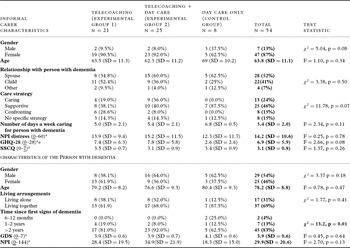
A total of 54 informal caregivers were included in the study: 21 in the first experimental group receiving telecoaching only; 25 in the second experimental group receiving telecoaching and day care; and eight in the control group receiving day care only. The baseline characteristics of the groups of informal caregivers are described in Table 1. The majority of caregivers in the study sample were women. The mean age range of the caregivers was 60–70 years, and most were caring for a person in the early stages of dementia and for more than five days a week.
Baseline characteristics of informal caregivers and people with dementia

a The underlined score of the range indicates a positive outcome on that measure.
Note: Significant effects are given in bold (p < 0.05).
NPI = Neuropsychiatric Inventory, GHQ-28; General Health Questionnaire; SSCQ = Short Sense of Competence Questionnaire; GDS = Global Deterioration Scale
No differences were found between the baseline characteristics of the caregivers in the experimental group and those in the comparison group.
Based on the diary entries of healthcare and medication use during the intervention period, we also found no difference between groups in the number of visits made by informal caregivers to GPs or mental healthcare professionals, or in changes in their use of medication (χ2 = 1.66, p = 0.44). We also kept track of informal caregivers’ illnesses and important life events, as these could also influence the outcomes. No differences between groups were found for caregivers’ illnesses or important life events at pre-test (χ2 = 1,67, p = 0.43) or post-test measurement (χ2 = 4,55, p = 0.10).
Table 1 also shows the sociodemographic characteristics of the people with dementia No differences were found in the baseline characteristics of people with dementia in the experimental and comparison groups. The groups only differed with regard to “time since first signs of dementia” (χ2 = 13.2, p = 0.01), and this variable was therefore included as a potential confounder in the effect analysis.
Though six people with dementia were admitted to a nursing home, there was no difference between the groups in terms of nursing home admittance (χ2 = 1.48, p = 0.48).
We tested whether the number of neuropsychiatric symptoms as measured with the NPI and severity of dementia were related to the outcome measures, but found no significant correlations.
Primary outcome measures by informal caregivers
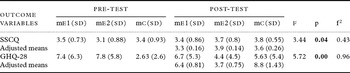
Table 2 presents all the mean scores and standard deviations of the outcome measures at baseline and post-test. The results showed a significant moderate effect (0.43) on the outcome measure of “feelings of competence” between the three groups at post-test (F = 3.44, p = 0.04). Pairwise comparisons revealed a significant increase in “feelings of competence” in informal caregivers who received telecoaching in addition to day care, as compared to informal caregivers who received telecoaching only (D = −0.57, 95% CI = −1.10, −0.03). No significant differences were found between the two experimental groups and the comparison group (day care only). These results suggest that the use of telecoaching in addition to day care effectively increases feelings of competence in informal caregivers of people with dementia living at home.
Results of ANCOVAs conducted on post-test scores of informal caregiversa

a Effect sizes (f 2) are reported for each outcome measure.
b Significant effects in bold (p < 0.05).
m = mean score; E = experimental; C = control; SSCQ = Short Sense of Competence Questionnaire; GHQ-28; General Health Questionnaire
A significant large effect (0.96) was found on the outcome measure “mental health complaints” among the three groups at post-test (F = 5.72, p = 0.00). Pairwise comparisons show a significant decrease in mental health complaints in informal caregivers who received telecoaching in addition to day care, as compared to informal caregivers who received day care only (D = −5.09 95% CI = −9.23,−0.95).
Satisfaction of informal caregivers with telephone coaching
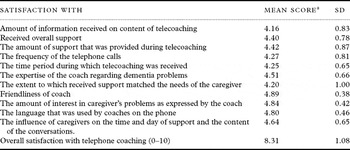
In the customer satisfaction questionnaire, informal caregivers were asked to express their satisfaction on different aspects of the received telecoaching. All informal caregivers in the study were contacted, except for those who had already dropped out (n = 18) at the time the questionnaire was administered. Other than death, the main reasons for a person with dementia dropping out included their institutionalization within three months of the start of the telecoaching, and the caregiver no longer wishing to participate in the study. Table 3 provides an overview of the results, which show high satisfaction with all aspects of the telecoaching. Overall, the informal caregivers valued the telephone coaching with a mean score of 8.31 (SD = 1.08, range 1–10), indicating that informal caregivers were indeed highly satisfied with the telecoaching they received in the intervention period.
Results of caregiver satisfaction with received telephone support

a Caregivers reported their satisfaction on a 5-point scale ranging from very dissatisfied to very satisfied.
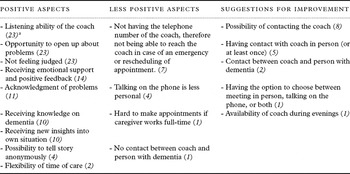
Some of the informal caregivers were reported as saying: “it is possible to tell my story,” “you can really open up to them, that brings relief,” “the feeling of being on your own is acknowledged,” and “telecoaching gives me a secure feeling to know that I am doing things right as a caregiver.” They could also report positive and less positive aspects of the telecoaching, and provided suggestions on improving the intervention (Table 4).
Comments of informal caregivers on telephone coaching after 16 weeks

a Numbers in italics correspond to the number of caregivers who made these comments.
The support provided
Thirteen coaching registration forms listing the type of support provided were returned. Telecoaches participated in an average of 7.6 (SD = 3.2) coaching sessions with an informal caregiver. The chief reasons for ending the telecoaching intervention prematurely (i.e. before ten sessions had taken place) were that caregivers said they no longer needed telecoaching, or thatthe person with dementia had died or been institutionalized. Problem areas that were seldom discussed included “being frightened, angry or confused,” “the feeling of having to face everything on your own,” “having medical problems as well,” and “miscommunication with formal carers.” Problem areas that were not often discussed were: “the feeling that something is wrong, sense of unease,” “being patronized by (in)formal caregivers,” and “financial issues.” The type of support that was most often provided was “emotional support” and “information and advice.” Telephone coaches made referrals to GPs, nursing homes and day care centers (in the telephone only group), mental healthcare, social workers, case management, and home care. Some of the informal caregivers in the telephone-only group who were referred to day care centers by their coaches also started using them (or were put on the waiting list). In all cases, this was not within three months of the intervention starting so all caregivers stayed in their original experimental group.
Discussion
In this study, we evaluated telecoaching provided by professional caregivers as a means ofsupporting informal caregivers of community-dwelling people with dementia.
Informal caregivers who received telecoaching in addition to day care felt more competent (moderate effect) in caring for the person with dementia and showed a substantial decrease in mental health complaints (large effect) compared with caregivers who received day care only. Caregivers who received the combined support also reported a significant decline in mental health complaints as compared to caregivers who received day care only.
This suggests an additional value of telephone coaching over day care in decreasing experienced burden and mental health complaints in caregivers of people with dementia. This is in line with previous studies in which combined interventions for both the caregiver and the person with dementia have been found to be more effective than single interventions (Smits et al., Reference Smits, de Lange, Dröes, Meiland, Vernooij-Dassen and Pot2007). Overall, the informal caregivers were satisfied to very satisfied with the different aspects of the intervention, in particular the friendliness of the coaches, the interest coaches showed in the problems of caregivers, and the way the coaches communicated with the caregivers. In addition, caregivers said they valued having someone who listened to them: they felt they could be really frank with their coaches and tell them things anonymously that they would not easily share with others.
The results of this study are in line with previous studies that investigated the effectiveness of telephone coaching on informal caregivers of people with dementia and which have shown a decrease in burden (Finkel et al., Reference Finkel, Czaja, Schulz, Martinovich, Harris and Pezzuto2007), a decrease in depression, andimproved well-being and ability to cope with psychosocial stress (Chang et al., Reference Chang, Nitta, Carter and Markham2004).
Informal caregivers in our study wanted more personal contact with their coach (meeting face-to-face at least once) and reported wishing to have the possibility of contacting the coach in a crisis situation. A possible solution to this desire for more personal contact would be video-conferencing with a coach. This combines the benefits of telecoaching (i.e. in the caregiver's own home, caregiver decides when support is given, personalized support) with personal contact through a video screen. At present, one drawback may be that video-conferencing requires installation of relatively expensive equipment, although this could be easily solved by a care organization offering telecare as a service. Another drawback could be that the older adult population are less comfortable with the technology of video-conferencing than the adult child caregivers (as opposed to spouse caregivers) of people with dementia (Smith and Toseland, Reference Smith and Toseland2006). Also, they may be inclined to speak less freely than is the case in non face-to-face contact. More research into this type of support is needed. Naturally, to satisfy the need for social contact, caregivers could also be referred to support programs in which individual support can be provided as well, such as the Meeting Centres Support Program (Dröes et al., Reference Dröes, Meiland, Schmitz and van Tilburg2006) which has an individual consulting hour once a week.
This study had several limitations that should be taken into account when considering the results. First, the number of participants included in this study was lower than initially planned. In particular, the group that received psychogeriatric day care only was much smaller than the other two experimental groups. This was caused partly by the fact that caregivers of people with dementia in day care centers could only participate if the person with dementia had started attending day care within the last month. Only a few people started day care in the day care centers that participated in this project during our intervention period. Although we corrected for differences between groups at baseline in our analysis, it was clear that the comparison group differed from the two experimental groups in some respects. Due to the small sample, the power of the tests was very small and potential effects may not have been found. The small sample size of this study also threatens the generalizability of the results, which should therefore be treated with some caution. Due to the small sample size, we also were not able to conduct subgroup analyses on informal caregivers. This means we are unable to draw conclusions on which characteristics of informal caregivers are predictors of positive effects of the different types of support described in this study. Previous studies have explored the effects of telephone support in different subgroups, for instance, caregivers with high self-efficacy (Gallagher-Thompson et al., Reference Gallagher-Thompson2007), older female caregivers (Winter and Gitlin, Reference Winter and Gitlin2006), and adult children caregivers (Smith and Toseland, Reference Smith and Toseland2006).
A second limitation was that our design did not allow for the investigation of the effect of telephone coaching alone compared to not receiving any care, because it was not feasible within this project to find caregivers who were not receiving any support.
Third, our sample consisted predominantly of female caregivers. Thus, it is unclear whether our positive results can be generalized to male caregivers. Female caregivers might be more open to telephone coaching and might have a stronger desire to talk about their problems in daily life than male caregivers (Gant et al., Reference Gant, Steffen and Lauderdale2007).
Despite these limitations, our study shows positive effects of telephone support on burden and mental health complaints of informal caregivers of people with dementia, and satisfaction with this intervention was high. Furthermore, this intervention promises to be an efficient solution by making use of an experienced work force in the field of psychogeriatrics, and by delivering telephone support instead of face-to-face contact. This strategy of using professional caregivers who work as telephone coaches in conjunction with their existing work also aims to increase the productivity of a large number of part-time workers in the psychogeriatric sector, especially women (Telkamp and De Koning, Reference Telkamp and de Koning2008) and is expected to narrow the gap between the existing needs of caregivers and people with dementia and the available professional care. For instance, one professional caregiver can provide support to three different informal caregivers by expanding their work hours by only 45 minutes a week.
Telephone support could offer an alternative solution for those who are not making optimum use of the care services: the intervention enables caregivers to receive support in their own personal environment, making it easily accessible to many caregivers, including not only those who are unable to travel but also those who have no other services available nearby. Telephone coaching has the added value of providing personalized support that is tailored to the specific problems experienced by caregivers. This is not always possible in larger group settings. Ultimately, providing adequate and tailored support, such as telephone support, to informal caregivers of people with dementia will help to reduce the burden and mental health complaints they experience, and it may enable them to provide better care for their relatives with dementia and postpone their institutionalization. These are important aims in dementia care in the coming decades, as the pressure on informal caregivers to support people with dementia at home will increase.
Conflict of interest
None.
Description of authors' roles
R. M. Dröes designed the study, formulated the research questions and assisted in writing the paper. L. D. van Mierlo carried out the study, analyzed the data and wrote the paper. F. J. M. Meiland assisted in the analysis and writing the paper.