





Antipsychotic agents play a dual role in relation to obsessive–compulsive phenomena. Second-generation antipsychotics (SGAs) are established augmentation strategies for treatment-resistant obsessive–compulsive disorder (OCD), with meta-analytic evidence indicating clinically meaningful improvement in roughly a third of patients who do not respond adequately to selective serotonin reuptake inhibitors (SSRIs). Reference Dold, Aigner, Lanzenberger and Kasper1 At the same time, clozapine and, to a lesser extent, other SGAs have been associated with the emergence of de novo obsessive–compulsive symptoms (OCS) among individuals treated for psychotic disorders, an adverse effect first described systematically in the early post-reintroduction period of clozapine use by Baker and colleagues. Reference Baker, Chengappa, Baird, Steingard, Christ and Schooler2
This ‘antipsychotic paradox’ has important clinical consequences. Clozapine remains uniquely efficacious in treatment-resistant schizophrenia and is the only antipsychotic consistently shown to reduce suicidality. Reference Sareen, Kirshner, Lander, Kjernisted, Eleff and Reiss3 However, across observational and clinical studies, de novo OCS are reported in approximately 5.9–44.3% of clozapine-treated individuals. Reference Fonseka, Richter and Müller4,Reference Moreno Tarazona, Orozco Gonzalez, La Rosa Giron, Ruiz-Grosso and Lazo-Porras5 When present, these symptoms are often functionally disabling, Reference Kim, Barr, Lu, Stewart, White and Honer6 requiring clinicians to weigh OCS severity against the indispensable benefits of ongoing clozapine treatment.
De novo or worsening OCS occupy an unusual position within the clozapine risk–benefit calculus because, unlike haematological or metabolic adverse effects, these are rarely captured by routine monitoring frameworks and are easily mistaken for residual psychotic phenomena. Reference Fonseka, Richter and Müller4,Reference Schirmbeck and Zink7 When unrecognised, they may prompt premature dose escalation, polypharmacy or unnecessary clozapine withdrawal. Accurate characterisation of the OCS signal across antipsychotic agents therefore shapes how this uniquely effective treatment is delivered.
The pathophysiological mechanisms underlying antipsychotic-associated OCS have most commonly been conceptualised within a serotonergic framework. Reference Fonseka, Richter and Müller4 This model proposes that pronounced antagonism at 5-HT2A and 5-HT2C receptors, in the context of relatively modest dopamine D2 receptor blockade, disrupts the cortico-striato-thalamo-cortical circuits implicated in obsessive–compulsive pathology. Reference Schirmbeck and Zink7,Reference Grillault Laroche and Gaillard8 The orbitofrontal cortex and basal ganglia, which carry some of the highest densities of 5-HT2A and 5-HT2C receptors in the human brain, are central nodes of this circuitry, so sustained antagonism by anti-serotonergic antipsychotics is expected to perturb precisely those regions most implicated in obsessional pathology. Reference Schirmbeck and Zink7
Beyond this predominantly serotonergic account, partial agonism at dopamine D2 and D3 receptors, together with 5-HT1A activity, has been proposed as an additional route to antipsychotic-associated obsessive–compulsive and impulse-control symptoms, particularly for newer agents such as aripiprazole, brexpiprazole and cariprazine. Reference Nafisa and Kakunje9 Functional and diffusion neuroimaging studies in clozapine-treated patients have provided convergent in vivo evidence consistent with this model. Empirical support comes from pharmacological patterns across antipsychotic agents: compounds with high 5-HT2A/D2 affinity ratios, most notably clozapine and olanzapine, show the strongest association with OCS emergence, whereas predominantly dopamine-selective agents such as amisulpride and haloperidol are linked to sparse and inconsistent case reports. Reference Fonseka, Richter and Müller4,Reference Grillault Laroche and Gaillard8 Genetic polymorphisms in glutamatergic pathway genes, including the glutamate transporter SLC1A1 and NMDA receptor subunits such as GRIN2B, may further modulate susceptibility to antipsychotic-associated OCS. Reference Cai, Zhang, Yi, Lu, Wu and Chen10,Reference Kwon, Joo, Nam, Lim, Cho and Jung11
Beyond mechanism, the patient-level burden is increasingly documented. In a large clozapine cohort, Fernandez-Egea et al reported an OCD prevalence of 47% using the Obsessive–Compulsive Inventory-Revised, with checking compulsions predominating and severity correlated with antipsychotic load; symptoms were frequently egodystonic, time-consuming and associated with reduced well-being independent of psychotic and depressive symptoms. Reference Fernandez-Egea, Worbe, Bernardo and Robbins12 Such symptoms are often not spontaneously disclosed, because of stigma or misattribution to ongoing illness, contributing to under-recognition in routine clozapine clinics.
Despite increasing recognition of antipsychotic-associated OCS, significant gaps remain in the knowledge base. Systematic delineation of signal strength across the full spectrum of antipsychotic agents, including more recently introduced compounds such as lurasidone, brexpiprazole and cariprazine, has not been undertaken. Reference Moreno Tarazona, Orozco Gonzalez, La Rosa Giron, Ruiz-Grosso and Lazo-Porras5 Comparative phenomenology across diagnostic populations, treatment contexts and health systems remains poorly characterised. Notably, major clinical guidance on clozapine monitoring, including National Institute for Health and Care Excellence Clinical Guidelines, Maudsley Prescribing Guidelines and the American Psychiatric Association Practice Guideline for the Treatment of Schizophrenia (2020), identified no explicit recommendations for routine screening or monitoring of OCS during clozapine treatment, suggesting a potential gap between emerging evidence and clinical practice. Reference Keepers, Fochtmann, Anzia, Benjamin, Lyness and Mojtabai13–16
A preliminary search of PROSPERO, the Cochrane Database of Systematic Reviews and JBI Evidence Synthesis did not identify any published or ongoing scoping review that maps antipsychotic-associated OCS or OCD across the full range of antipsychotic agents while integrating mechanistic, comparative epidemiological and clinical management evidence in a single synthesis. Existing syntheses have addressed narrower questions, including Kim et al’s systematic analysis of 107 reported cases of clozapine-associated OCS Reference Kim, Barr, Lu, Stewart, White and Honer6 and meta-analyses examining antipsychotic augmentation in primary OCD. Accordingly, the scope and distribution of evidence across antipsychotic agents and domains has not yet been comprehensively mapped.
In view of the heterogeneity in study designs, populations and outcome definitions, we undertook a scoping review to systematically map the evidence on antipsychotic-associated OCS and OCD across antipsychotic agents. The specific objectives were to (a) identify areas of evidentiary concentration and paucity by antipsychotic compound and study design; (b) characterise reported clinical phenomenology and indicators of causality, including dose at symptom onset, latency to onset and dechallenge/rechallenge patterns; and (c) synthesise reported management strategies and clinical outcomes.
Method
We conducted a scoping review in accordance with Joanna Briggs Institute (JBI) methodology and report our findings following PRISMA Extension for Scoping Reviews (PRISMA-Sc) guidelines. Reference Peters, Marnie, Tricco, Pollock, Munn and Alexander17,Reference Tricco, Lillie, Zarin, O’Brien, Colquhoun and Levac18 A scoping approach was chosen because the evidence base spans heterogeneous designs and reporting depth, and the aim was to map and characterise available evidence rather than to pool quantitative estimates.
Protocol and registration
A protocol specifying objectives, eligibility criteria, search strategy and data-charting procedures was developed and registered at the Open Science Framework (registration DOI: https://doi.org/10.17605/OSF.IO/R8ZFA). The core review question, eligibility criteria and planned scoping review approach followed the registered protocol. Clarifications made during conduct of the review, including operational labelling of obsessive–compulsive phenomena, dose standardisation and the qualitative triangulation framework for signal strength synthesis, are described transparently below and in the supplementary materials available at https://doi.org/10.1192/bjo.2026.12090.
Research question and PCC framework
The review question was structured using the population–concept–context (PCC) framework. The population comprised individuals receiving antipsychotic medications for any indication, with particular emphasis on clozapine and other second-generation antipsychotics in schizophrenia spectrum disorders. The concept was the emergence of OCS or OCD during antipsychotic exposure, including de novo onset, exacerbation of pre-existing symptoms, putative mechanisms, risk factors and management strategies. The context encompassed psychiatric and general medical settings internationally, including in-patient, out-patient and community care.
Eligibility criteria
We included primary human studies of any design that reported de novo OCS, and also exacerbation of pre-existing OCS or OCD diagnoses temporally associated with antipsychotic exposure. Eligible designs were case reports, case series, cross-sectional studies, cohort or registry studies, randomised controlled trials and pharmacovigilance disproportionality analyses. Publications from database inception to December 2025 were eligible in any language provided an English-language abstract was available. No lower date limit was applied, so that records predating the 1989 reintroduction of clozapine could be screened rather than excluded a priori.
We excluded systematic reviews and meta-analyses from primary data charting, although these were retained for citation-chasing and contextualisation. We also excluded studies examining antipsychotics solely as treatment for primary OCD without adverse-event reporting, editorials and commentaries without primary data, conference abstracts lacking sufficient methodological detail for extraction and animal studies, except for landmark preclinical work that directly informed mechanistic interpretation.
Operational definitions
To support consistent extraction and interpretation across heterogeneous study designs, we applied operational definitions for de novo OCS, exacerbation of OCS, OCD diagnosis and total OCS (Fig. 1). Where studies reported standardised instruments, we recorded the thresholds they used: a positive Yale–Brown Obsessive Compulsive Scale (Y-BOCS) screen was taken to indicate OCS, a Y-BOCS score of 16 or higher to indicate clinically significant OCD Reference Öngür and Goff19 and an Obsessive–Compulsive Inventory-Revised score of 21 or higher as the validated cut-off applied in the largest screened cohort. Reference Fernandez-Egea, Worbe, Bernardo and Robbins12 Instrument heterogeneity across the evidence base precludes a single universal cut-off, and each prevalence estimate is labelled in Results, below, according to the category and instrument reported.
Operational definitions and triangulation framework for signal strength assessment. (a) The operational definitions used to classify obsessive–compulsive phenomena across included studies; symptoms emerging during antipsychotic treatment in patients without prior history were classified as de novo, whereas worsening of pre-existing symptoms following antipsychotic initiation or dose increase was classified as exacerbation. (b) The four dimensions used to characterise signal strength for each antipsychotic agent: observational prevalence, case literature density, pharmacovigilance signal and mechanistic plausibility. FAERS, United States Food and Drug Administration Adverse Event Reporting System; 5-HT2A/D2, ratio of serotonin 2A to dopamine D2 receptor affinities.

Fig. 1 Long description
Panel A: A list of operational definitions for obsessive-compulsive phenomena. It includes de novo OCS, exacerbation of pre-existing OCS, obsessive-compulsive disorder (OCD), and total OCS. Each definition is described in detail with specific criteria and conditions. Panel B: A framework for assessing signal strength of antipsychotic agents. It includes four dimensions: observational prevalence, case-literature density, pharmacovigilance signal, and mechanistic plausibility. Each dimension is described with specific metrics and criteria.
Information sources and search strategy
We searched two bibliographic databases, PubMed/MEDLINE and Scopus, from inception to December 2025. The searches were developed from 27 February to 3 March 2026 and the final reproducible searches executed on 12 June 2026. The final reproducible search set comprised records identified through PubMed/MEDLINE and Scopus, supplemented by documented citation searching of prior systematic reviews. To address differential reporting across data sources, we additionally queried two regulatory pharmacovigilance databases: the United States FDA Adverse Event Reporting System (FAERS, via the openFDA interface) 20 and the World Health Organization VigiBase (via VigiAccess). 21 Pharmacovigilance counts were treated as descriptive and hypothesis-generating and were not added to the included-study corpus.
Search strategies combined terms for individual antipsychotic agents and classes with terms for OCS and OCD, together with an induction/adverse-effect concept block to focus retrieval on treatment-emergent or antipsychotic-associated phenomena. The Scopus strategy mirrored this three-block structure, adapted to Scopus syntax. Records were captured to December 2025 with no lower date limit, and eligibility criteria, including the requirement for an English-language abstract, were applied during screening to distinguish induction or exacerbation evidence from management-only or contextual records. The full PubMed/MEDLINE and Scopus strategies, field restrictions and yields are provided in Supplementary Table 1.
Selection of sources of evidence
Search results were imported into Zotero 9 using macOS operating system (Corporation for Digital Scholarship, Falls Church, Virginia, USA; https://www.zotero.org/download) and de-duplicated. Two reviewers (S.A.B. and M.E.) independently screened titles and abstracts against the eligibility criteria, followed by independent full-text assessment of potentially relevant articles. Disagreements were resolved by discussion; where consensus could not be reached, S.A.B. adjudicated following re-review of the full text and extraction form. Interrater agreement was substantial at both stages (Cohen’s kappa 0.84 for title and abstract screening; kappa 0.91 for full-text assessment). Systematic reviews and meta-analyses identified during screening were logged in a prior-syntheses table, but were not treated as primary data to avoid double-counting.
Data-charting and dose standardisation
We developed and pilot-tested a data-charting form on the first ten included studies, refining it to ensure consistent capture of relevant variables. Data were extracted at two levels. At the study level we recorded citation details, country, design, sample size, antipsychotic agents, prevalence or incidence estimates labelled using the operational definitions, reported risk factors and key findings. At the case level, for case reports and series we extracted age, gender, primary diagnosis, antipsychotic and dose at OCS onset, time to onset, serum or plasma concentrations when reported, OCS/OCD phenotype, de- and rechallenge outcomes, management strategies and clinical outcomes. One reviewer performed data-charting and a second independently verified all entries, with discrepancies resolved by discussion.
To facilitate comparison of dose–response patterns across agents with different recommended dose ranges, we expressed dose at OCS onset as a percentage of the upper therapeutic range. Upper therapeutic dose ranges were taken from AGNP Consensus Guidelines for Therapeutic Drug Monitoring in Neuropsychopharmacology where available; for lurasidone, brexpiprazole and cariprazine, the upper bound of the recommended dose range from manufacturer prescribing information was used, and is flagged as manufacturer-derived in Supplementary Table 2. Reference Hiemke, Bergemann, Clement, Conca, Deckert and Domschke22 This approach allowed standardised comparisons: for example, 400 mg clozapine corresponding to 67% of the upper therapeutic range and 15 mg olanzapine to 75%.
Critical appraisal and synthesis
In keeping with JBI guidance for scoping reviews, we did not conduct formal risk-of-bias assessment of individual studies because the primary objective was to map and describe the extent and nature of the evidence rather than to derive graded effect estimates. Results were synthesised narratively and organised around the review objectives, with supporting evidence presented in tables. Meta-analysis was not attempted because of substantial heterogeneity in study design, populations, OCS/OCD definitions, assessment tools and reporting practices.
Triangulation framework for signal strength
To synthesise differential signal strength across antipsychotics, we triangulated four evidence dimensions (Fig. 1): observational prevalence, case-literature density, pharmacovigilance signal and mechanistic plausibility. Each agent was rated as either strongest, moderate, weaker or insufficient using explicit, pre-specified rules. Observational evidence was rated present when at least one cross-sectional or cohort estimate existed, and as convergent when at least two independent studies agreed in direction. Case-literature density, from role-classified induction counts (Table 1), was graded as either dense (at least ten), recurrent (three to nine), sparse (one or two) or none. A pharmacovigilance signal was counted as being present only with significant disproportionality showing cross-source concordance; this was treated as hypothesis-generating, could not by itself raise an agent’s tier and was labelled discordant where it coincided with sparse clinical induction evidence (aripiprazole is the worked example). Mechanistic plausibility combined the 5-HT2A/D2 affinity ratio with genetic and imaging support. A strongest rating required convergent observational evidence, dense case-level evidence with temporal association and de- or rechallenge where available, and a concordant pharmacovigilance or mechanistic signal; a moderate rating required recurrent evidence across at least two dimensions; a weaker rating reflected sparse, inconsistent or discordant evidence; and an insufficient rating was assigned where no eligible induction or exacerbation evidence was identified. Management-only evidence was not counted as induction evidence for the management drug. We did not compute a single numeric composite, because the dimensions are not commensurable; drug-specific assignments are provided in Supplementary Table 3.
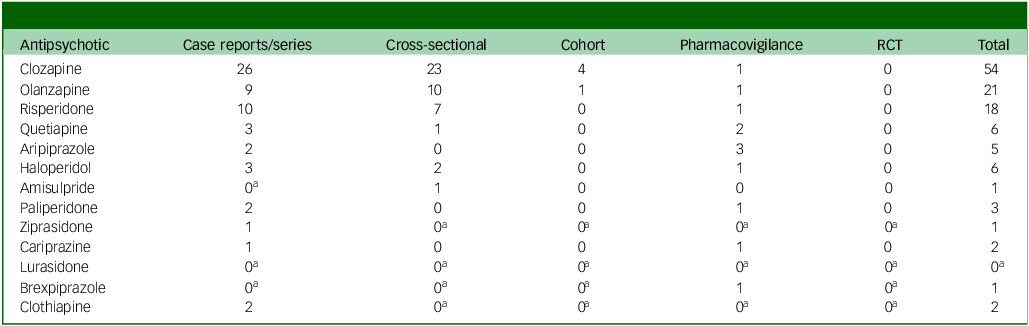
Role-classified evidence map of induction/exacerbation evidence, by antipsychotic agent and study design

Table 1 Long description
A table comparing evidence of induction/exacerbation by antipsychotic agents and study design. The table has 15 rows and 6 columns. The columns are labeled Antipsychotic, Case reports/series, Cross-sectional, Cohort, Pharmacovigilance, RCT, and Total. The rows list different antipsychotic agents and their corresponding evidence counts across different study designs. Row 1: Clozapine, 26, 23, 4, 1, 0, 54. Row 2: Olanzapine, 9, 10, 1, 1, 0, 21. Row 3: Risperidone, 10, 7, 0, 1, 0, 18. Row 4: Quetiapine, 3, 1, 0, 2, 0, 6. Row 5: Aripiprazole, 2, 0, 0, 3, 0, 5. Row 6: Haloperidol, 3, 2, 0, 1, 0, 6. Row 7: Amisulpride, 0, 1, 0, 0, 0, 1. Row 8: Paliperidone, 2, 0, 0, 1, 0, 3. Row 9: Ziprasidone, 1, 0, 0, 0, 0, 1. Row 10: Cariprazine, 1, 0, 0, 1, 0, 2. Row 11: Lurasidone, 0, 0, 0, 0, 0, 0. Row 12: Brexpiprazole, 0, 0, 0, 1, 0, 1. Row 13: Clothiapine, 2, 0, 0, 0, 0, 2.
RCT, randomised controlled trial.
This table maps role-classified drug-instance evidence in which the antipsychotic is the suspected inducer or exacerbator of obsessive–compulsive symptoms; totals are drug-instance counts and should not be summed to derive either the number of unique included studies, an indexed exposure in an observational association study or the primary suspected drug in a pharmacovigilance analysis. Management-only, add-on/switch reports are not counted as induction evidence for the management drug. Some comparative studies examined multiple antipsychotics and are counted under each relevant exposure.
a. No eligible induction/exacerbation studies were identified in our search; this represents absence of evidence rather than evidence of absence of risk.
Results
Selection of sources of evidence
The PRISMA-ScR flow diagram (Fig. 2) summarises the selection of sources. Searches of PubMed/MEDLINE and Scopus from database inception to December 2025 identified 1056 records (263 from PubMed/MEDLINE and 793 from Scopus). Following removal of 230 duplicates, 826 records were screened by title and abstract. The large majority were excluded because they did not concern antipsychotic-associated obsessive–compulsive phenomena; also excluded were studies of antipsychotic augmentation for primary OCD; reports of Tourette syndrome, Parkinson disease, movement disorders or dementia-related symptoms; animal and preclinical studies; and reviews and other non-primary articles. Records predating 1989 were screened and none were found to be eligible. Eighty-nine reports were assessed in full text, including five identified through citation searching of prior reviews; one (Mancano (2014), a multi-topic, adverse-drug reaction feature without primary data) was excluded. The final evidence map comprised 88 primary studies.
PRISMA Extension for Scoping Reviews flow diagram. PubMed/MEDLINE and Scopus were searched from database inception to December 2025, and five further studies were identified through citation searching of prior reviews. Reference Fernandez-Egea, Worbe, Bernardo and Robbins12,Reference Haan, Linszen and Gorsira27–Reference Sa, Hounie, Sampaio, Arrais, Miguel and Elkis30 The regulatory pharmacovigilance databases (United States Food and Drug Administration Adverse Event Reporting System and World Health Organization VigiBase) were consulted as descriptive data sources and did not contribute additional bibliographic records; published pharmacovigilance studies identified through database searching were included as primary studies, where eligible. The review comprised 88 primary studies; 14 prior systematic reviews and meta-analyses are summarised in Supplementary Table 4.

Fig. 2 Long description
The flowchart details the identification and screening process of studies for a review. It is divided into two main sections: identification of studies via databases and registers, and identification of studies via other methods. The first section starts with records identified from PubMed/MEDLINE and Scopus, totaling 1056 records. Duplicate records are removed, and records are screened, resulting in 826 records. After excluding 742 records, 84 reports are sought for retrieval, all of which are assessed for eligibility. One report is excluded for not being primary data, leaving 88 studies included in the review. The second section involves records identified from websites, organizations, and citation searching, totaling 5 records. All these records are sought for retrieval and assessed for eligibility, with none excluded, contributing to the 88 studies included in the review.
The 14 prior systematic reviews and meta-analyses retained for context are summarised in Supplementary Table 4, and the characteristics, outcomes and evidence-role classification of the 88 primary studies are provided in the extended Supplementary Table 5.
Characteristics of sources of evidence
Of the 88 included studies, 54 were case reports or case series, 26 were cross-sectional or pharmacogenetic case–control studies, 5 were retrospective or prospective observational cohorts and 3 were pharmacovigilance disproportionality analyses; no eligible randomised controlled trials were identified (Table 1). Clozapine was by far the most represented exposure, followed by olanzapine and risperidone, with newer agents appearing rarely or not at all (Table 1). Because counts are role-classified, drug-instance counts, comparative studies appear under each exposure and management-only reports are not counted as induction evidence. Low-evidence, newer-agent entries were largely pharmacovigilance-derived or \\case-level signals. Reference Kwon, Joo, Nam, Lim, Cho and Jung11,Reference Qi, Tian, Diao, Zhao, Li and Zhang23,Reference Pariwatcharakul and Suthisisang24 The great majority of studies concerned schizophrenia spectrum disorders, the predominant indication for the agents involved; antipsychotic-associated OCS was nonetheless also documented outside psychosis, in bipolar disorder, Reference Pariwatcharakul and Suthisisang24,Reference Lemke and Bustillo25 autism spectrum disorder Reference Silverstein, Shrimali and McDougle26 and major depressive disorder treated with adjunctive antipsychotics, Reference Qi, Tian, Diao, Zhao, Li and Zhang23 indicating that the phenomenon is notconfined to schizophrenia even though non-psychotic evidence remains sparse. Therapeutic dose and serum reference ranges used for dose standardisation are summarised in Supplementary Table 2.
Prevalence of OCS in observational studies
Cross-sectional and cohort studies consistently showed higher OCS prevalence in clozapine-treated patients than in those receiving other antipsychotics or no antipsychotic (Supplementary Table 6). Reported de novo OCS rates with clozapine ranged from 5.9 to 44.3% across observational studies, and total OCS prevalence (de novo plus exacerbation of pre-existing OCS) reached 77.9%. Olanzapine and risperidone consistently showed lower but recurrent total OCS proportions; in the largest comparative cohort (n = 543 Reference Scheltema Beduin, Swets, Machielsen and Korver31 ), prevalence was 20.1% on olanzapine and 23.2% on risperidone compared with 38.9% on clozapine. Longer treatment duration, higher clozapine or norclozapine levels and younger age repeatedly emerged as correlates of higher OCS prevalence.
Case-level causality markers
Case reports and series (127 patients; Table 2) indicated that clozapine-associated OCS typically emerged within months of treatment initiation but could occur across the full therapeutic dose range. In the subset with documented doses (Supplementary Table 7), median clozapine dose at onset was 400 mg/day (about 67% of the upper therapeutic range), with OCS appearing from approximately 21 to 150% of that range; positive dechallenge was reported in most clozapine cases with outcome data, and positive rechallenge in a smaller subset. Individual cases implicated several other SGAs, but case numbers for non-clozapine agents remained small.
Representative case-level causality markers, with dose at onset as percentage of therapeutic range

Table 2 Long description
A table summarizing case reports of drug-induced obsessive-compulsive symptoms. The table has 10 rows and 9 columns. Column headers are: ID, Age, Gender, Drug, Dose, Range, Time to onset, Dechallenge, Rechallenge, Causality evidence, Source. Row 1: ID, CLZ-01; Age, 39 years; Gender, M; Drug, Clozapine; Dose, 900 mg; Range, 150 percent; Time to onset, 2 years; Dechallenge, +; Rechallenge, -; Causality evidence, Temporal + challenge; Source, 2b. Row 2: ID, CLZ-02; Age, 52 years; Gender, M; Drug, Clozapine; Dose, 600 mg; Range, 100 percent; Time to onset, 2 years; Dechallenge, +; Rechallenge, +; Causality evidence, Dechallenge + rechallenge; Source, 26b. Row 3: ID, CLZ-03; Age, 42 years; Gender, M; Drug, Clozapine; Dose, 125-150 mg; Range, 21-25 percent; Time to onset, 4-9 weeks; Dechallenge, -; Rechallenge, -; Causality evidence, Temporal; de novo onset case series; Source, 30b. Row 4: ID, CLZ-04; Age, 42 years; Gender, M; Drug, Clozapine; Dose, 400 mg; Range, 67 percent; Time to onset, —; Dechallenge, +; Rechallenge, —; Causality evidence, Naranjo score: probable; Source, 33b. Row 5: ID, CLZ-05; Age, 51 years; Gender, M; Drug, Clozapine; Dose, 150 mg; Range, 25 percent; Time to onset, —; Dechallenge, +; Rechallenge, —; Causality evidence, Temporal only; Source, 34b. Row 6: ID, OLZ-01; Age, 30 years; Gender, F; Drug, Olanzapine; Dose, 15 mg; Range, 75 percent; Time to onset, 3 weeks; Dechallenge, +; Rechallenge, +; Causality evidence, Naranjo score 8; dechallenge + rechallenge; Source, 35b. Row 7: ID, RIS-01; Age, 20 years; Gender, M; Drug, Risperidone; Dose, 4 mg; Range, 50 percent; Time to onset, Shortly after; Dechallenge, +; Rechallenge, —; Causality evidence, Dose-response documented; Source, 36b. Row 8: ID, ARI-01; Age, 35 years; Gender, F; Drug, Aripiprazole; Dose, 5 mg; Range, 17 percent; Time to onset, 3 weeks; Dechallenge, —; Rechallenge, —; Causality evidence, Strong temporal; Source, 9. Row 9: ID, HAL-01; Age, 37 years; Gender, M; Drug, Haloperidol; Dose, 15mg; Range, 75 percent; Time to onset, 2 weeks; Dechallenge, +; Rechallenge, —; Causality evidence, The only haloperidol induction case; Source, 37. Row 10: ID, CAR-01; Age, —; Gender, —; Drug, Carpiprazine; Dose, —; Range, —; Time to onset, During treatment; Dechallenge, —; Rechallenge, —; Causality evidence, The only carpiprazine case; limited data; Source, 28.
+, positive; —, not documented or not performed. Selected illustrative cases summarise causality markers across antipsychotic agents; the table is not a patient-level extraction of all included case reports and series. Where a series reported multiple patients, the row summarises a representative case.
Pharmacovigilance evidence and mechanistic context
Direct queries of two regulatory pharmacovigilance databases (FAERS and WHO VigiBase; Supplementary Table 8) concorded in placing aripiprazole at the highest obsessive–compulsive reporting proportion of any antipsychotic, roughly an order of magnitude above the next agents and well above clozapine, despite aripiprazole’s sparse clinical induction literature. Clozapine’s reporting proportion was mid-range in both databases. Because spontaneous-report data are confounded by prescribing volume and co-reporting and cannot establish incidence, these signals are hypothesis-generating; their divergence from the clinical ranking indicates that the prominence of clozapine in the published literature is shaped by both research intensity and biology. Receptor-binding and genetic data were consistent with a serotonergic–glutamatergic framework, with agents characterised by higher 5-HT2A/D2 affinity ratios and glutamatergic vulnerability markers showing stronger clinical OCS signals than predominantly antidopaminergic agents (Supplementary Table 9).
Triangulated signal strength synthesis across antipsychotics
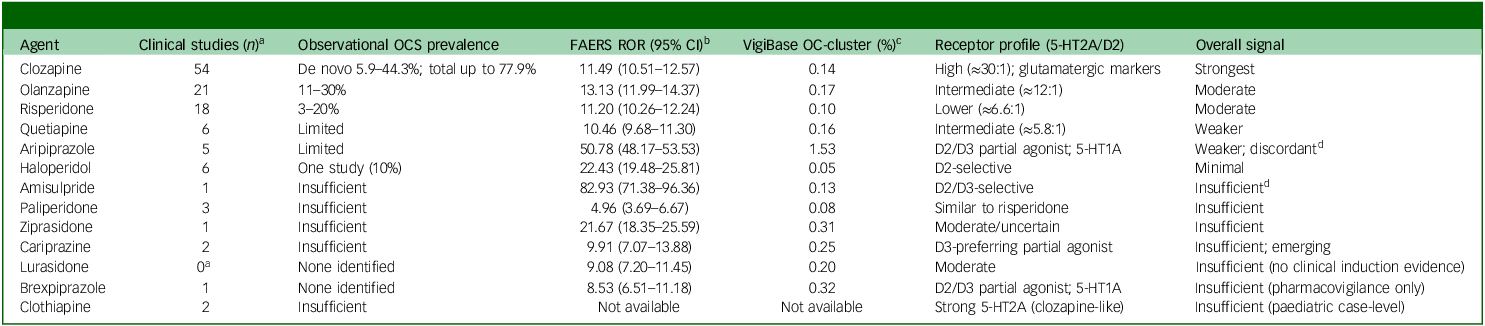
Using the triangulation framework, clozapine carried the densest and most consistent signal, supported by elevated observational prevalence, dense case literature with de- and rechallenge, a measurable pharmacovigilance signal and a high 5-HT2A/D2 affinity ratio (Table 3). Olanzapine and risperidone showed moderate signals across multiple dimensions; quetiapine and aripiprazole were weaker or discordant, and amisulpride and haloperidol showed minimal induction case literature. Table 3 maps all charted antipsychotics, including agents such as lurasidone with no eligible clinical induction evidence but available pharmacovigilance and receptor data, for which the map records an absence of study rather than demonstrated safety. The clinical ordering tracks research attention as well as any biological difference, and the pharmacovigilance columns deliberately do not reproduce it (Fig. 3).
Comparative signal strength and quantitative pharmacovigilance, prevalence and evidence-volume metrics across antipsychotics. (a) Qualitative signal strength across the four triangulation dimensions (Fig. 1), with agents grouped by tier. (b) United States Food and Drug Administration Adverse Event Reporting System (FAERS) reporting odds ratios with 95% confidence intervals against the whole-database comparator; aripiprazole (orange) is highest whereas clozapine (blue) is mid-range, illustrating that pharmacovigilance does not reproduce the clinical ranking. (c) Reported de novo obsessive–compulsive symptoms (OCS) prevalence ranges (bars) with total OCS where available (diamond). (d) Design-weighted evidence volume (cohort and cross-sectional studies weighted three times, case reports and series twice, pharmacovigilance once), with the number needed to harm for clozapine annotated. Reporting odds ratios are confounded and hypothesis-generating, not incidence. Insuff., insufficient; NNH, number needed to harm.

Fig. 3 Long description
Panel A: A horizontal bar chart shows the triangulated signal strength by evidence dimension for various antipsychotics. The dimensions include observational prevalence, case literature density, pharmaco vigilance, and mechanistic plausibility. Each antipsychotic is grouped by tier, with varying signal strengths from ‘insufficient’ to ‘strongest’. Panel B: A scatter plot displays the FDA Adverse Event Reporting System reporting odds ratios with 95 percent confidence intervals against a whole-database comparator. Aripiprazole has the highest signal, while clozapine is mid-range. Panel C: A bar chart illustrates the reported de novo obsessive-compulsive symptoms (OCS) prevalence ranges for clozapine, olanzapine, and risperidone, with a diamond marker indicating total OCS where available. Panel D: A horizontal bar chart shows the design-weighted evidence volume for various antipsychotics, with the number needed to harm for clozapine annotated.
Comparative evidence map across all antipsychotic agents

Table 3 Long description
A table comparing various antipsychotic agents across several dimensions. The table has 18 rows and 7 columns. The columns are labeled as Agent, Clinical studies, Observational OCS prevalence, FAERS ROR (95% CI), VigiBase OC-cluster, Receptor profile (5-HT2A/D2), and Overall signal. The rows list different antipsychotic agents and their corresponding data across these dimensions. Row 1: Clozapine, 54, De novo 5.9-44.3%; total up to 77.9%, 11.49 (10.51-12.57), 0.14, High (>3.01); glutamatergic markers, Strongest. Row 2: Olanzapine, 21, 11-30%, 13.13 (11.99-14.37), 0.17, Intermediate (>1.21), Moderate. Row 3: Risperidone, 18, 3-20%, 11.20 (10.26-12.24), 0.10, Lower (<0.61), Moderate. Row 4: Quetiapine, 6, Limited, 10.46 (9.08-11.30), 0.16, Intermediate (4-5.81), Weak. Row 5: Aripiprazole, 5, Limited, 50.78 (48.17-53.53), 1.53, D2/3 partial agonist; 5-HT1A, Weak; discordant. Row 6: Haloperidol, 6, One study (10%), 22.43 (19.48-25.81), 0.05, D2-selective, Minimal. Row 7: Amisulpride, 1, Insufficient, 82.93 (71.38-96.36), 0.13, D2/3-selective, Insufficient. Row 8: Paliperidone, 3, Insufficient, 4.96 (3.69-6.67), 0.08, Similar to risperidone, Insufficient. Row 9: Ziprasidone, 1, Insufficient, 21.67 (18.35-25.59), 0.31, Moderate/uncertain, Insufficient. Row 10: Cariprazine, 2, Insufficient, 9.91 (7.07-13.88), 0.25, D3-preferring partial agonist, Insufficient; emerging. Row 11: Lurasidone, 0, None identified, 9.08 (7.20-11.45), 0.20, Moderate, Insufficient (no clinical induction evidence). Row 12: Brexpiprazole, 1, None identified, 8.53 (6.51-11.18), 0.32, D2/3 partial agonist; 5-HT1A, Insufficient (pharmacovigilance only). Row 13: Clothiapine, 2, Insufficient, Not available, Not available, Strong 5-HT2A; dopamine-like, Insufficient (paediatric case only).
OCS, obsessive–compulsive symptoms; FAERS, United States Food and Drug Administration Adverse Event Reporting System; ROR, reporting odds ratio; OC-cluster, obsessive–compulsive cluster; 5-HT2A/D2, ratio of serotonin 2A to dopamine D2 receptor affinities.
Agents are ordered by overall signal tier. Every marketed antipsychotic charted in the review is represented, including agents with no eligible clinical induction evidence for which only regulatory pharmacovigilance and receptor data are available; this represents the coverage of the evidence map rather than evidence of comparable risk.
a. Role-classified drug-instance count from Table 1.
b. UFAERS reporting odds ratio against the whole-database comparator (drug in any role; openFDA, queried 12 June 2026).
c. World Health Organization VigiBase OC-cluster (obsessive–compulsive disorder plus OCS preferred terms) as a percentage of all reports for the agent (VigiAccess, 7 June 2026).
d. Whole-database reporting odds ratios are confounded by prescribing volume and co-medication and are hypothesis-generating, not incidence; the highest reporting odds ratios (amisulpride, aripiprazole) occur for agents with sparse or absent clinical induction literature, whereas clozapine, which carries the densest clinical evidence, sits mid-range.
Prior syntheses
Prior systematic reviews, scoping reviews, meta-analyses and narrative or critical reviews (Supplementary Table 4) broadly aligned with the present mapping, highlighting clozapine as the agent most consistently associated with OCS and showing modest benefit of antipsychotic augmentation for treatment-resistant OCD, particularly with risperidone and aripiprazole. Pharmacovigilance studies, including Burk et al, are treated as primary pharmacovigilance evidence rather than as prior syntheses. Reference Burk, DiGiacomo, Polancich, Pruett, Sivaraman and Birur38
Management strategies
Management most commonly involved SSRI augmentation across clozapine-, olanzapine-, risperidone- and quetiapine-associated OCS, Reference Poyurovsky, Hermesh and Weizman32,Reference Bonome, Barjau Romero, de Lara Muñoz and Tejero34,Reference Reznik, Yavin, Stryjer, Spivak, Gonen and Strous39–Reference Özer, Arsava, Ertuğrul and Demir41 and was effective in approximately half of pooled clozapine-OCS cases; Reference Kim, Barr, Lu, Stewart, White and Honer6 adjunctive aripiprazole, with reported benefit in clozapine- and olanzapine-treated patients, including SSRI non-responders; Reference Englisch, Esslinger, Inta, Weinbrenner, Peus and Gutschalk42–Reference Yesilkaya and Balcioglu45 and cautious dose modification or switching to lower-signal antipsychotics, supported by associations among clozapine dose, plasma concentration and OCS severity. Reference Aukst-Margetić, Margetić and Boričević Maršanić33,Reference Reznik, Yavin, Stryjer, Spivak, Gonen and Strous39,Reference Lin, Su and Pan46 Adapted cognitive–behavioural therapy with exposure and response prevention, consistent with established OCD guidance, was also described. 16 Systematic evidence for most of these approaches remains limited to case-level reports and small, open-label studies; no randomised controlled trial has specifically evaluated the management of antipsychotic-associated OCS as a primary outcome. Reference Fonseka, Richter and Müller4,Reference Kim, Barr, Lu, Stewart, White and Honer6
Discussion
Summary of main findings
This review mapped 88 primary studies and 14 prior syntheses across antipsychotic agents and designs. Triangulation across observational, case-level, pharmacovigilance and mechanistic dimensions identified a graded pattern: clozapine densest and most consistent, olanzapine and risperidone intermediate and predominantly antidopaminergic agents minimal, the gradient also shaped by uneven research attention. Convergent data supported a serotonergic–glutamatergic framework.
Interpretation and mechanisms
Our triangulated findings extend earlier narrative reviews by positioning individual antipsychotics along a qualitative signal strength spectrum rather than treating antipsychotic-associated OCS as an idiosyncratic phenomenon of individual drugs. Reference Fonseka, Richter and Müller4,Reference Moreno Tarazona, Orozco Gonzalez, La Rosa Giron, Ruiz-Grosso and Lazo-Porras5,Reference Schirmbeck and Zink7 Clozapine resides at the upper end of this spectrum, with olanzapine and risperidone occupying intermediate positions consistent with their receptor-binding characteristics, and predominantly antidopaminergic agents showing lower apparent signal. This gradient is consistent with the view that OCS emergence relates more to serotonergic modulation and its interaction with glutamatergic circuits than to D2 antagonism alone, although, as set out below, the gradient is also shaped by the uneven distribution of clinical research across agents.
The pharmacodynamic gradient is paralleled by an emerging, though still preliminary, pharmacogenetic signal. Cai et al reported that single-nucleotide polymorphisms in SLC1A1 (rs2228622) and GRIN2B (rs890) showed a significant gene–gene interaction effect on Y-BOCS scores in 250 clozapine-treated patients, with no comparable signal for the kainate receptor gene GRIK2 in isolation. Reference Cai, Zhang, Yi, Lu, Wu and Chen10 This finding extended the earlier observation of Kwon et al that SLC1A1 variants are over-represented among patients developing atypical antipsychotic-induced OCS, Reference Kwon, Joo, Nam, Lim, Cho and Jung11 and is consistent with the broader role of SLC1A1 in primary OCD. Schirmbeck et al similarly identified an interaction between SLC1A1 and DLGAP3 variants in clozapine- and olanzapine-treated patients. Reference Schirmbeck and Zink7 These results require independent replication, but suggest that susceptibility may be biologically constrained by glutamatergic transporter and receptor variation. Whether pharmacogenetic stratification could identify high-risk individuals before clozapine initiation remains an open research question rather than a current clinical capability.
Functional and structural neuroimaging studies provide a complementary line of evidence. Schirmbeck et al, comparing patients on clozapine or olanzapine with those on amisulpride or aripiprazole, observed increased orbitofrontal cortex activation during a go/no-go inhibitory control task in the anti-serotonergic group, with orbitofrontal activation statistically mediating the relationship between antipsychotic class and OCS severity. Reference Schirmbeck, Mier, Esslinger, Rausch, Englisch and Eifler47 Bıçakcı Ay et al extended these observations using diffusion tensor imaging, reporting altered fractional anisotropy in the genu of the corpus callosum, cingulum and frontal white matter tracts in clozapine-treated patients with OCS relative to those without. Reference Bıçakcı Ay, Oğuz, Özçelik Eroğlu, Has and Ertuğrul48 Together, receptor-binding, gene–gene interaction and imaging findings provide biologically coherent support for the mechanism.
A consistent dose- and exposure-related signal further supports a pharmacologically mediated effect rather than a stable trait phenomenon. Lin et al, in a clozapine-treated, cross-sectional cohort of 102 patients, identified de novo OCS in 28.4% with a mean latency of approximately 40 months, and demonstrated that plasma concentrations of clozapine and norclozapine were significantly higher in patients with OCS than in those without. Reference Lin, Su and Pan46 Aukst-Margetić et al and Schirmbeck et al similarly reported associations between higher clozapine exposure or longer treatment duration and OCS severity. Reference Aukst-Margetić, Margetić and Boričević Maršanić33,Reference Schönfelder, Schirmbeck, Waltereit, Englisch and Zink44 Although not all cohorts reproduce a linear dose–response, Reference Ertugrul, Yagcioglu, Eni and Yazici28,Reference Kim, Ryu, Nam, Lim, Baek and Joo49 the balance of evidence supports clozapine plasma concentration as a biologically plausible modifier of OCS risk and a potentially actionable parameter in clinical management.
Three features of the evidence temper a purely biological reading of this gradient. First, the apparent rank ordering tracks the volume and design of available research as much as any underlying risk: clozapine accounts for the large majority of cross-sectional and cohort evidence, whereas newer agents are represented by either isolated reports or none (Table 3 and Fig. 3). Second, regulatory pharmacovigilance does not reproduce the clinical ranking. In direct queries of FAERS and the World Health Organization VigiBase, aripiprazole carried the highest obsessive–compulsive reporting proportion of any agent, roughly an order of magnitude above clozapine, which itself sat mid-range (Supplementary Table 8). Because spontaneous reports are confounded by prescribing volume and cannot establish incidence, this discordance indicates that no single stream should be over-interpreted, rather than a reordering of risk. Third, the aripiprazole signal is accompanied in VigiBase by prominent compulsive shopping and compulsive sexual behaviour reports that are absent for the pure antagonists. Together with aripiprazole’s and brexpiprazole’s D2/D3 partial agonism and 5-HT1A activity, Reference Nafisa and Kakunje9 this suggests that part of the aripiprazole signal reflects the dopaminergic impulse-control and compulsivity spectrum, a mechanism distinct from the serotonergically mediated de novo OCS most characteristic of clozapine. This reconciles aripiprazole’s dual appearance in the literature as both a reported inducer and an effective adjunctive treatment for clozapine-associated OCS. Phenomenologically, obsessive–compulsive phenomena reported with D2/D3 partial agonists may overlap with impulse-control disorders, and future studies should distinguish intrusive, egodystonic obsessions and compulsions from reward-driven compulsive behaviours.
A concrete estimate of attributable risk is available from the single controlled cohort with a drug-free comparator. Using positive Y-BOCS screening, clozapine treatment for at least 6 months was associated with an absolute risk difference of 27.7% versus no antipsychotic (47.3 v. 19.6%), corresponding to a number needed to harm of approximately 4 (95% CI: 2–8); the effect was time-dependent, being absent before 6 months, and olanzapine and risperidone did not differ significantly from no antipsychotic. Reference Scheltema Beduin, Swets, Machielsen and Korver31 The study’s adjusted analysis (adjusted odds ratio 2.8, 95% CI: 1.3–5.9) survived adjustment for demographic and illness severity covariates, indicating that the association is not wholly explained by confounding by indication. This single-study estimate should not be generalised as a pooled incidence, but it provides a defensible order-of-magnitude anchor for the clozapine signal (Supplementary Table 10).
Two further patterns reinforce this reading. Grouped by chemical class, the strongest signals cluster among the dibenzazepine and tricyclic compounds (clozapine, olanzapine, quetiapine), a structural correlate of the receptor gradient, whereas the D2/D3 partial agonists form a distinct impulse-control group (Supplementary Table 11). The observational and pharmacogenetic evidence is concentrated in East Asian and European cohorts, with candidate gene associations studied almost entirely in East Asian samples (Supplementary Table 12), so the geographic pattern maps where evidence has been generated rather than population differences in susceptibility, which remain untested.
Comparison with prior literature
Our findings extend rather than contradict earlier syntheses. Earlier narrative reviews focused predominantly on clozapine and the anti-serotonergic mechanism, and neither integrated pharmacovigilance nor compared signal strength across agents. Reference Fonseka, Richter and Müller4,Reference Schirmbeck and Zink7 Moreno Tarazona et al reviewed 14 observational studies but restricted their scope to clozapine-treated schizophrenia and prevalence, without case-level causality, pharmacovigilance, mechanistic evidence or other agents. Reference Moreno Tarazona, Orozco Gonzalez, La Rosa Giron, Ruiz-Grosso and Lazo-Porras5 By triangulating observational, case-level, pharmacovigilance, neuroimaging and pharmacogenetic evidence across all available antipsychotics, the present review brings into focus both the density of clozapine-related evidence and the sparseness for newer agents; the discordant aripiprazole signal Reference Burk, DiGiacomo, Polancich, Pruett, Sivaraman and Birur38 illustrates the value of cross-source triangulation, because it would not be visible in any single stream.
Clinical implications
For clinicians, the central implication is not to avoid clozapine but to monitor OCS proactively when it is prescribed. Given the frequency and functional impact of clozapine-associated OCS, brief routine screening and a structured response pathway can be integrated into existing clozapine services. Because no randomised trial has evaluated the management of antipsychotic-induced OCS, the pathway in Fig. 4 is offered as a proposed pragmatic synthesis aid rather than a validated algorithm. Reported latency ranges from a few weeks to several years, with cumulative risk rising after the first 6 months of treatment; Reference Fernandez-Egea, Worbe, Bernardo and Robbins12,Reference Lin, Su and Pan46,Reference Schirmbeck, Esslinger, Rausch, Englisch, Meyer-Lindenberg and Zink50,Reference Grover, Hazari, Chakrabarti and Avasthi51 screening within the first 3 months of clozapine initiation, at 6 months and annually thereafter is therefore consistent with the observed onset distribution (Supplementary Fig. 1). In regard to management, the most consistent signal is for adjunctive aripiprazole, which reduced Y-BOCS scores when added to clozapine while preserving antipsychotic control. Reference Silverstein, Shrimali and McDougle26,Reference Englisch, Esslinger, Inta, Weinbrenner, Peus and Gutschalk42,Reference Eryılmaz, Hızlı Sayar, Ozten, Gögcegöz Gül and Karamustafalıoğlu43,Reference Yesilkaya and Balcioglu45 SSRI augmentation has produced more variable results and warrants particular caution because fluvoxamine markedly elevates clozapine plasma levels through CYP1A2 inhibition; Reference Haan, Linszen and Gorsira27 sertraline or escitalopram are pharmacokinetically preferable when serotonergic augmentation is pursued. Adapted cognitive–behavioural therapy with exposure and response prevention has shown feasibility and should not be withheld. 16
Proposed screening and response pathway for clozapine-associated obsessive–compulsive symptoms (OCS). The pathway integrates proactive screening with risk-balanced response when OCS emerge during clozapine treatment. It is a pragmatic synthesis aid derived from the mapped literature and existing obsessive–compulsive disorder (OCD) guidance, not a validated instrument or prescriptive algorithm. The six steps are presented sequentially, but should be applied iteratively in routine practice. Recommendations are derived from the synthesised evidence in this scoping review and from general principles of OCS assessment and clozapine safety monitoring; no randomised controlled trial has specifically evaluated the management of antipsychotic-induced OCS. Step 5 reflects a hierarchy of options to be considered in light of individual clinical risk–benefit balance. OCI-R, Obsessive–Compulsive Inventory-Revised; Y-BOCS, Yale–Brown Obsessive–Compulsive Scale; SSRI, selective serotonin reuptake inhibitor; CBT, cognitive–behavioural therapy; RCT, randomised controlled trial.

When clinically significant OCS emerge, the pragmatic stepwise approach in Fig. 4 is supported by the synthesised evidence. Routine structured screening is best justified for clozapine, but clinicians should remain alert across all antipsychotics, particularly with olanzapine and risperidone at higher doses and the newer partial agonists, because, for many agents, absence of evidence reflects absence of study rather than established safety.
Knowledge gaps and future directions
Several knowledge gaps remain. Prospective cohort studies with baseline OCS assessment, repeated validated follow-up and systematic dose and plasma-level reporting are needed to quantify the signal more robustly, and pragmatic trials are required to test SSRI augmentation, adjunctive aripiprazole, switching and adapted psychological interventions.
A particular priority is the inclusion of more recently introduced antipsychotics in prospective designs. The mapped evidence base contains no primary studies for lurasidone, a single signal detection study for brexpiprazole and only sparse evidence for cariprazine. Reference Qi, Tian, Diao, Zhao, Li and Zhang23,Reference Pariwatcharakul and Suthisisang24 Their partial agonism at D2 and D3 receptors and 5-HT1A activity differ meaningfully from clozapine, olanzapine and risperidone, so the dominant serotonergic–glutamatergic model may not generalise. Pharmacogenetic stratification by SLC1A1, DLGAP3 and GRIN2B variants could in principle support precision prescribing, but the current evidence base is too small for more than a heuristic.
Limitations
Several limitations warrant consideration. The evidence base is dominated by cross-sectional studies, retrospective cohorts and case reports with heterogeneous OCS definitions and instruments; mapped proportions cannot be pooled and may reflect selection and detection bias. No eligible randomised controlled trial was identified, so no estimate derives from randomised evidence. Confounding by indication is likely, because clozapine is preferentially prescribed for more severe illness and baseline OCS may be under-recognised. A related expectancy and recognition bias also operates: clozapine’s reputation for inducing OCS plausibly increases case ascertainment and publication, so the mapping may overstate its prominence relative to less-studied agents; consistent with this, regulatory pharmacovigilance did not rank clozapine highest. The search covered records from database inception, and pre-1989 records were screened and none found eligible, indicating that treatment-emergent literature genuinely originates in the post-reintroduction era. Because the search required an induction or adverse-effect term, a trial that recorded but did not flag an obsessive–compulsive imbalance could be missed; a sensitivity search without this term surfaced a large augmentation-for-OCD and comorbidity literature, but no unflagged induction studies. Therapeutic drug monitoring was inconsistently reported, and pharmacovigilance signals are susceptible to reporting and prescribing volume biases. Consistent with scoping review methodology, no formal risk-of-bias assessment was performed.
Priorities for research and practice
Two priorities follow. The foremost research priority is a prospective inception cohort of patients commencing clozapine, with baseline and serial Y-BOCS assessment, structured plasma level monitoring and pre-specified pharmacogenetic stratification, which would resolve much of the methodological ambiguity constraining current estimates. The foremost clinical priority is brief, structured OCS screening within the first 3 months of clozapine initiation and at routine review thereafter, embedded in existing monitoring infrastructure as a low-cost, high-value change. This dual liability is best managed not by withdrawing the drug that defines it but through earlier recognition, mechanistically informed adjunctive treatment and newer agents evaluated against this effect from the outset.
Supplementary material
The supplementary material is available online at https://doi.org/10.1192/bjo.2026.12090
Data availability
All data extracted and charted for this review are included in the article and its supplementary materials. Additional working files, including the full charting form and search logs, are available from the corresponding author upon reasonable request.
Author contributions
S.A.B.: conceptualisation, methodology, investigation, data curation, formal analysis, writing (original draft), writing (review and editing), supervision, project administration. M.E.: investigation, data curation, writing (review and editing). S.F.J.: methodology, writing (review and editing), supervision, project administration.
Funding
This research received no specific grant from any funding agency in the public, commercial or not-for-profit sectors.
Declaration of interest
None.






 Open access


eLetters
No eLetters have been published for this article.