THERE HAS BEEN GROWING INTEREST BY SCHOLARS OVER THE PAST FEW years in the transformation of rebel groups into political parties (Acosta Reference Acosta2014; Ishiyama and Batta Reference Ishiyama and Batta2011; Manning Reference Manning2007; Matanock Reference Matanock2017a, Reference Matanock2017b; Sindre Reference Sindre2016a, Reference Sindre2016b; Söderberg Kovacs Reference Söderberg Kovacs2007; Söderberg Kovacs and Hatz Reference Söderberg Kovacs and Hatz2016; Zukerman Daly Reference Zukerman Daly2016). This interest has expanded to include the analysis of the impact that this transformation has on party system development, democracy and peace duration (Ishiyama Reference Ishiyama2015; Lyons Reference Lyons2016; Marshall and Ishiyama Reference Marshall and Ishiyama2016; Rudloff and Findley Reference Rudloff and Findley2016; Suazo Reference Suazo2013). This work is a welcome addition to the literature, in as much it integrates both studies of civil wars and the literature on political party development, and crosses some heretofore stubborn existing subdisciplinary boundaries. This article extends this literature by seeking to link the extensive work on political party identity change with the transformation of armed rebel groups into political parties. Consistent with the general theme explored in this special issue about the identity change that accompanies the transformation of armed rebel groups to political parties, in this article I explore whether changes in identity (in terms of both image and ideology) positively impact the political success of former rebel parties once they engage in political competition.
There are two important theoretical contributions made by this piece. First, although there has been much in the literature on Western political parties explaining party identity change, most of this work has not examined whether such identity changes are of actual political benefit to the parties making them. This article tests whether such changes make any difference at all in terms of political success. Second, if image and ideological changes that move rebel parties from their civil war identities are politically rewarded, then this has important implications regarding the ‘successful’ transformation of rebel groups into political parties.
Using an original data set that includes 53 parties from 32 countries in 1990–2013, I examine whether former rebel parties that change their ‘identities’ (either by repackaging their images via renaming themselves and/or explicitly rejecting violence as a means to reach their political goals) are more politically successful than parties that have not done so. The results indicate that rebel parties that have ‘reimaged’ themselves, for whatever reason (in terms of name changes) fare no better politically after civil wars than parties that have not repackaged their identities. On the other hand, parties that officially renounce violence as a means to obtain political objectives are more likely to be politically successful than parties that did not renounce violence.
In the following sections I lay out a short review of the literature on party identity and its effects. The primary focus of this short review will be on the effects of party identity change on the political success of parties, with additional attention paid to the literature that helps identify the primary control variables in the analysis. This literature provides the basis for the theoretical framework of this article and the hypotheses that are tested.
Literature
Prior to laying out the literature and theoretical framework, it is important to clarify what is meant by ‘rebel groups’, ‘political parties’ and ‘rebel parties’. For the purposes of this article, rebel groups are ‘military organizations that fight against the central government’ (Jo Reference Jo2015: 36) and such groups that use ‘violence to compete for political power’ (Staniland Reference Staniland2014; Walter Reference Walter2015: 6). This definition distinguishes rebel groups from other armed groups, such as pro-government militias or criminal groups with purely profit motives, but it also notes that a key feature of a rebel group’s identity is the commitment to the use of violence. However, as Barbara Walter notes, there are many varieties of rebel groups – such groups:
[need] not be heavily structured or contain formal institutions, it merely requires a set of individuals who have organized themselves to pursue a specific goal and who employ violence to attain that goal. The term does not imply that rebel groups control territory, or are a certain size, or have consistent funding. There can be small, poorly funded, and badly organized rebel groups just as there can be large, well-financed, and highly professional rebel groups. (Walter Reference Walter2015: 7; see also Staniland Reference Staniland2014)
Although there are many different definitions of a ‘political party’, for our purposes, we use a variation of the classic definition of a political party offered by Giovanni Sartori (Reference Sartori2005 [1976]).Footnote 1 A rebel party is a former rebel group that participates in elections in an organized fashion – it is an identifiable political group with an official label that puts forward candidates for election (see also Ishiyama and Marshall 2013; Sindre Reference Sindre2014). Thus, a ‘rebel party’ is that rebel organization that has stood for election and offered candidates under a distinct label. If a rebel group does not stand for election and does not offer candidates, it is, by definition not a political party. Further, in this article we are only interested in post-war national-level and provincial-level elections. If a rebel party seeks national power then we consider results for national election. For parties that seek regional power only (such as the Partai Aceh in Indonesia) we focus on regional election results, after a civil war ends (not during the war).
The electoral performance of former rebel parties is important for several reasons. As many scholars have noted, the transformation of rebel groups into political parties is important because it provides opportunities for political process engagement for former rebels. By doing so, it is argued, inclusion thus contributes to a sustainable peace, stability and democracy (de Zeeuw Reference de Zeeuw2007; Ishiyama and Batta Reference Ishiyama and Batta2011; Manning Reference Manning2007). Parties that gain greater political access through political success are seen as more likely to commit in the long term to the post-war political settlement. Indeed, as many point out, the duration of peace after civil wars depends heavily on whether former rebel groups decide to adapt to, evade or exit the post-war political arena (de Zeeuw Reference de Zeeuw2007; Manning Reference Manning2007). In short, as Terrence Lyons points out, it is essential that rebel parties transform so that those organizations made powerful by war are now made capable of sustaining the peace (Lyons Reference Lyons2005). An important part of the promotion of this transformation is the extent to which the former rebel parties are electorally successful.
By ‘party identity change’ I mean changes in the party’s ‘image’ and the party’s ‘ideology’. In the literature on political parties, party identity refers to both the ‘image’ the party puts forward to the electorate, and its ‘ideology’ (Harmel and Janda Reference Harmel and Janda1994). The first involves change in emphasis for the party’s image, and the second is a content-based internal identity change (or ideology). Although image can mean many things, one fundamental part of a party’s image is its name, which represents the face the organization presents to an electorate. Although the name of the party is part of its image, along with party programmes, manifestos and party symbols, of these, the party name is the most visible image presented to voters.
It is important to note that such changes are made ultimately for tactical reasons – and in particular for electoral gain. Indeed, the literature on party image change suggests that parties are essentially conservative organizations that only change identities (including image) for tactical reasons (primarily see Janda et al. Reference Janda, Harmel, Edens and Goff1995; later works include van Biezen Reference Van Biezen2003; Gherghina Reference Gherghina2014; Gryzmala-Busse Reference Grzymala-Busse2002; Webb and Farell Reference Webb and Farrell1999). For instance, Robert Harmel and Kenneth Janda (Reference Harmel and Janda1994), and Janda et al. (Reference Janda, Harmel, Edens and Goff1995), have argued that party identity change occurs as the result of parties reacting to their electoral fortunes. In particular, poor performance, or the prospect of electoral loss, is what motivates change. Thus, party change is viewed as a rational and purposeful move by the party in response to electoral stimuli.Footnote 2
Although most of the literature suggests that political parties change their names for tactical reasons, often rebel parties change their names for different reasons. Some parties do change their names for tactical reasons, because they seek electoral advantage. For instance, recently, the Revolutionary Armed Forces of Colombia (FARC) sought to change its name (but retain the FARC acronym) to the Alternative Revolutionary Force for the Common People and to shift from the bar and sickle to the red rose (representing the turn towards social democracy) as its symbol. The shift was seen as the party trying to adapt to the conditions of electoral competition (Armario Reference Armario2017). Others change their names because they are legally obliged to do so before entering electoral competition. Thus, the last active rebel group in Burundi changed its name in 2009 to remove the word ‘Hutu’ because the law required that parties that were explicitly ethnic could not officially register as a political party. Thus the rebel group Parti pour la Libération du Peuple Hutu-Forces Nationales de Libération (Palipehutu-FNL) altered its name to the Forces Nationales de Libération (FNL) for just this reason on 9 January 2009 (IRIN 2009). Some parties change their names in order to maintain the post-war peace. For instance, the Free Aceh Movement (GAM), when transitioning from a fighting force to a political party, at first named its party (on 7 July 2007) the GAM Party and retained the emblems of the former separatist movement. This caused an outcry from other parties, with several claiming that this was evidence that GAM was not committed to either the peace process nor the unity of Indonesia. The peace settlement had been silent on the issue of name changes, but the GAM leadership understood that its choice of name and emblem ‘was needlessly provocative’ (Hillman Reference Hillman2012: 426). Thus, it chose to rename the party the Aceh Party (Partai Aceh) and inserted the new name on the party symbol in place of GAM. However, the colours and the design of the flag remained unchanged in order to be recognizable to GAM supporters (Hillman Reference Hillman2012).Footnote 3
A second aspect of party identity is a party’s ideology. There have been, of course, many conceptions of ideology in the literature. Anthony Downs (Reference Downs1957), for instance, thought of ideology as including a ‘verbal image of the good society and of the chief means of constructing such a society’ and as a ‘weapon’ and ‘a means to power’ (Downs Reference Downs1957: 96–7). For Francisco Gutiérrez Sanín and Elisabeth Jean Wood (Reference Gutiérrez Sanín and Wood2014: 215) an ideology involves a ‘package of ideas or beliefs that annunciates the grievances of a particular group, identifies a set of political or social objectives on behalf of that group, and proposes a plan of action for accomplishing those objectives’. Thus ideologies involve identifying who is part of a group and a plan of action (Baradat Reference Baradat2017).
There are many indicators of ideology and ideological change. These include the changing content of party manifestos that state ideological principles or party programmes issued after major party congresses. Although these are often used to examine ideological change in Western parties, such materials are often absent when examining former rebel parties. However, one important aspect of a party’s ideology, although clearly not the only aspect, is the stated means to attain power. In particular, rebel groups, like other revolutionary groups, embrace violence as an important and legitimate means to attain political objectives, which Sophia Moskalenko and Clark McCauley (Reference Moskalenko and McCauley2009) refer to as what makes ‘radical’ political movements ‘radical’. Part of the challenge for peace building after civil wars is the ‘de-radicalization’ of such groups as they enter into electoral competition. But what distinguishes radicalism from other types of behaviour, such as activism and terrorism? Reacting to the prevailing wisdom that ‘radicalization’ ‘begins with grievance and ends with violence’, social psychologists such as Moskalenko and McCauley (Reference Moskalenko and McCauley2009: 246) point out that there is no natural connection between grievance and radicalism. Rather than viewing radicalism as a more advanced stage of activism, they see radicalization and activism as distinctly separate spheres. Radicalism, they argue, is an ‘appraisal of the political situation, an appraisal that justifies or even requires political violence as the only possible path to political change’. Terrorism, they claim, is a subset of ‘radical’ action, but is unique in its willingness to use widespread ‘violence against civilian targets’.
Thus, for rebel groups, the commitment to use violence to enact political change is an important ideological element. However, an important part of political competition is for such groups to abandon (at least de facto) the use of violence to achieve political goals. Nonetheless, there is a difference between groups that lay down their arms and those that lay down their arms and officially renounce the use of violence. For the former, laying down arms may be a temporary respite until the renewal of the struggle, or perhaps the group is reluctant to rule out violence officially (lest circumstances change and violence again is considered a political tool). For instance, part of the leadership of the Communist Party of Nepal (Maoist), which although fully engaged in the disarmament, demobilization and reintegration (DDR) process, nonetheless remained also committed to renewing the popular struggle if its political goals were not met (Ishiyama and Batta Reference Ishiyama and Batta2011). However, for those that officially renounce violence, and present this to an electorate (such as the Partai Aceh in Indonesia), it is a major ideological shift that signals a fundamental change in a party’s identity. To be sure, this renunciation of violence may have been compelled by the conditions of a peace settlement. For the purposes of this article, this really does not matter. The most important factor is that the renunciation of violence is public and visible to an electorate and to other parties (whether it was compelled or not), thus making the rebel party a more acceptable political alternative than rebel parties that did not (or were not compelled to) renounce violence.
Independent Variable: Party Identity Change (Image Change and Ideological Change)
Surprisingly, there has been remarkably little quantitative comparative work in the literature on rebel party transformation on the factors that have led to the political success of rebel parties (with the exception of the contribution in this special issue by Manning and Smith Reference Manning and Smith2019). Certainly, there have been some attempts to explain the political success of former rebel parties, but these have been limited to the examination of single cases (Allison Reference Allison2006, Reference Allison2010; Ishiyama and Widmeier Reference Ishiyama and Widmeier2013; Sindre Reference Sindre2016a) or on a single region (Africa) (Schrader-Rashidkhan Reference Schrader-Rashidkhan2016). This is rather surprising given that there exists a great deal of work in the general literature on political parties and their political success, particularly those that transformed from other than competitive party organizations (such as the communist successor parties in Eastern Europe and the former Soviet Union) or on the electoral performance of populist and ethnic parties (Eatwell Reference Eatwell2003; Ishiyama Reference Ishiyama2001; Mudde Reference Mudde2007; Werkmann and Gherghina Reference Werkmann and Gherghina2018).
There has been much work on the importance of parties’ abilities to communicate their identities to voters. For instance, Janda (Reference Janda1980) emphasizes the importance of parties being able to communicate a common and consistent set of values or ‘identity’ in order to appeal to an electorate. Sergiu Gherghina (Reference Gherghina2014) underlines the importance of a party communicating a consistent and homogeneous message to stabilize electoral preferences in the electorate, which improves the credibility of the party and increases its electoral support (see also Mudde Reference Mudde2007). However, one factor that has been especially under-examined in the general party politics literature is the impact of party identity change on political success.Footnote 4 To be sure, there has been a long-standing research agenda on explaining changing party identities (including the party image – see e.g. Budge et al. Reference Budge, Robertson and Hearl1987, Reference Budge, Klingemann, Volkens and Bara2001; Ishiyama and Breuning Reference Ishiyama and Breuning2011; Ishiyama and Marshall Reference Ishiyama and Marshall2017; Janda et al. Reference Janda, Harmel, Edens and Goff1995; Klingemann et al. Reference Klingemann, Volkens, Bara, Budge and McDonald2006). However, this literature has largely focused on explaining why parties alter their identities as opposed to examining the impact of such changes on the likelihood of political success.
Although the literature certainly suggests that parties alter their identities to recoup electoral losses, and thus to expand their appeal (Janda et al. Reference Janda, Harmel, Edens and Goff1995), there is no work of which I am aware that examines whether changing identities actually leads to better electoral performance. Further, this literature has been of somewhat limited utility beyond Western Europe because of its focus on party manifestos – but whether voters actually follow what is said in a party manifesto presumes a knowledgeable and literate electorate, which is not the case in many post-conflict societies. In addition, unlike the West, many rebel groups that transform into parties (particularly in Africa) do not present electoral manifestos to the electorate; if they do, it is only one manifesto and not two (and two are required to examine manifesto change), making it difficult to assess identity change. Thus, conducting quantitative cross-national manifesto analysis, along the lines common to studies of Western parties, is simply not an option for the study of rebel groups transforming into political parties.Footnote 5
However, as John Ishiyama and Michael Marshall (Reference Ishiyama and Marshall2017) point out, at least in terms of the party’s image, the name of the party is readily visible, and changes in a party’s name provide important signals to an electorate. There have been some studies of name changes, but these have been limited to Western European (e.g. Harmel and Janda Reference Harmel and Janda1994; Janda et al. Reference Janda, Harmel, Edens and Goff1995) or post-communist parties (Ishiyama and Breuning Reference Ishiyama and Breuning2011) rather than parties in systems in transition (with the exception of some recent work by Elischer Reference Elischer2012). More recently, Ishiyama and Marshall (Reference Ishiyama and Marshall2017) examined name changes undertaken by former rebel parties. However, none of this literature examines whether name changes impact the political success of these parties, nor does it examine whether ideological change (such as the move away from ‘radicalism’ defined as the willingness to use violence to achieve political objectives) impacts electoral performance (whatever the reason for the name change).Footnote 6
The above suggests that party identity changes, both in terms of image and in terms of ideology, should impact the political success of former rebel parties. This makes a good deal of sense, in as much ‘repackaging’ a party’s image and changing its ideology signals distancing the party from its violent past. Although this may alienate a party’s core supporters, it may expand the appeal of the rebel party beyond its oftentimes limited support in the population, and it will signal to both voters (and other parties) that it can now be trusted to maintain the peace and be a credible partner in governance.
Theory
The dependent variable for this study is ‘political success’. There are two ways to think about ‘political success’. First, political success can be operationalized as electoral success, particularly the number of seats a party wins in the legislature. A primary goal of a political party is representation, and the chief institution where parties represent their interests is in the legislature, particularly the lower house of the legislature (Gunther and Diamond Reference Gunther and Diamond2003). Second, political success can also be thought of as inclusion in the executive. As Johanna Birnir (Reference Birnir2007) points out, a key goal of political parties, particularly smaller, minority parties (which includes in many cases former rebel parties), is to gain access to cabinet-level offices. This is because access to ministerial-level portfolios provides the party with access to dispersible, patronage resources for supporters and followers. Access to state subventions is a key motivation for all political parties in the modern era (Katz and Mair Reference Katz and Mair1995; see also Kopecký et al. Reference Kopecký, Mair and Spirova2012; Meyer-Sahling Reference Meyer-Sahling2006; Stokes et al. Reference Stokes, Dunning, Nazareno and Brusco2013; Wantchekon Reference Wantchekon2003).Footnote 7
Both image and ideological change can impact political success. Image change is primarily a signal by the party to an electorate that the party has changed, and according to the literature cited above, this should lead to improved performance in the polls. Further image change should also affect the likelihood of inclusion into the executive. The better a party performs, the more likely it is that it will be considered for inclusion in the executive (and consequently access to ministerial portfolios and potential patronage resources).
Ideological change (particularly the renunciation of violence) can also affect the likelihood of inclusion into the executive. First, renouncing violence communicates to the electorate that the party has accepted the democratic rules of the game. Thus, voting for the rebel party is not seen as a vote for returning to civil war. Second, by renouncing violence the rebel party signals to other coalition partners that it is a credible partner in a potential coalition government. Even if inclusion in the executive is part of the peace settlement, this is probably the result of the renunciation of violence. By publicly renouncing violence, the rebel party becomes a credible partner in the eyes of other parties – which is still a ‘political success’.
The above would thus suggest the following hypotheses:
Hypothesis 1: Rebel parties that change their images before they enter electoral competition will be more politically successful in terms of seats in the legislature attained than parties that do not change their identities.
Hypothesis 2: Rebel parties that change their images before they enter electoral competition will be more politically successful in terms of inclusion in the executive than parties that do not change their identities.
Hypothesis 3: Rebel parties that renounce violence before they enter electoral competition will be more politically successful in terms of seats in the legislature attained than parties that do not change their identities.
Hypothesis 4: Rebel parties that renounce violence before they enter electoral competition will be more likely to be included in the executive than parties that do not change their identities.
However, there are other factors that impact party political success beyond identity change that must be considered as control variables. In particular, three commonly mentioned dimensions in the literature affect party success: (1) the characteristics of the party organization as an ‘agent’; (2) the ‘supply’ of political support; (3) the ‘structure of opportunities’ or openings provided to political parties by the political environment (Eatwell Reference Eatwell2003; Ishiyama Reference Ishiyama1995, Reference Ishiyama1997, Reference Ishiyama2001; Mudde Reference Mudde2007; Werkmann and Gherghina Reference Werkmann and Gherghina2018).
Control variables
Party Organization
The first control variable relates to the characteristics of the party organization. Several scholars have argued that the characteristics of party organizations explain political party success (Ghergina 2014; Grzymala-Busse Reference Grzymala-Busse2002; Ishiyama Reference Ishiyama1995, Reference Ishiyama1997; Scarrow et al. Reference Scarrow, Webb and Poguntke2017; Tavits Reference Tavits2013; van Biezen Reference Van Biezen2003). Margit Tavits (Reference Tavits2013), Ingrid van Biezen (Reference Van Biezen2003) and Ishiyama (Reference Ishiyama2001) suggest that organizational capacity is critical to explain political success, particularly in coherent and professionally organized parties in post-communist Europe. One organizational capacity that advantaged the communist successor parties was their possession of administrative skills. Anna Grzymala-Busse (Reference Grzymala-Busse2002), for instance, points out the advantages that the communist successor parties had relative to other political parties in terms of trained cadres with managerial and other ‘portable skills’ inherited from the past communist regime. These skills were of critical importance in explaining the political return of the communist successor parties in the 1990s. In short, organizations that provide opportunities for the development of such administrative skills are more likely to be politically successful than organizations that do not provide such opportunities (see also Ghergina 2014; Tavits Reference Tavits2013; Webb and White Reference Webb and White2007).
However, formal organization alone does not guarantee political success. Organizations must also have the capacity to provide services to their followers, and the provision of policy outputs to reward those who have supported them. As George Breslauer (Reference Harmel and Janda1982) has noted, leaders of any organization have to engage in the process of authority building. Such a process involves leaders developing an image of themselves as effective problem solvers and can generate the goods in which their followers, and others, are interested. Mark Lichbach (1995) underlines this need to provide services that helps mobilize supporters and overcome the ‘rebel’s dilemma’. He identifies several solutions to the collective action problem for rebel organizations, which include solutions that rely on selective material incentives, and others that rely on ideational (or community) incentives (Lichbach Reference Lichbach1994). The former is related to the idea that organizations produce ‘capital’ to provide incentives for individuals to follow the organization. Thus, the services they provide to followers of the organization are a critical part of an organization’s capacity.
Support
In addition to the organizational capacity of the party, there is also the support the party receives. All parties, in order to be competitive and politically successful, must acquire access to resources to build infrastructure and establish relationships with important constituencies (see Ishiyama Reference Ishiyama1997; Ishiyama and Widmeier Reference Ishiyama2015; Werkmann and Gherghina Reference Werkmann and Gherghina2018). In the case of rebel parties, this involves the resources that the rebel groups can extract, usually from the territory they controlled (Ishiyama and Widmeier Reference Ishiyama and Widmeier2013). This represents the ‘supply’ of political support for the rebel group, which will affect the extent to which it is politically successful.
What is especially important in control of territory is the ability to extract revenues that help fund the activities of the rebel group, particularly through natural resource extraction and taxation of populations that are under the control of the group. Although all sources of revenue enhance the rebel group as an organization, the ability to extract revenue via taxation is particularly beneficial for a group that seeks to attract political support later. As John Ishiyama and Michael Widmeier (2015) note in their study of Tajikistan and Nepalese rebel groups, rebel groups that can extract revenue via taxation from the population they control are more likely to be capable organizations not just because of revenues they derive, but also because this associates them with a constituency to which they are accountable.
Further, not only does control of territory provide the opportunity for resource extraction, which is of benefit to the rebel party, but the capture and control of territory by rebel groups allows them to set up ‘bush bureaucracies’ (de Zeeuw Reference de Zeeuw2007). Such ‘bush bureaucracies’ can provide benefits and services to a population (which the government could not or would not provide) and thus cultivate political support. As Stathis Kalyvas (Reference Kalyvas1999: 259) points out, ‘an insurgent organization which controls a given area (a “liberated area”) operates as a counter-sovereign authority, a “counter-state”. It provides protection, administers justice, collects taxes, and applies its social program.’ For instance, Michael Allison (Reference Allison2010), in his study of post-war Salvadoran politics, notes that the Farabundo Martí National Liberation Front’s (FMLN) control of territory during the civil war allowed the rebel group the opportunity to develop ties with constituencies that translated to electoral support later. Ishiyama and Widmeier (Reference Ishiyama2015) also found a similar process in post-war Nepalese politics. Thus, control of territory and the provision of services during the war helps cultivate political support that may also explain rebel party success.
Another source of financial support that a rebel group can receive from a ‘constituency’ is foreign aid from external sponsors. Marshall (Reference Marshall2016) has argued that receipt of foreign aid benefits rebel parties in two ways. External aid: (1) allows rebel parties to build the necessary infrastructure to be successfully competitive (such as buildings, party presses, etc.); and (2) provides a source of patronage that builds linkages with voters.
Structure of Opportunities
In general, as Ishiyama (Reference Ishiyama1997) notes, there are ‘openings’ created in the political system by both electoral and political institutions – such as offices open to competition – and the method of election structures party competition. Electoral systems, presidentialism and territorial arrangements (such as the provision of regional autonomy) have long been cited as influencing political party success generally (Lijphart Reference Lijphart1977; Shugart and Carey Reference Shugart and Carey1992). The most noteworthy distinction in this body of literature is the impact of proportional representation (PR) on party success. In general, the more proportional an electoral system is, the more openings are available to even small political parties.
Another institutional feature that affects the likelihood of success of rebel parties is the degree to which a political system is decentralized and practises regional autonomy. The existence of empowered regional administrative units provides opportunities for parties to capture local offices that can act as ‘springboards’ for bids for national power later. Thus I would expect that the existence of some form of regional autonomy or federalism would be conducive to rebel party political success.
Further, the ‘structure of competition’ also impacts the likelihood of party success. On the one hand, the more fractionalized a party system, the more openings are created for smaller parties, increasing their opportunity to gain access to legislative (and potentially executive) office (Ishiyama Reference Ishiyama1997). On the other hand, the more fractionalized the party system, the more likely there are to be competitors that occupy the same ideological niche that the rebel party seeks to fill. This may ‘squeeze out’ the former rebel party, making it more difficult for it to gain representation.
Design and methodology
As noted above, I define the political success of rebel parties both in terms of the shares of legislative seats held by the rebel parties in the lower houses of legislatures and whether they are able to secure a position in the executive (such as president, vice president, prime minister or some other cabinet-level ministerial portfolio). The first measure of success is simply the natural log of the per cent of legislative seats held by former rebel groups.Footnote 8 I take the natural log of this variable because there are many former rebel parties that hold relatively few seats (or a distinct right skew in the distribution).Footnote 9 The second is a dichotomous measure of former rebel party membership in a governing coalition, which is particularly important in understanding whether these parties are involved in the executive. Inclusion in the governing coalition status is measured as a binary variable, where ‘1’ indicates the holding of the chief executive or ministerial portfolio and ‘0’ indicates the exclusion of a former rebel party from the governing coalition. To be sure, inclusion measured in this way may be a result of the political settlement that ended the civil war and not via elections. These measures of participation in post-conflict politics were collected using election data from PARLINE, the African Election Database, and information from Political Parties of the World and are reported in Marshall and Ishiyama (Reference Marshall and Ishiyama2016).
The primary independent variables are the ‘degree of party name change’ and whether or not the party renounced violence as a political tool prior to the first competitive election it entered after the end of a civil war. To measure the degree of party name change I employ the measurement strategy used by earlier studies that examined party image change (in terms of changes in the name of the party) (see Janda Reference Janda1980; Panebianco Reference Panebianco1988). As Janda (Reference Janda1980) notes, parties change names to establish new links to an electorate and to present a new face to potential constituencies. To measure the extent to which a former rebel group changes its image, I use an ordinal measurement. If the party changes its name in a major way, this is coded as ‘2’. This is where the rebel group: (1) changes its name completely; or (2) makes two or more changes in terms in the new name it adopts; or (3) merges completely with another party or completely breaks with the rebel past and organizes a new party. If a rebel group makes only minor changes (defined as one that involves the repetition of one term in the name, not including prepositions) this is coded as ‘1’. If there is no change in the name this is coded ‘0’.Footnote 10
The second independent variable for this study is whether the rebel party officially renounced violence as a political tool. I code this variable as a dummy, where ‘1’ indicates the rebel party renounced violence prior to an election and ‘0’ indicates that the party never officially renounced violence. To be coded a ‘1’ the party had to declare publicly and officially that violence had been renounced. This excluded simply engaging in DDR programmes, where engaging in DDR did not mean that remobilization could not occur later. Rather, to qualify, the party had to declare to a potential electorate and other parties that violence had to be renounced. There were two sets of sources used to code this. The first was the examination of the peace settlements reported in the Peace Accords Matrix data set (Joshi et al. Reference Joshi, Quinn and Regan2015; Peace Accords Matrix n.d.) to determine whether a rebel group had renounced violence as a political tool. Second, an extensive search of available web-based, news and secondary sources was conducted to determine whether a rebel party had officially renounced violence. The resulting search yielded seven (of the 53 parties in the data set) had explicitly renounced violence prior to competing in elections.
In addition to the two primary variables, to control for party organizational characteristics, I examine whether a rebel group from which the rebel party emerged had established a ‘counter-state’ (thus presumably developing organizational and administrative capabilities during the civil war). As noted above, some scholars (Allison Reference Allison2010; Ishiyama and Widmeier Reference Ishiyama2015) suggest that establishing a counter-state helps develop the administrative skills and organizational capacity that explain the post-war political success of rebel parties.
To measure this I use the governance2 variable from Reyko Huang (Reference Huang2016). The governance2 variable is a reduced form of Huang’s governance variable which is the sum of 11 dummy variables that list both structural and functional features of the rebel group. These 11 characteristics include whether: (1) the rebel group established its own courts, laws and justice system for people under its control; (2) the rebel group had an executive leadership (either elected or unelected); (3) the group had a central legislature, elected or unelected, and/or regional councils; (4) the group established a system of civilian taxation; (5) the group mandated a boycott of state taxes on local populations; (6) the group armed civilians to serve as defence forces for local towns and villages; (7) the group engaged in humanitarian relief operations and created a body dedicated to this task; (8) the group created its own schools; (9) the group provided healthcare services, including building hospitals and health clinics; (10) the group had its own mass communication outlets; or (11) the group established offices abroad and despatched emissaries to represent the group. The governance2 variable is a sum of the above and coded as ‘0’ if sum ≤ 1; ‘1’ if 2 ≤ sum ≤4; ‘2’ if 5 ≤ sum ≤ 7; ‘3’ if 8 ≤ sum ≤ 11.
The support variable includes three measures from Huang (Reference Huang2016), which are added together to form a composite measure of ‘aid resources’. The first is Civilian Aid, which is operationalized as a dummy variable that equals ‘1’ if a rebel group depended systematically or regularly on civilian financial or in-kind material support, particularly rebel taxes on civilians or regular in-kind material contributions of food weapons or other materials. The measure is indicative of a dependence on civilian inputs. The second measure is Natural Resources, which is operationalized as ‘1’ if a rebel group depended on profits from the extraction, sale or trade of natural resources such as diamonds, minerals, timber, metals, narcotics and so on. Third, we use Foreign Aid to show whether a rebel group received support from external states during the conflict, including economic and military aid, as well as sanctuaries for rebels, where ‘1’ indicates that the group received aid. The three values are added together to form a composite measure of all the forms of support.
In addition to the above, we also include in our models measures that capture the ‘structure of opportunities’. We include in our analysis three institutional variables that may create openings for ethnic minority parties – namely whether or not the electoral system is some variation of proportional representation, whether or not the political system is a presidential system, and the extent to which there is regional autonomy and decentralization in the political system. All three of these measures are from the World Bank’s Database on Political Institutions (Beck et al. Reference Beck, Clarke, Groff, Keefer and Walsh2001).
We also consider characteristics of the civil war which may affect the likelihood of rebel party success. First is whether the civil war ended in a rebel victory. Rebel group victories directly lead to the political dominance (i.e. ‘success’) of rebel parties. I use Huang’s (Reference Huang2016) update of Michael Doyle and Nicholas Sambanis’s (Reference Doyle and Sambanis2006) and Joakim Kreutz’s (Reference Kreutz2010) war termination data to establish both when the civil war ended and whether the civil war ended in a rebel victory (or not). Two other characteristics of the civil war that are also considered as controls are the log duration (in months) of the dyadic conflict between the rebels and government, the intensity of the conflict as measured in the log of battle-related deaths, whether the war was an ethnic war, and whether international peacekeepers were deployed (Kreutz Reference Kreutz2010). These variables have been used in other studies that have examined rebel party political success (Manning and Smith Reference Manning and Smith2016).
Finally, we include economic performance, measured by the annualized GDP/capita growth rate 1990–2013 by country. Presumably, negative economic performance may provide opportunities for former rebel parties.
Data
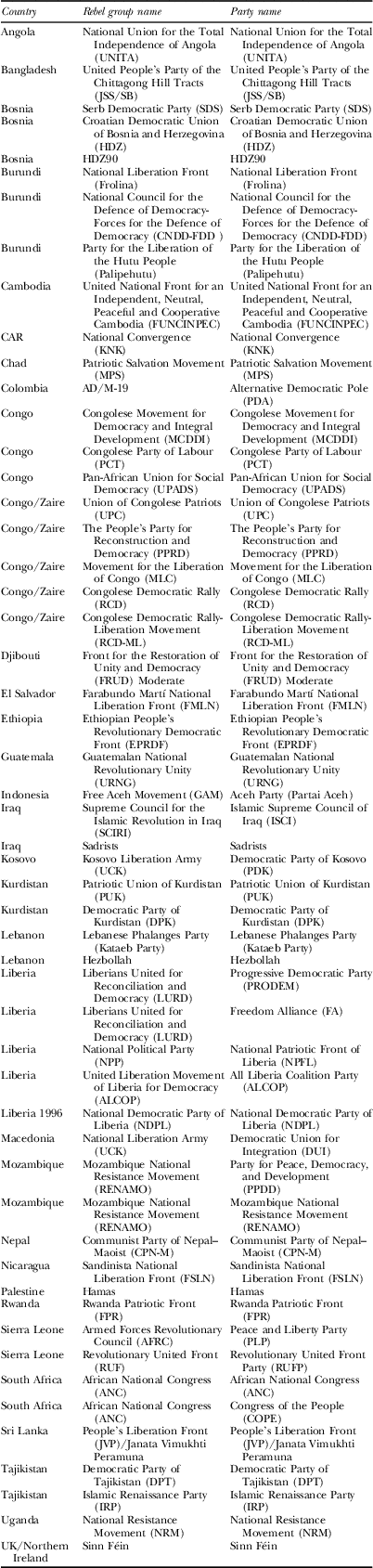
The data set used in this study is based on the list of rebel parties provided by Carrie Manning and Ian Smith (2016), with some modifications.Footnote 11 In their data set armed rebel groups that were anti-colonial liberation movements (such as the MPLA in Angola, Frelimo in Mozambique, etc.) were excluded from the data set. This left 50 parties across 30 countries. However, I was unable to find information of any kind on the MMD in Mozambique, and this case was deleted from the data for this article. In addition, since in many ways FRETILIN in Timor Leste and the HDZ in Croatia are similar to MPLA and FRELIMO in that they are national liberation movements that also successfully attained independence from a colonial power, they were deleted as well (to be consistent with the apparent Manning and Smith inclusion rule, who had explicitly excluded the liberation movements from the data set). However, the cases of the parties of Kosovo and Kurdistan were not deleted, because in neither case had full independence been attained. Further, I added the cases of FRUD (moderates) in Djibouti, RUF in Sierra Leone, and FROLINA and PALIPEHUTU-FNL in Burundi, which had been inexplicably not included in the original Manning and Smith list. All of these parties put up electoral lists for at least one legislative election between 1990 and 2013. This yielded 53 parties across 32 countries, and the list is provided in Table 1.
List of Rebel Political Parties

Analysis
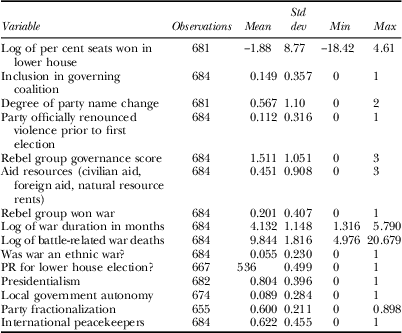
Table 2 lists descriptive statistics regarding the variables we employ in our analyses below.
Descriptive Statistics

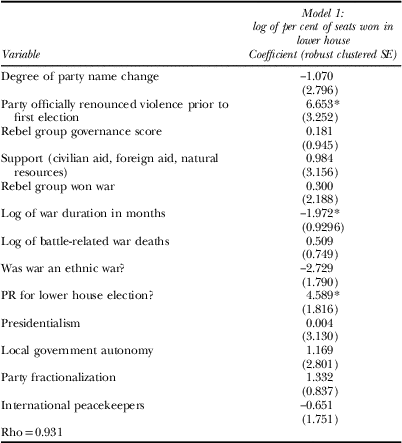
Table 3 reports the Prais–Winsten regression results with robust clustered standard errors by country (to take into account the nested effects of multiple parties per country). The Prais–Winsten estimation procedure is designed to deal with potential serial correlation of type AR(1). In a linear model this is likely when using panel data. We do this instead of using a lagged dependent variable in an OLS regression, which is often employed as a means of capturing dynamic effects and as a method for ridding the model of autocorrelation. However, as Luke Keele and Nathan Kelly (Reference Keele and Kelly2006) point out, this technique is fraught with problems. The use of a lagged dependent variable causes the coefficients for explanatory variables to be biased downward, because the first observation is dropped in a lagged model in a time series. Thus, the Prais–Winsten technique is generally preferable to the use of lagged dependent variables.
Prais–Winsten Estimation with Robust Clustered Standard Errors

Note: *=p<0.05; **=p<0.01; ***=p<0.001.
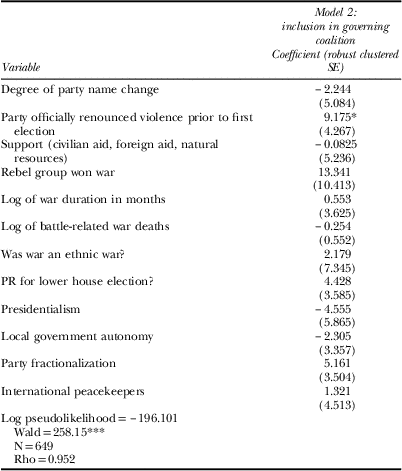
Turning to the results reported in Table 3, contrary to what we expected, parties that engaged in more significant name changes did not perform better in terms of seats won in the lower house of the legislature than parties that had not engaged in significant name changes (which does not support Hypothesis 1). In some ways, this is not particularly surprising, given that rebel parties engage in name changes for a variety of different reasons, not merely for electoral gain. As illustrated by the examples of FARC, PALIPEHUTU-FNL and the GAM/Partai Aceh parties above, some may engage in name changes for potential electoral gain, but others adopt name changes because of legal requirements for party registration, or to maintain the peace. Thus, name changes may not affect electoral gain (contrary to the way name changes are seen in the literature on Western parties) because they are not necessarily designed to do so in the first place. Further changing the party’s image did not increase the likelihood of the rebel party’s inclusion into the executive (contrary to Hypothesis 2).
These results call into question some of the party identity change literature that is prevalent in the study of Western political parties. This literature is premised on the assumption that parties are motivated to change their names and identities in order to reverse electoral loss and promote electoral gain. Clearly, there are many reasons why parties change their images, and this may not always have to do with the party responding to changes in the political environment.
However, renouncing violence does impact both the rebel party’s level of electoral success (Table 3) and its likelihood of inclusion into the executive (Table 4). Seemingly, parties that renounce violence are able to convince voters that they have no intention of returning to violence, and hence make them more credible to voters. This finding is consistent with the expectation expressed in Hypothesis 3 above. Changing identity in terms of ideological de-radicalization leads to better electoral performance on the part of rebel parties. Further, renouncing violence also appears to make the rebel party a more acceptable partner for inclusion in the executive coalition, a finding that supports Hypothesis 4.
TSCS Logit Results with Robust Clustered Standard Errors

Note: *=p<0.05; **=p<0.01; ***=p<0.001.
Regarding the control variables, none is significantly related (in either Table 3 or Table 4), statistically, to the dependent variable, save, unsurprisingly, the electoral systems variable for the electoral performance measured in terms of seat shares by rebel party. Further, the length of the previous war in months impacts electoral performance negatively. Given the negative sign of the coefficient, the longer the previous war, the less well the rebel party performs electorally. This may be because a war-weary electorate may hold the rebels accountable for seemingly never-ending conflicts, and thus punish the rebel parties. Interestingly, however, war intensity does not seem to have such an effect.
Regarding the other variables, neither the organizational nor the support variables (governance2 and Foreign Aid) were significantly related to the electoral performance of the rebel parties. Similarly, neither were the structure of opportunity variables (save for the electoral system variable as noted above). The results do not support the existence of a relationship between the ‘structure of opportunity’ variables and political success measured as the proportion in the national legislature won by the rebel party. In Table 4, none of the control variables is related to whether or not the rebel party is included in the governing coalition. Only whether the party renounced violence acted as a significant predictor of inclusion in the executive.
Conclusion
Although much of the extant literature on former rebel parties has focused mostly on transformation processes (and to some extent their post-war political success), scant work has examined the effects of identity change on the political success of former rebel parties. This article has suggested that party identity change – particularly where a rebel party explicitly rejects violence as a means to attain political objectives – or ‘de-radicalization’ significantly impacts that party’s electoral performance. In particular rebel parties that de-radicalize in this way are much more likely to be electorally successful, in terms of both seats won in the legislature and inclusion in the executive. This finding has important normative implications, especially that de-radicalized parties should be rewarded. Although I am not in a position to test this proposition, it would seem that electorally successful rebel parties are less likely to return to violence. Thus, providing incentives for rebel parties to de-radicalize may be one of the ‘best practices’ in the design of peace agreements.
However, as suggested by some earlier literature on rebel parties, this may be very difficult to do. As Ishiyama and Widmeier (Reference Ishiyama and Widmeier2013) and Ishiyama and Anna Batta (Reference Ishiyama and Batta2011) suggest (based on the logic of Tsebelis Reference Tsebelis1990), rebel parties, like all parties, are made up of different constituent groups, some of which comprise individuals who are attracted to the party because of their belief in the ‘revolutionary cause’ and others who are attracted to the organization’s banner because of personal ambition. For the former, compromising the ideology (including abandoning violence as a political tactic) would be considered a betrayal of revolutionary values. On the other hand, the latter would see this as a critical element in legitimizing the party and making it a credible political alternative to voters and potentially a partner for other parties. However, since the party leadership must balance the two (which amounts to a nested game) and maintain internal party harmony, this makes it very difficult to abandon ideological elements that may serve the party well in expanding its political appeal, but runs the risk of alienating a core constituency.
In sum, the above results are promising and suggest that understanding the process of identity change of rebel parties is a crucial part of the transformation of these parties from the use of ‘ballots to bullets’. This article thus intersects with other pieces in this special issue that examine both identity change and political success, and it helps bridge the research on rebel parties (which has largely been examined by conflict scholars) and the extensive literature and scholarship on political parties. There are of course a number of other potential topics regarding what explains the political success of the former rebel parties after a conflict ends (such as the key role played by party organization and the impact that past rebel organization has on political success) but such work is currently beyond the scope of this article.
Acknowledgements
I would like to thank the editors and the anonymous reviewers for their very helpful comments.