Clostridium difficile is a Gram-positive, anaerobic spore-forming bacillus that has the potential to infect humans and cause gastrointestinal disease ranging from acute, watery diarrhea to severe pseudomembranous colitis, hypotension, shock, and death.Reference Rupnik, Wilcox and Gerding 1 , Reference Koo, Garey and DuPont 2 Symptomatic Clostridium difficile infections (CDIs) are associated with excess healthcare utilization including hospitalization and prolonged hospital stay, increased healthcare costs, and increased risk for adverse outcomes.Reference Kelly and LaMont 3 Recent studies have documented significant morbidity and mortality due to CDI as well as increasing incidence.Reference Dubberke and Olsen 4 , 5 As a result, awareness of the magnitude and the potential threat of CDI has been growing.
In the Veterans Health Administration (VHA) system, individual studies focusing on unique aspects of CDI have been conducted,Reference Kyne, Warny, Qamar and Kelly 6 , Reference McFarland, Mulligan, Kwok and Stamm 7 but a comprehensive and up-to-date epidemiological study of CDI for the entire VHA is lacking. With this report, we aimed to fill that gap by studying CDI in both inpatient and outpatient settings with data collected through the VHA electronic medical records (EMR) system.
METHODS
We conducted a retrospective cohort study among VHA patients 18 years of age or older between January 1, 2009, and December 31, 2013.
Description of the VHA Population and Databases
The VHA of the Department of Veterans Affairs (VA) is the single largest integrated healthcare system in the United States; it provides comprehensive services to military veterans. During our study period, the VHA provided care in 152 hospitals, 135 long-term care facilities (LTCFs), and 820 community-based outpatient clinics. The VHA has an integrated and unified EMR system that contains information about inpatient and outpatient visits. This data system includes procedures, surgeries and diagnoses, inpatient and outpatient pharmacy utilization, laboratory results, extended care, vital signs, healthcare-related survey data and mortality for all persons treated within the VHA. Each patient is assigned a unique identification number that allows longitudinal follow-up.
Identification of CDI
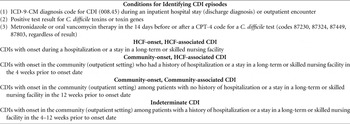
We identified CDI episodes from January 1, 2009, through December 31, 2013, using the following criteria: (1) ICD-9-CM diagnosis code for CDI (008.45) during an inpatient hospital stay (discharge diagnosis) or outpatient encounter; (2) positive test result for C. difficile toxins or toxin genes; or (3) metronidazole or oral vancomycin therapy in the 14 days before or after a CPT-4 code for a C. difficile test (codes 87230, 87324, 87449, 87803, regardless of result).
To identify only new incident episodes of CDI, we excluded episodes if the patient had had a CDI in the previous 84 days.Reference Riggs, Sethi, Zabarsky, Eckstein, Jump and Donskey 8 We used this washout period to minimize misclassification caused by carrying forward the ICD-9-CM diagnosis code for CDI during subsequent non-CDI clinical encounters.
Date of CDI Onset and Identification
The date of onset of CDI was defined as the date corresponding to the first recorded indication of CDI, as described above (ie, diagnosis, laboratory test, or treatment), unless additional information was available to define an earlier date as the date of onset. If a CDI toxin test was performed, the date of the first positive test was used as the date of CDI onset.
Onset Location and Attribution of CDI
We determined the location of onset and attribution for each CDI episode using an algorithm based on the most recent guideline definitions from the Society for Healthcare Epidemiology of America (SHEA) and the Infectious Diseases Society of America (IDSA).Reference Armbruster and Goldkind 9 These categories included (1) healthcare facility (HCF)-onset, HCF-associated CDI; (2) community-onset, HCF-associated CDI; (3) community-associated CDI; and (4) indeterminate. (Expanded definitions are included in Appendix A.)
Calculation of CDI Incidence
In any given year, the VHA has ~9 million enrollees, but only ~6 million have an outpatient or inpatient visit. To calculate the denominator, we counted the number of enrollees who had any inpatient or outpatient encounter in a single year because access to VHA patient medical information is contingent upon receipt of healthcare. Multiple outpatient encounters on the same day were counted as 1 visit. Same-day transfers within or between hospitals were collapsed to a single inpatient encounter (while retaining all relevant information from the collapsed records) to avoid overcounting hospitalizations. We compared incidence rates using a Poisson model. The χ2 test was used to compare proportions and prevalence; the Mann-Whitney test was used to compare continuous variables; and the rank-sum test was used to compare medians. SAS version 9.4 (SAS Institute) was used for data management and analysis.
Institutional Review Board Approval
Approval from the Dartmouth Institutional Review Board was obtained to conduct this research.
RESULTS
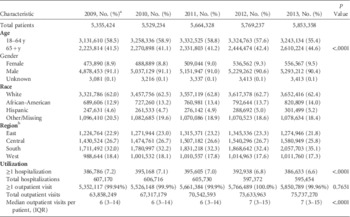
During the study period, the number of patients who had at least 1 inpatient or outpatient visit to a VHA facility rose from 5,355,424 patients in 2009 to 5,853,358 patients in 2013, and increase of 9.8% (Table 1). The proportion of VHA patients aged 65 or older also increased during that time from 41.5% in 2009 to 44.6% in 2013 (P<.0001). The female population increased from 8.9% to 9.5% (P<.0001), and the percentage of the total VHA population that was African-American rose from 12.9% to 14.0% (P<.0001).
Demographics and Healthcare Utilization in the Veterans Healthcare Administration

NOTE. IQR, interquartile range.
a Data were analyzed by and presented in calendar years.
b West: AK, AZ, CA, CO, HI, ID, MT, NM, NV, OR, UT, WA, WY; Central: AR, IA, IL, KS, LA, MN, MO, ND, NE, OK, SD, TX, WI; South: AL, Washington DC, FL, GA, KY, MS, NC, PR, SC, TN, VA, WV; East: CT, DE, IN, MA, MD, ME, MI, NH, NJ, NY, OH, PA, RI, VT.
The number of patients with ≥1 hospitalization at the VHA was essentially unchanged over the study time period (386,786 patients in 2009 vs 386,333 in 2013). The total number of outpatient visits rose from 63,858,249 visits in 2009 to 75,737,270 in 2013, an increase of 18.6% (Table 1). Additionally, the median number of outpatient visits per patient in the outpatient population rose from 6 in 2009 to 7 in 2013 (Table 1, P<.0001).
Trends in Overall CDI Incidence
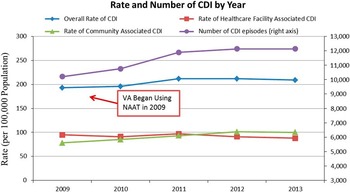
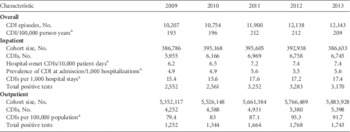
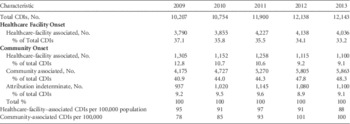
A total of 10,207 CDI episodes were recorded in 2009. The number of CDI cases increased through 2012 (12,138 CDI episodes) and leveled off from 2012 to 2013 (12,143 CDI episodes) (Figure 1; Table 2). These numbers represent an increase of 19.0% over the entire study period that was mainly driven by the 17% increase between 2009 and 2011 (Table 2).
Rate and number of CDIs by year.

Clostridium difficile Infection (CDI) Episodes by Type and Year

aChanges in these rates from 2009 to 2013 were statistically significant (P<.001).
The overall rates of CDI episodes per 100,000 patient years increased over the study years 2009–2013 by 8.3% (from 193 to 209). The rate stabilized between 2011 and 2012, and despite the increase in absolute cases of CDI between 2012 and 2013, the CDI rate across the population slightly decreased (Table 2).
Of the CDI episodes identified in 2009, 58% (n=5,955) were identified during a hospitalization, while the remaining 42% (n=4,252) were identified in the outpatient setting. The distribution was relatively similar in 2013 (Table 2). The rate of hospital onset CDI episodes increased from 6.2 per 10,000 inpatient days in 2009 to 7.4 per 10,000 inpatient days in 2013, an increase of 20% (P<.0001). In 2009, outpatient CDI episodes occurred at a rate of 79.4 per 100,000 patients years, and this rate was 91.7 per 100,000 patient years in 2013, an increase of 15% (P<.0001, Table 2). From 2010 to 2011, the incidence of CDI episodes overall increased by 8% (from 196 to 212 CDI episodes per 100,000 person years), compared to an increase of 2% from 2009 to 2010 (Table 2). This is particularly notable for hospital-onset CDI, for which the CDI incidence increased by 11.4% between 2010 and 2011, compared to a 5.5% increase between 2009 and 2010 (Table 2).
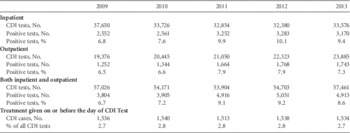
Changes in CDI testing practices offer a plausible explanation. We found that the number of positive tests increased significantly from 2010 to 2011 (16%) and then remained steady. Specifically, across calendar years 2009–2013, the percentages of all CDI episodes that had a positive CDI test were 37.5% (2009), 36.6% (2010), 41.6% (2011), 42.0% (2012), and 41.0% (2013), with a single large increase between 2010 and 2011, when there was a relative percentage increase of 13.7% (P<.001). We also studied the volume of CDI tests conducted and test results (Table 3). We found an increase in positive test rates, as expected, with the nucleic acid amplification tests (NAATs) in both inpatient and outpatient settings, as well as an increase in the number of tests performed in the outpatient setting. Overall, there was a decrease in the number of CDI tests between 2010 and 2012, although the proportion of tests with positive results increased. The positive test rate then decreased in 2013, probably as a result of the overall increase in the number of tests performed. It appears that NAAT conversion might have added ~1,000 new cases of CDI per year. Interestingly, the number and proportion of patients (from the total number of tests) who were suspected of having CDI and who were started on CDI treatment (eg, metronidazole or oral vancomycin) prior to the receipt of test results remained relatively stable (Table 3).
The prevalence of CDI in the inpatient setting, based on diagnosis and treatment only, and not counting positive tests, remained steady in the 5-year span of the study period. In contrast, the prevalence of CDI in the outpatient setting, based on diagnosis and treatment only, rose 15% from a rate of 78 per 100,000 persons in 2009 to a rate of 90 per 100,000 persons in 2013, mostly due to the rising number of community-associated CDIs among the VHA population.
Trends in CDI by Location of Onset and Attribution
We observed some changes in the setting to which CDI were attributed over the study period. The proportion of CDI episodes defined as being community-onset was ~64%, while the proportion of CDI episodes defined as being healthcare-facility-onset was ~36% (Table 4). Within the community-onset episodes, the proportion attributed to healthcare facilities, whether hospital or long-term care facility, decreased from 12.8% of all CDIs in 2009 to 9.1% in 2013. Conversely, the proportion of community-onset CDI episodes determined to be community-associated rose during this time period, from 40.9% in 2009 to 48.3% in 2013, a relative change of 18% (P<.001) (Table 3).
Clostridium difficile Infection Tests and Percent of Positive Tests

Clostridium difficile Infections by Year, Overall Number, Location of Onset, and Attribution

DISCUSSION
We conducted a retrospective cohort study to determine the incidence of CDI among VHA patients receiving care in the inpatient and outpatient settings. We observed a sharp increase in CDI episodes in the VHA from 2010 to 2011 that leveled off in 2012 and 2013 (Figure 1). We believe this could be attributed to the adoption of the more sensitive NAAT by the VHA because as the testing density (ie, the number of CDI tests per visit) remained stable throughout the study period. We also observed that the proportion of CDI episodes with onset and acquisition in the community setting rose during this time period (Figure 1).
Evans et alReference Evans 19 recently published a study of CDI in VHA acute care facilities, based on self-reported inpatient data from October 2010 through June 2012. Despite the use of different methods, we found similar inpatient rates. For instance, in the study by Evans et al, the pooled CDI admission prevalence rate was 0.66 cases per 100 admissions, whereas ours was 0.55 cases per 100 admissions (Table 2). Data regarding where CDI onset occurred and where C. difficile was acquired were also similar. Of their CDI admissions, Evans et al estimated those community-onset not-healthcare-facility-associated (CO-not HCFA) cases to make up ~53%, whereas our numbers suggest this rate could be as high as 57% (Table 4). Evans et al estimated that the community-onset healthcare facility–associated (CO-HCFA) cases made up ~21% of total CDI admissions, whereas our results indicated that this rate was ~15%. We believe the differences could be attributed to our use of complete EMR data rather than self-reporting.
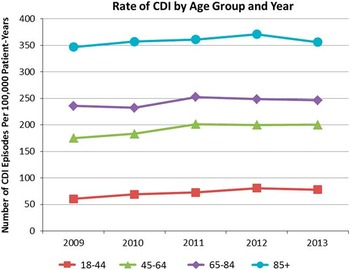
We observed a sharp increase in CDI episodes in the VHA from 2010 to 2011 that leveled off in 2012 and 2013. To expand upon our results, we conducted a sensitivity analysis that included CDI rates in 2008. We found similar rates between 2008 and 2010, suggesting that the surge we detected in 2010 and 2011 may have been due to exogenous factors. Additional analyses of CDI rates by age groups over the same period displayed the same pattern (Figure 2). We believe that the increase identified in our study could be attributed to the wider adoption of NAAT by the VHA. This hypothesis was supported by Evans et al, who reported that ~32% of facility clinical laboratories used NAAT in 2010. By 2012, 54% of VHA clinical laboratories used NAAT. Collectively, although limited to the VHA population and to data from 2009 to 2013, our findings suggest that, in the VHA, the dramatic rise in CDI incidence between 2000 and 2009 5 has somewhat abated despite the introduction of significantly more sensitive testing.Reference Jump, Olds and Jury 10 While the yearly number of CDIs continues to increase, the magnitude of this increase is currently not as dramatic as it has been in past years. In contrast, onset locations displayed little change over the study period, and this variable is not affected by testing methods. Furthermore, we observed a slight upward trend for outpatient CDI that deserves continued monitored because this trend could significantly change the VHA’s strategies to reduce the transmission of CDI.
CDI rates by age group and year.

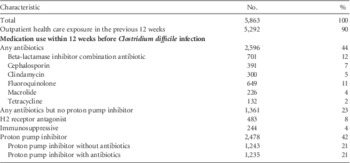
We looked closely at community-associated CDI cases using our most recent data (2013, Table 5). Similar to the finding of Chitnis et al,Reference Chitnis, Holzbauer and Belflower 21 90% of these cases had outpatient healthcare exposure in the 12-week period before their infection. The rate of exposure to antibiotics among CDI patients was higher in the study by Chitnis et al than in our study, 56% vs 44%, respectively. This result might be related to the low number of females in our population (<10%); 67% of the cohort studied by Chitnis et al were female. However, in our study, proton pump inhibitor use was almost as frequent as antibiotics (Table 5).
Clinical Characteristics among Patients with Community-Associated Clostridium difficile Infection, 2013

A number of potential limitations and factors should be considered when interpreting the results of our study. First, the specific definitions of CDI used in this study have not been validated through medical chart review. However, the ICD-9 code for C. difficile infection was shown to have sufficient sensitivity and specificity.Reference Bajaj, Ratliff, Heuman and Lapane 11 The additional use of positive C. difficile tests and treatment accompanying receipt of a test was based on clinical grounds and on usual practices employed in the diagnosis and treatment of patients with CDI at VHA facilities. Second, we had limited data regarding factors that could confound our results and explain the stabilization of CDI rates, such as changes in antibiotic use and infection control practices. However, the data available to us showed stable azithromycin and amoxicillin use over this time period. The VHA did successfully implement a methicillin-resistant Staphylococcus aureus (MRSA) bundle around the study period (2007–2010). Jain et alReference Jain, Kralovic and Evans 23 found a decline in healthcare-associated CDI in a limited number of non-ICU patients, with no significant change noted in ICU patients.Reference Huttner, Jones and Rubin 12 Thus, it does not appear that these factors contributed to an increase in the rate of CDI.
The VHA population is predominantly male, with men accounting for 93% of the inpatient population in 2012. More notably with regard to CDI risk, 50% of the 2012 inpatient population was age 65 or over, and 9% of the inpatient population was over the age of 85; both of these age groups are at greater risk for CDI. Furthermore, the VHA system employs its own policies, practices, and guidelines and functions relatively independently of other healthcare systems in the United States. Thus, our findings based on a veteran patient population cared for within an independent healthcare system may not be directly translatable to other populations and settings. However, the incidence rates we report as well as their distribution based on location of onset and acquisitions appear to be within the range based on the newly released data from Emerging Infections Program (EIP) of the Centers for Disease Control and Prevention.Reference McFarland, Clarridge, Beneda and Raugi 13
This is the largest study utilizing EMR data to describe the evolution of the CDI epidemiology at VHA over several years. The age demographics of the VHA population highlight the need for understanding the trends and epidemiology of CDI in this population. As the VHA continues to adopt more sensitive testing methods, the epidemiology of CDI in VHA is changing; however, the major effect of this diagnostic change may already have occurred. Our results should establish a new base rate by which to measure the effect of new CDI infection control measures currently being employed in VHA. Overall, despite an aging population with greater burden of comorbidity, our data show that VHA inpatient CDI rates stabilized between 2011 and 2013. In contrast, an area of concern is the noticeable rise in outpatient CDI rates, particularly of community-onset and/or community-associated cases. More studies are needed to identify patient groups at high risk for CDI and to develop effective and cost-efficient policies and procedures to combat CDI and improve the health of veterans.
Acknowledgments
The authors thank Drs. Clarisse Demont and Christian Felter for their careful review of the manuscript.
Financial support: This research was supported by an unrestricted research grant from Sanofi-Pasteur, Lyon, France.
Potential conflicts of interest: Dr. Young-Xu reports personal fees from Sanofi-Pasteur during the study and personal fees from Sanofi-Pasteur outside the submitted work. Dr. Gerding holds patents for the treatment and prevention of CDI licensed to ViroPharma/Shire. He is a consultant for Merck, Shire, Cubist, Rebiotix, Sanofi-Pasteur, Pfizer, and Actelion, and he holds research grants from Seres Health, GOJO, the Centers for Disease Control and Prevention, and the US Department of Veterans Affairs Research Service. Dr. Dubberke reports grants and personal fees from Sanofi-Pasteur during the study as well as grants from Microdermis and personal and/or other remunerations from Cubist, Merck, and Rebiotix outside the submitted work. Dr. Olsen reports grants from Sanofi-Pasteur during the study, as well as personal fees from Sanofi-Pasteur and Pfizer and grants from Cubist Pharmaceuticals outside the submitted work. Dr. Kelly reports personal fees outside the submitted work from Astellas, Cubist Pharmaceuticals, Novartis, MedImmune, Merck and QuantiaMed; grants and personal fees from Sanofi-Pasteur and Optimer; and grants from CSL-Behring and Merck. In addition, Dr. Kelly has a patent pending for passive immunotherapy for CDI using IgA. Dr. Mahé is an employee of Sanofi-Pasteur.
Appendix A. CDI Definitions