Grotesques are born out of eggs as out of people.
“The Triumph of the Egg,” Sherwood Anderson, 1920On 11 December 1912, Philadelphians encountered an extraordinary sight in their city's streets. Groups of prominent society women—“famous beauties and matrons … known all over the continent”—were selling eggs all over town. These eggs differed from those we buy today in that most had been in storage since April. Housewives nonetheless flocked to buy them, because they cost only 24 cents a dozen, much less than other April eggs. The sellers, themselves members of the Housekeepers' League, claimed they would not make money off the “hen fruit” that they had bought by the carload, but neither would they lose it. Rather, they aimed to break a commercial corner on eggs that, they claimed, fostered unfair and deceptive trade practices. In particular, they wanted to stop merchants from charging “strictly fresh” prices for what were in fact refrigerated eggs.Footnote 1
The Philadelphia ladies were not alone. Within days, the Housewives' League in New York City and the Clean Food Club in Chicago launched their own trust-busting egg crusades. The following year, a Boston women's group used chain mail to wage an egg boycott, which the press called “a modern counterpart of the famous tea party.”Footnote 2 All these protests coincided with a period of extraordinarily high inflation in both the United States and Europe. As the cost of provisions rose, so did consumers' suspicions of the industries that produced, distributed, and stored them. Controversies surrounding cold-storage eggs, however, began well before the inflationary boom, and lasted long afterwards. They reflected widespread popular distrust of a technology that was supposed to make the urban food supply cheaper, safer, and more varied, but that also raised troubling questions about when and which foods were truly fresh.
At a time when globalization and new food technologies have provoked similar concerns, the cold-storage egg controversies merit attention for at least three reasons. First, they help to illustrate how much the very meaning of “freshness” has varied over time and place, and matters more in some foods than others. Eggs alone do not tell the whole story of freshness, but their history reveals some quite radical shifts in how this taken-for-granted quality is produced and preserved. Second, these controversies show that meanings of freshness are often fuzzy, contradictory, and never just about food. Rather, societies' norms and practices surrounding fresh food reflect much broader ideas about their place in the natural world, and about how, through technology and social relations, they should mediate its perils and penuries. Lastly, these controversies and their eventual resolution illuminate the moral quandaries accompanying the making of modern food supply. At a time when the industrialized world's consumers enjoyed generally cheaper, cleaner, and more varied provisions than previous generations, refrigeration provoked both dishonesty and distrust, especially when applied to eggs. Farmers ultimately found the solution, and hens paid the price.Footnote 3
PERISHABILITY AND MARKET POWER
During the period between 1850 and roughly 1930, most Western nations made great progress in feeding their cities. Some of the progress owed to increasing grain, livestock, and fruit production, especially in the Americas, and to the rail and shipping lines that carried settler farmers westward and their harvests back east. Some progress was due to the passage of anti-adulteration laws, and some to the rise of large branded food companies that profited from the marketing of food purity. Some owed to the agricultural output of tropical colonies, which helped bring former luxuries—coffee and tea, sugar and chocolate, bananas and pineapples—into the budgets and diets of the working and middle classes. And much progress, of course, came from advances in food preservation through both heat and cold. All this has been well documented.Footnote 4 Less explored is how some of the technologies and trades that most contributed to the feeding of modern industrial society—namely by increasing the variety of fresh foods available and affordable year-round—were also the most contested. In particular, urban consumers doubted the durable freshness brought to them via refrigerated railcars, steamers, and warehouses.
Their attitudes contrasted sharply with the quasi-utopian optimism of refrigeration's early boosters. Among them was Charles Tellier, the French inventor of the basic compressed gas chilling method used today.Footnote 5 Like the many other engineers and scientists who experimented with mechanical cold during the second half of the nineteenth century, Tellier believed that refrigeration would allow for the “rational” reorganization of the global fresh food supply, away from crowded urban hinterlands and toward regions where land was abundant and labor cheap. It would encourage increased production, and eradicate gluts, waste, and want. Above all, refrigeration would improve workers' productivity and soldiers' fighting spirit, by making available not just more but better, fresher food. Fresh red meat was a top priority, since it was considered the ideal strength-building nutrient, and far more palatable and wholesome than either salted or canned meats.Footnote 6 But refrigeration's advocates saw many ways it could improve the human diet. “By slowing down time's destructive work,” Tellier once said, “le froid increases the power and resources of Man.”Footnote 7
Tellier had such confidence in his invention that he raised money to have it installed on a British steamer, which in 1877 he re-christened Le Frigorifique and sailed to Uruguay and back, loaded with chilled beef. After an on-board banquet in Montevideo, the South American press reported on the fine quality of the month-old meat. “The problem has found its solution,” one newspaper proclaimed. The problem, of course, was the sheer distance that had previously prevented the South Americans from selling their own fresh meat to the markets that most hungered for it.Footnote 8
Tellier's compatriots, however, saw things differently. They greeted the arrival of chilled South American meat with alarm, protest, and then hygiene laws strict enough to all but shut down the trade for the next quarter century. France's continental neighbors reacted similarly. Much of the outcry came, not surprisingly, from livestock farmers concerned about preserving their markets.Footnote 9 But refrigerated foods also encountered opposition in cities; the first Parisian fruit wholesaler to build a cold-storage chamber, for example, upset his customers so much that he had to tear it down.Footnote 10
In London, then the world's biggest market for all kinds of imported, refrigerated foods, consumers harbored similar doubts. Rumors circulated that cold-storage products caused cancer and appendicitis.Footnote 11 Even early-twentieth-century Americans objected to refrigeration in certain forms, even though they had been buying iceboxes for decades, supporting a thriving New England ice-harvesting industry.Footnote 12 In fact, peoples throughout the non-tropical world had long used cold to preserve food at home, whether that meant putting it in a well, a root cellar, or a snow bank.Footnote 13 So why did cold-preserved foods in the market encounter such opposition? I will argue that the most common concern was not the safety of either the technology itself (though early mechanical refrigeration was prone to explosions, gas leaks, and ruinous temperature variations) or the food it touched (though this, too, was sometimes questionable).Footnote 14 Rather, the root problem was who controlled both the technology and the food, and the scale and scope of their control.
This was an era when people worried about the expanding scope and scale of many kinds of economic enterprise, especially if it threatened their own livelihoods.Footnote 15 But again, popular opposition to refrigeration—and in particular, to commercial cold storage—was rather more complicated. It did not simply reflect generalized concerns about the corporations that increasingly controlled local markets, but also resistance to the market's conquest of a vital food quality. “Vital” here means both containing biological life (and thus subject to ripening and decay) and crucial to certain aspects of human life, social as well as physiological. These days we consider fresh foods vital to a healthy life insofar as they contain nutrients, fiber, and minimal “empty” calories. So we consider them worth eating every day and almost everywhere, whether in the form of a home-prepared family meal or, increasingly, a solitary on-the-road snack.Footnote 16
In the days before scientific nutrition and germ theory, the perceived healthfulness of fresh foods depended much more on context; consumed out of season or out of place, they might sicken or even kill. Somewhat paradoxically, however, fresh foods' seasonal and unstable nature also made them vital to the social life of many pre-industrial peoples, whether they fished in the Pacific Northwest, farmed in middle Europe, or hunted in the Kalahari.Footnote 17 One could say that the very ephemerality of these foods helped societies endure. Seasonal feasts celebrated more than good harvests and hunts, and nourished more than the bodies of the feasters. As forms of redistribution, they recognized and reinforced patron-client relations.Footnote 18 Perishability also strengthened the bonds of kin and community, for it imposed temporal rhythms and geographic boundaries on food exchange in as well as beyond the market. People had to come together regularly both to share meals and to buy and sell the ingredients.Footnote 19
The sociability of marketplace exchange, in particular, was not just mandated but also mediated by food's seasonality and perishability. A large anthropological literature shows how fresh produce traders across the world have traditionally coped with the volatile and unpredictable nature of their goods by cultivating the trust and loyalty of both suppliers and customers.Footnote 20 Less well-documented is how perishability has shaped relations between trader and traded as much as between seller and buyer. These two kinds of relationships are intimately linked. In other words, to the extent that a foodstuff's natural perishability limits farmers' and merchants' ability to wait or search for more lucrative markets, it also limits their bargaining power vis-à-vis customers. For the consumer, this check on the seller's power historically provided some assurance of a fair price for the expected quality, quality that depended at least partly on the product's freshness. When consumers could not immediately confirm this quality by sight or smell (as in the case of eggs) they had to trust the seller. But again, the seller of such perishable foods would likely be local or at least familiar,Footnote 21 and would not want to spoil a reputation by selling spoiled goods.
These generalizations about “traditional” market relations do not imply that such relations assured either food quality or transparent trade in any general way. On the contrary, in the mid-to-late nineteenth century—the period preceding refrigeration's spread, and thus the reference point for consumer nostalgia—the industrialized world's urban food supplies suffered from rampant adulteration, fraud, filth, and spoilage.Footnote 22 The point here is that refrigeration profoundly threatened the norms, practices and social relationships making up the moral economy of the perishable marketplace.Footnote 23 The inventor Charles Tellier died in poverty not because he overestimated refrigeration's revolutionary potential, but rather the reverse. Its very capacity to “slow down time's destructive work,” as he put it, gave those who controlled the technology greater power over both their goods and their clients.
The first to realize refrigeration's potential were the Chicago meatpackers. Led by the ambitious Gustavus Swift, they invested in its development and transcontinental dissemination, building some of the world's first modern corporations.Footnote 24 Their chilled slaughterhouses and railcars enabled them to produce and ship what was then known as “dead meat” on an unprecedented scale, and with unparalleled efficiency. Quickly conquering markets once supplied by live-cattle shippers and local butchers, they soon diversified beyond meat. Armour, for example, became one of the United States' biggest fruit packers, and later one of its biggest vegetable shippers. They were also major dealers in butter and eggs.Footnote 25
Yet refrigeration could not do everything for the packers. While it helped change popular ideas about what fresh meat should look like and where it could come from, it provided little shelter against the accusations of the anti-trust and pure-food campaigners.Footnote 26 These accusations proliferated in the early years of the twentieth century, and they were not directed only at the meatpackers and their meat. In some ways, cold-storage eggs became even more controversial commodities. They set off debates that were nominally about laws and labels, yet fundamentally about the meaning of freshness, and about who could be trusted to protect it. Both the debates themselves and their ultimate resolution provide new insights into what went into the creation of a perennially fresh food supply.
THE SPRING CROP
These days few people realize that the egg was once a seasonal crop. Acutely sensitive to changes in daylight and temperature, hens (at least those in the world's non-tropical zones) laid most of their eggs during the springtime. Egg quality as well as quantity dropped off in the summer as hens rested and molted. “Broody” hen varieties stopped laying altogether, instead seeking to sit on the eggs they had already laid. Except for the rare “everlasting layers”—varieties who could lay through the winter if well-fed and housedFootnote 27—most hens' output picked up again only in late winter, when their pituitary glands produced more of the hormones needed for egg maturation.
This seasonality made perfect evolutionary sense, because chicks hatched in fall or winter were least likely to survive. Culturally, the reappearance of eggs in a hen's nest signaled “as surely as buds swelling on trees” that winter would soon end.Footnote 28 It also marked the beginning of a season when people celebrated Easter and other spring holidays by eating, painting, rolling, and otherwise reveling in eggs. Not only did they symbolize rebirth and fertility; eggs were also “sweeter” and far more abundant than they would be any other time of the year. In the mid-nineteenth century, for example, New York City received seventy-two times more eggs in May than it did in January.Footnote 29 Prices varied accordingly, and, depending on the month and region, off-season eggs might easily cost three times as much as spring eggs.Footnote 30
In North America as in much of the egg-eating world, newly laid eggs were a rare luxury during the fall and winter. Yet rather than give up eggs altogether during those seasons, people found ways to store them. Not to be confused with preserved eggs (i.e., the pickled kind found in English pubs, or China's “ancient” salt-preserved varieties), home-stored eggs were by some accounts “just as good” as fresh, even after two years. The basic objective was to seal the shell and thus protect the egg against dehydration (which leads to shrinkage and staleness) and bacterial and fungal invasion (which leads to full-on spoilage). One of the most common preservation mediums was a sodium silicate solution known as “glass-water.”Footnote 31 Coating them with varnish or butter and then burying them in barrels of salt, bran, or oats also did the trick.Footnote 32 For just a few weeks of storage, The Book of Poultry recommended putting eggs “in a cool but not very cold place—about 50 to 60 degrees is best—and with the large end down.”Footnote 33
Because eggs were both seasonal and storable, they became long-distance trade commodities long before the advent of refrigeration. By the 1840s, when England became a major importer of eggs from Ireland and France, China's coastal egg trade was centuries old.Footnote 34 In the United States, however, most egg marketing was local and small-scale. Even in the early years of the twentieth century, an estimated 90 percent of eggs came from family farms. “The flocks usually consist of 100–300 fowls which range freely,” said one report, “little attention is paid to feeding… . The work connected with the fowls is done by women and children, and poultry is usually regarded as a source of pin money for the housewife. Marketing of eggs is through the general store or the traveling huckster.”Footnote 35
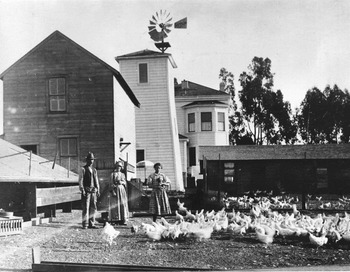
At the same time, however, expanding rail networks encouraged regional and local specialization. Chicken-rich counties in Illinois and Ohio competed with New Jersey and Long Island egg producers for shares of the New York market. In temperate central California, Petaluma became “the egg basket of the world,” and one of the state's richest towns in the early twentieth century (see Figure 1).Footnote 36 Millions of its eggs traveled to New York, as well as to western cities from Los Angeles to Fairbanks.Footnote 37
A Petaluma chicken farm, ca. 1910, photographer unknown. Courtesy of the Petaluma Historical Society.

In all these cities, most of the eggs arrived in springtime, and many went into storage. The first refrigerated warehouses were built in the 1860s. Chilled by ice and insulated with sawdust, they served primarily to store fruit, which did not require particularly cold temperatures. But as demand for perishables increased, cold storage became an industry in its own right. Temperature control improved with better insulation, and then in the 1890s with the gradual replacement of ice by mechanical refrigeration.Footnote 38
By 1904, the United States had more than six hundred cold-storage warehouses, most of them urban and many of them several stories tall. With a combined capacity of more than 102 million cubic feet, they held staggering quantities of food. Boston's Quincy Market Cold Storage Company had room for 150 million eggs at a time.Footnote 39 In addition, meatpackers, breweries, dairies, and fruit wholesalers were quickly building millions more cubic feet of refrigerated storage space, also mostly in urban areas. No other country—not even import-dependent Britain—had comparable facilities.Footnote 40 European refrigeration engineers marveled at the speed with which the United States had built a nationwide network of “industrial cold,” and at the variety of fresh, seasonal foods stored and sold year-round in East Coast cities.Footnote 41
COLD STORAGE CONTROVERSIES
What we are interested in when we buy eggs is whether they are good or not, and if it is a good egg its past history should be of no importance.
O. C. Mackay, President, Cold Storage Division of the American Warehousemen's Association, 1930Footnote 42The American people did not share the foreign engineers' enthusiasm for industrial cold. This was despite the fact that many of them owned kitchen iceboxes, and patronized grocers, butchers, and fishmongers who also used ice. Indeed, in their appetite for ice, Americans had long ago established themselves as the “first refrigerated nation.”Footnote 43 But the warehouses were different. Not only did they store fresh food for much longer periods than domestic iceboxes—perhaps longer than it was meant to be stored—they also gave middlemen unprecedented control over the supply, price, and quality of that food. These were distinct concerns, but often conflated.
People had good reason to doubt early cold storage, simply because it often did not work very well. Ice-chilled warehouses were difficult to keep at a stable temperature and humidity. They also lacked adequate air circulation, so goods might freeze in one corner and spoil in another.Footnote 44 While mechanical refrigeration facilitated temperature control, many merchants and warehousemen did not know which temperatures to use for different foodstuffs. Nor did they know how to keep them from developing a telltale “storage taste.” Merchants bore the cost of obviously spoiled food, such as moldy meat, but sometimes they just marked down prices. At Boston's Quincy Market in 1900, egg dealers had to discount stocks found to have a “fruity flavor,” most likely absorbed from apples in the next chamber. They reassured shoppers that this was “not a novel occurrence” and that the eggs were still fine for cooking.Footnote 45 The storage goods that sowed the most distrust, however, were those that consumers discovered were not fine only after they bought them, such as rotten eggs, mushy fruit, and frozen beef that spoiled as it thawed. Stories of these unfortunate purchases circulated long after refrigeration as a technology had greatly improved.
So did theories about the health dangers of cold storage. Early on, they focused on refrigerated beef, which was alternately accused of causing cholera, cancer, and appendicitis.Footnote 46 Again, the newness of the technology meant that experts did not really know what happened to food that spent months under its influence. They contributed to the kind of hearsay that one letter writer to the New York Times reported in 1906: “The writer has just returned from a seaside resort, where he found among the visitors as well as the residents annoying illness was the rule rather than the exception … the two physicians I consulted expressed the opinion that while weather conditions were responsible for some of these troubles, they thought cold storage, artificially preserved, and low-grade articles of food were responsible for their share of it. This bears out the opinion of the writer… .”Footnote 47
In 1906, shortly after the passage of the Pure Food and Drug Act, the Department of Agriculture's Food Chemistry Bureau undertook one of the first systematic epidemiological investigations of cold-stored foodstuffs. The findings were mixed. Dr. Harvey Wiley, the Bureau's chief and a self-proclaimed champion of cold storage, reported that some foods, namely meat and fruit, actually benefited from up to three months in a warehouse. Milk, cream, and eggs, on the other hand, all deteriorated “immediately” in storage.Footnote 48 A few years later expert opinion shifted. A Massachusetts study declared that properly stored foods, including eggs, were perfectly safe and wholesome, and could stay that way for nine months or longer. The Journal of the American Medical Association agreed: “the charge that cold storage in general is detrimental to public health is refuted by an impartial examination of this subject in hygienic aspects.”Footnote 49
But what happened when intermediaries used cold storage to hide improper trade practices? Here the public had more reason to worry. In the early years, merchants routinely stored goods that were already going bad, such as meat or fish that had spent all day in an exposed market stall. Cases of eggs went directly from the railcar to the warehouse without candling to check for rot or staleness.Footnote 50 Then retailers retrieved them in the “blind faith,” as one Department of Agriculture report put it, “that some magic property of cold storage had made good eggs of all the bad eggs, or else accepted the situation as one for which they were not responsible and which they could not remedy.”Footnote 51 Warehousemen indirectly encouraged these practices by offering easy credit to their clients and asking few questions.Footnote 52
In other words, cold storage was easy to use, and to abuse. In retail markets where neither shopkeepers nor their customers could assess freshness according to traditional measures (i.e., according to the season and the reputation of the farmer) cold storage itself took the blame. As a result, off-season eggs marketed as “freshly laid” continued to command a significant premium—say, 50 cents a dozen versus 35, at the height of winter. Many dealers, perversely, contributed to the poor image of cold-storage eggs by candling their own stocks, selling the best as “freshly laid” (and thus at the higher price), and leaving only the worst ones to bear the “storage” label.Footnote 53 Not surprisingly, experts warned against serving these eggs as eggs: “Of course I shouldn't think of trying to boil or even scramble them,” wrote one Good Housekeeping columnist, “But they help out in cooking.”Footnote 54
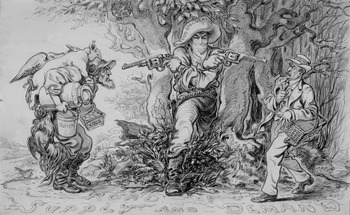
In order to improve their industry's image, warehousemen eventually began to set basic standards, such as requiring that eggs be candled before storage. However, these efforts at quality control did not appease those who believed that the very practice of large-scale, long-term food storage reeked of unscrupulous speculation (see Figure 2). There was no question that dealers bought millions of spring eggs in order to sell them at a profit several months later. But did this constitute hoarding? Did it drive up overall prices? Cold-storage proponents contended that, on the contrary, it made off-season eggs much more affordable. By reducing the likelihood of ruinous spring gluts, they said, cold storage also encouraged farmers to produce more eggs, thus increasing overall supply.Footnote 55
“A double hold-up—good guns in bad hands,” by Udo Keppler. Published in Puck Magazine, 20 May 1910. Library of Congress Prints and Photographs Division, Washington, D.C.

This argument looked tenuous when, for one reason or another, egg prices climbed. It did not help when newspapers reported that members of the “beef trust”—the meatpackers Armour, Swift, and Morris—stored millions of eggs in Chicago and other Midwestern cities. The first such reports appeared in 1902, and suggested that the meatpackers' eggs stocks foretold a giant “food combine.”Footnote 56 Within a few years the press routinely referred to “the egg trust,” but noted that early springs and winter warm spells—which brought on unexpected egg laying—could undermine its speculative profits. “The Hen as a Trust-Buster,” ran one headline in spring 1905. “Hens Happy—Smashed Egg Trust's Shell Game,” said another in January 1906.Footnote 57
When prices began to rise rapidly in 1909, talk of a refrigerated “food trust” once again filled the press. No one seemed quite sure who belonged to this trust or how much food they controlled, partly because companies did not have to report storage volumes. The mountains of perishables going into public cold-storage houses did indicate that the meatpackers were not the only suspects. Refrigeration's role in this trust appeared obvious.Footnote 58 As a Washington Post letter writer, signed “Householder,” put it in 1909, “I see editorials now and then commenting on the high prices of food … the explanation, however, is very simple. It is not because food is scarce. It is because there is a food trust … I don't think it is an organized concern, but to all intents and purposes, it might as well be. I understand that in our own markets, right here in town, the dealers get together and decide on prices before they open their stalls. Cold storage is responsible for the prices they charge. … They have thousands and thousands of eggs, but keep them in the refrigerator, in order to keep prices high.”Footnote 59
Soon politicians and Progressive reformers called for government action. The Chicago city council had voted down one of the first attempts at cold-storage regulation in 1906, after “energetic” opposition from warehousemen and their customers.Footnote 60 From 1909 onwards, several other cities and states introduced their own cold-storage bills. Most of these bills proposed to limit legal storage time to anywhere from one month to one year. Most called also for warehouse licensing and inspections, and the mandatory labeling of all cold-stored foods.Footnote 61 In New Jersey, the push for legislation began with a price-fixing investigation. In 1910, a grand jury indicted six companies (including the meatpackers Armour and Swift) “for conspiring to increase the price of foodstuffs.” The jury did not buy the argument about how cold storage evened out scarcity and glut, instead noting, “When eggs were plentiful they were cornered and kept from the market at times when it was natural that they should be cheap.”Footnote 62
In turn, warehousemen blamed the press for turning cold storage into populist politicians' favorite cause. Editorials in Ice and Refrigeration, the industry trade journal, expressed a mix of anger and bewilderment. “A consideration of the agitation which has led to the legislation, discloses a curious condition of the public mind. It has the symptoms of an unreal nervous and mental disease… . It is not based upon knowledge, fact, or investigation, and has no sponsors nor advocates except the sensational newspapers and the politicians who are looking for an issue.”Footnote 63
Newspapers did in fact run inflammatory headlines about what the New York World called “storage horrors.” Tapping into two reliable sources of reader outrage, they suggested that consumers were being simultaneously poisoned and cheated: “Thousands of Tons of Food Unfit to Eat Foisted on Public by Freezer Owners,” raged one headline. “Bad Eggs, Poisoned Poultry, Deadly Fish, Unwholesome Butter, and Decaying Vegetables Kept to Get Benefit of High Prices,” said another. The press also fueled suspicions of speculative hoarding by publishing figures on the quantity of warehoused provisions that, as the New York Evening Mail claimed in January 1910, could “feed the population of the United States for a month.” These reported reserves included the meat of 14 million cattle, 25 million dollars worth of fish, and more than 100 million dollars worth of other perishables—including, no doubt, lots of eggs.Footnote 64
Ice and Refrigeration urged its readers to combat these charges with more positive publicity. Informative advertising and recipe booklets, argued one columnist, would help calm the “agitation” of consumers who “do not understand the function of a cold storage warehouse, and do not understand anything but the simple fact that here is a big building … containing food that they want to get hold of.”Footnote 65 In Chicago, city officials and reporters were invited to a luncheon featuring exclusively cold-storage ingredients. The Chicago Tribune announced the event with the headline “TO DINE ON EMBALMED FOOD.”Footnote 66
The warehousemen and their major clients also stepped up their lobbying at the federal level, where a bill reached the Senate in 1910. The bill was the product of an investigation into the high cost of living led by the Massachusetts Senator Henry Cabot Lodge. Here, as in the press, questions of fairness and freshness were rarely far apart. In hearings held by the Committee on Manufactures, meatpackers reported on how cold storage affected meat pricing, and USDA chemists on how it affected meat texture and taste.Footnote 67 Physicians discussed digestibility, and lawyers brought lists of consumers who went on record to say they liked eating cold-storage foods.Footnote 68
Among those testifying in favor of cold storage was Dr. Mary Pennington, the director of the USDA's Food Research Laboratory and a woman once called the “voice of conscience in the refrigeration world.”Footnote 69 She was also one of the Western world's foremost authorities on chicken and egg hygiene. Like many refrigeration advocates, she blamed the bad image of cold-storage goods—especially eggs—on ideas leftover from the days when, “the nearby farm was the source of supply and when ‘freshness’ was measured by the number of hours that elapsed between the gathering of the produce and its delivery to the consumer. The fewer the hours, then, the better the goods, because the farmer had no facilities for preventing decay … Because the consumer has insisted that he must have produce ‘right fresh from the country’ the vendor has imposed upon his ignorance by pretending to give it to him.”Footnote 70
If consumers and congressmen wanted honest trade, in other words, they had to accept that refrigeration had altered the physics of freshness; no longer did it depend on time or distance. Whether or not the senators agreed with this view, it ultimately convinced them that setting time limits on the cold storage of an entire nation's food supply was just too complicated. After months of hearings, the bill died in committee.
More local initiatives were just heating up, however. Contrary to Pennington's characterizations of “the consumer,” the women who organized the citywide egg sales in 1912 had no illusions about getting fresh-laid eggs in December. And they had no qualms about advertising their stocks as “fine Aprils.”Footnote 71 Their gripe lay with the speculators who restricted the supply of such eggs, and the retailers who clearly profited from the pretense that they were fresh. As the leader of New York's Housewives' League explained, “The clerk tells [the housewife] he does not think she would like the storage eggs, and advises her to take fresh eggs. She pays 60 cents for the supposed fresh eggs, which in reality are storage eggs. Nine times out of ten when a woman believes she is getting fresh eggs she is getting storage eggs.”Footnote 72
The women's egg sales succeeded in pushing prices down until spring, and encouraged politicians to push forward with legislation. By 1915, eleven states, including California, Indiana, New Jersey, and New York, had passed cold-storage acts. Combined with the easing of inflation and the outbreak of World War I, these laws helped ease, at least temporarily, popular opposition to cold storage.Footnote 73 As the Warehousemen's Association gratefully noted in 1915, “The intervention of foreign strife has given the press so much to write about … that cold storage topics have slept peacefully.”Footnote 74
The new laws' labeling provisions, however, proved almost impossible to enforce in eggs, which were labeled by the case. It was still easy and tempting to switch eggs in and out of their cases and sell the best ones as “fresh” and the rest as “storage” eggs, a practice that became known as egg “bootlegging.” By the mid-1920s, health officials estimated that some 75 percent of the nation's cold-storage stock had been bootlegged.Footnote 75 So it is not surprising that consumers doubted the quality of these eggs long after they stopped worrying about the use of cold storage as a speculative tool.
Consumers' doubts, and the resulting price differential, also persisted despite years of pro-cold-storage egg campaigning on the part of the warehouse and poultry industries, as well as the USDA. Educational pamphlets and movies, a demonstration railcar, cut-rate pricing, free omelets at public health expositions—none of these publicity efforts convinced consumers that nine-month-old storage eggs could taste, as Mary Pennington insisted, “not only good but really delectable.”Footnote 76
To combat bootlegging, some states abolished their cold-storage labeling laws altogether, requiring that eggs be sold by grade instead.Footnote 77 Since grades rate eggs according to measurable quality indicators (including the size of the internal air cell), this policy shift neatly erased age as a measure of freshness. So too did the USDA's voluntary egg standards, adopted in 1925. At the same time, several states, under pressure from their own farmers' organizations, continued to protect geographic measures of freshness. In Florida, for example, only Florida eggs could be sold as “fresh;” out-of-state eggs had to be labeled “shipped.” In the Northeast, state-of-origin labels (i.e., “New York Whites”) encouraged consumers to buy local eggs.Footnote 78 Ultimately, though, the most revolutionary changes in the meanings of egg freshness—changes that ironically helped to destroy both cold-storage and local egg trades—did not pass through any state house. The place of real foment was the henhouse.
FIXING THE CHICKEN
If the egg came first in the longer history of engineering seasonless freshness, ultimately it was the chicken whose nature had to change most.Footnote 79 Farmers had long recognized that seasonal shifts in temperature and daylight affected their hens' eating, laying, and brooding habits. They also knew that they could modify these habits somewhat by giving them warm winter housing and richer feed. In the early years of the twentieth century, as urban demand for eggs increased, poultry scientists and a small but growing class of specialized poultry farmers undertook more systematic experiments. They sought to increase not simply overall egg production but also off-season laying. The first step was to suppress the hen's maternal instinct. As Rutgers University poultry science professor Harold Lewis put it in 1913, “The hen is too valuable an egg machine to allow her to waste weeks and months in hatching eggs.”Footnote 80 Lewis advised farmers, “if a continuous heavy production is desired, it is necessary to break up the broody habit as soon as possible… . The best way … is to confine them from three to five days … in specially constructed coops with slatted bottoms, feeding them light rations of wheat, with plenty of water… . The desire to sit is thus more quickly discouraged.”Footnote 81
Poultry breeding, previously a hobby that produced elegant and exotic show birds, increasingly focused on laying traits. Among breeds, the scrawny Leghorn excelled, thanks to a weak maternal instinct and strong metabolism. Leghorn hens regularly won the egg-laying contests that became popular around the turn of the century, and ads for Leghorn chicks emphasized that farmers, too, could be winners if they raised these seemingly winter-proofed birds. “Everlay” Brown Leghorns, for instance, were advertised as having “the winter-laying habit bred into them. You can own a flock of these Real Money Makers at small cost.”Footnote 82
The 1910s and 1920s also saw advances in avian nutrition. As with breeding, experts promoted scientific feeding as a means to increase egg production during the most profitable months of the year. Poultry manuals and magazines recommended formulas that would synchronize birds' life cycles with the egg market. A relatively sparse diet, for example, slowed down the maturation of chicks, so that they started and stopped laying later in the season. A few days of no food whatsoever “forced” an early molt, bringing hens back into full production before the springtime glut. And a rich, well-balanced winter diet—including buttermilk and leafy greens—encouraged them to lay throughout the cold months.Footnote 83 Not surprisingly, feed and chemical manufacturers soon offered convenient, vitamin-fortified alternatives to home-prepared rations. Products such as Quaker's Ful-O-Pep Egg Mash and Purina Poultry Chow specifically promised to boost laying during “high price time.”Footnote 84
While careful breeding and feeding brought incremental improvements in off-season egg production, the most immediate results came at the flick of a switch—literally. Sometime around the end of the nineteenth century, at least a few chicken owners found that their hens saw no difference between sunlight and artificial light, supplied by the newly invented light bulb.Footnote 85 This meant that they could effectively be “tricked” into thinking that it was May—and thus time to lay—even in the dead of winter. Whether or not the authors of The Chicken Book are right in calling henhouse lighting the “single most important discovery in the history of the domesticated chicken,” it certainly marked a turning point in the history of the egg.Footnote 86 One “early adopter” of electric lighting, a Cambridge, Massachusetts poultry farmer, reportedly described it as “the most definite control of production that we have. You can turn on a switch or turn it off.”Footnote 87
For farmers, control over the hen's laying cycle was invaluable, at least in principle. Especially as an egg glut sent high-season prices plummeting after World War I, off-season fresh eggs offered the salvation of surefire profits. Indeed, Scientific American in 1919 called the effects of lights on hens as “neither more nor less than a miracle.” A letter-writer from Bemidji, Minnesota described what happened when he tried to warm up his barn with a 50 watt light bulb: “To our great astonishment our chickens began to lay eggs, and they have since literally turned night into day, cackling and behaving in liveliest fashion, and laying practically all their eggs in the night, sometimes 3 or 4 even after 10 p.m.”Footnote 88
Despite such dramatic results, henhouse lights caught on slowly. This was partly because most farms had no electricity until the mid-1930s, and gas or kerosene lanterns posed too great a fire hazard. Fuel sources aside, many farmers must have been reluctant to tamper with their hens' sensitive cycles. As one 1926 article in Leghorn World warned, “Lighting, if it is properly used, is a most remarkable aid in increasing the egg production at the time when eggs are most valuable. It must be remembered, however, that slight mistakes … may have disastrous effects as birds are under more or less artificial conditions. When lights are used they must be used regularly. It is not at all practical to turn on the lights for two or three weeks and then suddenly change … it was found that discontinuing the use of lights suddenly dropped the egg production from about 30 percent to almost zero over two weeks… .”Footnote 89 Some farmers also reported cases of hen exhaustion. “The vitality of the hens in the Northwest has been greatly reduced through forcing the birds to commence laying in the early fall,” The Hen Coop wrote in 1922, “A bird cannot be kept off her perch from 4 am until 9 am without showing the effect of the daily grind for eggs.”Footnote 90 So it was reasonable to think that too much artificial light would be akin to killing the goose that laid the golden egg.
Such fears seemed to fade by the end of the 1920s. Writing in Poultry World, Mrs. George Simmons argued that lights for laying hens were indisputably profitable, and would not “deplete their body resources” if farmers simply managed their henhouses as attentively as industrialists did their factories. This essentially meant assuring that the hens had ample food and water for their “overtime” hours. Plus, she noted, once the farm's hens had electricity, so could the home: “it is a heartening thing to know that not only this kind of increase in profits can be ours, but we farm women who have longed for city electrical conveniences can have them as a literal by-product of needed and sensible equipment for our flocks.”Footnote 91
Additional support came from the Ohio Agricultural Experiment Station, where studies suggested that if a little extra light was good, more was better. In particular, they showed that all-night light, long considered “out of the question,” was actually effective and safe. It was also convenient, since it spared the farmer midnight and pre-dawn trips to the henhouse. The Ohio studies compared the wintertime eating and laying habits of Leghorns receiving no extra light, those receiving light from 4 a.m., and those exposed to all-night light. The differences were remarkable; hens in the all-night light group ate on average 25 percent more than those in the control group, and laid twice as many eggs.Footnote 92
The researchers warned that the hens eventually tired, so leaving the henhouse lights on all winter would “usually mean less spring eggs.” But while fresh eggs fetched low prices in the spring, fresh chicken meat sold well. The Ohio researchers suggested that this would be a logical way to dispense with worn-out winter layers. Altogether, what made all-night lighting a worthwhile investment was not that it increased overall egg production but rather that it increased production during the most profitable period.Footnote 93
For the many farm families that kept barnyard flocks mostly for their own use, electrifying the henhouse must have seemed like a ludicrous idea in the middle of the depression. Simply keeping their flocks from starving was hard enough.Footnote 94 For commercial poultry farmers, on the other hand, selling fresh eggs in winter looked like a smart survival strategy. So as New Deal electrification projects brought power to rural areas across the country,Footnote 95 henhouse lighting became more commonplace, especially in major egg-producing regions. Poultry magazines provided advice on how to boost winter “henhouse morale” with the help of lamps, automatic on-off switches, and lighting schedules.Footnote 96 Even off-the-grid farmers could light up their henhouses with a Wincharger windmill, which cost $27.50 in 1941 and advertised an immediate quadrupling of egg production.Footnote 97
By that time, the national January rate of lay averaged nearly 40 eggs per 100 layers. While still considerably lower than the June rate of 53.5 eggs, it marked an 80 percent increase in just fifteen years.Footnote 98 For consumers this meant that wintertime “strictly fresh” eggs were no longer such a costly luxury. For dealers in cold-storage eggs, on the other hand, this evolution spelled what Business Week called the “doom” of their trade: “Of the several factors which have forced the sales of storage eggs to a depressingly low point, the most important is the ever increasing supply of year-round fresh eggs. Millions of modernized hens, scientifically fed and housed, start laying three months earlier than their barnyard sisters. They come into production at a time when eggs are normally scarce and high-priced, and they lay twice as many eggs as those fed on grain and grasshoppers. … Now there is only a limited demand for storage eggs, and grocers have to make a wide spread between them and fresh eggs.”Footnote 99
In response, egg dealers tried to convince the USDA that cold-storage eggs should be renamed refrigerated, in order to get rid of their “unmerited stigma and unjustly unfavorable reputation.”Footnote 100 Warehousemen, though, recognized that a new label could not save an obsolete commodity. At their annual meeting in 1941, one speaker declared that while “the shell egg is fading in importance,” they could celebrate the nation's booming demand for frozen eggs.Footnote 101 Sold in cans or cartons, these were the kinds of stable, simple, uncontroversial commodities that warehousemen liked. After all, they did not have to pretend to be “farm fresh.”
EGG CITIES
Chicken Little has truly become Chicken Big.
W. O. Wilson, 1974Footnote 102As egg production became less seasonal, it also became more attractive to agribusiness. High prices during World War II briefly boosted the fortunes of family-run chicken farms, but by the early 1950s, they were competing against producers operating on a scale unimaginable in the pre-war era, when 400 birds still counted as a “commercial” flock.Footnote 103 These veritable “egg cities,” whether run by corporations or individual poultry moguls, relied on machines to collect, grade and pack the daily output of tens of thousands of layers. Together with slumping demand (a product of Americans' shift towards a more meat-centered diet) industrial-scale enterprises pushed tens of thousands of small producers out of business within a decade.Footnote 104 They also pushed forward pre-war developments in poultry breeding, feeding, and housing. Vitamin D-enriched feeds and UV-light bulbs replaced sunshine, battery cages replaced free-range chicken houses, and the old belief that hens needed exercise and fresh air gave way to the idea that continuous confinement was efficient, clean, and altogether modern.Footnote 105
Admittedly, birds kept under these conditions were prone to bad behavior as well as disease. But technology could fix these problems. Cutting off hens' beaks prevented them from pecking their cage-neighbors to death, while antibiotic-enhanced feeds suppressed epidemics and speeded growth.Footnote 106 The larger goal of these measures was to maximize hens' capacity, throughout their brief lives, to turn out eggs with assembly-line regularity. In this sense, they worked. Once hens had little or no exposure to seasonal variations in light, temperature, or feed, they obediently became full-time, year-round workers, producing around 300 eggs a year. As the American Egg Board boasts, “Today's laying hen doesn't need to depend upon the fickle sun to tell her when laying time has arrived.”Footnote 107 Now it is always laying time. The USDA's charts of monthly egg production rates, still jagged in the early 1940s, had flattened out by the mid-1970s.Footnote 108 Seasonal prices did the same. Eventually, storage eggs disappeared, along with the very idea that eggs were freshest and best in springtime. The giant warehouses were either torn down or, as in the case of Boston's Quincy Market, turned into more valuable real estate.
These days, the typical egg “production complex” is itself a formidable piece of property, housing perhaps a million layers. Such facilities make up the multi-state egg empires of companies such as Cal-Maine Foods and Moark LLC (owner of the Eggland brand). And although most are located in rural areas, news of their unsavory practices and by-products (ranging from labor abuses and animal cruelty to pollution and antibiotic-resistant bacteria) has by now reached the urban consumer.Footnote 109
Much less familiar is the history of the industrial egg itself. Since the early twentieth century egg production has not just become, like agricultural production more generally, more capital-intensive and geographically concentrated. It has also become perennially fresh, in response to demand for a vital food quality that consumers ultimately would not entrust to commercial cold storage—or rather, to the users of cold storage. This distinction is crucial, for behind consumers' seemingly “irrational” suspicions of cold storage were well-founded concerns about the carelessness and deception that this technology enabled. As Mary Kujovich observed in her account of the Chicago meatpackers' iced railcars, early refrigeration introduced “an element of confusion” into the perishable food marketplace, confounding efforts to develop fair and feasible regulations.Footnote 110 It did so by altering not just the distances and timeframes of commerce, but also, and more fundamentally, the power relations between different sets of buyers and sellers. The irony is that popular concerns about the resulting manipulation of the fresh egg market helped justify radical and permanent manipulations of the hen's life cycle.
This chicken and egg story forms just one chapter in a much broader history of freshness.Footnote 111 It must be understood in light of concurrent developments in (among other things) nutritional science, public health, and advertising, which together fostered the notion that daily doses of fresh food were essential to a healthy life and productive workforce.Footnote 112 Nonetheless, even by itself the egg's story shows that the popular legitimacy of the modern industrial food supply hinged on much more than the abolition of famine and deadly filth. As the circuits of food commerce grew lengthier and more complex, the role of intermediaries, both big and small, became more suspect. People demanded assurances that their “fresh” eggs were just that. Seemingly such a naturally desirable food quality, it ultimately was secured through entirely unnatural means.