The Swan-Ganz, or pulmonary artery catheter (PAC), has fallen out of favor as a tool for hemodynamic monitoring for the critically ill because of potential increases in mortality associated with these devicesReference Connors, Speroff and Dawson 1 , Reference Rajaram, Desai and Kalra 2 and challenges in interpreting their data. Niche applications of the PAC persist in intraoperative and cardiac surgical monitoring, but the PAC has largely been supplanted by noninvasive monitoring tools. One specific population in whom the use of this device persists is pre–heart-transplant patients; the use of a PAC makes the patient eligible to be actively listed with a high medical urgency status for heart transplantation. Status 1A patients have the highest priority for transplantation, requiring continuous infusion of at least 1 intravenous inotrope and continuous hemodynamic monitoring of left ventricular filling pressures, performed via an indwelling PAC. The medical urgency statuses were subcategorized in October 2018, but they have the same qualifications. Due to this requirement, these patients often have PACs in place for weeks to months while awaiting a suitable organ and are thus at prolonged risk for infection. In 2016, these patients accounted for 10% of central-line–associated bloodstream infections (CLABSIs) at our institution, despite being <1% of the total at-risk population.
Pioneering work by the Comprehensive Unit Safety Program has demonstrated that CLABSIs are also largely preventable, leading to stiff penalties for institutions with more than a handful of such cases. Several interventions have been associated with lower infection rates with central lines and are recommended by a variety of professional organizations.Reference Marschall, Mermel and Fakih 3 – Reference Yokoe, Anderson and Berenholtz 7 One of the most strongly associated risks for line infection is the duration of the line in place, held true across several different types of catheters.Reference O’Horo, Maki, Krupp and Safdar 8 – Reference Hassan, Elsherbiny, El-Rehim, Soliman and Ahmed 11 Although several interventions have been proven to reduce CLABSI, the single most important is removing unnecessary lines. Thus, quantifying the risk presented by PACs compared to the benefits from the use of this technology is critical in discussing the future role of the PAC in the pretransplant population.
Methods
We conducted a retrospective, descriptive review of characteristics of PAC use and infection rate in adult pre–heart-transplant patients. We collected data from January 2013 to December 2016. Patients were identified by internal transplant center data, and their characteristics were collected through the institution’s electronic medical record system. We included patients with active high medical urgency listing on the heart transplant list and a PAC in place during the study interval. High medical urgency was defined as status 1A on the previous United Network for Organ Sharing (UNOS) medical urgency designations, corresponding to the current status 1, 2, and 3 designations. We excluded patients aged <18 years or without research authorization on file. Patients were followed through end of study period, loss of follow-up, transplantation, or death.
We performed a chart review, gathering data including age, gender, dates of admission, transplant, and/or death, and Acute Physiology and Chronic Health Evaluation (APACHE) score. PAC data included dates of insertion and removal, indication for placement, location, and associated lines. Infection data included date of positive blood culture; associated symptoms, organisms isolated, removal of line, and associated complications. Data were collected by trained clinicians, and complete data were available.
CLABSI events were verified by infection prevention and control staff, using the Centers for Disease Control/National Healthcare Safety Network definition for infection. 12
Rates were computed as number of CLABSIs per 1,000 line days of follow-up. The 95% confidence intervals (CIs) of rates were estimated based on the Poisson distribution and were used to infer potential risk factors. Time to CLABSI was further described with Kaplan-Meier event rate and quartile estimates. Cumulative incidence of transplant was estimated over time by taking into account the competing risk of death. The effect of CLABSI on time to transplant and death were analyzed in time-dependent Cox models. Risk factors included for analysis were defined a priori, including duration of PAC use, location of placement (internal jugular, subclavian, femoral), number and location of other concomitant lines, age, gender, APACHE score at line placement, and total number of previous PACs in place. We also captured complication data, including CLABSI, infection-related complications (device infection, infective endocarditis, osteomyelitis due to same organism), relapse of bacteremia with same organism, as well as mechanical complications including local infection, compromised sterility, leaking or malfunctioning catheter, and catheter-associated deep vein thrombosis.
Results
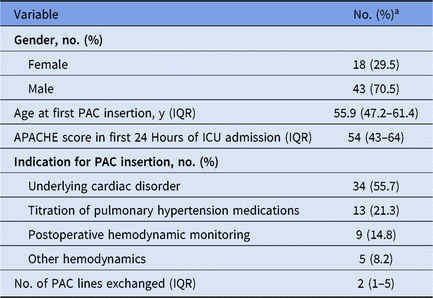
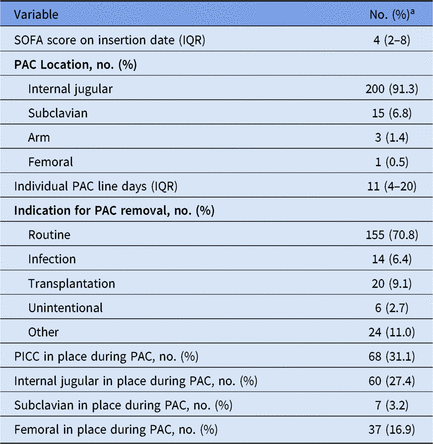
During the study interval, 61 status 1A pre–heart-transplant patients with a PAC in place were identified. This resulted in 219 individual PACs and 2,566 total line days, with a median duration of PAC use of 11 days. Table 1 lists patient-level characteristics and Table 2 lists line-level characteristics.
Patient Characteristics

NOTE. PAC, pulmonary artery catheter; APACHE, acute physiologic assessment and chronic health evaluation; IQR, interquartile range.
a Except where otherwise noted.
PAC Characteristics

NOTE. SOFA, sequential organ failure assessment; PAC, pulmonary artery catheter; PICC, peripherally inserted central catheter; IQR, interquartile range.
a Except where otherwise noted.
CLABSIs
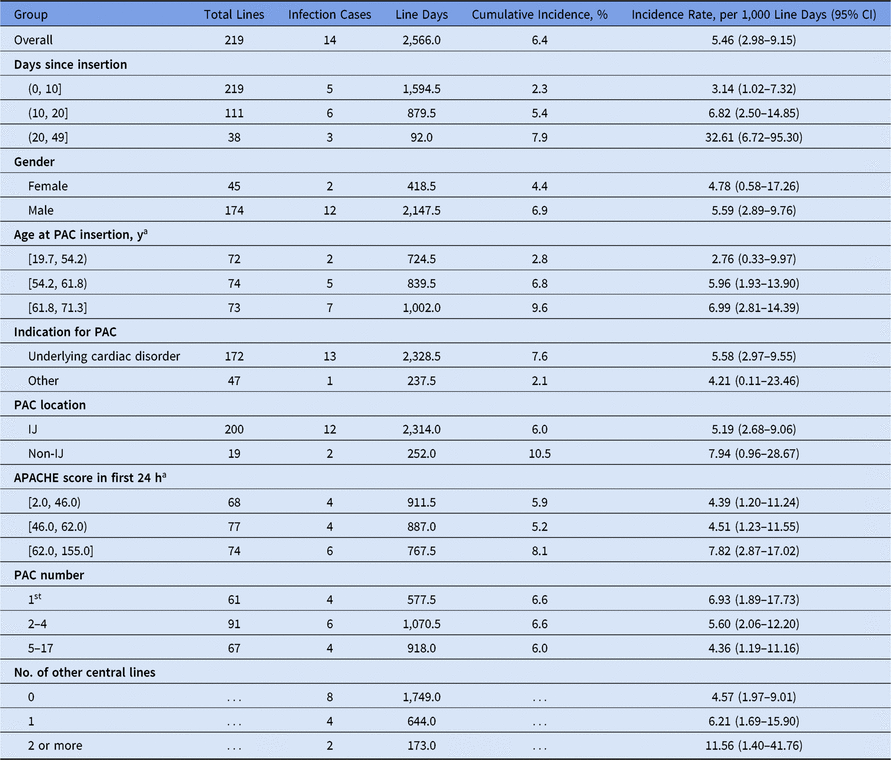
We identified 14 CLABSIs in the data we collected, resulting in an infection rate of 5.46 per 1,000 line days (95% CI, 2.98-9.15). Our institution’s intensive care unit patients had a CLABSI rate of 1.06 per 1,000 line days over the same time frame. Causative organisms included coagulase-negative Staphylococcus (n = 11 CLABSIs, 79%), Enterobacter (n = 1, 7%), Escherichia coli (n = 1, 7%), and Klebsiella (n = 1, 7%). Median time to diagnosis of infection from PAC placement was 29 days (95% CI, 23–49). Table 3 lists the CLABSI case characteristics.
CLABSI Characteristics

Note. CLABSI, central-line–associated bloodstream infection; CI, confidence interval; PAC, pulmonary artery catheter; IJ, internal jugular; APACHE, acute physiologic assessment and chronic health evaluation.
a Separated as tertiles
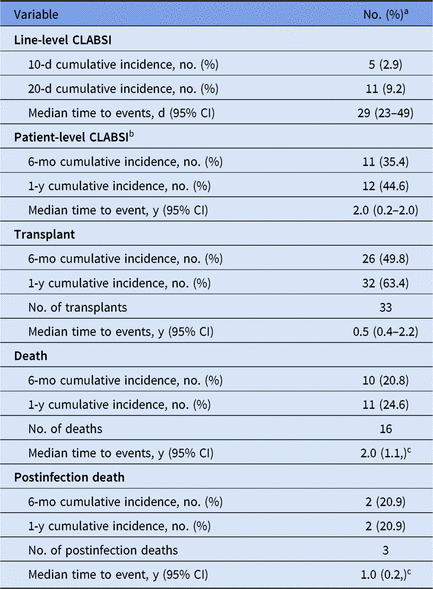
Patient and Line-Specific Outcomes

a Except where otherwise noted.
b 13 patients due to 1 patient experiencing 2 separate CLABSI events.
c Upper limit not estimable due to very sparse data at or beyond the median survival time estimate.
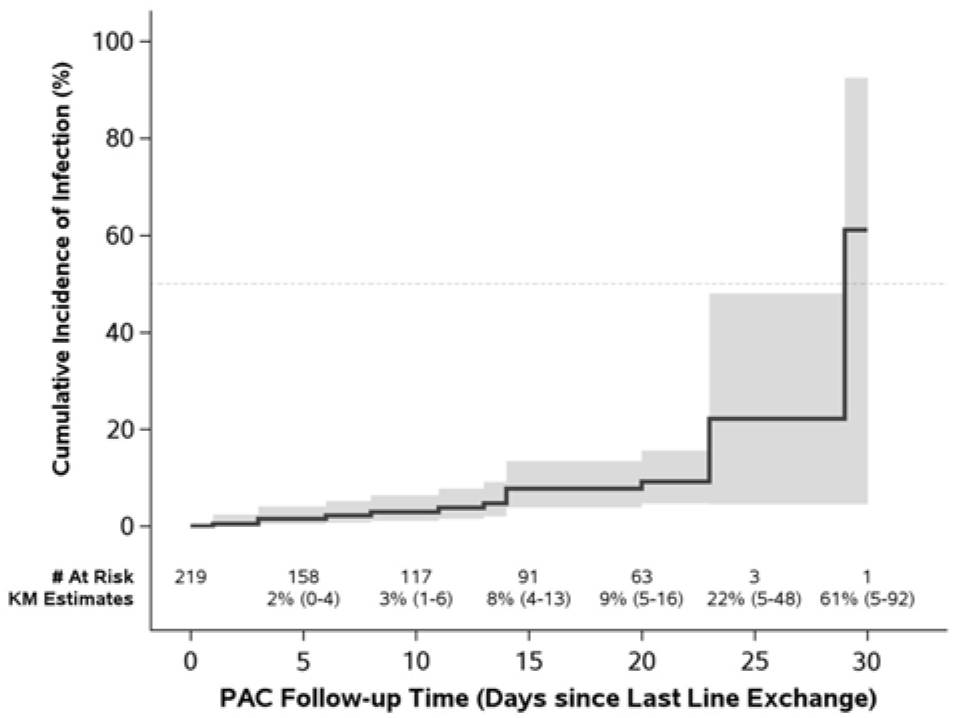
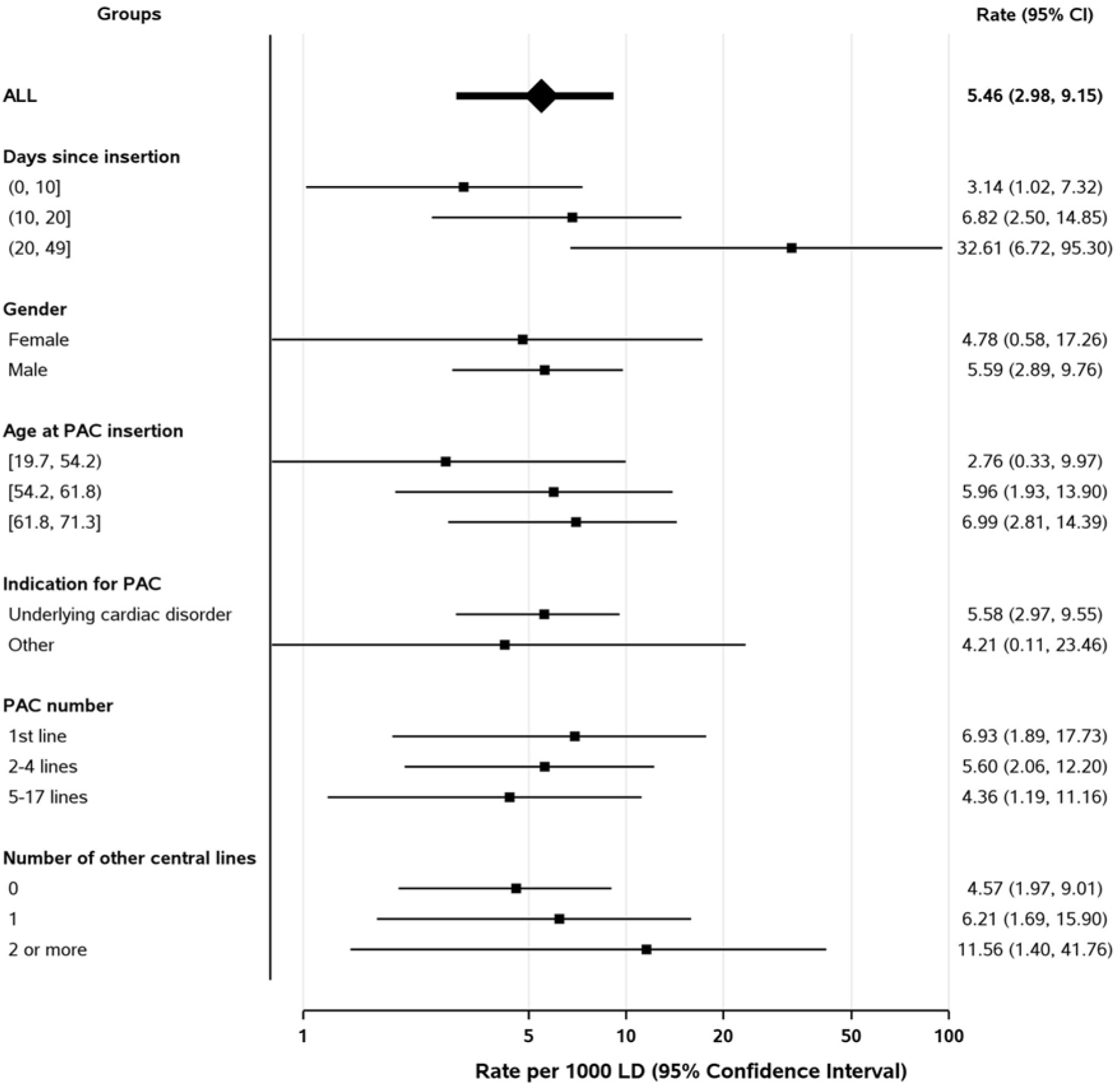
Longer duration of individual PAC presence was associated with a higher infection rate per 1,000 line days. Lines in place for 0–10 days resulted in an infection rate of 3.14 (95% CI, 1.02–7.32); 11–20 days resulted in an infection rate of 6.82 (95% CI, 2.50–14.85); and >20 days resulted in an infection rate of 32.61 (95% CI, 6.72–95.30). Figure 1 demonstrates the risk of infection as a function of days since last line insertion. Figure 2 displays the Kaplan-Meier cumulative incidence of infection over time for all individual lines. We also detected a tendency for higher infection rates with more concomitant non-PAC central lines used. Concomitant use of zero other central lines was associated with an infection rate of 4.57 (95% CI, 1.97–9.01); concomitant use of 1 other central line was associated with a rate of 6.21 (95% CI, 1.69–15.90); concomitant use of 2 or more other lines was associated with a rate of 11.56 (95% CI, 1.40–41.76). APACHE scores were analyzed, but these data are not presented because there was no clear difference in CLABSI rate by APACHE score. Our unadjusted analysis showed an apparent association between diagnosis of CLABSI and shorter time to transplant, with a hazard ratio of 2.49 (95% CI, 1.11–5.58; P = .027); however, adjustment for line-day exposure attenuated the CLABSI hazard ratio to 1.18 (95% CI, 0.41–3.41; P = .760), suggesting that increased catheter exposure was driving the association. In addition, infection had no significant effect on mortality, with a hazard ratio of 1.79 (95% CI, 0.52–6.19; P = .355). Table 4 lists patient and line-specific outcomes. Figure 3 shows time to transplant and death as competing events in relation to first PAC insertion. Figure 4 shows the rate of CLABSI by individual subgroup.
Risk of infection since last pulmonary artery catheter (PAC) exchange.

Cumulative incidence of infection since last pulmonary artery catheter (PAC) exchange.

Competing risk analysis of transplantation and mortality since first pulmonary artery catheter (PAC) insertion.

Comparison of central-line–associated bloodstream infections (CLABSI) rate by subgroup.

Other complications
During our study period, 6 (2.7%) of the 221 PAC removals were deemed inadvertent and required replacement with a new catheter (most commonly due to accidental manipulation by the patient). Moreover, 3 PACs were removed due to leakage, 6 due to compromised sterility, 3 due to concern for local infection (erythema, tenderness, or unexplained fever with negative blood cultures), and 5 due to malfunctioning PAC. There was 1 infection-related complication attributed to the CLABSI, infection of an implantable cardioverter-defibrillator. There were no instances of infective endocarditis or osteomyelitis. In our cohort, 2 line-associated deep vein thromboses were documented.
Discussion
Our study results show that patients listed with a high medical urgency status on the pre–heart-transplant list with long-term PAC use are at high risk for CLABSI. This population’s rate of CLABSI is noteworthy at 5.46 per 1,000 line days. This is particularly striking in relation to our institution’s overall intensive care unit CLABSI rate of 1.06 per 1,000 line days in the same period.
Reported rates of PAC colonization and infection have varied in the literature. A study comparing replacement of PAC every 4 versus 7 days found a 14.1% rate of PAC tip colonization, a 10.5% rate of bacteremia, and a 1.1% rate of catheter-related bacteremia (1.1 episodes per 1,000 catheter-days) in the group with catheter changes every 7 days.Reference Chen, Yen, Yang, Liu, Wang and Chou 13 CLABSI related to PAC use from a group utilizing antimicrobial prophylaxis with cefazolin or vancomycin had a 11.6% colonization rate and a 0.6% rate of bacteremia, representing 17.7 and 0.93 episodes per 1,000 catheter days, respectively.Reference Kac, Durain, Amrein, Herisson, Fiemeyer and Buu-Hoi 14 Studies reviewing CLABSI in patients with central venous catheters in an ICU overall have shown a range of CLABSI rate from 0.93 to 4.01 per 1,000 line days.Reference Kac, Durain, Amrein, Herisson, Fiemeyer and Buu-Hoi 14 – Reference See, Lessa and ElAta 16 Despite these findings, studies have not been able to define an optimal interval for invasive lines to be routinely exchanged, and there is no uniform practice across diverse institutions regarding prevention of CLABSI in the PAC population.Reference Chen, Yen, Yang, Liu, Wang and Chou 13 , Reference Cook, Randolph and Kernerman 17 Our current clinical practice does not include antimicrobial prophylaxis, but routine line exchange with a new line placed at a separate anatomical site occurs every 21 days. However, there is flexibility in this policy based on clinical scenario. Additionally, 1 PAC captured during this window was tunneled, and these devices are not subject to this policy.
The CLABSI cases were predominantly caused by coagulase-negative Staphylococcus, part of normal skin flora. The National Healthcare Safety Network reported the 3 most common causative organisms as coagulase-negative Staphylococcus (16.4%), Staphylococcus aureus (13.2%), and Enterococcus faecalis (8.4%), respectively.Reference Weiner, Webb and Limbago 18 However, this varies between studies. Pawar et alReference Pawar, Mehta, Kapoor, Sharma, Gupta and Trehan 19 showed only a 5.8% incidence of coagulase-negative Staphylococcus. Instead, E. coli was the dominant organism at 47%.
Furthermore, long-term PAC use in this population may place patients at even higher risk for CLABSI when other lines are in place simultaneously. Having additional lines in place provides microorganisms with another nidus through which they can establish infection and additional areas for access and manipulation. Existing literature comparing the number of lumens in central venous catheters in the ICU has not uniformly shown a greater risk of CLABSI with more lumens.Reference Dezfulian, Lavelle, Nallamothu, Kaufman and Saint 20 , Reference Templeton, Schlegel and Fleisch 21 However, this PAC use primarily in a short duration in which patients have the catheter in place through an acute illness. Similar but longer-term research into peripherally inserted central catheters (PICC) has shown increased infection rates with more lumens present.Reference Chopra, Ratz, Kuhn, Lopus, Chenoweth and Krein 22 – Reference Baxi, Shuman and Scipione 24 In the pre–heart-transplant population specifically, PICCs with >1 lumen are associated with an earlier time to infection.Reference Haglund, Cox and Lee 25 With the complexity of their illness, the pre–heart-transplant population often has other lines in place and demonstrates the need to remove unnecessary catheters. Additionally, findings of this study suggest higher risk of CLABSI with longer duration of individual PAC use, which agrees with prior studies showing a correlation in several different types of intravascular catheters.Reference O’Horo, Maki, Krupp and Safdar 8 – Reference Hassan, Elsherbiny, El-Rehim, Soliman and Ahmed 11
CLABSI appeared to be associated with a shorter time to transplant, although this is largely explained by greater catheter use among cases and may also reflect illness severity in this population. Some patients were able to be medically optimized, with improved hemodynamics and being weaned from inotropes. These factors would result in lowering their UNOS status and a longer wait time. Furthermore, CLABSI heralded a worsening of hemodynamic status in some patients, requiring more aggressive cares such as ventricular assist device implantation. More study into this association is needed.
The high rate of CLABSI in this population is troublesome for the excess morbidity and cost associated with it. Although this study did not show a significant effect on mortality, CLABSI overall has been shown to be associated with increased in-hospital mortality.Reference Ziegler, Pellegrini and Safdar 26 The economic burden of CLABSI is significant through additional ICU length of stay, total hospital length of stay, and additional therapies.Reference Haglund, Cox and Lee 25 , Reference Nelson, Geiger, Brown, Concannon, Dumyati and Stevens 27 , Reference Zimlichman, Henderson and Tamir 28
The limitations of this study include its retrospective nature and inclusion of a single center, allowing for the potential introduction of selection bias. The study is further limited by the small number of CLABSI events, and caution should be taken when drawing conclusions. Furthermore, the practice of routinely exchanging PAC every 21 days was limiting as well. These exchanges drastically reduced data beyond the 21-day point, possibly altering the true rate of infection past this point. A small number of patients did retain the PAC beyond the protocol 21 days, typically decided by a clinician due to specific circumstances that may also increase the risk of infection.
Whether the act of repeatedly exchanging and manipulating the PAC and thus performing more invasive procedures could have predisposed patients to more complications remains unclear. However, we did not find a difference in CLABSI rates when evaluating the number of previous PAC catheters per individual.
Recent changes to the UNOS adult heart allocation system, which took effect on October 18, 2018, updated the adult allocation statuses. The previous status 1A has been divided into statuses 1, 2, and 3. These statuses are sorted by the degree of pharmacologic or mechanical support, with statuses 1 and 2 being the highest medical urgency and including patients on VA-ECMO, intra-aortic balloon pumps, ventricular assist devices, and severe life-threatening arrhythmias. Patients with PACs for invasive hemodynamic monitoring will now be in status 3 for the priority listing. Whether the new categorization of heart allocation statuses will impact PAC use patterns remains to be seen. However, this new subcategorization is unlikely to change overall PAC use.
In conclusion, our study has demonstrated a high rate of CLABSI with PAC use pre–heart-transplant population at a time when presence of a PAC allowed the patient to be listed at the highest medical urgency status. Prolonged PAC use in the pre–heart-transplant population should be revisited, particularly in the age of noninvasive measures of hemodynamics. In a population at high risk for complications at baseline, further research is needed to determine the necessity of invasive monitoring. Institutions working on decreasing and monitoring their CLABSI rates should be aware of the high rate of CLABSI noted in patients listed for a heart transplant with PACs. Similarly, as the National Healthcare Safety Network reviews various institutions’ CLABSI rates, the proportion of this high-risk population may need to be accounted for.
Author ORCIDs
Zachary Yetmar, 0000-0003-2098-2868
Financial support
This project was supported by the Clinical and Translational Science Awards (grant no. UL1 TR000135) from the National Center for Advancing Translational Science (NCATS). Its contents are solely the responsibility of the authors and do not necessarily represent the official views of the National Institutes of Health.
Conflicts of interest
All authors report no conflicts of interest relevant to this article.