

1. Introduction
Life insurers have historically relied upon investment markets as a key source of profit and crucially have been able to do this while embarking on relatively “vanilla” investment strategies. In the current low-yield environment, broadening their investment horizons is critical to maintaining profitability.
Insurers are critical to the infrastructure of the investment society, representing the largest collective long-term lenders to the market with over £1.8 trillion of assets under management in the United Kingdom and €8.4 trillion in Europe (Insurance Europe, 2014). The form of this investment is both in “originating” lending, i.e. lending directly to the retail or institutional market as well as (more normally) providing secondary investment in these important markets.
Fortunately, there are a range of economic and political initiatives driving demand for institutional lending; in addition to this, traditional lenders (mainly banks) are more reluctant than ever to tie up liquidity by lending for long durations. Insurers are subject to less pressure on liquidity than banks that may allow them to fill the void in the long-term debt market.
Throughout this paper, we have provided explanatory text within the body of the report, through footnotes or through specific glossaries as appropriate. Other financial terms are well defined in the Association of Corporate Treasurers glossary (http://www.treasurers.org/glossary).
The Working Party (WP) considered five sub-groups of investments that insurers either currently utilise or that the WP expect will grow in significance over the coming years. These investments are biased towards assets backing annuities, which have seen the most material move towards non-traditional assets over recent years. These sub-groups are:
1. Infrastructure debt: covering infrastructure financing and social housing financing.
2. Real-estate-backed debt: covering residential mortgage loans, commercial real estate financing, equity release mortgage loans, ground rents and student accommodation.
3. Other asset-backed debt: covering asset-backed securities (ABS); specifically residential mortgage-backed securities and commercial mortgage-backed securities, collateralised loan obligations and aircraft financing (as an example of real-asset-backed debt).
4. Unsecured debt: covering private placements, high-yield bonds and emerging market bonds.
5. Other assets: covering private equity (PE), hedge funds (HF) and insurance-linked securities (ILS).
This paper is structured around each of these sub-groups as follows:
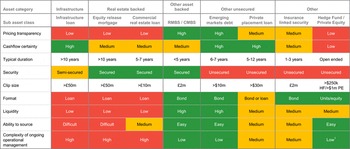
∙ A high-level summary of the key features of sample assets within each sub-group is covered in Table 1.
∙ Section 2 covers general considerations for all non-traditional assets and seeks to draw comparisons between sub-groups and within sub-groups.
∙ A detailed consideration of each asset sub-group is covered within section 3 of a longer paper published on the Institute and Faculty of Actuaries’ website (http://www.actuaries.org.uk/).
Overview of Certain Investments

1 Low if we assume that the hedge fund or private equity fund will manage the assets on the insurers’ behalf. This would be high if significant oversight was required by the insurer.
The availability and format of data is very varied across the different asset classes and so the WP has necessarily made use of whatever data are available without necessarily seeking to standardise it.
Although we note that some of the features in Table 1 are subjective, we attempt to illustrate some notional terms for the benefit of the reader. The Red/Amber/Green (“RAG”) ranking contained within Table 1 is particularly subjective and was itself a source of significant debate for the WP; it should be noted that the rankings are relative to other assets within this paper (rather than broader market instruments). However, we believe that the rankings are useful to highlight some of the critical areas of difficulty with each investment.
We considered the following items within Table 1:
∙ Pricing transparency: whether the investments have a market price or have to be marked to model. The presence of indices or other relevant market data may also be useful.
∙ Cash flow certainty: whether the cash flows are predictable. Early repayments and other probabilistic decrements can reduce certainty for some fixed income investments, whereas equity-like investments inherently exhibit low certainty.
∙ Duration: we have attempted to determine a modified duration for each investment and this is the “duration” definition that we have used throughout this paper. This varies significantly within each of the sectors, but we have identified the common durations for investments.
∙ Security: we have considered the presence of tangible security collateralising the bond or loan. We have considered the presence of security to be a favourable feature.
∙ “Clip size”: we have attempted to set out what a typical insurance investment “unit” might be in each asset. Investments in funds, which are backed by non-traditional assets, may be available at smaller clip sizes.
∙ Format: either bond, loan or equity. We have assumed that loans are more difficult to manage than bonds or equity.
∙ Liquidity: depends on the presence of a secondary market and the ability to quickly sell at the “market prevailing” price.
∙ Ability to source: due diligence is required before purchasing assets but bonds and equities tend to be relatively easy to source, whereas loans require specific conduits into the market.
∙ Complexity of ongoing operational management: this captures a range of considerations which are elaborated upon later in the report. However, this captures the scale of the ongoing commitment to the management of the assets.
Return and capital characteristics are covered in section 2. We have not attempted to tabulate the return and capital characteristics here.
2. General Considerations for Non-Traditional Investments
2.1. Format of Investment
Investments considered within this paper can be made in a number of ways. Typical considerations are whether the investment is made in bond, loan or equity format. Insurers can generally access the investments directly or through specific vehicles. Alternatives to direct investment, which are possible for many of the investments covered in this paper, include:
∙ Pooled fund investment: in this case, insurers invest with other investors into a fund which buys the investments. Typically, this would be offered by a specialist investment manager who would manage the assets on behalf of all investors. The insurer would generally have no discretion over the investments made within the fund. Note that investors can access the fund in many different forms including UCITS compliant, jurisdiction-specific funds, closed- or open-ended, via debt, equity or loan consideration. This type of investment may be difficult for certain insurers (e.g. UK annuity writers) who will need to demonstrate their own control over the investment.
∙ Segregated mandate or “fund of one”: in this case, the insurer would invest in the instruments through an asset manager. A segregated mandate may be such that investments are made directly on the insurer’s balance sheet but are managed by the asset manager on behalf of the insurer. The insurer may retain some control over the investments (they may have a “right of veto” for assets which they do not wish to purchase) or the mandate may allow the asset manager full freedom to invest on the insurer’s behalf, subject to meeting certain criteria. The investment objectives and constraints are usually specified in the mandate’s Statement of Investment Principles. As above, the exposure to the fund can vary significantly.
∙ Syndicated loans or “club deals”: insurers may participate in larger investments either with other investors directly (as part of a “club”) or with other investors and arranged through an underwriter (usually a bank) via a syndicated loan. In this case, the insurer can access the investments directly but in smaller chunks.
∙ Securitisations: these are mechanisms for insurers to take structured forms of direct investments. This may be important or beneficial where the “clip size” is too low for the insurer to participate otherwise. This is particularly the case for small- and medium-sized enterprise loans.
Insurers may also access alternative investments through a variety of mechanisms, i.e. through direct origination of the assets, through purchase in the secondary market (i.e. purchasing existing investments from a third party) or through participation in a structured investment where relevant characteristics of the underlying investment have been isolated on behalf of the insurer.
2.2. Typical Returns
As noted above, high risk-adjusted investment returns are critical to insurers’ profitability.
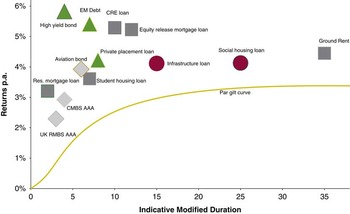
A high-level summary to illustrate the typical returns obtainable on some of the asset classes within each of the “debt-like instrument” sub-groups is covered in Figure 1, and a detailed consideration of the return and risk characteristics of each asset sub-group is covered within the specific sections later in this paper.
Illustration of returns for certain investments. EM, emerging market; CRE, commercial real estate; CMBS, commercial mortgage-backed security; RMBS, residential mortgage-backed security

The following points describe the methodology used and necessary caveats:
∙ In order to facilitate ease of comparison, all of the instruments were swapped into fixed sterling by adding the relevant spreads to the UK yield curve.
∙ Given that these instruments are heterogeneous and have different features (e.g. fixed versus floating payments, issuer options, different amortisation periods, etc.), comparability between them is necessarily approximate.
∙ Following on from the above, the quality of available data is highly variable (e.g. for emerging market and high-yield debt, indices were used and there were relevant market prices, whereas for equity release mortgages the data were anecdotal as there is no active market).
∙ A degree of subjectivity was used to estimate typical durations for the sub-classes.
∙ The data used in this sample was as of 31 March 2014. Over the course of the economic and credit cycles, both the gilt rates and the spreads will fluctuate in absolute terms and relative to each other.
∙ Returns for the equity-like classes (e.g. PE, HF and ILS) have not been plotted on this chart. The data for these as well as the finer details for each of the sub-groups are covered within the specific sections later in this paper.
Figure 1 plots these typical returns against a typical duration. The data points are deliberately large to illustrate the fact that this is a highly subjective exercise, particularly for the non-traded assets. The key is as follows:
∙ circles: infrastructure loans;
∙ squares: real-estate-backed loans;
∙ diamonds: other ABS;
∙ triangles: other unsecured assets.
The data behind these returns is non-public in most cases and so the WP has drawn on proprietary information or anecdotal evidence where possible.
2.3. Standard Formula Capital Considerations
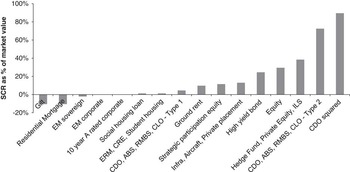
Figure 2 and Table 2 cover the key capital considerations for standard formula firms when assessing the non-traditional assets in this paper. The standard formula solvency capital requirement (SCR) is as at 9 November 2014, i.e. the source of the following figures is based on the WP’s interpretation of the Delegated Acts published in October 2014. The Solvency II SCR calculated is undiversified and gross of any loss-absorbing effects.
Solvency capital requirement (SCR) for certain investments compared with 10-year A-rated corporation bond. EM, emerging market; CRE, commercial real estate; RMBS, residential mortgage-backed security; ERM, equity release mortgage; CDO, collateralized debt obligation; ABS, asset-backed security; CLO, collateralised loan obligation; ILS, insurance-linked security

SCR Treatment for Selected Investments

* The symmetric adjustment for the equity risk sub-module varies, depending on the level of the market compared with a rolling average. At 31/12/12, EIOPA calculated this as +7.5%.
† British Venture Capital Association (BVCA) and European Venture Capital Association (EVCA) are trade bodies representing venture capital and private equity companies. The EIOPA response to this paper can be found at https://eiopa.europa.eu/fileadmin/tx_dam/files/publications/reports/EIOPA_Technical_Report_on_Standard_Formula_Design_and_Calibration_for_certain_Long-Term_Investments__2_.pdf
‡ The European Insurance and Occupational Pensions Authority (EIOPA) is an independent advisory body to the European parliament (https://eiopa.europa.eu/).
§ The symmetric adjustment for the equity risk sub-module varies, depending on the level of the market compared with a rolling average. At 31/12/12, EIOPA calculated this as +7.5%.
SCR, solvency capital requirement; LTV, loan-to-value ratio; SPV, special purpose vehicle; PFI, private finance initiative; PPP, public–private partnerships; RMBS, residential mortgage-backed security; CMBS, commercial mortgage-backed security; CLO, collateralised loan obligation; CDO, collateralized debt obligations.
Figure 2 compares the undiversified standard formula SCR against a 10-year A-rated corporate bond, which has an SCR of 10.5%, with bars below the line showing lower capital requirements, and above the line being higher capital requirements.
Table 2 sets out the SCR, with comments, for each of the non-traditional assets within this paper as well as comparisons with the traditional assets. It also considers qualitatively the position of internal model firms by identifying the underlying risks (both default risk and spread widening risk as appropriate) and considering whether the standard formula capital charge is likely to be a suitable proxy for the real capital at risk. The source of the internal model information is proprietary information and knowledge of individuals within the WP.
The table identifies a small number of areas where the standard formula is unlikely to be a suitable proxy for the underlying risks of these assets, which is unsurprising, given the esoteric nature of the assets. This is particularly in respect of:
∙ Highly illiquid assets where the expected spread risk is higher than that for liquid assets.
∙ Assets with underlying security, where either the underlying security does not meet the requirements of the Solvency II Delegated Acts (Article 219) or where the security benefit is capped at 50%.
∙ Assets with a default history, which is significantly more benign than an equivalently rated corporate bond.
∙ Assets where the standard formula bucket is particularly heterogeneous (e.g. assets classified as “other equity”).
It should be noted that companies may wish to consider the appropriateness of the standard formula in accurately reflecting the underlying risks whether or not the company is applying for an internal model.
2.4. Currency Hedging
Broadening insurers’ investment horizons naturally takes insurers outside of investments denominated in local currency and into assets denominated in foreign currency to broaden the asset universe. This section sets out the overall considerations for any asset (traditional or non-traditional) denominated in another currency.
At first glance, an investment into assets denominated in a foreign currency creates a foreign exchange (FX) risk over and above the assets’ intrinsic risk. The intrinsic risk will drive the market value of the assets in the foreign currency, but their value in the domestic currency also depends on the prevailing spot exchange rate.
Although this is broadly correct for equity-like investments, in the case of fixed income assets the reality is less straightforward, in particular for insurers who will invest for income and yield rather than for capital appreciation. Complexity arises because:
(i) the market value of the fixed income asset in the domestic currency of the investor depends on:
∙ credit spreads;
∙ foreign interest rates (e.g. swaps);
∙ the FX rate.
(ii) the individual market impact of such risk factors is difficult to fully isolate.
As a result, in practice, the range of hedging strategies employed by investors purchasing assets denominated in a foreign currency differs significantly between companies and among investments (whether investments are static, buy-and-hold or are dynamic portfolios with reinvestments).
When considering a preferable hedge, an insurer typically needs to determine whether:
∙ It is primarily interested in hedging mark-to-market movements (in which case a rolling strategy may be appropriate).
∙ Fully fixed GBP cash flows are required (e.g. as the matching adjustment rules require in the Solvency II Directive Article 77b “the cash flows of the assigned portfolio of assets are fixed”), in which case a “full hedge” is needed.
Both strategies are considered further below, along with considerations if hedges are not included.
2.4.1. No hedge
At one extreme, an insurer can choose not to hedge foreign currency exposure. In such a scenario, the foreign fixed income assets will:
∙ Provide no duration in the domestic currencyFootnote 1 as there is no direct sensitivity to movements in the domestic interest rates, e.g. a USD denominated bond does not have a duration in GBP as movements in sterling rates do not change USD rates.
∙ Be fully exposed to the volatility of the exchange rate, in comparison with domestic fixed income assets.
2.4.2. Full hedge
At the other extreme, an insurer can choose to enter into a cross-currency swap where the cash flows from the foreign denominated assets are converted into a pre-defined schedule of cash flows in the domestic currency. In such a scenario, the combined exposure will:
∙ provide duration in the domestic currency;
∙ eliminate cash flow exposure to the currency (or FX) risks.
However, the hedge will introduce new exposures:
∙ An exposure to “currency basis”
In theory, the cross-currency swaps are priced based on the interest rate differential offered by the two currencies. This is contrary to what is observed in the market, where participants also pay or receive a cross-currency spread (or basis), which means that one currency trades at a premium over the other currency. Such cross-currency spread/basis can be volatile over time and therefore can impact the valuation of the cross-currency swaps.
When hedging with a cross-currency swap, the currency basis is locked at the level prevailing at the time of hedging for the remaining term of the swap; therefore the exposure to currency basis will (i) create a new source of mark-to-market volatility and (ii) brings an additional cost (if spread is paid) or yield (if spread is received).
In summary, this currency basis exposure brings about market value volatility as a cost of fully fixing the cash flows in GBP.
∙ A contingent exposure upon default of the foreign denominated asset
A vanilla cross-currency swap, which hedges, e.g. a foreign denominated bond, is independent of the credit performance of the bond. Hence if the bond defaults, the swap will continue to exist. This means that in such situations the insurer will have (i) a windfall profit if the cross-currency swap has a positive mark-to-market or (ii) an unexpected loss if the cross-currency swap has a negative mark-to-market.
2.4.3. Alternative hedges
In between these two approaches there are other ways in which the hedge can be implemented.
Simple overlay with rolling short-term FX forwards: an alternative approach, which is widely used in fund management, is to use an overlay of rolling 3-month FX forwards to manage the volatility in the market value of the domestic currency of foreign denominated fixed income assets.
Such an approach is simple to implement and avoids the lock-in of the currency basis for the long term (i.e. only 3 months). However, the approach does not provide any duration in the domestic currency and does not provide fixed cash flows in GBP.
Enhanced overlay with interest rate swaps and rolling short-term FX forwards: the simple overlay with rolling short-term FX forwards can be enhanced by translating the foreign currency duration into domestic currency duration or mitigating the risk of underperformance of the portfolio relative to its associated insurance liabilities.
The translation of the foreign currency duration into domestic currency duration can be achieved by:
∙ Entering into an interest rate swap in the foreign currency where the insurer receives floating rate (plus spread) and pays fixed rate (equivalent to the coupon income) on a notional equal to the notional of the bond.
∙ Entering into an interest rate swap in the domestic currency where the insurer receives a fixed rate and pays a floating rate (e.g. GBP Libor flat) on a notional equal to the notional of the FX forward hedge and the notional of the bond.
Further considerations need to be given if:
∙ The investment portfolio is not static (i.e. if there are reinvestments and embedded calls) and therefore the foreign currency duration is expected to change.
∙ The investment portfolio has a large credit component and therefore the foreign currency duration may be adjusted as credit spreads move.
∙ The domestic currency duration is not directly linked to the foreign currency duration and therefore the domestic currency duration may be adjusted independently.
For such situations, a flexible overlay approach would need to be considered where the FX forward notional would not necessarily match the domestic/foreign interest rate swap notional.
Either of these alternative strategies avoids the cross-currency basis exposure and thus is expected to result in lower mark to market volatility. However, they do not provide fixed cash flows in GBP terms, which may be particularly problematic for annuity insurers seeking a matching adjustment approval.
2.5. Transforming Cash Flow Certainty
Cash flow certainty is a topic which is receiving increasing focus, particularly for annuity writers who place a high value on fixed cash flows in order to make assets eligible for the matching adjustment.
Many of the investments set out in this paper have features that create uncertainty over the payment term. Cash flow certainty considerations for specific assets are considered within the longer version of this paper, whereas this section deals with the general issues for financial assets. Clearly, no financial asset has complete certainty of cash flows, thus, in this section, any reference to cash flow certainty refers strictly to the definition of “fixed cash flows” required to comply with matching adjustment rules. The PRA has provided a number of key criteria setting out the way it expects insurers to fix cash flows (Bank of England, 2014a). These points are further elaborated upon in Paul Fisher’s letter of 15 October 2014 (Bank of England, 2014b). Both papers make requirements on the insurer to demonstrate full cash flow certainty (not just “highly predictable”) and suggest that any cash flow transformation solutions need to transfer real risk. Any new risks introduced by the transformation also need to be fully considered.
In the process of examining potential options for creating the required cash flow certainty, it is useful to differentiate between the various types of “uncertainty” present in financial asset cash flows. Briefly, these can be characterised as:
1. Structural/contractual uncertainty (cash flows are not fixed in local currency by virtue of the nature of the cash flow terms themselves), e.g.:
∙ foreign currency denominated bonds;
∙ floating rate instruments;
∙ index-linked bonds (outside the matching adjustment allowance on inflation-linked liabilities).
2. performance uncertainty (cash flows vary depending on the performance of an underlying business or non-financial variable), e.g.:
∙ Amortisation schedules which depend on underlying cash flows.
∙ Equity release mortgages (where final payment timing and amounts depend on longevity, mortality and voluntary early repayments).
3. Borrower optionality, e.g.:
∙ mortgage pre-payment risk;
∙ callable bonds;
∙ optional/mandatory deferral clauses.
There are a number of options available to insurers that may wish to transform investments in order to make them more favourable for the insurer.
In weighing such options, an insurer needs to consider:
∙ The impact on the annuity insurer, i.e., does the solution provide fixed cash flows for the solo annuity entity.
∙ The impact on the insurance group (i.e. does the solution still provide capital relief when the annuity insurer is consolidated into the group).
∙ The impact on the counterparty (i.e. is the counterparty a suitable holder of the risks and what will be its capital treatment).
In the longer term, it would clearly be preferable for the insurer if it were able to influence the terms on which it invests. There is some precedent for this in the UK market, e.g., certain social housing loan contracts in 2012 and 2013 were amended to ensure fixed cash flows.
The differences in the commercial real estate market between short-term loans, which are written with less economic early repayment penalties and long-term loans, which are written with economic early repayment penalties has arguably been influenced by the presence of insurers in the long-term market which has helped to define the “market standard” for such loans.
By contrast, we understand that anecdotally, the infrastructure market is one which insurers have had mixed experience in demanding protection against pre-payment, with some insurers finding it difficult to change the market standard, which tends to allow pre-payment. This situation may improve over time.
2.5.1. Derivative overlays
Standard derivative overlays
In the case of assets with “structural uncertainty” (item 1 in the list at the start of section 2.5), it is generally possible to convert variable cash flows into a fixed cash flow. For example, a floating rate asset can generally be converted into fixed cash flows through the purchase of a swap converting floating cash flows to fixed cash flows. Equally, cash flows made in a foreign currency can be hedged back to the insurer’s domestic currency through currency derivatives (the hedging of foreign currency assets is covered more fully in section 2.4).
In many cases, the derivative solution required to give the requisite level of “certainty” for matching adjustment, as well as to sufficiently remove any basis risk, may entail additional costs relative to the simpler (but potentially less robust) solutions, such as internal guarantees, which might otherwise be used to deal with these assets. This additional cost would then need to be factored in to the overall investment case. Any additional liquidity costs or risks resulting from the requirement to post collateral on long-dated derivative overlays would also need to be considered.
Structured complex derivative (or reinsurance) overlays
In principal, it might be possible to structure more complex derivatives (or reinsurance) to remove performance uncertainty (item 2 in the list at the start of section 2.5). For example, longevity derivatives/reinsurance would be one element of any solution structured to make the cash flows from equity release mortgages more certain. To the extent that the amortisation profile of an asset is dependent on underlying financing and economic variables, it may also be possible to structure hedges. For example, the pre-payment risk on a pool of residential mortgages (which is likely to be highly correlated to interest rates). However, the key issue here is likely to be cost and/or basis risk, with the likely outcome being that a third-party solution that gave sufficient certainty to meet matching adjustment rules could create costs, which would outweigh any increase in investment yield. A more practical solution in these situations could be to write such a derivative/reinsurance contract intra-group.
In general, it will likely be difficult to find third parties willing to write contracts to indemnify against borrower optionality (item 3 in the list at the start of section 2.5), except in the limited context mentioned above for a mortgage pool. Extension risk associated with callable bonds is another situation for which it may be possible to find third parties willing to offer protection if it is determined that this is required by the rules.
2.5.2. Block reinsurance
Annuity liabilities could be reinsured to a (re)insurance company that could be willing to accept the ineligible assets as a reinsurance premium. Should the reinsurer be a natural holder of these assets, then in theory it may be willing to price the reinsurance contract in such a way that it is equivalent or similar to the impact of valuing the liabilities using a matching adjustment.
There is already a market for bulk annuity reinsurance/transfers in the United Kingdom and, whereas (re)insurers are understandably reluctant to pass a material proportion of future investment profits to cedants as a reduced premium, in many cases pricing reflects a reasonable premium above “risk-free”. This would be expected to be the case on an ongoing basis as long as the risk-adjusted asset returns exceed the cost of longevity cover.
Furthermore, if the premium were to be paid in specie using assets which were difficult to use for the matching adjustment, then this would likely require a reinsurer domiciled outside the EEA (whether that jurisdiction is deemed equivalent or not) and hence not fully subject to Solvency II rules in order for them to give credit for any “liquidity premium” embedded in the assets.
Although this solution is potentially cleaner than others, it is likely to be considered as an option only for insurers wishing to ameliorate the impact on capital of legacy blocks of annuities in run-off: if writing new annuity business were important strategically then the resulting loss of control over pricing, which this option entails, would most likely be unattractive.
2.5.3. Special purpose vehicles (SPVs)
A SPV could be used to formally bifurcate the fixed and the non-fixed cash flows. In this case, the ineligible assets would be held by the SPV that would issue a note to the annuity insurer reflecting the fixed cash flows. An equity or subordinated tranche would be created and held by another part of the group (or externally) covering the non-fixed cash flows.
One problem with this approach is the level of tranching which would be required in order to create the requisite fixed cash flows on the senior tranche. Generally speaking, this form of solution would necessitate a (potentially material) reduction in the yield associated with the senior tranche, and could also potentially reduce the term. In the context of a structure in which the junior tranches were to remain within the group, the absence of direct capital markets constraints could enable more yield to be channelled to the senior tranche.
A further potential issue with this form of solution is the likelihood that for firms calculating capital requirements using the standard formula, such a structure could fall into the securitisations category, and hence attract a high capital charge. For internal model firms, insurers could argue that the senior tranche should not carry a charge higher than the combined asset (senior+junior tranches), whose treatment under the company’s internal model is likely to be known. However, given the relatively strict segregation of assets in the matching pool envisaged by the rules, this could prove a difficult argument to put to regulators.
2.5.4. Intra-group transactions
Where an annuity insurer is part of an insurance group, it may wish to hold the ineligible assets elsewhere within the group with the fixed cash flows passed to the annuity writer, and any cash flow variability met elsewhere in the group. Alternatively, and equivalently, the asset could be held within the matching asset pool, together with an overlay written by another part of the group to cancel out any cash flow variability.
Although we note that these solutions are inherently attractive and sometimes less complex than an alternative solution, there are a number of potential constraints to their uptake. This is most notably because of the uncertainty that they provide sufficient real risk transfer to be deemed an appropriate solution for cash flow fixing. There are additional concerns over the preservation of the fixed cash flows once the annuity company and the internal transaction is consolidated at group level because of the issues presented by Article 342 of the Solvency II Delegated Acts: “The aggregated group eligible own funds shall be adjusted to eliminate the impact of an intra-group transaction where the impact of the intra-group transaction affects the best estimates of the insurance and reinsurance undertakings in such way that the amount … is different depending on whether the intra-group transaction is eliminated in the calculation of that amount or not”.
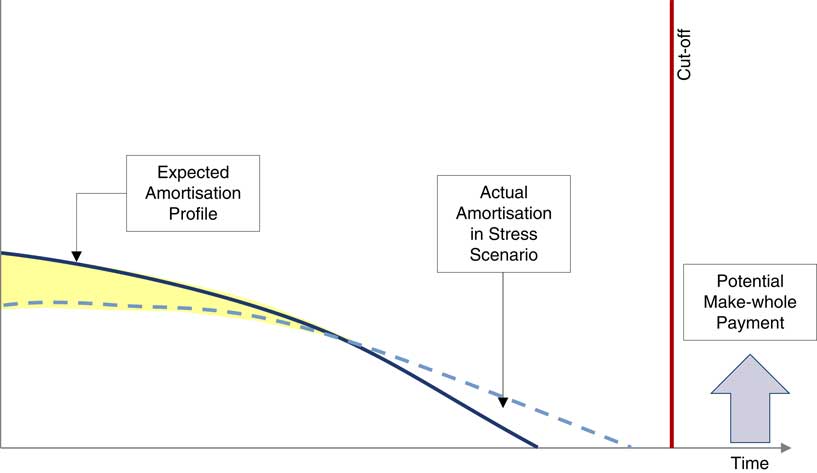
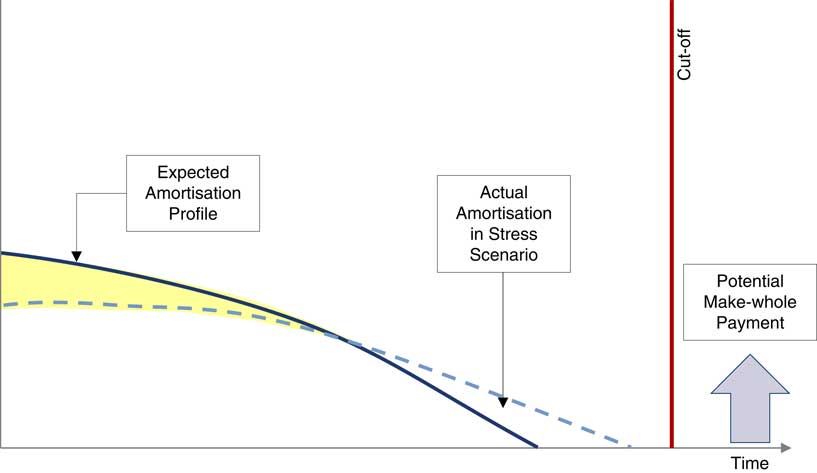
An example of how such an arrangement could function is illustrated below, which is effectively an actual-expected swap. The annuity writer pays the actual amortisation profile of the asset, and in return receives the pre-agreed expected amortisation profile. The cut-off feature, along with a potential “make-whole” payment, is necessary in order that the annuity writer retains full exposure to the performance of the asset, and has a hedge against the uncertainty. The swap is required to be on a “full indemnity” basis, i.e. it will need to take all cash flow uncertainty risks out of the asset, but the swap or the overall package will be considered to have defaulted in the event that the overall structure no longer provides fixed cash flows.
This feature effectively makes the swap a pure intra-group lending arrangement (e.g. in Figure 3 the shaded area represents lending from the group to the annuity writer), which could be priced appropriately.
Sample of intra-group transaction
A similar structure could be envisaged in which the group holds the asset and lends to the annuity writer directly. In both cases, the full exposure to the credit risk of the asset (or a significant majority of this exposure) would need to be passed to the annuity writer in order to justify the asset held by the matching portfolio paying a material spread.
We note that this type of structure may provide a benefit for the annuity company, but this benefit may not remain when the annuity company is consolidated at group level if intra-group transactions are required to be consolidated out.
2.5.5. Conclusions and comparison of options
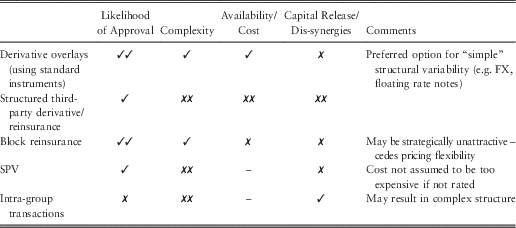
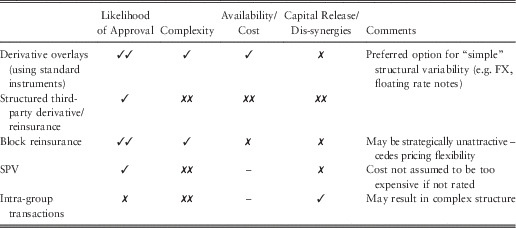
Table 3 compares the various features of the potential solutions discussed above. As a general rule, the simpler the nature of the cash flow uncertainty, the greater will be the availability and cost-effectiveness of third-party solutions. For more complex situations, it is more likely that internal solutions will be preferable. Table 3 considers relative benefits and issues with different solutions with two ticks being most certain to be favourable and two crosses being most certain to be unfavourable.
Illustration of Different Options for Cash Flow Certainty
FX, foreign exchange; SPV, special purpose vehicle.
There remain two further “solutions” to this issue which we have not discussed – specifically these are more drastic options for avoiding or deferring the issue entirely: an insurer could either seek to employ transitional measures as a temporary fix, or could elect to not apply the matching adjustment. These options are discussed below.
2.5.6. Utilising transitional measures
One possibility to deal with problematic annuity blocks could be to seek approval to use the transitional measures set out in the Solvency II rules to limit the impact on technical provisions over the medium term. Applying transitional measures will be subject to regulatory approval. However, in the context of a run-off block, this might be a viable option to manage the capital position.
2.5.7. Is the matching adjustment necessary?
As described above, in many cases it should be possible to engineer the assets described in this paper such that an annuity writer could in some form utilise them within its matching adjustment-eligible asset pool. However, it is also clear that there are potentially high costs of complying with matching adjustment rules. These could include both direct costs (such as administrative and operational complexity, higher costs for hedging and derivative overlays, and potentially ceding a proportion of investment yield to third parties) and opportunity costs (through lost investment flexibility and a potentially reduced universe of accessible investments). In addition, there may be capital dis-synergies introduced by the constraints on the management of the matching adjustment portfolio. These constraints could either be capital constraints (i.e. diversification may not be granted between the matching adjustment portfolio “ring-fenced fund”) or they could be real constraints (i.e. opportunity costs of not being able to invest more freely).
From a risk-management perspective, the use of a matching adjustment removes one of the key advantages of a mark-to-market approach, namely that it allows full flexibility to manage risk dynamically. The sale of assets which have fallen in value is now not only discouraged both by the rules themselves, but also by the resulting impact on liabilities when higher spread assets are replaced by lower-risk, lower-spread assets. This constrains the ability of insurers to de-risk in adverse scenarios (in fact, this was and remains a key criticism of the application of the current UK Pillar 1 rules for annuities). The rules also appear to explicitly disallow the sale of assets in order to exploit more attractive investment opportunities, or to manage asset risk more actively through the cycle (with the exception of “maintaining the replication of expected cash flows”).
Doubtless, for most annuity writers the matching adjustment will prove to be a necessity. However, it is plausible that for insurers with only limited annuity liabilities in the context of the group, the costs of applying the matching adjustment may well outweigh the benefits. There are also a small number of annuity insurers where the ineligible assets are sufficiently small that they can be left outside of the ring-fenced fund (either within the assets backing risk margin, SCR or surplus) or simply not counted.
2.6. Operational Challenges for Loans
When an insurance company holds a corporate bond, it generally holds it to maturity (or certainly with an intention to “buy and maintain”, i.e. it will buy and hold unless an issue with the holding emerges and an appropriate replacement will be found). It will probably continue to assess the credit rating, either through an internal assessment or through tracking any external credit rating(s). It will certainly continue to monitor the change in market value (and thus the change in spread). As such, it will intervene if and only if there are some obvious market factors that lead to a change in the bond.
A loan is different. For a loan, there is no available market value and generally there is no credit rating. As such, the management of loans is more challenging than the management of a corporate bond portfolio.
There are a number of operational challenges for insurance companies managing loans, such as those considered within the longer version of this paper. The main operational challenges are:
1. calculating a market value for an illiquid asset;
2. credit assessment of the asset;
3. changes in borrower circumstances;
4. borrower optionality;
5. variations (or changes to loan terms).
2.6.1. Valuation
As there are no market values for the asset, a modelled value must be created. This modelled value is likely to have to meet IFRS standards and so the parameters should be market observable, where possible. The modelled value is likely to be close to the transaction price soon after purchase, but market conditions may change, leading to a requirement to update parameters. Companies can put in place certain measures to manage the valuation of the asset; the fact that the valuation is modelled rather than marked to market may be a particular benefit for certain insurers, given that this creates less accounting volatility. Care needs to be taken to ensure that a robust valuation framework is in place even for modelled values.
Proxy valuation
When considering the valuation, it is helpful to consider traded assets that are similar to loans. In particular, there are bonds covering:
∙ social housing;
∙ Infrastructure;
∙ universities and higher education;
∙ commercial real estate.
A relationship can be determined between the bonds and similar loans, which, at the very least, give a reasonable view of the market’s view of the sector. However, changes in the situation of an individual borrower and contract-specific terms, e.g. borrower optionality are not captured.
A relationship can be determined between bonds and loans in general. The most liquid market to be able to determine this relationship is generally the private placement market and equivalent corporate bonds. The historic relationship between loans and bonds has been such that loans had a negative spread to bonds (e.g. pre-Global Financial Crisis) but, more recently, this has become a significant premium.
Individual issuers will carry different credit risk to the sector. As such, an idiosyncraticFootnote 2 spread will be required to bridge from the sectoral view to the individual asset. This idiosyncratic spread is likely to require a link to the credit rating.
Decomposing the spread on the loans into a spread on an equivalent bond, a loan to bond premium and the idiosyncratic spread of the bond allows insurers to more accurately monitor and assess the spread on the loan. This ensures that the valuation of the asset is easier to explain.
Hard valuation
For assets with real assets backing the loans, the underlying collateral needs to be valued on an ongoing basis. For certain assets (e.g. property, aircraft and infrastructure), this can be both costly and time-consuming. This is likely to be an important consideration for insurers relying on the value of the underlying collateral to support the valuation or risk measurement of the loan.
2.6.2. Credit rating
The credit rating of loan assets tends to depend on both the loan characteristics and the underlying borrower. The credit assessment of the loan will generally be complex and will likely require consideration of both quantitative factors (e.g. financial position of the borrower, covenants within the loan) and qualitative factors (e.g. outlook for the sector). At the time of loan purchase, the assets will undergo full due diligence so that these factors will be considered in detail. Once the loan has been purchased, an insurance company needs to have the ability to monitor and update the credit rating factors to feed into the valuation of the asset, but also to understand whether any action needs to be taken on the asset.
2.6.3. Changes in borrower circumstances
Depending on the outcome of the sectoral analysis described above and the credit analysis, the borrower may be determined to be higher risk than at the time of lending. These changes are likely to factor into the cash flow projections as well as the valuation of the asset.
The borrower’s circumstances also need to be taken into account in both the valuation of the borrower options and the variation requests.
2.6.4. Borrower optionality
Borrowers tend to have many options within the contracts, as set out in the cash flow certainty section above. Specific options that may be available to borrowers within loan contracts include:
∙ full or partial pre-payment;
∙ extension of all or part of the contract;
∙ fixed rate or floating rate linkage;
∙ linkage to certain underlying risk-free curves.
The options may either be contractual, so that the lender is mandated to accept the option, or the lender may have the choice to either deny the option or to price the change in contract. In either case, the value of the options is challenging to calculate. The existence of the options also makes the cash flows uncertain, which presents a challenge for insurers seeking the use of the matching adjustment.
2.6.5. Variations
A loan contract is different from a bond in that the borrower and lender typically have closer relationships. If something goes wrong, the borrower is likely to phone up the lender and see what can happen to resolve the issue. This is generally to the benefit of both sides as default-type events may be mitigated or stopped.
However, the existence of this relationship does make a loan contract more complex to manage. In the case of retail loans, this generally requires the insurance company to have a call centre to manage borrower requests. For commercial loans, the variations may still be complex to assess.
Variations are always accepted only at the discretion of the lender. A lender reserves the right to reject all variations; however, this may not always be in its best interest. Furthermore, it may generate negative reputation in the market should the lender wish to write further loans.
An insurance company would therefore need to be able to assess whether the variation proposed is reasonable. If so, it would need to determine what the cost of the change should be and whether any contractual changes are required. The impact on the cash flows (and any potential impact on matching adjustment) needs to be considered. The impact on the credit rating of the borrower with or without the variation is also important.
It is important for insurance investors to ensure that information is provided on a regular basis in order to be able to make decisions on the variations. Industry examples of poor decisions made by investors often include asymmetry of information.
The most complex and common example is for infrastructure loans, and so we have considered a case study here of some variations within infrastructure contracts.
For an infrastructure loan, there are several parties involved, i.e.:
∙ soft services, e.g. portering and cleaning;
∙ hard services, e.g. repairing of assets;
∙ long-term services, e.g. boilers, freezers.
The cost of these services is estimated at outset and may need resetting over time. Changes to the estimates made at outset require a change to the contract, i.e. a variation.
Any change to the contract will generally change the risk profile and this change will need to be formally consulted upon by both the bond (or loan) holders and the equity investors. As the risk appetite of the bond and equity investors tends to be different, the decision making may not be aligned. However, bondholders have entrenched rights and so have the ability to block variations, which they would generally do in the event of an increase to the risk profile.
Variations are usually accompanied by a change to the financial model underpinning the loan, which the investors should review. In some cases, the equity investors may accept a variation with inadequate consideration or consultation with the debt investors. In this instance, the debt investors have the ability to withhold dividends to be paid to equity investors.
Where an infrastructure project is performing poorly (through poor service quality), the debt investors have the right to be able to enforce changes to the running of the project in order to ensure that significant penalty points do not accrue against the contract and cause the trust to shut the project down (with loss to the debt holder).
The ability for insurers to be able to access this information depends on the vintage of the loan (rights are enhanced on newer deals) and the level of control over the project.
2.6.6. Summary
Loan investment requires caution on the part of the insurance company. Management of the above issues needs to be overseen by the insurance company but some of the expertise can be outsourced. Insurance companies generally need to follow one of the following models:
∙ Hire expertise in house: the insurer may need general loan management, credit management and specialist sectoral expertise. Insurers who lend significant amounts of money to certain sectors tend to have in-house specialists covering that sector.
∙ Utilise investment management expertise: investment managers tend to have further resources dedicated to management and monitoring of individual assets as well as sectors. The management of the investments needs to be agreed between the insurer and the investment manager, i.e. whether the investment manager has discretion to amend the contracts on behalf of the insurer or whether recommendations are made.
∙ Loan insurance (“wrapping”) may also be utilised to provide some of these services offered by a specialist investment manager.
∙ Outsource all management: insurers could outsource all decision making to an investment manager such that the performance of the assets is placed completely in the hands of the investment manager. The investment manager will therefore take responsibility for management of all of the above, with information reported to the insurer.
Acknowledgement
The author would like to express his deep appreciation for the work of the members of the working party. The working party members would like to thank their employers for their support whilst committing material time to the research included in this paper.