I. INTRODUCTION: CLASSICAL POLITICAL ECONOMY IN GERMANY
There are many truths that are actually self-evident. But it is precisely for being self-evident that they most easily lead men into confusion when they are questioned; for since men are least prepared to prove what they have so far regarded as the simplest thing in the world. To re-establish the truth, everything must be tackled from the very start and brought back into its rightful order from the foundation of concepts. (L. Bamberger apud Dietzel Reference Dietzel1895, p. v)Footnote 1
Gottlob Heinrich Andreas Dietzel (1857–1935) used this quote to encapsulate one of his most significant works, Theoretische Sozialökonomik. In his view, the path to solve matters of scope and method of the science of economic phenomena—particularly during the period marked by the Methodenstreit—lay in addressing the misunderstandings that had been perpetuated and amplified since the classical economists (primarily Adam Smith and David Ricardo) laid the foundations of the discipline. Dietzel contended that the root of these misunderstandings stemmed from the classicals’ lack of attention to explaining what they assumed to be self-evident. For instance, the study of a free-trade society, detached from the will of the State, was clouded by classical terminology; the correct method was also already present—the isolation method—but it needed to be refined in order to correctly demarcate the scope of the discipline; and the cost of production theory of value was on the right track, but it required adjustments, such as overcoming the antinomy between use and exchange value.
This positions Dietzel as a late reformer of classical thought, and, according to Erwin von Beckerath, the last representative of this tradition in Germany, along with Karl Heinrich Rau (1792–1870), Johann Heinrich von Thünen (1783–1850), Friedrich B. von Hermann (1795–1868), Hans Karl Emil von Mangoldt (1824–1868), and, especially, Adolph Wagner (1835–1917). Dietzel reformulated the position of several classical authors (mainly Ricardo), while incorporating what he saw as positive from both sides of the Methodenstreit, in order to build his “social economy” (Sozialökonomik). It is in this sense that Erwin Beckerath (Reference Beckerath1944) refers to his work with the expression “Non nova, noviter?” (Not new, in a new way?).Footnote 2 It is crucial to emphasize, however, that it is not their methodological positions that unite these authors. Rather, for Beckerath (Reference Beckerath1944, p. 4), it is their “naive or deliberate … conviction that the intellectual framework of the classical economists provided a solid foundation for our science, and that the future task would be to continue building on this foundation.”
Dietzel assumed the same definition of “classical political economy” as his contemporaries. Following Roger Backhouse (Reference Backhouse2023, p. 165), after Karl Marx’s death,Footnote 3 “classical political economy” became “an accepted term to describe English political economy” and similar forms of economic discourse in other countries, before marginalism. We understand Dietzel as a scholar who participated in this discourse. His greatest influences were undoubtedly John Stuart Mill and Jean-Baptiste Say,Footnote 4 whereas he saw Marx as a radical revolutionary (Dietzel Reference Dietzel1895, p. 211). From the classicals, he sought to preserve an ideal of a free-trade society, the abstract method and a value theory based on production costs. The classical doctrine, however, had its shortcomings, a reason why he also sought to keep the discipline open to other theoretical perspectives, especially in his defense of different economic orders, other methods besides Sozialökonomik, and the specific cases when marginalism is useful. He recognized that utilitarian calculus could not be considered “classical political economy.” Marginalists were seen as challenging classical tradition, and Dietzel (Reference Dietzel1895, p. 227) repeatedly referred to them as “die Neuen” (the newcomers).
In the following sections, we explore how Dietzel perceived the classical foundations as the basis for the proper method and scope of political economy. The core issue for him was the definition of the economic science itself—"what it encompasses, what it excludes, how it arrives at knowledge, and how it is structured" (Dietzel Reference Dietzel1895, p. 1). His most important concern was the role of abstract theory and the distinction between ethical and material aspects. Furthermore, value theory is seen as a cornerstone for economic theory but not directly related to these points; Dietzel’s objectives included reforming value theory as well.
Labeling Dietzel is not an easy task. He did not accede to the German Historical SchoolFootnote 5 or to the Austrians, although he put himself closer to the latter (Dietzel Reference Dietzel1895, p. 2). His reliance on classical political economy placed him in opposition against most of his peers in Germany, who rejected British laissez-faireFootnote 6 and Ricardo’s abstract approach.Footnote 7 Israel Kirzner ([1960] Reference Kirzner2007, p. 40) wrote that his exhaustive works on the definition of economics anticipated many discussions in neoclassical and modern Austrian theory, making him part of more subjectivist traditions. He did not fully subscribe to subjectivism, though. He cannot be seen as a devoted opponent of more historically minded authors, even of their most radical representative, Gustav Schmoller. As pointed out by Nils Goldschmidt (Reference Goldschmidt2002, p. 142), Schmoller even supported Dietzel’s nomination to replace Adolph Wagner at the University of Berlin, instead of Hermann Schumacher, who was closer to Schmoller’s ideas.
Dietzel’s attempt to combine different perspectives was noted by other economists. The early Japanese economist Shinzo Koizumi considered Dietzel, along with Alfred Marshall, an important scholar in synthetizing Ricardo and William Stanley Jevons and building modern economics (Mori Reference Mori and Takenaga2016, p. 186). The early Chilean economist Guillermo Subercaseaux praised Dietzel for synthetizing German Historical School and classical policy ideas, thinking them to be better suited to the Latin American context (Couyoumdjian Reference Couyoumdjian2015). Dietzel’s perspective also provided new insights into the evolution of the social sciences in his time, particularly concerning their scientific character. Dietzel is also linked to the ordoliberal tradition, notably through his influence on Walter Eucken, who was his student (Nientiedt Reference Nientiedt2022). Eucken admired Dietzel’s ability to identify the core problems of economics and adopted his distinction between collective and competitive economic orders (Goldschmidt Reference Goldschmidt2002, Reference Goldschmidt2013; Klinckowstroem Reference Klinckowstroem2024). Dietzel is also mentioned in Diego Guerrero’s history of heterodox economic thought textbook as making an important contribution to matters of value theory (Guerrero Reference Guerrero2005). Although we will not explore the issue of economic order in detail here, it is important to highlight that Dietzel’s definition of the objectives of economics was closely tied to his Sozialökonomik.
In summary, our primary intention here is to present Dietzel’s work, standing in contrast against both the historical method of the German Historical School (especially Schmoller) and the first Austrian economists, students of Carl Menger. He is an understudied scholar whose extensive and well-regarded work emerged during a period of intense debate over the future of the social sciences.Footnote 8
In order to discuss Dietzel’s contributions and his intellectual context, this article is structured as follows: in section II, we examine Dietzel’s definition of key concepts in political economy. His critique was directed at contemporary views regarding the demarcation of economic phenomena and the objectives of political economy. To clarify his stance, Dietzel even proposed renaming the discipline as Sozialökonomik, to avoid the misconceptions associated with “political economy.” In section III, we outline how Dietzel structured Sozialökonomik to offer a potential resolution to the Methodenstreit. Lastly, in section IV, we discuss Dietzel’s theory of value, illustrating how closely it aligned with classical thought. Although value theory was not a central concern for the German Historical School (at least for the younger generation, influenced by Schmoller), it was a key issue for both the Austrians and the British.
II. DIETZEL AND THE STATE OF POLITICAL ECONOMY IN GERMANY
Dietzel was born in Leipzig in 1857. He got a degree in law at Heidelberg and Berlin, and received his doctorate in political economy, under the supervision of Adolph Wagner. His teaching career started in 1885 as a professor at the University of Dorpat. In 1890, he became a professor at Bonn, where he remained until his retirement in 1925. He died in Bonn, ten years later (Kasprzok Reference Kasprzok2005, p. 52). Dietzel defended his doctorate while the Methodenstreit was at its highest point. During it, Schmoller defended and expanded the scope of the historical method of Wilhelm Roscher, Karl Knies, and Bruno Hildebrandt (Schmoller Reference Schmoller1888). For him, classical political economy lacked historical analysis: laws should also answer to the historical method, not being built from psychological abstractions such as self-interest (Schmoller Reference Schmoller1893).
The Methodenstreit was the main stage. Nevertheless, several issues regarding the correct method of political economy and its scope were already being discussed while Dietzel attended classes and wrote his thesis. One of these earlier debates was on Gustav Schönberg’s (Reference Schönberg1882) Handbook of Political Economy. In summary, Schmoller ([1882] Reference Schmoller, Fiedler and Karl1986) argued that Schönberg’s Handbook had little to contribute to political economy, since the historical method required an extensive work of collecting historical data in order to find patterns to discover historical laws. Schönberg and others saw Schmoller’s radical historical method as a deviation from what Roscher, Knies, and Hildebrandt proposed. Wagner (Reference Wagner1883) argued that Schmoller’s method would lead to an unnecessary piling of historical monographs.Footnote 9 Under Wagner’s influence, Dietzel did not adhere to Schmoller’s radical historical method. He followed his mentor, deepening his reconstruction of the scope and method of the discipline. Not only abstract theory should be preserved, but several other ideas of classical political economy should be reconsidered, including value theory and the rightful distinction between economy and politics.
Dietzel sided mostly with Menger during the Methodenstreit but presented his ideas as a synthesis of not only German and Austrian ideas but also of classical political economy. Following Menger, his criticism focused on the possibility of obtaining exact knowledge using a purely inductive process, as Schmoller proposed. However, he did not agree with Menger on the path by which political economy should be rebuilt. While Menger saw no use in returning to the classics,Footnote 10 Dietzel defended their relevance. He considered David Ricardo’s abstract approach to be the closest to a suitable methodological framework for the discipline. Therefore, he is usually seen as “the last upholder of classical British economists in Germany” (Graf Reference Graf2004, p. 104), a “lone epigone,” for Ludwig von Mises ([1969] Reference Mises1984, p. 14). Dietzel (Reference Dietzel1895, p. vi) placed significant emphasis on reinforcing the abstract and material nature of economics, particularly in his efforts to reconstruct its objectives and method. This becomes evident in his Sozialökonomik and how it was intended to solve the questions of method and scope of the disciplines.
The Science of Economics in the Context of Social Phenomena
As Klaus Lichtblau (Reference Lichtblau2011, p. 198) showed, Sozialökonomik is the German translation, which Dietzel popularized, of Say’s économie sociale (“social economy”). However, the word Dietzel first used to identify his “social economics” is Sozialwirtschaftlehre. The name Sozialökonomik would appear only later. He changed it after Wagner (Reference Wagner1892, p. 265) observed that Sozialwirtschaft(lehre) was a vulgarized term and possible source of misunderstandings. Then, in a lecture intended to introduce German universities to an American audience at Chicago, in 1893, Dietzel started to use the name Wagner had suggested: Sozialökonomie (Nau Reference Nau1997, p. 199). He later changed it to Sozialökonomik, with the intention of making a distinction between the object (Sozialökonomie) and the discipline (Sozialökonomik).
When Say chose the term “social economy,” he intended to dispel the confusion introduced by the physiocrats between economic analysis (“the independent investigations of the science of human wants”) and the art of administration (Forget Reference Forget1999, p. 127). Say argued that the State should be the object of analysis of an independent science of politics. Smith, Say continued, did not make this mistake but continued using the misleading term “political economy.” This brought the necessity of studying society as individuals with agency, detached from the will of the State.
Dietzel (Reference Dietzel1884, p. 107) agreed with Say on the necessity of clearing up the terminology in order to make this point better. He did so by criticizing several and potentially confusing definitions of the discipline in his German context. First, there was the simple translation of “political economy” as politische Ökonomie. Many German-speaking authors used this term out of convenience, in spite of their critiques that it did not capture the complexity of economic phenomena. Others, however, appealed to terms that better underlined the ethical questions missing in classical political economy: “national economy” (Nationalökonomie), “science of national economy” (Volkswirtschaftslehre), and “science of the state economy” (Staatswirtschaftslehre).Footnote 11 Again, scholars were aware that the terms were connected to different ways of seeing the object of study but used them interchangeably, nonetheless.Footnote 12 Therefore, even with the distinction between State and society, the German Historical School, in Dietzel’s opinion, allowed for political interference in the theoretical study of the economy. In this sense, they were trespassing disciplinary boundaries, with Schmoller being the biggest offender (Dietzel Reference Dietzel1883). In fact, there was no clear sense of how much social reality the discipline should encompass.Footnote 13
Therefore, the correct demarcation of the scope of the discipline was essential to Dietzel and directly connected to his objective. The greatest example of this incomplete demarcation of the scope of the discipline was Schmoller’s (Reference Schmoller1893, p. 54) idea of “political economy as social science” (Nationalökonomie als Sozialwissenschaft). Wagner (Reference Wagner1886, p. 198n1) accused Schmoller of aiming for a science of all social relations (eine Wissenschaft vom gesellschaftlichen Gesamtzusammenhang), while Dietzel (Reference Dietzel1884, p. 133) held that only sociology (in Comtean terms) “could meet Schmoller’s demand.”
Schmoller’s political economy encompassed all social reality because it was his intention to understand all motivations that led to economic actions. Therefore, he preferred the term “ethical political economy.” A people’s ethics (understood as a system of moral values that influences action, normally limited within a nation-state) are crucial to unraveling economic laws. That would make political economy geographically limited and historically dependent. Given that political economy would deal with ethical questions regarding social action, the discipline alone would suffice to understand social reality. Schmoller (Reference Schmoller1897, p. 54), on the other hand, denied that his method and scope would lead to an all-embracing discipline.
Dietzel (Reference Dietzel1883, pp. 2–4) pointed out how Smith and Ricardo were in the right direction in defining the objective of political economy. Smith’s intention was to advocate for individual freedom against government interference, which hindered the productive forces of labor and international exchange. Smith focused on the economic phenomena of social exchange, leading to recognition of him as the first scholar dealing with scientific economic ideas.Footnote 14 And Dietzel said of Ricardo, “And with the clearest awareness, the greatest theoretician of economic life, David Ricardo, makes this problem of distribution the sole focus of his classical work” (Dietzel Reference Dietzel1883, p. 4).
The correct demarcation of the objective of political economy, however, had been partially done by Mill. For Dietzel (Reference Dietzel1883, p. 4), while Mill was able to differentiate between practical and theoretical political economy, he circulated between the two when demarcating the objective of the discipline: “to exhibit the economic phenomena of society in relation to the best social ideas of the present time.” In Dietzel’s view, the advance of the science of economic phenomena depended on this definition. His solution was presented in his Sozialökonomik.
Dietzel and the Method of Social Economy: Mill’s Influence
Historically minded scholars, such as Wilhelm Dilthey and Schmoller, considered the method of the human sciences as distinct from the natural sciences. For them, the study of social phenomena should follow the historical method. Dilthey ([1883] Reference Dilthey1989) made the case for an epistemological distinction between both sciences and the independence of Geisteswissenschaften (humanities). Menger, on the other side, saw both sciences in search for rigorous laws.
Dietzel, at this point, was closer to Menger. Nevertheless, he argued for more theorems, not laws, to bring more heuristics to theory. What he saw as the right method for both natural and social sciences was the “isolation method.” Dietzel (Reference Dietzel1884, p. 109) argued that both natural and social sciences must isolate, “seal off” specific phenomena “from the involvement or influence of everything else” in order to be analyzed (Mäki Reference Mäki and Dilworth1992, p. 321); the only difference is the level of exactness that each science can achieve when doing so. This method had been discussed since the eighteenth century, pioneered by A. R. Jacques Turgot and Ricardo, followed by several German-speaking authors, such as von Thünen, von Hermann, Karl Rau, Wagner, and Menger (Goldschmidt Reference Goldschmidt2002, pp. 151–152). Mill popularized it in his essay “On the Definition and Method of Political Economy,” being already implicit in its first paragraph: “Political Economy considers mankind as occupied solely in acquiring and consuming wealth” and the means to achieve it through the best uses of someone’s resources (Mill [1836] Reference Mill and Hausman2008, p. 42; emphasis added). By doing so, Mill isolated economic phenomena to better study their economic consequences in society. He admitted it would be “absurd” to suppose that they are the only thing that matters in human action, but “this is the mode in which [economic] science must necessarily proceed” (Mill [1836] 2008, p. 42). This is a statement that most authors connected to the German Historical School would oppose in varying degrees. Dietzel himself mostly agreed with Mill, claiming that one can at least approximate such achievements using the isolation method (Dietzel Reference Dietzel1884, p. 361). It is imperfect, but the alternative would be Schmoller’s historical method—something that would bring even fewer satisfactory results: “We would like to call it a physics of material possession … it is thus limited to a possibly narrow field, but what it loses in breadth will win her clarity” (Dietzel Reference Dietzel1883, p. 7).
For Dietzel, the isolation method was the core issue during the Methodenstreit, and not the dispute between induction and deduction posed by Schmoller: “Isolation of the economic motive as the only psychological causal factor of economic phenomena to be taken into account in the doctrine —and as an independent sub-discipline of social science; or non-isolation, taking into account all concrete motives—and thus ‘merging social economics into social science’” (Dietzel Reference Dietzel and Conrad1911, p. 443).
As Goldschmidt (Reference Goldschmidt2002) argued, Dietzel goes beyond his predecessors, with a detailed and systematic discussion of the isolation method in social economic theory.Footnote 15 This is important for Dietzel as a reformist of the classicals. He argued that the idea of isolation was already present in earlier works. However, it was based in the wrong principle: self-interest. This was the reason why the isolation method did not solve the Methodenstreit, because Menger, just as Wagner and Rau, defended self-interest as the central principle of economics. Instead, the isolation method combined with a “correct” view of the “economic motive” was the solution.
Had the Classical School, instead of relying on the premise of the ‘egoistic’ motive or ‘self-interest’—a premise that is in no way inherently related to the tasks of economic theory and has given rise to numerous misunderstandings—adopted the premise of the economic motive with that of the ‘principle of least means’ (Mittlesaufwand), we would likely have been spared from the Methodenstreit. (Dietzel Reference Dietzel and Conrad1911, p. 446)
Dietzel considered the “rational actions of individuals” as purpose-driven behavior, focusing on human rational decisions guided by an “‘ethically colorless assumption’ or an ‘ethically indifferent method’” (Goldschmidt Reference Goldschmidt2002, p. 155). However, in order to correctly demarcate the object of study of Sozialökonomik, the purpose that drives this behavior cannot be merely “self-interest” but the combination of “the drive to satisfy the need for material goods, for wealth” (the economic motive) and the economic principle, or principle of least means, i.e., “seeking to achieve economic purposes—gaining economic advantage, avoiding economic disadvantage—with the least possible expenditure of economic resources” (Dietzel Reference Dietzel and Conrad1911, p. 444). This would put economic theory on a much more solid ground, since Dietzel considered it was not possible to prove that self-interest was the most powerful driving force behind human actions; the existence of altruism would challenge economic method.
The question of deductive or inductive methods, on the other hand, shows us how Dietzel understood the possibility of achieving theoretical statements in Sozialökonomik in a broad, pluralistic sense, when comparing to his contemporaries, or even to Mill, from whom he had great respect, in spite of his strictly deductive method.
As Karl Milford (Reference Milford and Streissler2002) wrote, Mill saw the natural sciences following the steps of causal induction that he presented in his A System of Logic (Mill Reference Mill and Robson1843). Mill argued that it is possible to verify the truth of assertions through cognition, following the steps of the process of induction, in the case of the natural sciences. Social sciences, on the other hand, depend on premises of deductive inference to realize such a verification. Therefore, since the social sciences fail in following the five steps of induction, they should instead follow three different deductive steps, which include first induction, then deduction and verification. Nevertheless, Mill would see political economy as a special case and propose a direct deductive method.Footnote 16 Mill regarded the behavior of a group as the sum of the self-interested behavior of its individuals. This is enabled by isolating their self-interest as the guiding principle of economic action—something not entirely possible for other social sciences (Mattos Reference Mattos1999). The verification stage here is not immediately necessary. The connection of this abstract formulation to empirical reality occurs in practical political economy, where deviations of theoretical cases are taken into account. In this sense, following Mill, it would be possible to separate social economy from social reality, allowing the use of the economic man (Mill [1836] Reference Mill and Hausman2008). In reforming the classics, Mill resorted to a radical deductive method (an exception within the social sciences), justified by the connection between economic action and self-interest. The economic man, then, would be its object. Dietzel, on the other hand, presented a similar but wider and more open view.
For Dietzel (Reference Dietzel1895, p. 93), both induction and deduction could be used in Sozialökonomik: “Economic theory attains its abstract, hypothetical causal formulas in two ways, either by deduction or by induction.”Footnote 17 The central question here is in regard to applying the isolation method to economic phenomena. While the isolation method in deduction is built on premises (its economic man) in the abstract, a more difficult and complex path is necessary for induction. When observing phenomena in all their complexity, one should be able to see which effects are caused by pure economic reasons: “i.e. it must be determined what would happen if the acting subjects were motivated exclusively by economic motives” (Dietzel Reference Dietzel and Conrad1911, p. 443). This is what Dietzel (Reference Dietzel1895, p. 73) named the “direct path.” The “indirect path” (deduction), however, built from abstraction, depends on the testing of induction on its connection to the real world. In this sense, independent of induction or deduction, what enables the existence of a discipline dedicated to economic phenomena is the possibility of understanding causal relationships purely based on economic motivation. The use of induction or deduction depends on the material in hand. Therefore, Dietzel departs from Mill not only in his use of self-interest but also in the role induction had to play in the study of economic phenomena.
Dietzel, just as MillFootnote 18 earlier, attempted to improve Ricardo’s system, instead of replacing it. Smith and Ricardo were already on the right track; they required only some changes in their doctrines (Dietzel Reference Dietzel1895, p. vi). Armed with an updated isolation method, Dietzel could build Sozialökonomik as a viable means of analyzing social and economic phenomena.
III. DIETZEL’S SYSTEM OF SOZIALÖKONOMIK
Dietzel defined the social economy (Sozialwirtschaft)—the abstract society where the object of study of his Sozialökonomik is present—as:
the organism that is formed as soon as a group of individual economies has entered into a regular market relationship with each other. The cause of the formation of this organism is not the will of the State—as it is for the organism of the national economy (Volkswirtschaft)—but the natural dependence relation of individual economies on each other in the struggle with the material world. (Dietzel Reference Dietzel1883, p. 3n1)
Additionally, the questions the discipline should try to answer are:
How will the proportion of the active economic classes be determined in the organism of social-economic relations if the State does not intervene, to the extent that it does not intervene in the exchange mechanisms of these classes? How will the welfare and distress of the social classes—which depend materially on the sum of prices obtained by the entrepreneurial class for its products, on the amount of rent that the landowning class imposes as tribute on the non-owners, and on the real value of wages that the propertyless working class receives as settlement—be shaped if the State does not intervene, if the exchange is not organized, and not consciously guided? How will classes be configured if all economic forces are unleashed, and all competitors use their strength without restraint? (Dietzel Reference Dietzel1883, pp. 5–6)
Dietzel employed the distinction between the individual and the State in order to differentiate Sozialwirtschaft from Volkswirtschaft (Volkswirtschaftlehre’s object of study). In practical terms, Sozialökonomik assumed that the State would not influence individual action; it had no role to play at all. Dietzel (Reference Dietzel1883, p. 15) had no intention of denying Nationalökonomie but only through an independent science of the “general theory of commerce” (allgemeine Verkehrslehre).
Dietzel distinguished between the theory and the practice of Sozialökonomik in terms of “being” and “ought to be,” respectively.Footnote 19 Theory regards what it is. In this sense, it analyzes reality and depends on the isolation method in order to proceed. Dietzel pointed out that many theoretical formulations of his time, even of those who were not followers of Schmoller’s radical historical method, depended on a conceptual idea of practical political economy. To illustrate, Dietzel referred to Friedrich J. Neumann’s chapter in Schönberg’s Handbuch der politischen Oekonomie. Neumann wrote that theoretical political economy should encompass both market concepts and phenomena, as well as their relations to the general well-being of the population. Due to that, argued Dietzel, Neumann’s theory depended on his definition of welfare, which is an object of study of practical political economy: “the assignment of linking the doctrine of ‘what should be’ (the doctrine of the economic mass-rules, concerning the public welfare) with the doctrine of ‘what it is’” (Dietzel Reference Dietzel1883, p. 10).
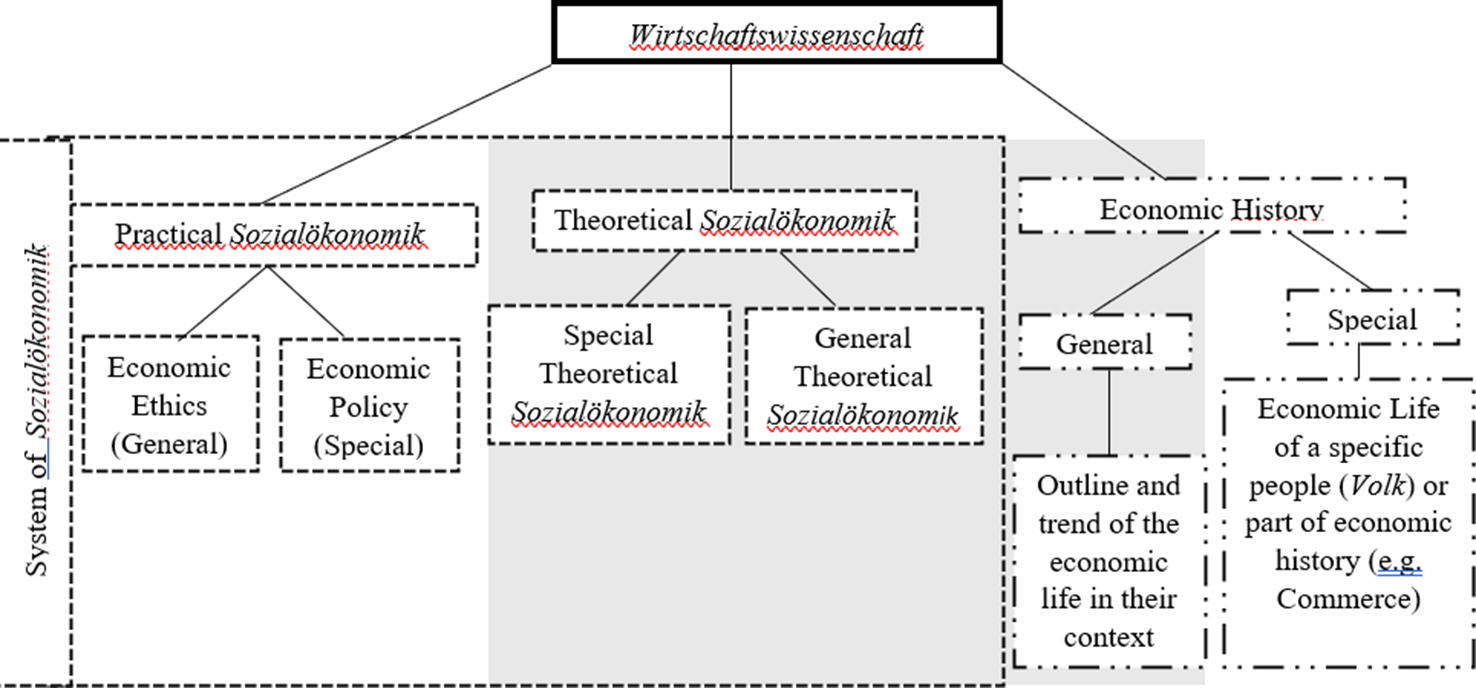
For Dietzel, economic ethics (Wirtschaftsethik) are part of ethics in general, and should study the ethical consequences of economic actions. They establish the “ought to be.” Economic policy (Wirtschaftspolitik), in its turn, is the attempt to change reality according to these ethical grounds, so that “what it is” can be shaped according to the “ought to be,” or “life according to the ideal” (Dietzel Reference Dietzel1895, p. 33). These two disciplines are part of practical Sozialökonomik, where the isolation method should not be used. In this sense, practical Sozialökonomik is not applied Sozialökonomik theory and their methods are completely distinct. Dietzel’s idea of Sozialökonomik can be seen in Figure 1.
Dietzel’s Understanding of Economic Knowledge.
*The gray area corresponds to what Dietzel (Reference Dietzel1895, p. 30) designated as the theoretical sciences of economic life. Source: Elaborated by the authors.

We can compare Dietzel’s ethical dimension of practical Sozialökonomik to the work of John Neville Keynes: “no one desires to stop short at the purely theoretical inquiry” ([1890] Reference Keynes1999, p. 26). Keynes was involved in the British Methodenstreit with the British Historical School,Footnote 20 which had similar discussions as the German one (Moore Reference Moore2003). Keynes, just as Mill, defended the deductive method in political economy; it was what made using economic hypotheses possible (Keynes ([1890] Reference Keynes1999, p. 100).
Therefore, Keynes isolated (positive) economic theory from normative economics and the art of economics, i.e., economic policy. Keynes followed Mill’s isolation method but rejected his stricter isolations, as well as Auguste Comte’s proposal of subsumption of economics into sociology (Moore Reference Moore2003, pp. 25–27). Similarly, he rejected Schmoller and other German historicists’ idea of economics as a “philosophy of economic history” (Keynes [1890] Reference Keynes1999, p. 147). The historical method is unreliable because it depends on flawed and non-existent sources, while a logical theory can provide better guidance independent of history.
However, continued Keynes, it is more productive to separate theory from ethical and practical questions; ethics would determine “economic ideals,” while the art of political economy would make practical “economic precepts” (Keynes [1890] Reference Keynes1999, p. 22). They are strictly independent of economics as a positive science (Keynes [1890] Reference Keynes1999, p. 32). Nevertheless, he did not dismiss these ethical questions from economic inquiry, for they matter to society as a whole (Keynes [1890] Reference Keynes1999, p. 40); they should be dealt with in a later stage, putting him close to Dietzel’s division of practical and theoretical. In addition, for Keynes, practical political economy cannot be dealt with merely as an application of theory, because theory cannot take into account ethical, social, and political questions, while they are necessary for several practical issues. Keynes used the same term as Dietzel for the first discipline: the “ethics of political economy,” a branch of applied ethics.Footnote 21 In its turn, the “art of political economy” is also called “economic policy” in Dietzel’s Sozialökonomik (see Figure 1).
Economic history in Sozialökonomik, Dietzel acknowledged, can be used to deal with theoretical questions, with its general (allgemeiner) and special (besonderer) parts.Footnote 22 However, in the end, he denied that economic history and economic theory have the same status, although both are part of theoretical study of economic phenomena. Furthermore, contrary to Sozialökonomik, economic history was not an independent discipline but only part of social history (Dietzel Reference Dietzel1895, p. 61), so its acceptance within Sozialökonomik was not complete: it cannot be understood fully as “theoretische Sozialökonomik” (Dietzel Reference Dietzel1895, p. 76). The role of economic history in Dietzel’s work was to verify and complement theoretical findings when needed. Furthermore, although the inductive method can use theoretical statements, if it is not done through the isolation method, it cannot be theoretical, like what Schmoller defended.
The questions presented here put Dietzel’s argument as a middle-term solution to the Methodenstreit. Despite denying the historicists’ definition of economics, like Schmoller’s, Dietzel tried to incorporate their ethical issues in his approach, while still saving space for deduction. Similar to Keynes, he sought to separate different domains in political economy, where different methods would be most useful depending on which part of economics is being considered, while avoiding subsuming economics into other disciplines or turning it into a science of everything. Furthermore, Dietzel’s Sozialökonomik embraced distinct perspectives and built a synthesis that, in his view, would preserve the most important insights of classical political economy. This is reinforced in his views on value theory, which already had suffered a severe attack from marginalists.
IV. DIETZEL’S IDEA OF VALUE
Value is another significant aspect of Dietzel’s thought and his defense of classical political economy. Unlike in previous discussions, the primary issue was not tied to the abstract/real dichotomy or the Methodenstreit. Instead, he aimed to defend the Ricardian theory of value against the critiques posed by marginalists. Nevertheless, the lack of a thorough explanation is again to be blamed for most of the confusion regarding the classicals’ ideas, especially Ricardo: “his hasty presentation of a fundamental doctrine is to be censured—but far more severe is the hasty criticism" (Dietzel Reference Dietzel1895, p. 229).
By Dietzel’s time, other attempts to develop a subjective theory of value advanced in Germany, in the works of Heinrich von Storch, Rau, Hermann, Peter Mischler, Lorenz von Stein, Albert Schäffle, Wagner, and Dietrich von Hildebrand, besides Menger himself; not all of them subscribed to marginalism (Priddat Reference Priddat1998; Harper and Endres Reference Harper and Endres2023). Dietzel would propose a reform of classical political economy without departing from its theoretical objectives. He defended the cost of production measurement of value, while accepting notions of marginal utility in some cases. In his words: “I believe that this riddle has since long been solved—that the problem of value, however in detail inadequate, has been overall answered definitively and invulnerably by Ricardo” (Dietzel Reference Dietzel1890, p. 562).Footnote 23
Dietzel directed his views on value mainly to Menger’s followers in Austria, especially Eugen von Böhm-Bawerk (Reference Böhm-Bawerk1886),Footnote 24 since they were the closest and best-known representatives of marginal utility theory in German-speaking countries. As Heinz Kurz (Reference Kurz and Steedman1995) showed, Böhm-Bawerk introduced marginalist theory in German economic journals, prompting several responses, including Dietzel’s, who used several arguments that critics of marginalism would later reiterate. Dietzel agreed that Ricardo had misunderstood the difference between value and utility when asserting that utility cannot be the measure of exchange value (see Kurz Reference Kurz and Steedman1995). Despite that, Ricardo was the correct starting point.
One initial issue that Dietzel tried to overcome was the antinomy between use and exchange value. “The one cause of the dispute between cost and utility theorists is the erroneous proposition of the contradiction or ‘antinomy’ between the utility of things … and their exchange value” (Dietzel Reference Dietzel1895, p. 206). According to Dietzel (Reference Dietzel1895, p. 207), this antinomy existed since the scholastics’ ethical economics, who pointed out that goods do not necessarily receive their just price (the principle of “to each according to his work”) or are exchanged by an objective intrinsic value but rather “according to the subjectively determined utility value.” This means there could be no equalization between exchange and use values, and the point was a normative one, an ideal price. Ricardo continued the antinomy while making the distinction between exchange and use values, but now with prices determined in the opposite way, through costs of production. Ricardo’s theory, however,
shed its ethical, normative character; it is purely theoretical. … Ricardo does not say that every good should be paid according to the amount of labor or cost necessary for its production, but simply asserts that the majority of goods and services are paid for in this way, provided that competition is free. (Dietzel Reference Dietzel1895, p. 208; emphasis added)
“The majority of goods” refers to reproducible goods. Here, we can see important points for Dietzel’s argument: the demarcation of theory as a field that should not encompass the explanation of all real possibilities, the distancing from normative postulates, and also the objective expression of the premises regarding the object of study—in this case, that price will have this behavior in a free competition system. To overcome this antinomy completely, Ricardo lacked the ability to see that costs determine exchange value, while it does not exclude utility, “since costs are synonymous with a loss of utility” (Dietzel Reference Dietzel1895, p. 208). He was aware that both utility and scarcity work simultaneously in the emergence of value (Dietzel Reference Dietzel1895, pp. 227–228), but failed to see their connection in its measurement.
Authors such as Nassau Senior, Mill, and Rau, continued Dietzel, had already surpassed the separation of the two types of value. The marginalists actually dealt the final blow to this idea (Dietzel Reference Dietzel1895, pp. 208–216). In sum, for Dietzel, marginalists were right in trying to reconcile use and exchange values. The solution, however, was not satisfactory: utility would determine use and exchange value from both reproducible and non-reproducible goods.
Dietzel sought to tackle the aforementioned challenges, particularly regarding the measurement of value, by clarifying what Ricardo meant. His solution involved incorporating all possibilities within his framework of Sozialökonomik while clearly defining its primary objective as theory. Concerning the antinomy between use and exchange value, ethical issues could be framed as matters of practical Sozialökonomik, distinguishing between ideal and real values (Dietzel Reference Dietzel1895, pp. 212–213). However, within the realm of theory, this opposition loses its significance.
In his theory, exchange and use value converge through the “economizing principle” (or principle of least means).
The practical behavior of man toward the goods (which our language describes as economizing) and the theoretical behavior (which it presents as the concept of cost in terms of value-estimation) are in the closest possible proximity. Economizing is only possible with the goods available in limited quantity to the subject—only the effort for such goods costs, only they are appreciated as value. (Dietzel Reference Dietzel1895, p. 218)
From this question of scarcity, he argued that having two goods costing the same amount (i.e., that, in order to be obtained, will inflict on him the same amount of effort pain) would cause one to choose the scarcest one, due to the higher possibility of not obtaining it in the future. This, argued Dietzel, brings together use and exchange values since now they are based in the same relation. Now, when measuring the cost of production, we measured use value, not merely exchange value.
This is valid only for scarce goods, since scarcity is a condition for value to exist. For Dietzel (Reference Dietzel1895, p. 219), goods that have unlimited supply have no value and therefore should not be the object of study of Sozialökonomik. However, there is an important distinction between reproducible and non-reproducible goods. These are the two categories of goods that, for Ricardo and Dietzel, justify two different measurements. The reproducible ones possess relative scarcity (when their availability diminishes, it is possible to partially or fully replace them), while the non-reproducible ones have absolute scarcity (i.e., they cannot be replaced by means of labor). It is in this latter case that there is space for a marginal utility theory, although reproducible goods are Dietzel’s main concern, and also Ricardo’s, according to Dietzel.
While reproducible goods have their value measured by the cost of their production alone, which represents the effort to produce them—something the buyer will have to compensate in order to acquire them—there is no such possibility for goods that cannot be reproduced or replaced after consumption. In this case, “this utility is lost as the means of reproduction are lacking; its size is measured by the subject making clear the relative importance of this utility” (Dietzel Reference Dietzel1895, p. 277). In the case of non-reproducible goods, given that there are different quantities of goods available, an individual would first acquire the one that brings them the most enjoyment, followed by the second one, until the one that brings them the least possible utility they are able to acquire. This, however, does not make non-reproducible goods disconnect from costs.
All goods are worth according to the costs that would occur in the event of loss … but the non-reproducible according to the costs which would arise in the light of the impossibility of reproduction. These [extra] costs exist because [in their consumption the] quantum of utility, which so far has been drawn from the very thing itself, is lost. (Dietzel Reference Dietzel1895, p. 293)
For Dietzel this goes in line with Ricardo’s statement that non-reproducible goods are governed by “wealth and inclinations of those who are desirous to possess them” (apud Kurz Reference Kurz and Steedman1995, p. 17), while reproducible goods are measured by costs.
In sum, utility as a measure for non-reproducible goods is not disconnected from costs (due to the costs associated with the impossibility of reproduction), and costs as a measure for reproducible goods are similarly tied to utility (due to the aforementioned link between costs and the loss of utility). Dietzel sought to reframe the classical economists, clarifying what he viewed as obscure points in order to mitigate the criticisms and the marginalist rupture. In his words, his objective, with his 1890 essay, was “reconciliation, at a synthesis of the two value theories that were on the warpath. … Unfortunately, the goal could not be achieved without polemics” (Dietzel Reference Dietzel1921, p. 107). He ultimately considered that the value problem distracted economists from other economic problems, claiming it “led many brilliant minds astray, minds that could have achieved far greater things and likely would have, had they not believed that this question was particularly worthy of the toil of the noble man” (Dietzel Reference Dietzel1921, p. 144).
From these words, we see that Dietzel’s personal concern was with what kind of questions economists should pay attention to. Koizumi (Mori Reference Mori and Takenaga2016), Kurz (Reference Kurz and Steedman1995), and Diego Guerrero (Reference Guerrero2005, p. 113) note that neoclassicals such as Jevons, Philip Wicksteed, and Marshall also did not believe they were in contradiction with classical political economy, just as Dietzel. His method, as demonstrated in this section, was different from theirs, though. Kurz (Reference Kurz and Steedman1995, p. 19) noted that his interpretation of Ricardo “had little in common with Ricardian analysis.” His conciliatory tone was not enough to provide foundations for a more “classical reformed” view of economics, as it became clear that marginalism advanced in all centers of economic research.
V. CONCLUSION
In this article, we presented some aspects of Heinrich Dietzel’s work. Dietzel is a forgotten author, especially outside Germany. His independent scholarship was enough for him to keep a stable job at Bonn but not enough to make him stand out more in the history of economic thought. His insistence in preserving classical political economy did not earn him many allies in German academia. He did end up attracting scholars who saw him as an example to be emulated, but they were either outside the German context (Koizumi, Subercaseaux) or saw his ideas as close to liberalism and predominantly subjectivist traditions (Eucken, Mises,Footnote 25 KirznerFootnote 26). And yet, his work made unique contributions to the nature of economic science, which influenced these aforementioned authors.
Analyzing his work, it is possible to show other perspectives towards political economy in a context dominated by the German-Austrian dichotomy. During this time, most of those authors were trying to rebuild the discipline by denying, in varying degrees, the foundations of classical political economy. Dietzel attempted to prove that, although there were some mistakes, most of the structure present in the work of authors such as Smith, Ricardo, Mill, and Say could provide foundations for a sound science of political economy.
His contribution is particularly relevant in the manner with which he dealt with the definition of each concept, in order to correctly demarcate the discipline (thereby avoiding trespassing on boundaries of other social sciences). In his own retrospective notes on his debates in the 1890s, he wanted both to criticize marginalists for their erroneous criticism of the classicals and to defend marginalism from being the target of their own unfair criticism (Dietzel Reference Dietzel1921, p. 107). This is also connected to how he thought one should understand economic theory detached from every other social phenomenon and what questions should matter for an economist.
Standing between the German Historical School, the Austrians, and the classical political economy, he created his own approach, his own path. He walked this path alone, though. Dietzel was embedded in a context of important discussions between different approaches (historicism, marginalism, and classical political economy). If pluralism is the belief that all approaches to political economy can bring something new to it, then Dietzel applied this principle to his work when he assumed that different methods could be used to study economic phenomena, although he was committed to a correct manner of doing so. Wagner taught him to doubt Schmoller’s radical method but also to absorb his qualities, such as concerns with ethical propositions. From classical political economy and Menger, he inherited the need to universalize propositions that were not limited to just a single culture. When we analyze his work more closely, we see a great deal of unique discussion, concerned to understand the economic reality rather than promote the flag of a school, and to bear the cost of doing so.
COMPETING INTERESTS
The author declares no competing interests exist.