1. Introduction
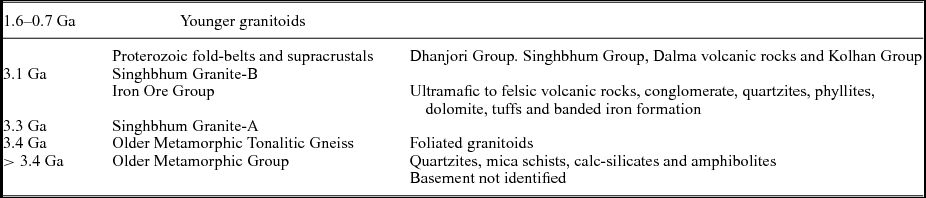
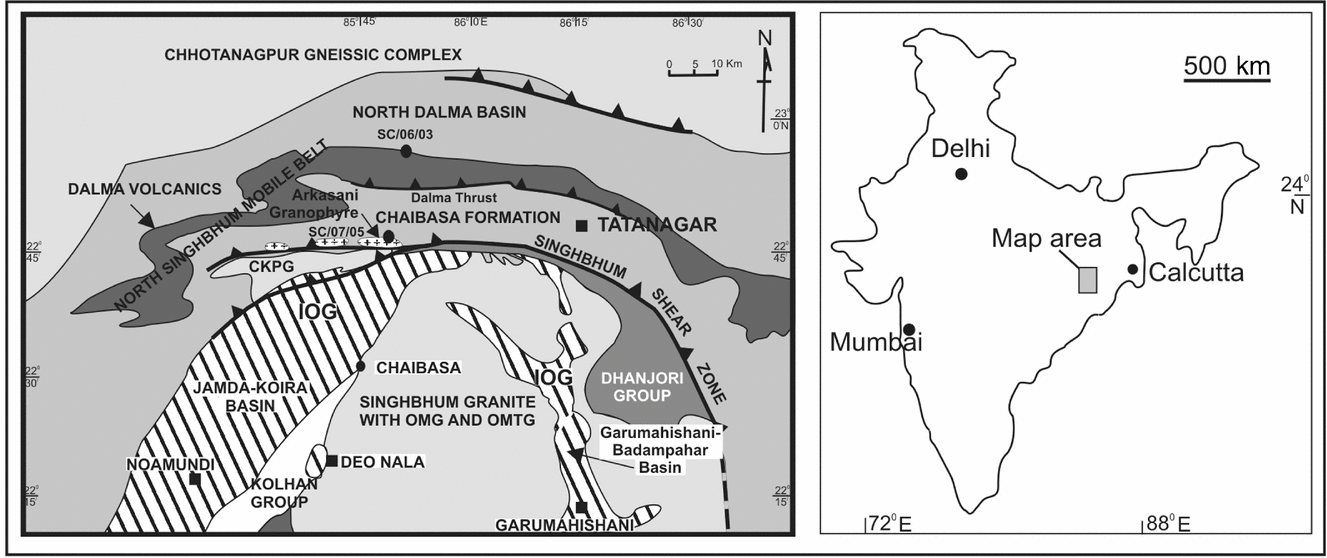
The eastern segment of the Indian Precambrian Shield, commonly referred to as the Singhbhum Protocontinent, preserves a record of geological events spanning early Archaean – late Proterozoic time (Saha, Reference Saha1994; Sarkar & Gupta, Reference Sarkar and Gupta2012). The early Archaean Singhbhum Craton (Sarkar & Saha, Reference Sarkar, Saha and SinhaRoy1983) comprises tonalite-trondhjemite-granodiorite and middle–late Archaean supracrustal volcano-sedimentary greenstone belt successions (IOG) that have been intruded by late Archaean granites. A Proterozoic thrust–fold belt, the North Singhbhum Mobile Belt (cf. Gupta, Basu & Ghosh, Reference Gupta, Basu and Ghosh1980; Mukhopadhyay, Reference Mukhopadhyay1984; Sarkar, Gupta & Basu, Reference Sarkar, Gupta, Basu and Sarkar1992; Fig. 1), occurs between the Archean Singhbhum Craton in the south and the Chhotanagpur Granite Gneissic Complex in the north. The North Singhbhum Mobile Belt (NSMB) is a nearly 200 km long and 50 km wide curvilinear orogenic belt (Fig. 1). In the east, the belt has a general north–south trend, which gradually changes to east–west in the central part and NE–SW in the west (Fig. 1). The NSMB is regarded as a Proterozoic rift basin (Bhattacharya & Mahapatra, Reference Bhattacharya and Mahapatra2008) that developed along a major suture zone (Sarkar & Saha, Reference Sarkar, Saha and SinhaRoy1983). Rifting produced Dhanjori, Chaibasa, Dalma and North Dalma sub-basins with distinctly different petrotectonic evolutionary histories, juxtaposed as linear domains during a terminal orogeny (Mukhopadhyay, Reference Mukhopadhyay1984; Sarkar, Gupta & Basu, Reference Sarkar, Gupta, Basu and Sarkar1992). The contacts between such linear domains are sheared with north-dipping shear planes. A simplified stratigraphy of the terrane is provided in Table 1.
Generalized stratigraphy of Singhbhum, east India.

Geological map of North Singhbhum Mobile Belt (NSMB), showing the occurrences of Arkasani Granophyre, Dalma volcanic rocks and Singhbhum Shear Zone. Sample locations for geochronological analyses and other important stratigraphic units are also shown in the map. The location of the study area is shown in the map of India.

The southern margin of the NSMB is marked by a curved zone of intense shearing, 1–10 km wide and over 200 km long, known as the Singhbhum Shear Zone (SSZ) (Fig. 1) which separates the Chaibasa Formation of the Singhbhum Group and the Dhanjori Group (Saha, Reference Saha1994). The SSZ becomes bifurcated in the west, with the Chakradharpur Granite (CKPG) coming in between the two branches (Fig. 1). The shear planes in the shear zone dip at 45° or less towards the north. Several granite lenses were emplaced along the shear zone (Dunn & Dey, Reference Dunn and Dey1942). The shear zone was active during a prolonged period and is characterized by repeated cycles of mylonitization, folding and down-dip rotation/stretching of pre-existing structures, indicating ductile shearing (Sengupta & Ghose, Reference Sengupta and Ghose1997). Truncation of stratigraphic units in the zone lying between Kudada and Saraikela indicates thrusting along the Singhbhum Shear Zone (Bhattacharya & Mahapatra, Reference Bhattacharya and Mahapatra2008). Metamorphism close to the shear zone further suggests crustal thickening due to thrusting (Mahato et al. Reference Mahato, Goon, Bhattacharya, Misra and Bernhardt2008). The SSZ therefore records both ductile shearing and thrusting during the closure of the Dhanjori and Chaibasa sub-basins.
Five different tectonic models have been proposed to explain the evolution of the NSMB. Three of these models are based on principles of plate tectonic (Sarkar & Saha, Reference Sarkar and Saha1977; Bose & Chakraborti, Reference Bose and Chakraborti1981; Sarkar, Reference Sarkar1982; Bose, Chakrabarti & Saunders, Reference Bose, Chakrabarti and Saunders1989), drawing analogues from Phanerozoic crustal segments. The fourth model proposes intracratonic extension and ensialic orogenesis with or without reference to an early stage of a Wilson Cycle (Gupta, Basu & Ghosh, Reference Gupta, Basu and Ghosh1980; Mukhopadhyay, Reference Mukhopadhyay1984; Sarkar, Gupta & Basu, Reference Sarkar, Gupta, Basu and Sarkar1992; Gupta & Basu, Reference Gupta and Basu2000; Sarkar, Reference Sarkar2000). The fifth model (Bhattacharya & Mahapatra, Reference Bhattacharya and Mahapatra2008) emphasizes sedimentological aspects of the sub-basins and proposes the formation of younger basins along the margins of the main rift and their collapse during a terminal orogeny. As a result of this south-directed terminal orogenic movement, the Chhotonagpur Granite Gneissic Complex in the north overrode the NSMB along a thrust, and the NSMB was driven onto the Archean cratonic block lying to the south.
The Dhanjori and Chaibasa sub-basins of the NSMB may have developed during reactivation of regional curved faults that were formed during doming of the Archean craton as a result of the emplacement of granite sheets (Roy & Bhattacharya, Reference Roy and Bhattacharya2012).
The findings of the present study indicate that the NSMB does not form a single regional rift basin, as was conceived in proposed models, but instead consists of separate basins that developed over a considerable time period. The present paper integrates a stratigraphic, sedimentologic, structural and tectonic database with precise SHRIMP U–Pb zircon dates to present a new and comprehensive model for the evolution of the NSMB.
2. Arkasani Granophyre
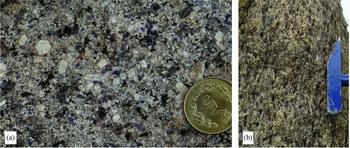
At least seven isolated lens-shaped granitic bodies, known as the Arkasani Granophyre, were emplaced well within the mylonitized metasediments of the NSMB, forming the northern branch of the forked Singhbhum Shear Zone in the north of CKPG-Gneissic Complex (Fig. 1). The largest body forms the Arkasani Hill. These granitic bodies were first mapped by Dunn (Reference Dunn1929) and later studied by Banerjee, Bhattacharya & Chattaopadhyay (Reference Banerjee, Bhattacharya and Chattaopadhyay1978), Sengupta et al. (Reference Sengupta, Bandyopadhyay, Van Den Hul and Chattopadhyay1984) and Chattopadhyay (Reference Chattopadhyay1990). The cores of these granite bodies are generally massive and porphyritic (Fig. 2a), but they are schistose near their peripheries (Fig. 2b). Schistosity is more pervasive in the smaller bodies. Near their margins, these granitic bodies commonly contain enclaves of mica-schist and schistose amphibolites. Sengupta et al. (Reference Sengupta, Bandyopadhyay, Van Den Hul and Chattopadhyay1984) reported a Rb–Sr whole-rock isochron date of 1.0 Ga, interpreted as the time of a post-emplacement thermal event, for the Arkasani Granophyre.
Field photographs of (a) porphyritic variety and (b) schistose variety of Arkasani Granophyre. Schistosity is defined by biotite/muscovite flakes and flattened and recrystallized quartz grains forming quartz ribbons (QR).

The Arkasani Granophyre is a medium- to coarse-grained porphyritic rock with phenocrysts of plagioclase (An22–An35) commonly occurring as clusters or cumulates. The groundmass contains sodic plagioclase (An2–An15), K-feldspar, greyish quartz, biotite and muscovite as the major minerals, with accessory tourmaline, epidote, zircon, apatite, titanite and magnetite. The grain size is commonly reduced towards the body margins. The groundmass shows intergrowth texture, mostly granophyric with myrmekitic and micro-pegmatitic variations. The proportion of granophyric intergrowth in these granite bodies commonly increases towards their margins. Along the margins the granite bodies are schistose, with the schistosity defined by flattened and recrystallized quartz grains with wavy extinction forming quartz ribbons, and parallel-aligned biotite and muscovite flakes (Fig. 2b).
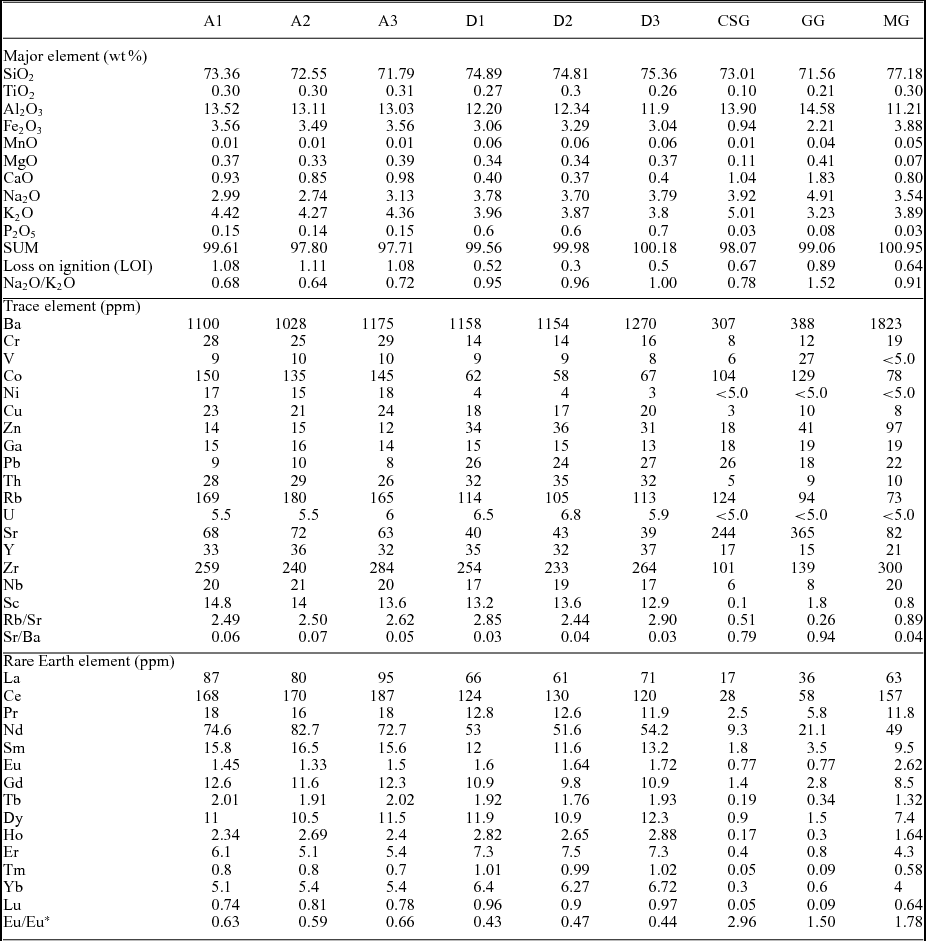
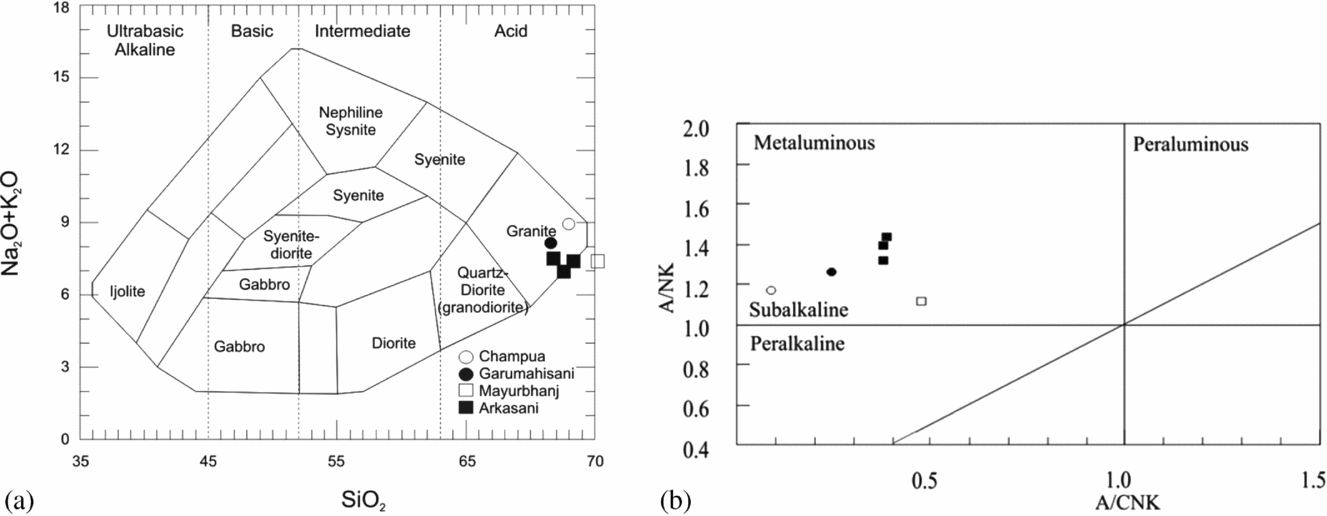
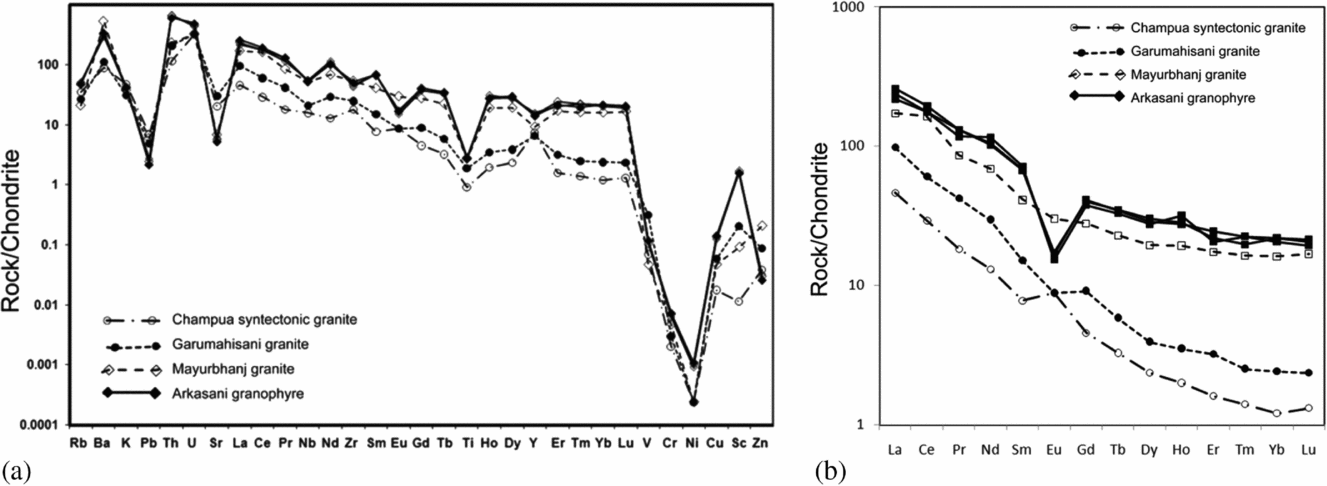
Major, trace and rare Earth element (REE) chemical compositions of the Arkasani Granophyre, obtained at the Wadia Institute of Himalayan Geology by inductively coupled plasma mass spectrometry (ICP-MS; Khanna et al. Reference Khanna, Saini, Mukherjee and Purohit2009), are presented in Table 2. Bulk chemical compositions of granitic rocks that have intruded the Older Metamorphic Group at Champua, Garumahisani Granite and Mayurbhanj Granite are also listed in Table 2 for comparison. The SiO2 content of the Arkasani Granophyre lies within the range 71.79–73.36 wt%, K2O exceeds Na2O and the Ba and U contents are exceptionally high. Plots in the SiO2 v. Na2O+K2O classification diagram (after Cox, Bell & Pankhurst, Reference Cox, Bell and Pankhurst1979) show the granitic character of the Arkasani Granophyre (Fig. 3a), whereas plots in the A/NK (molecular proportion of Al2O3/Na2O + K2O) v. A/CNK (molecular proportion of Al2O3/CaO + Na2O + K2O) diagram (after Maniar & Piccoli, Reference Maniar and Piccoli1989) reveal its metaluminous character (Fig. 3b). Plots of chondrite-normalized trace elements show prominent negative Sr, P, Ti and V anomalies (Fig. 4a). Chondrite-normalized REE plots (Fig. 4b) show an unfractionated pattern ([La/Yb]uc = 2.04–2.42) with slight enrichment in the light REEs (LREEs) relative to heavy REEs (HREEs), and a prominent negative Eu anomaly (Eu/Eu* = 0.59–0.67).
Major element, trace and rare Earth element composition of Arkasani Granophyre and other granites of the Singhbhum region.

A1–A3 – Arkasani Granophyre; D1–D3 – Dalma felsic volcanic rocks; CSG – Champua syn-tectonic granite; GG – Garumahisani granite; MG – Mayurbhanj granite.
(a) Na2O+K2O/SiO2 variation plots of Arkasani Granophyre (after Cox et al. Reference Cox, Bell and Pankhurst1979), showing the granitic character of the intrusion. (b) Alumina saturation (Shand index) diagram for the studied Arkasani Granophyre (modified after Maniar & Piccoli, Reference Maniar and Piccoli1989).

(a) Trace element spider diagram, normalized by chondrite values of Arkasani Granophyre, after Sun & McDonough (Reference Sun, McDonough, Saunders and Norry1989). (b) REE distribution patterns normalized by chondrite values of Arkasani Granophyre, after Boynton (Reference Boynton and Henderson1984).

The porphyritic texture of the Arkasani Granophyre reflects early growth of feldspar crystals during slight cooling of the magma, followed by finer grains resulting from more rapid cooling due to shallow emplacement. The granophyric texture indicates rapid and simultaneous crystallization of quartz and K-feldspar from an under-cooled magma at shallow depth (Clarke, Reference Clarke1992). Flattened quartz grains with wavy extinction and parallel-aligned biotite and muscovite flakes defining schistosity are likely responses to syn- to post-kinematic emplacement (see also Sarkar & Gupta, Reference Sarkar and Gupta2012). Apatite, zircon and magnetite grains are euhedral, consistent with their primary nature (Clarke, Reference Clarke1992). These minerals form the majority of inclusions in other minerals.
The relatively constant K2O/Na2O and K2O > Na2O of the Arkasani Granophyre indicate differentiation of magma generated from a single source (Jung et al. Reference Jung, Hoernes, Masberg and Hoffer1999), whereas Ti/P ratios near 2 and the negative Nb anomaly suggest a shallow crustal source. Rb/Sr (2.48–2.61) and low Sr/Ba (0.05–0.07) ratios are the result of early crystallization of plagioclase from the melt during fractional crystallization. The negative Sr and Eu anomalies (Fig. 4a, b) are consistent with early plagioclase fractionation (Rollinson, Reference Rollinson1993). Prominent Zr, P2O5, TiO2 and V anomalies possibly reflect crystallization/removal of accessory minerals such as rutile, apatite, zircon and magnetite from the melt.
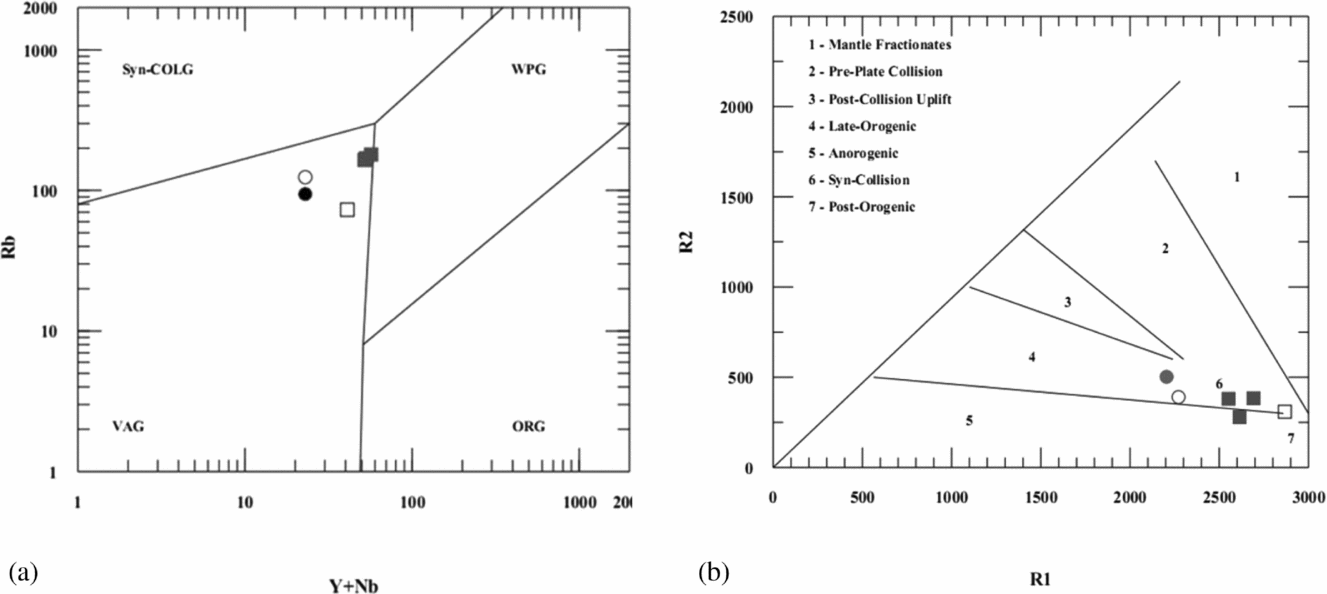
High K contents, low Ti/P ratios, the negative Nb anomaly and unfractionated HREE (and Y) lend strong support in favour of the melting of a metaluminous shallow crustal source for the generation of Arkasani Granophyre (see also Sengupta et al. Reference Sengupta, Bandyopadhyay, Van Den Hul and Chattopadhyay1984). Rb v. Y+Nb plots (Fig. 5a) after Pearce, Harris & Tindale (Reference Pearce, Harris and Tindale1984) show that the Arkasani Granophyre has some geochemical similarities to recent volcanic arc granites with proximity to within-plate granite. The R1 (4Si–11(Na+K)–2(Fe+Ti) v. R2 (6Ca+2Mg+Al) diagram (Fig. 5b) after Batchelor & Bowden (Reference Batchelor and Bowden1985) shows that the Arkasani Granophyre samples plot in the syn-collisional to post-orogenic granite field.
(a) Geotectonic discrimination diagram after Pearce, Harris & Tindale (Reference Pearce, Harris and Tindale1984). (b) Geotectonic regimes discrimination diagram after Batchelor & Bowden (Reference Batchelor and Bowden1985). R1 = 4Si–11(Na+K)–2(Fe+Ti); R2 = 6Ca+2Mg+Al. Symbols as for Figure 3.

In summary, field, petrographic and geochemical characteristics of the Arkasani Granophyre indicate that the parent magma was derived by low degrees of partial melting of upper crustal material and was emplaced along the Singhbhum Shear Zone during a late phase of an orogenic movement.
3. Dalma volcanic rocks
The Dalma volcanic suite and intercalated sediments constitute the Dalma Belt which forms an east–west range along the middle of the NSMB. The belt is composed of interlayered carbonaceous shales, cherts and felsic and mafic volcanic rocks that grade upwards to high-Mg komatiitic flows and pyroclastics. This volcano-sedimentary succession is followed upwards by pillowed low-K, high-Mg tholeiites. The succession is deformed into a synclinal structure, with the lower horizons exposed along the flanks of the east–west range of hills. The felsic volcanic rocks exposed near the downstream side of the Chandil Dam on the Subarnarekha River (Fig. 6) were sampled for geochronological study (see the following section).
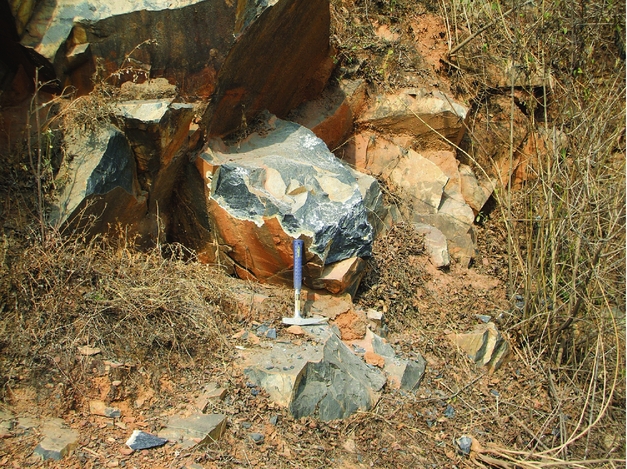
Field photograph of felsic volcanic rocks of Dalma volcanic suite, southern bank of Subarnarekha River, near Chandil dam.

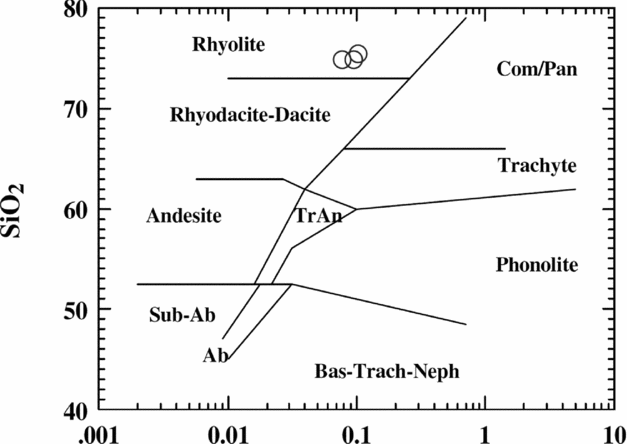
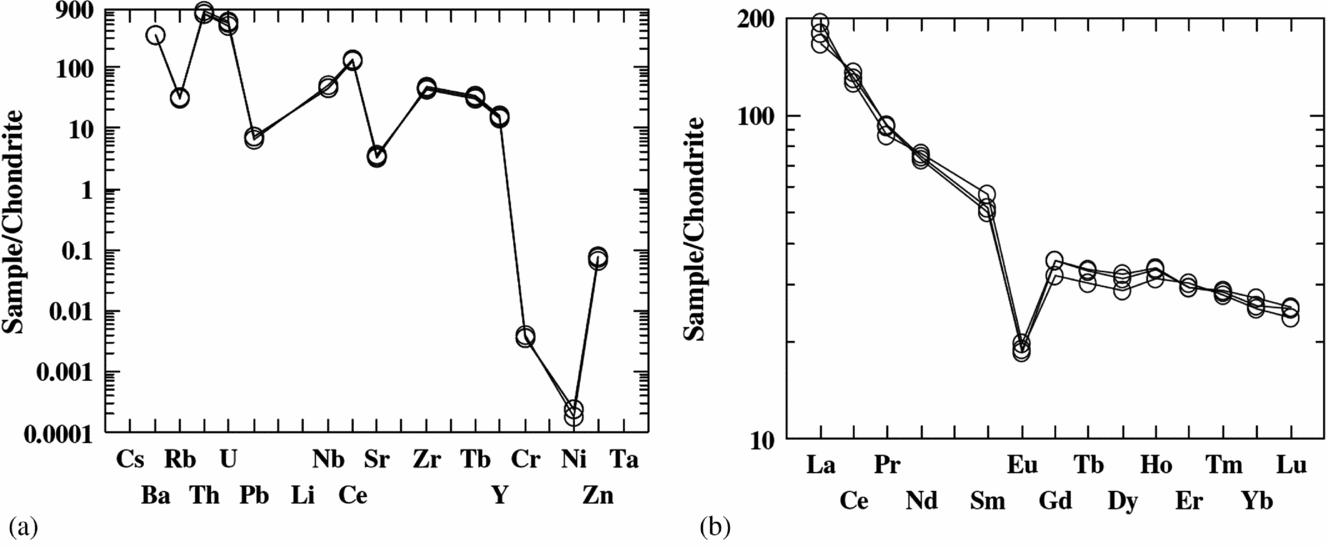
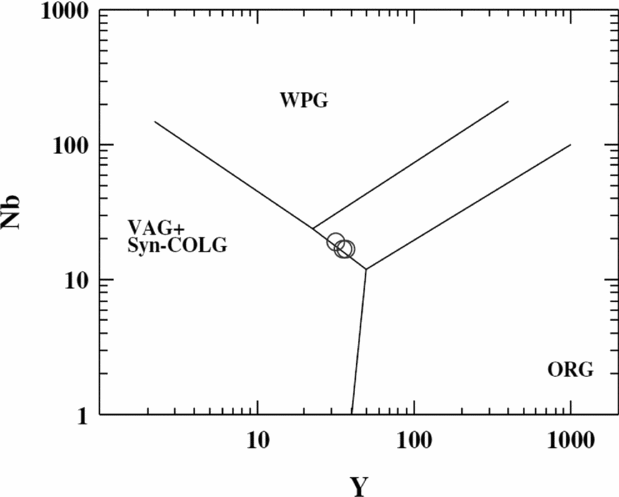
Major, trace and REE chemical compositions of the felsic volcanic rocks, obtained at the Wadia Institute of Himalayan Geology by X-ray fluorescence (XRF) and ICP-MS (Khanna et al. Reference Khanna, Saini, Mukherjee and Purohit2009), are listed in Table 2. The felsic volcanic rocks have high concentrations of SiO2 and K2O+Na2O and lower abundances of TiO2, Al2O3, MgO, CaO and P2O5. The felsic volcanic rocks fall in the rhyolite field of SiO2 v. Zr/TiO2 × 0.0001 classification diagram of Winchester & Floyd (Reference Winchester and Floyd1977) (Fig. 7). In general, the felsic volcanic rocks display the typical geochemical characteristic of A-type granitoids with high SiO2, Na2O+K2O, Fe2O3, MgO, Ga/Al, Zr, Nb, Ga, Y and REE (except Eu), and low CaO and Sr (Eby, Reference Eby1990; Bonin, Reference Bonin2007). A chondrite-normalized trace element plot (Fig. 8a) shows enrichment in Ba, Th, U, Nb and Zr and depletion in Pb, Sr, Co and Ni. Chondrite-normalized REE patterns of the felsic volcanic rocks (Fig. 8b) show large negative Eu anomalies (Eu/Eu* = 0.43–0.47) and fractionated and enriched LREE over HREE. Rb/Sr (2.44–2.90), low Sr/Ba, low Sr and large Eu anomalies suggest early separation of plagioclase or retention of these elements in feldspar at the source during partial melting (Rollinson, Reference Rollinson1993), whereas low contents of Zr, P2O5, TiO2 and V supports early crystallization and separation of rutile, apatite, zircon and magnetite from the melt. The felsic volcanic rocks also plot in the within-plate tectonic setting field in Nb v.Y tectonic discrimination diagram (after Pearce, Harris & Tindale, Reference Pearce, Harris and Tindale1984; Fig. 9).
SiO2 v. Zr/TiO2×0.0001 plots of felsic volcanics, Dalma volcanic suite, showing their rhyolitic character (after Winchester & Floyd Reference Winchester and Floyd1977).

(a) Trace element spider diagram, normalized by chondrite values of the studied felsic volcanic rocks, after Sun & McDonough (Reference Sun, McDonough, Saunders and Norry1989). (b) REE distribution patterns normalized by chondrite values of the studied felsic volcanics, after Boynton (Reference Boynton and Henderson1984).

Log Nb v. Log Y plots of Dalma felsic volcanic rocks, after Pearce, Harris & Tindale (Reference Pearce, Harris and Tindale1984). Syn-Colg – syn-collision granite; VAG – volcanic arc granite; WPG – within-plate granite; ORG – ocean ridge granite.

The A-type granitoid chemistry of the felsic volcanic rocks lends support to a non-orogenic rift setting (Barbarin, Reference Barbarin1990). Further, their overall geochemical signatures favour their generation by low degrees of crustal melting in an extensional tectonic setting under the influence of advecting mafic–ultramafic magma (also see Roy et al. Reference Roy, Sarkar, Jeyakumar, Aggrawal and Ebihara2002; Sarkar & Gupta, Reference Sarkar and Gupta2012).
4. Geochronology
Sample SC07/5 was taken from the Arkasani Granophyre for geochronology from a 1 m diameter boulder located c. 20 m up on the SE side of the forested slopes of Arkasani Hill, on the track to the Arkasani Temple (sampling site coordinates 22°46′11″N, 85°51′20″E). Dark grey to black, unfoliated felsic volcanic rocks occur at the base of the Dalma volcanic succession. Sample SC06/3 was taken from a steep rocky outcrop (Fig. 6) on the left side of the access road to the Subernarekha River road bridge crossing, 250 m SSE (downstream) of the Chandil Dam wall (22°58′11.5″N; 86°01′16.0″E). The felsic volcanic rocks at this site are homogeneous and aphanitic and contain rare, 1 mm thick, whitish quartz veins (not included in the sample processed). The sample is microfelsitic (in places, spherulitic) to vitrophyric and contains subhedral to anhedral phenocrysts of quartz and sodic plagioclase with accessory biotite, partly replaced by iron oxides, zircon, titanite and tourmaline. The phenocrysts are set in a cryptocrystalline groundmass, at places glassy with variable degree of devitrification. No evidence of flow layering is evident in thin-section.
Crushing and screening of samples was undertaken at Presidency University, Kolkata. Heavy minerals were isolated from 0.5 kg of sample using conventional heavy-liquid and magnetic techniques. Representative zircons were hand picked, mounted in epoxy and sectioned approximately in half, and the mount surface was then polished to expose the grain interiors. U, Th and Pb isotopic measurements were taken using the Perth Consortium SHRIMP II instrument employing operating and data processing procedures similar to those described by Compston, Williams & Meyer (Reference Compston, Williams and Meyer1984) and Williams et al. (Reference Williams, Compston, Black, Ireland and Foster1984). Pb/U ratios were determined relative to that of the zircon standards CZ3 and Temora, which have been assigned 206Pb/238U values of 0.0914 and 0.066783 corresponding to 206Pb/238U dates of 564 Ma and 417 Ma, respectively. Data processing and plot generation were undertaken using the generalized ion-microprobe data processing software package CONCH (Nelson, Reference Nelson2006).
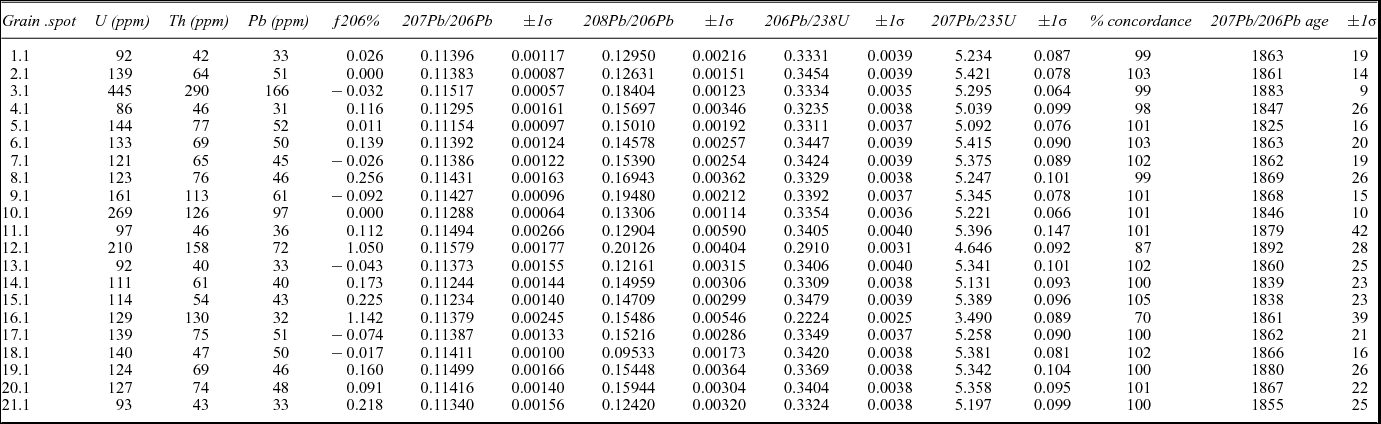
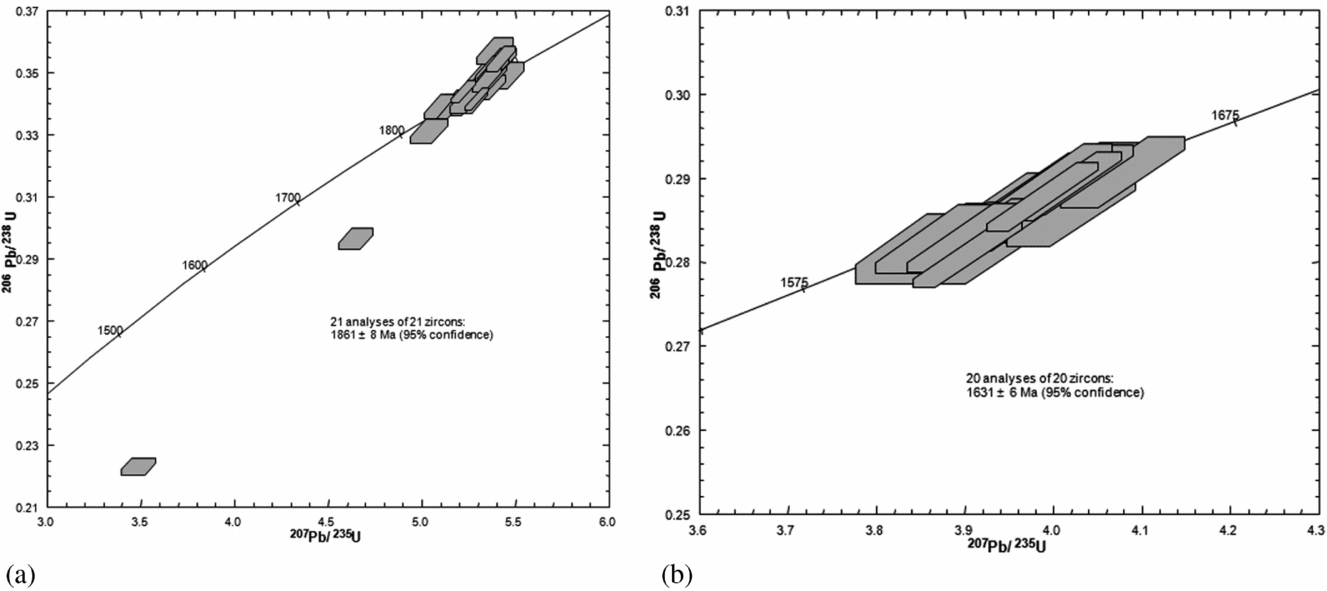
For the Arkasani Granophyre (sample SC07/05), 21 analyses were obtained of 21 zircons (Table 3; Fig. 10a). Most analyses are concordant within uncertainty, although two analyses indicating high common-Pb contents (12.1 and 16.1) plot along a zero-age discordia line. The population weighted mean 207Pb/206Pb ratio and uncertainty correspond to a date of 1861±8 Ma (chi squared = 0.83). This is interpreted as corresponding to the time of igneous crystallization of the granophyre. As the Arkasani Granophyre occurs as massive pods and lenses within and aligned along the Singhbhum Shear Zone, and these lenses are only weakly deformed around their margins, the date of 1861±8 Ma is interpreted as providing the time of the final stages of major tectonic displacement along the Singhbhum Shear Zone.
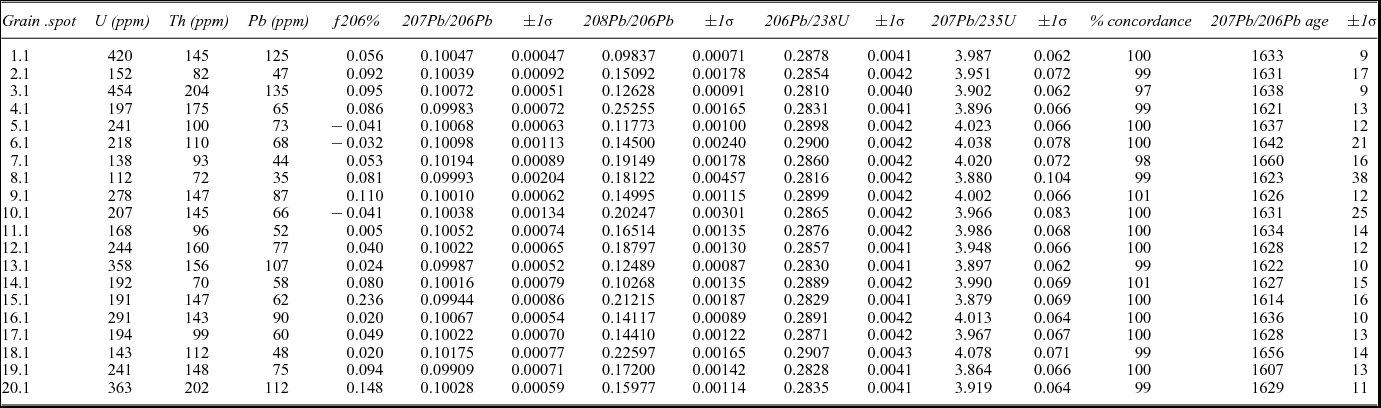
Ion microprobe analytical results for sample SC07/5: Arkasani Granophyre.

(a) Wetherill Concordia diagram for sample SC07/05: Arkasani Granophyre. (b) Wetherill Concordia diagram for sample SC06/03: felsic volcanic rocks, Dalma volcanic suite.

All 20 analyses obtained for zircons from the felsic volcanic rocks from the base of the Chandil Formation (SC06/03) are concordant within uncertainty (Table 4; Fig. 10b). The population weighted mean 207Pb/206Pb ratio and uncertainty correspond to a date of 1631±6 Ma (chi squared = 0.71). This is interpreted as corresponding to the time of igneous crystallization of the felsic volcanic rocks and the timing of initiation of volcanism in the Dalma sub-basin.
Ion microprobe analytical results for sample SC06/3: felsic volcanic rocks of Dalma volcanic suite

5. Discussion
It has been established that NSMB is a collage of sedimentary and volcano-sedimentary successions that were developed in fault-controlled sub-basins in a regional rift basin that was closed during the Northern Singhbhum Orogeny (Bhattacharya & Mahapatra, Reference Bhattacharya and Mahapatra2008; Sarkar & Gupta, Reference Sarkar and Gupta2012). The Dhanjori, Chaibasa and Dhalbhum formations, along with the Dalma volcanic and North Dalma volcano-sedimentary successions, have been juxtaposed as curved linear belts within the NSMB. The contacts of these sub-basin ensembles are tectonized (see Saha, Reference Saha1994; Bhattacharya & Mahapatra, Reference Bhattacharya and Mahapatra2008; Sarkar & Gupta, Reference Sarkar and Gupta2012) and the times of opening and closure of these sub-basins are not yet firmly established. The Singhbhum Shear Zone separates the Chaibasa Formation from the Dhanjori Formation and movement along the shear zone may also have resulted in the closure of the Dhanjori and Chaibasa sub-basins. The history of sedimentation (Bhattacharya & Mahapatra, Reference Bhattacharya and Mahapatra2008), deformation (Sengupta & Ghose, Reference Sengupta and Ghose1997) and metamorphism (Mahato et al. Reference Mahato, Goon, Bhattacharya, Misra and Bernhardt2008) indicates development of this shear zone over a prolonged period of time that must have begun long before the intrusion date of 1861±8 Ma of the Arkasani Granophyre.
The Arkasani Granophyre evolved through fractional crystallization of a metaluminous felsic magma generated at shallow crustal level and emplaced as numerous isolated bodies aligned along the Singhbhum Shear Zone. Development of schistosity in the Arkasani Granophyre, particularly along the intrusion margins, and the geochemical character of Arkasani Granophyre indicates its syn- to post-kinematic emplacement. The SHRIMP U–Pb zircon date of 1861±6 Ma for the Arkasani Granophyre therefore provides a minimum age for the shearing/thrusting along the Singhbhum Shear Zone and for the time of closure of the Chaibasa and Dhanjori sub-basins.
Singhbhum Shear Zone hosts minable Cu–P and U mineralizations. Cu–P and U mineralization occurrences are genetically unrelated and U mineralization might have been superimposed on Cu–P mineralization (Sarkar & Gupta, Reference Sarkar and Gupta2012). The 1.882±23 Ma uraninite and 1.885±31 Ma monazite dates (U–Pb dates by ICP-MS laser ablation) reported by Pal et al. (Reference Pal, Chaudhuri, McFarlane, Mukherjee and Sarangi2011) and the date of 1861±6 Ma reported here for the Arkasani Granophyre do not support any genetic linkage between granophyre emplacement and ore mineralization. Arkasani Granophyre emplacement might have been preceded by Cu–P and U mineralizations.
The SHRIMP U–Pb zircon date of 1631±6 Ma obtained for the felsic volcanic rocks of the Dalma sub-basin in the north of the Chaibasa sub-basin corresponds to a younger basin formation event that post-dates the orogenic movement responsible for closure of the Chaibasa and Dhanjori sub-basins.
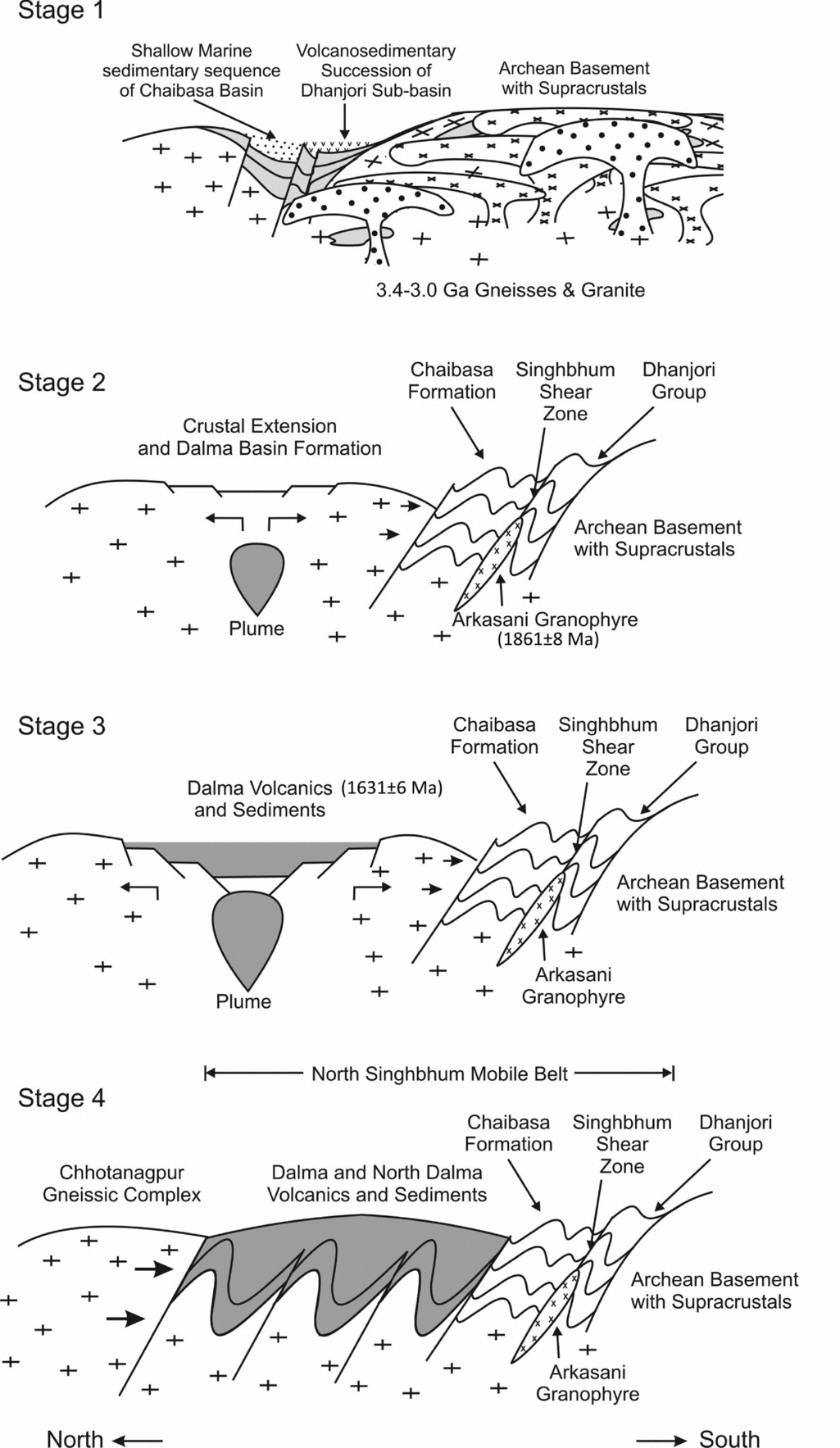
The new age data indicate that the evolution of adjacent sub-basins within the NSMB is complex, occurring at different times and by unrelated orogenic movements. Further, it seems evident that the younger sub-basins formed further north away from the Archaean basement, and that the accretion of these basin ensembles onto Archaean basement was episodic. Domal exhumation of the Archean granitoid basement due to episodic emplacement of granite sheets during 3.4–3.0 Ga may have resulted in development of peripheral curved fault systems and down-sagging of banded-iron-formation (BIF) -bearing IOG basins (Roy & Bhattacharya, Reference Roy and Bhattacharya2012). Movements along such Archean shear planes might have been responsible for the formation of Proterozoic basins skirting the Archean craton (see Roy and Bhattacharya, Reference Roy and Bhattacharya2012). The Dhanjori and Chaibasa sub-basins to the north of the Archean basement may be manifestations of such a process. The curved outcrop pattern of these two sub-basins is consistent with their development by the reactivation of ancient (Archean) curved fault systems. Closure and accretion of these two sub-basins on the Archean basement complex took place around 1861±6 Ma, as indicated by the age of emplacement of syn- to post-kinematic emplacement of Arkasani Granophyre. The SSZ, presently defining the contact between Chaibasa and Dhanjori sub-basins, might be related to ancient fault systems that were reactivated during closure of the two sub-basins. The mafic-felsic Dalma volcanic sequence and associated sediments developed in an extensional basin that formed at least 200 Ma after the closure of the Dhanjori–Chaibasa sub-basin and its accretion onto the Archean basement complex. An evolution model for the NSMB is summarized in Figure 11.
The evolution of the NSMB. (a) During stage 1 (late Archean – early Proterozoic), Dhanjori and Chaibasa sub-basins were formed as a result of reactivation of the early fault system developed skirting the central Archean block due to granite emplacement and doming. (b) During stage 2 (c. 1861 Ma), the Dhanjori and Chaibasa sub-basins were collapsed and accreted on the southern Archean block with the development of the Singhbhum Shear Zone and emplacement of the Arkasani Granophyre along the shear zone. Development of a zone of crustal extension in the north, under the influence of an uprising plume (see Roy et al. Reference Roy, Sarkar, Jeyakumar, Aggrawal and Ebihara2002), led to the compression which caused the collapse of the Dhanjori and Chaibasa sub-basins. (c) During stage 3 (c. 1631 Ma), the Dalma volcanic suite and the associated sediments were deposited in the extensional rift basin after the plume burst. (d)The ensembles of the Dalma sub-basin were juxtaposed on the Dhanjori and Chaibasa sub-basinal rocks after a later terminal orogeny during stage 4.

The results obtained in the present study suggest that the different sub-basins in the NSMB did not evolve simultaneously within a regional rift system, as conceived in earlier models. Instead, the formation and closure of these basins took place diachronously. Late orogenic movement was responsible for juxtaposition of the sub-basins to form the NSMB. The present model also explains the curved pattern of the orogenic belt and the distinctly different petrotectonic evolutionary histories of the sub-basins.
Acknowledgements
We are grateful to Dr Subhasis Sengupta, Dr Saumitra Misra and Dr Nilanjan Dasgupta for their help during the different phases of fieldwork. We also thank Mr Kaushik Kiran Ghosh, who drafted some of the figures. We wish to acknowledge the technical support provided by Tarak Pradhan at Presidency University. Finally, we extend our sincere gratitude to anonymous reviewers for their constructive suggestions.