



Introduction
Although there is no universally agreed upon definition, Dufault and Martocchio (Reference Dufault and Martocchio1985) put forward that hope can be defined as “a multidimensional dynamic life force characterized by a confident yet uncertain expectation of achieving a future good which […] is realistically possible and personally significant.” In their model, they identified two types of hope, generalized and particularized hope, and listed six dimensions underlying hope, namely the affective, cognitive, behavioral, affiliative, temporal, and contextual dimensions (Geiser et al., Reference Geiser, Zajackowski and Conrad2015). Hope is crucial when facing an illness and when preparing for death (Miller, Reference Miller2007; Kylmä et al., Reference Kylmä, Duggleby and Cooper2009). Due to its importance, the study of hope in the oncological context has increased during the last few years and it has been found to be an effective resource under circumstances of loss and suffering (Ebright and Lyon, Reference Ebright and Lyon2002; Chi, Reference Chi2007). According to these studies, hope provides the adaptability to cope with stressful situations and achieve desired outcomes. Hope is positively associated with patients’ quality of life, self-esteem, coping, physical well-being, and their level of satisfaction with their relationships and communication with caregivers and healthcare providers (Vellone et al., Reference Vellone, Rega and Galletti2006). Furthermore, oncology patients may better cope with their illness when experiencing a high level of hope by actively accepting the disease, experiencing reconciliation between life and death, and by maintaining regular everyday practices (Daneault et al., Reference Daneault, Lussier and Mongeau2016). Moreover, hope seems to be unrelated to the stage of the oncological disease and patients, regardless of the stage of cancer, desire help in finding or increasing hope (Daneault et al., Reference Daneault, Lussier and Mongeau2016). Daneault et al. (Reference Daneault, Lussier and Mongeau2016) suggested that, as the patient approaches the terminal phase of the disease, he/she fluctuates between despair and acceptance.
Relative to the advanced phases of the oncological disease, it has been found that hope represents one of the most important needs of a terminal patient (Young-Brockopp, Reference Young-Brockopp1982). Hope plays a critical role in the quality of life and death among terminally ill oncology patients as it helps in reshaping the dread of dying and in achieving meaning and perceived control over the disease; conversely, the absence of hope is associated with poor quality of life (Reb, Reference Reb2007). As such feelings of hope for terminal patients centers on positive family outcomes, utilizing remaining time as well as possible, the absence of suffering, and passing away peacefully (Duggleby and Wright, Reference Duggleby and Wright2004).
In light of the importance of sustaining hope and based on the existing literature, it was deemed relevant to investigate which variables foster or impede hope during the final stage of the patient's illness. Several studies have explored hope in various oncological samples (e.g., newly diagnosed, undergoing active treatments, in the early stages of the disease, and cancer survivors) and in association to a variety of physical and psychological factors. It has been shown that fatigue and disabling symptoms are negatively associated with hope (Lee, Reference Lee2001). Surprisingly, no differences were found between levels of hope for patients with and without pain (Chen, Reference Chen2003). Finally, a higher level of hope has been associated with being aware of the diagnosis (Lin et al., Reference Lin, Tsai and Chiou2003), and also, it has been shown that patients with advanced cancer preserve their hope when they are given truthful prognostic and treatment information, even when the information is negative (Smith et al., Reference Smith, Dow and Viraho2011). As for psychological factors, it has been found that common threats to hope include demoralization, psychological distress (i.e., depression and anxiety), a lack of social support, and spiritual and existential distress (Miller, Reference Miller2007; Berendes et al., Reference Berendes, Keefe and Somers2010; Abdullah-zadeh et al., Reference Abdullah-zadeh, Agahosseini and Asvadi-Kermani2011; Schjolberg et al., Reference Schjolberg, Dodd and Henriksen2011; Rawdin et al., Reference Rawdin, Evans and Rabow2013). Moreover, Benzein et al. (Reference Benzein, Norberg and Saveman2001) found that hope promotes a dignified death and Chochinov et al. (Reference Chochinov2002) highlighted a significant association between the loss of dignity and hopelessness in terminally ill patients, which might indicate that patients with higher levels of hope can maintain or increase their sense of dignity regardless of the progression of the disease. Moreover, with respect to socio-demographic features, it has been found that hope is usually not associated with variables such as, for example, age and gender, but it is associated with socioeconomic status, education, and social support (Chi, Reference Chi2007; Butt, Reference Butt2011).
Considering the importance of hope and since, to our knowledge, most studies on hope in the oncological setting have focused on previous stages of the disease and on heterogeneous samples of cancer patients, the aims of this study are the following: (1) to determine the prevalence of hope and of the aspects that form it in a sample of end-of-life cancer patients; (2) to investigate, in these patients, the relationships between hope and a set of clinical and psychosocial variables, i.e., dignity-related distress, demoralization, anxiety, depression, spiritual well-being, and pain.
Methods
Study design and participants
Participants were recruited between July 2017 and December 2018 at “Città della Salute e della Scienza” Hospital of Turin. The inclusion criteria consisted of having received a cancer diagnosis, being hospitalized, and meeting the criteria for access to palliative care as stated in two articles of Italian legislation, namely the Piedmont regional legislative Decree n.45/2002 and in the National law on provisions for palliative care and pain treatment (n.38/2010). The legislative criteria involve being terminally ill, with no available or appropriate curative treatment and having an unfavorable/poor prognosis with a presumed life expectancy of 4 months or less, and a Karnofsky Performance Status (KPS; Karnofsky, Reference Karnofsky and MacLeod1949) of 50 or lower. The life expectancy of the patient was assessed by the palliative physician reflecting on whether or not the physician would be surprised if the patient passed away within the following 12 months (Moss et al., Reference Moss, Lunney and Culp2010), the Palliative Prognostic Score (PaP; Maltoni et al., Reference Maltoni, Nanni and Pirovano1999), and physician's clinical experience. Aside from these criteria, potential sparticipants were excluded if their ability to provide informed consent and valid responses was potentially impeded. This was the case if they could not fluently speak Italian or if they had any severe psychiatric disorders or cognitive impairments (Folstein et al., Reference Folstein, Folstein and McHugh1975).
Initially, 445 patients were screened. An evaluator (R.B.) used a Mini-Mental State Examination (MMSE) and psychological consultation to determine whether a patient was able to provide valid informed consent and answers. Clinical records were consulted to assess the presence of any severe psychiatric disorders. A cutoff score of 19 was used to discriminate between mild and moderate-severe cognitive impairment. Patients scoring equal or lower than the cutoff were excluded from the sample. After this process, 402 patients were identified as candidates. Of those, 32 patients did not want to take part in the study, due to lack of motivation or due to their physical or emotional state; 8 of them did not meet the inclusion criteria (3 did not speak Italian and 5 had a KPS above 50); 7 had incomplete data; and 5 passed away before data collection. The final sample consisted of 350 patients. For each patient, the palliative physician conducted a clinical interview and assessed clinical records to gather personal and clinical data regarding the patient's state of illness and the terminal phase, such as the life expectancy, prognostic information, and performance status. Through the clinical interview, the palliative physician also evaluated whether the patient was aware of their diagnosis and/or prognosis. This was coded using his/her clinical consultation with the patients and their caregivers as 0 “No awareness of the diagnosis/prognosis,” 1 “Awareness of the diagnosis,” 2 “Awareness of the diagnosis and overestimation of the prognosis,” 3 “Awareness of terminality and no awareness of diagnosis,” 4 “Complete awareness.” All participants had recently started a series of sessions with a psychologist and, during the first consultation, patients were interviewed at their bedside and administered the Italian validated versions of a set of rating scales. The psychologist revised the patients’ ability to provide valid informed consent and answers before the administration of the rating scales. The psychologist also assessed the awareness of the patient during his/her psychosocial assessment, and then, the different figures of the multidisciplinary team had a team discussion. All patients received care from a multidisciplinary team of physicians, nurses, and psychologists that were trained in palliative care and all patients received palliative care without undergoing any curative treatments or palliative chemo-radiotherapy.
Informed consent was obtained from all participants. All the procedures performed in this study were done in accordance with the ethical standards of the “Comitato Etico Interaziendale A.O.U. San Giovanni Battista di Torino A.O. C.T.O./Maria Adelaide di Torino”: protocol number 0034403, procedure number CS2/1178, date of approval: 29/03/19 and with the 1964 Helsinki Declaration and its later amendments or comparable ethical standards.
Measures
The Italian version of the following rating scales were administered:
The Herth Hope Index (HHI) (Ripamonti et al., Reference Ripamonti, Buonaccorso and Maruelli2012a) is a self-report questionnaire composed of 12 items, on a 4-point Likert scale, ranging from 1 “Strongly disagree” to 4 “Strongly agree." The total score varies from 12 to 48 with a higher score implying greater levels of hope. It was developed on the basis of Default and Martocchio's conceptual framework, in order to evaluate hope in the clinical context, especially within oncological care. Factor analysis showed a 3-factor structure of the HHI, in line with the abovementioned theoretical background (Herth, Reference Herth1992). The HHI is therefore composed of three subscales, namely the Inner Sense of Temporality and Future subscale, Inner Positive Readiness and Expectancy subscale, and the Interconnectedness with Self and Others subscale.
The Patient Dignity Inventory-Italian Version (PDI-IT; Ripamonti et al., Reference Ripamonti, Buonaccorso and Maruelli2012b) is a 25-item self-report questionnaire that examines different sources of dignity-related distress. Each item is based on a theme or a sub-theme of the Dignity Model in the Terminally Ill (Chochinov, Reference Chochinov2002) and ranges on a 5-point Likert scale, from 1 “Not a problem” to 5 “An overwhelming problem.” The total score reflects the dignity-related distress perceived by the patient. The version administered in this study was validated for end-of-life patients and includes the following five subscales: Psychological Distress, Social Support, Physical Symptoms and Dependency, Existential Distress, and Loss of Meaning and Purpose (Bovero et al., Reference Bovero, Sedghi and Botto2018).
The Demoralization Scale-Italian Version (DS-IT) is a self-report measure (Costantini et al., Reference Costantini, Picardi and Brunetti2013), in which patients are asked to rate 24-items using a 5-point Likert scale, ranging from 0 “Never” to 4 “Always,” while considering the previous two weeks. An exploration in end-of-life patients showed four dimensions: Loss of meaning/purpose, Disheartenment, Sense of failure, and Dysphoria (Bovero et al., Reference Bovero, Botto and Adriano2019a). The DS total score indicates the presence and intensity of demoralization (Costantini et al., Reference Costantini, Picardi and Brunetti2013). The cutoffs used in this study were 0–25th percentile for mild demoralization, 25th–75th percentile for moderate demoralization, and above the 75th percentile for severe demoralization (Robinson et al., Reference Robinson, Kissane and Brooker2016).
The Hospital Anxiety and Depression Scale-Italian Version (HADS-IT) (Costantini et al., Reference Costantini, Musso and Viterbori1999) is a 14-item self-report scale. The patients rated each item on a 4-point Likert scale, ranging from 0 to 3, reporting how he/she has been feeling in the past week. It consists of two subscales related, respectively, to depressive and anxious symptomatology. A total score higher than eight in both subscale indicates clinically relevant symptomatology (Bjelland et al., Reference Bjelland, Dahl and Haug2002; Castelli et al., Reference Castelli, Binaschi and Caldera2011).
The Functional Assessment of Chronic Illness Therapy-Spiritual Well-Being (FACIT-Sp-12; Peterman et al., Reference Peterman, Fitchett and Brady2002) is a self-report questionnaire that assesses spirituality in people with chronic and life-threatening illnesses. It does not assume a belief in God and is therefore also suitable for atheists and agnostics. It is composed of 12 items, scored on a 5-point Likert scale ranging from 0 “Not at all” to 4 “Very much,” and contains the Faith and Meaning/Peace dimensions. The first factor measures several aspects of the relationship between the patient's faith and spiritual beliefs and his/her illness. The second factor evaluates a sense of meaning, peace, and purpose in life. The total score ranges from 0 to 48 with higher scores indicating greater levels of spirituality.
The Visual Analogue Scale (VAS) for pain (Scott and Huskisson, Reference Scott and Huskisson1976) was used to assess the subjective experience of pain. Participants indicated the intensity of their current pain by drawing a cross on a horizontal line of 10 cm. On the left end of the line is written “No pain” and on the right “Intolerable pain.” It was scored by measuring the distance between the left end of the line and the patient's cross.
Statistical analysis
Descriptive analysis was used to assess the prevalence of hope and included looking at frequencies, means, and standard deviations. Also, we presented the description of the HHI items through their frequencies in the sample. The associations between HHI and different clinical, psychological, and socio-demographic variables were explored by computing Pearson's correlations and conducting an Analysis of Variance. Furthermore, to identify significant predictors of hope and analyze their contribution to the explanation of its variance, a standard multiple linear forced-entry regression was performed. After choosing the predictors with the highest β coefficients, a standard multiple block-wise regression model was specified to further analyze their predictive ability. Statistical analysis was executed using the software SPSS Statistics Version 24.0 (IBM Corp. Armonk, NY, USA).
Results
Socio-demographic and clinical characteristics of the sample
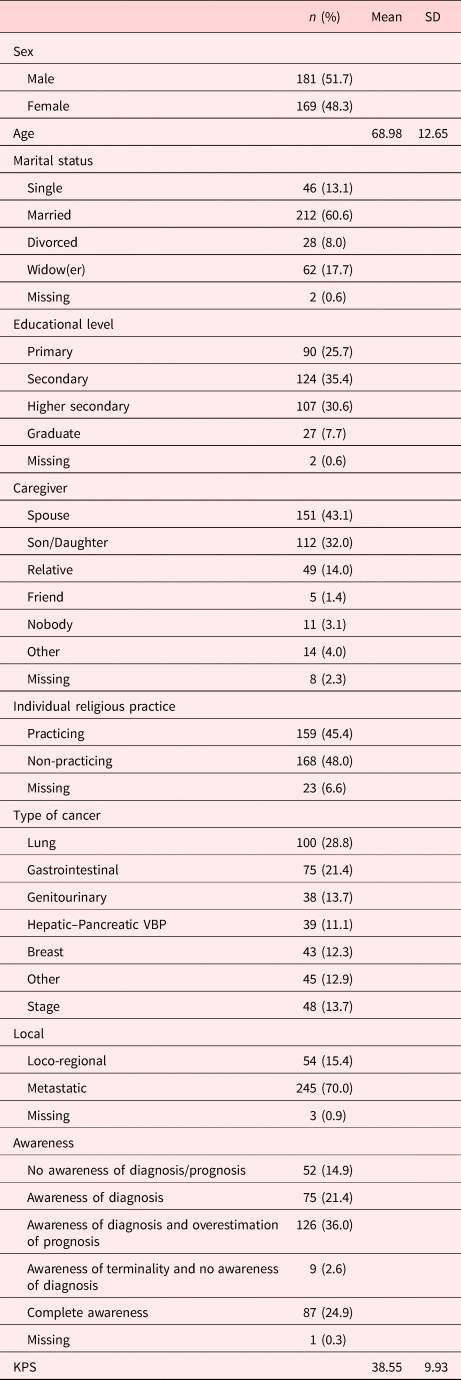
The participants’ average age was 68.98 years. Most patients were male, married, non-practicing Catholics, had a secondary school diploma, and their most frequent caregiver was their spouse. The most frequent type of cancer in the sample was lung cancer (see Table 1). The majority of the sample had metastatic cancer with an average KPS score of 38.55. Regarding their awareness of their prognosis and diagnosis, 14.9% of the participants were deemed unaware of their diagnosis or prognosis, 21.4% were only aware of the diagnosis, 2.6% were aware of the terminality but were unaware of the diagnosis, 24.9% had complete awareness of the diagnosis and prognosis, but most (36%) were aware of the diagnosis, but overestimated the prognosis, i.e., their life expectancy.
Socio-demographic and clinical characteristics of the sample (N = 350)

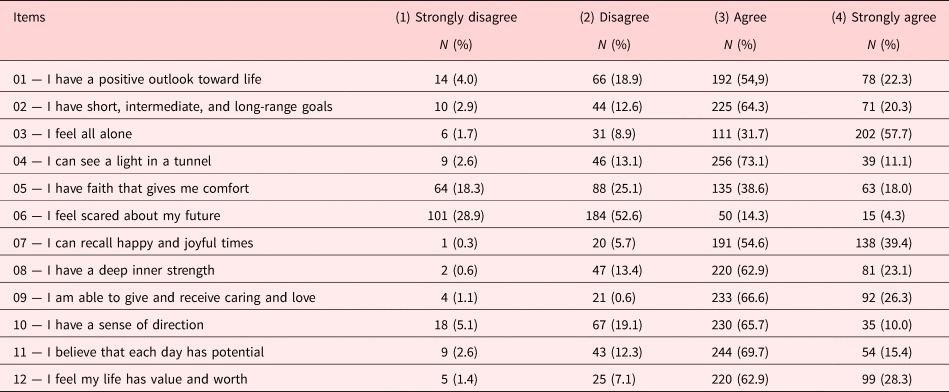
In this sample, the average score for the measure of Hope, as measured through the HHI, was medium-high (mean = 35.46, SD = 5.10). The average scores were medium-high for the three HHI subscales: Inner Sense of Temporality and Future (mean = 10.93, SD = 2.03), Inner Positive Readiness and Expectancy (mean = 12.27, SD = 2.07), and Interconnectedness with Self and Others (mean = 12.26, SD = 1.97). The most frequent answer given on all items was “Agree,” e.g., “I have a positive outlook toward life” (54.9%, n = 192), “I have short, medium, and long-term goals” (64.3%, n = 225), “I believe each day has potential” (69.7%, n = 244), while most patients answered “Strongly disagree” to item 3 (“I feel all alone”) (57.7%, n = 202) (see Table 2).
Answers frequency to HHI items

The average VAS score was low (mean = 1.6, SD = 2.43), and participants reported experiencing relatively low levels of pain. However, according to the results of the HADS-IT, most patients presented clinically relevant anxious and depressive symptomatology (mean = 9.66, SD = 3.16; mean = 10.10, SD = 4.27), with, respectively, 76.7% and 74.1% of the sample scoring above the cutoff. Participants on average also scored high on the Demoralization scale (mean = 36.25, SD = 14.11), and 63.4% of the patients were moderately/highly demoralized. Finally, the sample on average scored high on levels of spirituality on the FACIT-Sp-12 items (mean = 23.12, SD = 7.11).
Associations between HHI and psychological, socio-demographic, and clinical variables
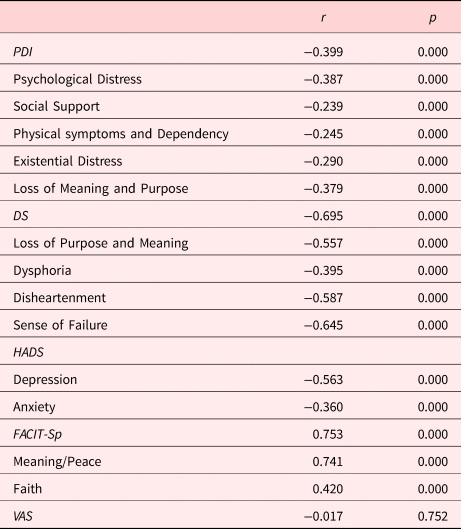
The HHI total score significantly correlated with the total score of all the rating scales and their subscales, with the exception of pain (see Table 3). Of the social and clinical features, only personal religious practice was significantly associated with HHI scores (F = 0.923; p < 0.05). The participants who prayed (mean = 36.23, SD = 4.77) had higher HHI average total scores than those that did not (mean = 34.96, SD = 5.20). Otherwise, no association between the latter and the other socio-demographic and clinical features of the sample was found, therefore they were not reported in the tables.
Hope's associations with other continuous variables

r Pearson's correlation coefficient; p ≤ 0.05.
PDI, Patient Dignity Inventory; DS, Demoralization Scale; HADS, Hospital Anxiety and Depression Scale; FACIT-Sp, Functional Assessment of Chronic Illness Therapy-Spiritual Well-Being; VAS, Visual Analogue Scale.
HHI predictors
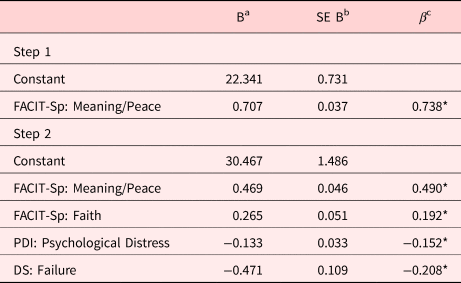
Taking into account the variables that significantly correlated with HHI, a forced-entry regression model was performed. Significant predictors of HHI scores were scores on the “Meaning” (β = 0.364; p < 0.01) and “Faith” (β = 0.190; p < 0.01) FACIT-Sp subscales, the “Psychological Distress” PDI subscale (β = −0.156; p < 0.01), and the “Sense of failure” DS subscale (β = −0.175; p < 0.01). Afterwards, multiple regression using the block-wise method was performed, by inserting the same predictors in order of β-coefficient from highest to lowest. Therefore, in the model, the “Meaning” FACIT-Sp subscale was inserted in step one, and then the “Faith” FACIT-Sp subscale, the “Psychological Distress” PDI subscale, and the “Sense of Failure” DS subscale in step 2. The model showed that the “Faith” FACIT-Sp subscale, “Psychological Distress” PDI subscale, and “Failure” DS subscale contributed minimally to the explanation of the variance of the dependent variable HHI with respect to “Meaning” FACIT-Sp subscale. Thus, the “Meaning” FACIT-Sp subscale was deemed to be the main predictor of HHI (β = 0.490; p < 0.01). Details regarding the block-wise regression model are reported in Table 4.
Block-wise regression model

Summary of standard multiple linear block-wise regression.
R 2 = 0.545 for step 1, ΔR 2 = 0.097 for step 2 (p < 0.001). n = 350;
a B = unstandardized regression coefficients;
b SE B = standard error B;
c β = standardized regression coefficients;
* p-value < 0.0001.
Discussion
This study aimed to investigate feelings of hope and the relation between hope and other psychosocial factors and predictors in a sample of end-of-life patients with cancer. To our knowledge, this is the first study to explore this topic with patients who are in the terminal phase of the disease. The relevance of hope for patients’ well-being in other stages of the disease and in various samples of patients with cancer has been repeatedly confirmed (Vellone et al., Reference Vellone, Rega and Galletti2006; Chi, Reference Chi2007; Butt, Reference Butt2011). Therefore, it was necessary to explore which elements play a role in enabling or impeding hope when patients are nearing death.
Regarding the first aim of the study, the majority of patients reported to be rather or very hopeful. The average total score of the HHI was medium-high, which is similar to the score reported in studies that also investigated hope through the HHI in different populations, i.e., in samples of mixed cancer patients, of non-advanced cancer patients, and of patients undergoing chemotherapy or radiotherapy (Balsanelli et al., Reference Balsanelli, Grossi and Herth2010; Ripamonti et al., Reference Ripamonti, Buonaccorso and Maruelli2012a; Geiser et al., Reference Geiser, Zajackowski and Conrad2015). These results might indicate that hope is a relevant variable regardless of the stage of cancer (Daneault et al., Reference Daneault, Lussier and Mongeau2016): as the disease progresses hope will not decrease when sustained and it can even be maintained when nearing death. However, the stage to which cancer has progressed may affect the role of hope, not with respect to its intensity, but qualitatively. When therapy is found to be ineffective, patients may evolve from believing in the possibility of healing to enjoying the present (Daneault et al., Reference Daneault, Lussier and Mongeau2016). This is crucial to clinical interventions as hope might help patients develop personal goals, promote relationships with kin and healthcare providers, and allow them to experience closure.
At the same time, it would be important to further analyze the influences of diagnosis and prognosis awareness on hope since most patients in our sample overestimated their prognosis, i.e., their life expectancy. In fact, high levels of hope in terminal patients can be fostered by different factors, such as not having had a conversation with their healthcare providers about their prognosis up until the very end, not wanting to know the prognosis, or being in denial. Nevertheless, engaging in a conversation with patients about advance care planning, in order to comprehensively take care of their health has been found to increase patients’ knowledge without disrupting hope, even when the clinical conditions worsen (Smith et al., Reference Smith, Dow and Viraho2011). Therefore, providing patients a central role in the care process would allow them to pursue realistic goals and promote hope even in the last stage of the disease.
With regard to the answers to the HHI items, results showed an interesting picture of the patients’ hope. Despite facing a critical clinical condition and nearing death, most participants maintained a positive perspective when thinking about life and cherished life. Most participants set various goals and retained a sense of purpose. They felt that they possessed resources within themselves and that they were able to care for and were being taken care of by others. Moreover, even though most patients reported being scared of their future, most of them could also see the potential in each day and could recall happy memories. Furthermore, most of the patients did not feel abandoned which might be one of the factors explaining the high levels of hope, despite being terminal cancer patients since social support represents one of the most important factors in enabling hope (Crothers et al., Reference Crothers, Tomter and Garske2006).
Interestingly, the sample also presented clinically relevant depressive and anxious symptomatology and high levels of demoralization (Bovero et al., Reference Bovero, Botto and Adriano2019a). This result might be because the patients did not have a clear understanding of their prognosis, possibly making them hopeful without any supporting evidence. The concurrence of anxious and depressive symptomatology and high levels of hope might be indicative of the development of unrealistic hope. Another explanation for concurrent experiences of both positive and negative feelings might be the fluctuation between despair and acceptance experienced by the patients at the end of life, as described by Daneault et al. (Reference Daneault, Lussier and Mongeau2016), and the consequent progressive adjustment of the person to their death.
With respect to the second aim of the research, the results were also in accordance with previous studies: hope was found to be negatively associated with demoralization, anxiety, and depression (Miller, Reference Miller2007; Berendes et al., Reference Berendes, Keefe and Somers2010; Abdullah-zadeh et al., Reference Abdullah-zadeh, Agahosseini and Asvadi-Kermani2011; Schjolberg et al., Reference Schjolberg, Dodd and Henriksen2011). Moreover, it was found to be positively associated with spiritual well-being (Rawdin et al., Reference Rawdin, Evans and Rabow2013) and our results confirmed that pain is not associated with hope (Chen, Reference Chen2003).
The study supports Chochinov results because we also found that if patients experienced higher levels of hope, they might be able to maintain or increase their sense of dignity. Thus, as stated before, by promptly targeting the abovementioned psychosocial factors, healthcare providers can foster hope and utilize it as a resource for terminal cancer patients.
This study found that the “Meaning” FACIT-Sp subscale was the main predictor of hope. The items of the subscale indicate feeling peaceful and harmonious, having a reason to live, purpose, and meaning, acknowledging to have led a productive life, and having the ability to seek comfort alone. In addition, the only socio-demographic variable associated with hope was religious practice. Seemingly, spiritual well-being and being able to assign meaning to what is happening may promote the ability to preserve goals and the desire to achieve them, and to see and plan for the future (Dufault and Martocchio, Reference Dufault and Martocchio1985). This data are in accordance to the state of art, which shows that religious and spiritual beliefs influence the way patients cope with the stress and burden of the disease and the way they adjust to being ill by providing a sense of meaning, purpose, and hope (Puchalski, Reference Puchalski2012; Delgado-Guay, Reference Delgado-Guay2014; Garssen et al., Reference Garssen, Visser and de Jager Meezenbroek2016). In fact, it was shown that spiritual well-being offers protection against end-of-life despair (McClain et al., Reference McClain, Rosenfeld and Breitbart2003; Bovero et al., Reference Bovero, Tosi and Botto2019b). Spiritual or existential well-being promotes a sense of purpose and meaning: a lack of the latter may lead to hopelessness and to the disinvestment in life itself (Daneault et al., Reference Daneault, Lussier and Mongeau2016). In accordance to this, it has been shown that patients receiving Meaning-Centered Psychotherapy, which specifically addresses the loss of spiritual well-being or sense of meaning in life and the existential distress […] in patients with advanced cancer (Breitbart et al., Reference Breitbart, Rosenfeld and Pessin2015; Breitbart et al., Reference Breitbart, Pessin and Rosenfeld2018), positively influences the quality of life and the spiritual well-being of patients and lessens hopelessness, depression, and their desire for a hastened death. Therefore, it is crucial to provide tailored clinical interventions, which target this specific stage of the disease and its needs, in order to sustain hope.
This study provides a description of the complexity of hope in end-of-life cancer patients and its relationship to a set of psychosocial factors involved in the quality of life and death. This study also highlighted the importance of fostering hope during the terminal stage of cancer to allow patients to experience a dignified death since it represents a tool for pursuing realistic goals and coping with stress. This study also highlighted a need for exploring the possible influences of diagnosis and prognosis awareness on patients’ hope in general and the kinds of hope that awareness might foster. Therefore, to expand upon the results emerging from this study, an interesting line of research could look at the impact of diagnosis and prognosis awareness on patients’ levels of hope and the elements affecting awareness.
Conflict of interest
The authors declare that they have no conflict of interest.



Target article
Hope in end-of-life cancer patients: A cross-sectional analysis
Related commentaries (1)
A reflection on: Bovero et al. (2021) “Hope in end-of-life cancer patients: A cross-sectional analysis”