Introduction
Western flower thrips (WFT), Frankliniella occidentalis is a minute insect, native to North America that has spread throughout the world (Reitz et al., Reference Reitz, Yu-lin and Zhong-ren2011). It is one of the most destructive pests of vegetables, fruits and ornamental crops, causing extensive damage by direct feeding of leaves and flowers. It also reduces quality and transmits economically important viruses, including tomato spotted wilt virus and impatiens necrotic spot virus (Cloyd, Reference Cloyd2009; Zhao et al., Reference Zhao, Xu, Lu, Chen, St. Leger and Fang2014). The need for environmentally sound management tactics for WFT is urgent because growers commonly report evidence of WFT resistance to many chemical pesticides (Jensen, Reference Jensen2000). Additionally, the public is increasingly concerned about environmental and human health hazards of chemical pesticides and seek plants grown more ecologically. However, the cost of biological control is increasing and for many, shipping costs are more than the biocontrol agents themselves (Skinner et al., Reference Skinner, Sullivan, Parker, Kogan and Heinrichs2019). Therefore, novel strategies to enhance the persistence and efficacy of biological controls, while reducing costs, must be found to encourage grower adoption of integrated pest management (IPM) strategies.
The potential of entomopathogenic fungi for biological control of WFT has been widely reported (Maniania et al., Reference Maniania, Ekesi, Lohr and Mwangi2002; Ugine et al., Reference Ugine, Wraight and Sanderson2007; Gao et al., Reference Gao, Lei and Reitz2010; Davari et al., Reference Davari, Skinner and Parker2018). Entomopathogenic fungi are commercially available in numerous formulations. However, few are granular formulations (Arthurs and Dara, Reference Arthurs and Dara2019). Most thrips control strategies have been limited to their management at the adult and larval stages using foliar applications of entomopathogenic fungi. However, the efficacy of most fungal strains has been inconsistent mainly due to environmental variables such as humidity and temperature (Skinner et al., Reference Skinner, Gouli, Frank Sullivan, Parker and Kim2012). Granular formulations have advantages over conventional sprays to control insects that have a lifecycle with soil-dwelling stages (Jackson et al., Reference Jackson, Dunlap and Jaronski2010; Zhang et al., Reference Zhang, Lei, Reitz, Wu and Gao2019). Ansari et al. (Reference Ansari, Brownbridge, Shah and Butt2008) reported the efficacy of several isolates of entomopathogenic fungi to control soil-dwelling stages of WFT. Thrips enter the soil as late second instars and go through their prepupal and pupal stages there before emerging as adults. According to Berndt et al. (Reference Berndt, Meyhofer and Poehling2004), depending on the host plant species, up to 98% of thrips pupate in the soil. Therefore, targeting the soil-dwelling stage with entomopathogenic fungi could be an effective strategy to reduce their populations (Skinner et al., Reference Skinner, Parker and Kim2014).
Incorporation of entomopathogenic fungi into potting soil using a solid-substrate culturing method or drenching the soil with a fungal suspension has shown significant efficacy against thrips (Ansari et al., Reference Ansari, Shah, Whittaker, Prasad and Butt2007; Skinner et al., Reference Skinner, Gouli, Frank Sullivan, Parker and Kim2012). Millet-based granular formulations of entomopathogenic fungi, when applied to soil decreased rice water weevil, Lissorhoptrus oryzophilus populations up to 2 weeks after application (Kim et al., Reference Kim, Lee, Skinner and Parker2014). Lee et al. (Reference Lee, Kim, Kim, Lee, Hossain, Shin, Kim and Kim2017) reported 90% population reduction of WFT treated with granular formulations of B. bassiana 40 days after application. Although the effectiveness of entomopathogenic fungi has shown promise in managing WFT at the soil-dwelling stage, the long-term persistence of fungi in the soil and the most effective methods of application are still poorly understood. There are no registered and commercialized granular formulations of B. bassiana in the USA (Arthurs and Dara, Reference Arthurs and Dara2019) and even if they were available, application of granular materials on a regular basis and to every crop plant would be cost-prohibitive for many growers (Behle and Jackson, Reference Behle and Jackson2014). Moreover, the fungal growth often visible on the soil surface might not be appealing to customers. Alternatively, fungal-based soil treatments could be effectively used as a sustained means of managing WFT. Plant species that are highly attractive to WFT could be deployed in the greenhouse to draw the pest out of the crop then they could be maintained at low levels throughout the production period. Previous studies reported that marigolds are highly effective at attracting thrips from the crop, and the marigold guardian plant system (GPS) that combines thrips, natural enemies on the foliage/flowers and a fungal formulation in the soil is an exciting option for WFT management (Waite et al., Reference Waite, Scott-Dupree, Brownbridge, Buitenhuis and Murphy2014; Skinner et al., Reference Skinner, Sullivan, Parker, Kogan and Heinrichs2019). A GPS is based on the concept that adult thrips are attracted out of the crop to the flowering marigolds, where they reproduce. This attractiveness may be enhanced by the addition of pheromones. Once thrips adults are attracted and reproduce, the eggs and immatures serve as prey for biological control agents such as predatory mites, Neoseiulus cucumeris, or Orius insidiosus Say (Hemiptera: Anthocoridae), sustaining them and encouraging their dispersal throughout the crop. In the absence of thrips, the natural enemies survive on the marigold pollen (Wong & Steven, Reference Wong and Steven2013; Delisle et al., Reference Delisle, Shipp and Brodeue2015). Thrips that escape predation drop to the soil to pupate, where they may become infected with the fungus. Many growers want to use marigold guardian plants but are limited because B. bassiana granular formulations are not commercially available (Skinner et al., Reference Skinner, Gouli, Frank Sullivan, Parker and Kim2012). Wettable powder (WP) and emulsifiable concentrate (EC) of B. bassiana are available, but these require frequent reapplication. The whole concept of GPS has been investigated in our previous study (unpublished data) and herein we tested the potential of combining a nutritive material (e.g., millet) with a commercial B. bassiana WP formulation and added it to the soil to assess the fungal persistence for use in marigold guardian plants. This would enable growers to produce marigold guardian plants themselves to manage WFT by creating a simple, self-sustaining granular fungal treatment using a commercially available fungal product. The research objectives of this study were to evaluate the persistence of B. bassiana strain GHA on a solid nutritional substrate (millet) in potting mix to assess their efficacy against WFT using different application methods. The difference between this work and previous studies (Skinner et al., Reference Skinner, Sullivan and Parker2013; Kim et al., Reference Kim, Lee, Skinner and Parker2014), is that the millet grains were not mycotized before application to the soil, this is a ‘do-it-yourself’ way to be used by growers to create conditions under which the fungus can persist in the soil with millet as a source of nutrition.
Methods
Assessing fungal persistence in soil
Production of millet grains
To prepare the millet substrate, 250 g of organic millet (Panicum miliaceum L.) was cooked in 125 ml of water for 20 min until all the water was absorbed. Once cooked, the millet was spread on a baking tray covered with aluminum foil and dried in an oven for 2 h at 150°C until it was completely dry. The millet was mixed every 1 h to prevent clumping and sticking to the aluminum foil. When dry, it was cooled at room temperature for 20 min, placed in clean Ziploc bags and stored in a cool dry place until it was used for the experiment. Because it is the process of assessing the suitability of a Do-It-Yourself (DIY) granular fungal-based formulation for use by growers, drying the millet enables growers to store the grain for a longer period instead of making it repeatedly or right before application.
Fungal application process
Beauveria bassiana strain GHA from BotaniGard® WP (Lam International, Butte, MT, USA) was used in this study. Four methods of treatment were compared, (1) GHA applied as a drench to potting mix that contained millet (GHA drench + millet), (2) millet mixed with GHA WP and then applied to potting mix (GHA mix + millet), (3) GHA applied as a drench to potting mix without millet (GHA drench), and (4) GHA applied to potting mix as WP without millet (GHA mix). All these treatments were tested in sterile and non-sterile potting mix, allowing us to determine the effect of the treatment with and without background competing saprophytic fungi. Soil samples were sterilized using an autoclave at 121°C for 30 min for treatments with sterile soil.
Plastic pots (14-mm diam.) were filled with 250 g potting mix (MetroMix®360). For GHA mix + millet treatment, oven-dried millet was coated with corn oil (5 ml oil kg−1 grain) and 6 g of it was mixed with dry BotaniGard® WP (0.7 g pot−1 equivalent to 2 × 10¹⁰ spores pot−1) and incorporated into the top 5 cm of potting mix. For drench treatments, 6 g of oven-dried millet coated with corn oil (5 ml oil kg−1 grain) was added to the top 5 cm of potting mix without a fungal treatment. Then a fungal suspension with the spore concentration of 2 × 10¹⁰ spores pot−1 was prepared by adding 0.7 g of dry BotaniGard® WP to 10 ml of 0.05% Silwet L-77® and applied to the surface of the potting mix. This would show that adding dry millet to the soil provides a substrate on which B. bassiana could grow after a drench and proliferate over time. GHA drench and GHA mix treatments were applied directly to the potting soil with the same fungal concentration (2 × 10¹⁰ spores pot−1). The pots were watered with sterile distilled water throughout the experiment to maintain a moisture level normal for plant production. Each treatment was replicated 3 times and the entire experiment was repeated 3 times.
Treated pots were sampled 1, 10, 30, 60, and 75 days post treatment. Because of natural variability in the pots, four 1 g samples of potting mix were randomly taken from the upper 5 cm of soil in each pot using a soil auger (1.6 cm diam.) (Oakfield Apparatus Company, Oakfield, WI, USA) to provide a representative profile throughout the pots. The fungus was isolated from soil samples following the method provided in Zhang et al. (Reference Zhang, Lei, Reitz, Wu and Gao2019). Further, 4 g of soil were mixedwith 96 ml of 0.05% Silwet L-77® in a 250 ml flask. Contents were then placed in a rotary shaker at 195 RPM for 2 h and following four serial dilutions (1:10–1:10,000). The spore concentration of B. bassiana in soil was estimated from the final diluted suspension using a Bright-Line hemocytometer chamber (Hausser Scientific, Horsham, PA) under phase-contrast optical microscopy by following the morphological characteristics of B. bassiana described by Humber (Reference Humber and Lacey1997).
Efficacy of granular millet-based fungal formulation on WFT
Lab trials were conducted to test the efficacy of a B. bassiana WP formulation (BotaniGard®) combined with a nutritive grain (millet) in the potting mix against WFT. Three treatments were tested, GHA mix + millet, GHA drench + millet and untreated pots that served as control. Each treatment was tested in sterile and non-sterile potting mix. Clear plastic deli containers (14 × 11 cm2; height/diameter) were filled to a depth of ~5 cm with potting mix (MetroMix®360) (~70 g). For the GHA mix + millet treatment, oven-dried millet was coated with corn oil (5 ml oil kg−1 grain) and 6 g of it was mixed with 0.7 g of dry BotaniGard® WP container−1 (equivalent to 2 × 10¹⁰ spores container−1) and scattered on the surface of the potting mix. A 5-cm layer of potting mix was added over the millet/fungus layer (~50 g). For the GHA drench + millet treatment, 6 g of oven-dried millet coated with corn oil (5 ml oil kg−1 grain) was placed on the surface of the potting mix without a fungal treatment. A 5-cm layer of potting soil was added and 10 ml of the fungal suspension of BotaniGard® WP with the spore concentration of 2 × 10¹⁰ spores container−1 was applied to the surface of the potting mix. Each container was watered with sterile distilled water throughout the experiment to maintain a moisture level normal for plant production. Containers were incubated at 25°C and 16: 8 (L/D) for 2 weeks. Each treatment was replicated 3 times and three trials were conducted for this experiment. Ten even-aged 2nd instar WFT were added to each pot after 2 weeks when signs of fungal growth were observed in fungal treated containers. Thrips were placed on a green bean leaf (Phaseolus vulgaris L.) with stems in a 2 ml vial that contained water attached to the plastic container at a distance of 5 cm above the soil surface. After 5 days, a clear plastic sticky lid covered with Tangle-Trap® sticky coating was placed over the pots, sticky side down and secured with a lid. The number of WFT that were stuck to the sticky lid was counted after 2 weeks. Dead insects were surface sterilized using the method described by Skinner et al. (Reference Skinner, Gouli, Frank Sullivan, Parker and Kim2012) and placed in Petri dishes with B. bassiana selective medium to confirm the cause of mortality.
Statistical analysis
Raw Data on the number of B. bassiana spores and the numbers of WFT on sticky lids were tested for normality and homogeneity of variance, and the data were normally distributed and meet the assumption of homogeneity of variance. Subsequently, two-way repeated-measures analysis of variance (ANOVA) followed by Tukey's honestly significant difference (HSD) at the α = 0.05 level (first factor: treatment, second factor: soil condition) were used to compare the fungal persistence in soil over time. Data on the number of WFT on sticky lids among treatments were analyzed by two-way ANOVA followed by Tukey's HSD at α = 0.05. All data were analyzed using IBM-SPSS v.25 (IBM, Armonk, NY, USA).
Results
Persistence of B. bassiana in fungal treatments
The results of the two-way repeated measures ANOVA showed that there was a statistically significant effect of time on B. bassiana spore concentrations (F 4,32 = 25.83, P < 0.001). The number of spores in soil increased over time, reached a peak at day 30 and then decreased through the last day of sampling in most of the treatments (fig. 1). The results also revealed a significant interaction between time and treatment (F 12,96 = 45.17, P < 0.001) as well as time and soil condition (F 4,32 = 45.25, P < 0.001). The fungal persistence in soil was significantly higher in pots contained millet than in pots without millet throughout the experiment (F 3,24 = 208.74, P < 0.001) (table 1). In the fungal treatments without millet, B. bassiana concentrations remained fairly constant at 1 × 10⁶–4 × 10⁶ spores g−1 of dry soil throughout the experiment, whereas in the fungal treatments with millet, spore concentration was 3–4 times greater at 30 days, except for GHA drench + millet in non-sterile soil in which spore concentration was relatively constant from day 10 to 75 (fig. 1). The soil condition has a significant impact on the fungal persistence in soil and more B. bassiana spores were observed under sterile soil than non-sterile soil conditions regardless of treatments (F 1,8 = 599.68, P < 0.001). In addition, the interaction between treatment and soil condition was significant (F 3,24 = 32.27, P < 0.001). In treated pots with millet, the peak in fungal concentration at 30 days was significantly lower in non-sterile soil compared with the same treatments in sterile soil conditions.
Number of Beauveria bassiana spores (mean ± SE) in treated pots with and without millet over time.

Mean (±SE) number of B. bassiana spores (×104) g−1 dry soil in treated pots with and without millet over time in different soil conditions.

Means within a column and soil condition followed by the same letter are not significantly different (Tukey's HSD: P > 0.05).
WFT emergence from soil in millet-based fungal formulation
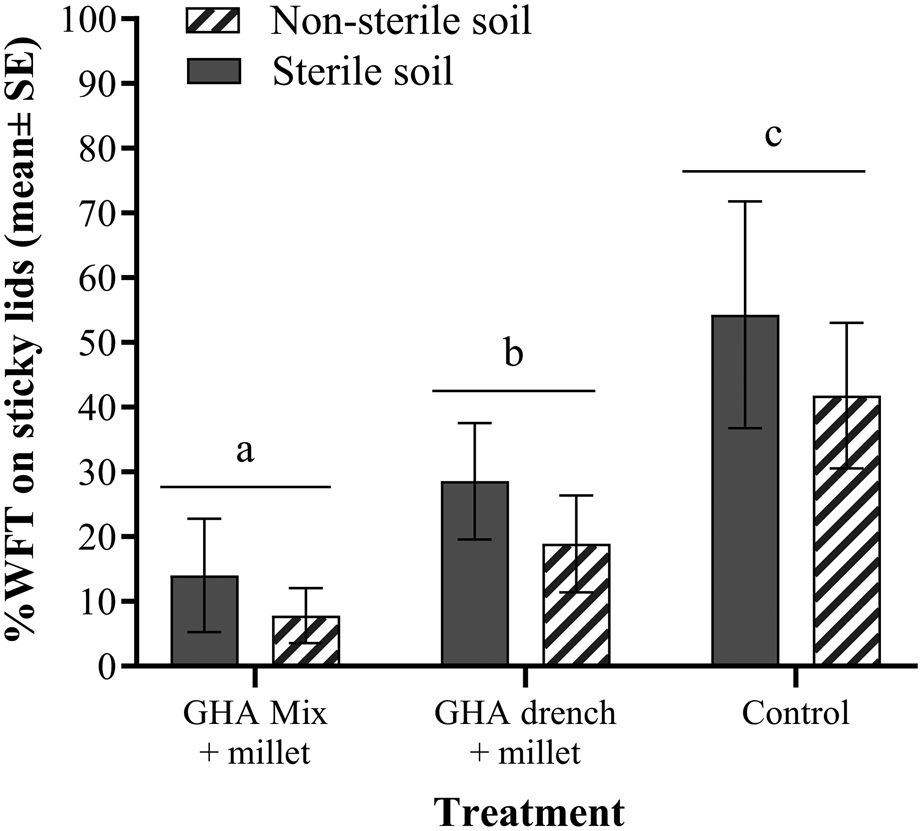
In general, significantly fewer WFT were detected on sticky lids in the GHA mix + millet than in the GHA drench + millet and the controls in both sterile and non-sterile potting mix treatments (F 2,54 = 65.30, P < 0.001). This suggests that more WFT pupae may have become infected and died during the pupal stage when B. bassiana was applied as GHA mix + millet than as GHA drench + millet. Additionally, for both fungal and control treatments, significantly fewer WFT emerged in non-sterile than sterile potting mix treatments (F 1,54 = 11.35, P < 0.001) (fig. 2). The interaction between treatments and soil condition was not significant in this experiment and the soil condition did not affect the effectiveness of the mix + millet treatment in comparison with drench + millet and controls (F 2,54 = 0.45, P = 0.64). No B. bassiana outgrowth was observed from WFT cadavers collected from the control treatments. In contrast, 85% of the WFT cadavers from the GHA mix + millet treatment, and 40% of those from the GHA drench + millet showed infection with B. bassiana.
Percentage (mean ± SE) of WFT adults on the sticky lids in different treatments 2 weeks after inoculation. Bars with a different lowercase letter are significantly different according to Tukey's HSD (P < 0.05).

Discussion
Adoption of marigold GPS by growers is limited because a granular formulation of the insect-killing fungus, Beauveria bassiana, is not commercially available. WP and liquid formulations of B. bassiana are on the market, but these require frequent reapplications. This study evaluated the potential of combining a nutritive material (millet) with a commercial B. bassiana wettable formulation to enhance fungal persistence in potting soil for use within marigold GPS. This would enable growers to produce their own marigold GPS to manage WFT by creating a simple, self-sustaining granular fungal treatment using a commercial fungal product. This is a DIY, environmentally-sound IPM approach for greenhouse ornamentals and vegetables that could save growers money and improve plant quality. In our previous study, marigolds were highly effective at maintaining thrips populations at relatively low levels for up to 10 weeks in greenhouses (Skinner et al., Reference Skinner, Gouli, Frank Sullivan, Parker and Kim2012). Guardian plant systems provide a sustained source of biological control over time (Skinner et al., Reference Skinner, Sullivan, Parker, Kogan and Heinrichs2019) that could be readily available to growers if we could develop a simple way for growers to use commercial WP fungal products to create their own fungal formulations. In the current study, BotaniGard® WP (GHA) persisted in soil for 75 days, however, the highest spore concentration was observed 30 days post application. This increased concentration of B. bassiana at day 30 was significantly higher in treatments that contained millet, especially in sterile soil condition. A number of studies have compared the persistence and efficacy of entomopathogenic fungi in sterile relative to non-sterile soils and the results showed that B. bassiana conidia in non-sterile soil greatly decreased due to the prevalence of the soil fungus Penicillium urticae, which produced a water-soluble inhibitor of B. bassiana and suppression of B. bassiana growth in non-sterile soil (Wartenberg and Freund, Reference Wartenberg and Freund1962; Clerk, Reference Clerk1969; Lingg and Donaldson, Reference Lingg and Donaldson1981; Jaronski, Reference Jaronski2007), a phenomenon we believe happened in our study.
The potential of a grain-based solid culture method has been previously confirmed in several studies (Gouli et al., Reference Gouli, Gouli and Kim2014; Lee et al., Reference Lee, Kim, Kim, Lee, Hossain, Shin, Kim and Kim2017). Kim et al. (Reference Kim, Je and Roh2010) confirmed a considerably high spore concentration of a millet-based B. bassiana culture in potting mix 18 days post-application, providing a long-lasting fungal source in the area where WFT commonly pupate. A significant increase in CFUs of B. bassiana isolates on millet 2 weeks post-application was also reported in other studies as a result of fungal reproduction on nutrients in the formulations (Parker et al., Reference Parker, Skinner, Gouli, Gouli, Tobi and Kim2015). In related research, most B. bassiana conidia mycotized on millet grains remained in the upper layers of soil in pots receiving continuous watering for 3 weeks, ensuring that fungal-based granular formulations pose no threat from leaching (Kim et al., Reference Kim, Je and Roh2010).
Application of entomopathogenic fungi in the soil to control insect pests that have a soil-dwelling stage in their life cycle has received more attention over the last years. Despite the effectiveness of the foliar application of fungal conidia, there are limitations that increases the need for alternative approaches (Hu and Leger, Reference Hu and Leger2002; Da Silva and Neves, Reference Da Silva and Neves2005; Ugine et al., Reference Ugine, Wraight and Sanderson2007). The conidia on the leaves can dry quickly and die or become inactivated by ultraviolet light from sunlight and high temperature (Morley-Davis et al., Reference Morley-Davis, Moore and Prior1995; Fernandes et al., Reference Fernandes, Rangel, Moraes, Bittencourt and Roberts2007; Rangel et al., Reference Rangel, Alston and Roberts2008). Whereas when fungi are inoculated in the soil, the conidia are protected from unfavorable environmental conditions and the soil provides additional humidity that improves the fungal survival and germination (Lee et al., Reference Lee, Kim, Kim, Lee, Hossain, Shin, Kim and Kim2017). In this study, the application of a WP formulation of GHA + millet reduced the sticky lid counts from averaged 48.05 ± 3.3 in untreated controls to 10.6 ± 1.6 and 22.6 ± 2.17 in mix and drench treatments, respectively. Fewer WFT were detected on sticky lids in the GHA mix + millet than in the GHA drench + millet and the controls for both the sterile and non-sterile potting mix treatments. This may have been because more WFT pupae became infected and died during the pupal and/or larval stage when B. bassiana was applied as a mix than as a drench. These results were in accordance with other studies that one-time drench application of fungal suspension did not control the targeted pest effectively and second drench application was recommended (Widmer and Shishkoff, Reference Widmer and Shishkoff2017). Additionally, for both GHA + millet and control treatments, fewer WFT emerged from the non-sterile than the sterile soil probably due to other mortality factors in non-sterile soil. Inglis et al. (Reference Inglis, Johnson, Kawchuk and Goettel1998) reported that grasshoppers ovipositing into soils containing conidia of B. bassiana were highly susceptible to the fungus, however in contrast to our results higher prevalence of mortality was observed for females ovipositing into sterile than non-sterile soils. Sterilization process may cause changes to the physical and/or chemical properties of the soil and because fewer WFT emerged from non-sterile soil in our study, there is no recommendations for the use of sterile soil to make the fungal millet treatment.
Several conclusions can be gained from our results. First, incorporating millet into the potting mix clearly enhanced the effect of the fungal treatments, particularly for the GHA mix + millet treatment. The millet provided a nutritive substrate on which the fungus could become established, producing a sporulating fungal matt which WFT come in contact with and become infected. Secondly, results from the GHA drench + millet treatment were inadequate. Movement of the spores within the drench to the millet layer may have been impeded by the 5-cm potting mix layer. We suspect the drench treatment would be more effective if there was a shorter distance between the surface of the potting mix layer and the millet. Moreover, more than one drench application might be more effective. The efficacy of both fungal treatments might be enhanced by reducing depth of the potting mix layer above the millet or incorporating the millet into the top 5 cm of potting mix. We also think that different potting mixes can have an effect on the pathogenicity of B. bassiana in the GHA drench + millet system and this must be taken in the interpretation of these types of studies. Our recent results also demonstrated that oven-dried millet mixed with a commercial WP B. bassiana product significantly reduced WFT populations emerging from the soil. The next step is to test the treatment in cooperation with growers under commercial greenhouse conditions. This is going to be the last stage of this process and enables us to assess the suitability and effectiveness of this technique with the intention of devising standard methods that growers could follow.
Acknowledgements
The authors are grateful to Dr Svetlana Gouli for her assistance in the laboratory trials. Authors thank BioWorks Inc. (Victor, NY) for providing BotaniGard® WP. Research presented herein was supported by the American Floral Endowment, Univ. of Vermont College of Agriculture and National Institute of Food & Agriculture, US Dept. of Agriculture, HATCH Multistate Project (VT-HO1408, Regional Project S-1024) Any opinions, findings, conclusions, or recommendations expressed herein are those of the authors and do not necessarily reflect the view of the US Dept. of Agriculture.