


Background
When the diminishing practice of psychotherapy by psychiatrists in the USA was highlighted by Harris (Reference Harris2011) in his New York Times article ‘Talk doesn't pay, so psychiatry turns to drug therapy’, it set off a firestorm in the psychiatric community (Delaney & Handrup, Reference Delaney and Handrup2011). Psychiatrists quickly responded to the article, attesting to the value of psychotherapy and the ethical reasons for providing therapy when indicated (Pies, Reference Pies2011). The role of psychotherapy within psychiatry continues to be debated.
There is an expectation from both the public and other mental health professionals that psychiatrists have a basic working knowledge of psychological therapies (Hull & Swan, Reference Hull and Swan2003). This has been clearly acknowledged by UK psychiatry and is reflected in the basic psychotherapy competencies that must be achieved by psychiatric trainees [Bateman, Reference Bateman2007, Royal College of Psychiatrists (RCP), 2012]. Currently, the RCP curriculum for core trainees in psychiatry stipulate that all psychiatrists in training in the UK should deliver two episodes of psychotherapy, using two models and over two different time durations (RCP, 2012). In practice, it is likely that one of these cases will be delivered using cognitive behavioural psychotherapy. These UK-based requirements to have had experience in delivering psychotherapy mirror similar training requirements elsewhere, including Australia and New Zealand (Royal Australia and New Zealand College of Psychiatrists, 2012). There is an acknowledgement that talking treatments have been a neglected part of psychiatric training schemes and that this needs to be improved upon (Weissman et al. Reference Weissman, Verdell, Gameroff, Bledsoe, Betts, Mufson, Fitterling and Wickramaratne2006 for USA; and Thirunavukarasu, Reference Thirunavukarasu2012 for India). It is likely that the situation in the UK has improved as the RCP has been emphasizing the need for trainees to have experience in the direct delivery of psychotherapy for some years now. A relatively recent survey by the RCP (Johnston, Reference Johnston2013) showed that most psychiatric trainees have been receiving a broad experience of psychotherapy.
In the UK in recent years, despite the step-change increase in the provision of talking treatments in primary care (Department of Health, 2012), there has yet to be an equivalent increase in the numbers of consultant medical psychotherapists (previously referred to as ‘consultant psychiatrists in psychotherapy’). This applies to medical psychotherapists from all the major models of therapy – and is likely to equally apply to those whose predominant model of working is cognitive behavioural therapy (CBT) (P. O’Connor, personal communication). A total of 383 consultants in the UK have ‘medical psychotherapy’ listed by the RCP as a speciality in which they work; however, we do not know whether this is their main speciality or just one area in which they work. The RCP also does not record the consultant membership by their predominant model of therapy – such as CBT/dynamic, etc. (C. Munroe, personal communication). Using data from the British Association for Behavioural Psychotherapies (BABCP), from a total accredited membership of 4385 from all professional backgrounds, only 54 (1.24%) are psychiatrists (C. Munroe, personal communication). This compares to 1348 (30.74%) accredited CBT therapists from a nursing background and 1051 (23.97%) from a psychology professional background. Even social work, which is perhaps not a profession generally associated with talking therapies, has four times as many accredited cognitive behavioural therapists in its ranks (213, 4.86%) compared to psychiatrists (C. Munroe, personal communication). This headline figure of just 1.24% of UK-accredited CBT therapists coming from a psychiatric professional background is a markedly lower proportion than the recent past when approximately 14% of BABCP-accredited therapists were psychiatrists (Hull & Swan, Reference Hull and Swan2003). The absolute numbers of psychiatrists who are accredited have increased only slightly over the past 11 years (from 40 in 2003 up to 54 in June 2014). However, the number from other professional backgrounds have increased markedly – particularly those from a nursing and counselling background, in line with these professions being employed as therapists within primary-care IAPT services. Indeed, NHS secondary-care services have not seen anything like an equivalent rise in the number of talking therapists (from any professional background) that can compare with the rise in investment in primary care.
The position of psychiatry and within the practice of CBT in general in the UK has therefore changed markedly. Medical psychotherapists from all theoretical backgrounds are faced with constant pressures to cut costs (and sometimes capacity) in the current NHS. Therefore, a survey was undertaken to ask psychiatrists with a particular interest in, and experience of CBT, what they thought was the place of formal CBT and the cognitive behavioural model in routine psychiatric practice outside of the formal sessional CBT provided by a medical psychotherapist, in addition to considering the role of the medical psychotherapist specializing in CBT.
Aims
The current study aimed to answer two major questions: What are the uses and the usefulness of the cognitive behavioural model within the day-to-day practice of psychiatrists? This aimed to understand the role of CBT and the underlying cognitive behavioural model in the jobs of psychiatrists from a range of backgrounds (i.e. not just in the jobs of medically trained psychotherapists). Second: What are the most important roles of the consultant medical psychotherapist who has specialized in CBT? It was decided that the individuals most likely to have opinions relevant to both of these questions would be psychiatrists who had a particular ‘interest in CBT’.
Method
Study sample
As a proxy to the criterion of ‘interest in CBT’, it was decided to survey psychiatrists who were registered as ‘members’, or ‘accredited members’ of the lead body for CBT in the UK – the BABCP. The study lead-investigator approached the BABCP who provided him with the 174 email addresses of psychiatrists who were either members or accredited members of that organization. The investigator also managed to obtain email addresses of a further six psychiatrists who attended the annual meeting of the interest group ‘CBT medics’ in July 2012. This meeting was part of the BABCP 2012 Annual Conference at the University of Leeds. The total number of psychiatrist contacts held was therefore 180, which is a tiny proportion (1.39%) of the total number of UK-practising psychiatrists (13339 on 29 September 2012; P. O’Connor, personal communication).
Study tool
A survey questionnaire was designed specifically for this study and was piloted with academic staff and non-CBT-orientated psychiatric colleagues. In terms of background information – facts were gathered about the psychiatrist's grade [e.g. consultant or SAS (non-training grade doctor)]. Questions were also asked about the amount of postgraduate CBT training that they had undertaken and the number of years of experience the doctors had had in the delivery of CBT, the amount of CBT supervision they both received themselves and provided to others, and the proportion of their weekly clinical time spent engaging in CBT.
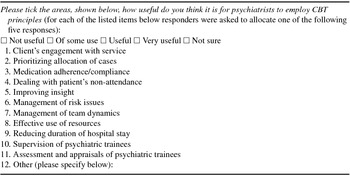
First major study question: What are the uses and the usefulness of the cognitive behavioural model within the day-to-day practice of psychiatrists? – To answer this overarching question a number of questionnaire items were posed. A closed question asked: ‘Should psychiatrists leave CBT to therapists from other disciplines?’ They were then invited to explain their response to this question in an open answer. Another closed-answer question asked whether the psychiatrists believed that CBT informed their day-to-day practice, followed up by an open item (for those who said CBT does inform their practice), of how it does so. A final item asked responders to choose the areas of psychiatric practice where they believed it was particularly useful to employ CBT principles. A number of potential options were provided to choose from (see Table 1) which included the management of risk and with medication adherence/compliance. Finally, the psychiatrists were asked to indicate whether any areas had been omitted from this list and to write these down.
Questionnaire item assessing roles of CBT for psychiatrists

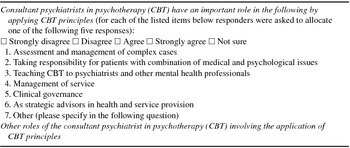
Second major study question: What are the most important roles of the consultant medical psychotherapist who has specialized in CBT? To answer this second overarching question a closed-answer question was posed first (see Table 2). A list of six potential roles was written down (taken from the relevant Royal College Council report; RCP, 2006). It asked responders to choose any of these roles if they believed them to be important in the job of ‘consultant medical psychotherapist’ (note that the original job title ‘consultant psychiatrist in psychotherapy’ was used in the questionnaire, but this title has since been changed by the RCP to ‘consultant medical psychotherapist’). Second, they were asked whether they believed any roles had been omitted from the list and to write those down.
Questionnaire item assessing roles of the consultant medical psychotherapist (CBT)

Date collection and analysis
Emails were sent to the 180 psychiatrists attaching a questionnaire by SurveyMonkey (www.surveymonkey.com/). The same invitation was sent to non-responders four times. The resulting collected data was analysed using the same programme and SPSS v. 19 (SPSS Inc., USA).
Results
Of the 180 email addresses provided, three were invalid and were thus excluded. Of the remaining psychiatrists (177 emails), 46 completed the questionnaire, three opted out, and the remaining 128 did not respond. The response rate was therefore 26% (46/177).
The majority of the responding psychiatrists were senior and experienced. Thirty-eight of the 46 responders were practising at consultant level (the remaining eight were trainees or non-training grades or in two cases did not state their status). Almost half were accredited members of BABCP – indicating that they had completed a higher qualification in CBT combined with significant amounts of supervised CBT practice. Indeed, 27 (58.7%) had completed a postgraduate training in CBT at diploma level or higher. The mean length of time that the psychiatrists had delivered CBT was 12.1 years. Forty (91.0%) of the 44 responders to this item had over 4 years’ CBT experience (range 0.5–33 years).
In general they were supervised quite frequently for their CBT practice. Thirty-three (75.0%) of the 44 responders received CBT supervision at least once per month. Only seven (15.9%) were receiving no supervision at all. A similarly high proportion (30/44 responders, 68.2%) provided regular CBT supervision to other professionals at a frequency of at least once per month. Only nine (20.5%) did not supervise the CBT practice of others at all. The mean proportion of their jobs spent delivering CBT ranged from nil to 100%, with a mean of 41%.
First major study question: What are the uses and the usefulness of the cognitive behavioural model within the day-to-day practice of psychiatrists?
When asked: ‘Should psychiatrists leave CBT to therapists from other disciplines?’, 36 (87.8%) of 41 responders stated that it should not be left to other disciplines. When asked why – the common response was that general psychiatric skills and psychotherapy skills can be integrated especially for complex, refractory and difficult-to-engage patients – not just in psychotherapy posts but also in more general psychiatric settings. Some also commented that psychiatrists need to know whom to refer for CBT even if they do not practise CBT themselves, and that they need to be able to deliver their own component of a care package in a manner that is in keeping with the therapy: ‘the more awareness there is of the model, the more we are able to communicate and understand patients’ needs’. One psychiatrist said that the transfer of skills from one arena (therapy) to another (outpatient clinics) was a highly desirable aim but they believed that there was no guidance or supervision on how to do this. A number of responders stated that psychiatrists with experience in CBT were best placed to train junior psychiatrists in the model. Of the five psychiatrists who said that CBT should be left to other disciplines, two explained their responses. One said that there were already too few psychiatrists and that it was not cost-effective for the NHS. Another stated that most psychiatrists have inadequate time to develop adequate expertise to deliver CBT to a secondary-care population.
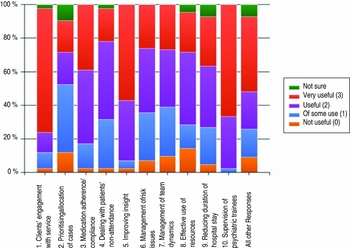
In a separate question item, most of the psychiatrists (38/41 responders, 92.7%) reported that CBT did indeed inform their practice. (We do not know why the practice of the remaining three psychiatrists was not influenced by CBT, but it may be that these professionals were interested in CBT, but had not yet experienced enough CBT-related training, for their general psychiatric practice to be significantly influenced by it.) When asked in an open question item how the CBT model influenced their practice, they said that it was helpful to understand patient's behaviour and motivations (or lack of it), in giving structure, in widening their holistic assessment, and helpful in formulating problems and patterns and as a means to overcome ‘stuckness’. Some described how it allowed them to view a situation differently thus allowing them to overcome previously held personal assumptions. Others said that it allowed them to have a closer relationship with patients – sometimes by utilizing the more collaborative nature of the ‘working relationship’ integral to the CBT model. Formulating using CBT models was mentioned as useful in acute settings such as by formulating risk, by sharing understanding with patients to improve compliance and to allow communication of the overall situation with other colleagues and disciplines. When the closed-answer question asking the psychiatrists to choose which potential roles were usefully employed using CBT principles (see Table 1), most found the model useful in a wide variety of roles but in particular in client's engagement, improving client's insight, adherence to medications, and in the supervision of trainees (see Fig. 1).
Results of the questionnaire item: On the areas shown below, how useful do you think it is for psychiatrists to employ CBT principles? (Respondents had already been provided with options 1–10 listed on the x axis, and were asked to indicate how useful it was for all psychiatrists to use CBT principles while trying to undertake these tasks.)

Second major study question: What are the most important roles of the medical psychotherapist who has specialized in CBT?
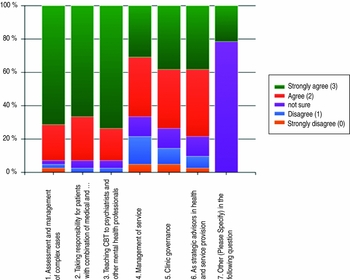
When the psychiatrists were asked about the roles of a consultant medical psychotherapist (see Table 2) they generally agreed with almost all of the six roles mentioned in the relevant RCP report (RCP, 2006). Three of these roles were viewed as particularly important for the consultant medical psychotherapist in CBT – they were: ‘The assessment and management of complex cases’; ‘Taking responsibility for patients with combination of medical and psychological issues’; and ‘Teaching CBT to psychiatrists and other mental health professionals’ (see Fig. 2).
Results of the questionnaire item: Consultant psychiatrists in psychotherapy (CBT) have an important role in the following by applying CBT principles. (Respondents had already been provided with options 1–7 listed on the x axis, and were asked to indicate how important they believed each of these roles to be for the consultant medical psychotherapist in CBT.)

Discussion
The authors accept that the response rate for this survey was low and that this is an important limitation to the conclusions that can be drawn. Only 26% of the study population of psychiatrists with an interest in CBT (as evidenced by BABCP membership) responded to the email requests to complete the survey – and this was after four email reminders being sent to the non-responders. We did not incentivize in any way, and we also did not send out paper reminders. Presumably such additions would have led to a better response rate. Earlier paper-based surveys on a similar topic area have indeed had markedly better response rates (Hull & Swan, Reference Hull and Swan2003; Whitfield et al. Reference Whitfield, Connolly, Davidson and Williams2006) and this finding is itself particularly salient for those planning internet-based surveys in this area. Nevertheless, the survey still gives the collective opinion of 46 predominantly senior psychiatrists (mainly consultants); the majority of whom have received significant postgraduate training in CBT – to a level of postgraduate diploma or higher. They are likely to represent a mix of medical psychotherapists as well as psychiatrists from other fields including child psychiatry and general adult psychiatry and who maintain an interest and variable practice in CBT. Some clear patterns can be drawn from the psychiatrists, who did respond, many of which confirm the results of other studies in this area.
This study adds to the evidence of other surveys (e.g. Ashworth et al. Reference Ashworth, Williams and Blackburn1999; Hull & Swan, Reference Hull and Swan2003, Whitfield et al. Reference Whitfield, Connolly, Davidson and Williams2006). It suggests that CBT-trained psychiatrists (not necessarily medical psychotherapists) use the cognitive behavioural model in a much more complex way than simply delivering formal CBT. Responders said that they applied CBT principles in their general psychiatric practice, finding them particularly useful for their patient's engagement with the service as well as in many other roles that are highlighted in Figure 1. Many of these uses have not be researched empirically and the evidence for them are only limited to the psychiatrists’ opinions. The use of CBT principles in such practices is certainly in its early stages, and will require further research, development of standards, etc. A number of responders in this survey specifically mentioned the challenges of managing inpatients and the particular role of formulating and managing such complex situations using their CBT training. It may be that some competencies in this area of training should be particularly emphasized. For example – the ability to formulate a complex case may be especially relevant to a psychiatrist. In the current survey, one participant mentioned the importance of transferring learned skills from one arena (therapy) to another (outpatient clinics). The curriculum for the core training of psychiatrists states that the trainee doctors need to: ‘demonstrate the ability to conduct a range of individual, group and family therapies using standard accepted models and to integrate these psychotherapies into everyday treatment, including biological and socio-cultural interventions’ (Intended Learning Outcome 5, RCP, 2012, p. 37). As yet it is not clear which competencies achieved in psychotherapy training can be effectively translated into generic practice (Moorhead et al. Reference Moorhead, Lloyd and Holmes2011). However, being able to formulate using different models/seeing the patient through different lens/different perspectives is perceived as useful for such complex/stuck patients. The skills required to formulate such cases may not be solely achieved through undertaking a psychotherapy case and through case-based discussion groups in the first year of core psychiatric training. Rather, the skills may be best practised through training, perhaps even through additional case-based discussion groups at a higher level of training. Moorhead et al. (Reference Moorhead, Lloyd and Holmes2011), describe how generalization needs to occur outside of specialist CBT sessions and rather supervised practice should be implemented within the trainees ‘usual’ clinical environment – e.g. inpatient wards and outpatients, with assessment possibly occurring by videotaping.
The study respondents were generally in agreement about the key roles of a medical psychotherapist. Although this survey only asked those practitioners with a particular interest in CBT, the results reinforced the primacy of roles that had already been forwarded elsewhere (Fig. 2). Clinical roles, and teaching and supervision roles to other psychiatrists, were more commonly viewed as central to the job of a consultant medical psychotherapist (specializing in CBT) than the management of a service. Over 90% of responders either ‘agreed’ or ‘strongly agreed’ with a view that the ‘assessment and management of complex cases’, and ‘taking responsibility for patients with a combination of medical and psychological issues’ were important roles. Likewise, over 90% ‘agreed’ or ‘strongly agreed’ with a view that a role of a consultant medical psychotherapist (CBT) was ‘teaching CBT to psychiatrists and other mental health professionals’. In comparison, less than 70% viewed ‘service management’ in an equivalent way.
The responders in this study emphasized the need to be able to formulate very complex cases in psychiatry. So many of the roles of the psychiatrist involves looking at a very complex clinical system and being able to put the disparate pieces together into a coherent understanding to assist with coordinating patient/client care. This coordination involves most of the specific roles outlined in Figure 1, such as the patient/client's engagement with services, management of risk, and dealing with patient non-attendance. The patient/client's world view – their thoughts, core beliefs, past experiences, and default behaviours, will of course impact on all of these areas and being experienced in identifying patterns and putting those patterns into a model to predict future attitudes and behaviours should assist the psychiatrist in these roles. The current study population of CBT-trained psychiatrists confirmed that their knowledge of the CBT model helped them in these roles. This finding has implications on what should be the learning objectives/competencies achieved in core and higher training of psychiatrists and on the method of training delivery and on who is best placed to deliver that training and supervision. There needs to be more of an emphasis on all psychiatric trainees being able to use formulation, rather than this skill simply being held by those who elect to undergo a specialist training in psychotherapy (see Abbas et al. Reference Abbas, Walton, Johnston and Chikoore2012). It is the authors’ own experience that some very seriously ill patients, and in particular in many inpatients settings, have the least exposure to talking treatments (see Forsyth, Reference Forsyth2008). The clinical leadership of many mental health teams are psychiatrists. Having teams led by professionals who can formulate in terms of an overarching psychological model – whether that be systemic, CBT or psychodynamic – should lead to a common language and a common focus for all staff treating the patient and provide a common framework and understanding to connect with the patient themselves. A challenge for the psychiatric profession is to encourage the translation of CBT competencies, learned through individual CBT practice in training, through to the use of diverse roles such as encouraging medication compliance when engaging in generic psychiatric practice. Using medical psychotherapists, who understand the role of generic psychiatric practice through their own training and professional backgrounds is going to be crucial if this translation is going to be successful. Much more research needs to be undertaken to understand how the accrual of specific psychotherapeutic skills in psychiatric training are translated (if indeed they are), into the everyday work of the general psychiatrist. This information would then feedback to inform the specific requirements of the CBT training for psychiatrists. For example, does there need to be more of an emphasis on formulating skills or on basic Socratic questioning skills, or perhaps on identification of risk, based on more thorough identification of core beliefs about the self and the world?
The importance of psychiatrists taking a lead in ‘skilling up’ the psychiatric workforce has been described elsewhere (e.g. Bateman, Reference Bateman2007; General Medical Council, 2012; Johnston, Reference Johnston2014). Psychiatrists understand where psychological models can be used in the working life of other psychiatrists and can make sure that their understanding of these models is tailored to the psychiatric role and perspective. A major aim is to encourage the psychiatrist to think both in terms of a dysfunctional brain and a psychologically distressed human being. Docherty et al. (Reference Docherty, Marder, van Kammen and Siris1977) have termed this dual role ‘bimodal relatedness’, akin to the physicist who must simultaneously think in terms of particles and waves. We know that psychiatrists who have received postgraduate training in CBT do not necessarily get the chance to deliver formal therapy – but they do find that their routine psychiatric practice is altered by employing CBT principles (Hull & Swan, Reference Hull and Swan2003; Whitfield et al. Reference Whitfield, Connolly, Davidson and Williams2006). This contrasts with the experience of many in secondary care that CBT principles are in practice rarely formally employed to promote the patient's adherence to care plans outside of formal therapy. This has created a barrier between secondary-care CBT services and the generic psychiatric care of the severely mental ill, as non-medical CBT therapists often do not attend ward reviews or Care Programme Approach (CPA) meetings, reviews, etc. (or at least do not lead them). The latter are where the important decisions about client care are discussed and made. According to Bateman (Reference Bateman2007), integrating principles of the psychological therapy models into other areas of psychiatry is dependent on psychiatry embracing psychotherapy, and on psychotherapy assimilating psychiatry. Indeed, where a psychiatrist takes the lead with such training in psychological therapies and associated models – the training is more likely to happen. The absence of a dedicated medical psychotherapy post within a training scheme for psychiatric trainees reduces the opportunities for training (Martinez & Horne, Reference Martinez and Horne2007) as the psychotherapy curriculum for psychiatric trainees is five times more likely to be fulfilled when the psychotherapy tutor is a consultant psychiatrist in medical psychotherapy (Johnston, Reference Johnston2013). Therefore, translation of the cognitive behavioural model into the language and culture of general psychiatry in terms of patient care, advice to other psychiatrists, and in particular – the training of other psychiatrists are likely to remain key parts of the role of the consultant medical psychotherapist in CBT. This study tells us how 46 psychiatrists with a key interest in this area view the role of this professional. It obviously does not tell us what the view of other professions outside of psychiatry would be, or indeed the view of psychiatrists who do not have an interest in psychotherapeutic models. They might not believe that a good working knowledge of psychotherapy models is an essential requirement for the practice of general psychiatry.
Which areas of clinical practice are especially suited for the consultant medical psychotherapist in CBT? Will a niche develop for psychiatrists with such specialist further training in clinical specialities such as eating disorders or the neuroses such as in the specialist treatment of OCD? Or perhaps as the CBT model moves more into the treatment of personality disorders, should they (in common with consultant medical psychotherapists in dynamic psychotherapy) define a role in treating this group of patients? Further research could address the attitudes of other professionals to the creation of such roles. How do they view psychiatrists with an interest in CBT? Are such psychiatrists viewed as a threat or are they experienced as easier to collaborate with than other psychiatrists? A better understanding of these experiences and perceptions would also help further define the roles of the medical psychotherapist.
Summary of main points
-
• Psychiatrists with a particular interest and experience in CBT find that the CBT model is useful not just in formal CBT practice, but also in a range of roles in generic psychiatric practice, such as the engagement of patients, improving client's insight, adherence to medications, and for the supervision of trainees.
-
• Being able to formulate complex cases using different models is a key skill that needs to be taught and practised in the role of the psychiatrist. Some areas such as inpatient psychiatry might be particularly helped in this regard.
-
• Consultant medical psychotherapists have a key role in teaching and supervising psychiatrists and are assisted in this respect by their own knowledge of the context of psychiatric practice.
-
• Psychiatrists who are trained and experienced in CBT believe that major roles of the consultant medical psychotherapist are the assessment and management of complex cases, taking responsibility for patients with a combination of medical and psychological issues and teaching CBT to psychiatrists and other mental health professionals.
-
• The curriculum for trainee psychiatrists includes a requirement that they undertake formal experience in delivering at least two psychotherapy cases. However, it has yet to be shown whether skills learned in doing so are translated into generic psychiatric practice.
-
• In the future, case-based discussion groups and other novel teaching/supervision methods such as using video-feedback, may need to be used in higher psychiatric training to assist with this translation of CBT skills into generic practice.
Ethical standards
Ethical approval was not required for this work.
Acknowledgements
The authors thank Professor Christopher Brannigan, University of Derby for his support throughout the stages of the work, and Dr Najma Siddiqi and Dr Rachel Voller for reviewing the survey questionnaire.
The research received no specific grant from any funding agency, commercial or not-for-profit sectors.
Declaration of Interest
None.
-
(1) To have considered the place of CBT in the overall training needs of psychiatrists.
-
(2) To understand the issues and debate around translating CBT knowledge and skills gained from formal CBT practice into generic skills within daily non-specialist psychiatric practice.
-
(3) To understand the elements of the CBT model which are perceived as potentially useful by interested psychiatrists outside of formal CBT practice.
-
(4) To have an improved understanding of the role of the medical psychotherapist as perceived by other interested members of the psychiatric profession.



Comments
No Comments have been published for this article.