We were doing four nights at the Public Theater. Load-in would be at one o'clock, soundcheck would be at three o'clock, and around 1.30 I got a call from Lester [Bowie]. This was around the time the Ayatollah took over in Iran. He said, ‘We need you to get something in time for the soundcheck […] I need an official New York Mets uniform, I need a midget dressed up as the Ayatollah, I need two shotguns, ten bags of confetti, and fifty firecrackers.’ I said, ‘Lester – listen, man, I've got an hour and a half before soundcheck, how am I going to get all this stuff?’ He said, ‘No man, you can do it! You can do it.’ So I called the Public Theater and said, ‘What are the rules about shooting off firecrackers and shotguns in the Public Theater?’ And the guy said, ‘Oh no, it's completely against the rules. The Fire Department will close us down.’ So I called Lester and said, ‘Can't do it, man, the Fire Department will close us down.’ He said, ‘OK, never mind.’ Who knew what conversation was leading to this? I assumed that at some point during the performance, a midget was going to run across the stage dressed as the Ayatollah, two guys were going to pull out the shotguns and fire, they were going to set off the firecrackers, and bags of confetti were going to fall from the ceiling. What the New York Mets uniform was for, I'm not sure. Maybe Lester just needed it for his kid.Footnote 1
The music of the Art Ensemble of Chicago was often considered to be politically oriented, for understandable reasons.Footnote 2 The band emerged from the Association for the Advancement of Creative Musicians (AACM), a Chicago-based African-American artists’ collective that was deeply committed not just to musical innovation, but also to community activism and social transformation, as were several other musicians’ organizations founded during the nationwide Black Arts Movement of the 1960s and 70s.Footnote 3 Additionally, many of the Art Ensemble's performances included compositions or theatrical sketches that addressed controversial political issues, both domestic and international. During a concert at the Harper Theater in Chicago around 1967, one musician danced across the stage with a life-size Raggedy Ann doll while another member of the group ‘trail[ed] after them with a shotgun’, in a parody of societal anxieties about integration and interracial romance.Footnote 4 The Malachi Favors piece ‘Immm’, performed at the 1972 Ann Arbor Blues & Jazz Festival, alerted the audience to the dangers of air pollution:Footnote 5 ‘The air you is a-killing me; I can't feed my children in the sea; and the flowers, they cry all day.’Footnote 6 And of course there are countless stories, such as the above anecdote told by former Art Ensemble manager Marty Khan, about the group's penchant for using absurd humour to create new forms of political critique.
However, all the political content in the Art Ensemble's music seems to be counterbalanced by public pronouncements in which the members of the band expressly denied that their work was motivated by political convictions. In a 1971 interview with John Litweiler, Joseph Jarman explained that ‘I used to be into the Student Peace Union, that kind of thing, during [college]. I've always been interested in politics, but now I'm more toward the left in a nationalistic way, black nationalism. But we, the Art Ensemble, we're not about politics.’Footnote 7 Some years later, Lester Bowie reaffirmed this distinction between individual political beliefs and the group's ostensibly apolitical stance, while offering a broad theorization of why the Art Ensemble's music was perceived as political, particularly during their European sojourn from 1969 to 1971:
The music is universal, our politics is the politics of the planet. […] Our politics transcends religions, race and language, so we're dealing in another area. They all made it look like that, if you were black, you were political. That's all they would ask you about, you were put into it. Some cats like it, Joseph Jarman was a little speechmaker anyway, he likes that kind of stuff, so he would do it. Everyone in the Art Ensemble has the right to do whatever they want to do.Footnote 8
Like most of Bowie's provocative utterances, this quotation demands to be unpacked. Bowie begins by attempting to distance the Art Ensemble's performances from politics, including any sectarian or nationalist ideology that cannot be reconciled with ‘universal’ principles. Next, he contrasts the band's aesthetic aims with their reception, claiming that critics and audiences consistently and wilfully misinterpreted the Art Ensemble's work, because of how they looked or what their political views were expected to be as African-American artists. Finally, he acknowledges that one of his bandmates could be outspoken, but then explains that Jarman's politics are his own, and not the Art Ensemble's. Or, to paraphrase:
We aren't a bunch of political activists.
If you think we are, you're mistaken.
And if anything about our performances seems political, it was Jarman's idea, not mine.
Bowie's statement, intriguing as it already is, becomes even more fascinating if it is read alongside an actual Art Ensemble performance from the time period to which he refers. For instance, ‘Get in Line’ – which appeared on the band's 1969 LP A Jackson in Your House – appears to contradict almost all of Bowie's words.Footnote 9 ‘Get in Line’ progresses through a series of musical styles and sonic structures that could represent the military or the experience of war (see Figure 1). To listeners in late 1960s Chicago, where the piece was composed, or in 1969 Paris, where the recording session took place, these sounds would evoke the Vietnam conflict, certainly the most divisive geopolitical issue in both the United States and France, not to mention Southeast Asia.Footnote 10 Furthermore, ‘Get in Line’ also includes a theatrical ‘script’, made up of verbal texts and vocal sounds, that depicts the US Army as thoroughly afflicted by an institutional racism that causes harms within both American society and the international arena. This portrayal of the military would undoubtedly register as a political critique, especially for Americans who followed the public debate about Muhammad Ali's induction, or for French listeners who sympathized with ‘third-worldist’ accounts of Vietnam as an imperialist incursion by Northern powers on a Southern nation.Footnote 11
‘Get in Line’ formal diagram.

The apparent inconsistency between ‘Get in Line’ and Bowie's remarks about politics and the Art Ensemble points to another way in which to understand the piece. In this article, I place Bowie's words in dialogue with the musical and theatrical content of the performance, in particular a dramatic conflict between two characters, played respectively by Joseph Jarman and Roscoe Mitchell. What results is an analysis that alternates between musical and theatrical frames of reference.Footnote 12
This analysis will lead to three interrelated conclusions, each of which maps onto one of Bowie's contentions. First, ‘Get in Line’ is not an apolitical work, nor is it political in the ordinary sense (party activism, policy advocacy, etc.). The musical and theatrical layers of the piece form an intermedia narrative that critiques militarism and racism, while demonstrating how African Americans can respond to these issues in a politically unconventional way. Second, the Art Ensemble's political critique strategically departs from the rhetorics of Vietnam-era protest songs and contemporaneous black experimental musics, such as free jazz. In this respect ‘Get in Line’ also functions as a cultural critique that allows the group to navigate and even reshape the distinct reception environments they encountered in the United States and abroad. Third, the performance contains an additional meta-narrative about the social practice of pluralism, which dramatizes the diverse aesthetic and political viewpoints among the members of the Art Ensemble as well as within the broader African-American community. This is consistent with the Art Ensemble's philosophy, inherited from the AACM, which valued multiplicity and individual agency over allegiance to an orthodox agenda, whether in politics or in music.
Analysis: ‘the fight inside’Footnote 13
‘Get in Line’ begins with a two-note ostinato played by Malachi Favors on the double bass (see Example 1). This ostinato is based on the preceding track – the title track of the album, ‘A Jackson in Your House’ – and the immediate impression is that ‘Jackson’ has returned at a rather manic tempo. Four bars later the rest of the band enters: Roscoe Mitchell, the composer of ‘Get in Line’, plays a blistering chromatic melody on alto saxophone, which is doubled by Lester Bowie on trumpet; Joseph Jarman, also playing alto saxophone, starts with a slower counter-melody and then joins Mitchell and Bowie for the final two bars of the phrase (see Example 2). Considered together, the upper-register melody, the simultaneous counter-melody, and the ‘oom-pah’ bass line implies that ‘Get in Line’ is a march, somewhat reminiscent of the angular, stylized marches that permeate the twentieth-century modernist concert repertoire.Footnote 14 However, this hearing is confounded by what happens next. After tearing through the theme, the musicians fall silent for a few seconds. They then re-enter with a barrage of sound: whistles, bicycle horns, and an exclamation from Jarman that shocks the listener: ‘Get in line, n-----, it's time to be a soldier! Get in line!’
‘Get in Line’, opening bass line played by Malachi Favors.

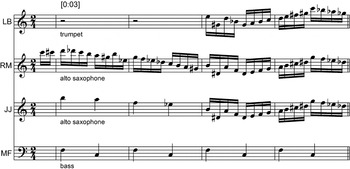
‘Get in Line’, march music, first theme statement. This and later music examples present the lines for trumpet (in B♭) and alto saxophone (in E♭) as transposing parts rather than at concert pitch, and may be read as scores for improvisers. The staves are labelled with the musicians’ initials: LB (Lester Bowie), RM (Roscoe Mitchell), JJ (Joseph Jarman), MF (Malachi Favors).

Jarman's stunning outburst brings the first theme statement into sharper focus. ‘Get in Line’ is a military march, and Jarman's words are those of an irate non-commissioned officer addressing a black soldier, presumably a recently enlisted private. This theatrical scenario hit close to home for the members of the Art Ensemble, all of whom entered the US armed forces in the 1950s, the decade when President Truman's order to integrate the military was finally implemented. Jarman and Bowie in particular spoke (to me and other interviewers) about experiencing racial discrimination while serving on bases in the South.Footnote 15
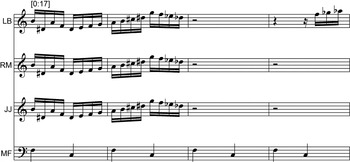
This nascent interpretation of ‘Get in Line’ as a theatrically inflected military march is confirmed in the next section of the piece (see Example 3). The band plays a reprise of the opening theme – and then, while Favors's march-bass vamp continues, the other musicians play interlocking melodies built from durational patterns that are idiomatic to marches (such as triplets and dotted rhythms). Midway through the passage Jarman breaks into a familiar army cadence call, chanting ‘Left! Right! Left! Right!’ as if he is a drill instructor, commanding the other musicians to get in line and execute a quick-time march.Footnote 16

March music, second theme statement.


Continued

The second theme statement ends abruptly, with all the performers playing a three-note figure in a cleanly articulated one–and–two rhythm. Like the ‘stinger’ accents heard at the end of many marches, this gesture provides musical closure as well as a vivid visual image of marching soldiers coming to a halt, left–right–left. However, the sense of resolution achieved by the Art Ensemble proves to be short-lived.
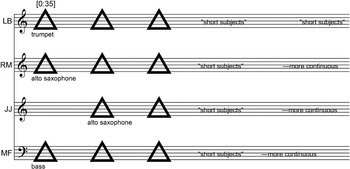
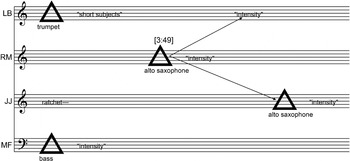
After two seconds of silence the musicians launch into an extraordinarily brief group improvisation, lasting only as long as it takes Bowie, Jarman, and Mitchell to release a single breath through their instruments (see Example 4). Another silent moment leads to more ‘short subjects’; then the process repeats again.Footnote 17 Some of these improvised fragments draw on the idiomatic march rhythms from the previous section, but because Favors has abandoned his ‘oom-pah’ ostinato, they never coalesce into a proper march. Instead, all four musicians play independent melodic lines, while staggering their phrasing and breathing to create the impression of a continuous sonic texture. The members of the Art Ensemble are getting out of line, theatrically speaking. In musical terms, they are gradually progressing towards an improvisation style that they would describe as an ‘intensity’ structure – complex, dense, and highly energetic.Footnote 18 Or, to quote the poetic formulation offered by Jarman in the album liner notes, the former servicemen are ‘marching through the intense flood of the military world that surrounds us’.Footnote 19
Short subjects, assembling the intensity structure. The triangles are graphic notation symbols used by AACM composers to mean ‘improvise(d)’.

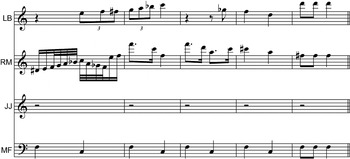
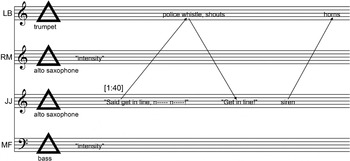
The intensity structure that is materializing at this point in the performance contrasts strikingly with the opening march music, a dynamic that can best be illustrated with a brief conceptual exercise.Footnote 20 Military marches, like the precision drills that they accompany, are defined by a few key characteristics. They possess rhythmic regularity: a steady, uninterrupted metre and a narrowly circumscribed range of tempos, optimized for walking or running. They are stratified, with instrumental groups performing specific and non-overlapping functions (for instance, the bass and percussion instruments that imitate the footfalls of marching infantry). And, finally, they are coordinated, with strict style norms that mirror the command structure and meticulous protocol governing every aspect of military routine, from training activities and daily life on base to actual combat. This careful scheme is overturned when the members of the Art Ensemble approach the intensity structure. Suddenly there is no regular metre or tempo; each musician determines his own pacing independently of the others. They also shift from register to register, and from one timbre to another, with impressive speed, replacing stratification and top-down coordination with a non-hierarchical structure that is ‘extremely dense, fast-moving, [and] ultimately static’, as George E. Lewis phrased it.Footnote 21 If, during the two theme statements, the performers were marching or otherwise moving in formation, the music now conveys that their ranks have been broken, and that the Art Ensemble soldiers are operating in a chaotic, unpredictable environment – like the fields and forests of Vietnam. Jarman responds by putting down his saxophone and shouting at the men under his command, in an attempt to gain control of a rapidly deteriorating situation (see Example 5).
Intensity structure, Mitchell solo. The arrows denote an audible interactive relationship.

Jarman's latest verbal eruption seems to be triggered by developments in the music, specifically Mitchell's increasing prominence at the front and centre of the texture. For this reason Mitchell's saxophone playing does not have to be heard as an improvised ‘solo’ that contributes only to the musical layer of the performance. Instead it would be more accurate to analyse this moment in theatrical terms. Here, Mitchell emerges as a distinct character who provides a dramatic foil to Jarman's officer persona. Furthermore, one can regard Favors and Bowie's instrumental sounds, siren noises, and police whistles as sonic backdrops that establish a theatrical change of scene, and set the stage for the mounting conflict between the characters played by Jarman and Mitchell.
In another effective dramatic touch, the performers decide to let the exact nature of the dispute remain ambiguous. Mitchell could be protesting against the dehumanizing conduct of his superior, or expressing solidarity with other soldiers so treated. Another interpretative possibility draws on a story that Jarman related to me about his combat experiences as a paratrooper in the US Army, 11th Airborne Division.Footnote 22 In the mid-1950s, Jarman and his fellow Pathfinders were deployed in Southeast Asia, where they conducted secret operations prior to official American involvement in Vietnam. On one nightmarish occasion Jarman's platoon was dropped near a Vietnamese village suspected of being a Communist hideout. Eighteen paratroopers were killed in the landing, but Jarman and eleven others survived, and they were ordered to destroy the village. The incident was incredibly traumatic for Jarman, and not just because of the leg wound he sustained while retreating. He was subsequently unable to continue in a combat role.Footnote 23 As he told Jamil Figi, ‘I had to get out of the line.’Footnote 24 Jarman requested a transfer to the division's concert band, and he spent the remainder of his enlistment playing the saxophone in Augsburg, West Germany, an assignment vastly preferable to dangerous paratrooper jumps.Footnote 25 With this personal history in mind, Mitchell's performance can be interpreted as a conscientious soldier rebelling against unlawful orders. Jarman himself might hear an echo of his own escape from Vietnam, saxophone in hand.
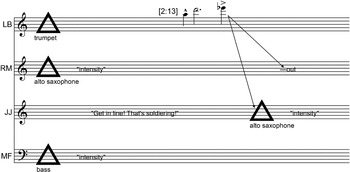
Thirty seconds into Mitchell's ‘solo’, the members of the Art Ensemble create another musical-verbal exchange that reinforces this character-based analysis of ‘Get in Line’ (see Example 6). Jarman calls out the soldier once more, and now Bowie reacts, playing a cadence gesture on trumpet. His bandmates answer immediately, as they often do in response to what George E. Lewis called his ‘brass witnessing’ and ‘signifying punditry’.Footnote 26 Mitchell drops out, and Jarman re-enters on saxophone, transforming his verbal assault into an energetic instrumental monologue.
Intensity structure, transition.

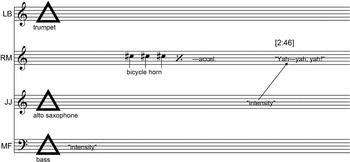
During the opening stage of Jarman's saxophone performance Mitchell rests. Then, as Jarman's lines increase in volume, timbral complexity, and other markers of ‘intensity’, Mitchell returns with a handheld bicycle horn, playing a series of beeps and bleats that imitate Bowie's trumpet exclamations.Footnote 27 A few more soldiers, it seems, have joined the rebellion. The dramatic conflict culminates about half a minute into the passage (see Example 7). Mitchell shapes his bicycle-horn chatter into a steady rhythmic pulse, which sounds like an alarm or emergency signal cutting through the dense texture generated by the other musicians. Shortly thereafter, Jarman reaches the peak of his saxophone improvisation, and Mitchell answers – not with a bicycle horn, but with his voice: ‘Yah – yah, yah!’
Intensity structure, Jarman solo.

Mitchell's vocal cries have two important consequences for this analysis. The first stems from how they illustrate the continuity between verbal texts, vocal sounds, and instrumental music in ‘Get in Line’, as well as other theatrical pieces performed by the Art Ensemble. The interchangeability of these sounds greatly expands the group's compositional and improvisational resources, while adding depth to characters and dramatic scenarios. The second analytical consequence of Mitchell's ‘yah, yahs’ hinges on how their semiotic meaning is interpreted. Mitchell could be shouting encouragement to his bandmates, catalyzing Bowie, Favors, and Jarman at an exciting musical moment. Alternatively, Mitchell's cries might carry some dramatic weight, as rejoinders to the commanding officer or as expressions of a soldier's anguish and distress during combat. Any dramatic interpretation, however persuasive, must nonetheless take into account the clearly comical tone that Mitchell adopts during this section of the piece. Here Mitchell's performance registers not as genuine defiance or distress, but as a purely ludic response that foregrounds the subjectivity of black soldiers. This is trickster logic, a kind of ‘meta-play’ intended to be ‘disruptive of settled expectations’, in the words of Brian Sutton-Smith.Footnote 28 Mitchell's ludic response is a critique of the asymmetrical power relationship between the officer and the soldier, and simultaneously a creative, improvisatory move that establishes a ‘place where the “writ does not run”’, where military protocol does not apply.Footnote 29 The put-upon soldier realizes that he cannot beat the officer at the officer's game – so he creates a new game, a new ludic space with himself (and his agency) at the centre, and the abusive officer at the periphery. This kind of ‘subversive play’ – according to bell hooks, whose theory of the ludic resonates with Sutton-Smith's – is characteristic of artworks informed by ‘radical black subjectivity’.Footnote 30 ‘[I]t seems to me a practical gesture’, hooks observed, ‘to shift the scene of action if in fact the location of one's political practice does not enable change.’Footnote 31
Mitchell's ludic response is one of the primary factors distinguishing ‘Get in Line’ from many 1960s anti-war compositions, which tended to employ various combinations of mobilizing rhetoric, earnest pleading, and world-weary cynicism.Footnote 32 In contrast, the members of the Art Ensemble are articulating what Aldon Nielsen called ‘the dada of the black experimentalist’, a declaration that if the American ‘“power structure” […] is reasonable, then we prefer not to be reasonable’.Footnote 33 This very conviction is at the core of Jarman's poem and artistic manifesto ‘AS BLACK/AND WILD AS IT CAN BE-’, which reads in part:
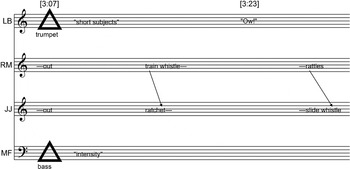
In the wake of Mitchell's ludic moment, Jarman leaves the ‘stage’, so to speak, and Bowie's trumpet becomes the temporary focal point of ‘Get in Line’ (see Example 8). The musical texture is noticeably less dense than when the saxophonists were playing – not because Favors's vigorous bass lines are slowing down, which they are not, but on account of Bowie's sparse phrasing.Footnote 35 Mitchell and Jarman soon return, though, playing some of the Art Ensemble's characteristic ‘little instruments’: a train whistle and a ratchet, then rattles and a slide whistle.Footnote 36
Intensity structure, Bowie solo.

In the early part of this analysis it made intuitive sense to interpret ‘Get in Line’ as mimetic or representational. A military march was followed by a one-sided verbal dispute between an abusive officer and an African-American enlisted man; the intensity structure seemed to represent soldiers breaking out of formation and then contending with either their superior officer or the sheer chaos of war. At this point in the performance, however, it is less obvious how to analyse the little instruments played by Mitchell and Jarman. Ratchets and slide whistles do not belong in a proper march, and neither do they contribute sounds ordinarily identified with a theatrical battle scene, or even a standard Art Ensemble intensity structure. These are the instruments of slapstick, animated cartoons, and a foley artist's studio. Perhaps the whistles, rattles, and ratchet are functioning as another instance of the ludic response – ‘subversive play’ that deconstructs the tense theatrical scenario as well as the intensity structure itself. Tellingly, the only vocal sound heard during this passage comes from Bowie, who pauses between trumpet phrases to holler at no one in particular, or at himself, confirming the subjectivity of Mitchell's ludic response. For a moment at least, the officer–soldier conflict has yielded to ‘the dada of the black experimentalist’, a phenomenon found not only in ‘Get in Line’ but in any number of Art Ensemble compositions, where the performers transform meaningful music into ‘serious fun’, as Bowie used to say.Footnote 37
Eventually Mitchell returns on saxophone, playing fast-paced melodies that consume the silences between Bowie's trumpet phrases. Jarman adds a few more ratchet sounds, as if to blur the textural transition that is occurring, and then enters on saxophone once again. The members of the Art Ensemble have reconstituted the intensity structure that began three minutes earlier, creating a formal ‘arch’ that spans the entire middle section of the piece (see Example 9). This passage clearly recalls the early stages of the intensity structure, but the verbal texts and vocal sounds are missing. Jarman is not yelling invective, and one hears no comical cries or vocal calls from Bowie, Favors, and Mitchell. Due to the temporary absence of the theatrical layer, the Art Ensemble's multifaceted music is no longer explicitly joined to a dramatic scenario, or to the images of disintegration and wartime chaos that emanated from the march at the beginning of the piece. Consequently, the intensity structure is now ready to be re-examined for new meanings.
Re-assembling the intensity structure.

One sonic connotation is immediately apparent: the close resemblance between this intensity structure and the so-called ‘energy-sound’ performance mode associated with 1960s free jazz.Footnote 38 The reception of free jazz was extremely contested, as many scholars have observed in recent years. Audiences and critics heard this unmistakably experimental music as either aligned with or totally opposed to their cultural politics, generating a polarized and sometimes racially charged atmosphere around a musical style that is – even today – described as a ‘permanent avant-garde’, always new and always radical.Footnote 39 On the American scene, particularly in East Coast cities such as New York, one faction viewed free jazz as a corruption of the venerable jazz tradition in the service of half-baked agitprop; another faction saw it as a bourgeois pursuit that was insufficiently committed to the revolutionary aims of the Black Arts Movement. As bell hooks wrote, ‘avant-garde jazz musicians, grappling with artistic expressivity that demanded experimentation, resisted restrictive mandates about their work, whether they were imposed by a white public saying their work was not really music or a black public which wanted to see more overt links between that work and political struggle’.Footnote 40
These critical currents were somewhat less treacherous in Chicago, the home of the Art Ensemble. They were the beneficiaries of favourable press coverage in a cross-section of local publications, from Downbeat and the Chicago Tribune to the Daily Defender and the Nation of Islam weekly Muhammad Speaks.Footnote 41 Additionally, the Art Ensemble's place in the Black Arts Movement was secure, owing to their affiliation with the AACM. (Lester Bowie was the Association's president in 1968 and 1969, and his bandmates were founding members.) Furthermore, the Art Ensemble's politically themed performances were frequently leavened with a sketch-comedy humour that disarmed sceptical listeners. At a 1967 concert, for example, one of the musicians donned an army uniform and a Lyndon B. Johnson mask, and then attempted to give a speech, which ended abruptly when one of his bandmates hurled a pie in his face. ‘For all parties (except perhaps any Democratic Party precinct captains who may have been present), it was probably a very satisfying affair.’Footnote 42
The Art Ensemble's critical and popular reception changed markedly when they crossed the Atlantic in 1969. French critics who encountered black experimental musicians, including the Art Ensemble, considered free jazz to be both culturally and politically transgressive, the sonic manifestation of an essential black identity.Footnote 43 One widely held assumption was that all African Americans, musicians or not, were active in the Black Panther Party.Footnote 44 This is the precise context for Bowie's claim: ‘They all made it look like that, if you were black, you were political.’Footnote 45 Although such misperceptions gave the Art Ensemble a certain cachet among credulous Paris leftists, the Chicagoans understood the real risks of appearing to be radical, given their precarious social position as non-white immigrants to France, a body politic still reeling from the events of May 1968. In one famous case, the African-American trumpeter Clifford Thornton was denied entry to France in retaliation for the organizing he had done on behalf of the Black Panthers.Footnote 46 As Bowie remembered, ‘Everybody was gaining reputations as powerful nationalists, but this […] stopped a lot of cats from making it. Clifford Thornton for instance, I remember he couldn't get back into France, he was arrested, put back on the plane. I have no time for that kind of stuff.’Footnote 47 Decades later, Bowie's recollections support an analysis of ‘Get in Line’ – especially the intensity structure – not just as a political protest against war and institutional racism, but also as a cultural critique of how the Art Ensemble's music was received. By denying that pieces like ‘Get in Line’ were politically motivated, Bowie and his bandmates could resist essentialist perceptions of their work while opening up a space for expression that ‘continually opposes re-inscribing notions of “authentic” black identity’, as bell hooks phrased it.Footnote 48 Instead of choosing sides in the contentious debate on black experimentalism, the members of the Art Ensemble cultivated a discourse around their own music that would be as ‘oppositional and liberatory’ as the sounds they played.Footnote 49
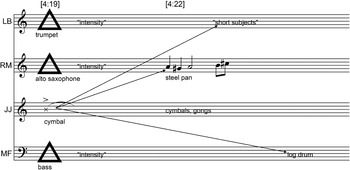
Four-and-a-quarter minutes into ‘Get in Line’, Jarman suddenly pivots away from his microphone and starts crashing a cymbal with considerable force (see Example 10). Within seconds, the other musicians also switch to various percussion instruments: gongs, steel pan, and a log drum. This rapid transition ends the intensity structure, and marks the final formal division of the piece. As often happens in Art Ensemble performances, the musicians have produced a ‘confrontation of various […] expression[s] and style[s], in which the expressive power of one level is relativized by the other’, to quote Ekkehard Jost.Footnote 50 That is to say, the members of the Art Ensemble are deliberately disrupting and drowning out the intensity structure, along with everything that accompanied it – the dramatic conflict and the combat scene, as well as the political turmoil over Vietnam and the ‘culture war’ around free jazz.
Percussion texture, metallic sounds.

As the percussion texture unfolds, Bowie continues to play trumpet, but the dominant instruments here are gongs, cymbals, and other large, metallic sound-makers. All these instruments share a sound envelope in which the waveform peaks quickly and then slowly decays. Unlike the dense and complex intensity structure, where a single second of musical time might contain dozens of notes, the present texture consists of massive, discrete events that resemble nothing more than a series of deafening explosions: ‘total pandemonium’, in Ekkehard Jost's description.Footnote 51 These sounds can be analysed mimetically, like the sirens and police whistles earlier in the piece that evoked a defiant soldier engaged in battle. However, when the Art Ensemble effectively dismissed the intensity structure, all of its associated meanings also began to recede. The new percussion texture, therefore, may not be composed of combat depictions, or explosions as such. Instead, these are explosive sounds, abstracted from their original theatrical context and redeployed towards other ends. The listener is reminded of Jimi Hendrix's ‘The Star-Spangled Banner’, performed at Woodstock eight weeks to the day after ‘Get in Line’ was recorded. Like Jarman, Hendrix was a former army paratrooper, and his solo rendition of the US national anthem includes a quotation from ‘Taps’, feedback noises, and guitar gestures called ‘divebombs’, repurposed as expressions of tragic beauty.Footnote 52 Of course Hendrix's anthem would not end the Vietnam War or the military draft, as many at Woodstock surely wished, but he could offer his audience the feeling of aesthetic transcendence through music, if only for a few moments. Indeed, the power to ‘transcend reality’, according to Brian Sutton-Smith, belongs to playful interpreters such as Hendrix, because ‘one can never quite lose while still at play’.Footnote 53 Jarman, too, envisioned performative experiences that would prepare the way for psychological, social, and political transformation. In his poem ‘-HATEWAR-’, Jarman wrote about music that liberates and heals:
A minute before the end of ‘Get in Line’, the members of the Art Ensemble construct one more textural shift (see Example 11). Favors and Jarman vigorously strike a pair of resonant log drums while Bowie crashes a set of cymbals, loudly and enthusiastically. The musicians seem to be playing with complete abandon – ‘un jeu total’Footnote 55 – an impression that is confirmed seconds later when they start shouting and ‘HOLLER[ing] like damn mad fools’, to quote Jarman once more.Footnote 56 This time, though, the performers’ vocal sounds do not communicate any of the moods previously heard in ‘Get in Line’. Instead they convey boundless joy, the ludic response no longer subversive and now re-imagined as exultation. Mitchell reacts by moving from steel pan to bell lyre, playing little melodic ideas that diverge, both sonically and emotionally, from the rapturous contributions of his bandmates.
Percussion texture, Mitchell bell lyre.

The bell-lyre melodies played by Mitchell form an audacious contrast to the rest of the group. One hears restraint against ecstasy, clarity in the midst of complexity. The rest of the musicians are confronting the intensity structure in a direct, unified way; even Jarman has completely discarded his dramatic persona to stand in solidarity with Bowie and Favors. Still, Mitchell remains apart from his bandmates and chooses to counter the intensity structure with an entirely different strategy: oblique disregard. This response typifies Mitchell's oppositional approach to group improvisation.Footnote 57 More importantly, it shows the Art Ensemble's aesthetics in action, a pluralist model of music and social relations that plainly refutes simplistic perceptions of African-American performance, politics, and protest.
The Art Ensemble's pluralist philosophy is traceable to the band's origins in the AACM, which was founded in response to societal and institutional forces that threatened the economic viability of black musicians. At the same time, the music industry neglected black experimentalists and other innovators whose work did not fit one-dimensional, readily commercialized portrayals of African-American culture. In the AACM's view, collective action could provide a solution to these problems, but only if it prioritized ‘personal freedom, mobility, and individuality’.Footnote 58 For this reason George E. Lewis characterized the ‘AACM project of collectivity’ as ‘diversity within unity’, a concept that is exemplified by the musical and social practices of the Art Ensemble.Footnote 59
The members of the Art Ensemble conclude ‘Get in Line’ with another salvo of gongs, steel-pan strokes, and cymbal crashes (see Example 12). The thunderous resonance of all these metallic instruments creates the single loudest moment in the performance, overwhelming the recording-studio signal chain and forcing the audio engineer to adjust the mixing board on the fly. As this climactic passage unfolds, the musicians keep shouting in a final, definitive articulation of the ludic response and its power to transform one's situation – musically, dramatically, and in the political sphere. The last sounds heard are a cryptic trumpet line, followed by six pulsations from a small bell, quietly reverberating as the percussion texture fades away.
Percussion texture, conclusion.

Conclusion: Fanfare for the Warriors
Some forty years after its recording, the Art Ensemble's ‘Get in Line’ remains a profoundly compelling performance situated at the intersection of musical sound, theatre, and political critique. When faced with militarism and institutional racism, Bowie, Favors, Jarman, and Mitchell offer a remarkable ludic response that stands toe-to-toe with the enormity (and the absurdity) of prejudice and essentialism. Additionally, while ‘Get in Line’ is certainly rooted in Vietnam-era debates, the absence of specific textual references to the Vietnam conflict also invites contemporary listeners to propose their own disruptive responses to twenty-first-century political issues. Finally, from the intensity structure to Mitchell's contrasting bell lyre, one hears the Art Ensemble's collective play becoming more and more pluralist in nature, in a real-time illustration of the group's practices for accommodating differences in aesthetics and in political orientation.Footnote 60 It is not coincidental that Jarman, who was a peace activist during his years as a music and drama student, portrays the character responsible for converting a march into political street theatre, while his politically circumspect bandmate redirects the dramatic conflict back into the realm of musical sound. As Mitchell observed, ‘Jarman has definitely incorporated concepts related to theater and politics […] and, yes, I do insist on structure.’Footnote 61
These pluralistic musical and social practices are present in every Art Ensemble performance, and they also account for the group's exceptional longevity and creative output, which spans the better part of five decades. Whether in 1969 or today, the Art Ensemble's legacy is a testament to the power of multi-voiced music and critique, as well as an eloquent answer to bell hooks's call for ‘cultural production’ that reflects ‘multiple black experience [and] the complexity of black life’.Footnote 62