1. Introduction
In the scholarly community, clientelism as a mode of citizen–politician linkage is widely considered at odds with the classic vision of a well-functioning democracy derived from Western experience. According to this vision, political parties should offer distinctive policy programs that they promise to follow through once elected into office. Voters will experience the impact of these policy programs administered by a politically neutral civil service and evaluate the incumbent party based on their satisfaction with the consequences of implemented policies. In contrast to the logic of the programmatic linkage, clientelism is founded on the delivery of selective material payments to citizens who surrender their votes fearing that those payments will otherwise be withdrawn. The clients' support for political parties is contingent on the continuous flow of particularistic goods rather than their evaluation of policy achievements (Kitschelt, Reference Kitschelt2000).
While there is a rich body of scholarship on the effectiveness of clientelism in engineering voter support,Footnote 1 few studies have explicitly examined whether and how the political functions of clientelism evolve as one party consolidates its dominant position in a society. Treating popular support for ruling parties as the dependent variable, this article argues that the role of clientelist exchanges for maintaining such support depends on how long a particular party has been in power. In the presence of robust party competition and regular alternation of power, different parties can have roughly equal access to clientelism as a political tool for gaining popular support. In this scenario, rampant clientelist practices and intense party competition can coexist and reinforce each other, as demonstrated by the experiences of many Latin American countries (Levitsky, Reference Levitsky, Kitschelt and Wilkinson2007; Lindberg and Morrison, Reference Lindberg and Morrison2008).
In dominant-party systems,Footnote 2 by contrast, clientelism mainly functions as a political instrument to further entrench incumbency advantage. This article uses party duration to refer to the number of years one party has remained in power through winning multiparty elections (cf. Thomas, Reference Thomas2015). Lengthy party duration makes the promise of distributing selective goods more credible and facilitates the politicization of bureaucracy and other state resources essential for clientelist exchanges. It is therefore more likely for the beneficiaries of clientelism to be supporters of the ruling party in dominant-party regimes than in other multiparty electoral systems.
The main arguments of this article are tested on data from the Afrobarometer survey, a project that measures public attitudes in over 30 African countries. The African continent provides an ideal context for studying the interrelationship between electoral support, party duration, and clientelism. Since the end of the Cold War, a global wave of democratization has pushed most African countries to adopt competitive multiparty elections. At the same time, there is a substantial cross-national variation in the ability of the incumbent party to continuously dominate elections (Lindberg, Reference Lindberg2006; Morse, Reference Morse2015). Moreover, a combination of factors, such as underdevelopment and ethnic heterogeneity, has made clientelism an important basis for political mobilization and accountability in Africa (Van de Walle, Reference Van De Walle, Kitschelt and Wilkinson2007). Comparative evidence from Africa is therefore well-suited for examining the role of clientelism in the entrenchment of political incumbents and transitions to consolidated democracies.
This article makes original contributions to two important research areas in comparative politics. First, it improves our understanding of dominant-party regimes by showing that long-ruling parties often rely on different mechanisms to maintain power at different stages of their life cycles. Early in their tenure, dominant parties may enjoy genuine popular support due to charismatic leaders or appealing policy proposals. However, as the grip over state resources tightens, these parties tend to resort to clientelism as a more dependable and permanent instrument to prevent power turnover. Trapped in the clientelist network, even voters deeply disillusioned with an incumbent party's overall performance might refrain from supporting the opposition. While some existing studies have discussed the changing role of clientelism in individual countries, they fail to provide systematic evidence based on cross-national data. Combining mass survey data from the Afrobarometer project and information about partisan turnover in office, we provide original evidence that clientelist exchanges indeed play an increasingly important role for generating mass support for the ruling party as party duration prolongs.
Second, understanding the evolving role of clientelism under electoral contestation has profound implications for the study of democratic consolidation and the reverse phenomenon of democratic erosion (Lust and Waldner, Reference Lust and Waldner2015; Bermeo, Reference Bermeo2016). To the extent that the incumbent could incrementally tighten its control over state resources to co-opt citizens, clientelism thwarts regular rotation of power and contributes to the increasingly pervasive polity known as ‘electoral authoritarianism’ (Schedler, Reference Schedler2006; Levitsky and Way, Reference Levitsky and Way2010). It is therefore critical that domestic opposition groups and international donors stay vigilant and resist the incumbent party's attempt to cultivate clientelist networks at early stages of its tenure. The prevention of excessive partisan control over civil service, regulatory bodies, and the economy is important not only for the quality of governance but also for the enhancement of democratic accountability.
The rest of the article is organized as follows. The next section explains how clientelism is defined in this study and introduces the three major forms of clientelist exchanges. The following section outlines the main argument about how the political functions of clientelism evolve as the ruling party moves toward a dominant position in the party system. In addition, the observable implications of the theory are laid out. The fourth section introduces the data sources, the operationalization of key concepts, and the empirical strategy for testing the research hypotheses. This is followed by a presentation of the main empirical findings and results from several robustness checks. We conclude the article by discussing the implications of its findings for the understanding of the resilience of dominant-party regimes.
2. Clientelist linkage and its varieties
Before exploring the role of clientelism in generating support for ruling parties and how this role evolves with party duration, it is necessary to clarify the nature of clientelism and the various forms it could assume. In the context of this study, clientelism is defined as a particular pattern of elite–citizen linkage in which the politicians' delivery of material goods to citizens is strictly contingent on the latter's electoral support (Kitschelt and Wilkinson, Reference Kitschelt and Wilkinson2007; Stokes, Reference Stokes, Boix and Stokes2007b; Hicken, Reference Hicken2011). There are two elements of this exchange relationship that are central to the definition of clientelism.
The first is the contingent or reciprocal nature of the patron–client exchange. For the politicians, the criterion of distributing material payments is simply whether the citizens offered their electoral support in the past or have promised to do so in the future. Thus, politicians who deliver jobs, loans, or administrative assistance to the citizens know that the beneficiaries are highly responsive to such material payments and willing to surrender their votes for the right price. The contingent nature of the relationship can be seen as a form of threat: the patrons try to send a clear signal that the benefits will be withdrawn if the clients vote ‘the wrong way’. Another critical feature of clientelism is the repeated nature of the interaction. If the exchange of votes for material payment is a one-off affair, it does not constitute a stable pattern of elite–voter linkage. Instead, clientelism is typically ‘an iterated interaction, with each side anticipating future interactions as they make decisions about their behavior today’ (Hicken, Reference Hicken2011: 292).
Incentives for defection are a major threat to the smooth functioning of clientelist practices. It is important to note that the exchange of votes for benefits is rarely simultaneous: there is generally a time lag between the delivery of material payments and the casting of the vote. This raises the obvious question of how to enforce the promised behavior of the other party: for example, what prevents the voters from taking bribes from a political party and still voting according to their genuine preferences? The literature has identified two primary mechanisms to overcome this commitment problem. First, parties can rely on a bottom-heavy organizational network deeply embedded in local communities to monitor the voting behavior of their clients. Even with the introduction of secret ballots, some clientelist parties can draw upon their local knowledge to make informed guesses about voting behavior, helping them to condition future flows of goods based on estimated electoral support (Brusco et al., Reference Brusco, Nazareno and Stokes2004; Stokes, Reference Stokes and Schaffer2007a). Second, in many societies without well-organized parties, clientelist relations may be supported by norms of reciprocal obligation. The distribution of goods and services can create feelings of indebtedness and gratitude that lead voters to voluntarily support the patrons (Finan and Schechter, Reference Finan and Schechter2012; Lawson and Greene, Reference Lawson and Greene2014).
Analysts of clientelism often understand this concept in contrast to two other mechanisms of cultivating electoral support: programmatic linkage and pork barrel goods. In the former, political parties appeal to voters by developing coherent policy programs that either provide public goods or target benefits to specific socioeconomic groups (Kitschelt, Reference Kitschelt2000). Even when programmatic appeals allocate benefits to some voter groups at the cost of others, the criterion for receiving those benefits is not the voters' past or promised electoral support but their objective membership in specific groups. Thus, an unemployed worker will benefit from a party's policy to raise unemployment benefits regardless of her political support. In the latter, elected officials appropriate government spending to fund projects in their home constituencies in an effort to win electoral support. Unlike clientelism, though, voters' receipt of the pork is conditional on their membership in the targeted constituency rather than their political support for any particular politician.
Therefore, what is most distinctive about clientelism is the contingent, quid pro quo feature of the exchange, not the electoral considerations behind targeted benefits or the nature of goods and services involved in the relationship. In practice, the types of material benefits supplied by patron politicians can come in various guises. As Scott noted, the clientelist link is ‘a very flexible one in which the needs and resources of the partners, and hence the nature of the exchange, may vary widely over time’ (1972: 95). Despite the theoretical existence of unlimited forms of clientelist exchanges, three types have figured prominently in the literature: vote-buying, the offer of public sector jobs, and the targeted delivery of benefits to local communities.
Vote-buying, defined as ‘a transaction whereby candidates distribute private goods such as cash and gifts in exchange for electoral support or higher turnout’ (Guardado and WantchÉkon, Reference Guardado and WantchÉkon2017: 1) is by far the most studied form of clientelist practices. Typically, candidates distribute cash, liquor, food, or clothes at campaign rallies or on election day to entice voter's support, mainly targeting the poor whose votes are cheaper to buy. The second form of exchange is usually referred to as ‘patronage’, describing the distribution of public sector jobs to clients for their political support. The holders of public jobs are afraid to vote against the patrons who, once reelected, might retaliate by withdrawing the patronage goods. Even if the clients can overcome the collective action problem by voting an unpopular patron out of power, the prospect of losing public jobs under a different ruling party would still deter them from taking this option.
Both vote-buying and patronage involve the allocation of private goods to individual citizens and correspond to the classic image of face-to-face, dyadic patron–client interaction (Lemarchand, Reference Lemarchand1972; Scott, Reference Scott1972). By comparison, the politically motivated distribution of material benefits to geographically delimited communities is not necessarily clientelist. As noted above, if the disbursement of resources to the localities follows general rules and benefits members of the community regardless of their political support, then it does not meet the definition of clientelist linkage. For example, Harding (Reference Harding2015) demonstrates that voters in Ghana use elections to hold officials accountable for road maintenance. Because the budget for road maintenance was shown to follow formal rules rather than contingent on past electoral support, road distribution in this case is not clientelist. If, however, the allocation of locally-oriented goods is conditional on the political support of the recipients, such exchanges should be duly considered clientelist. To tie the distribution of such ‘club goods’ to political support, clientelist parties often need to rely on political appointees who have substantial discretion to reward party loyalists and withhold benefits from non-supporters (Kitschelt and Wilkinson, Reference Kitschelt and Wilkinson2007: 12). The enforcement of the clientelist bargain might also require accurate information regarding the compliance of small groups of voters, which can be obtained by measures such as the counting of ballots at the ward or prescient level.
3. The evolution of clientelism under long party duration
One of the reasons clientelism is widely considered an impediment to democratic development has to do with its potential to stifle party competition and strengthen incumbency advantage. As voters become dependent on the selective material payments distributed by their patrons, they lose the ability to remove corrupt and unpopular political leaders from office through electoral means (Fox, Reference Fox1994; Stokes, Reference Stokes and Schaffer2007a). However, empirical studies have shown that prevalent clientelist practices can exist in societies with very different dynamics of party competition. The distribution of targeted benefits contingent on electoral support is the mainstay of elite–voter linkage in both dominant-party regimes such as Singapore (Tremewan, Reference Tremewan1996; Mauzy and Milne, Reference Mauzy and Milne2002) and societies with regular partisan alternation of government such as Argentina (Magaloni et al., Reference Magaloni, Diaz-Cayeros, EstÉvez, Kitschelt and Wilkinson2007) and Ghana (Lindberg, Reference Lindberg2010). Thus, the simple argument that clientelism advantages the ruling party by tilting the electoral playing field fails to capture its differential functions in various political environments.
The degree to which clientelism is used to consolidate incumbency advantage in a multiparty electoral system is determined by a variety of factors, some of which are largely exogenous to party competition while others are deeply related to the duration of one-party dominance. Thus, any effect that clientelism has on the dynamics of party competition must be understood within a complex web of interactive relations. That said, it is still possible to make a ceteris paribus proposition about how the functions of clientelism depend on the time elapsed since the last party turnover in government. This article argues that, other things being equal, the longer the party duration, the more it becomes reliant on clientelist exchanges for generating popular support. The key mediator variable is the ruling party's control over state resources, which is essential for establishing the party's credibility with its clients and cementing their conditional electoral support. State resources in this study mainly include public budgets, state-owned enterprises (SOEs), public sector jobs, regulatory power over private businesses, and the state bureaucracy (Greene, Reference Greene2007: 40–41).
Partisan control over these public resources plays a crucial role in distributing targeted goods and monitoring the compliance of the clients (Grzymala-Busse, Reference Grzymala-Busse2008: 649–651). First, the power over the budgetary process and SOE management enables the ruling party to increase relative spending on those benefits and services that can be targeted to individuals and small groups instead of public goods accessible to everyone. As a result, targeted goods such as rural credit programs, land titles, and local infrastructure projects will have a prominent place in politician–voter linkage. Second, packing the state bureaucracy with party loyalists ensures that the provision of state services such as housing and education will prioritize supporters of the ruling party. Finally, the same political appointees responsible for delivering targeted goods can also monitor and enforce the voters' support. Thus, rural development officials, local registrars, and school teachers who owe their employment to patronage can serve as the eyes and ears of the ruling party to monitor the political behavior of the recipients.
The longer a political party has remained in power, the more opportunities it has to politicize state resources to gain advantage over the opposition parties. Long-ruling parties tend to establish paralleled party and state structures, subordinating the latter to party loyalists at every administrative level. In Singapore, for example, the ruling People's Action Party (PAP) ‘has set up a … system of party cells at the grassroots level and combined it with a direct role in the administration of the electoral wards and city districts. The PAP and government, in a sense, are more or less one and the same’ (Sachsenroder, Reference Sachsenroder, Sachsenröder and Frings1998: 19). Likewise, the hegemonic People's National Congress (PNC) which ruled Guyana between the mid-1960s and 1992 embraced the doctrine of ‘Party Paramountcy’, which allowed the PNC to override all branches of government and promoted loyalists to powerful positions in the bureaucracy, the security forces, and the economic sector (Hintzen and Premdas, Reference Hintzen and Premdas1982; Griffith, Reference Griffith1991).
Qualitative case studies have generated some evidence that, as party duration prolongs, the rulers increasingly draw upon their control over state resources to foster clientelist linkage with the supporters. For example, the Cambodia People's Party (CPP) was heavily dependent on political killings and imprisonment when it first captured power in a multiparty system in the late 1990s. After the early 2000s, however, the CPP's use of physical repression declined ‘following its mastering of the use of patronage to win votes’ (Un, Reference Un2011: 549). The CPP channeled centrally controlled resources to rural communities to build schools, roads, and irrigation systems, generating much legitimacy and electoral support for the ruling party (Ibid.: 556). A similar trajectory was followed by Zambia's Multiparty Movement for Democracy (MMD), which came to power in the country's first multiparty election in 1990. Initially, the newly founded party did not have the organizational infrastructure necessary for clientelist exchanges and relied mainly on repressive measures to weaken opposition. After the decline in vote share in the 2001 election, the MMD shifted its electoral base ‘towards rural areas where the party could channel state resources into patron–client relationships’ (Paget, Reference Paget, Doorenspleet and Nijzink2014: 159).
While a political party's desire to prolong its rule is certainly a key factor that promotes clientelist practices, the question still remains how it decides between clientelist and programmatic appeals as the primary instrument for cementing dominance over the opposition. A major insight from relevant literature is that, under certain conditions, clientelism is a more effective tool to solve the commitment problem in politician–voter linkages. As Robinson and Verdier (Reference Robinson and Verdier2002: 1) point out, the essence of this credibility problem is that ‘(c)itizens/voters must indeed deliver their support, and politicians, once in power, must pay for their support with the policies they promised’. The clientelist approach addresses this problem by offering targeted benefits to individuals or small groups, often shortly before the election, sending a costly signal that the politicians have the capacity and disposition to meet voter demands in the future (Muñoz, Reference Muñoz2014; Kramon, Reference Kramon2016). The targeted nature of the exchanges makes it easier for politicians to monitor compliance and punish defectors. As the ruling party's grip over state resources tightens, its ability to maintain and enforce the clientelist exchanges also tends to grow at a rate the opposition can never expect to match.
Programmatic appeals, which involve the presentation of policy programs that distribute costs and benefits to all citizens regardless of electoral support, cannot take advantage of the informational value of targeted goods or monitoring to solve the commitment problem. Thus, there is much less certainty that the potential beneficiaries of a policy platform will actually turn out and vote for the proposing party. The credibility problem for the programmatic approach is especially serious in new democracies where citizens' belief in policy promises is low (Keefer, Reference Keefer2007) or in postcolonial societies where popular perception of the state as an illegitimate creation makes programmatic policy not a viable option (Lindberg, Reference Lindberg2010: 133). From the ruling party's perspective, another drawback of the programmatic approach is that it does not fully utilize the incumbent's control of state resources, as competition based on alternative policy programs tends to put the governing party and opposition on a more equal footing. A programmatic party will also be held accountable for its general policy performances, which are influenced by exogenous events and unforeseen circumstances beyond the ruling party's control. Given these features of programmatic appeals, it is understandable why ruling parties will see clientelism as a more dependable path toward a hegemonic equilibrium (Magaloni et al., Reference Magaloni, Diaz-Cayeros, EstÉvez, Kitschelt and Wilkinson2007).
To sum up, as the duration of a party's rule extends, it will increasingly resort to its hold over state resources to foster clientelist linkage with voters in its attempt to remain in power. A corollary of this argument is that, due to the causal importance of partisan control over state resources, forms of clientelist exchanges that do not hinge on monopoly over the state apparatus will play a lesser role in the ruling party's effort to maintain popular support. Among the three forms of clientelism mentioned above, the targeted delivery of benefits to localities (club goods) and patronage are both strongly associated with the monopoly of state resources: these targeted goods are impossible to distribute without controlling government budget and the process of bureaucratic recruitment. By comparison, vote-buying does not necessarily require access to public funds, and opposition parties could use cash handouts to gain support as well. Survey research shows that both governing and opposition parties may offer bribes to voters (Finan and Schechter, Reference Finan and Schechter2012; Guardado and WantchÉkon, Reference Guardado and WantchÉkon2017), and opposition politicians could turn to their own salaries, business donations, and party funds to provide for their campaign spending (Lindberg, Reference Lindberg2003: 133–134). Thus, we do not expect the role of vote-buying to differ significantly across regimes with varying lengths of party duration.
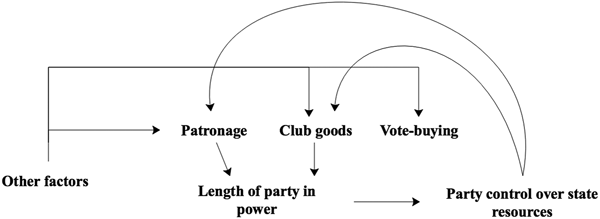
This article's main research hypothesis is therefore that, in regimes with multiparty elections, the longer a party has remained in power, the more clientelist exchanges in the form of club goods and patronage will serve to bolster popular support for the ruling party. The foregoing theoretical analysis also leads us to expect that the effects of vote-buying on popular support to be NOT associated with party duration. The causal relationships between key variables in our verbal model are visualized in a causal diagram (Figure 1) in which the arrows represent causal influences and the arrowheads indicate the direction of causality. To begin with, there are a range of exogenous factors, such as the levels of development and cultural traditions, which will determine the pervasiveness of all three forms of clientelism in a given society. Next, the distribution of patronage and club goods will serve to consolidate the incumbency advantage for the ruling party, extending its time in office. Vote-buying, however, is not expected to have such an effect. The absence of partisan rotation in power will then strengthen the party's control over state resources, which in turn facilitates the provision of patronage and club goods. Short of exogenous shocks that alter the viability of clientelist practices, we expect clientelism, long party duration, and partisan control of the state to operate in a mutually reinforcing system.
The relationship between clientelism and party duration.

4. Data and measurement
The basic empirical strategy for testing the research hypotheses is to use Afrobarometer survey data to examine the effects of clientelism on popular support for the ruling party, and whether those effects depend on party duration. The Afrobarometer project measures public attitudes in sub-Saharan Africa. Until 2017, six rounds of surveys have been carried out, with the number of covered countries increasing from 12 in round 1 to 36 in round 6. Face-to-face interviews were conducted with a randomly selected sample of 1,200 or 2,400 people in each country. For each round, the interviewers ask a standard set of questions, making it possible to compare countries systematically.Footnote 3
Although the survey questionnaires are largely similar across different rounds, they have gone through minor adjustments with each new round to meet changing research needs. Importantly for this study, the questions best suited for measuring the respondents' exposure to clientelism have not remained consistent over the six rounds. In this study, we choose round 6 as the primary data source for the analysis since it is more up-to-date and has greater country coverage (36) than previous rounds. For reasons explained below, survey data from round 3, which covers 18 countries, was used to supplement the empirical tests.Footnote 4
The main outcome variable we seek to explain is the degree to which citizens support the political party in power. In countries with multiparty elections, the most important way of expressing this support is obviously through vote choices. Afrobarometer includes the following question: ‘if a presidential election were held tomorrow, which party's candidate would you vote for?’ We identified the ruling party for each surveyed country at the time the interviews were conductedFootnote 5 and coded the dependent variable as 1 if the respondent intended to vote for the ruling party. Respondents whose answers were coded as 0 include those who intended to vote for opposition parties, did not intend to vote, refused to answer the question, or did not know how they would vote. Across the last three rounds, the average percentage of eligible voters who intended to support the ruling party is 36.94. Other studies have reported that the distribution of intended vote choices conforms to known patterns, such as official results of previous or subsequent elections (Bratton et al., Reference Bratton, Bhavnani and Tse-Hsin2012). It is therefore unlikely that the reported voting intentions were meaningfully distorted by political pressure.
The key explanatory variable is whether the respondent is involved in a clientelist exchange with politicians. Hypothesis testing requires that we identify survey responses that could be used to measure citizens' exposure to each of the three major forms of clientelism. To measure citizens' involvement with vote-buying, the following question in round 3 is used: ‘(a)nd during the (most recent) election, how often (if ever) did a candidate or someone from a political party offer you something, like food or a gift, in return for your vote?’ We create a binary variable (vote-buying) that equals 1 if the respondent had been offered something for her vote. Because this question was not included in later rounds, we rely on round 3 data to examine whether the relationship between vote-buying and electoral support depends on party duration.
It is more challenging to measure citizens' exposure to club goods, since there are various types of locally-oriented benefits and because we cannot directly observe if receiving these benefits is contingent on electoral support. Fortunately, round 6 asks the following question: ‘(h)ow well or badly would you say the current government is handling the following matter: maintaining roads and bridges?’ Responses are coded on a four-point scale that moves from ‘very badly’ to ‘very well’. The same inquiry is made with regard to five other types of local public goods: basic health services, educational needs, water and sanitation services, food provision, and supply of electricity. It is reasonable to assume that voters who have more positive evaluation of the provision of these locally-based benefits are on average more likely to be the recipients of club goods. Therefore, we combine information from these six questions to generate a proxy for respondents' experience with club goods delivery.
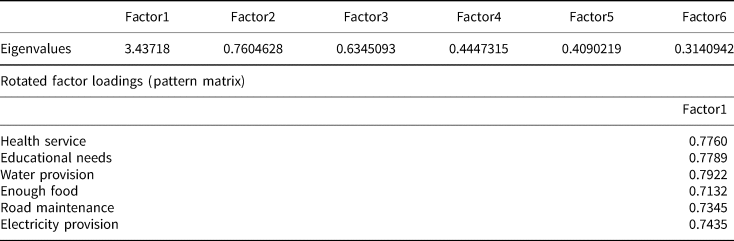
To do this, factor analysis is employed to collapse the six variables into a smaller number of interpretable underlying factors. We expect that voters respond similarly to questions about local public goods because they are all associated with the latent variable ‘club goods’. In factor analysis, there are the same number of factors as there are variables, and each factor captures a certain amount of the overall variance in the observed variables. Table 1 displays each factor's eigenvalue, which measures the amount of variance in the six observed variables that can be explained by a single factor. As the factors are listed in the order of how much variation they explain, it is clear that Factor 1, with an eigenvalue of 3.44, accounts for much more variance than any other factor. The fact that other factors' eigenvalues are well below one is strongly suggesting that variations in the six variables mainly reflect variations in just one latent variable. We therefore decide to retain only Factor 1 as a proxy for the latent variable and name it ‘club good’. This variable ranges from −1.80 to 2.40 and has a standard deviation of 1.
Factor analysis

Method: principal-component factors.
Rotation: orthogonal varimax (Kaiser off).
Number of observations = 49241.
Finally, to operationalize citizens' exposure to government patronage, we utilize a question in round 6 that asks about the employer of respondent. A binary variable (patronage) is generated that takes the value of 1 if the respondent reports that she works for the government. We should emphasize a significant limitation to our measurement of club goods and patronage: it indicates the receipt of benefits but does not capture the contingent nature of these goods – whether voters fear that withdrawing support from the ruling party will endanger the obtaining of such goods is unobservable. While we have made the best use of available data to approximate the underlying concepts, an ideal solution will depend on future innovation in survey questions. On the other hand, to the extent we mistake non-contingent provision of goods for clientelism, this measurement error should bias against any significant finding: there is no theoretical reason to believe that the effects of receiving ‘normal’ benefits on electoral support should depend on party duration. Therefore, if we do find party duration to be a significant moderating variable, it should be interpreted as strong evidence supporting the main hypothesis.
To examine whether the effects of clientelism on voters' choices depend on party duration, we count the number of years the ruling party had been in power by the time the survey was conducted in a given country (Years in power). This continuous variable will be interacted with each of the three measures of clientelist exchange. A positive sign of the coefficient for the interaction term will indicate that the effects of clientelism grow along with the ruling party's tenure, providing empirical support for our research hypotheses. For the 17 countries covered in round 3, the average duration of the ruling party is 10.81 years, with the Botswana Democratic Party (BDP) being the longest-serving party (39 years) and Kenya's National Rainbow Coalition being the youngest ruling party (2 years). For the 34 countries surveyed in round 6 in 2014 and 2015, the average party duration rose to 11.59 years. By then, the BDP has been in power for exactly half a century, and there were three ruling parties with the shortest duration of 2 years.
Needless to say, the benefits of clientelism are not randomly distributed over the citizens. There is inevitably a wide array of factors that will both affect the likelihood of receiving clientelist goods and the voters' electoral preferences. The following paragraphs discuss these confounding variables that must be controlled for if we were to produce unbiased estimates of the coefficients.
First, popular support for the ruling party may be closely linked to citizens' evaluation of the present economic conditions. There is a rich body of literature that argues that people vote for the incumbent party when the economy is doing well (Key, Reference Key1964; Tufte, Reference Tufte1978; Lewis-Beck and Stegmaier, Reference Lewis-Beck and Stegmaier2000). Therefore, we include in the model a variable that measures the respondents' perceptions of their own living conditions. The responses were coded on a five-point scale ranging from ‘very bad’ to ‘very good’. We also include an index that summarizes the respondents' opinions on a four-point scale of how well the incumbent government has managed the economy.
In addition to respondents' self-perception, it would be useful to include a measure of their objective well-being. Although the Afrobarometer project does not directly probe the respondents' income level, round 6 does ask questions on the ownership of a television, a radio, a vehicle, and a mobile phone. Responses to these questions are binary (0 = don't own; 1 = own). Based on this information, we follow previous literature (Dionne et al., Reference Dionne, Inman and Montinola2014; Higashijima and Houle, Reference Higashijima and Houle2018) in constructing an indicator of asset-based wealth, which is a sum of responses to the four questions, divided by four. The indicator is thus normalized such that it ranges from 0 to 1.Footnote 6
Second, there is a scholarly consensus that the level of economic development directly affects the prevalence of political clientelism (Kitschelt and Wilkinson, Reference Kitschelt and Wilkinson2007; Stokes, Reference Stokes and Schaffer2007a; Hicken, Reference Hicken2011). As voters become increasingly wealthy and mobile, the costs of distributing targeted goods and monitoring voter compliance will rise accordingly. Development also brings voters into greater engagement with the national economy, raising the importance of broad-based policies vis-à-vis clientelist benefits. The more well-informed and educated the citizens become, the more discontent they are likely to show toward the inefficiencies and corruption that are usually associated with clientelism.
Based on these considerations, the statistical models control for several personal and contextual indicators of development. On the personal level, we use a survey question that asked the respondents to choose one of eight educational levels ranging from ‘no formal schooling’ to ‘post-graduate’, and a question that identified the respondents' employment status that falls into one of three categories: no job, part-time job, and full-time job. On the community level, we control for whether the respondents resided in an urban or rural primary sampling unit and whether the electricity grid that most houses could access was available in that unit.
Third, citizens' electoral choices may also be driven by their ethnic identities. In societies where elites highlight the salience of ethnic cleavages to mobilize political support (Laitin, Reference Laitin1986, Wilkinson, 2004), feelings of ethnic solidarity can motivate citizens to vote against leaders who are not from their own communal background. Meanwhile, ethnocultural divides are also believed to be an important cause of clientelism (Kitschelt and Wilkinson, Reference Kitschelt and Wilkinson2007: 33–34). In ethnically complex societies, the state apparatus is rarely seen as neutral vehicles capable of implementing universal policy programs, and politicians tend to offer targeted clientelist goods to their co-ethnics in order to assemble a winning electoral coalition. This insight leads us to look for a variable that measures the voters' sense of ethnic affinity to the government. In rounds 3 and 6, the following question was asked: ‘how often, if ever, are ______s [R's Ethnic Group] treated unfairly by the government?’ Responses were coded on a four-point scale that varies from ‘never’ to ‘always’.
Finally, since survey respondents were clustered within countries, an analysis that ignores the hierarchical nature of the data will probably make erroneous statistical inferences. Observations within the same country may be affected by the same observed or unobserved factors specific to each country. We therefore control for country fixed-effects in the empirical models, an approach that will generate consistent estimates even if the unit effects are correlated with the included covariates. Moreover, because fieldwork for round 6 was conducted in 2014 for some countries and 2015 for others, a dummy variable is created to control for temporal fixed-effects. This dummy is not necessary for data originating from round 3, since the surveys for all the 18 covered countries were carried out in 2005.
5. Empirical analysis and results
5.1 Main results
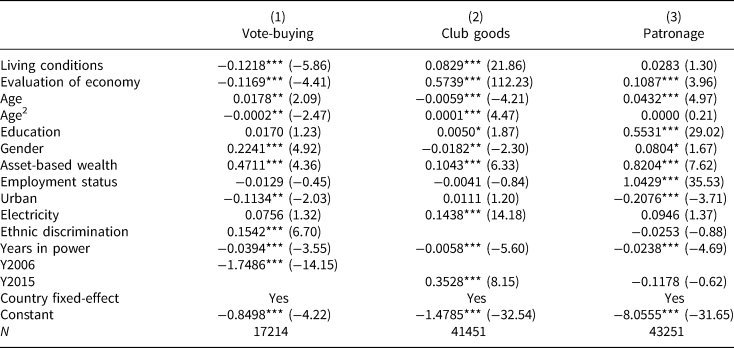
Before we report the main findings with respect to the effects of clientelism on intended vote choices, it is worth examining what kind of voters are more likely to be targeted by clientelist parties. For this purpose, we run logistic models that use the covariates mentioned in the last section to provide maximum likelihood estimations of the respondents' exposure to various clientelist goods. The results are presented in Table 1, with models 1–3 estimating the probability of being a recipient of vote-buying, club goods, and patronage, respectively. The coefficients represent the logarithm of odds ratio.
A major insight that emerges from this exercise is that different forms of clientelist exchange tend to target different groups of voters. With respect to vote-buying, respondents are more likely to feel its impact if they perceive themselves as coming from the lower end of the socioeconomic group. This finding is consistent with the conventional wisdom that it is more cost-effective to buy off poor voters. Specifically, those who have negative evaluations of their living conditions and the government's handling of the economy, and those from rural areas, are significantly more likely to report receiving bribes for their votes. For example, holding other variables at their means, the predicted probability of receiving bribes changes from 14.26 to 9.27% as the self-evaluation of living conditions moves from ‘very bad’ to ‘very good’. In terms of objective well-being, however, recipients of vote-buying are actually better off than the rest of the population, as they are more likely to own various assets.
Citizens that receive club goods and government patronage are generally well-positioned in their societies, both in terms of self-evaluation and asset-based wealth. The effect of education on the likelihood of being a government employee is particularly strong: the predicted probability is 1.97% for someone who only completed primary school, but rises to 35.7% for a post graduate. In comparison, the effect of wealth seems a lot more moderate: respondents who possess all the specified assets are only slightly more likely to be working for the government than those deprived of any asset (3 vs 1.35%). Moreover, the predicted probability for being a government employee is actually lower in urban areas (1.83%) than in rural areas (2.25%). Viewed together, these pieces of evidence suggest that, while basic literary and administrative skills are valued in the recruitment process, the granting of public sector jobs seems to favor the impoverished voters who are more willing to offer their political support in exchange for patronage (Table 2).
Predicting the recipients of clientelist goods

t statistics in parentheses.
*P < 0.10, **P < 0.05, ***P < 0.01.
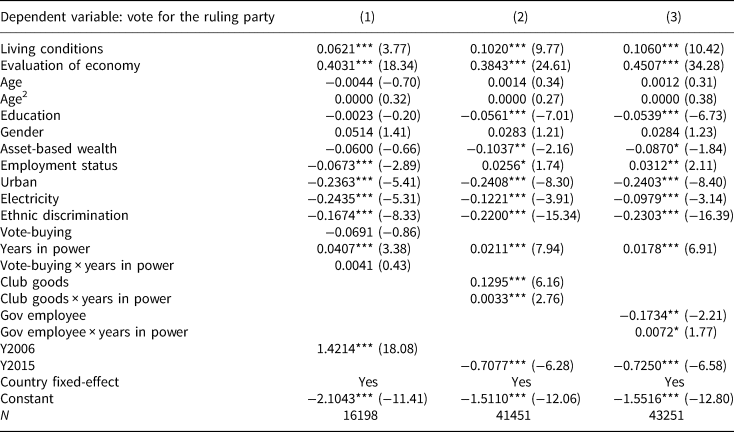
The foregoing analysis provides strong evidence that the segment of the population targeted by clientelist exchanges is systematically different from other voters, and it is important to take these differences into account as we examine the effects of clientelism on vote choices. Table 3 reports the results of our main analysis, with the three models estimating the effects of vote-buying, club goods, and patronage on popular support for the ruling party, respectively. We are primarily interested in the main effects of the three clientelist variables and their interactions with the duration of the ruling party's tenure.
Predicting intended vote choice

t statistics in parentheses.
*P < 0.10, **P < 0.05, ***P < 0.01.
In model 1, the coefficient for the interaction term is positive but statistically insignificant. Thus, there is no evidence that vote-buying becomes a more important tool for generating political support as party duration increases. In fact, the effect of vote-buying on vote choices is insignificant regardless of how long the ruling party has been in power. This is exactly what our theoretical analysis would imply: a political party need not draw upon state resources to bribe the voters. The presence of multiple funding sources mean that vote-buying can be utilized to gain electoral support by the opposition as well as by the ruling party. Even if a long-ruling party can establish increasingly comprehensive control over state resources, opposition parties might still locate financial support within the private sector or civil society to sustain a vote-buying network.
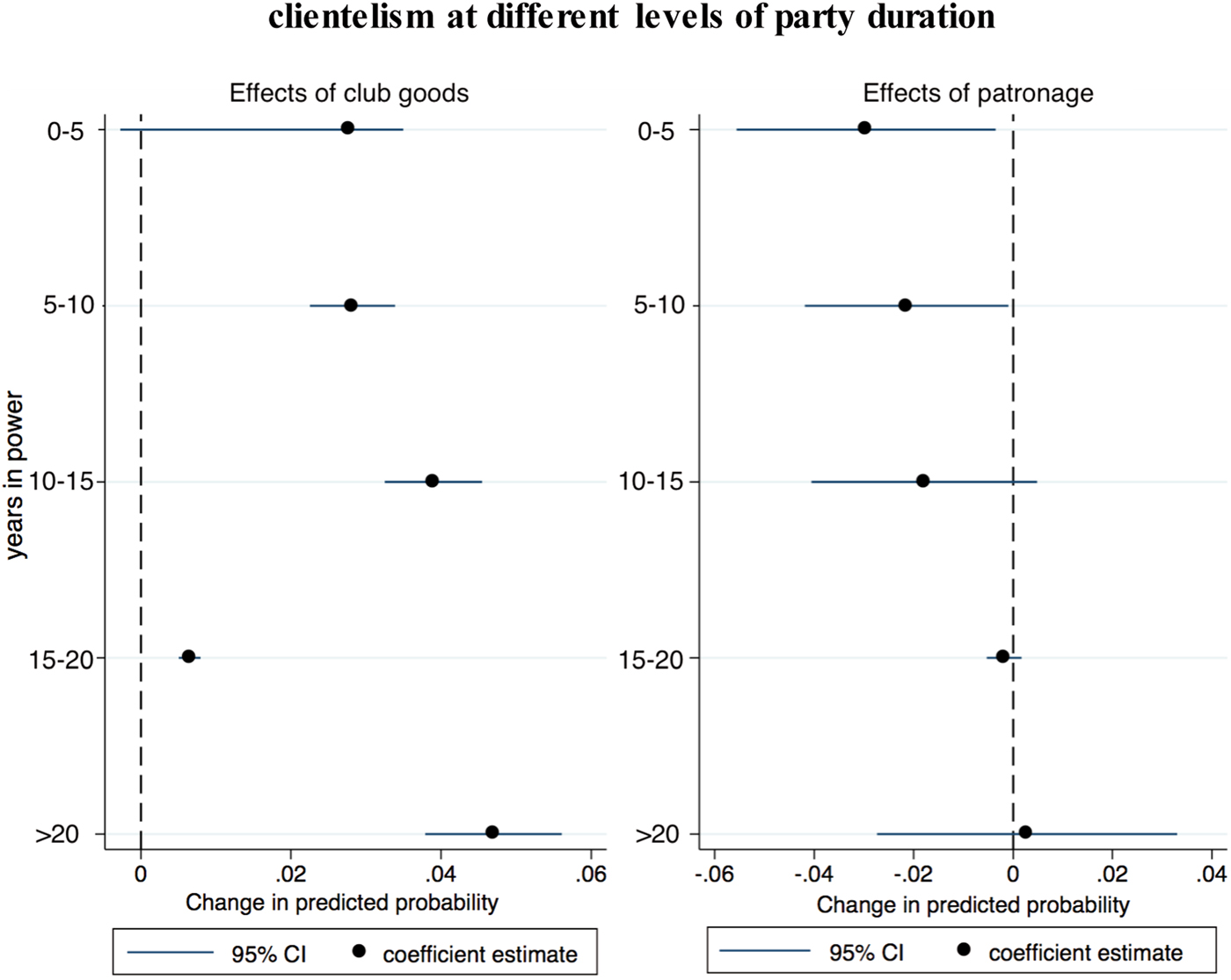
Results from model 2, which uses data from round 6 to investigate the effects of clientelist club goods, tell a different story. The coefficient for the main effects of club goods is positive and statistically significant, meaning that recipients of club goods are more likely to support the ruling party than other voters even when the duration of incumbent party rule is zero. The coefficient for the interaction term, moreover, is positive and significant at P = 0.05 level, supporting the hypothesis that the effects of club goods on popular support will increase as party duration grows. To ease substantive interpretation, we graph the marginal effects of club goods on the predicted probability of voting for the ruling party at five different levels of party duration. As shown in the left panel of Figure 2, when party duration is between 0 and 5 years, the positive impact of club goods is insignificant; as duration moves to the 5–10 year level, receiving club goods will on average increase the predicted probability of voting for the ruling party by about 2.77 percentage points (P < 0.001). The magnitude of the effects generally increases along with party duration; as the length of incumbent tenure passes the 20-year threshold, the marginal effects on predicted probability increase to 4.70 percentage points (P < 0.001).Footnote 7
Marginal effects of clientelism at different levels of party duration.

As we turn to analyzing the effects of government patronage on intended vote choices, a surprising finding is that, at low levels of party duration, recipients of public jobs are actually less likely to support the ruling party than the rest of the population. For example, when the incumbent party's tenure is below 5 years, being a government employee reduces the predicted probability of voting for the ruling party by 2.96 percentage points (P < 0.001). This is the case even as we hold constant other demographic variables such as education, age, and employment status. Consistent with our hypothesis, as party duration increases, the effects of patronage move gradually in the positive direction – the coefficient for the interaction term is positive at P = 0.1 level. The right panel of Figure 2 shows that, when the ruling party has remained in office for 10–15 years, the negative effects of patronage become statistically insignificant. Once party duration exceeds 20 years, the effects turn positive, although the coefficient estimate has a very wide 95% confidence interval.
One interpretation of model 3's results is that, with regular partisan rotation in office, government employees do not feel indebted to the ruling party for their jobs, and their firsthand experiences with any wrongdoing that might exist within the public sector make them less willing to support the governing party. The longer a party has stayed in power, however, the more government employees become beholden to the ruling party, and the link between knowledge of government operation and discontent with the rulers grows weaker. In other words, with the extension of party duration, patronage becomes increasingly important to mitigate the grievances held by political elites most familiar with the negative aspects of the government.
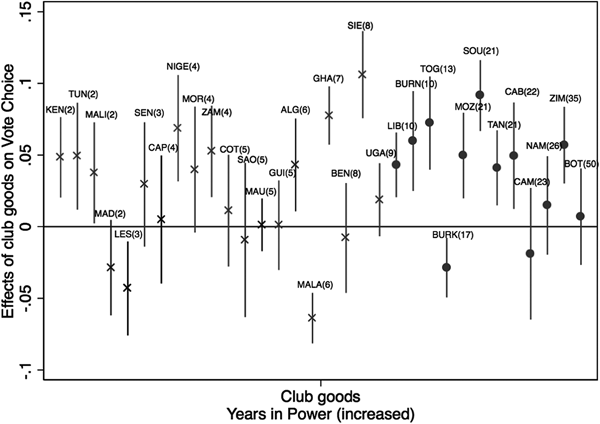
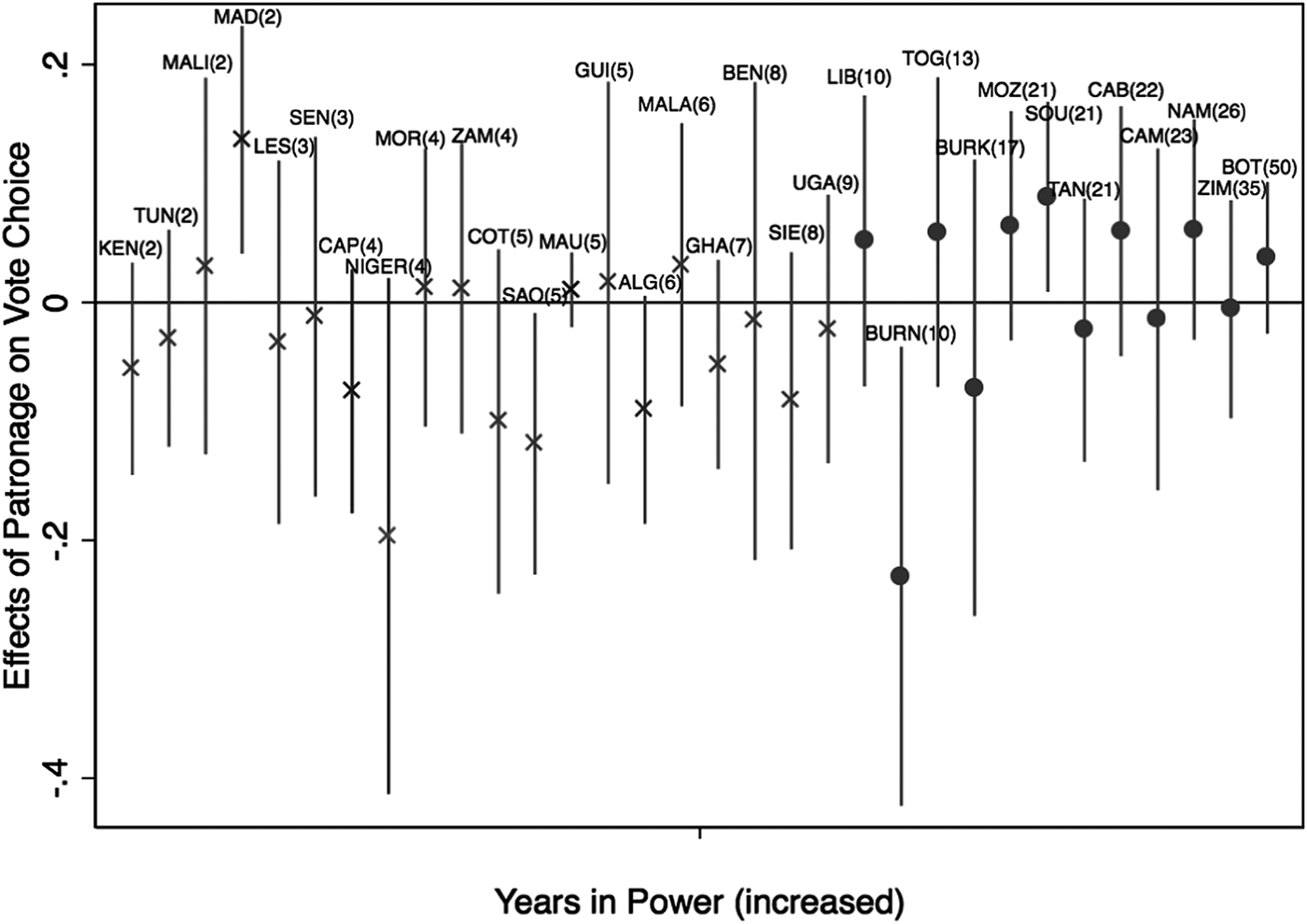
To better illustrate how the results from Table 3 were aggregated from individual surveyed countries, Figure 3 plots the logistic regression coefficient estimates for club goods for each country. The figure shows a considerable amount of variation in the effects of club goods on vote choices, and there appears to be a positive relationship between party duration and the strength of the effects. Among the 20 countries for which party duration ranges from 0 to 10 (depicted with x symbols), eight (40%) exhibit significant positive effects for club goods. By comparison, for the 12 countries where one party has ruled for at least 10 years (depicted with solid circle), the effects of club goods are positive and statistically significant in eight countries (66%). In the same manner, Figure 4 reveals that long party duration tends to moderate the negative effects of government employment on popular support. For the 20 countries where party duration is less than 10, 13 countries (65%) report negative effects. By contrast, once party duration reaches the threshold of 10 years, only five of the 12 countries (41.7%) report negative effects.
Marginal effects of club goods on vote choice.

Marginal effects of patronage on vote choice.

Examining the effects of the control variables paints a more complete picture of the determinants of vote choices. First, there is strong evidence that voters' decisions are driven by their evaluation of personal living conditions, and to a greater extent by the evaluation of the government's management of the economy. Both variables are significantly positive at P = 0.01 level across the three models. Take model 3, for example: holding other variables at their means, respondents who have the best evaluation of personal conditions are predicted to vote for the ruling party with a probability of 35.5%, compared with 26.5% for those with the worst evaluation. Meanwhile, the contrast between voters with the best and the worst evaluation of government handling of the economy stands at 60.6 vs 20.2%. This finding implies that African citizens are mature enough to judge the rulers on the basis of national economic performance rather than personal well-being.
Second, the effects of the demographic covariates clearly indicate that citizens with lower socioeconomic statuses are more likely to support the incumbent party. Again using results from model 3 to illustrate, the difference in predicted probabilities is 8.7 percentage points between the most poorly educated (32.5) and the best educated voters (23.8), 5.0 percentage points between rural (32.1) and urban voters (27.1), and 2 percentage points between voters who have access to electricity (29.3) and those who do not (31.3). One reasonable explanation for this phenomenon is that ruling parties find it more cost-effective to secure support from poor voters by providing them with clientelist goods. As ruling parties increasingly resort to clientelist practices, the gap between the rich and poor in their support for the incumbent party is expected to grow wider. We will provide empirical evidence for this claim in the ‘Robustness checks’ sub-section.
Finally, as we expected, the perception of ethnic discrimination has a major impact on the respondents' political attitudes. In model 1, voters who believe that their ethnic groups are ‘always’ treated unfairly by the government are significantly less likely to support the ruling party than those who feel that such discrimination has never occurred (35.7 vs 47.9%). In model 3, the same gap increases to 13.2 percentage points (32.9 vs 19.7%).
5.2 Robustness checks
This sub-section performs a number of additional tests to cross-validate the main findings.Footnote 8 First, although the respondents' stated voting intention is arguably the best indicator of their support for the ruling party, there are other questions available in the surveys that provide alternative measurement of such support. Both round 3 and 6 asked the respondents about their approval of one-party rule,Footnote 9 with answers recorded on a five-point scale running from ‘strongly disapprove’ to ‘strongly approve’. It could be argued that citizens who firmly support the ruling party are also more favorably disposed toward single-party rule. Another plausible measurement of popular support is respondents' trust in the ruling party, which is scored on a four-point scale running from ‘not at all’ to ‘a lot’.
We re-run the analysis in Table 3 by replacing the original dependent variable with the indicator of approval of one-party rule. The results offer additional support for the main hypotheses. Most importantly, as party duration increases, the effect of club goods on voters' likelihood to favor one-party rule gets amplified. We also discover that the longer a party has remained in power, the more recipients of vote-buying tend to approve a one-party system. When trust in the ruling party is used as the dependent variable, the main hypothesis receives support only when we examine the effects of club goods. This finding is compatible with the argument that clientelist ties are mostly maintained by instrumental calculations: the clients' support is enforced by mechanisms of monitoring instead of inner affinity for the ruling party.
Second, both our empirical findings and the existing literature suggest that clientelist parties purposefully target poor voters, which explains why African ruling parties tend to receive more electoral support in rural than urban areas. If long-ruling parties become increasingly dependent on clientelism, and if they devote most of their clientelist resources to attract support in rural areas, we should observe a widening of the urban–rural gap in electoral support for the ruling party as party duration increases. This implication can be tested by adding to the original models an interaction term between the party duration variable and the dummy variable indicating urban residential status. Under this model specification, the coefficients for the interaction term are negative and statistically significant with data from both round 3 and 6. Consistent with our theoretical argument, the negative effects of urban status on popular support for the ruling party increase together with party duration.
Third, while the analysis so far has considered the effects of party duration on clientelism as linear, it is possible that such effects will grow with the passage of time to a certain point and fade away afterwards. For example, a ruling party's control over clientelist resources might increase steadily during its first 10 years in power, but remain largely unchanged after the one-decade threshold. To probe whether there indeed are diminishing returns to time in office, we picked two arbitrary thresholds – 10 and 20 years. We then looked for evidence on whether the importance of clientelism no longer increases with party duration after these dates. In the actual analysis, we re-estimate the models in Table 3, replacing the continuous variable Years in power with a binary variable that indicates whether the ruling party has been in power for at least 10 years (20 years). The results show that the supportive role of clientelism keeps growing with party duration even after the 10- or 20-year threshold has been passed. Although this is not a systematic test on the possibly non-linear effects of party duration, it provides preliminary evidence about its long-running impact on the dynamics of clientelism.
Fourth, to rule out the possibility that a few influential countries drove the key findings, we employed the Jackknife resampling technique by which the coefficient for the interaction terms was estimated on 33 sub-samples, each of which excluded one country from the analysis. In general, this exercise shows that the results are robust to the exclusion of any specific country from the sample, although when we estimated the effects of government patronage, the t statistic of the coefficient for the interaction term was slightly above the conventional threshold of statistical significance in a few sub-samples.
Lastly, the original analysis is replicated with random-coefficient models that specify country-specific random intercepts and country-specific random coefficients for the main explanatory variable – that is, the three forms of clientelist goods. This approach is inferior to the inclusion of country fixed-effects in that, when unobserved unit-specific effects are correlated with included covariates, it could generate biased estimates of coefficients. As an additional check, the results of the random-coefficient models are largely similar to the findings presented in Table 3, with the exception that the interactive effect of party duration and patronage becomes statistically insignificant (z = 1.15). Overall, the robustness checks give the authors high confidence in the findings with respect to the effects of vote-buying and club goods, while any conclusion related to the differential effects of patronage should be treated with greater caution.
6. Conclusion
This paper makes an original contribution to our understanding of how clientelism helps generate popular support for the incumbent party in multiparty electoral systems. It shows empirically that, the longer the party duration, the more clientelist exchange becomes an effective means of maintaining voter support. The underlying mechanism driving this correlation is that long party duration allows the incumbent party to gradually strengthen its control over state resources essential for the distribution of targeted goods and enforcement of the clientelist bargain. Therefore, forms of clientelism that do not depend on partisan control over state resources will play a less important role in generating support for the ruling party. This novel claim is supported by empirical findings: the delivery of club goods and patronage become increasingly important for maintaining pro-incumbent sentiments, while the same cannot be said about vote-buying.
It is important to note the limitations of this study due to the nature of data and measurement and how they might affect the validity of the findings. First, while the article's main thesis applies to all multiparty electoral systems, the empirical data were only drawn from countries covered by the Afrobarometer survey. The authors have cited single-case studies that demonstrated long-ruling parties' growing reliance on clientelism, but future studies should test the thesis using cross-country data outside of the African context. Second, the measure of popular support in this study is based on the respondents' stated voting intention, which could be different from their actual vote choices. This potential measurement error might have led the authors to underestimate the effects of clientelism since in actual electoral environments voters are under stronger pressure to comply with the patron's demands. Finally, in measuring voters' exposure to the targeted distribution of local public goods, the authors made the assumption that respondents who evaluated the provision of local public goods more positively were on average more likely to be involved in clientelist exchanges. While the authors are comfortable with this assumption, the subject matter may benefit from future research that more directly measures exposure to club goods.
This article's findings highlighted one important element in the formation of dominant-party systems: the gradual colonization of state apparatus and resources by the ruling party. For international and domestic pro-democracy groups, enacting reforms that insulate the civil service from political influence, establish regulatory agencies independent of the government, and reduce state intervention in the economy remains the most sensible recipe for ensuring regular partisan rotation in office. Future studies should devote more attention to inquire how a combination of factors, including severe economic crises, international pressure, and the rising costs of delivering clientelist goods, might eventually induce a long-ruling party to adopt such reforms that effectively amount to digging the grave for the dominant-party system.
Qingjie Zeng is an associate professor at the Department of Political Science, School of International Relations and Public Affairs, Fudan University. His research focuses on personnel management within the Chinese Communist Party, one-party regimes around the world, and authoritarian resilience. His works have been published in The China Quarterly, The Journal of East Asian Studies, China: an International Journal, Japanese Journal of Political Science, and Chinese Political Science Review. Qingjie earned his doctoral degree in political science from the University of Michigan in 2015, master degree in political science from Columbia University in 2009, and bachelor degree in international relations from Beijing University in 2008.