Introduction
Sleep difficulties have been linked to negative health outcomes (Byles et al. Reference Byles, Mishra, Harris and Nair2003), cognitive decline (Nebes et al. Reference Nebes, Buysse, Halligan, Houck and Monk2009) and poor quality of life (Ancoli-Israel and Cooke Reference Ancoli-Israel and Cooke2005; Khan-Hudson and Alessi Reference Khan-Hudson, Alessi, Verster, Pandi-Perumal and Streiner2008) among older people. Evidence suggests that the prevalence of sleeping difficulties increase with age and that the problem is more pronounced for women than for men (Brabbins et al. Reference Brabbins, Dewey, Copeland, Davidson, McWilliam, Saunders, Sharma and Sullivan1993; Foley et al. Reference Foley, Monjan, Simonsick, Wallace and Blazer1999; Groeger, Zijlstra and Dijk Reference Groeger, Zijlstra and Dijk2004). Typically, these difficulties are attributed to normal age-related changes in sleep architecture where sleep becomes more fragmented and lighter (Ohayon et al. Reference Ohayon, Carskadon, Guilleminault and Vitiello2004). Disruption of circadian rhythms in late life can also result in increased night-time awakening and day-time sleepiness (Neikrug and Ancoli-Israel Reference Neikrug and Ancoli-Israel2010; Stepnowsky and Ancoli-Israel Reference Stepnowsky and Ancoli-Israel2008). Difficulty sleeping in late life is also often attributed to co-morbid conditions and medication use (Ancoli-Israel and Cooke Reference Ancoli-Israel and Cooke2005; Byles et al. Reference Byles, Mishra, Harris and Nair2003; Foley et al. Reference Foley, Ancoli-Israel, Britz and Walsh2004; Stone, Ensrud and Ancoli-Israel Reference Stone, Ensrud and Ancoli-Israel2008). A related and concerning issue, recently well documented in Australia (Windle et al. Reference Windle, Elliot, Duszynski and Moore2007), is the high prevalence of benzodiazepine prescribing within general practice for the management of sleep difficulties among older women. Windle et al. (Reference Windle, Elliot, Duszynski and Moore2007) found that in a sample of nearly 4,000 Australian general practice patients aged 65 and over, 20 per cent of women were prescribed benzodiazepines, compared to 11 per cent of men. The prevalence of benzodiazepine prescribing increased with age, with at least one-quarter of women aged 85 and over prescribed benzodiazepines. A growing body of evidence suggests that the benefits of sedative use for sleep in an older population are outweighed by the increased risk of falls and cognitive impairment (Glass et al. Reference Glass, Lanctot, Herrmann, Sproule and Busto2005). The broader social implications of what has been termed an ‘over-prescription of sleeping pills’ (Byles et al. Reference Byles, Mishra, Harris and Nair2003) among older women suggests that sleep issues in this population are being ‘medicalised’ without due regard for the role of socio-environmental or behavioural factors (Hislop and Arber Reference Hislop and Arber2003a). Acknowledgement of the broader social meaning behind sleep difficulties, or the ways in which sleep difficulties in late life might reflect social pressures on older women (such as demands associated with caring for an ill spouse etc.), have only recently been theorized (Arber et al. Reference Arber, Hislop, Bote and Meadows2007; Bianchera and Arber Reference Bianchera and Arber2007; Hislop and Arber Reference Hislop and Arber2003a, Reference Hislop, Arber, Arber, Davidson and Ginn2003b, Reference Hislop and Arber2003c, Reference Hislop, Arber, Calasanti and Slevin2006).
From a public health perspective, there is clearly a need to understand better the issue of sleep among older women to prevent difficulties arising in the first place, as well as avoiding problems associated with sleep disturbance and sleep medication. Researchers from the Australian Longitudinal Study on Women's Health (Byles et al. Reference Byles, Mishra, Harris and Nair2003: 160) argued that, ‘Difficulty sleeping is a symptom that should be taken seriously among older women, because of its impact on quality of life, because it may be a prodroma for serious physical and psychological illness, and because of the associated use of sleeping medicines’. Yet while it is increasingly acknowledged that ageing and health occur within a social and historical context there is little understanding of the nature of sleep disturbances among older women in such a context.
Theoretical framework: a gendered lifecourse approach
To address the high prevalence of sleep difficulties and to understand the sociological underpinnings of why sleep difficulties disproportionately affect older women, we would argue that this invokes a gendered lifecourse approach (Chambers Reference Chambers2005; Elder Reference Elder1985; Moen Reference Moen, George and Binstock2001; Moen, Dempster-McClain and Williams Reference Moen, Dempster-McClain and Williams1992). This approach values historical context and considers experience in the frame of a larger lifecourse, including changes in gendered roles (Moen Reference Moen, George and Binstock2001). Increasingly, social gerontologists are recognising the importance of ageing in the context of the lifecourse, or that individual experiences in late life are ‘an accumulation of a lifetime's experience’ (Chambers Reference Chambers2005: 57). We focus on women's sleep difficulties in relation to how these might reflect gendered patterns which could be seen to characterise a particular generation of women. To emphasise the historical context which has shaped their lives, all of the women participants were born between 1918 and 1926 and so were married and raised families at a time of considerable hardship associated with the Great Depression and post-war reconstruction. It was also a period of clear demarcation between the roles of men and women. Although many women were employed outside the home during the Second World War, the vast majority returned to traditional roles as home-makers, or worked in low-skilled service or administrative positions once the war was over. Thus, the participants in this research experienced their formative pre-adult years during a time of traditional gender roles and were socialised around the importance of family responsibilities, with home-making and child rearing being the main concern of women (Lindsey Reference Lindsey2004). Our examination of these women's experiences of sleep, currently and in the past, thus recognises the unique values, beliefs and expectations typified by this generation, and offers an insight into how sleep difficulties can be viewed as a gendered phenomenon.
Theories of gender in the sociological and gerontological literature have long recognised that ageing does not affect men and women in the same ways (Arber, Davidson and Ginn Reference Arber, Davidson and Ginn2003; Beeson Reference Beeson1975; Sontag Reference Sontag1972). The differences between women's and men's roles and responsibilities in earlier life stages clearly remain in later life and impact on their experiences in a range of settings (Arber, Davidson and Ginn Reference Arber, Davidson and Ginn2003; Russell Reference Russell2007). For example, women's greater longevity has meant that they are less likely to be able to rely on a spouse for care and support in later life, are more likely to be living alone, in poverty and to rely on care from adult children (Moen Reference Moen, George and Binstock2001). Earlier in the lifecourse, women are more likely to care for older relatives whereas men remain working outside the home, and these different roles clearly have implications for how men and women might experience aspects of ageing. As Phyllis Moen has commented,
the social construction of the roles and identities of older men is formed against a lifetime of paid employment as a principal source of identity … women are not only more likely than men to be doing care work as they age, for their husbands, their children, their own parents – they are also more likely to experience strain in doing so. (2001: 182)
The lifecourse perspective highlights that the timing of role transitions can potentially influence wellbeing (Elder Reference Elder1985), and that women's different role transitions (beginning/ceasing work outside the home; caring for children, older parents, spouses), might differentially affect their wellbeing, depending on factors such as the ease with which these fit with other roles, and the resources available to adjust to these new roles (Williams and Umberson Reference Williams and Umberson2004).
In terms of an integration of a gendered lifecourse approach to sleep difficulties, we aim to complement and extend the body of research carried out by sociologists Jenny Hislop and Sara Arber who have highlighted how sleep not only influences women's day-to-day experiences, but importantly is influenced by their roles, especially in relation to work and family life. Through a range of methodologies including survey, focus-group, in-depth interview and audio diaries, Hislop and Arber have explored the nature of mid- and late-life women's sleep as a ‘social act’, in other words, the gendered nature of women's roles and responsibilities and how these impinge on sleep quality. Among middle-aged women, gendered roles such as worrying about family wellbeing were found to impact on sleep patterns (Hislop and Arber Reference Hislop and Arber2003c). The common reality of sleep at this stage of life was one of disruption, shaped typically by women's various roles and responsibilities with regard to maintaining the family, ageing parents, and paid work. Also, women often dismissed their lack of sleep as something they had little control over and which went hand-in-hand with their gender roles as wife, daughter, and mother. Similarly, transitions in older women's lives, such as that of widowhood and retirement were documented in relation to the onset or worsening of sleep disturbances (Hislop and Arber Reference Hislop, Arber, Calasanti and Slevin2006). Although much of this work has been carried out in the United Kingdom (UK), a study of mid- and late-life Italian women similarly found that caring for family members, which is an entrenched societal expectation of women in Italy, was associated with significant sleep disruption at the time of caring, and could persist even when the caring relationship had ended (Bianchera and Arber Reference Bianchera and Arber2007).
This paper aims to extend current sociological knowledge of sleep by tapping into women's understanding of how sleep difficulties emerged in a biographical, as well as a current, context. Participants were encouraged to share their personal experiences of factors which have impacted on their sleep (e.g. influences on the quality of their sleep now and in the past) and were asked to describe how they responded to their sleep disturbance (e.g. whether they took sleeping pills and how this had evolved). Because the women in this study were in an oldest-old (aged 80+) group, their perceptions and experiences enable a rich understanding of how sleep difficulties have evolved over a long period of time, as well as focusing on the unique pressures and challenges that might be faced currently by this growing sub-group of the older population (Australian Bureau of Statistics 2006).
Methods
The study was undertaken in Adelaide, South Australia, and involved participants from the Australian Longitudinal Study of Ageing (ALSA), a bio-psycho-social cohort study of over 2,000 older adults which began in 1992 (Andrews, Clark and Luszcz Reference Andrews, Clark and Luszcz2002; Luszcz et al. Reference Luszcz, Giles, Eckermann, Edwards, Browne-Yung and Hayles2007). Participants for this sub-study of ALSA were identified based on their responses to questions about sleep difficulties at the most recent ‘wave’ of data collection which took place in 2003. Following approval from the Flinders Clinical Research Ethics Committee, a letter of invitation was sent to 24 women who had indicated that they experienced sleep disturbances such as problems with waking up during the night and not being able to fall asleep again, trouble with falling asleep, and/or taking a sedative to help with sleep. Of these, 12 consented to participate, four could not be contacted and eight declined.
The interviews lasted, on average, from one to two hours and were conducted in participants' homes. All interviews were tape-recorded with the participants' consent, and later transcribed. Interview transcripts were entered into a computer-assisted qualitative data analysis program, NVivo, for coding and analysis.
Data analysis
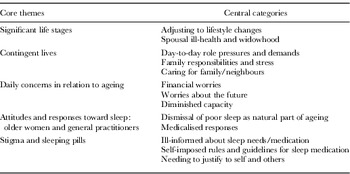
The transcribed interviews were analysed by a process adapted from grounded theory (Strauss and Corbin Reference Strauss and Corbin1998). Pre-existing theory on lifecourse and gender sensitised the researchers to the types of questions that were examined during the research. We sought to extend and elaborate existing theories by combining a gendered theoretical lens with a lifecourse lens. Existing theory was then integrated using the constant comparative process resulting in an emergent theory that corresponded with both the new data and relevant concepts from existing theory. Data analysis was conducted according to the concept of open and axial coding (Ezzy Reference Ezzy2002; Strauss and Corbin Reference Strauss and Corbin1998). Firstly, preliminary analysis or ‘open coding’ was carried out. The text of individual interviews was examined to reveal how women experienced sleep, and the structures they drew upon to frame the issues, situations and relations that were influential in their experiences of sleep. Each transcript was read at least once and selected text coded under themes or ‘nodes’ that were used to analyse the following interview transcript. Initial codes identified included ‘beliefs about sleeping pills’, ‘family worries’, ‘husband's declining health’, and ‘past sleeping patterns’. After devising a list of codes and collating them with data extracts, potential themes and subthemes were identified using the next level of analysis termed ‘axial coding’, or the integration of codes around central categories (Ezzy Reference Ezzy2002; Strauss and Corbin Reference Strauss and Corbin1998). The final level of analysis, ‘selective coding’ involved the abstraction of these themes into core themes or categories (see Table 2) and comparing these categories with existing theory on gender, ageing and the lifecourse.
Findings
The mean age of women was 86 years and all were living independently in the community. As can be seen in Table 1, most (eight of 12) were widowed (mean duration nine years) and just over half were currently taking sleeping pills. Although sleep difficulties fluctuated during different times in the lifecourse in response to life events and stressors, for most women their sleep difficulties originated in late life.
Description of participants

As can be seen in Table 2, five core themes emerged to the ways in which sleep difficulties have evolved and are experienced. All of these themes related to women's domestic roles, but also older women's (lack of) status in society more broadly. The themes provided a conceptual framework to explain the reality of sleep difficulties through a gendered and lifecourse lens. The five themes and their dimensions are described below with reference to the participants' accounts.
Core themes relating to older women's experiences of sleep difficulties

Significant life stages
Although experiences of sleep difficulties were associated with a range of factors, when focusing on their onset, all women described how adjusting to particular life stages or specific transitions over the lifecourse had impacted on their sleep. For some women, these adjustments had occurred around mid life, such as the advent of menopause or ceasing paid employment, as the following participant describes:
I think it might have been when I was going through the menopause because the doctor said I was suffering with a nervous problem and, I didn't feel a bit well and I reckon that could have been when I first went on those [sleeping pills]. He gave me nerve tablets and different tablets to take and he said to me the best thing I could do was to get a job. (Audrey, 86 years, widow)
The transition to widowhood is a well-known trigger for sleep difficulties, yet women's account of the broader context of their lives surrounding this significant life stage shed light on the complexities around their broader roles and changes happening within the couple relationship itself. One woman described how her sleep difficulties started around the time her husband ‘was not so well’, but as she talked further about the timing of her sleep difficulties, she discussed how they had been accompanied by a general ‘slowing down’ of her life, at the time her husband's health declined:
[My husband] belonged to the Lions Club and the Racing Clubs and we always went down to the races and up to the country race meetings. And then we'd go to the functions that were put on … so we were leading a pretty busy life when he was well. But then he lost interest because he wasn't so well, he lost a bit of interest in things. Perhaps that is what happened. (Pam, 91 years, widow)
Such accounts illustrate how widowhood should be viewed as a transition in the context of the rest of a woman's life rather than a separate, finite period of time (Chambers Reference Chambers2005). While for some women it appeared that their sleep difficulties originated around the death of their spouse, they were part of a more of a gradual process beginning sometimes prior to, or in tandem with, their spouse's ill-health. As Pam explained, her sleeping patterns coincided with a range of significant changes in her life to do with a sense of lifestyle change, coupled with her husband's sense of disconnection and ill-health. This suggests that it could be the (re)structuring of women's lives around the time of spousal ill-health, rather than widowhood per se, which is linked to sleeping difficulties. As Molly described, while the disturbed sleep she experienced during spousal ill-health and consequent bereavement signalled the start of her sleep difficulties, she felt unable to explain how it was that her sleep was still poor:
And yet I used to be a good sleeper, I had to have my eight, nine hours sleep a night over the years there, but I don't know when it started, I think probably when Reg was ill I didn't get a proper sleep then, but there's no reason later on why I couldn't have got back into it. (Molly, 85 years, widow)
Contingent lives
As in the previous theme, certain significant life transitions such as widowhood clearly had an impact on older women's sleep. As well as discussing the role of these late-life transitions on sleep, the informal caring roles that women occupy, currently and in the past, was a strong theme to emerge. Notions of ‘needing to be around’, ‘feeling obliged’, ‘not being anyone else to help’, ‘being patient and tolerant when you're a carer’, were all gendered responses to the roles that these women occupy or had occupied, even in the very late stages of life when their own health and capacity was declining. For some participants, this sense of duty to others had impacted on sleep around mid life or earlier. When examining the sorts of triggers those women felt underpinned their sleep difficulties they began to associate certain events that were usually linked to roles such as caring for older parents, as Yvonne described:
It probably was that period when we were looking after my mother, and the stress, and it's never gone away. And then when you are retiring it is different with your husband home all the time. I suppose you could put it down to stressful times, but I don't know. (Yvonne, 84 years, married)
Some of the women described how they were currently caring for ageing siblings or neighbours. One woman, in discussing the sorts of worries which might keep her awake, described how, shared with another elderly neighbour, she was responsible for administering eye-drops daily to her 100-year-old neighbour with glaucoma:
I wake up in the morning and I think now, what time have I got to get up? Eight o'clock. I'd better get up because Raelene will want her eyes done. All that sort of thing. Or will I go shopping first? I mean it's silly. But it's always there. (Ann, 87 years, widow)
For some women, the daily context of family life, and certain stressors involved with these relationships, was linked to sleep difficulties. While these stressors were not connected with the need to overtly ‘care’ for others in an instrumental sense, some women were affected emotionally by their relationships with family members. Audrey described how for most of her married life she had experienced a close and supportive family network. Her husband had done shift work and so they had lived with her parents and siblings and their families, as a means of supporting one another. In late life, however, these relationships had deteriorated and she was currently estranged from some of her siblings and wider family network. She became upset during the interview describing how these family issues currently impacted on her sleep:
It's not every night but just some nights all these things go through my mind and I just can't sleep, even sleeping tablets, just can't get to sleep. (Audrey, 86 years, widow)
Similarly, while Mabel's sleeping difficulties started around the time she gave up work 30 years ago, and had never improved, focusing on the broader context of her life since then draws attention to a number of stressors in her life. Her husband became unwell about seven years ago and her never-married son had at that time moved home to live, and was still living with her. Although reluctant to talk at length about her son (who was at home during the interview) she described how:
We get on very well but we live entirely separate lives. He goes his way, I go mine. Sometimes I'm told things, sometimes I'm not. (Mabel, 88 years, widow)
Mabel's situation highlights how, by sharing her home with her adult son (possibly beyond her control), her maternal role had become salient in very late life. She implied that having her son living with her was associated with a degree of strain, in that she did not feel that they communicated openly, and she was always aware of his presence in her home. These sorts of familial and care-giving dynamics illustrate how older women's lives, at different stages over the lifecourse, could be described as ‘contingent’ lives (Moen Reference Moen, George and Binstock2001). They are formed around the experiences of others, and their choices often influenced by the demands of these individuals. To focus on the past and current milieu of women's contingent lives extends the predominant focus from one in which sleep difficulties appear to be tied to bereavement, and highlight how other relationships and concerns are involved. In addition, these concerns all resonate with each other. For example, as the previous theme described, although spousal ill-health signalled the start of sleeping difficulties for some women, all of the women were currently experiencing role pressures and demands that were either influencing or exacerbating their continuing difficulty in sleeping.
Daily concerns in relation to ageing
Being ‘tense’ and a ‘worrier’ in relation to facets of day-to-day living were common reasons women described when talking about their sleeping difficulties. For some of the widowed women, this included financial concerns such as ‘needing to pay bills’, or the amount of the single person's pension, which they expressed as making them tense or worried when lying awake at night. Some of the married women described how their husband's mood or concerns about ageing affected their sleep, particularly when this occurred around bedtime, as Nancy describes:
If he keeps on talking about what he's worried about then he gets me upset, then I get uptight. I don't think he realises how uptight I get. I can understand him worrying but if you worry before you go to sleep you're not going to sleep very well, that's my opinion. But the first thing he's doing in the morning is worrying, then I get uptight, that will stop me if I want to go back to sleep again. (Nancy, 90 years, married)
For many women, day-to-day worries or concerns about the future influenced their sleep. The notion was that these sorts of concerns in and of themselves might not have been the catalyst for sleep difficulties, but that they played a central role in making sleep less ‘easy’:
It's very annoying because you feel sleepy, you're sitting there at the end of the day and think, ‘it's time to go to bed, I feel so sleepy’. By the time you get ready to go to bed, you're wide awake again. Then I try to say, ‘sleep, sleep’ … sometimes it works. You think of what you've got to do the next day and other problems, what's going to happen to us as we get older, and old age is revolting and that sort of thing. (Yvonne, 84 years, married)
Sleep difficulties were at times also tied to a wider perception of diminished physical capacity, or not being able to do as much as in the past. One woman described how not being able to sleep led to her mind ‘racing’ with the sorts of activities that she would like to achieve, but the awareness that she was becoming less able to accomplish such tasks:
But I just lie there, I try to get back to sleep again, but I can't. You set the world on fire, you think ‘Oh well I'll get up and do that’, but then when you try to do it, you just can't. I'm just slower at everything, I'm even finding that I can't cook as well. I burn things. (Kath, 83 years, married)
These accounts could be interpreted as representing very personal concerns or ruminations about their own end of life, in addition to broader role pressures associated with caring and widowhood. Older women's positioning in society, intimately tied to gender roles of wife and mother, clearly impact on the sorts of worries they might have in late life. Needing to care for and reassure ageing husbands, or having to cope as a widow with fundamental daily tasks such as money management, in addition to concerns over their own future/mortality can thus present significant challenges to women's ability to cope and hence their experience of sleep.
Attitudes and responses toward sleep: older women and general practitioners
This core theme emerged by examining the ways in which women framed their ‘need’ for sleep, and how this related to their general practitioners' (GPs') attitudes and practices for responding to poor sleep. Overall, when focusing on older women themselves, their experience of sleep seemed coupled with a sense of needing to ‘make do’ and not to complain. While all women felt that sleep was vitally important to function the next day, commenting: ‘I feel better if I've had a good sleep’, ‘If you don't get to sleep, you're miserable the next day and you can't concentrate on things’, they seemed to feel that they should not expect to sleep as much in later life, as the following comments illustrate: ‘I feel at this age I don't require that [much] sleep because I am not doing strenuous work or anything’, ‘I think sleep's important but I don't think you need as much at my age’, ‘I sort of feel it's just our age, that we just don't need that sleep and we're not active’, ‘they say really that as you get older you don't sleep like you used to when you were younger’. Potentially, older women are aware of the fact that sleep needs do change with age, and this leads them to ‘disregard’ any concerns they may have over their lack of sleep, or poor sleep quality. However, these attitudes could also be viewed as an extension of broader gender roles and expectations, that is, a sense of not acknowledging poor sleep as a hindrance because it did not obviously impact on their physical health or impede their ability to carry out daily routines. As one woman said: ‘Sometimes I feel really sluggish but once I get going I'm fine, I try and keep on the go all day’. Another woman mentioned that she had never discussed her sleeping difficulties with her family because she did not overtly display any signs that anything was wrong:
They think I'm all right because I'm always bright and happy, so no I don't discuss it with them. They wouldn't understand anyway, I don't think they probably realise I take sleeping tablets. (Yvonne, 84 years, married)
This tendency to ‘make do’ seemed to be reinforced by the responses of GPs. Some women described how they felt their GP did not have the time to ‘analyse why you can't sleep’, preferring instead to treat it as a normal aspect of ageing and not a physical ailment or illness. Several women described how they felt their GPs did not have time to hear about the personal or social issues which might be underpinning sleep difficulties, or that they often dismissed sleep issues in general. While it is understandable that GPs might prefer to down-play sleep difficulties due to the evidence that sleep needs change in late life, some women did express concern with the way GPs responded, as Pat described:
There is one thing which I think most doctors say all the time, when anything that happens like this [sleep difficulties], ‘of course it's your age’. It's always your age. As well as to say, you've got to put up with it more or less. (Pat, 85 years, widow)
As shown in Table 1, over half of women were taking sleeping pills, which suggests another more alarming response to women's sleep. Most women felt that their GP saw prescription of medication as an appropriate response, and had rarely discussed side-effects, the continued need for medication, or underlying issues surrounding their experience of sleep and need for medication. The somewhat indifferent approach to prescription of medication was captured in the following quote from Yvonne, who had been taking sleeping pills for over 30 years.
They don't seem to worry about it, because you can get [the sleeping pills] 25 at a time. Our current doctor gives me a prescription for 100. I can get four bottles. If I wanted to be suicidal, I could take the lot … so she must think I am not that way inclined, but I think it's quite odd that you can do that. You just say Temaz when you mention sleep and they just write you a prescription. (Yvonne, 84 years, married)
Stigma and sleeping pills
Related to the previous theme, a sense of stigma surrounding sleeping difficulties and use of sleeping pills was evident in the women's responses. Firstly, the way women felt the need to justify or excuse their use of sleeping pills and/or poor sleep patterns suggests that needing help to sleep or even having poor sleep was felt to be a sign of not coping. As previously mentioned, just over half of the participants were taking sleeping pills and this was, for most women, a recent occurrence associated with spousal ill-health and/or the bereavement process. While they viewed sleeping pills as necessary for them to attain sleep, and saw it as ‘comforting’ to know they had them to ‘help me get off to sleep’, most women felt they had to point out their regime:
I only see [my GP] about once in three months and I have 25 of them [in a bottle] and I've often got some left after that … I would never take them two nights in a row, but if say I hadn't slept well for about five nights, well then I'd take one. And that seems to help me, it sort of settles me down for a while so I'm not addicted to them by any means. Some of my friends, the doctor just lets them [take them] every night. (Pat, 85 years, widow)
Well if I do [take the sleeping pill], if I'm a bit agitated about anything because with your family you have always got something. Occasionally I'll take it before I go to bed but then I think ‘well I might not need it’ so I leave it [on the dresser] and if I wake up at half past 1, I give myself time to go to sleep but if I don't … then I'll take it. (Pat, 85 years, widow)
Secondly, women expressed an overall lack of knowledge in terms of ‘normal’ sleep patterns in late life, suggesting that at a societal level sleep remains a personal domain and broad community knowledge of ‘typical’ sleep patterns in late life might be limited. Related to this was the fact that some women were ill-informed about the nature of sleeping pills, in relation to taking them with other non-pharmacological products such as over-the-counter ‘natural’ sleep products, changing the dosage or even whether what they were taking was indeed a sleeping pill. Audrey, who had been taking sleeping pills for around 30 years, described her desire to stop taking them, despite recently increasing her dosage, and raised concerns over whether they caused side-effects:
I've been taking them for years. I couldn't even tell you [when I started taking them]. I was taking a quarter of a tablet but since Les died I've been on half a one. I would love to go off them because they say they do something to the memory, or the brain? I went in the bedroom today for my antibiotics and I thought ‘what have I come in here for?’ and then I remembered, I went in for the antibiotics. But that's happening quite a bit. I don't know if it's the tablets. (Audrey, 86 years, widow)
The ways in which women talked about their experiences of sleep, particularly the use of sleeping pills, to some extent reflects a gendered response of ‘making-do’. At the same time women seemed somewhat ill-informed about their sleep needs in late life, and the use of sleeping pills, with some women expressing a lack of knowledge about ‘normal’ sleep patterns in late life, and whether what they were experiencing was indeed ‘typical’. The ways in which having difficulty sleeping was ‘accepted’ and (in some cases) medicalised suggests that the attitudes of women themselves, and their GPs, might reflect a sense of stigma or concealment around the gendered dimensions of sleep.
Discussion
This paper has attempted to add to sociological understandings of the differential gender patterning of sleep difficulties among older women by taking a lifecourse, gendered examination of the past triggers and present exacerbating factors that contribute to sleep difficulties. We have illustrated how certain responsibilities at different stages of these women's lives have influenced their sleep and how gendered dimensions of care-giving, and providing emotional and instrumental support to others continue to affect sleep.
It is well-recognised that in Australia, as in most countries worldwide, women carry the vast burden of informal care for family members (Australian Bureau of Statistics 2003), and indeed it is a societal expectation that women carry out the bulk of this unpaid work over their lifecourse (Moen, Dempster-McClain and Williams Reference Moen, Dempster-McClain and Williams1992). Perhaps strains and pressures associated with this sort of gender role can lead to poor wellbeing in relation to sleep disturbance and use of sleep medication. As Hislop and Arber (Reference Hislop and Arber2003c: 709) found when focusing on the sleep of mid-life women, ‘women do sleep in the way they do activities in their waking lives’, seemingly disregarding their own need for sleep and accepting sleep difficulties as a ‘side-effect’ of gender roles of mother, carer, wife. As James (Reference James1992) has differentiated, and was clearly the case for women in this study, ‘care-giving’ is multidimensional, encompassing physical, emotional and organisational or managerial labour. For a number of women, their day-to-day lives involved consideration of the physical, emotional, social and economic realities of both their own lives, and the lives of those around them. While such a caring role can be linked to women's broader socialisation in terms of communality and nurturing (Eagly Reference Eagly1985), the impact this role has on sleep highlights how in very late life these demands do not abate and can be distressing and detrimental to health at a time when women's own capacity is diminishing.
The overemphasis on the physiological and physical facets of sleep serves to obscure or neglect the sociological or social context (Williams and Bennelow Reference Williams, Bennelow, Williams and Bennelow1998). From a public health perspective, this neglect of the broader context of sleep raises a number of concerning issues around responses to sleep difficulties (particularly medicalisation) which perpetuates an invisibility or stigmatisation of older women's sleep patterns. Firstly, most women tended to normalise their own sleep patterns by describing them as ‘erratic’, on the one hand, but ‘normal for my age’. It became evident that the majority of women were unsure and puzzled by how much sleep was ‘normal’, or indeed whether disturbed sleep was something that other older women experience. Secondly, a tendency to dismiss sleep difficulties was evident in most women's responses, regardless of whether they were taking sleeping pills or not. While they were happy to discuss their sleep patterns and the ways in which their sleepless nights unfolded on a, usually, nightly basis, there was a general feeling that it was what was to be expected for them at this stage of life. This finding is in accordance with Hislop and Arber's (Reference Hislop, Arber, Arber, Davidson and Ginn2003b: 194) research where they found a general ‘deprioritising of individual sleep needs in response to women's commitment to care for the well-being of their partner’. However, not wishing to complain about the issue could be seen as an extension of the tendency to accept this as part of their role (for the women who were still caring for their spouses) or trivialise it because it is a personal experience that they need to deal with, rather than a physical or medical condition. Nevertheless, the fact that sleep disruption is associated with impaired concentration, depression and a general poorer quality of life among older people is justification to recognise it as a public health issue. The fact that sleep difficulties disproportionately affect older women justifies it as a gendered phenomenon which could be seen to represent older women's relative disadvantage in relation to older men (Gibson Reference Gibson1996). We would also suggest that sleep difficulties, and medication use, have the potential to reduce the independence of older women, through curtailing their social activities due to daytime tiredness or fear that they may fall asleep while driving. One woman described how she feared losing control of her bowels or bladder during the night due to the effects of sleeping pills, and when she goes to stay with her daughter secretly takes a waterproof sheet to place underneath the sheet in case of incontinence.
The second issue relates to the inclination of GPs in this study to treat sleep difficulties in a limited way, by on the one hand ignoring the social issues relating to sleep, but also by tending to prescribe sleeping pills without re-visiting the need for such medication, or explaining to women the side-effects. Some women commented that their GP never actively discussed or reviewed their sleep difficulties, even if they knew that this was an issue, and for some a very long-standing one. Some women did mention that they had discussed the issue of ‘dependence’ on sleeping pills with their GPs and responses tended to centre around the fact that as long as they were not taking sleeping pills nightly, or only as needed, then there was no problem. Two issues which are clearly linked to the need for active dialogue between older women and their GPs are firstly, while very few women expressed concerns over the side-effects of sleeping pills, some did not know what side-effects could be related to their sleeping tablets as opposed to normal age-related changes. Secondly, several women expressed interest in ceasing the use of sleeping pills, either because they were worried about the side-effects or the continued need for them.
This general ambivalence towards older women's sleep difficulties, to some extent shown by the women themselves but also reinforced by their GPs, sheds light on the ways in which social contextual pressures and their sequelae are recognised and seen as (un)important. The Royal Australian College of General Practitioners (2000) guidelines on the use of benzodiazepines does not include explicit guidelines for use among older people, apart from those living in residential aged-care facilities. They do state that benzodiazepine use among the elderly is associated with a high risk of falls and fractures and that long-term use for insomnia has not been demonstrated to be effective. This suggests that there is a clear disjuncture between professional guidelines on the use of benzodiazepines and the experiences of the women in this research, some of whom have been taking benzodiazepines for at least five years and some as long as 30 years.
In coming decades, in most developed nations, the proportion of women aged 85 and over is set to increase. These women will bring to very late life an increasingly diverse range of experiences, roles, pressures and demands which could potentially become manifest in sleep disturbance, inappropriate sleep medication use and possibly poor wellbeing as a result. It should be pointed out that the present findings relate to a convenience sample, in one geographical location. It should not be assumed that the experiences of these women can be generalised to all older women or subsequent generations raised in a culture of women's increased labour-force participation, more equal parenting roles and diverse gender roles. The sample was very small, and other findings may emerge from expanded work. Lastly, although this was a ‘gendered’ examination of sleep, this paper focuses on women's experiences of sleep and did not address men's sleep, although we would like to pursue a separate examination in this regard in light of a number of issues raised by some of the husbands who were present during the interviews with their wives. With the exception of some recent work on masculinities and sleep (Meadows et al. Reference Meadows, Arber, Venn and Hislop2008) and the nature of sleep among younger (Venn et al. Reference Venn, Arber, Meadows and Hislop2008) and older (Hislop and Arber Reference Hislop, Arber, Arber, Davidson and Ginn2003b) couples, men's sleep has largely been overlooked in the current sociological literature focusing on the gendered nature of sleep. In particular, a distinct examination of older men's sleep would balance the perspectives presented in the current paper.
Notwithstanding these limitations, we would argue that this research presents some broad-ranging issues around sleep difficulties but also pressures facing older women. Firstly, this research emphasises the need for improved acknowledgement and recognition of the care-giver role, and the multiple roles that women play in general (not just to the family and spouse) over their lifecourse. For as long as ‘women's work’ is taken for granted as ‘given’, the everyday reality of the stresses and challenges it brings and the impact it can have on health via mechanisms such as poor sleep, the full contributors to women's health will remain poorly explained. Secondly, this research highlights not just the role strain associated with care-giving, but also the impact of widowhood, and the need to support women experiencing spousal ill-health. It reaffirms this transition as one which can lead to loneliness, difficulty in coping with finances and general worries about the future. Lastly, it highlights the role of health professionals in dealing more effectively with the realities of older women's lives, as relationships with these health professionals are usually trusted and long-standing.
We think that this paper raises a number of important questions for future research in this area. Firstly, not all women experience difficulties sleeping in late life. It would be valuable to add to the sociological understanding of sleep to focus on older women's positive experiences of sleep, the sorts of social and familial context they live within and furthermore to focus more on other dynamics such as whether socioeconomic status matters. Secondly, this research underscores the importance of a lifecourse approach to understanding the factors impacting on older women's health in very late life, an area which is largely under-studied and under-theorised. We need to ascertain better triggers earlier in the lifecourse which may act as markers for poor health and loss of independence among older women. Too often in gerontological research older women are viewed as an homogenous group, sharing common physiological and social issues without taking into account the diversity of their lives, experiences and family dynamics which stand to differentially impact on outcomes in late life.
Acknowledgements
This study was made possible by a research grant awarded to the authors by the RM Gibson Research Fund of the Australian Association of Gerontology. We also thank the participants of the Australian Longitudinal Study of Ageing who have given so generously of their time over many years. The first author expresses her gratitude to Megan Warin for her feedback on the manuscript.