Introduction
Disasters affect millions of people worldwide each year, resulting in tens of thousands of deaths and causing billions of dollars in economic losses. Due to its geographical location, Türkiye is exposed to a wide range of disasters including earthquakes, floods, forced migrations, and acts of terrorism, making it one of the high-risk countries for disaster occurrence. The 2023 Türkiye–Syria earthquakes, which claimed over 50,000 lives, stand among the most devastating disasters globally. 1 – 3
In such a high-risk geography, disaster risk reduction efforts are of critical importance, and disaster education plays a fundamental role within these efforts.Reference Zhang, Zhu and Zhou 4 , Reference Sakurai and Sato 5 Not only the quantity but also the quality of educational interventions determines the level of awareness and preparedness achieved.Reference Mızrak 6 Consequently, recent research has increasingly focused on identifying how educational programs influence individuals’ knowledge, attitudes, and behaviors. One of the most frequently employed theoretical frameworks in this context is the Health Belief Model (HBM).Reference Ejeta, Ardalan and Paton 7
Although various studies have evaluated the effectiveness of disaster education, a closer review reveals that most of these studies are conducted with healthcare professionals.Reference Amberson, Wells and Gossman 8 –Reference Mirzaei, Eftekhari and Sadeghian 11 Moreover, few of them provide detailed analyses based on the specific subdimensions of the Health Belief Model.
Against this background, the present quasi-experimental study with a single group, longitudinal design aims to examine the impact of disaster awareness training provided at a Public Education Center on participants’ general disaster preparedness beliefs, while also exploring the demographic variables that may influence this effect. Specifically, this study seeks to answer the following research questions:
-
1. How does disaster awareness training affect participants’ disaster preparedness belief levels?
-
2. How does this effect change over time?
-
3. How do economic status and gender moderate this effect?
Disaster Education
Education plays a crucial role in reducing disaster risk and ensuring sustainable development.Reference Shaw, Takeuchi, Ru Gwee, Shaw, Shiwaku and Takeuchi 12 Disaster education increases public awareness and enhances individual and community preparedness.Reference Mızrak 6 Moreover, the quality of services delivered by professionals during disaster response is directly linked to their level of training and education.Reference Mirzaei, Eftekhari and Sadeghian 11
Given its importance, interest in disaster education has grown in recent years. However, alongside this growing interest, criticisms have been raised regarding the superficiality of some existing programs.Reference Tan, Liao and Su 13 Despite ongoing educational initiatives, significant gaps in disaster awareness remain.Reference Zhang, Zhu and Zhou 4 Misconceptions and unrealistic expectations concerning post-disaster response activities exemplify these shortcomings.Reference Baker and Cormier 14 These issues indicate that there is still considerable progress to be made in developing comprehensive disaster education programs.Reference Codeanu, Celenza and Jacobs 15 , Reference Shannon 16 Among the key recommendations in this field are the widespread dissemination of educational activities and the improvement of both their quality and scope.Reference Mızrak 6 , Reference Tan, Liao and Su 13
To enhance the reach and effectiveness of disaster education, the integration of modern technology, community engagement, and non-formal education methods plays a pivotal role.Reference Shaw, Takeuchi, Ru Gwee, Shaw, Shiwaku and Takeuchi 12 , Reference Preston 17 , 18 Disaster education can be delivered through formal, nonformal, and informal channels.Reference Kitagawa 19 Nonformal education, like its formal counterpart, is structured and institutionalized, but typically takes the form of short-term courses, workshops, or seminars that complement formal education throughout the lifelong learning process. These programs usually do not confer official qualifications. 20
In Türkiye, there have been significant efforts to expand disaster education nationwide. A notable example is the declaration of 2021 as the “Year of Disaster Education,” during which over 53 million people received training. 21 One of the key institutions responsible for delivering such education is the Public Education Centers, first established in 1953. 22 In 2023 alone, these centers provided training to 11,028,051 individuals. Among the most widely offered programs is the Disaster Awareness Training Course. 23
General Disaster Preparedness Belief (GDPB)
The Health Belief Model (HBM) has been widely used to explain health-related behaviors since the 1950s. Originally, the model consisted of 4 key components: Perceived Susceptibility (PS), Perceived Severity (PSev), Perceived Benefits (PB), and Perceived Barriers (PBar). Over time, two additional elements were incorporated into the model: Cues to Action (CTA) and Self-Efficacy (SE).Reference Bandura 24 –Reference Champion, Skinner, Glanz, Rimer and Viswanath 27
In recent years, the HBM has also been frequently applied to the field of disaster preparedness.Reference Mhd Noor, Shahar and Baharudin 28 –Reference Azhar, Jaes and Rameli 36 The 6 components of the model have been adapted to the context of disaster-related behaviors as follows:
-
• Perceived susceptibility to experiencing a disaster,
-
• Perceived severity of the potential disaster’s impact,
-
• Perceived benefits of being prepared,
-
• Perceived barriers to taking preparedness actions,
-
• Cues to action that trigger preparedness behavior, and
-
• Self-efficacy, or the belief in one’s own ability to respond effectively to a disaster.Reference Inal and Dogan 37
Methods
Research Design
This study employed a quasi-experimental design utilizing a single-group pre-test, post-test, and follow-up test approach. While the lack of a control group limits the strength of causal inferences, this design was chosen due to practical constraints. Specifically, the disaster awareness training was implemented as part of a public education program offered to all eligible participants, making random assignment or withholding the intervention from a subgroup ethically and logistically unfeasible. This design, which is commonly used in disaster education research, allows for the observation of changes in disaster preparedness beliefs over time within the same group.Reference Amberson, Wells and Gossman 8 , Reference Sahebzadeh, Gherekhloo and Atighechian 10 , Reference Azmi, How and Abdul Rahman 32 , Reference Al-Qbelat, Subih and Malak 38
To enhance internal validity, the interval between the pre-test and post-test was restricted, thereby reducing the potential impact of external events and participant maturation. During the intervention period, no major public disaster-related events occurred. Additionally, a validated and consistent measurement tool was used across all testing points to minimize testing bias. The inclusion of a follow-up assessment further strengthens the design by enabling the evaluation of the persistence of observed effects over time.Reference Stratton 39
Sample Selection
Participants were recruited from individuals attending the Disaster Awareness Training course at a designated Public Education Center. The training is open to all literate individuals over age 13, and no selective invitation or targeted recruitment was used. Participation in both the course and the study was entirely voluntary.
Inclusion criteria were: (1) being over 18 years old, (2) attending the full course, and (3) providing informed consent. Individuals with prior comprehensive disaster preparedness training were excluded. Over a 2-month period, 60 individuals enrolled in 2 separate training sessions were invited to participate; 53 consented, and data from 51 participants were included in the final analysis after excluding incomplete responses.
While participation was open to the general public, it is likely that vocational school students were overrepresented in the sample. This may be due to the close proximity between the Public Education Center and a local Vocational School, where some educators worked in both institutions. Despite this, the final sample reflected diversity in gender, educational background, and socioeconomic status, aligning with the study’s aim to examine a range of participant characteristics.
Data Collection Tool
The data collection tool used in this study comprised two distinct sections. The first section consisted of a demographic information form designed to capture participants’ personal characteristics. This form included questions related to gender, educational background, economic status, previous disaster training, and past disaster experiences.
The second section included the General Disaster Preparedness Belief (GDPB) Scale, developed by İnal and Doğan (2018). The scale consists of 45 items distributed across 6 dimensions: Perceived Susceptibility (PS), Perceived Severity (PSev), Perceived Benefits (PB), Perceived Barriers (PBar), Cues to Action (CTA), and Self-Efficacy (SE).Reference Inal and Dogan 37 Items are rated on a 5-point Likert scale. The GDPB Scale is among the few validated instruments available for assessing general disaster preparedness levels.Reference Osman and Altıntaş 40
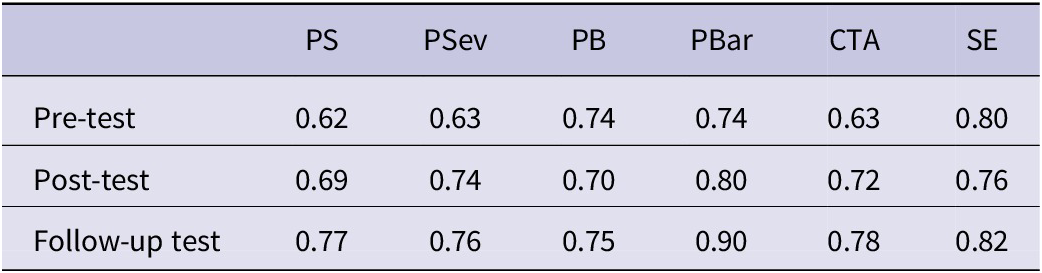
As the scale had previously undergone factor analysis in a comparable population, an additional factor analysis was not conducted in this study. Instead, the internal consistency of each dimension was assessed using Cronbach’s alpha (CA). The resulting CA values are presented in Table 2.
Intervention
The present study utilized this widely implemented Disaster Awareness Training program, a standardized 32-hour course officially accredited by the Ministry of National Education of the Republic of Türkiye, under its Directorate General for Lifelong Learning. 41 The course is open to literate individuals over the age of 13 and is designed to increase disaster preparedness and awareness in line with national policies such as the Türkiye Disaster Response Plan. The curriculum is divided into 2 modules: (1) Basic Risks and Precautions in Disaster Awareness (16 hours) and (2) Proper Behaviors During Disasters (16 hours). Course delivery is limited to a maximum of 8 hours per day and 10 hours per week. The training employed a multifaceted pedagogical approach combining interactive lectures, visual materials, and scenario-based learning.
The interactive lectures consisted of instructor-led sessions in which participants were actively engaged through questions and discussions. This approach allowed participants to clarify issues at each stage of the training, while questions posed by both instructors and participants kept the sessions dynamic and reinforced collective learning.
Visual materials, including posters, short videos, and infographics, were employed to illustrate disaster risks, preparedness strategies, and to reinforce key messages of the course. Hazard maps prepared by the AFAD, images and videos from major disasters that occurred in the last decade, and infographics highlighting key summaries and outputs of the sessions were utilized. Given that the participants were predominantly young and technologically inclined, these visual materials played a crucial role in capturing attention, sustaining engagement, and enhancing focus during the sessions.
Scenario-based learning was implemented through group activities in which participants worked on simulated disaster situations, discussed potential responses, and developed practical action plans. These exercises particularly followed applied sessions, encouraging active learning, fostering risk awareness, and strengthening preparedness beliefs. During these activities, instructors acted as facilitators, guiding participants to critically analyze risks, consider multiple perspectives, and generate feasible solutions.
Overall, the use of interactive, visual, and scenario-based methods was not limited to the transfer of knowledge but was designed to holistically strengthen participants’ cognitive, emotional, and behavioral preparedness for disasters.
The program was delivered by certified instructors approved by MoNE or AFAD. A summary of course topics, instructional methods, and learning objectives is presented in Table 1.
Training methods and content

Cronbach’s alpha internal consistency values of scale dimensions

Data Collection Process
Data were collected at 3 points: prior to the training, immediately after the training, and 1 month (30 days) following the completion of the course. Verbally informed consent was obtained from all participants before administering the instruments. The data collection tool was first completed before the course sessions began. Upon completion of the 32-hour training program, participants were asked to complete the same tool again. The final administration occurred one month later, using the identical instrument.
To ensure consistency, standardized instructions were provided to all participants at each stage of data collection.
Data Analysis
The data collected for this study were analyzed using IBM SPSS Statistics version 22 (IBM Corp., Armonk, NY). Descriptive statistics, including frequencies (n) and percentages (%), were used to summarize participants’ demographic characteristics. The normality of the data distribution was assessed through skewness and kurtosis values, which indicated that the data were normally distributed.
Accordingly, repeated measures ANOVA was employed to examine differences across the pre-test, post-test, and follow-up test scores. Results are reported with accompanying values for frequency, mean, standard deviation, effect size (partial η²), and degrees of freedom (df). The interpretation of partial η² followed conventional thresholds: η² ≥ 0.01 (small), ≥ 0.06 (medium), and ≥ 0.14 (large). Similarly, Cohen’s d values were interpreted as follows: d ≥ 0.2 (small), ≥ 0.5 (medium), and ≥ 0.8 (large).Reference Cohen 42 All statistical tests were conducted as two-tailed with a significance level set at P < .05
Ethical Considerations of the Study
Prior to conducting the study, permission to use the GDPB Scale was obtained from its developers. To ensure compliance with ethical standards, approval was secured from the Scientific Research and Publication Ethics Committee of Gümüşhane University (Approval Date: 29.12.2021; Reference No: E-95674917-108.99-71601/22118).
Verbal informed consent was obtained from all volunteer participants. Participants were assured of the confidentiality of their responses, the secure storage of all collected data, and their right to withdraw from the study at any time without penalty.
Results
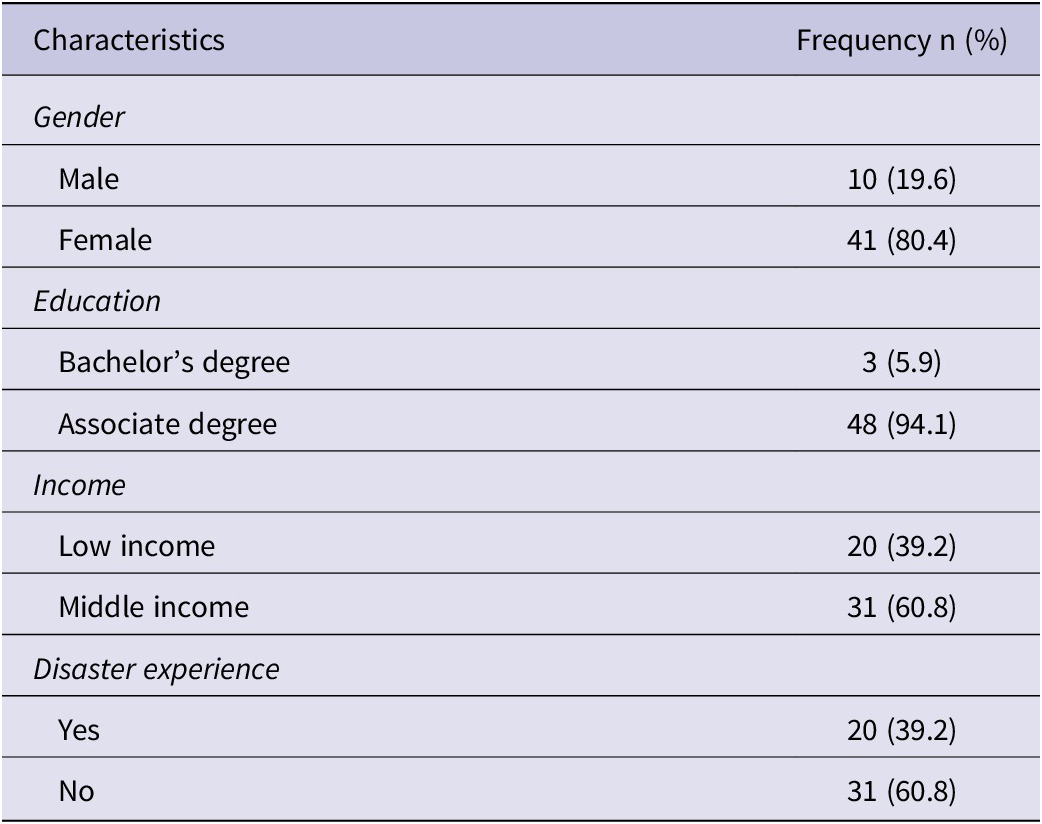
A total of 51 participants were included in the final analysis. Of these, 80% were female and 20% were male. In terms of educational background, 94% of the participants held an associate degree, while 6% held a bachelor’s degree. The mean age of the participants was 21 years (SD = 4.9).
With regard to monthly income, 39% of the participants reported low income, whereas 61% reported middle income levels. Additionally, 39% indicated that they had previously experienced a disaster. None of the participants reported having a chronic illness or disability, and none had received prior disaster-related education (see Table 3).
Sociodemographic characteristics of respondents (n = 51)

The impact of disaster education on GDPB and its subcomponents-PB, PS, PSev, PBar, CTA, and SE-was assessed using a repeated-measures ANOVA. The results showed no statistically significant effect on PB. However, significant effects were observed for PS, PSev, PBar, CTA, and SE (Table 4 and Figure 1).
Repeated-measures ANOVA analysis of the impact of disaster education on GDPB dimensions

Trend Chart of Questionnaire Sub-Dimensions Scores Across Three Tests

Post hoc pairwise comparisons with Bonferroni adjustments indicated that PS scores significantly increased from pre-test to post-test (P = .001, Cohen’s d ≈ 0.39, small), and decreased from pre-test to follow-up (P < .001, Cohen’s d ≈ 0.41, small). PSev scores were significantly lower at follow-up compared to both the pre-test (P = .007, Cohen’s d ≈ 0.42, small) and the post-test (P = .044, Cohen’s d ≈ 0.25, small). PBar scores were significantly higher at the pre-test compared to the post-test (P < .001, Cohen’s d ≈ 0.54, medium) and the follow-up (P = .045, Cohen’s d ≈ 0.27, small). Additionally, PBar scores at the follow-up were significantly higher than those at the post-test (P = .003, Cohen’s d ≈ 0.27, small). CTA scores were significantly lower at the pre-test compared to the follow-up (P = .028, Cohen’s d ≈ 0.35, small). SE scores increased significantly from pre-test to post-test (P < .001, Cohen’s d ≈ 0.71, medium), and from pre-test to follow-up (P < .001, Cohen’s d ≈ 0.67, medium).
To examine whether certain variables influenced baseline GDPB, 2 potential moderating factors were identified. The first of these was gender. A repeated-measures ANOVA was conducted separately for male and female participants to evaluate the effect of disaster education on GDPB scores.
The analysis revealed no statistically significant changes across any subcomponents of GDPB for male participants. In contrast, female participants showed significant changes in multiple dimensions, including PS, PSev, PBar, CTA, and SE (Table 3/Figure 2).
Trend Chart of Questionnaire Sub-Dimensions Scores Across Three Tests by Gender

Post hoc pairwise comparisons with Bonferroni adjustments provided further detail. PS scores among females significantly increased from pre-test to post-test (P = .004, Cohen’s d ≈ 0.40, small) and from pre-test to follow-up (P < .001, Cohen’s d ≈ 0.43, small). PSev scores decreased significantly at follow-up compared to both the pre-test (P = .035, Cohen’s d ≈ 0.46, small) and post-test (P = .042, Cohen’s d ≈ 0.30, small). For PBar, scores were significantly higher at the pre-test than at the post-test (P < .001, Cohen’s d ≈ 0.53, medium) and follow-up (P = .024, Cohen’s d ≈ 0.30, small). Additionally, PBar scores at follow-up were significantly higher than post-test scores (P = .011, Cohen’s d ≈ 0.24, small), indicating a slight increase in perceived barriers over time.
Although repeated-measures ANOVA indicated an overall significant effect on CTA, post hoc comparisons did not reveal statistically significant pairwise differences in this subcomponent. Finally, SE scores demonstrated a robust increase, with significantly higher scores at both the post-test (P < .001, Cohen’s d ≈ 0.81, large) and the follow-up test (P < .001, Cohen’s d ≈ 0.81, large) compared to the pre-test. These results suggest that disaster education was particularly effective in enhancing several dimensions of preparedness beliefs among female participants.
Income was examined as the second variable. The sample was divided into lower- and middle-income groups, and repeated-measures ANOVA was conducted separately. For the lower-income group, significant effects were found only in PBar and SE. In the middle-income group, disaster education significantly affected PS, PSev, PBar, CTA, and SE (Table 4 and Figure 3).
Trend Chart of Questionnaire Sub-Dimensions Scores Across Three Tests by Income Level

For the lower-income group, post hoc pairwise comparisons with Bonferroni adjustments indicated that PBar scores were significantly higher at the pre-test than at the post-test (P = .001, Cohen’s d ≈ 0.65, medium). Additionally, SE scores were found to be significantly lower at the pre-test compared to both the post-test (P = .038, Cohen’s d ≈ 0.46, small) and the follow-up test (P = .019, Cohen’s d ≈ 0.54, medium) (Table 5).
Repeated-measures ANOVA analysis of the impact of disaster education on GDPB dimensions by gender

In the middle-income group, PS scores were significantly higher at the post-test than at the pre-test (P = .001, Cohen’s d ≈ 0.48, small) and at the follow-up test (P < .001, Cohen’s d ≈ 0.59, medium). PSev scores were significantly lower at the follow-up test than at both the pre-test (P = .004, Cohen’s d ≈ 0.57, medium) and the post-test (P = .003, Cohen’s d ≈ 0.48, small). PBar scores also showed a significant decrease from pre-test to post-test (P < .001, Cohen’s d ≈ 0.49, small), and an increase was observed at follow-up compared to the post-test (P = .018, Cohen’s d ≈ 0.24, small).
Although the ANOVA revealed an overall significant effect of disaster education on CTA within the middle-income group, the post hoc comparisons did not yield statistically significant differences across time points. Finally, SE scores increased markedly, with significantly higher values observed at both the post-test (P < .001, Cohen’s d ≈ 0.90, large) and the follow-up test (P < .001, Cohen’s d ≈ 0.77, medium) compared to the pre-test (see Table 6).
Repeated-measures ANOVA analysis of the impact of disaster education on GDPB dimensions by income

Discussion
This study evaluated the impact of disaster awareness training on participants’ General Disaster Preparedness Belief (GDPB) at a public education center. The findings revealed significant improvements in Perceived Susceptibility (PS), Perceived Severity (PSev), Perceived Barriers (PBar), Cues to Action (CTA), and Self-Efficacy (SE) following the intervention, with more pronounced effects among female and middle-income participants. Notably, the training was ineffective for male participants.
Initially, PS increased but returned to baseline levels in the follow-up test, suggesting that the heightened risk perception was temporary. Similarly, PBar decreased immediately post-training but rebounded later, indicating only a short-term reduction in perceived barriers. In contrast, PSev exhibited a sustained decline, demonstrating that the training durably reduced participants’ perception of risk severity. Meanwhile, CTA and SE showed continuous post-training increases, implying lasting improvements in participants’ motivation and confidence to take preparatory actions. These results align with prior research linking high CTA and SE levels to proactive disaster preparedness.Reference Rostami-Moez, Rabiee-Yeganeh and Shokouhi 43 The training’s role in fostering these dimensions underscores its value in promoting preparatory behavior. Supporting this, studies have found that prior disaster training correlates with higher GDPB scoresReference Ertuğrul and Ünal 44 and positive shifts in PS, PB, PBar, CTA, and SE.Reference Dasci Sonmez and Gokmenoglu 45 Similar outcomes have been documented in other disaster education programs.Reference Alim, Kawabata and Nakazawa 9 –Reference Mirzaei, Eftekhari and Sadeghian 11 , Reference Al-Qbelat, Subih and Malak 38 , Reference Aliakbari, Heidari and Moezzi 46
Although Perceived Benefits (PB) is a central construct of the Health Belief Model, our analysis revealed no significant change across measurement points. One plausible explanation is the high baseline level of PB, as participants already reported strong agreement with the advantages of preparedness (M = 4.14/5 at pre-test). This ceiling effect limited the potential for further measurable improvement. In addition, the training program placed greater emphasis on risk awareness, barriers, and appropriate disaster behaviors rather than explicitly highlighting new benefits of preparedness. Future interventions should therefore incorporate explicit modules demonstrating the tangible advantages of preparedness (e.g., reduced injury risk, faster recovery, family protection) to reinforce this dimension.
While PS and PSev trends were similar across genders, women consistently reported higher PSev values, likely reflecting greater threat perception. Conversely, men exhibited a larger increase in CTA. SE trends were comparable, though women scored lower than men, a pattern corroborated by prior research. For instance, female students had higher GDPB scores than males,Reference Ertuğrul and Ünal 44 and female teachers displayed elevated PSev, whereas males scored higher in CTA.Reference Dasci Sonmez and Gokmenoglu 45 Another study noted that earthquake training significantly reduced PBar and boosted other dimensions among women, further highlighting gender-based disparities in risk perception and response.Reference Amini, Biglari and Khodaveisi 29
However, in our study the intervention did not produce significant changes across any dimensions for male participants (n = 10). While P-values were above the .05 threshold, several dimensions yielded medium-to-large effect sizes (e.g., SE η² = .23, PSev η² = .18), suggesting that the absence of statistical significance may reflect limited statistical power due to the small subgroup size rather than the absence of meaningful change. Future studies should therefore aim for more gender-balanced sampling to clarify these effects and to explore educational strategies that enhance male engagement.
Economic status influenced training outcomes. Middle-income participants showed improvements across multiple dimensions including PS, PSev, PBar, SE, and CTA, whereas low-income participants demonstrated significant gains only in PBar and SE. The more limited response among low-income individuals may reflect structural barriers such as limited access to resources or reduced coping capacity, which may hinder the application of newly acquired knowledge. In contrast, middle-income participants may have been better positioned to benefit from the training due to greater opportunities for integration and practice. These findings align with prior research showing that higher socioeconomic status is positively associated with general disaster preparedness beliefs.Reference Inal, Altintas and Dogan 47
Strengths and Limitations
This study utilized a quasi-experimental, single-group pre-test/post-test/follow-up design to evaluate the longitudinal effects of disaster education. This approach enabled the tracking of individual participants’ changes over time, offering valuable insights into both immediate and lasted impacts of the intervention. The inclusion of a follow-up assessment further strengthened the study by providing preliminary evidence of the training’s durability, a key consideration for disaster preparedness programs.
However, several limitations must be acknowledged. First, the lack of a control group limits causal inference, as extraneous factors (e.g., concurrent disaster-related news or community initiatives) could have influenced the observed outcomes. Second, the sample’s limited demographic diversity, overrepresentation of women (80%) and associate degree holders (94%), absence of high-income participants, and lack of individuals with advanced education, substantially constrain the generalizability of findings. While subgroup analyses by gender and income were conducted, the homogeneity of the sample precluded robust interaction analyses to explore how demographic factors moderate intervention effects.
Methodologically, the 30-day follow-up period, though aligned with prior disaster education research, may be insufficient to assess long-term behavioral retention. Additionally, the study measured preparedness beliefs rather than tangible behaviors (e.g., emergency kit assembly, evacuation drills, or household planning). While attitudinal shifts are prerequisites for action, future work should incorporate behavioral metrics to fully evaluate program efficacy.
To enhance the generalizability of findings and gain a deeper understanding of disaster education’s impact, future studies should aim to recruit more demographically diverse samples, encompassing various genders, educational backgrounds, income groups, and both urban and rural populations. It would also be beneficial to test for interaction effects to better understand how demographic variables might moderate the impact of disaster education. Furthermore, incorporating behavioral indicators will offer a more complete picture of program effectiveness. Finally, considering extended follow-up intervals would allow for a better capture of sustained outcomes over time.
Conclusions
This study demonstrates that disaster awareness education effectively enhances preparedness beliefs, with outcomes significantly influenced by gender and socioeconomic factors. These findings emphasize the need for tailored, audience-specific program designs to maximize intervention effectiveness.
For policymakers, our results underscore the value of developing gender-sensitive and economically inclusive disaster education initiatives to strengthen community resilience.
Future research should prioritize three key improvements: (1) more diverse demographic sampling, (2) controlled study designs for causal clarity, and (3) behavioral outcome measures alongside belief assessments. These advancements would provide a more robust understanding of disaster education’s long-term impacts and practical effectiveness.
Data availability statement
The data that support the findings of this study are available from the corresponding author upon reasonable request. The educational materials, such as the presentation slides used in the intervention, are not publicly available due to institutional restrictions but can be provided by the authors for noncommercial research and educational purposes upon request.
Acknowledgments
The initial version of this article was presented as an abstract paper at the 3rd International Disaster Management Congress, June 9-10, 2022, Tokat, Türkiye.
Author contribution
Ömer Demirbilek: Study design, data collection; Ramazan Aslan: Study design, analysis, manuscript drafting, correspondence.
Competing interests
The authors declare that they have no competing interests.
Declaration on the use of AI
The artificial intelligence tool ChatGPT was used to translate the text of this study into English. The output generated by the tool was reviewed and finalized by the authors. Full responsibility for the final content of this work rests with the authors.