The lifetime of the statesman, teacher and writer Ausonius of Bordeaux (c.310–395 c.e.) coincided with significant developments in geographical literature and cartographic production. The fourth century saw the rise of a distinctive genre of Christian travel writing, exemplified by the Itinerarium Burdigalense and the Itinerarium Egeriae; witnessed the flourishing of what has recently been termed ‘encyclopedic topography’, a mode of geographical description that included both surveys such as the anonymous Expositio totius mundi and more official notitiae and laterculi; and probably produced our largest and most detailed map from antiquity, the Tabula Peutingeriana.Footnote 1 It is hardly surprising that Ausonius responded to and was influenced by contemporary ways of describing the world and charting imperial space, not least because Gaul was a vibrant centre of geographical thought in Late Antiquity. And yet his original contribution to the debates of his day has not received the scholarly attention it merits.Footnote 2
Over the past two decades, studies under the influence of the ‘spatial turn’ have explored the ways in which space was produced, understood and experienced in the Roman world.Footnote 3 Focussing largely on maps and travel literature, scholars have investigated the diversity of Roman models of spatial cognition, from linear routes and itineraries to two-dimensional means of mapping the empire as a cluster of provinces.Footnote 4 A second, related strand of scholarship has addressed questions of identity: for some scholars, Late Antiquity witnessed the development of distinct regional identities, including among Gallic aristocrats in Ausonius’ day;Footnote 5 others have highlighted the universalizing ideologies of state and church and described late antique elites as transregional and cosmopolitan.Footnote 6
The geographical outlook of provincial elites has been largely absent from these scholarly narratives. While scholars of late antique space have focussed on explicitly geographical texts, such as travel literature,Footnote 7 Ausonius’ literary works give us precious insight into how people in Late Antiquity imagined the world they inhabited. Ausonius’ letters and poems also perform ideological work: evidence of an idiosyncratic provincial perspective, they demonstrate that geography played an important role in late antique constructions of identity.Footnote 8
This article is divided into three sections, each of which explores a different spatial mode and its use in the Ausonian corpus. In section I, I outline the ways in which Ausonius conceptualizes space through road networks in Ep. 24. Ausonius draws on this ‘hodological’ paradigm not just to describe the physical realities of travel across the Roman empire but also as a metaphor for the transfer of information and virtual connections between far-flung places. Next, in section II, I explore how Ausonius’ poem on oysters (Ep. 3) uses sudden leaps between distant locations (which I term ‘teleports’) to embed Gaul within a virtual network that embraces the entirety of the empire. In so doing, he makes a powerful argument for the centrality of Gaul in the multipolar political and economic landscape of the late fourth century. Finally, in section III, I read the Ordo nobilium urbium, a series of poems on cities of the Roman empire, alongside other rankings of cities and catalogues from Late Antiquity. Using the recent paradigm of ‘landmarks’, I argue that the Ordo nobilium urbium articulates unity in line with imperial messaging while championing Gaul's place in the empire. These sections contextualize Ausonius’ work within the geographical debates of his day and show what is at stake in the way in which Ausonius constructs his cognitive map.
Scholars of Late Antiquity have tended to contrast classical and Christian geographies,Footnote 9 and assumed that the former persisted unchanged far into the sixth century, with a central civilized zone and Rome at their core.Footnote 10 This article challenges this assumption by showing that, along with discrete regional identities, provincial elites developed a distinctive sense of geography that differed from both classical antecedents and contemporary Christian conceptions.Footnote 11 Ausonius’ geography emphasized his province of origin but also recognized the importance of other major cities. In this respect, his mental geography seems less conservative than has been assumed, and was better suited to the political reality of a polycentric empire.Footnote 12 Symmachus’ famous statement (Relat. 3.10) that pagans and Christians shared a similar view of the stars, sky and earth, and differed only in the scheme of thought (prudentia) they used to seek the truth is not even true for his fellow pagan and close friend Ausonius, as this article will show. For Ausonius, all roads led not to Rome or Jerusalem but to Bordeaux.
I. ROADS THROUGH GAUL
Rome was by no means the first ancient power to chart its empire hodologically, that is, as a series of stops along a path,Footnote 13 but its extensive roadbuilding programmes made linear connectedness into a key physical and conceptual feature of Roman imperial space.Footnote 14 Milestones and epigraphic itineraries not only aided the ancient traveller; they also visibly reified the spatial logic of empire throughout the provincial landscape. Similarly, many surviving textual itineraries and monumental maps not only served practical purposes but also functioned as intellectual analogues to the physical road network. Roads structured and organized imperial space; geographical texts and maps translated this system for the Roman mind.Footnote 15
Appreciating the pervasiveness of hodological thinking can help us understand a seemingly random catalogue of cities in one of Ausonius’ letters. Ep. 24 is addressed to Ausonius’ former student Paulinus, consul in 377 c.e. and later Bishop of Nola, who had withdrawn from politics to dedicate his life to religion. Paulinus had departed for Spain and long refused to reply to Ausonius’ letters (Epp. 21–2). When he did reply, he failed to promise to come and visit. Ausonius was distraught at the distance that separated him from his friend (Ep. 24.67–80):Footnote 16
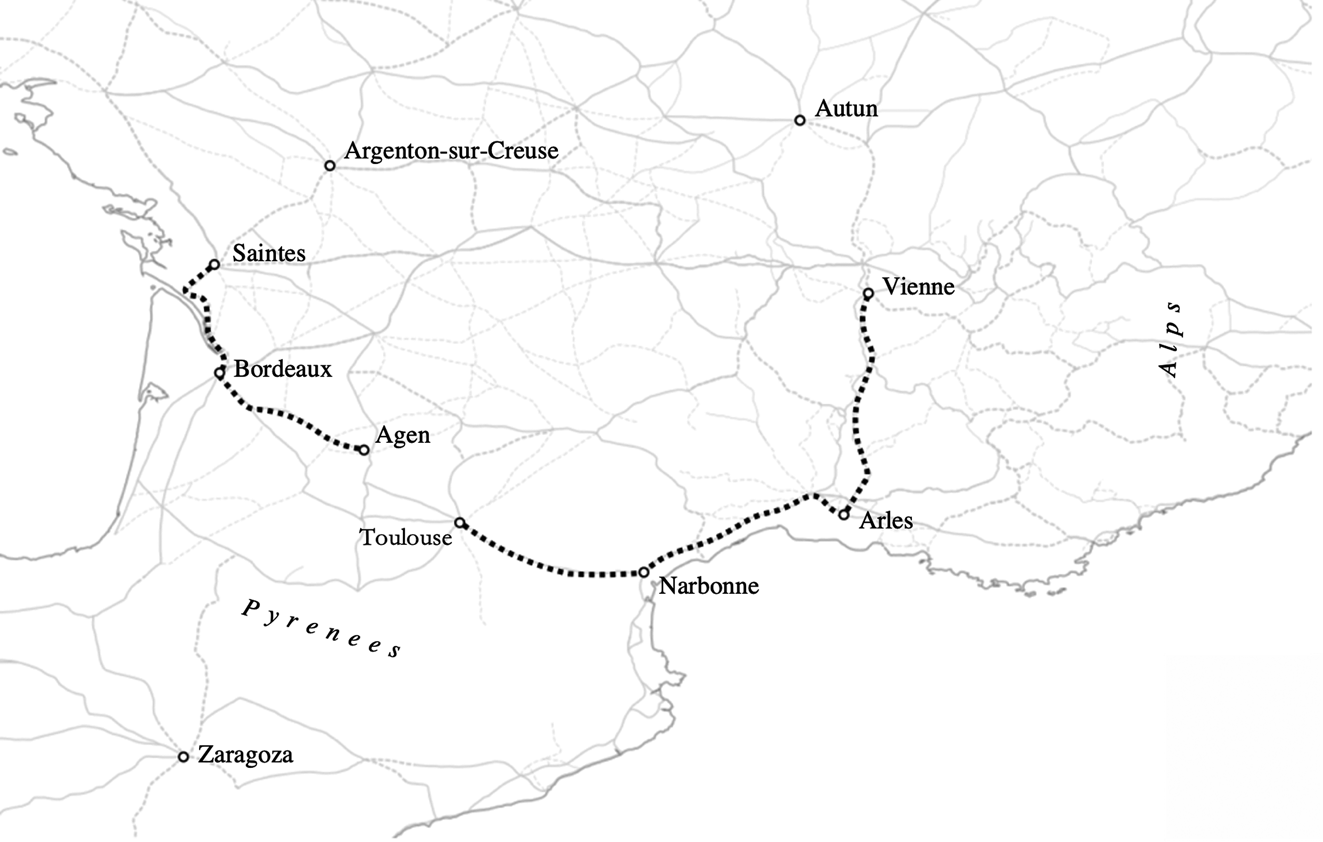
But if a short path placed a bearable distance between us (although those who wish to be together think any distance long), even so affection itself would make the places near, joining distant places with a bridge of words; as Saintes keeps in touch with Bordeaux, and Bordeaux then with Agen and the crowds who till the fields of Aquitaine; and as two-fold Arles links to itself at equal distances the roofs of Alpine Vienne and Narbonne, and then you, Martian Narbonne, ally five-fold Toulouse to yourself. If our distance were of this order, to a nearby city, then I could embrace you as if you were fixed in my arms, and the breath of my complaint would waft into your ears. Now beyond the Alps and marble-white Pyrenees, Zaragoza is your home …
Ausonius contrasts faraway Zaragoza beyond the Pyrenees (trans Alpes et marmoream Pyrenen) with a close-knit Gallic network.Footnote 17 Where the separating space (interualli spatium) is not too great, the affection felt by one friend for another makes places seem near (faceret … propinquos | cura locos), linked as they are by a community of travellers who can function as messengers (mediis iungens distantia uerbis); the cities of Gaul can thus be described as neighbouring towns (uicinis moenibus). This is true not only for the cities of Aquitania Secunda that are relatively close by—Saintes and Agen are within striking distance from Bordeaux, and the former was home to Ausonius’ villa Lucaniacus—but also for a nexus of cities in other provinces of the dioecesis septem prouinciarum: Arles, Vienne, Narbonne and Toulouse (see Fig. 1).Footnote 18
Road networks in Ep. 24.67–80

In describing the pathways that so closely connect these Gallic cities, Ausonius juxtaposes two modes of travel: local and imperial. The Aquitanian nexus of cities represents travel along local routes: the journeys between Saintes and Bordeaux and between Bordeaux and Agen correspond to historical routes attested under the heading De Aquitania in Gallias in the Antonine Itinerary (458–62 Parthey/Pinder), a collection compiled toward the end of the second century and updated in the second half of the fourth.Footnote 19 Both journeys in the Itinerary had Bordeaux as their point of departure, and Saintes and Agen were pivotal points: one route headed north from Bordeaux to Saintes, then veered east and ended in Autun; the other followed the Garonne to Agen, then turned sharply north and ended in Argenton-sur-Creuse. The second series of cities Ausonius lists were larger and more important: Arles was a major economic centre and Vienne, Narbonne and Toulouse are listed as the metropoleis of their respective provinces in the Notitia Galliarum. They were connected by major imperial highways: the Via Agrippa between Arles and Vienne, the Via Domitia between Arles and Narbonne, and the Via Aquitania between Narbonne and Toulouse.
In both the local and the imperial nexuses, however, Ausonius represents the relationship between locations as unidimensional, that is, cities are connected by what social-network theory terms ‘bridges’: Saintes is first linked to Bordeaux, then Bordeaux with Agen (24.70–1), but there is no sense of the relative locations of Saintes and Agen. Similarly, Ausonius does not proceed in a straight line from Vienne to Toulouse but connects Arles to Vienne in the north and to Narbonne in the south (24.73–4); only then is Narbonne coupled with Toulouse (24.74–5). Of course, by listing cities, Ausonius demonstrates a ‘certain level of spatial awareness in more than one dimension’,Footnote 20 since the first group of cities represents the micro-region of Aquitania Secunda (cf. populos Aquitanica rura colentes) and the second group charts the diocese as a whole. Nevertheless, both the regional and the provincial spaces are conceptualized through the dominant hodological paradigm, as a series of linear journeys between two points.Footnote 21
Ausonius’ rhetoric of connectivity strikingly reproduces a trope in the imperial discourse of roadbuilding. In particular, Ausonius’ claim that affection moved places closer together (faceret … propinquos | cura locos) echoes the language Domitian and Statius employed three centuries earlier to describe the completion of the Via Domitiana in 95 c.e. The large marble inscription that honoured Domitian in Puteoli (AE 1973, 137) described how the city was ‘moved closer’ (admota) to Rome by the emperor's indulgentia, and Statius’ poem celebrating the construction of the road repeated the metaphor of movement with reference to Baiae (septem montibus admouere Baias, Silu. 4.3.26).Footnote 22 Ausonius’ geographic focus is on Gaul in general and on Aquitania, his and Paulinus’ home, in particular, but the metaphor he chooses to characterize their connection draws on an established imperial idiom.
But while Ausonius’ letter to Paulinus was shaped by hodological thinking, he elides the physical roads themselves. Ausonius is describing not the literal transport of goods or people but the virtual transfer of information. The system of local and imperial roads functions as a simile: friendly feelings ‘join distant places with a bridge of words, just as Saintes joins Bordeaux to itself’ (mediis iungens distantia uerbis | Santonus ut sibi Burdigalam … iungit). Perhaps this is an indication that Ausonius, like his contemporary Symmachus, found the physical realities of travel distasteful and preferred his words and feelings to journey in his stead.Footnote 23 Nevertheless, when his words make their imaginary journey through Aquitania and Gaul, they travel along established paths.
This mode of description, which we might term ‘pseudo-hodological’ occurs also in an earlier letter by Ausonius in which he complains that a friend of his has long been absent from his villa Lucaniacus. Theon had not been to visit him for ninety days, a figure underlined by a series of periphrases, including the following (Ep. 15.11–15):
The laws’ measurement bids defendants traverse twice nine hundred miles in full in so many days. I could already have gone to Rome on foot, and on foot returned, since the time when a few miles separated you from me.
Roman law required a defendant to travel at least 20 miles per day in order to appear before the court (Dig. 2.11.1), and Ausonius humorously applies this requirement to calculate the distance he could have travelled since he last saw his friend. Yet he is clearly not describing an actual journey. Not only is the figure he cites too small—the Itinerarium Burdigalense gives a distance of 2,526 miles for the round trip from Bordeaux to Rome and back as opposed to Ausonius’ 1,800 miles—but both journeys, that of Theon to Lucaniacus and Ausonius’ imagined journey to Rome, are unlikely to have been completed on foot. The final lines of the poem make it clear that Theon was in the Médoc and would cross the Garonne by boat (puppe citus propera, Ep. 15.27), and the most natural route from Bordeaux to Rome involved embarking at Narbonne.Footnote 24 Perhaps of greater significance, however, in spite of Rome's notional importance as a source of civic identity (cf. Ordo nob. urb. 166–7, discussed below), is the fact that Ausonius never went to Rome. As in the case of his metaphorical use of the connections between the cities of Gaul, he here borrows heavily from the hodological paradigm: he imagines a land journey to the source of all roads,Footnote 25 and his itinerary is measured—however inaccurately—in miles as opposed to, say, Gallic leagues.Footnote 26 Nevertheless, his itinerary is pseudo-hodological, since the link it establishes between Bordeaux and Rome—between the centre of Ausonius’ life and the ideological centre of the western empire—is purely imaginary.
II. OYSTERS OF THE EMPIRE
The previous section explored the ways in which Ausonius exploited the paradigm of hodological travel as a metaphor for virtual connections within and beyond Gaul. This section discusses a different strategy he used to situate Gaul within the Roman empire: that of juxtaposing local cities with far-off places at the edges of his mental map.
In Ep. 3 Ausonius responds to a request of his friend Paulus to write a catalogue of oysters in verse. After objecting that oysters are an unsuitable topic for an old and frugal man like himself, the poet names his sources: the report and testimony of men (enumerabo tamen famam testesque secutus, 3.16). The coda to his poem elaborates (3.41–4):
These things I tell you, not as a poet, nor as a historian, nor yet as a world-wandering gourmand, but things I have heard from many, as is customary, whenever someone at a lavish dinner-party spurs on gentle drinking with friendly conversation.
Ausonius again leaves the travelling to others (neque toto | orbe uagus). His exhaustive catalogue turns out to derive from a group of people similar to the catalogue that linked the cities of Gaul: a vast network of elite travellers (tradita multis; cf. bonos, 3.51) who come together at dinner parties for polite conversation (comi sermone).
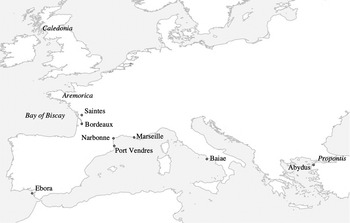
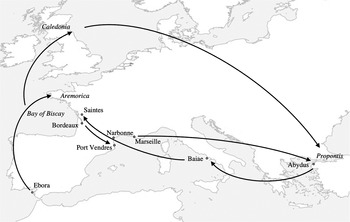
The places these travellers mention offer a precious glimpse of the geographic horizons of the new Gallic aristocracy (see Fig. 2):Footnote 27 the oysters of the Médoc are naturally the best of all, named after Bordeaux and served even at Caesar's tables (3.18–25); there follow oysters from Marseille, ‘which Narbonne feeds near Port Vendres’ (3.26–8), Abydus on the Hellespont (3.28–9), Baiae (3.30), Saintes (3.31), the ‘Genoni’ (3.31),Footnote 28 Ebora at the mouth of the Guadalviquir (3.32–4), the sea off Aremorica in modern-day Brittany (3.35), the Pictonic coasts of the Bay of Biscay (3.36), the Caledonian shore (3.37) and the Propontis ‘below Byzantium's shores’, the birthplace of a Theodosian commander sent against the usurper Maximus (3.38–40).
Provenance of Ausonius’ oysters

Ausonius terms this poem nugae (3.10), and it is tempting to dismiss it as mere versificatory showmanship akin to his many other ludic catalogues and dinner-table diversions, another instance of an encyclopedic aesthetic that has been seen as characteristic of late antique literature more generally.Footnote 29 To see the potential of this culinary catalogue as a means of constructing a distinctive geographical vision, however, it is helpful to turn to its antecedents. It is testament to the enduring popularity of shellfish on the tables of the Roman empire that Ausonius could fall back on an established tradition of ranking bivalves by their place of origin.Footnote 30
The Elder Pliny's Natural History has a section on oysters (32.59–65) that lists their medical benefits and discusses ‘the countries that breed oysters, lest the shores should be cheated of their proper fame’ (de nationibus, ne fraudentur gloria sua litora, HN 32.62). Pliny quotes the opinion of Gaius Licinius Mucianus (d. 77 c.e.) who served as the governor of Syria under Nero and wrote a book of geographical mirabilia (HN 32.62–3):Footnote 31
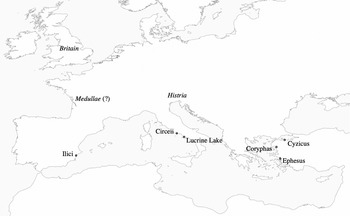
sunt ergo Muciani uerba, quae subiciam: Cyzicena maiora Lucrinis, dulciora Britannicis, suauiora Medullis, acriora Ephesis, pleniora Iliciensibus, sicciora Coryphantenis, teneriora Histricis, candidiora Cerceiensibus. sed his neque dulciora neque teneriora ulla esse compertum est.
These then are the words of Mucianus which I will append: The oysters of Cyzicus are larger than those of the Lucrine Lake, sweeter than the British, more pleasant than those of Medullae, sharper than those of Ephesus, fuller than those of Ilici, less slimy than those of Coryphas, softer than those of Histria, whiter than those of Circeii. It is agreed, however, that none are sweeter or softer than those of Circeii.
Mucianus gives pride of place to oysters from Cyzicus, a peninsula jutting out into the Propontis, mentioned also by Ausonius (Ep. 3.38–40). The locations that follow chart the full extent of the Neronian empire (see Fig. 3): Italy (Lucrinis … Cerceiensibus), Britain (Britannicis), Gaul (Medullis), Asia Minor (Ephesis … Coryphantenis), Spain (Iliciensibus) and Dalmatia (Histricis). Mucianus was a connoisseur—Pliny punned on the peritia of his lingua, his organ of taste as well as of speechFootnote 32—and the organizing principle of his list is clearly not geographical. Instead, he focusses on size (maiora), taste (dulciora … suauiora … acriora), consistency (pleniora … sicciora, teneriora) and colour (candidiora). Nevertheless, his list is carefully balanced and organized so as to emphasize the pre-eminent position of Italy: Italian locations (the Lucrine Lake, Circeii) frame two tripartite sets of places from across the empire (Britain, Aquitaine, Ephesus; Alicante, the Turkish Aegean, Istria).Footnote 33 In this way, Mucianus’ culinary ranking of oysters reflects the geopolitics of empire: Italy stands at the centre of a carefully calibrated global network of trade, with faraway provinces serving the needs of the Roman elite.Footnote 34
Provenance of Mucianus’ oysters (via Pliny)

The only other extensive catalogue of oysters that survives from antiquity also dates to the first century c.e. Xenocrates of Aphrodisias, whose work on the nutritional value of marine creatures (Περὶ τῆς ἀπὸ ἐνύδρων τροφῆς) was preserved by Ausonius’ contemporary Oribasius, devoted a paragraph to the locations where the best oysters were found (Coll. Med. 2.58.95–6):
κάλλιστα κατὰ τὰς ἐκβολὰς τοῦ Νείλου ἐν Αἰγύπτῳ. καὶ ἐν Ἐφέσῳ κατὰ τὴν εἰσβολὴν τοῦ Καϋστρίου εἰς καταβόλους τίθεται ὡς σπέρματα, καὶ αὔξεται, ἔαρι δ’ ἐμπίπλαται παχυνόμενα λευκῷ χυμῷ γαλακτώδει⋅ πάλιν κατὰ Βρεντέσιον, Ταρακῶνα, Ναρβῶνα, Δικαιαρχείαν ἐν Λουκρίνῳ λάκκῳ, Χελιδονίας, Λευκάδα, Ἄκτιον, Λιβυκοὺς κόλπους.
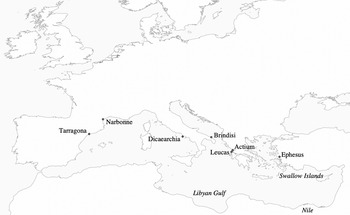
The best are in Egypt at the mouth of the Nile. And in Ephesus at the mouth of the Cayster they are placed in oyster-banks like seeds and grow; and in spring they fill up, growing fat with a white, milky humour; the same is true in Brindisi, Tarragona, Narbonne, Dicaearchia on the Lucrine Lake, the Swallow Islands, the island of Leucas, Actium and in the Libyan Gulf.
There is some overlap between Mucianus and Xenocrates: both mention the Lucrine Lake as well as oysters from the Balearic Sea (Tarragona and the Ilici) and Gaul, albeit from different bodies of water (Narbonne on the Mediterranean vs the Medullae on the Atlantic).Footnote 35 But though Xenocrates’ list is perhaps less carefully arranged than that of his Latin-speaking contemporary, his cultural centre of gravity clearly lies further east, closer to his hometown in Cilicia. All other locations he gives are located in the Greek-speaking world of the eastern Mediterranean (see Fig. 4): Egypt and the Cyrenaica in the south, Ephesus and the Swallow Islands in western Asia Minor on the Aegean, Leucas and Actium on the Ionian Sea, and Brindisi on the Adriatic. The inclusion of Actium shows that the fact of Roman empire has left traces in Xenocrates’ catalogue, too, but the two westernmost cities, Narbonne and Tarragona, fall comfortably within the world of Greek colonization, and are sandwiched between Italian cities with Greek pasts and connections: Brindisi, the principal link between Italy and Greece, and the Greek colony of Dicaearchia (Roman Puteoli, modern Pozzuoli). The world of Xenocrates and his sources is Greek first and Roman second;Footnote 36 perhaps tellingly, it is limited to the Mediterranean.
Provenance of Xenocrates’ oysters

The examples of Mucianus and Xenocrates show that more than gourmandizing is at stake in the letter Ausonius wrote to Paulus three centuries later. Ausonius carefully arranges the places known to his cosmopolitan friends to emphasize Gaul's connection to important imperial centres of power and tie it to the rest of the empire. He frames the catalogue with explicit political references of a kind rarely found in his œuvre: the oysters of Bordeaux are served on the imperial tables of Theodosius (in Rome or in Constantinople?) (Ep. 3.20), while the Propontid oysters of Byzantium are named after one Promotus (3.40), who was most likely an officer of Theodosius sent to fight the usurper Maximus in Gaul.Footnote 37 These two figures, Theodosius and Promotus, construct a conceptual axis between Bordeaux and the political heart of the Roman empire in the East, a polarity that valorizes Ausonius’ hometown.Footnote 38
In the body of his catalogue, Ausonius shuttles back and forth between Gaul and other provinces (see Fig. 5): from Marseille to Abydus, from Baiae to Saintes, from the Atlantic coast of Spain to Brittany and from the Bay of Biscay to the shores of Britain (3.27–37). In this way, he covers some of what was by then conventional territory for ostreophiles: the Hellespont had been mentioned prominently by Mucianus, as had Britain and (Mediterranean) Spain; Baiae corresponds to Mucianus’ and Xenocrates’ oysters from the Lucrine Lake. But if Xenocrates’ perspective was centred in the eastern Mediterranean, Ausonius’ list evinces a western bias: not only does it contain more oysters from Gaul than from anywhere else but, with the exception of Byzantium, all locations fall within the western half of the empire; the majority of oysters are Atlantic rather than Mediterranean in origin.Footnote 39
‘Teleports’ in Ausonius, Ep. 3

In part, the western focus in this poem can be understood as a product of the economic realities of Ausonius’ day. While luxuries such as oysters were often traded across wide geographical ranges (which explains the inclusion of Byzantium),Footnote 40 exchange systems for staples in the eastern and western Mediterranean were largely independent of each other by the fourth century, notwithstanding the enduring political and ideological unity of the empire.Footnote 41 Moreover, unlike the senatorial elite based in Rome, who owned property across the entire empire, most landowners in the East and in Gaul tended to own property exclusively within their own region, and even the wealthiest members of society had few holdings in other regions.Footnote 42 In the case of Ausonius, only the marriage of his daughter to a praeses in Illyricum brought property outside of Gaul into the family, the overwhelming majority of whose estates were in Gaul.Footnote 43 By transporting his reader to and from his homeland in Ep. 3, Ausonius weaves a dense web of connections that figures Gaul as an important economic hub of the western half of the empire.Footnote 44
But Ausonius’ poem does more than simply reflect these economic realities: it centres the empire around Bordeaux. Even though Bordeaux was not an imperial residence, Ausonius bookends his catalogue with references that link Bordeaux to Constantinople, thereby conferring legitimacy on Bordeaux as a new centre. Seemingly effortless leaps to and from a new periphery, which includes places in Asia Minor, Italy, Spain and Britain, confirm and stabilize the centrality of Gaul to the empire. By ‘teleporting’ oysters to his dinner table from the very edges of the Latin West Ausonius coins a novel spatial idiom to describe a multipolar empire.Footnote 45 The imperial ecosystem of the fourth century was too expansive and disjointed to rely on connection by roads alone:Footnote 46 like the pseudo-hodological link between Rome and Bordeaux, his catalogue of oysters elides the physical realities of travel and substitutes a network of virtual relationships that charts Ausonius’ cultural geography. This network is no longer built around a Roman demand; it serves the Gallic gourmandizers in Ausonius’ circle.
III. A WORLD OF CITIES
The Ordo nobilium urbium, a collection of twelve poems on famous cities composed after 388 c.e., demonstrates most clearly Ausonius’ new geographical outlook. The poems vary in length from a single line (Rome) to forty lines (Bordeaux), and are organized in the following order: Rome, Constantinople and Carthage, Antioch and Alexandria, Trier, Milan, Capua, Aquileia, Arles, Seville, Athens, Catania and Syracuse, Toulouse, Narbonne and Bordeaux. The author of the most recent full-scale commentary on Ausonius’ œuvre denies that there is much purpose—political or otherwise—to the catalogue and its arrangement as a whole;Footnote 47 other scholars have highlighted the centrality of Rome and the role of the poet's personal connection with the cities of Gaul.Footnote 48 This section will focus instead on the worldview that the catalogue form encodes: by comparing and contrasting the Ordo nobilium urbium with contemporary travel writing, I situate the poem within a late antique tradition of conceptualizing the totality of imperial space via landmarks and identify what is distinctive about Ausonius’ perspective.Footnote 49
An unusual feature of Ausonius’ Ordo nobilium urbium is that it establishes a clear hierarchy of cities. A variety of factors—including historical fame, size and present importance—are at play in determining a city's rank: Rome is the first city (prima, 1), Constantinople and Carthage vie for the second place (2–9), Antioch and Alexandria aim to outdo each other in vice (17–18), Trier yearns to be praised (28–9), Milan holds its own despite its proximity to Rome (45), Capua once sought to rival Rome (50), Aquileia has been elevated into ninth position in virtue of recent accomplishments (64), and Arles is a miniature version of Rome and an important trade centre (74).
While contemporary geographical writing had some hierarchical traits, other sources generally did not establish an overall ranking comparable to the Ordo nobilium urbium. The Peutinger Table used a variety of symbols to represent towns of different sizes; Rome, Constantinople and Antioch were each singled out with larger vignettes that contained personifications of the city. Geographical surveys similarly distinguished between cities in every area they describe: the Expositio totius mundi et gentium, composed in Greek between 350 and 362 c.e., singled out major cities (Trier and Arles in the case of Gaul), while the Notitiae Galliarum (c.400 c.e.), a list of the ciuitates of the seventeen Gallic provinces, gave the name of the metropolis at the beginning of the section for each province. Even itineraries provided more than a list of stopping points: subtotals of distances and summaries constructed a hierarchy of places in the Itinerarium Burdigalense (333–334 c.e.), within which Constantinople, Jerusalem, Rome and Milan emerged as the most important cities.Footnote 50 However, none of these sources established a clear hierarchy among notable cities.
Not all of the cities described in the Ordo nobilium urbium fit a hierarchical framework. After the poem on Aquileia that sits at the centre of the collection, Ausonius ceases to make explicit reference to cities’ rank, a concern that resurfaces only in the last poem, in which he criticizes himself for not mentioning his hometown of Bordeaux among the foremost (inter primas, 131).Footnote 51 The alternate title of the Ordo nobilium urbium in our manuscripts is catalogus, and Ausonius himself refers to his collection as a ‘tally’ of famous cities (numerus, 161). Consequently, the collection can also be read as part of a separate tradition of geographical writing popular in Late Antiquity whereby a catalogue of famous cities stood in for the empire as a whole. A brief passage in Ausonius’ speech of thanksgiving delivered to Emperor Gratian during his consulship in 379 c.e. illustrates the form (Grat. act. 34–5):
celebrant equidem sollemnes istos dies omnes ubique urbes quae sub legibus agunt, et Roma de more et Constantinopolis de imitatione <et> Antiochia pro luxu et Carthago discincta et donum fluminis Alexandria, sed Treueri principis beneficio et mox cum ipso auctore beneficii. loca inter se distant, uota consentiunt. unus in ore omnium Gratianus, potestate imperator, uirtute uictor, Augustus sanctitate, pontifex religione, indulgentia pater, aetate filius, pietate utrumque.
It is true that every city which lives under our governance observes these annual days of festival, Rome as a matter of custom, Constantinople out of imitation, Antioch out of love for indulgence, as also do degenerate Carthage and Alexandria, the gift of its river; but Trier is enabled to do this by the kindness of our prince, and will soon do so in company with the author of that kindness. These places are far apart, but the prayers they offer up are all to one effect: one name is on the lips of all—the name of Gratian, Gratian who in virtue of his authority is styled Imperator; of his courage, the Victorious; of his sacred person, Augustus; of his devotion, Pontifex; of his tenderness, Father; of his age, a Son; and of natural affection, both one and the other.
Green marks a lacuna before this passage, and it is difficult to pinpoint exactly what celebration istos dies refers to.Footnote 52 Nevertheless, the cities named correspond exactly to the first six items of the Ordo nobilium urbium, with a similarly negative assessment of Carthage and the cities of the East.Footnote 53 Moreover, these six cities stand in for all cities in the empire (omnes ubique urbes quae sub legibus agunt); their unanimous support for Emperor Gratian overrides the fact of their geographical separation (loca inter se distant, uota consentiunt).Footnote 54
The passage as a whole is certainly a tribute to Trier, as Green reads it—in this respect, this passage exhibits the same Gallocentrism as the poems discussed above—but the rhetoric of universality and imperial unity is no less significant. Earlier in 379 c.e., Gratian had appointed Theodosius Augustus to govern in the East, and his own activities as emperor had always been centred in the West. Nevertheless, the notion of imperial unity was a cornerstone of the propagandistic programme of fourth-century emperors who shared triumphal cognomina with their colleagues and announced their victories across the entire empire.Footnote 55 Ausonius flatters his former pupil by suggesting that Gratian alone is on the lips of all (unus in ore omnium Gratianus) and lends support to the fiction that figures the major cities of the empire as one undivided whole.
The clearest visual analogue for this synecdoche—that is, the representation of the entire empire through a selection of its leading cities—can be found in the Calendar of 354, an early codex that contains a vast amount of information and illustrations along with the calendar for which it is named (it survives in a number of Renaissance copies). The dedicatory page was followed by four successive pages with depictions of the city goddesses of Rome, Alexandria, Constantinople and Trier. Rome was depicted first and portrayed as pre-eminent: unlike the other goddesses, she was seated and held a globe in her right hand. Moreover, a bag of coins labelled ‘MCCCC’ signalled her superiority to Constantinople, the personification of which is depicted with a bag labelled ‘M’.Footnote 56 Beyond the special distinction of Rome, found also in Ausonius’ Ordo nobilium urbium (prima, 1), it is clear that the four cities were selected to represent the empire in its totality: it is as if the compiler of the Calendar had merely adjudicated the disputes that animate the double poems of Ausonius’ Ordo nobilium urbium, selecting Constantinople over Carthage and Alexandria over Antioch.Footnote 57 Late antique representations that symbolized the empire through its leading cities showed some flexibility in their choice of cities, doubtless based on regional concerns similar to the ones visible also in Ausonius’ catalogue: Stern adduces a group of four statuettes of Rome, Constantinople, Antioch and Alexandria found on the Esquiline as well as a sarcophagus found in Pećs in Hungary that featured Rome in the centre, with Constantinople and Carthage to its left and Nicomedia (in north-western Asia Minor) and Siscia (in modern-day Croatia) to its right.Footnote 58 Nevertheless, these arrangements represent a striking development when read against earlier depictions of Rome on her own or of Rome with Constantinople. Imperial space could no longer be epitomized by one or even two capital cities: a larger number of places was necessary to capture and unify a territory that was characterized by shifting cultural and political centres.
But even when the Ordo nobilium urbium is properly contextualized within Ausonius’ œuvre and other types of geographical writing of his time, it is difficult to account for the varied nature of this catalogue and find unity in a work that one major commentator has characterized as unsystematic and eclectic.Footnote 59 It is precisely these traits of the collection, however, that align it with a well-studied mode of spatial perception via so-called ‘landmarks’. In a seminal study of non-cartographic ways of charting space, Kai Brodersen draws on the findings of cognitive psychologists and urban planners to investigate the role of landmarks, routes and surveys in ancient conceptual geographies. He correlates the use of landmarks, individual points in space often given without a sense of their relative location to one another, with conceptualizations of macrospace (Großraum). Mapping space non-cartographically through landmarks is an ‘act of possession’: regardless of their actual location on the map the naming of landmarks makes large territories comprehensible to the conqueror; the more landmarks lie in a territory, the larger it appears.Footnote 60
By the time of Ausonius, this conceptualization of space had had a long history: it underlay the naming and representation of conquered gentes and urbes in Roman triumphs and the Hellenistic tradition of city personifications, evident (for instance) in Ptolemy II's procession of cities (Ath. Deipn. 5.201d–e).Footnote 61 Over the course of the first centuries c.e., imperial representations of cities increasingly emphasized the more peaceful notion of cura imperii rather than ideas of conquest, but cities continued to be listed as landmarks, without any discernible geographical order.Footnote 62 Ausonius, whose work actively engages with the visual art of his day (cf. for example his Cupido Cruciatus), consciously follows this artistic tradition of city personifications. His list of cities expresses not the tidy structural coherence of different administrative units within the empire; rather, his chosen mode of representation—the impressionistic catalogue—conveys the diversity and size of the empire without drawing attention to its limits on the map (which, however, correspond roughly to those seen in section II above).Footnote 63
The catalogue form also allows Ausonius to emphasize his province of origin. On Brodersen's understanding, the number of landmarks in a list determines the ‘size’ of the territory charted: the Ordo nobilium urbium thus not only celebrates the size of the empire as a whole; it also enlarges the space occupied by Gaul within this empire: of the seventeen cities named, five lie within the Gallic provinces. Ausonius’ negative portrayal of the great cities of the East and his long poems on Narbonne and Bordeaux serve the same aim: they advertise the importance of Gaul within the empire to Theodosius.Footnote 64 Moreover, in portraying the cities of Gaul as bulwarks of Roman culture and indispensable military and economic allies, Ausonius suggests that they realize the idea of Rome in what has recently been termed translatio urbis.Footnote 65 The final lines of the collection in particular equate Rome and Bordeaux (Ordo nob. urb. 163–8):
Let this last task conclude the muster of famous cities. And as illustrious Rome leads at one end of the rank, so at this end let Bordeaux establish her place, leaving the primacy uncertain. This is my own country; but Rome transcends all countries. I love Bordeaux, Rome I venerate; in Rome I am a citizen, in both cities a consul; here was my cradle, there my curule chair.
While Ausonius recognizes Rome's status as ‘supra-patria’ (166), Bordeaux can hold its own as a city:Footnote 66 Rome and Bordeaux frame the collection, but the length of their respective poems—one line for Rome and forty for Bordeaux—casts doubt on the hierarchy established by the Ordo nobilium urbium; the question of primacy remains uncertain (ancipiti uertice, 165). Far from being a straightforward ranking from most to least important, the Ordo nobilium urbium reproduces the cities of the empire in diffuse order, as landmarks, with greater weight given to Gaul and Bordeaux.
The final poem of the Ordo nobilium urbium in fact constructs Bordeaux as a new centre for the western half of the Roman empire using a ‘teleport’ similar to those seen in Ep. 3. Ausonius’ praise of the river Garonne unexpectedly mentions the Persian king (Ordo nob. urb. 153–6):
You would have wished to reach this river with your camp, King of the Medes, when streams were consumed and rivers failed; from this source to carry waters through foreign cities, you who through them all were wont to drink Choaspes alone.
Ausonius’ primary points of reference in this passage are classical: he is alluding to stories about Xerxes and Cyrus the Great, whose armies drained the waters of various rivers (cf., for example, Hdt. 7.43) and who transported water from the Persian river Choaspes with them on their expeditions (cf. Hdt. 1.188.1);Footnote 67 the idea that the Persian king might (or might not) drink a non-native foreign river echoes a famous Virgilian ἀδύνατον (aut Ararim Parthus bibet, Ecl 1.62). At the same time, his mention of the Persian king also uncomfortably recalls contemporary troubles at the eastern frontier of the empire, where Theodosius had recently been forced into an unfavourable agreement with Shapur III regarding the partition of Armenia.Footnote 68 In suggesting that the Persian king might long to reach the Garonne, Ausonius startlingly telescopes a vast geographical distance and puts Bordeaux on the map as a key city of the empire. His suggestion that the Garonne will replace the Choaspes as the Great King's water of choice, however improbable or paradoxical, establishes Gaul as a counterweight to the imperial Far East.Footnote 69 The image of the Persian king transporting the waters of the Garonne throughout the cities of the empire remains bizarre and jarring, but it is based on a familiar metaphor of water for poetry and encodes a conventional ambition for widespread poetic fame. Ausonius’ poetry will not only be read across the empire in all the cities he has listed; it will even reach the enemy in the East. All roads used to lead to Rome; this final image of ubiquitous diffusion again figures Bordeaux as a centre and source. With Ausonius as its spokesman, all roads really do lead to Bordeaux.
4. CONCLUSION
This article has explored three different strands in Ausonius’ conceptual geography. His two letters discussed in section I demonstrate once again that itineraries were a pervasive paradigm of spatial imagination, capable of charting entire regions and sub-regions in ways that parallel other contemporary geographical texts such as the Antonine Itinerary or the Notitia Galliarum. But roads did not merely provide physical links between far-flung locations in the Roman empire; they could also be used to establish virtual connections between places, allowing provincial elites such as Ausonius to transmit information and embark on imaginary journeys to Rome, the source of all roads. Section II showed that seemingly banal poems on shellfish could express distinctive geographic perspectives grounded in the politics, culture and economic position of their authors. Ausonius effortlessly teleported his reader across the entirety of the Roman empire, in which his Gallic homeland occupied culinary pride of place. Section III, finally, argued that lists of cities served both as a means for conceptualizing the reach of Roman power and as a way of expressing local pride and regional identity. While Ausonius’ Ordo nobilium urbium celebrated a wide range of Roman cities, the order and length of the poems, along with explicit praise for Bordeaux in the final poem, made clear where Ausonius’ geographical centre of gravity lay.
Ausonius’ geographical exploits have not been entirely forgotten. Today, a footpath in Rhineland-Palatinate that leads from Bingen am Rhein to Trier bears his name, a tribute to the journey he describes in the opening lines of his most famous poem, the Mosella (1–24).Footnote 70 And yet scholars have paid scant attention to Ausonius’ geography, even though he lived in times that witnessed a virtual explosion in geographical writing and thinking. This article has attempted to show that there is much to be gained from looking more closely at the literary production of fourth-century authors such as Ausonius. No less than the maps and travelogues of his contemporaries, his works bear witness to the myriad ways in which writers of this period imagined the expansive world they inhabited, which they perceived as dynamic and unified, not (as too many scholars still would have it) as lifeless and fragmented. They also show that the cultural geography of Late Antiquity was more diverse than has previously been assumed, not least because of the key role played by cultural identity, in addition to changing political and economic realities, in shaping the geographic outlook of individuals. The example of Ausonius demonstrates that provincial perspectives could co-exist with universalizing ideologies in the ‘glocalized’ world of Late Antiquity, in a way that is bound to appear at once familiar and foreign to Ausonius’ twenty-first-century readers. After all, many today similarly understand themselves as part of both local and global communities, even if few would express that sentiment in an ode to the oyster.