What happened to the Tea Party in 2012? How did their candidates for office, particularly for the US House of Representatives, fare? This article discusses the political experience, fund-raising capacity, and relative electoral success of Tea Party and non–Tea Party Republican candidates for election to the US House of Representatives in 2012. It also examines the electoral consequences of both belonging to the Tea Party Caucus and receiving Tea Party endorsements.
TEA PARTY IN THE HOUSE
The Tea Party candidates for the House of Representatives are examined because this is where the Tea Party has had its greatest success. In 2010, Tea Party activists sought the Republican nomination for congressional office and, in some cases, successfully challenged Republican incumbents. On July 21, 2010, after receiving official recognition from the Republican Party in the House of Representatives, 51 House members formed the Tea Party Caucus and selected Michele Bachmann as their leader (Lorber Reference Lorber2010). Republican victories in November gave that party control of the House of Representatives in 2010 and subsequently increased Tea Party membership in the House. In 2011, CNN reported that there were 60 members of the Tea Party Caucus in the House of Representatives (Travis Reference Travis2011). As a consequence of members running for higher office, retirements, and primary defeats—including some defeats by other Tea Party candidates—only 52 of those individuals ran for office in 2012. A somewhat larger number, however, was endorsed by Tea Party groups during 2012, including members of the Tea Party Caucus, incumbents who were endorsed but never joined the caucus, and nonincumbents.
Although all of the members of the Tea Party Caucus in Congress are Republicans, the caucus has tried to differentiate itself from mainline Republicans. Representative Michelle Bachmann gave the first official Tea Party response to President Obama’s State of the Union Address in 2011. This tradition has continued, with addresses delivered by Herman Cain in 2012 and, on a more serious note, senators Rand Paul in 2013 and Mike Lee in 2014. In addition to the caucus in the House, the Tea Party has formed a small, three-member caucus in the Senate, as well as caucuses in some state legislatures (Gervais and Morris Reference Gervais and Morris2012). Footnote 1
Officially, the Tea Party Caucus is only one of a number of Republican caucuses. However, it is more visible than other congressional caucuses and its relationship to the rest of the Republican Party is more complicated. Jacobson (Reference Jacobson2011, 28) argues that “the Tea Party conferred a label and... a self-conscious identity on a pre-existing Republican faction that already held strongly conservative views.” If this is the case, the Goldwater movement, which united Southerners and conservatives, would seem to be the historical antecedent of the Tea Party. In reality, the Tea Party has become a faction within the Republican Party—one that most closely resembles the Southern Democrats of old. The Tea Party, however, is not as exclusively regional as the Dixiecrats were and neither is it (as yet) as large a part of its party.
The Tea Party has a number of separate associated organizations: specifically, the Tea Party Express, Tea Party Patriots, and Freedom Works. Of these three organizations, Freedom Works for America—founded by former House majority leader Dick Armey—was the most effective (Karpowitz et al. Reference Christopher, Quin Monson, Patterson and Pope2011). Its current status, however, is unknown since a leadership struggle that resulted in Armey’s ouster. Further complicating the situation is the fact that Armey’s ouster reportedly was accomplished by promising him $8 million, presumably to create a new organization and to compensate him for leaving (Gardner Reference Gardner2012).
ELECTORAL IMPACT
This article attempts to answer two questions. First, are Tea Party candidates less professional than other Republican candidates? Previous research has distinguished between amateur and professional politicians (Cannon Reference Cannon1990; Hofstetter Reference Hofstetter1971; Nimmo and Savage Reference Nimmo and Savage1972; Wilson Reference Wilson1962). The general consensus of this research is that ideologically motivated political activists are more willing to risk electoral defeat than more established officeholders who value continued service over ideological purity. Occasionally, however, accidental candidates are elected who are running for ideological reasons. One potential explanation for the Tea Party is that it is the result of the sudden influx of several politically less-professional activists who have not experienced the moderating effects of a political career. If this is so, we would expect Tea Party candidates to be less likely to have held prior public office, to be less well funded, and not to have served as long in office.
The empirical question, then, is to what extent are these journalistic perceptions an accurate portrayal of what is happening to the Tea Party in the House of Representatives? That is, does a Tea Party endorsement help or hinder a Republican candidate’s chances of election?
Second, does being a member of the Tea Party or receiving a Tea Party endorsement confer an electoral advantage? Membership and endorsements have several advantages. They generate favorable publicity, identify the political position of the endorsed candidates, cue like-minded citizens to vote for those candidates, attract financial contributions, and help to recruit volunteers. Previous studies of Tea Party endorsements found that with the exception of Freedom Works for America—whose endorsements were accompanied by campaign contributions—those made by most Tea Party groups in 2010 had little effect on the election (Karpowitz et al. Reference Christopher, Quin Monson, Patterson and Pope2011). Bullock and Hood (2012, 1435) found that in 2010, the Tea Party “…took on many unbeatable Democrats and was more likely to target incumbents than open-seat challengers.” In short, the Tea Party was much less strategic in deciding whom to endorse than politicians like Sarah Palin (Bullock and Hood Reference Bullock and Hood2012).
Estimates of Tea Party support vary. Abramowitz (Reference Abramowitz2011) found in a 2010 survey that 23% of all Americans and 45% of all Republicans supported the Tea Party, whereas more recent surveys show a decline, with more voters strongly disagreeing than strongly agreeing with the Tea Party (Blake Reference Blake2012; Campbell and Putnam Reference Campbell and Putnam2011; Zernike Reference Zernike2011). Consequently, these results suggest that a Tea Party endorsement would be of importance to a limited but significant portion of the electorate.
THE 2012 ELECTION
President Obama’s victory, the Tea Party’s senatorial losses, the internal difficulties of Freedom Works, the defeat of some of the more visible Tea Party members in the House, and Michele Bachmann’s narrow reelection resulted in a number of journalists questioning the Tea Party’s viability. Headlines such as “Has the Tea Party Become a GOP Liability?” (Blake Reference Blake2012), “Is the Party Over for the Tea Party?” (Greenblatt Reference Greenblatt2012), and “The Decline and Fall of the Tea Party” (Friedersdorf Reference Friedersdorf2013) appeared in the press. The empirical question, then, is to what extent are these journalistic perceptions an accurate portrayal of what is happening to the Tea Party in the House of Representatives? That is, does a Tea Party endorsement help or hinder a Republican candidate’s chances of election?
RESEARCH DESIGN AND MEASUREMENT
One problem for scholars is identifying members of the Tea Party in Congress. Whereas the press frequently referred to “Tea Party freshmen” after the 2010 midterm elections, very few freshman Republicans actually belonged to the official Tea Party Caucus. There is a difference between belonging to the Tea Party Caucus and being endorsed by the Tea Party. Particularly in the Senate, several candidates who were endorsed by the Tea Party and subsequently won election refused to join the caucus (Jonsson Reference Jonsson2011; Rucker Reference Rucker2011). Therefore, this article examines how candidates who belonged to the Tea Party Caucus and were endorsed by the Tea Party fared in the 2012 election.
Although membership in the Tea Party Caucus varies over time, it is fairly easy to determine because it is available online in several places. This article uses Travis’s (Reference Travis2011) list to determine who was a member of the caucus during the 2012 election. It is more difficult to determine who was endorsed by the Tea Party because it is not a single organization. However, the Institute for Research and Education on Human Rights compiled a list of candidates endorsed by groups generally considered to be Tea Party organizations (Burghart Reference Burghart2012). The list includes candidates endorsed by Freedom Works for America, the Freedom Works PAC, the Tea Party Express, and the Patriot Super PAC. In this article, candidates endorsed by any of these groups are treated as Tea Party–endorsed candidates.
The dataset used in this analysis consists of all Republican candidates running for election in 2012. Footnote 2 The analysis begins by examining Republican candidates who were defeated in 2012, then compares the characteristics of Tea Party Caucus and non–Tea Party members of Congress, and finally uses multivariate models to determine the influence of Tea Party Caucus membership and endorsement on the vote for Republican candidates running for the House of Representatives.
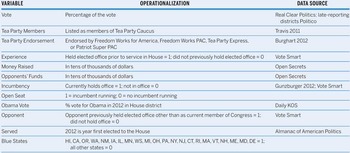
To determine the influence of membership in the Tea Party Caucus and Tea Party endorsement on the election, it is necessary to control for other variables that also might affect the chances of a candidate’s election. This process is complicated by the 2012 reapportionment, which created a number of entirely new House of Representatives districts. Because of the redistricting, the full demographic dataset is not yet available for all congressional districts. Consequently, a more limited set of control variables was used in this analysis. Several important factors are controlled for, however. Specifically, incumbency, the amount of money raised by a candidate, and having held prior elected office should increase a candidate’s margin and chances of victory. Conversely, having an opponent who has held prior elected office, the amount of money raised by a candidate’s best-funded opponent, and the presence of an open seat should reduce a candidate’s margin and probability of victory. Finally, lacking more specific information about the demographic composition of the new congressional districts, Obama’s 2012 vote by district was used as a proxy for a host of other social variables and is expected to reduce both the percentage of the vote received by Republican House candidates and their chances of winning. Table 1 indicates how the variables were operationalized and measured.
Operationalization of Variables and Data Sources

RESULTS
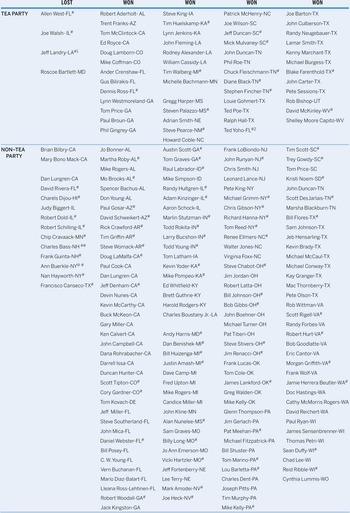
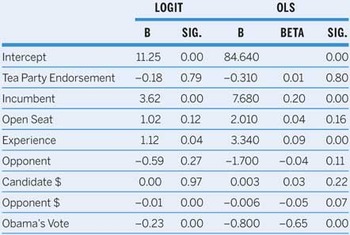
Table 2 presents information about the 2012 electoral outcome for Tea Party and non–Tea Party Republican candidates. Three members (or 5%) of the Tea Party Caucus lost to Democrats. A fourth member of the Tea Party Caucus, Jeff Landry, lost to a non–Tea Party Republican in a runoff election. Further complicating the situation, a fifth caucus member—Cliff Stearns—lost the Republican primary to a Tea Party challenger, Ted Yoho. If Stearns is not counted as a defeat and Landry is, then the four defeated members constituted 6.6% of the Tea Party Caucus. Three of the four losing candidates were freshmen, representing 15.7% of freshmen members of the caucus. When compared with other Republican candidates, nothing is unusual about these losses. Losses for all members of the Republican Party were 13.7% for freshmen members and 2.6% for other Republicans.
Results for Republican House Incumbents in 2012 General Election
Sources: Compiled from Ballotpedia United States Congressional Election Results, 2012, and Vote Smart.
Notes: @ = Endorsed by Tea Party but not in Tea Party Caucus; # = Freshman; 1 = Defeated by another Republican in a runoff election in Louisiana; 2 = Defeated another Tea Party candidate in primary.
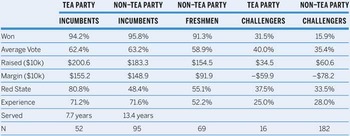
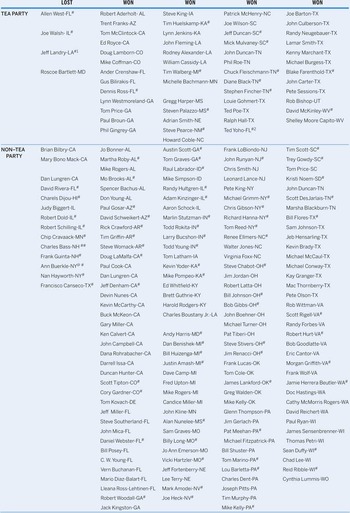
Table 3 examines the characteristics of Republican congressional candidates in 2012. Tea Party incumbents are much like other Republican incumbents. Their average vote is similar. Footnote 3 They raised slightly more money than other Republican incumbents but outspent their opponents by about the same amount. Like other incumbents, they also are overwhelmingly likely to have held a prior elected office. They have, however, served a somewhat shorter time in the House. Although somewhat less experienced, they are not political amateurs unused to the rules of the game. They are more likely, however, to come from “red” states. Although Tea Party challengers are slightly less likely to have held prior elected office than non–Tea Party challengers, both are amateur politicians who lack prior political experience. Tea Party challengers, in fact, fit Cannon’s (Reference Cannon1990) notion of ideological amateurs. They also are substantially less well funded than other Republican challengers, but they are outspent by a smaller margin than the non–Tea Party challengers. This disparity, however, made little difference in the final vote received by Tea Party versus non–Tea Party challengers in 2012. Both types of challengers were running in “blue” states and both were largely unsuccessful, although the Tea Party challengers did not fare as badly as other Republican challengers.
The Republican Party is in the process of becoming a bi-factional organization. This split is most evident within the House of Representatives, where the Tea Party is strongest, but it also includes divisions among think tanks, interest groups, and donors. Although it is unclear how complete the schism will be, at a minimum, the Tea Party is likely to remain a well-entrenched minority faction within the Republican Party in the House for some time to come.
Characteristics of Republican House Candidates 2012
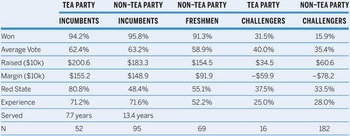
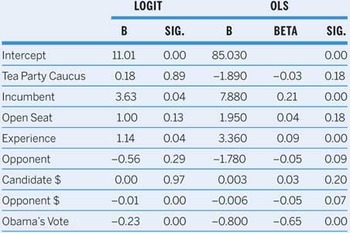
Table 4 presents a logit analysis of the impact of membership in the Tea Party Caucus on victory and an OLS analysis of the impact of membership in the Tea Party Caucus on the percentage of the vote received in 2012. Logit results provide a test of the ability of members of the caucus to win the election, whereas an OLS analysis measures the influence of membership in the caucus on the percentage of the vote received. Although related, these variables do not measure the same thing. It is entirely possible that a factor that influences the percentage of the vote received by a candidate may not be sufficiently strong enough to affect the chances of ultimate electoral success. Both equations indicate that belonging to the Tea Party Caucus had no significant impact—after the other variables were controlled for—on either the candidates’ election or the vote. Obama’s vote and incumbency have a significant impact in both equations. Having held prior elected office has a significant impact on winning office and a marginally significant impact (p ≤ 0.10) on the percentage of the vote received. As expected, Obama’s vote is associated with reduced support for Republican candidates, whereas incumbency and holding prior elected office are associated with increased support. An opponent’s spending has a significant negative impact on victory and a marginally significant impact (p ≤ 0.10) on percentage of the vote received. In reviewing the OLS results, Obama’s vote would appear to have by far the greatest impact, a finding that is consistent with Maxwell and Parent’s (Reference Maxwell and Wayne Parent2012) analysis of the 2010 election. These results, however, are complicated by the relationship between the independent variables. Obama’s vote is correlated with incumbency (r = -0.62) and having an opponent who has held prior elective office (r = 0.49)—correlations at which multicollinearity begins to have some influence on the results. Fortunately, all other intercorrelations between the independent variables are low (r< 0.50).
Impact of Tea Party Caucus Membership on 2012 House Election (Logit Predicts Victory; OLS Predicts Percentage of Vote Received)

Nagelkerke r2 = 0.90
Model χ2 = 462.74
Sig. = 0.00
% Predicted = 96.1%
Null % = 57.1%
n = 415
R2 = 0.76
F = 167.44
Sig. = 0.00
n = 415
Table 5 is a logit and OLS regression analysis of the impact of Tea Party endorsement on the vote for Republican candidates in 2012. Again, Obama’s vote and incumbency had the same significant impact on victory and the percentage of the vote received. Having held prior elected office also has the same significant impact on election results and again a marginally significant impact on the vote. As for campaign spending, an opponent’s spending has a significant negative influence on the chances of victory but only a marginally negative influence on the percentage of the vote received. This result should be compared to Karpowitz et al.’s (Reference Christopher, Quin Monson, Patterson and Pope2011) analysis of the influence of Tea Party endorsements in the 2010 elections, which found that only endorsements by the Tea Party Express had a beneficial effect. Their explanation of this phenomenon was that only the Tea Party Express endorsement included a substantial monetary contribution—a factor that is controlled for in this equation. These results also should be compared to Bullock and Hood’s (Reference Bullock and Hood2012) work, which found that Tea Party endorsements were unrelated to those factors generally thought to increase a candidate’s probability of victory. Although Bullock and Hood were interested primarily in which candidates the Tea Party chose to endorse rather than the effect of that endorsement, their statistical results are consistent with those in table 5.
Impact of Tea Party Endorsement on Republican Candidates for the House (Logit Predicts Victory; OLS Predicts Percentage of Vote Received)

Nagelkerke r2 = 0.90
Model χ2 = 462.78
Sig. = 0.00
% Predicted = 96.6%
Null % = 57.1%
n = 415
R2 = 0.76
F = 166.52
Sig. = 0.00
n = 415
Conclusion
Members of the Tea Party Caucus in the House of Representatives have ample campaign funds, are as likely to have held prior elected office before being elected to the House of Representatives, but have served for a shorter time in Congress. For a Republican to win a House seat was closely related to the presidential vote in 2012, Footnote 4 incumbency, and the experience and resources of his or her opponent. Tea Party endorsements had neither a negative nor a positive influence on the percentage of votes received by or the chances of election in 2012 of Republican candidates to the House of Representatives. The decline in public approval of the Tea Party documented by national surveys may make it difficult for candidates identified with this faction to prevail on a state or national level. The fact that slightly less than half of all Republicans support the Tea Party, however, means that it should continue to be a viable force in Republican primaries and that it will remain competitive in a number of safe Republican districts where President Obama is particularly unpopular. Consequently, the Tea Party is unlikely to either go away or increase in size in the House of Representatives.
The Republican Party is in the process of becoming a bi-factional organization. This split is most evident within the House of Representatives, where the Tea Party is strongest, but it also includes divisions among think tanks, interest groups, and donors. Although it is unclear how complete the schism will be, at a minimum, the Tea Party is likely to remain a well-entrenched minority faction within the Republican Party in the House for some time to come. It is a faction that has considerable influence within the Republican Party when that party controls the House, and it may have even more influence if the disproportionate defeat of moderate Republicans results in that party’s loss of control over the House.
Acknowledgments
The author thanks Jillian McClain for her assistance and the anonymous reviewers for their comments.