

Introduction
Intensive livestock production units with high-yielding dairy cows require large volumes of high-quality grass silage. However, soil compaction and mechanical plant damage caused by field traffic affect dry matter yield and the botanical composition of mixed grass-clover leys (Hansen, Reference Hansen1996). The controlled traffic farming (CTF) system aims to reduce the effects of random soil compaction and mechanical plant damage by confining all field traffic to the least possible area, in permanent traffic lanes (Tullberg et al., Reference Tullberg, Yule and McGarry2003).
Scandinavia and Northern Europe often experience heavy rainfall (EEA, 2015) during the grass harvesting season. These weather conditions exacerbate soil compaction problems from intensive machinery use in grass silage production. This study compared three CTF machinery systems (8, 9, 12 m working width) in terms of their potential to reduce the trafficked field area compared with a random traffic farming (RTF) scenario. Three alternative outcomes of CTF in terms of silage quality were evaluated and the cost of feed rations compared.
Machinery system design - controlled traffic in grass ley
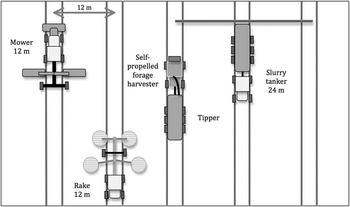
A CTF system (Figure 1) was designed to minimise the field area subjected to machinery traffic, referred to hereafter as ‘trafficked area’, by concentrating all traffic to permanent traffic lanes. Using a standardised machine working width (module width) or multiples of module width, all field traffic can be performed in these permanent traffic lanes (Tullberg et al., Reference Tullberg, Yule and McGarry2003). The machinery operations associated with grass silage harvest and slurry or manure application often exert high wheel loads with intensive traffic patterns. Kroulik et al. (Reference Kroulik, Paula, Chyba and White2014) found that two common silage harvest systems trafficked 64% of the field area in one silage cut. In forage harvesting, the power requirement for mowers, rakes and rotor cutter or chopping wagon is relatively low, permitting greater working widths of e.g. 8–12 m using standard tractors (often <250 horsepower). Hence, CTF in forage production, including fertiliser/manure/ slurry application and harvesting, may be possible without investing in larger tractors.
Controlled traffic farming (CTF) system for silage.

Materials and methods
This study applied a programming model based on linear relationships with mixed integer programming (Alvemar, Reference Alvemar2014) to maximise total farm profit depending on the distribution of crops, machinery system and feed ration for livestock. The profitability of changing to CTF for silage depends on the yield outcome relative to the CTF investment costs, where the yield outcome depends on reducing the trafficked area.
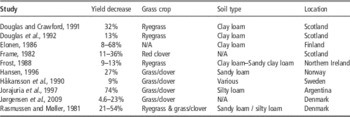
The initial investment scenarios due to CTF conversion tested here followed the principle of least possible trafficked area with lowest possible investment cost. However, this principle had to avoid causing negative changes to silage quality due to reduced machinery capacity or poor silage handling procedures. Thus potential effects of the CTF system on silage quality were evaluated in economic terms. Previous field trials comparing forage yields from grass leys exposed to machinery traffic and from non-trafficked plots indicate major yield reductions due to traffic (Table 1).
Summary of reported effects of machinery traffic on grass/clover yield

One of the potential benefits of CTF in grass-clover leys is increased forage quality and protein content. Hansen (Reference Hansen1996) found that soil compaction impaired herbage yields and the botanical composition of grass-clover leys, reducing the red clover content by 8% after three years of compaction compared with non-compacted soil. Frame (Reference Frame1982) also found that red clover is particularly sensitive to soil compaction.
For ruminants, clover is nutritionally superior to grass with respect to protein and mineral content and feed intake capacity (McDonald et al., Reference McDonald, Edwards, Greenhalgh, Morgan, Sinclair and Wilkinson2011). Hence, the botanical composition of grass-clover leys is important in dairy production. When evaluating the potential profitability of increased forage quality with CTF, a feed ration perspective must therefore be included in the total benefits.
The yield potential of a CTF system was calculated here based on the trafficked area and the expected yield reduction from soil compaction or mechanical plant damage. Using the method from Pedersen and Novak (Reference Pedersen and Novak2013), the trafficked area for each system was calculated based on actual machinery measurements. The theoretical no-traffic yield (XY) was calculated using results from Hansen (Reference Hansen1996), which are most comparable to contemporary Scandinavian practical farm operations, to determine the relative yield reduction on trafficked and non-trafficked soils, respectively (eq. (1)). The yield for the CTF systems (YCTF) was then calculated based on the trafficked area of the CTF system (eq. (2)).
 $$X_{Y} \, {\equals}\, {{Y_{{RTF}} } \over {A_{T} \cdot (1{\minus}Y_{D} ){\plus}A_{{NT}} }}$$
 $$Y_{{CTF}} \, {\equals}\, X_{Y} \cdot \left( {A_{T} \cdot \left( {1{\minus}Y_{D} } \right){\plus}A_{{NT}} } \right)$$
where YRTF is yield with random traffic, YCTF is yield with controlled traffic, XY is theoretical no-traffic yield, YD is yield depression from field traffic, AT is trafficked area and ANT is non-trafficked area.
To evaluate the potential profits of a more protein-rich silage, adjusted feed rations according to assumed outcomes of CTF in grass-clover leys were included in the model. The value of silage quality differences was analysed using four alternative feed rations based on three potential scenario outcomes from CTF in terms of silage quality:
-
∙ Alternative 1: The CTF system reduces the trafficked field area by 50–55% compared with a random traffic (RTF) system, depending on the CTF machinery selected. This potentially increases yield from 10.8 to 11.6% (according to eq. 2). Alternative 1 assumes that CTF will increase yield, but that silage quality remains the same as in RTF.
-
∙ Alternative 2: The CTF system increases silage quality through a 10% increase in clover content and increased yield according to eq. 2. A 10% in clover content is assumed to result in a 25% silage crude protein increase.
-
∙ Alternative 3: If CTF results in quicker regrowth for the second and third cut, they can be harvested earlier, which can result in higher energy silage. Alternative 3 assumes similar herbage yields from RTF and CTF but increased crude protein (by 25%) and increased energy content (from 10.5 to 11.2 MJ/kgDM) with CTF.
The farm-level profits were modelled on a 300 hectare dairy operation, with a herd of 300 milking cows per year and compared to the RTF (existing standard practices).
Results
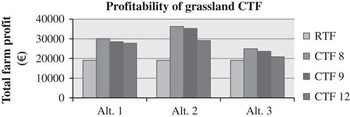
The total farm profits for CTF Alternatives 1–3 with grass silage and the three machinery working widths (8, 9 and 12 m) were compared with those of the RTF scenario (Figure 2). In all three Alternatives, the 8 m CTF system gave the highest total farm profits, closely followed by the 9 m system. The CTF systems were profitable in all cases, with significant increases in total farm profits.
Summary of total farm profits for the three working widths studied (8, 9 12 m) system and silage quality Alternatives 1–3, compared with the RTF system.

In Alternative 1, where a yield increase was calculated based on the trafficked area for each machinery system, a combination of a 10.8% yield increase and a relatively low increase in machinery costs for the 8 m CTF system gave a substantial increase in total farm profits compared with the RTF system. The 9 and 12 m CTF systems gave marginally lower total farm profits than the 8 m system, but still a marked increase compared with the RTF system.
Alternative 2, assuming increased herbage yield and silage quality, gave the highest total farm profits for all CTF systems. The 8 m system gave a 90% increase in total farm profits, closely followed by the 9 m system (85% increase). Again the 12 m system gave the lowest total farm profits of the CTF systems, but still gave a 53% increase in total farm profits compared with RTF.
In Alternative 3, assuming earlier harvest time and higher energy and protein silage, but no yield increase, the 8 and 9 m CTF systems increased total farm profits by 31% and 24%, respectively, while the 12 m system increased only 9% compared with RTF.
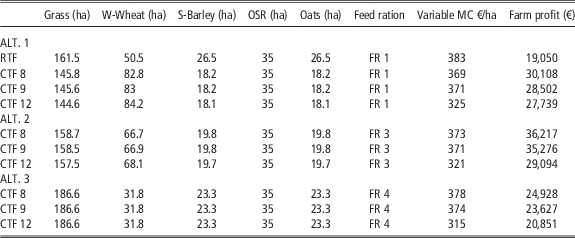
The maximisation model was used to generate the maximum total farm profits, subject to crop rotation, feed ration and machinery system (Table 2). The total farm profits are the sum of gross margins for each crop multiplied by hectares produced, gross margin from the dairy production subject to feed costs and fixed and variable machinery costs according to the model from Alvemar (Reference Alvemar2014).
Summary of profit optimisation results for Alternatives (ALT.) 1–3

The model altered the crop rotation and feed ration based on the machinery system and the silage yield associated with each system. The RTF system was used as a baseline to compare the CTF systems in each Alternative. For Alternatives 1 and 2, the yield increased as the trafficked area decreased in the 8, 9 and 12 m CTF systems. For Alternative 1, the major profit driver was reduced grass area in favour of cash crops, in this case winter wheat, as it was assumed that grass leys in CTF systems were harvested for four years, rather than three in the RTF system. This assumption is based on experiences from Danish farmers practising CTF, a reported yield increase from non-compacted plots in later years of ley and a botanical composition with higher clover content in year four (Hanson, Reference Hansen1996). This longer-lying ley reduced the required land area for barley and oats with under-sown grass by 25%, which may be re-allocated to growing winter wheat. In Alternative 1, feed ration two (FR 2) gave higher silage quantity at lower feeding costs per cow. However, the optimal solution involved feed ration one (FR 1), which indicates that feeding more silage of similar quality is not automatically the best way to reap the benefits of CTF. Hence, the increase in total farm profits from CTF for Alternative 1 stems from re-allocation of the land resource in the crop rotation from grass ley to winter wheat production.
Alternative 2 gave the highest total farm profits, with the profit increase based on increased winter wheat production and reduced feeding costs. The land available for increased winter wheat production mainly derived from the assumption that CTF allows a four-year grass ley. The silage yield increase was used in feed ration three (FR 3), which gave a significant reduction in feeding costs per cow (8%) (Table 2).
When the CTF system was assumed not to provide a yield increase, but gave high silage quality in terms of energy and protein, this also increased farm profits. For Alternative 3, the 8, 9 and 12 m CTF systems gave higher total farm profits than the RTF system. For Alternatives 1 and 2, the grassland area was reduced when using CTF, enabling an increase in cash crop production. In Alternative 3, the grassland area was increased to meet the increased silage quantity in feed ration four (FR 4), leaving less potential for cash crops to contribute to total farm profits.
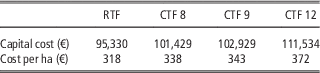
In general for all Alternatives, a yield or silage quality increase due to CTF was a benefit contributing to the overall profitability of the farming system. However, when comparing machinery systems, it was clear that the crucial factor was to minimise the cost of investing in the CTF system. Fixed machinery costs derive from the cost of capital (Table 3). The CTF systems required large initial investments, with the fixed machinery costs increasing with module width.
Fixed machinery costs for the RTF and CTF machinery systems

The CTF systems increased the fixed machinery costs, but from a cost per hectare perspective this increase was relatively low. Given the potential benefits, the increase in fixed machinery costs of the 8 m system (€20/ha) must be regarded as reasonable.
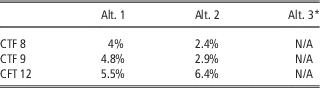
To check the potential of the CTF system, a break-even analysis was performed to determine the yield increase required for Alternatives 1 and 2 (Table 4). For Alternative 2 and the 8 m CTF, a 2.4% yield increase justified the investment in CTF machinery. For the 12 m CTF system, the break-even yield increase was 5.5 and 6.5% for Alternatives 1 and 2, respectively.
Break-even yield increases to cover the costs of CTF

* Alternative 3 is not based on a yield increase
Discussion
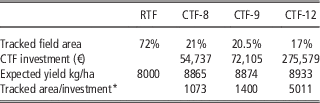
This study showed significant economic benefits of the CTF system, but there are still some uncertainties to be considered when converting to a CTF system. These include the initial fixed investment costs for the CTF system, the expected yield increase and the value in terms of feed rations of any yield increase. This study showed the importance of keeping investments low when converting to CTF, with a major reduction in trafficked field area by a minor investment being more important than the lowest possible trafficked area with high investment costs. An approach to evaluating the technical returns on invested capital in terms of CTF as tracked area reduction and investment quota is presented in Table 5. The tracked area investment quota clearly showed that reducing the trafficked field area to the 8 and 9 m CTF systems required a relatively low investment (€1000–1400) for each percentage reduction, whereas the 12 m system required ~€5000 for each percentage reduction in tracked area.
Summary of tracked area and investment quota in different systems

* Investment cost (€) per unit (%) reduction in trafficked field area
If CTF increases the yield of grass silage, this a clear benefit. However, it is not until that yield increase is used in a feed ration or allows changes in the crop rotation that the true monetary value can be presented. The possibility to reduce the grassland area in favour of cash crops in a crop rotation is one way to use the benefits of CTF. Moreover, increased silage yield can be used to reduce feed costs by shifting to a more silage-dominated feed ration. Hence, the value of increased silage yield from CTF is determined by cash crop net profits as the alternative land use or compound feed prices and the possibility to reduce grain and protein feeds and lower the feed costs. These factors in turn are affected by the volatile grain market and annual cropping conditions, which may be regarded as temporal variations.
The specific conditions for each farm need also to be considered as well. CTF may not provide the same yield increase for all fields, e.g. large, square fields are preferable to small and/or irregularly shaped fields.
Conclusions
The profitability of a CTF system for grass silage is determined by machinery costs, forage yield and silage quality. Even though there is substantial evidence in previous research that machinery traffic in many cases reduces herbage yield, the introduction of CTF systems require attention to detail in terms of machinery costs. On individual farms, the potential profitability of converting to CTF is determined by the existing machinery system and the investment required for a CTF system. On-farm profitability potential is also determined by site-specific conditions in terms of yield response from CTF, opportunities to produce other cash crops and know-how and commitment to using the CTF system. Based on the specific conditions assumed in this study, CTF in silage production can increase total farm profits by 9–90% depending on machinery system, forage yield and forage quality outcome. This represents a profit of €6-57 per hectare for this example farm of 300 ha.
Acknowledgements
This project was partly funded by Stiftelsen Alfa Laval AB:s (AB Separators) foundation through KSLA–The Royal Swedish Academy of Agriculture and Forestry. Thanks to Dr. Rolf Spörndly for supporting with the feed ration calculations.