I INTRODUCTION
Physically and politically, post-Neronian Rome was a city of ruins, remainders and survivors. Vespasian and his successors claimed to offer redemption not just from Nero's catastrophic reign, but also from the sequence of civil conflict and successive coups that followed it. Visual cues throughout Flavian Rome reinforced this message: while plots of land destroyed in the Great Fire of a.d. 64 apparently continued to lie in wasted states until well into Vespasian's tenure, deliberately orchestrated reminders of Nero's reign stood in concert with new monuments celebrating Flavian renewal.Footnote 1 To offer only the most iconic example: from the footprint of the private lake that had greeted visitors to Nero's Golden House rose the monumental Flavian Amphitheatre. Yet evidence survives of a relatively under-studied set of monuments dedicated by Domitian, which directly name Nero and the 64 Fire as their inspiration. Ara(e) Incendii Neroniani is the modern Latinism invented to refer to this presumed set of monumental altars to Vulcan, dedicated by Domitian in fulfilment of a vow made, according to their dedicatory inscription, ‘when the city burned for nine days in the time of Nero (Neronianis temporibus)’. Hereafter I refer to these monuments as the Arae for brevity's sake.Footnote 2 There appear to have been multiple altars, although at present only two sites can be identified with any confidence. The lone surviving architectural example suggests that they were of massive dimensions, and their associated precincts occupied a number of conspicuous urban frontages, inviting the attention of viewers at various points around the city.
In this paper, a close reading brings out the implications of the text of the inscriptions associated with the Arae.Footnote 3 This reading creates a framework for exploring the larger historical and cultural context in which these monuments are embedded, with particular attention to the function of ritual and collective memory in relation to civic disasters at Rome, and to the rôles therein of the two emperors named by the text: Nero and Domitian. Offered as a religious solution to a specific problem, these monuments deserve greater attention than they have heretofore received as a striking example of the Roman response to disaster. If the Arae do indeed go back, as their inscriptions seem to claim, to a vow by Nero, Domitian's decision to fulfil this vow some twenty or more years later is a significant choice — all the more so given the lapse between vow and fulfilment. Dedicating these altars to the god of fires and forges seems to have presented Domitian with an opportunity to stake two rhetorical claims at once. First, Domitian attempts to portray himself as a responsible emperor who fulfils sacred obligations, even those of a reviled predecessor. Second, Domitian aims to consign the catastrophes of Nero's reign (as well as, perhaps, some more recent ones) definitively into the city's past: a past under the rule of a ‘bad’ emperor.
II THE ALTAR PRECINCTS: LOCATIONS AND LAYOUT
It is unclear how many Arae may once have existed. Unmentioned in literary sources, they are known only from the text of an inscription, which seems to have existed in multiple copies. The actual stones from which these examples come are all now lost, and the documentary evidence relating to their respective discoveries is old, discontinuous, and fragmentary. Dedicatory in nature, the text shared by these examples describes an ara intended for sacrifices on the day of the Volcanalia, the annual festival of Vulcan on 23 August. The remarkable text of this inscription, even combined with an associated monumental structure surviving in situ on the Quirinal Hill, has provoked little scholarly debate, probably due in large part to the fragmentary and challenging nature of the surviving evidence.Footnote 4
The first recorded example of the dedicatory inscription, found in the Vatican Plain, was published by the antiquarian Giacomo Mazzocchi in his 1521 compendium of the ancient inscriptions then visible in Rome. Mazocchi's Latin discussion of the epigraphic text speaks in this instance of an item having been ‘brought over’ (oblatum) for use as building material in the construction of the second Basilica of St Peter. Already at that point this example is very likely to have been removed from its original context, and thus no definitive conclusions may be drawn from it.Footnote 5
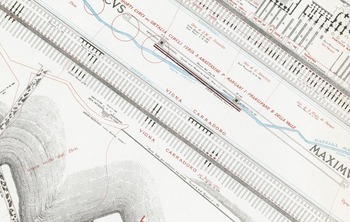
The next record of the text, which dates to 1618, is claimed to have been found on the slope of the Aventine Hill near the edge of the Circus Maximus. It was almost certainly copied from Mazocchi's publication.Footnote 6 Nevertheless, Hülsen argues for the existence of an Aventine Ara on the basis not of this alleged text, but of the surrounding architectural evidence described by its recorder. The source describes in some detail the setting in which this purported epigraphic example was found; the terms are too analogous to features subsequently discovered on the Quirinal to be dismissed as coincidence.Footnote 7 Thus, we can tentatively conclude that an altar site once existed on the Aventine (Fig. 1).
Ara Incendii Neroniani, Aventine. (Rodolfo Lanciani, Forma Urbis Romae (Quasar, 1988), pl. 35)

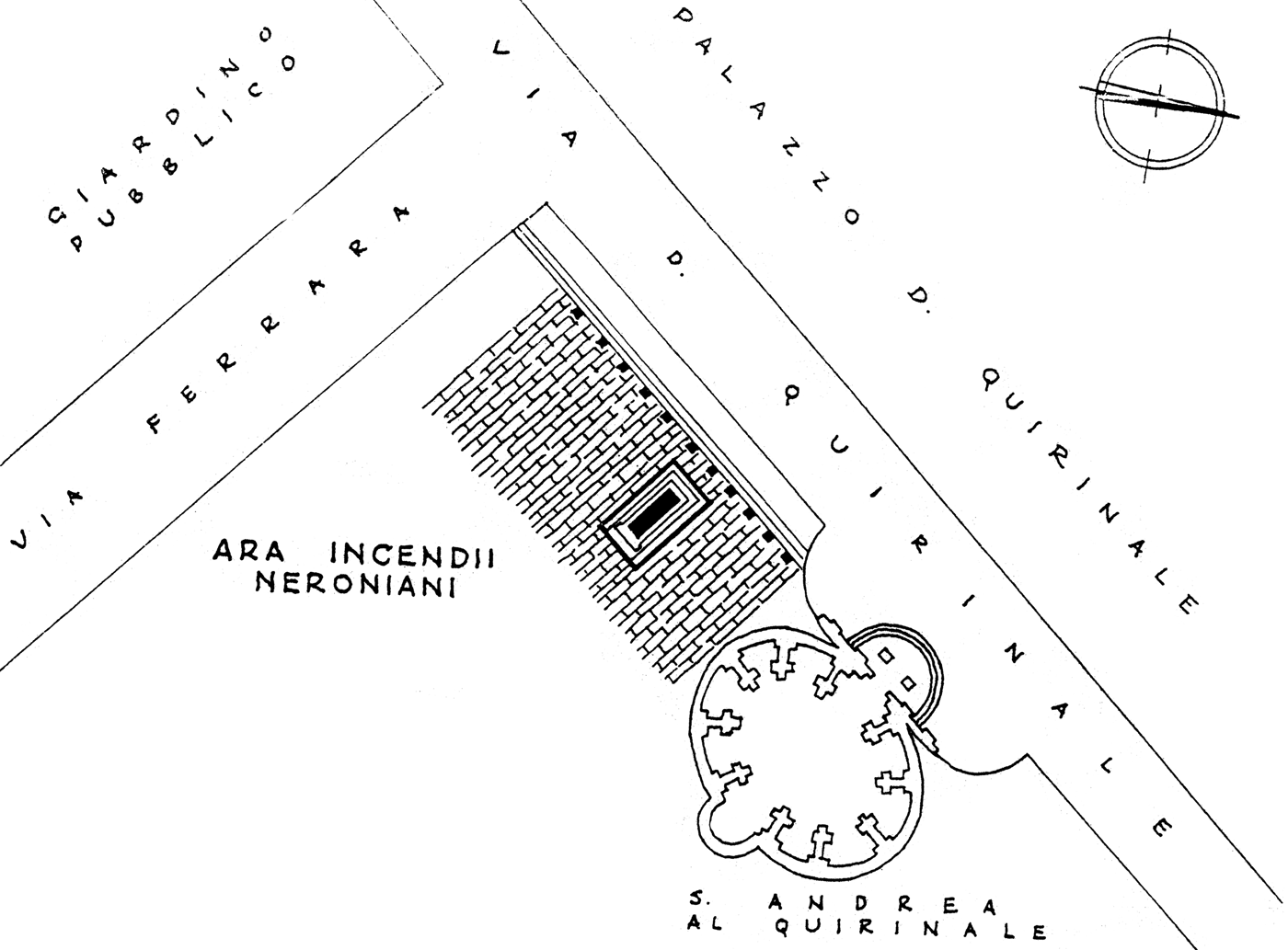
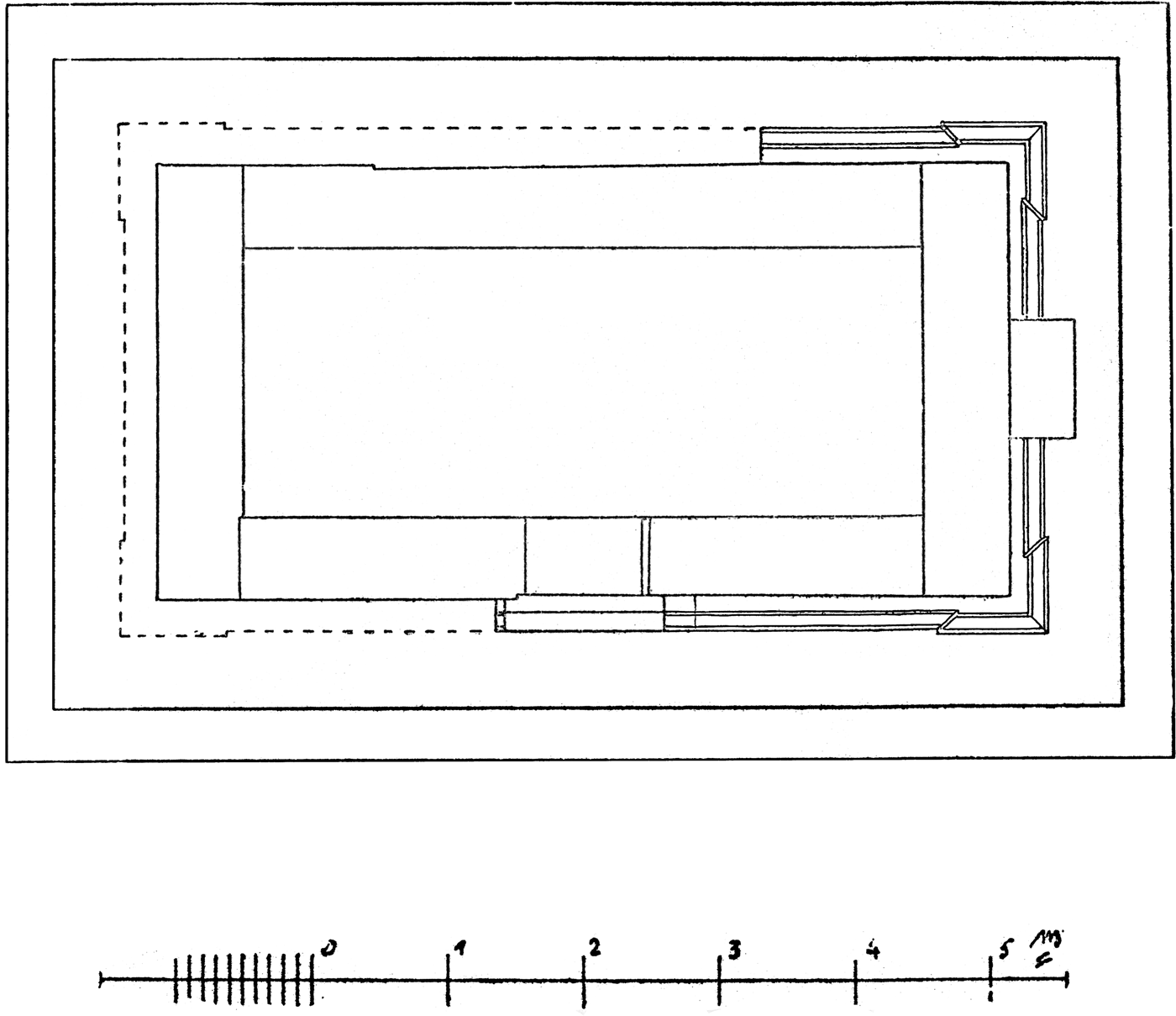
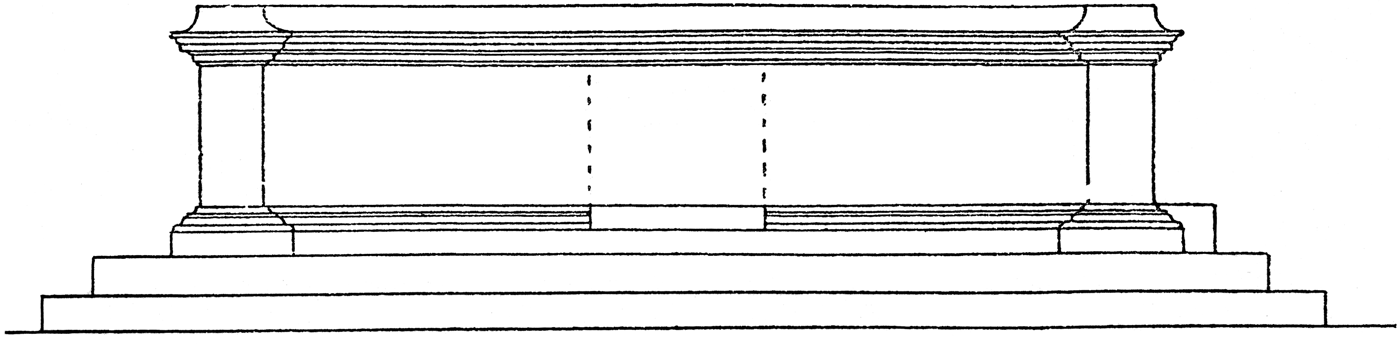
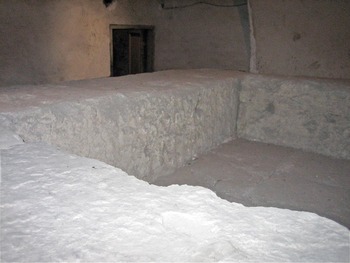
The last and most complete example of the inscription, recorded in 1642, came to light on the Quirinal. Nineteenth-century excavations on the same site uncovered a travertine altar core (Figs 2–6), along with a large part of the associated precinct. This is the only surviving site, and the only one excavated to archaeological standards. The altar core survives today in situ (Fig. 3). In antiquity, this precinct was an imposing one: three steps ran some 35 m along the contemporary street edge; these led to travertine paving about a metre below the top step; the final step down was lined with obelisk-shaped cippi, 1.4 m high, set at intervals around the perimeter of the pavement. Within this stretch of sunken paving lay a platform of steps leading up to a structure interpreted as the travertine core of a massive altar, measuring some 6.25 m long by 3.25 m wide, and over 1.5 m high without its posited marble facing or upper cyma (Figs 4–5). The altar structure has additional steps, presumably added to facilitate sacrifices, set against its south and west faces (Figs 4–5).Footnote 8 Holes for metal clamps in the travertine suggest a marble cornice to match the marble facing running around the base (still extant in parts along the bottom), as well as marble facing along the sides.Footnote 9 Notably peculiar is the unusually large and deep depression, oblong in shape, formed by the surviving travertine slabs that were the core of the altar (Fig. 6).Footnote 10 Beyond this, further reconstruction is problematic, as the altar core itself is too exceptional in size and design to find many easy comparanda.Footnote 11
Plan of the Quirinal Ara Incendii Neroniani complex. Note the cippi positioned along the edge of the paving, parallel with the modern Via del Quirinale. (Source: LTUR)

Quirinal Ara Incendii Neroniani. Note the stepped platform leading up to the altar core. (Source: Nash 1981: fig. 52)

Plan of Quirinal Ara Incendii Neroniani. Note the large interior cavity and additional steps against the altar core's south and west faces. (Source: Hülsen 1894)

Reconstruction of Quirinal Ara Incendii Neroniani with posited marble facing. (Source: Hülsen 1894)

Quirinal Ara Incendii Neroniani. Note deep oblong depression set into altar core. (Photo: author, July 2005)

III THE TEXT: CIL VI.826 = 30837B = ILS 4914 = AE 2001, 182
The text offered below is that copied from the inscribed cippus found on the Via del Quirinale around 1646: CIL VI.826 = 30837, example (b). It appears to be the most complete of the three, but certain disagreements with the other two texts will be noted and discussed below.
[1] This area, within this boundary of cippi enclosed with spikes, and the altar which is below, has been dedicated by [5] the Emperor Caesar Domitian Augustus Germanicus, from a vow undertaken, which was long neglected and not fulfilled, for the sake of repelling fires, [9–10] when the city burned for nine days in the time of Nero. By this law it is dedicated, that it is not allowed within these confines for anyone to build a structure, settle, [15] conduct business, place a tree, or plant anything, and that the praetor to whom this region has come by lot, or some other magistrate, shall make a sacrifice [20] on the Volcanalia, the tenth day before the Kalends of September, every year with a red calf and a (red) hog, along with prayers. Written below [aedi-…]Kalends of September […] [26] be given, which s[…] chief pontiff Emperor Caesar Domitian Augustus has established … (and which he has ordered that?) (there shall be?) …
This text contains several significant differences from that of CIL VI.826 = 30837 example (a), Mazocchi's find, though their lineations match.Footnote 12 First, (a) shows the apparent chiselling out of Domitian's titulature from ab (4)…Germanico (6). Mazocchi comments that they have been deeply (celte) erased: the probable result of memory sanctions enacted against Domitian following his death. After verre (line 22), the text of (a) breaks off. Given Mazocchi's efforts elsewhere to record all visible text, this suggests that the stone was either broken or only partially visible when it was recorded. States of completion and small inconsistencies notwithstanding, the three examples are similar enough to accept the text of (b) as representative of what is likely to have been inscribed at each of the dedicated sites.Footnote 13 The descriptive nature of the introductory lines is likely to reflect the original language of the vow, which proposed a dedication in specific terms to be fulfilled when the supplicant's wish was granted.Footnote 14 The apparent consistency of the design across multiple locations suggests that the altars were intended to send a clear message. Nevertheless, what remains of each inscription makes no reference to any of the other sites, which suggests that each monument was expected to function independently within its own setting.Footnote 15
Lines 1–3 (haec … ara) open with a definitive marking off of the area. The cippi would have been sufficient to mark a ritual boundary (intra hancce definitionem cipporum), so the addition of a spiked railing (veribus) suggests an elevated concern about keeping the precinct clear. According to the letter that records the text of (b), the cippus bearing the inscription was found in association with steps and the remains of metal spikes set in lead: these spikes were most probably the means by which the site (area) was ‘enclosed with spikes’ (clausa veribus).Footnote 16
Lines 3–4 (et … inferius) again reflect the apparent design of the surviving site on the Quirinal, with an altar surrounded by a paved area set approximately a metre below contemporary street level. The recorders of the 1618 find on the Aventine also describe steps as part of the complex. Thus, it appears the inferius nature of the altar was part of the original proposal of the vow, rather than a feature determined by local setting. The verb in line 4 (dedicata est) appears to take both ara and area as its subjects. The entire precinct, then, is marked off for ritual activity. Many altars in the urban context apparently lacked any defined zone of protection, and might have gone virtually unnoticed by those not involved in whatever cult activity they attracted. Simply referring to an ‘altar’ may have been insufficient for this new monument, with its sunken paving and fenced precinct. Such a structure may have been unparalleled enough in the vocabulary of sacred architecture at Rome that instruction was necessary for the public to understand how to behave around it.
Lines 4–6 (ab … Germanico) identify Domitian as the dedicator. Domitian did not assume the title of Germanicus until a.d. 83. Since no more specific date is indicated, such as a year of tribunician power or a consulship (though possibly this information appeared in a now-lost part of the inscription), the altars may have been dedicated in any year ranging from 83 until his death in 96. The text as it stands, however, may flesh out another kind of truth: it focuses not on commemorating a specific year, but on the ritual activity that must take place on the site in perpetuity. The inclusion of only a military distinction (‘Conqueror of the Germans’), not of Domitian's filiation or other status markers may likewise point to his self-styling as protector of Rome (and by extension, Romans everywhere) from threats, be they external (invasion) or internal (fire).Footnote 17
Line 6 reinforces the attention to ritual and religion: the claimed fulfilment of a vow (ex voto suscepto) confirms that the Arae were offered as a response to a specifically religious problem. Something was asked of a deity, and was believed to have been granted. This is straightforward enough, but the picture is immediately complicated by the lines that follow (7–11), ‘quod diu erat neglectum nec redditum, incendiorum arcendorum causa, quando urbs per novem dies arsit Neronianis temporibus’, ‘[a vow] which was long neglected and not fulfilled, [undertaken] for the sake of repelling fires, when the city burned for nine days in the time of Nero’. The monuments were not vowed by Domitian, their dedicator, but were promised at the time of the Neronian fire. A votum was a solemn commitment made in favour of a divinity: the promissor (and after his death, his heir) was obligated to the divinity at the hazard of further divine punishment.Footnote 18 The most logical originator in ‘Neronian times’ of a sacred obligation that could be passed on to Domitian is presumably his forerunner in the rôle of Pontifex Maximus: Nero himself.
Yet the text seems to avoid crediting Nero directly for the origination of the vow, instead couching his notorious name in an adjectival form that encompasses the entire period in question (Neronianis temporibus). The inclusion of Nero's name (in any form) on a new monument would have been striking in an urban landscape in which other reminders of his reign had been erased or conspicuously altered.Footnote 19 The phrasing seems less concerned with the exact date of the fire than with connecting Nero to the event in general terms. This may be in part because the date was common knowledge, but perhaps also bespeaks an elevated interest in comparing Nero with Domitian as a leader—Domitian's titulature is featured prominently and with embellishments (Imp. Caesar Domitianus Aug. Germanicus Pont. Max.), while Nero's cognomen is relegated to an adjectival modifier.Footnote 20 The inscription notably lacks any suggestion of Nero's guilt in the fire, a popular accusation amongst Nero's contemporary and posthumous detractors. Nevertheless, the Arae were dedicated in an environment that promoted these accusations so actively that it was perhaps unnecessary to make any direct reference to them.Footnote 21 The quando clause, combined with the perfect tense of arsit, suggests that rather than vowing the altars during the crisis of the fire itself, Nero made the vow in the fire's aftermath to prevent another catastrophe.Footnote 22 Nero's extraordinary measures in the wake of the 64 fire, which included numerous special lustrations and supplications, are consistent with the idea of vowing monumental altars: perhaps, of promising them if some period of time passed without significant incendiary activity.Footnote 23 Additionally, if Nero met his end before the time at which the vow required fulfilment (i.e. the completion and dedication of the altars), it would help explain how it came to be ‘long neglected and not fulfilled’.
The remaining lines of the inscription (12 ff., hac lege dedicata est …) all concern the ritual nature of the site. Domitian's additional imprimatur at the conclusion of the text, identifying himself as Pontifex Maximus (27) underscores the religious nature of this dedication.Footnote 24 Celebrated on 23 August, the festival of the Volcanalia was an ancient rite of appeasement.Footnote 25 Offerings went up to Vulcan, as well as to other gods suggesting security and protection from fires, warfare, and food shortage.Footnote 26 The offering at the Arae of red animals (vitulus robeus and verres r(obeus), 20–2) calls to mind the sacrifice of the rutilae canes to protect crops from the heat of the sun, reinforcing the apotropaic nature of Vulcan's worship.Footnote 27
The prohibitive ne clause (ne … serere, 12–16) makes reference again to the boundaries of the precinct (intra hos terminos, 13) first outlined in lines 1–3, forbidding any kind of building, settling, commercial activity or cultivation from taking place there. These kinds of ritual injunctions are very well understood to have applied to any space defined as sacred.Footnote 28 It is quite unusual, however, to see them spelled out on the sites themselves, especially in such an emphatic and specific way. As with the addition of a spiked railing (see above, line 3), it seems the boundaries of this type of monument were of greater than usual concern. Vitruvius stresses that the temples of Vulcan, Venus and Mars must be outside the city due not just to the physical risk of conflagration, but also to the psychic disruptions of fire, love and war.Footnote 29 The Arae may have aimed to channel the potent emotions evoked by Vulcan's cult, while visually enforcing the boundaries around his destructive force. If these injunctions were part of the original language of the Neronian vow, then the prohibitions may also have served at least as an indirect reminder of Nero's other fire-prevention measures (to be discussed further below). Alternatively, Domitian's identification in the text as dedicator at lines 4–6 may signal a shift to language formulated in the Domitianic period, including the laws (hac lege, 12 ff.). This perhaps suggests that, given the long lapse between vow and dedication, Nero's original boundaries were in some danger of being disrespected, and the injunctions therefore needed to be emphasized.
The scenario that best explains the injunctions in lines 12–16 (if indeed it is a Domitianic modification) is one in which the altar was vowed, and even partially begun, by Nero, but then lay unfinished after his death for many years as a reminder of a vow ‘long neglected and not fulfilled’. In the twenty-odd years between initiation and dedication, local retailers and residents would naturally have encroached upon the unfinished monument; hence the express detailing of the newly dedicated boundaries. The text's assertion that the project first began with Nero but fell into neglect may thus simply articulate what had been readily apparent for years.Footnote 30
The issue of the ‘long neglected’ vow may, in fact, have achieved an additional salience in the years leading up to Domitian's principate. The brief reign of Titus had dealt some significant blows to the Roman urban population's sense of security. In a.d. 80, a major fire burned a significant portion of the city, and was followed by a devastating plague; Titus met his untimely demise shortly thereafter, in a.d. 81. If Nero's unfinished altars, and the vow they represented, had been lying in neglect for all to see, it would have become highly tempting for Domitian to appeal to the memory of Nero and the 64 disaster, thereby diverting attention from more recent misfortunes. Domitian, an emperor noted for his scrupulous attention to religious matters, may well have seen in the unfulfilled vow of the Arae an opportunity to advance his own standing in the field of religious leadership: ingeniously, this monument exploits Nero's own prodigious efforts in the wake of 64 to re-cast him as a religious failure.
IV LOCATION AND DATE
Evidence of how many altars once existed, and of exactly what principle guided their placement around the city, is simply lacking. The Quirinal and the Circus Maximus are two of the more archaeologically devastated areas in Rome, making fine-grained topographical analysis of the Arae highly problematic. Several theories have been advanced, but all depend on dubious factors. Lanciani suggested at the turn of the last century that there was one altar for each of the fourteen regions, but parallel examples of religious sites distributed according to administrative region are lacking.Footnote 31 Coarelli posits that they marked the perimeter of the 64 fire's destruction.Footnote 32 Regio VI, however, in which the Quirinal altar was found, is generally agreed to have been unaffected by the fire.Footnote 33 So, the monuments were not necessarily placed by means of an easily understood connection to the events of a.d. 64 or the administrative organization of the city. Nevertheless, the Alta Semita, which ran along the Quirinal ridge, and the foot of the Aventine, at the edge of the Circus Maximus, are analogous in several ways. Both zones were highly visible to the public, situated on key routes of access along the perimeter of the urban centre and well furnished with shops and businesses. Both featured unusually long, straight frontages of urban space, very similar to that on which Tacitus blames the rapid spread of the 64 fire, which quickly travelled along the closely built strip of shops at the edge of the Circus at the foot of the Palatine Hill.Footnote 34 The location of the Aventine Ara, just across the Circus from the fire's origin point, may have been motivated by a desire to remind the public of the constant danger such environments presented.
The broader idea that the specific locations of the Arae had apotropaic significance is also worth developing. Certainly, the symbolic protection of the city, and the leader's rôle in guaranteeing it, is a major message of the Arae.Footnote 35 Whether Nero chose the location of the altar on the Quirinal or Domitian did, its proximity to the Temple of Quirinus, a tutelary deity with martial associations (and the deified form of Rome's first king) is a significant choice.Footnote 36 A shrine of Hora, Quirinus’ consort, received veneration on the Volcanalia.Footnote 37 Placing an altar to Vulcan so close to the seat of Rome's symbolic warrior-king forged a link between the leader's ancient rôle as a military protector, and the current emphasis on his ability to maintain the city's security through the related endeavours of urban management, food provision, and fire prevention. Domitian carried out a major religious re-organization of the Quirinal, restoring the Temple of Quirinus and converting his own family's former home into the Temple of the Flavian Gens. If (as argued above) one or more of the sites was designated and partially built under Nero, then Domitian could not necessarily be credited with their locations, but would nevertheless have been able to exploit their proximity to sites of significance to the Flavians.Footnote 38 As mentioned above, the 64 fire's point of origin is one possible factor in the placement of the Aventine example. Additionally, however, a Flavian monument with strong parallels to the implied message of the Arae stood in the Circus itself, close to the Aventine Ara.
At the eastern end of the Circus, a triple arch commemorating Titus’ triumph after the conquest of Jerusalem replaced an earlier arch demolished by Nero — a memory it implicitly conjured up.Footnote 39 Thus, the Arae inscription and Titus’ triple arch both imply that they are making good Nero's depredations to the city. In the Jerusalem arch inscription, Titus claims to have ‘tamed the nation of the Jews, and the city of Jerusalem — which all generals, kings, and nations before him had either assaulted in vain or avoided altogether’.Footnote 40 Rather than offering a simple identification of the builder, with titles and dates, both Titus’ triple arch and Domitian's Arae inscribe a leadership narrative into the landscape. While Titus asserts a success that eluded ‘all generals, kings, and nations before him’, Domitian repays a vow ‘long neglected and not fulfilled’, which dates back to when ‘the city burned for nine days in the time of Nero’. Both inscriptions are notable for their historicizing chutzpah: they play on momentous events, but not just those in the careers of the emperors as individuals.Footnote 41 Rather, they lengthen the timescale, lending their dedicators’ actions a historical weight as measured against previous leaders and events in the life of Rome itself.
Attempts at assigning a specific date to the dedication of the Arae have largely revolved around connecting the text of their inscription with specific terms found in Martial's Epigrams. Rodríguez-Almeida identifies the Quirinal Ara with Martial's mention of a pila Tiburtina on the Quirinal in Ep. 5.22, and furthermore sees Martial's mention of the newly respected boundaries of a pila in Ep. 7.61 as part of the poem's larger celebration of Domitianic legislation to clear street space.Footnote 42 Rodríguez-Almeida dates this poem to a.d. 92, and argues for a dedication on the Volcanalia of the same year.Footnote 43 Palmer draws a parallel between Ep. 5.7, in which Martial appeals to Vulcan to spare Rome from future fires, and the dedication of the Arae to Vulcan ‘incendiorum arcendorum causa’; he thus proposes dating the dedication to a.d. 88 based on Ep. 5.7's possible reference to the secular games of that year.Footnote 44 Overall, it seems plausible that Martial is alluding, as he so often does, to the dedication of imperial building projects in one or more of the poems cited above.Footnote 45 As a resident of the Quirinal who frequently mentions landmarks there, Martial can credibly be imagined to make reference to known features of the Quirinal Ara and its inscription in these lines.
Finally, however, remaining sceptical about the validity of these identifications has no impact on the key interpretive issues of this discussion. Without insisting on a specific date, much less divining (from exceptionally slender evidence) the motivations for the siting or design of the Arae, we can nonetheless ask what significance these altars would have attained in Domitian's Rome. The message ultimately sent by the Arae appears consistent with Flavian efforts to redeem Nero's purported damages to the fabric of the city, no less than his offences to the gods. Importantly, however, the Arae demonstrate that this campaign of monumental rhetoric was waged not only on the massive scale of the Flavian Amphitheatre or the restored Temple of Claudius, but also at street level, on a more localized basis.
V LEADERSHIP, RELIGION, AND CATASTROPHE
The tremendous sense of religious alarm that the 64 fire would have evoked is an often-overlooked aspect of its lasting effect upon Rome.Footnote 46 The sheer number of irrecoverable dead, and the impossibility of offering them correct burial, must be imagined as a source of deep distress for a society as invested as the Romans were in death ritual and commemoration.Footnote 47 In the aftermath of the destruction, Nero undertook extraordinary divine propitiations, some of which may have partially addressed religious anxiety surrounding the inability to identify or even to remove remains, the failure to perform the requisite rituals, and the absence of a physical site to deposit (and later, to visit) the dead.Footnote 48 Moreover, he initiated a radical re-imagining of Rome's urban space, introducing extensive measures designed to prevent subsequent fires from spreading rapidly. Suetonius describes them as follows:
Formam aedificiorum Urbis novam excogitavit et ut ante insulas ac domos porticus essent, de quarum solariis incendia arcerentur, easque sumptu suo exstruxit …
… he thought out a new design for the city's buildings, and (specified) that there should be porticoes on the street-facing sides of apartment blocks and private houses from which fires could be fought off, and built them at his own expense. (Suet., Ner. 16)
Here the same terms we find in the Domitianic inscription, incendium and arcere, are clearly used in relation to a physical structure from which the fire could be fought.Footnote 49 Tacitus, describing measures decreed by Nero to check fires, uses an analogous gerundival phrase (with a typically Tacitean variation in vocabulary): ‘ignibus reprimendis’.Footnote 50 In other examples from the epigraphic record, arcere bears functional significance: ‘to drive off’ or ‘to keep away’ a threat in a literal sense.Footnote 51 Later legal texts also employ the phrase incendia arcenda for this purpose.Footnote 52
Richardson suggests that the pavements, cleared of any structure or activity as the inscription dictates, might serve as a firebreak.Footnote 53 Darwall-Smith rejects this notion, concluding ‘one can only see it as a religious gesture, to appease the gods by keeping some areas ritually waste’.Footnote 54 Yet while parallels are lacking for maintaining ‘ritually waste’ zones in Rome's bustling commercial centres, the idea of keeping areas open in order to fight fire is well attested, as the discussion above demonstrates. Tacitus tells us it was in shops on the Palatine side of the Circus Maximus that the Great Fire of 64 first broke out, and it was their closely-built frontages that had in fact allowed the fire to propagate so quickly.Footnote 55 Accordingly, the open space of the altar precincts may have been intended to suggest, at least visually, the polar opposite of these conditions, if not to provide a literal firebreak. The notion that a pavement such as that around the Quirinal monument, roughly the same size as a regulation basketball court, might stop a conflagration on the order of the 64 fire is of course absurd. The concept, however, that space left open was believed to have some effect is undeniable, and might have sent a politically useful message.
The monuments could have served less as functional firebreaks than as didactic exempla: demonstrating both the means by which the fire might be averted, and the emperor's commitment to enforcing such measures.Footnote 56 Like imperial ustrina, the Arae had the potential to serve as monumentalized reminders of the emperor's implied regulation of the crowds attending the rites associated with them. The precincts of the Arae, with large and spectacular fires set in a focal feature, railed or spiked enclosures, and strict delimitation of space marked by cippi, are highly reminiscent of ustrina.Footnote 57 The extreme set of precautions and controls necessary to manage incendiary events like cremations or large sacrificial fires safely in the urban environment were in and of themselves a striking assertion of the emperor's control over life and worship in the city.
As originally vowed by Nero, the altars would have served to anchor and stabilize the memory of recent cataclysm within Rome's sacred topography. Equally, the Flavians represented their seizure of the city as a return to order after Nero's death and the succession of emperors engaged in the ugly struggle for control in a.d. 68–9. When Vespasian's forces ultimately prevailed, he made every effort to represent the establishment of his dynasty as a break with the chaos and impiety of the previous era. He lost no time in restoring the sacred areas on the Capitoline Hill, which had burned in a.d. 69 during a clash between his own supporters and those of his predecessor Vitellius.Footnote 58 Vespasian also dedicated the massive Temple of Claudius on the Caelian Hill: like the vow of the Arae, this project had originated in the Neronian period, but fallen into neglect.Footnote 59 These projects, no less than the Flavian Amphitheatre and the Baths of Titus on the site of Nero's Golden House, called attention to Nero's former use (or abuse) of urban space, and reminded the public of the disaster Rome had suffered under his auspices. In redeeming the damage that (as hostile post-Neronian rhetoric would have it) Nero's depravity had wrought upon Rome, they perhaps also hoped to elide the destruction of a.d. 69, in which Vespasian, his sons, and their supporters were deeply implicated.
Yet Rome was never entirely able to leave its dread of apocalyptic collapse in the past. The eruption of Vesuvius in a.d. 79 again reminded Rome — and urban populations around the Empire — of their vulnerability to disaster.Footnote 60 Moreover, the fire of a.d. 80 consumed much of the Campus Martius, the Palatine, and the glorious new Flavian Capitol, only recently restored after the destruction of a.d. 69. The damage was a stark reversal of the message of progress and recovery that Flavian leadership had no doubt hoped to project, and the human toll was soon compounded by an outbreak of plague. After Titus’ untimely death in a.d. 81, Domitian thus faced the unenviable task of again restoring Rome and reassuring the people of his dynasty's stability.Footnote 61
A capable administrator, Domitian augmented Rome's finances with aggressive taxation measures, and his ambitious building programme is still apparent today in the city's landscape.Footnote 62 Yet he also needed to prove his capacity to provide security from divine threats. He lavishly rebuilt numerous temples lost in a.d. 80, including the Capitoline temple to Jupiter Optimus Maximus;Footnote 63 radically expanded and redefined the imperial cult, even as he reinstated a number of archaic religious customs;Footnote 64 and cultivated a notable personal devotion to Minerva, to whom he dedicated a temple in the Forum Transitorium (which, like the Arae, had previous associations with Nero's building programme).Footnote 65 Finally, the significance of escaping fire's violence was perhaps a personal issue for Domitian. During the siege and burning of the Capitol in December of 69, the young Domitian had taken shelter in the house of a temple porter. He later dedicated a shrine to Jupiter Custos on the site of this house, and seems to have promoted the tale of his survival as an instance of divine intervention, aligning himself with the tradition of uniquely blessed figures who miraculously escape incendiary threats unscathed.Footnote 66 A set of monuments incendiorum arcendorum causa would thus remind Rome not only of Nero's signature catastrophe, but also of Domitian's own claims to divine protection from a similar threat.
Ultimately it is in the capacity of Rome's rebuilder, protector, and religious leader that Domitian seems to claim primacy in the inscriptions of the Arae. The rôle of the princeps as Rome's symbolic protector was crucial to imperial self-fashioning, but early imperial Rome no longer feared foreign invasion of its city boundaries, dreading instead the destructions wrought by civil conflict and conflagration.Footnote 67 Veneration of Vulcan offered a vital nexus of the emperor's obligations to Urbs Roma, presenting a divine threat to be warded off with supplications, and failing that, an opportunity to rebuild and provide in a time of crisis. Overall, Domitian made extraordinary efforts not only towards the city's structural renewal after the fire of a.d. 80, but also towards religious revival.Footnote 68 Dedicating the Arae displayed his commitment to both issues: they ritualized the memory of recent catastrophe through their annual use on the Volcanalia, injecting an element of current concern into a very old Roman festival day. The Arae wrote Nero's memory, and that of the 64 fire, into multiple locations in Rome's sacred landscape, as well as into the ritual time of the city's future.
VI MEMORY
The Rome that rose under the Flavians was in all likelihood built according to the regulations Nero had laid out after a.d. 64.Footnote 69 Thus, Flavian Rome itself was, in a piquant irony, an all-encompassing monument to Nero's new vision for the city. Likewise, the Arae were predicated on a plan initiated by Nero in response to the 64 fire. Yet, as built by Domitian, they also evoked the memory of Nero's later history, and Rome's history more generally in the turbulent years that followed the fire. As Flavian Rome developed, sites of large-scale disaster, violent conflict, and considerable loss of life again became homes, businesses, and places of worship. Rebuilding wasted zones may have necessitated some other way of recognizing the impact of Nero and the 64 fire: the Arae and their associated inscription have often been described as ‘commemorative’ of the 64 destruction.Footnote 70 This is unsatisfactory, in that they have a stated purpose: they are altars to Vulcan, and they are first and foremost sites of Vulcan's worship. The categories of ritual and commemoration are not mutually exclusive (quite the opposite), but building public monuments commemorating civic disasters seems not to have appealed to Roman sensibilities.Footnote 71
Romans did mark historic losses in their sacred calendar, designating their anniversaries as nefas. In fact, the dies Alliensis, which commemorated the defeat of Roman forces (and the subsequent sacking and burning of Rome) by the Gauls in 387/6 b.c., became closely identified with the 64 destruction: the fire broke out on or near the anniversary of the Gallic disaster, and numerological diminutions of the calendar allowed for a specious reckoning of the interval between these two conflagrations into equal numbers of years, months, and days.Footnote 72 Dedicating the Arae for use on the day of the Volcanalia perhaps reflects a new twist on the Julio-Claudian practice of co-opting previously established rites: ancient holidays were paired with recent events in the lives of the imperial family, which by accident or design fell on the same day.Footnote 73 Obviously, however, a fire does not fit into the category of a felicitous event for Rome or the emperor, nor did the 64 fire occur on the Volcanalia. Nevertheless, dedicated some twenty to thirty years after the 64 catastrophe, the Domitianic Arae may yet have addressed the living memory of some of the fire's survivors. Footnote 74
For those who had lost homes and loved ones in a.d. 64, the altars could become a way of focusing memories of the destruction. They designated a given site as the proper repository for such concerns; the rest of the city was freed to move into the future.Footnote 75 Yet between a.d. 64 and 83 (the earliest possible dedication date for the Arae), an entire generation would have come of age without direct recollection of the fire. In these inscriptions the princeps claims the authority to tell the story, instructing the public on how to remember the events of 64. Within what Assman calls the ‘communicative’ period, memory is still malleable and mutually negotiated by those who have shared an experience first-hand.Footnote 76 At the other end of the spectrum, deep foundational memory, or ‘reference to the past’ constructs narratives of a semi-mythic past from centuries-old accounts, creating a sense of timeless continuity. In between these two, however, lies a liminal phase, in which meanings, though still in flux like living memory, are becoming subject to claims and manipulation from groups in power; this intermediary period gives rise to the practices Assman defines as ‘memory culture’.Footnote 77 Memory culture comprises written narratives and performances representing the events of the past; rituals and ceremonies perpetuating the memory of past events on commemoration days; and lieux de mémoire establishing temporal horizons from which viewers and visitors grow ever more remote, even as sites become repositories of the new memories developing around them in the course of everyday life.Footnote 78 The Arae, in consigning the events of 64 to the realm of ‘memory culture’, also form a living following of their own, ensuring that the events they represent will continue to get their due and remain a part of civic life for as long as each altar is venerated.
Elsner has argued for such a multifaceted, diachronic function in the rituals associated with the Ara Pacis: the past acquires meaning through the repetition of sacred action.Footnote 79 As Elsner describes the sacrificial practice: ‘Even as sacrifice took place, its participants were surrounded by the memento mori of its results — the fruitfulness of life brought at the ritual cost of death.’Footnote 80 At the Arae on the Volcanalia, this double vision was intensified: the future fires they promised to ward off, as well as the very conflagration that had occasioned their original vow, would have been evoked by the sacrificial fire of the altar itself. The Arae thus provided lasting reminders of the dangers from which the emperors claim to provide protection, in sites that evoked the risk of renewed destruction. Though they are not ‘commemorative’ in the sense often ascribed to them, in the fullest sense of the Latin term, they are monimenta: they simultaneously recall and foretell.Footnote 81
VII CONCLUSION
The Arae were an architecturally and rhetorically unified programme of monuments dispersed around Rome's cityscape, creating an innovative complex of time, worship, memory, and urban space. The fulfilment of a vow long neglected, the provisions made against the risk of another disastrous fire, and Domitian's monumental efforts in Rome more generally may be seen as the culmination of the Flavian agenda for the city: the symbolic endpoint to a turbulent chapter in Rome's history. Yet the dedication of the Arae perhaps also reveals an instance of blowback from the Flavians’ generally very successful attempts to portray Nero as a depraved and destructive enemy of the Roman people. Titus, upon hearing the news of the fire ravaging the city in a.d. 80, reportedly said only, ‘I am ruined’.Footnote 82 This eloquently succinct personalization of civic disaster may also suggest a recognition that the aggressive campaign of post-Neronian propaganda, which asserted Nero's culpability for the fire of 64, could easily circle around now to tarnish any subsequent ruler who faced a similar catastrophe. Having so thoroughly promoted the narrative of Nero's inappropriate response to, if not his personal responsibility for the 64 conflagration, the Flavian propaganda machine was faced with a significant liability in the aftermath of the destruction of a.d. 80: if bad emperors mean bad fires (and vice versa), then Domitian had some explaining to do. Thus the Arae, and the convenient narrative of Nero's unredeemed vow, may have constituted an artful dodge: they pinned the anxiety created by the recent disaster back onto a vilified figure from Rome's past.Footnote 83
The annual rituals celebrated at the Arae, in concert with the ancient citywide veneration of Vulcan, would now perpetually renew the memory of Nero's disgrace and dynastic failure. In time, these monuments also became implicated in the collapse of Rome's second dynasty: although the evidence from the Quirinal site suggests continued use at least into the Antonine period, Domitian's name appears to have been chiselled out of the inscription at other locations, evidently as part of the posthumous attack on his memory. Thus, Nero's name survived on all known Arae inscriptions, while Domitian's rôle in their dedication was (in one if not more instances) consigned to conspicuous oblivion. The best-known ritual activity associated with the Volcanalia was the throwing of live fish into a bonfire, an offering which Varro tells us is pro se (‘in place of oneself’ or ‘to redeem oneself’);Footnote 84 ‘in place of human souls’ Festus says, more precisely.Footnote 85 In this striking instantiation of the so-called ‘substitution offering’, people appeased the god of fire with a victim normally beyond his reach, hoping thereby to ward off his incendiary ire.Footnote 86 Domitian, in dedicating the Arae, perhaps aimed at similar redemption: effectively, in the Arae inscription, Nero becomes the substitute figure for a failed emperor — or at least for the failure to control fire. Testament to the success of these efforts is perhaps simply this: if today's public at large knows one ‘fact’ about Roman history, it is that ‘Nero fiddled while Rome burned’. The veracity of this claim (or the lack thereof) has nothing to do with its appeal. Rather, its evocative linkage of urban disaster and failed leadership calls up the same anxieties and concerns that the Arae themselves, and their elaborate inscription, seem designed to address.